
Official guidance that helps readers know where to begin, what to read next and how to approach books or systems.

Ask SRS conceptual artwork by Syed Raheel Shahzad showing a person surrounded by screens and messages while remaining inwardly alone, symbolizing loneliness despite constant connection.

Why Do I Feel Lonely Even Though I’m Always Connected?

Ask SRS · Loneliness, Belonging, Digital Connection and the Inner Life

Why Do I Feel Lonely Even Though I’m Always Connected?

A psychologically grounded philosophical answer to one of the defining contradictions of modern life: being reachable almost all the time while still feeling unseen.

Ask SRS conceptual artwork by Syed Raheel Shahzad showing a person surrounded by screens and messages while remaining inwardly alone, symbolizing loneliness despite constant connection.
Why Do I Feel Lonely Even Though I’m Always Connected? — Ask SRS by Syed Raheel Shahzad | سيد راحيل شهزادImage creator: Syed Raheel Shahzad · Copyright © Syed Raheel Shahzad / The Syed Group · All rights reserved · Source: https://ask.syedraheelshahzad.com/wp-content/uploads/2026/09/always-connected-lonely-syed-raheel-shahzad.jpg

Connection and loneliness are not opposites

It is possible to speak to people all day and still feel lonely at night. That can be confusing. You may have active group chats, social media, colleagues, family, followers or people who regularly react to what you share. Yet beneath all that activity there can remain a persistent feeling that nobody really reaches the part of you that feels alone.

The first thing to understand is that loneliness is not measured by message count. Human beings do not only need contact; they need meaningful recognition. We need to feel known, trusted, received and able to exist without constantly performing a version of ourselves for approval.

The opposite of loneliness is not constant communication. It is meaningful belonging.

Why being always connected may still leave you unseen

Modern loneliness is therefore not solved by maximizing contact. A person can receive hundreds of messages and still feel unseen. Interaction is not intimacy. Visibility is not recognition. Reach is not belonging. The opposite of loneliness is not constant communication; it is meaningful connection rooted in trust, reciprocity and the sense that one’s presence matters to someone beyond performance. This is why the attempt to eliminate all aloneness can backfire. If people never learn the difference between solitude and abandonment, they may use social contact to escape themselves while still failing to build the depth required for real intimacy. The solution to loneliness requires both stronger relationships and stronger selves—people capable of receiving connection without making every silence feel like rejection.

You may be performing connection rather than experiencing it

The deeper transformation of digital culture is not only that we communicate more. It is that increasingly little of life feels unwitnessed. A meal can be photographed before it is tasted. A journey can be narrated while it is happening. A private emotion can be converted into a status, a post, a message or a prompt before it has been fully understood. Even when no one is physically present, the imagined audience may remain psychologically present. This creates what might be called the permanently witnessed self: a person who experiences life while simultaneously anticipating how that life could be shown, explained, liked, interpreted or answered. Such a person may become highly socially literate while becoming less practiced in inhabiting experience that has no audience. The danger is subtle. Identity slowly shifts from what is inwardly known to what is externally reflected. The self becomes increasingly dependent on response for confirmation that experience is real.

Some loneliness is actually loss of contact with yourself

There is also an emotional reason solitude has become difficult. Silence removes the protective layer of continuous input. Grief becomes more audible. Anxiety becomes harder to disguise. Unmade decisions return. So do neglected ambitions, unresolved anger and questions about whether the life being lived is actually the life one intended. Many people therefore do not fear aloneness itself; they fear what becomes audible when external noise recedes. This is one reason constant connection can function like emotional anesthesia. Another message, another video, another conversation can postpone self-contact. But postponement is not resolution. Feelings that are never metabolized do not disappear; they remain available to re-enter through irritability, exhaustion, avoidance or a vague sense of disconnection from one’s own life. Solitude is not therapy by itself, but it creates the conditions in which inner material can at least become visible enough to be understood.

When people feel lonely, the natural impulse is to reach outward. Often that is exactly right: call someone, meet a friend, speak honestly, ask for help. But sometimes there is another layer. If every quiet moment is immediately filled, you may lose the ability to notice what kind of relationship you are actually seeking. Do you need companionship, understanding, reassurance, affection, intellectual connection, belonging, rest or simply relief from anxiety?

Without solitude, every discomfort can look like a need for more interaction. Yet some discomfort is asking for interpretation rather than company. Learning to remain with yourself briefly can help distinguish genuine relational hunger from the reflex to escape silence.

Helpful distinction: being alone is a physical condition; loneliness is an emotional condition; solitude is a capacity.

Why healthy solitude can reduce relational desperation

Paradoxically, people who can tolerate healthy solitude often become capable of better relationships. If another person is required to protect me from myself, the relationship carries a burden it was never designed to carry. Love becomes mixed with rescue. Attention becomes mixed with reassurance. Presence becomes mixed with dependency. Solitude helps separate need from possession. It teaches that another person can be deeply loved without being required to occupy every silence. This creates room for generosity. One can listen without constantly demanding confirmation, give without using care as a transaction, and allow others to have their own interiority. Healthy intimacy is not the merger of two people who cannot stand alone; it is the meeting of two persons who retain depth even when temporarily apart.

What about AI companionship?

The rise of conversational artificial intelligence adds a new layer to this question. For the first time, a responsive presence can be summoned almost instantly at almost any hour. This can be useful, educational and even comforting. But it also changes the architecture of aloneness. Historically, there were moments when no one was available and a person had to remain with an unanswered thought. Increasingly, even that gap can be filled. The philosophical issue is not whether people should use AI. The issue is whether every form of absence should be abolished. If the moment of uncertainty, sadness, confusion or boredom is always met by an immediately responsive system, the human being may lose practice in carrying unfinished states. We should therefore ask not only whether technology can keep us company, but whether there remain times in which company—human or artificial—is deliberately not summoned, so that the self can still learn how to remain present without continuous reply.

If an AI conversation helps you organize thoughts, learn, write or feel temporarily less alone, that can be useful. The question is not whether the tool is “real” in the same way a human relationship is real. The practical question is whether it is helping you move toward a fuller life or becoming the place where you avoid the risks of human connection altogether. Human relationships require reciprocity, patience, misunderstanding, repair and mutual vulnerability. Those difficulties are not bugs; they are part of what makes relationship formative.

Rebuilding belonging instead of merely increasing contact

Start by asking a more precise question than “Why am I lonely?” Ask: “Where in my life do I feel known?” Then ask: “Where do I perform?” “Who can I speak to without managing their reaction?” “Which relationships contain reciprocity rather than only availability?” These questions reveal the architecture of belonging.

Meaningful connection often grows more slowly than digital contact. It may require recurring presence: the same friend, the same family table, the same community, the same shared work. Trust is built through return. One deep relationship can nourish a person more than dozens of weak interactions.

Practice being alone without calling it failure

Recovering solitude does not require withdrawal from society. It requires restoring some boundaries around attention. A walk can remain unbroadcast. A meal can be eaten without documentation. A question can be carried for an hour before being searched. A difficult emotion can be named in a notebook before it is converted into a public signal. Reading can continue without the interruption of commentary. The goal is not silence for its own sake. The goal is to rebuild an interior life that is capable of standing long enough to recognize itself. Solitude becomes healthy when it returns us to relationship with greater honesty, not when it becomes an excuse to avoid people. The test is simple: does time alone make a person more available for truth, responsibility and meaningful connection, or merely more closed? Genuine solitude deepens relation because it gives the self something real to bring back.

You do not need to become isolated. In fact, if loneliness is severe, persistent or painful, reaching out matters. But solitude can become one part of the repair. It teaches you that a quiet evening is not proof of rejection, that a delayed reply is not proof of abandonment, and that your existence does not lose value when nobody is currently responding.

Conclusion

If you feel lonely even though you are always connected, the contradiction is real but understandable. Connection is a channel; it is not automatically intimacy. You can have access without belonging, messages without trust and visibility without recognition.

The way forward is not simply “more people” or “less technology.” It is a more truthful relationship to both connection and solitude. Seek relationships in which you can be known, and cultivate enough inner steadiness that you do not have to turn every silence into an emergency.

Sometimes loneliness asks for another person. Sometimes it asks for a deeper relationship. And sometimes, quietly, it asks you to become someone who can remain with yourself long enough to know what kind of connection you actually need.

Also explore: SyedRaheelShahzad.com · Ask SRS · The Syed Group · Syed Foundation

Syed Raheel Shahzad — سيد راحيل شهزاد

ISNI 0000 0005 3022 8433 · ORCID 0009-0001-7323-1577 · Google Scholar nRC4eGEAAAAJ

SyedRaheelShahzad.com · Ask SRS · The Syed Group

Publisher / Imprint: The Syed Group · ISNI 0000 0005 3027 5408 · Ringgold 850493

Ask SRS article with Syed Raheel Shahzad on AI attachment, loneliness, emotional connection, human relationships and social comfort

Why Do I Feel Closer to AI Than to Some People?

Ask SRS · AI Attachment · Loneliness · Comfort · Human Connection

Why Do I Feel Closer to AI Than to Some People?

A direct reflection on why artificial conversation can sometimes feel safer and easier than human relationships—and how to preserve the comfort without allowing human connection to disappear.

Because AI removes many of the risks of talking

Human conversation carries uncertainty.

Someone may judge you. misunderstand you. become bored. interrupt. remember something awkward. disagree. tell another person. or simply not know what to say.

An AI conversation can feel easier because many of those social risks are reduced.

Feeling understood is real. The question is whether the relationship is helping you return to human life—or making human relationships feel increasingly unnecessary.

Availability changes the experience

People have jobs, families, moods, responsibilities and limits.

AI can often respond whenever you open the conversation.

That immediate availability can feel deeply comforting, especially when you are lonely, anxious or reluctant to burden another person.

There is nothing shameful about finding comfort in availability.

The important question is what happens next.

It can feel safer because you control the distance

With AI, you can leave the conversation whenever you want.

You can rewrite the question. start again. delete the exchange. choose the topic.

Human relationships give us much less control.

That control can be calming, but too much control can also make ordinary relationships feel unnecessarily difficult.

Disclosure is easier when embarrassment is lower

People sometimes say things to AI they would hesitate to tell another person.

That may help them organize thoughts or find words for difficult feelings.

But private disclosure should ideally increase your ability to understand yourself, not permanently replace the possibility of being known by safe human beings.

Validation feels powerful

When you are hurt, reassurance can feel like relief.

AI can often produce calm, supportive language quickly.

The danger is not reassurance itself.

The danger is using reassurance to avoid every answer that might challenge you.

A healthy relationship with AI includes asking it to question your assumptions as well as comfort you.

Human beings are less convenient

A friend may disagree. A partner may need something from you. Family members may have their own problems.

These demands can feel frustrating beside a system designed around your conversation.

But relationships are reciprocal.

They become meaningful partly because another person has a life that does not revolve around you.

Ask whether AI is a bridge or a replacement

This is one of the most useful questions.

Does talking to AI help you prepare for a difficult conversation, practice expressing yourself, understand what you feel and reconnect with people?

That is bridge behavior.

Or do you increasingly avoid people because AI is easier, more agreeable or more available?

That may be replacement behavior.

Comfort is not automatically dependence

Using AI frequently does not by itself mean you are dependent.

Dependence begins when your ability to function, decide or regulate yourself feels increasingly impossible without the system.

Notice whether you can still tolerate periods without it.

Notice whether you can make ordinary decisions without checking first.

Notice whether your confidence in human support is shrinking.

Comparison can quietly change your expectations

If you compare people with a system that can respond instantly and endlessly, people will often lose.

But that comparison is unfair.

A person who becomes tired is not less caring because software does not become tired.

A friend who sometimes needs the conversation to be about them is not failing at friendship.

Reciprocity is part of human connection.

The five-stage check: Comfort, Dependence, Comparison, Balance, Connection

Comfort: What is the interaction giving me that I need?

Dependence: Am I beginning to feel unable to cope without it?

Comparison: Am I judging human relationships against an impossible standard of availability and personalization?

Balance: Do I still have time and emotional energy for real people, activities and responsibilities?

Connection: Is this tool helping me become more connected to life—or more withdrawn from it?

You do not need to feel embarrassed

If you feel attached to an AI companion, shame will not help you understand the attachment.

Ask what need the relationship is meeting.

Safety? attention? routine? validation? curiosity? loneliness? a place to think?

Once the need is clear, you can decide whether AI is the best place for all of it.

Keep some human unpredictability in your life

Call someone. Meet someone. Join something. Help another person. Allow yourself to be needed.

Human connection is imperfect partly because human beings are real centers of need and freedom.

That imperfection can be frustrating.

It is also where reciprocity lives.

Protect your private life

Intimate conversation can contain highly personal information.

Be thoughtful about what you disclose to digital systems and understand the privacy settings and policies of the services you use.

Emotional comfort should not make you forget that technology is still technology.

Do not ask AI to decide who people are

AI can help you reflect on patterns in a relationship.

But it sees the relationship through the information you provide.

Avoid turning it into a final judge of another person’s motives, personality or worth.

Use it to help you think, then return to reality, evidence and conversation.

Balance means more than screen time

The important balance is relational.

Do you still have people you can disappoint and forgive? People who can disagree with you? People whose needs sometimes come before your own?

Those experiences train capacities that a perfectly personalized system may not require.

If AI feels easier, ask what feels hard about people

Perhaps you fear rejection.

Perhaps previous relationships hurt you.

Perhaps you are exhausted. isolated. shy. new to a city. caring for others. or simply do not yet have the relationships you want.

Those realities deserve attention.

The answer does not have to be ‘stop using AI.’

It may be ‘use the comfort while slowly rebuilding human connection.’

A machine can be a place where you gather your thoughts. Try not to let it become the only place where your life feels understood.

The final question

After a meaningful AI conversation, ask: what is one thing this conversation can help me do in the human world?

Maybe send a message. set a boundary. apologize. ask for help. attend something. make a decision. or simply go outside.

Let the technology return you to life.

Notice whether human silence now feels intolerable

People do not always reply immediately.

If delayed human response begins to feel unbearable because AI has trained you to expect instant attention, that is useful information.

You may not need to stop using AI.

You may need to rebuild tolerance for ordinary human delay.

Practice reciprocal conversation

When you talk to a person, ask about their life without immediately returning the conversation to yourself.

Let them be complicated. Let them misunderstand sometimes. Let the relationship contain two centers of attention.

Reciprocity is a skill as well as a condition.

Do not use AI to rehearse only the version of events that protects you

When hurt, it is easy to describe a conflict in a way that makes your own position look obviously reasonable.

Ask the system to identify missing context, alternative interpretations and what the other person might say.

That makes the tool more useful as a thinking partner and less useful as a validation machine.

Create a human minimum

Decide on a minimum level of real-world connection you want to preserve: a weekly call, a meal with someone, a class, a workplace conversation, a community activity.

The exact number does not matter.

The principle does: do not allow the easiest relationship format to become the only one you practice.

If loneliness is becoming severe, widen the support system

AI can be part of coping, but it should not be the only support when loneliness is deeply affecting your daily life.

Reach toward trusted people, community resources or qualified professional support where appropriate.

Connection becomes stronger when more than one pathway remains open.

Ask yourself:
Is AI helping me understand myself well enough to reconnect with people—or is it becoming the place I go so I do not have to risk being known by them?

What is one human connection this conversation could help me strengthen?
Syed Raheel Shahzad — سيد راحيل شهزاد, Author, Philosopher and Founder
Syed Raheel Shahzad — سيد راحيل شهزاد · Author · Philosopher · Founder

Syed Raheel Shahzad — سيد راحيل شهزاد

ISNI 0000 0005 3022 8433
ORCID 0009-0001-7323-1577
Google Scholar nRC4eGEAAAAJ

Author, philosopher, systems thinker and Founder & Group CEO of The Syed Group. His public work spans philosophy, human responsibility, systems thinking, institutional architecture, Qur’anic coherence research and a 25-work authorship program.

Official author website: SyedRaheelShahzad.com · Ask SRS: ask.SyedRaheelShahzad.com · The Syed Group ISNI 0000 0005 3027 5408 · Ringgold 850493

Reflective conceptual artwork by Syed Raheel Shahzad featuring an hourglass pouring screens instead of sand, symbolizing why doing nothing feels uncomfortable in an age that fills every empty moment.

Why Does Doing Nothing Feel So Uncomfortable Now?

Ask SRS Essay · Attention, Restlessness, Overstimulation and Everyday Life

Why Does Doing Nothing Feel So Uncomfortable Now?

A practical philosophical answer to a very modern discomfort: why quiet now feels harder to bear, and why doing nothing often feels like failure.

The first few quiet minutes can feel worse before they feel better

If doing nothing feels uncomfortable, you are not imagining the change. Many people now spend most waking hours moving between tasks, messages, media and background stimulation. When that stream suddenly stops, the mind does not immediately become peaceful. It often becomes restless.

That restlessness can be misread as proof that quiet is bad. More often it is the transition between a highly stimulated state and a less stimulated one. The mind is waiting for the next input because it has been trained to expect one.

Stillness can feel uncomfortable not because nothing is happening, but because your attention has forgotten how to live without constant arrival.

Why your hand reaches for the phone before you decide to

Habit is faster than intention. If you repeatedly fill tiny gaps with a device, the movement becomes automatic. The elevator door closes and the phone appears. A conversation pauses and the screen appears. You wake during the night and the hand searches before the mind has formed a question.

This is not simply a failure of willpower. It is learned association. Empty moment equals available stimulation. Breaking that association requires repeated experiences in which the empty moment is allowed to remain empty long enough for a new response to become possible.

Sometimes quiet reveals what distraction was covering

There is also a more emotional reason doing nothing feels difficult. Silence makes certain thoughts easier to hear. If you are carrying unresolved anxiety, loneliness, grief, guilt or uncertainty, constant stimulation can act like a lid. Remove the stimulation and the contents rise.

This is why “I am bored” can sometimes mean “I do not want to be alone with what I am feeling.” That does not make the feeling dangerous. It makes the distraction understandable.

Ask yourself: when I reach for stimulation, what am I trying to add—and what might I be trying not to feel?

Rest and entertainment are not identical

If you finish a long day and immediately spend two hours consuming fast-moving content, you may feel that you rested because you stopped working. But your attention may still have been continuously activated. True rest often requires a drop in demand, not merely a change in subject.

This is why some people feel exhausted after “relaxing” online. The body stopped working, but the mind never stopped switching.

Start with tiny periods, not heroic detoxes

You do not need to prove anything by sitting in silence for an hour. Begin with five minutes. Let a short queue remain unfilled. Walk around the block without headphones. Drink tea without opening anything. Sit after a meal before the next input begins.

The goal is not to enjoy every second. The goal is to discover that discomfort can rise and fall without needing immediate rescue.

Notice what returns when stimulation drops

After the first restlessness, other things often appear: an idea you had forgotten, a memory, a practical problem, a desire to call someone, a realization about your mood. These are signs that attention is becoming generative again.

Keep a small notebook nearby if that helps, but do not immediately convert every thought into another digital task. Let some thoughts remain thoughts long enough to develop.

Boredom can help you understand what you actually want

Constant stimulation keeps desire externally cued. You want what appears next because it appears next. Quiet creates a gap in which you can notice slower desires: the wish to read, sleep, repair a relationship, change direction, create something, pray, walk, learn or simply recover.

Those desires are easy to miss when every available second is occupied by louder ones.

A practical one-week experiment

For seven days, choose three daily gaps that will remain unfilled: the first five minutes after waking, one short journey or wait, and the final ten minutes before sleep. Do not measure success by serenity. Measure it by whether you stayed present without immediately escaping.

At the end of the week, ask what changed in your concentration, sleep, reading, mood and sense of time. The point is not perfection. It is re-familiarization with a state modern life rarely leaves intact.

Conclusion

Doing nothing feels uncomfortable because your mind has been trained inside an environment that treats every gap as available space. But that training can change. Quiet is a capacity, and capacities return through use.

You may discover that the empty moment you were trying to escape is not empty at all. It may contain the first honest thought you have had time to hear all day.

A further implication concerns freedom. The person who cannot tolerate unfilled time is not simply busy; they are easier to direct because attention must continuously be supplied from outside. The capacity to remain in quiet is therefore connected to autonomy. It creates a small protected interval in which desire can be examined before it is acted upon and in which the next object of attention can be chosen rather than merely accepted. Rebuilding boredom tolerance is, at least in part, rebuilding the capacity to author one’s own attention.

A further implication concerns freedom. The person who cannot tolerate unfilled time is not simply busy; they are easier to direct because attention must continuously be supplied from outside. The capacity to remain in quiet is therefore connected to autonomy. It creates a small protected interval in which desire can be examined before it is acted upon and in which the next object of attention can be chosen rather than merely accepted. Rebuilding boredom tolerance is, at least in part, rebuilding the capacity to author one’s own attention.

A further implication concerns freedom. The person who cannot tolerate unfilled time is not simply busy; they are easier to direct because attention must continuously be supplied from outside. The capacity to remain in quiet is therefore connected to autonomy. It creates a small protected interval in which desire can be examined before it is acted upon and in which the next object of attention can be chosen rather than merely accepted. Rebuilding boredom tolerance is, at least in part, rebuilding the capacity to author one’s own attention.

A further implication concerns freedom. The person who cannot tolerate unfilled time is not simply busy; they are easier to direct because attention must continuously be supplied from outside. The capacity to remain in quiet is therefore connected to autonomy. It creates a small protected interval in which desire can be examined before it is acted upon and in which the next object of attention can be chosen rather than merely accepted. Rebuilding boredom tolerance is, at least in part, rebuilding the capacity to author one’s own attention.

A further implication concerns freedom. The person who cannot tolerate unfilled time is not simply busy; they are easier to direct because attention must continuously be supplied from outside. The capacity to remain in quiet is therefore connected to autonomy. It creates a small protected interval in which desire can be examined before it is acted upon and in which the next object of attention can be chosen rather than merely accepted. Rebuilding boredom tolerance is, at least in part, rebuilding the capacity to author one’s own attention.

A further implication concerns freedom. The person who cannot tolerate unfilled time is not simply busy; they are easier to direct because attention must continuously be supplied from outside. The capacity to remain in quiet is therefore connected to autonomy. It creates a small protected interval in which desire can be examined before it is acted upon and in which the next object of attention can be chosen rather than merely accepted. Rebuilding boredom tolerance is, at least in part, rebuilding the capacity to author one’s own attention.

A further implication concerns freedom. The person who cannot tolerate unfilled time is not simply busy; they are easier to direct because attention must continuously be supplied from outside. The capacity to remain in quiet is therefore connected to autonomy. It creates a small protected interval in which desire can be examined before it is acted upon and in which the next object of attention can be chosen rather than merely accepted. Rebuilding boredom tolerance is, at least in part, rebuilding the capacity to author one’s own attention.

A further implication concerns freedom. The person who cannot tolerate unfilled time is not simply busy; they are easier to direct because attention must continuously be supplied from outside. The capacity to remain in quiet is therefore connected to autonomy. It creates a small protected interval in which desire can be examined before it is acted upon and in which the next object of attention can be chosen rather than merely accepted. Rebuilding boredom tolerance is, at least in part, rebuilding the capacity to author one’s own attention.

Syed Raheel Shahzad — سيد راحيل شهزاد

ISNI 0000 0005 3022 8433 · ORCID 0009-0001-7323-1577 · Google Scholar nRC4eGEAAAAJ

SyedRaheelShahzad.com · Ask SRS · The Syed Group

Publisher / Imprint: The Syed Group · ISNI 0000 0005 3027 5408 · Ringgold 850493

Reflective Ask SRS artwork by Syed Raheel Shahzad showing countless saved digital moments surrounding a quiet mind, symbolizing why saving everything can leave a person remembering less.

Why Do I Save Everything but Remember So Little?

Ask SRS · Self, Technology, Attention, Recall and Everyday Memory

Why Do I Save Everything but Remember So Little?

A practical-philosophical reflection on why saving more can coexist with remembering less, and how to rebuild a memory that is lived rather than merely archived.

Because saving and remembering are not the same act

Many people feel puzzled by a strange modern experience. They have thousands of photos, notes, screenshots, bookmarks, chats and saved posts, yet they still feel mentally scattered. They can retrieve evidence that something happened, but not the inward sense of having truly held it.

This happens because saving is external, while remembering is internal. Saving creates access. Remembering creates presence. The first protects material from disappearance. The second allows it to remain active in your mind, emotions and judgment.

If you save a quote but never return to it, you have not made it part of your thinking. If you photograph a moment but never dwell in it, the photograph may outlast the experience while the experience itself remains thin.

The mind grows not by what it owns in storage, but by what it carries in living attention.

Why endless saving can weaken recall

There are at least four reasons this happens.

1. Saving can become a substitute for attending

If you believe something is safely stored, your mind relaxes its effort to remember it. This is efficient in one sense, but it can also reduce the depth of your original engagement.

2. Quantity overwhelms meaning

When everything is saved, very little feels chosen. But selection is part of memory. What you choose to keep inwardly often becomes more meaningful than what you merely preserve mechanically.

3. Retrieval is not reflection

Finding an old file is not the same as learning from it. Memory becomes powerful when it is revisited with thought, not when it is merely rediscovered in a folder.

4. A distracted life leaves weak mental traces

Attention is the first condition of memory. If your day is fragmented into constant notifications, partial conversations and hurried scrolling, the mind lays down thinner impressions.

Helpful distinction: digital storage protects information from disappearance; mindful recall protects experience from shallowness.

What to do if you want to remember better

You do not need to reject technology. You need to use it in a way that serves your memory rather than replacing it.

Pause before capturing everything

Not every moment needs a photo. Sometimes putting the device down is the very thing that allows the event to become memorable.

Practice recall without checking

At the end of the day, ask yourself what mattered most, what you learned and what you want to remember next week. This strengthens memory because it makes retrieval active.

Keep fewer but more meaningful notes

Instead of saving everything, save less and write one or two lines about why it matters. Meaning helps memory adhere.

Revisit what you save

A saved document becomes useful when it is returned to, reflected on and connected to life.

Talk about important experiences

Conversation is one of the oldest technologies of memory. Telling a story is a way of ordering it.

There is also an emotional reason we save too much

Sometimes endless saving is driven by anxiety. We are afraid moments are slipping away, afraid we will forget, afraid our lives will become untraceable. The archive feels like security.

But a secure archive is not the same as a secure self. Inner steadiness comes from a life interpreted, not merely stored. You become more grounded not because everything is preserved, but because some things have been understood.

Conclusion

If you save everything but remember little, the answer is not that your mind is failing. It may be that your memory has been asked to live in an environment designed more for capture than for contemplation.

Rebuild memory by choosing attention over reflex, retrieval over passive storage and meaning over volume. Remembering is not about carrying everything. It is about carrying enough of what matters that your life can continue teaching you.

Syed Raheel Shahzad — سيد راحيل شهزاد, author of The Architect’s Protocol and The Source of Truth System
Syed Raheel Shahzad — سيد راحيل شهزاد · The Architect’s Protocol · The Source of Truth System™

Syed Raheel Shahzad — Author of The Architect’s Protocol

Ask SRS is part of his wider author platform, exploring clarity, responsibility, systems, selfhood and moral life through public-facing essays and reflections.

Syed Raheel Shahzad — سيد راحيل شهزاد — is an author, philosopher, Founder & Group CEO, business strategist, systems thinker and architect.

ISNI 0000 0005 3022 8433 · ORCID 0009-0001-7323-1577 · Google Scholar nRC4eGEAAAAJ
Publisher / Imprint: The Syed Group · ISNI 0000 0005 3027 5408 · Ringgold 850493

Ask SRS article with Syed Raheel Shahzad on disagreement, difficult conversations, evidence, listening, respect and common ground

How Do I Talk to Someone Who Believes the Opposite of Me?

Ask SRS · Disagreement, Dialogue, Evidence and Common Ground

How Do I Talk to Someone Who Believes the Opposite of Me?

A direct reflection on how to speak with someone whose beliefs differ sharply from your own—without surrendering judgment, attacking identity or turning every conversation into a contest.

Start by deciding what kind of conversation this is

Not every disagreement deserves the same approach.

Sometimes you are trying to understand someone. Sometimes you are trying to make a practical decision together. Sometimes you need to correct a factual claim. Sometimes the disagreement is about values. And sometimes the healthiest choice is not to continue the conversation at all.

If you do not know the purpose, the discussion can become an endless attempt to win.

A conversation becomes impossible when both people are trying to defeat an identity rather than examine a claim.

Separate the person from the position

When a belief becomes attached to identity, criticism of the belief can feel like criticism of the person.

Try to discuss the claim without reducing the person to it.

Instead of “People like you always believe nonsense,” ask, “What makes this explanation convincing to you?”

The second question creates space for evidence. The first creates a fight over dignity.

Ask what they actually believe

You may be arguing against a version of their view they do not hold.

Ask them to state the claim as clearly as possible. Then repeat it back in your own words and ask whether you understood correctly.

This can feel slow, but it prevents an hour of arguing with a position nobody actually defended.

Find the level of disagreement

Do you disagree about what happened? About why it happened? About what it means? About what should be done?

Those are different conversations.

If you agree on the facts but disagree about values, adding more facts may not solve anything. If you disagree on the facts, arguing about moral conclusions may be premature.

Ask where the information came from

Source questions do not need to be hostile.

“Where did you see that?” “Is there an original source?” “Can we check the full document?”

You should be willing to answer the same questions about your own claims.

The aim is not to trap the other person. It is to move the conversation closer to something both of you can inspect.

Use the same standard on your own side

One of the fastest ways to lose credibility is to demand perfect evidence from claims you dislike while accepting weak evidence for claims you prefer.

If you ask them to verify their source, verify yours too.

Fair standards build trust even when agreement never arrives.

Ask what would change their mind

This question is powerful because it reveals whether the belief is genuinely open to evidence.

But ask yourself first.

What would change your mind?

If the honest answer on both sides is ‘nothing,’ the conversation is no longer primarily an evidence discussion.

Do not confuse confidence with proof

People often speak more confidently about subjects that matter emotionally.

Strong tone is not strong evidence.

Slow the conversation down. Ask what is known directly, what is inferred and what remains uncertain.

Look for the smallest area of agreement

You may not share the same conclusion, but perhaps you agree that people should not be harmed, that evidence should matter, that children deserve safety, that institutions should be accountable, or that families need stability.

Shared values do not erase disagreement. They can reveal why both people care enough to argue.

Know when the conversation is no longer productive

You are not required to remain in a discussion that has become insulting, threatening, repetitive or emotionally destructive.

A boundary can sound like: “I am willing to discuss this if we can both stay respectful. I am not willing to keep going if we are attacking each other.”

Leaving a bad conversation is not the same as being unable to defend your position.

Do not make every relationship carry every disagreement

Some people can remain important in your life even if you will never agree on a particular subject.

Ask whether the disagreement affects safety, integrity or major life decisions—or whether it is one area in a much larger relationship.

Not every difference needs to become the relationship’s central fact.

Understand before persuading

If you want someone to reconsider a belief, understanding why they hold it matters.

Did the belief come from personal experience? Trust in a particular person? Fear? Community? Professional training? A past betrayal?

Evidence lands differently depending on the reason the belief exists.

A simple five-step method

Understand. Ask what they believe and why.

Clarify. Separate facts, interpretations and values.

Source. Trace important claims toward evidence.

Test. Ask what evidence would increase or decrease confidence.

Boundaries. Decide whether the conversation remains respectful and useful.

You do not have to win for the conversation to matter

A successful conversation may end with no conversion at all.

Perhaps you understand the other person more accurately. Perhaps they understand you. Perhaps one false claim was corrected. Perhaps both of you discover that the disagreement is moral rather than factual.

That is still progress.

Better conversations do not require identical minds. They require enough respect for both people to keep reality in the room.

Protect the relationship without surrendering judgment

You can be kind without pretending to agree.

You can say, “I respect you, but I do not think the evidence supports that.”

You can say, “I understand why you see it that way. I still reach a different conclusion.”

You can say, “I do not think we will resolve this today, and I do not want the disagreement to become cruelty.”

That is not weakness. It is mature disagreement.

The real goal

The goal is not to make every person believe what you believe.

The goal is to preserve the possibility that two human beings can examine a claim, remain honest about their differences and still recognize one another as human.

Try charitable reconstruction before rebuttal

Before arguing against a position, state the strongest version of it that you can genuinely understand.

Then ask the other person, “Is that fair?”

This prevents you from winning against a weaker position they never actually held.

It also lowers defensiveness because the person can see that understanding came before disagreement.

Family disagreements need a different temperature

With family, the history of the relationship enters the argument.

A disagreement about one claim can quickly become a disagreement about respect, authority, childhood, gratitude or old wounds.

Keep returning to the actual subject. If the conversation becomes a trial of the whole relationship, pause.

Do not use endless evidence as punishment

Sending someone twenty links rarely creates openness if the relationship has already become adversarial.

Choose the strongest source, explain why it matters and give the other person room to examine it.

Good evidence can be weakened by bad delivery.

You are allowed to preserve an epistemic boundary

There are conversations in which the other person repeatedly misquotes you, changes the claim, insults you or treats every source you offer as corrupt.

You can say, “I do not think we have enough shared ground to make this useful right now.”

That is not intellectual surrender. It is recognition that inquiry requires conditions.

Return to the relationship after the argument

If the person matters to you, do not let the final sentence of the disagreement become the final definition of the relationship.

Ask about their life. Share a meal. Remember what you still value in one another.

A disagreement can remain serious without becoming total.

Ask yourself:
Are we disagreeing about facts, interpretation, values—or all three at once?

What evidence could each of us examine together before deciding that the other person is simply unreasonable?
Syed Raheel Shahzad — سيد راحيل شهزاد, Author, Philosopher and Founder
Syed Raheel Shahzad — سيد راحيل شهزاد · Author · Philosopher · Founder

Syed Raheel Shahzad — سيد راحيل شهزاد

ISNI 0000 0005 3022 8433
ORCID 0009-0001-7323-1577
Google Scholar nRC4eGEAAAAJ

Author, philosopher, systems thinker and Founder & Group CEO of The Syed Group. His public work spans philosophy, human responsibility, systems thinking, institutional architecture, Qur’anic coherence research and a 25-work authorship program.

Official author website: SyedRaheelShahzad.com · Ask SRS: ask.SyedRaheelShahzad.com · The Syed Group ISNI 0000 0005 3027 5408 · Ringgold 850493

Ask SRS article with Syed Raheel Shahzad on uncertainty, anxiety, pressure, self-trust, reflection and honest thinking

Why Do I Feel I Must Always Be Certain?

Ask SRS · Uncertainty, Pressure, Self-Trust and Honest Thinking

Why Do I Feel I Must Always Be Certain?

A direct reflection on why uncertainty can feel unsafe, why certainty sometimes becomes emotional protection, and how to make responsible decisions without pretending to know what cannot yet be known.

Because uncertainty can feel like loss of control

You may not actually need certainty as much as you need the feeling of safety that certainty seems to promise.

When a situation is unresolved, the mind keeps scanning. What if I choose badly? What if I misunderstand the person? What if the plan fails? What if people judge me? What if I discover later that I was wrong? A definite answer appears to offer relief from all of those possibilities.

That is why people sometimes become certain before they have enough reason to be certain. The answer calms the nervous system even when it does not improve the evidence.

Sometimes certainty is not knowledge. It is anxiety that has found a conclusion.

You may have learned that intelligent people always have answers

Many of us grow up absorbing a quiet message: competence means knowing. At school, the person who answers quickly appears prepared. At work, hesitation can look weak. In social situations, “I don’t know” may feel less impressive than a confident opinion.

Over time, not knowing can become embarrassing.

But real thinking does not work that way. Difficult questions often deserve a pause. Some answers depend on missing information. Some situations genuinely contain several plausible interpretations. Some decisions require action even though certainty will never arrive.

Certainty and self-trust are not the same

It is possible to be uncertain about the outcome and still trust yourself.

Self-trust can sound like this: “I do not know exactly what will happen, but I can examine the evidence, make the best decision available to me, and respond if circumstances change.”

That is a more resilient form of confidence than insisting that the future must unfold exactly as predicted.

The person who needs certainty is trying to control the unknown. The person who has self-trust is preparing to meet it.

Ask what kind of uncertainty you are facing

Not every uncertainty deserves the same response.

Sometimes you need more information. Sometimes the information exists but you are afraid to make the decision. Sometimes nobody can know the outcome in advance. And sometimes you already know enough but continue researching because another hour of searching feels easier than commitment.

A useful question is: Would more information realistically change my decision?

If yes, seek it. If no, the problem may no longer be information. It may be fear.

You are allowed to hold a provisional view

You do not have to turn every early thought into a permanent identity.

You can say: “This is what I currently think.”

You can say: “Based on what I know today, this seems most likely.”

You can say: “I am leaning this way, but I am still open to better evidence.”

These statements are not evasions. They are accurate descriptions of a mind still doing its work.

Other people may pressure you to sound more certain than you are

Someone may ask, “So what do you think?” when what they really want is a simple answer. A manager may want a guarantee. A family member may want reassurance. A friend may want you to take a side immediately.

You can be clear without pretending.

“Here is what I know.”

“Here is what I think is most likely.”

“Here is the part I am still unsure about.”

“Here is what I would need to learn before becoming more confident.”

That is not weak communication. It is disciplined communication.

Do not use uncertainty to avoid responsibility

There is another trap. Once you become comfortable saying “I don’t know,” you can accidentally use uncertainty to postpone every difficult choice.

Life often requires a decision before certainty arrives.

You may have to choose a job without knowing how the organization will change. Enter a relationship without knowing its final outcome. Move to a new place without knowing how quickly it will feel like home. Begin treatment, study, investment or a major project with incomplete information.

Maturity is not waiting until risk disappears. It is understanding enough of the risk to choose responsibly.

Separate the decision from the prediction

A good decision can produce a disappointing outcome. A poor decision can sometimes get lucky.

So instead of asking only, “Did this work?” also ask: “Given what I knew at the time, did I make the decision carefully? Did I consider the relevant risks? Did I ignore information because it was inconvenient? Was I willing to revise?”

That distinction protects you from judging your past self solely with information you acquired later.

Practice uncertainty in small places

If uncertainty is very uncomfortable, do not begin with the biggest unresolved question in your life.

Notice small opportunities to resist premature closure. Wait before assuming why someone has not replied. Ask one more question before deciding what a colleague meant. Read a position you disagree with before summarizing it. Allow yourself to say “I’m not sure yet.”

You are training the mind to discover that uncertainty is survivable.

A practical reflection

When you feel the urgent need to be certain, ask yourself:

What do I actually know? What am I assuming? What outcome am I afraid of? Is there useful information I can still obtain? If no more information arrives, what decision would be most responsible anyway?

The goal is not perfect calm. The goal is to stop anxiety from impersonating knowledge.

You do not need certainty about everything in order to live responsibly. Sometimes maturity begins with knowing exactly where your certainty ends.

Let your confidence have room to move

A healthy mind can become more confident when evidence accumulates and less confident when evidence weakens.

That movement is not inconsistency. It is responsiveness.

You are allowed to learn. You are allowed to revise. You are allowed to make a careful decision without promising yourself that you can control the future.

Certainty feels safe because it closes the question. Growth often begins when you discover that an open question does not have to frighten you.

Relationships make uncertainty especially difficult

Uncertainty becomes more painful when another person is involved. You may want to know whether someone loves you, whether a friendship will last, whether an apology is sincere or whether a relationship has a future. The mind asks for a guarantee because emotional risk feels unbearable.

But many human questions cannot be answered with absolute certainty in advance. Character is observed through patterns. Trust is built over time. Commitment is demonstrated repeatedly. Trying to force certainty too early can produce interrogation, overanalysis or control rather than clarity.

Sometimes the healthier question is not “Can I know for sure?” but “Is there enough evidence for the next responsible step?”

You can regret an outcome without condemning the decision

People who crave certainty often judge themselves harshly after outcomes go badly. They think: “If I had been smarter, I would have known.” But hindsight contains information your earlier self did not possess.

A more useful review asks whether you ignored available evidence, rushed because of pressure, or made a careful choice with limited information. Learning from a decision is different from demanding that your past self should have predicted the future.

Your identity does not need to depend on always being right

Sometimes certainty protects self-image. If being knowledgeable, strong or competent has become central to how you see yourself, uncertainty can feel like personal diminishment.

Try a different identity: not “I am the person who always knows,” but “I am the person who tries to think honestly.” The second identity has room for questions, correction and growth.

Make room for a sentence that is neither yes nor no

Some questions are genuinely unfinished. Practice saying: “I am not ready to conclude yet.” This is different from avoidance when you can explain what remains unresolved and what would help you decide.

An unfinished answer can be responsible when the evidence itself is unfinished.

Syed Raheel Shahzad — Author, Philosopher and Founder
Syed Raheel Shahzad — سيد راحيل شهزاد · Author · Philosopher · Founder

Syed Raheel Shahzad — سيد راحيل شهزاد

ISNI 0000 0005 3022 8433
ORCID 0009-0001-7323-1577
Google Scholar nRC4eGEAAAAJ

Author, philosopher, systems thinker and Founder & Group CEO of The Syed Group. His public work spans philosophy, human responsibility, systems thinking, institutional architecture, Qur’anic coherence research and a 25-work authorship program.

Official author website: SyedRaheelShahzad.com · Ask SRS: ask.SyedRaheelShahzad.com · The Syed Group ISNI 0000 0005 3027 5408 · Ringgold 850493

Reflective Ask SRS artwork by Syed Raheel Shahzad contrasting an old telephone and human voice with a smartphone full of polished messages, symbolizing the vulnerability of talking versus the control of texting.

Why Does Talking to People Feel Harder Than Texting Them?

Ask SRS · Texting, Vulnerability, Social Confidence and Human Voice

Why Does Talking to People Feel Harder Than Texting Them?

A practical philosophical reflection on why texting can feel safer than speech, what live conversation asks of us, and how to rebuild conversational confidence without forcing yourself to become someone else.

Texting gives you something conversation cannot: control

If talking feels harder than texting, the first thing to understand is that the two forms of communication ask different things from you. Texting allows preparation. You can choose your words, delay the reply, delete a sentence, check the tone and wait until you feel ready. Conversation removes much of that control.

When you speak live, you have to respond while another person is present. Your voice may reveal nervousness. You may pause. You may say something imperfectly. The other person may react in a way you did not expect. That does not mean you are bad at communication. It means live conversation contains more vulnerability.

Texting lets you present a response. Conversation asks you to participate in a moment.

Why “easier” can slowly become “safer”

Convenience can quietly reshape confidence. If you repeatedly choose the channel that gives you the most control, the less controlled channel can begin to feel increasingly threatening. A phone call starts to feel unusually serious. Talking to a stranger feels like a test. An awkward pause feels like failure.

This is how ordinary discomfort can grow. The problem is not texting itself. The problem is that avoided experiences do not become easier through avoidance. Conversational confidence is a practiced capacity.

You may be afraid of being seen before you are ready

Writing allows you to edit yourself before another person receives you. Speaking reveals more of the unfinished version. That can feel exposing, especially if you are sensitive to judgment or have become used to carefully managing how you come across.

But real relationships eventually require the unfinished person. Nobody can remain perfectly composed in every meaningful conversation. Trust grows partly when people discover that imperfection does not always end connection.

Try asking: Am I afraid of the conversation itself, or am I afraid that I will not be able to control exactly how I appear inside it?

Conversation is not a performance

Many people approach social interaction as though they are being examined. They monitor every sentence, search for the perfect response and judge themselves after the conversation ends. This turns connection into self-surveillance.

A better aim is not to perform well but to become curious. Listen for what the other person is actually saying. Ask one honest question. Allow yourself to take a second before answering. Let a small pause exist. Most conversations do not need brilliance. They need presence.

Rebuild the skill gradually

You do not need to force yourself into long, emotionally intense conversations. Start with small forms of live contact and let your nervous system learn that ordinary interaction is survivable.

  1. Choose one short phone call where you would normally send several messages.
  2. Ask one follow-up question in an everyday conversation.
  3. Speak to someone without planning the entire exchange in advance.
  4. When an awkward moment happens, resist the urge to replay it for hours.
  5. For important misunderstandings, choose voice or face-to-face communication before adding more text.

The goal is not to become endlessly social. It is to recover choice. You should be able to text because texting is appropriate, not because speaking has become impossible.

Some people genuinely communicate better in writing

There is no reason to turn this into a moral competition between speech and text. Writing can help people articulate complex thoughts. It can provide necessary space during conflict. It can be more accessible for people with different communication needs. The point is not to abandon written communication.

The point is to notice when convenience has become fear. If you deeply want closeness but repeatedly avoid the forms of interaction that create fuller presence, the avoidance may be protecting you from discomfort while also protecting you from the connection you want.

What you are practicing is not talking; it is tolerating uncertainty

Good conversation requires a small amount of surrender. You cannot control the other person. You cannot control every impression. You cannot guarantee that you will never be misunderstood. You can only show up with attention, honesty and enough courage to remain in the exchange.

The confidence you are looking for may not arrive before the conversation. It may be built by having the conversation imperfectly.

If talking feels harder than texting, you do not need to shame yourself. You may simply be out of practice with a more exposed form of human contact. Start small. Let your voice be imperfect. Let the other person be imperfect too. Conversation becomes less frightening when you stop demanding that it prove your social competence and allow it to become what it was always meant to be: two people trying to understand one another in real time.

Syed Raheel Shahzad — سيد راحيل شهزاد, author and researcher with a public Google Scholar record
Syed Raheel Shahzad — سيد راحيل شهزاد · Author · Research · Google Scholar

Syed Raheel Shahzad — سيد راحيل شهزاد

Author · Philosopher · Founder & Group CEO · Business Strategist · Systems Thinker & Architect

ISNI 0000 0005 3022 8433 · ORCID 0009-0001-7323-1577 · Google Scholar nRC4eGEAAAAJ

Syed Raheel Shahzad writes across philosophy, human responsibility, social life, systems thinking, institutional architecture and Qur’anic coherence. His 25-work publishing program examines how human beings understand truth, agency, moral life and the structures through which people live together.

SyedRaheelShahzad.com · TheSyedGroup.com · The Syed Group ISNI 0000 0005 3027 5408 · Ringgold 850493

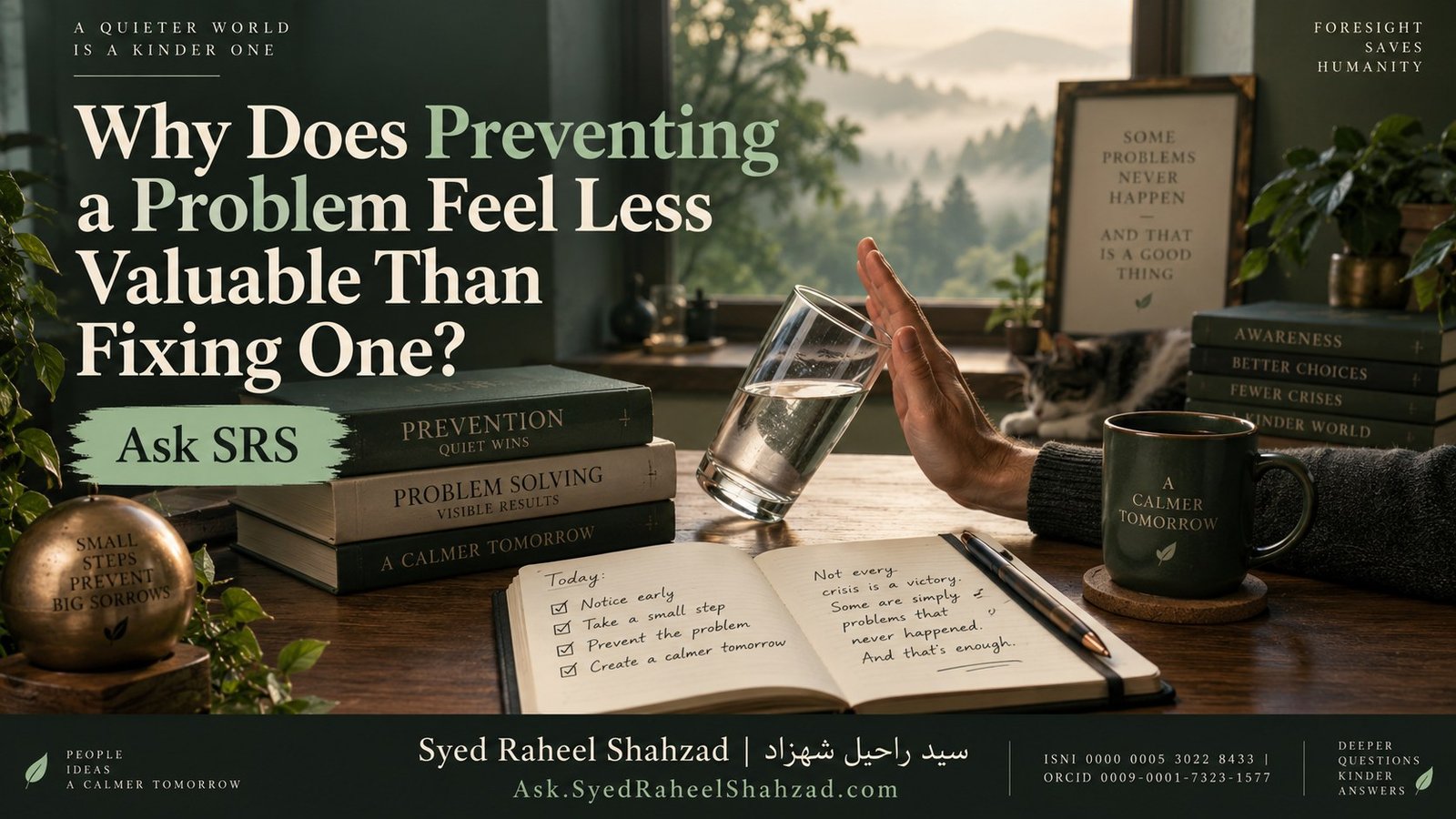
Reflective Ask SRS artwork by Syed Raheel Shahzad showing a hand stopping a falling glass, symbolizing prevention, early action, care, foresight and the quiet value of avoiding harm.

Why Does Preventing a Problem Feel Less Valuable Than Fixing One?

Ask SRS · Prevention, Self-Understanding, Quiet Care and Emotional Recognition

Why Does Preventing a Problem Feel Less Valuable Than Fixing One?

A reflection on why quiet prevention often feels less rewarding than dramatic repair, and how to learn to honor small acts of foresight and care.

Why fixing feels more satisfying than preventing

Many people feel a strange imbalance in the way they value effort. If they solve a visible problem, they feel useful. If they quietly prevent that problem from happening in the first place, they often feel less certain that anything important was done. The same can happen in families, friendships, work and inner life. We feel relief after repair, but prevention can seem emotionally thin.

One reason is simple: fixing gives us evidence. Something was broken, and now it is better. Prevention gives us ambiguity. Something might have gone badly, but it did not. Because the harm never fully appeared, the mind can begin to question whether the effort mattered at all.

Prevention is often difficult to feel because its success arrives in the form of an absence.

That absence can be hard to trust. If you had the conversation early, set the boundary in time, rested before burnout, apologized before resentment hardened, or noticed the warning sign before a larger crisis formed, there may be no dramatic scene to prove your action mattered. Quiet success can feel like ordinary life.

Why the mind undervalues unseen good

Human attention is drawn toward events. We notice the fire being extinguished more than the wiring that was repaired before fire began. We notice the relationship saved after breakdown more than the habits of care that prevented breakdown from taking root. We notice the body recovering after collapse more than the daily discipline that kept collapse from arriving.

This means your emotional system may be biased toward visible repair. It is not always a sign of ingratitude or shallowness. It is partly how the mind works. But if you never correct that bias, you may slowly start neglecting exactly the kinds of actions that protect your life most deeply.

Prevention does not mean nothing happened

Sometimes people say, “Nothing happened,” when what they mean is, “No disaster became visible.” But those are not the same sentence. A lot may have happened beneath the surface. You may have noticed something early. You may have acted with maturity before emotion escalated. You may have chosen a calmer response, taken one small responsible step, or addressed an issue before it multiplied.

In those moments, prevention is not the absence of action. It is the fruit of action. The fact that you do not have an emotional spectacle afterward is not proof that the action had no value. It may be proof that it worked.

How to value your own preventive work

If you tend to dismiss prevention, try asking more exact questions. What did I notice early? What kind of difficulty might have grown if I had ignored it? What small action reduced future harm? What part of today’s calm exists because I acted yesterday with care?

These questions are not an invitation to self-congratulation. They are an invitation to accuracy. Many people punish themselves by only respecting visible heroics. But life is not sustained by heroics alone. It is sustained by maintenance, foresight, boundaries, and small honest steps taken in time.

  • Prevention in relationships may look like saying something gently before resentment becomes injury.
  • Prevention in inner life may look like resting, asking for help or stepping back before exhaustion turns into collapse.
  • Prevention in work may look like clarity, preparation and early correction rather than late panic.

Why quiet good still counts

There is a temptation to believe that goodness becomes real only when it is dramatic. But much of what protects a human life is not dramatic at all. It is repetitive, responsible and easy to overlook. A wiser form of self-respect learns to honor those quieter actions. It knows that sometimes the best thing you did today is the thing that left no visible crisis behind.

Not every victory looks like rescue. Some look like peace that never had to be fought for.

If preventing a problem feels less valuable than fixing one, the answer may not be that prevention is weaker. It may be that you have been trained to recognize value only when it arrives in noise. Part of maturity is retraining that recognition. The small step taken in time, the difficult word spoken early, the boundary that kept harm from deepening, the rest that stopped collapse before it formed — all of this counts. Quiet good is still good. And sometimes it is among the most merciful things a person can do.

Syed Raheel Shahzad — سيد راحيل شهزاد, philosopher and author of a multi-work publishing program
Philosopher and Author Syed Raheel Shahzad — سيد راحيل شهزاد

Syed Raheel Shahzad — سيد راحيل شهزاد

ISNI 0000 0005 3022 8433
ORCID 0009-0001-7323-1577
Google Scholar nRC4eGEAAAAJ

Author, philosopher, systems thinker and Founder & Group CEO of The Syed Group. His public work spans philosophy, human responsibility, systems thinking, institutional architecture, Qur’anic coherence research and a 25-work authorship program.

Official author website: SyedRaheelShahzad.com · Ask SRS: ask.SyedRaheelShahzad.com · The Syed Group ISNI 0000 0005 3027 5408 · Ringgold 850493

Reflective Ask SRS artwork by Syed Raheel Shahzad showing an open journal divided between what was chosen and what was lost, symbolizing guilt, grief, limits, mercy and the residue left by difficult decisions.

Why Do I Still Feel Guilty When I Made the Best Choice I Could?

Ask SRS · Guilt, Difficult Choices, Moral Grief, Responsibility and Peace

Why Do I Still Feel Guilty When I Made the Best Choice I Could?

Sometimes the mind can know that a decision was necessary while the heart continues to carry the person, possibility, or future that the decision could not preserve.

There are decisions you can defend with reason and still grieve in private.

You may have ended a relationship that had become harmful. Refused money you could not afford to give. Moved away from someone who depended on you. Chosen one family obligation over another. Said no to a request you genuinely wished you could meet.

Later, the question returns: If it was the best choice I could make, why do I still feel guilty?

Guilt is not always a verdict. Sometimes it is the emotional shadow of caring about something you could not preserve.

Two truths can exist together

The first step is to stop forcing the situation into one of two simple stories: either “I was right, so I should feel nothing” or “I feel bad, so I must have done something wrong.”

Sometimes both of these statements are true:

  • I made the most responsible choice available to me.
  • That choice still hurt someone, ended something, or closed a possibility I valued.

The emotional difficulty comes from trying to make one truth cancel the other.

Ask what the guilt is actually saying

Not all guilt means the same thing. Sometimes guilt is morally useful because we violated our own values. Sometimes it is learned guilt because we were taught that saying no is selfish. Sometimes it is grief wearing the language of blame.

Ask: What exactly do I believe I did wrong?

If you can name a specific wrong—dishonesty, cruelty, negligence, avoidable harm—then guilt may be asking for repair. But if the answer is simply, “Someone I care about was hurt by a boundary I genuinely needed,” then the feeling may not be evidence of wrongdoing. It may be sorrow.

The heart does not use the same logic as a decision

Reason asks whether the choice was justified. The heart often asks what was lost.

You can know that leaving was necessary and still miss the person. You can know that refusing a request was responsible and still wish you could have said yes. You can know that a treatment decision was correct and still mourn what it cost.

This is not hypocrisy. It is what happens when a human being values more than one thing at once.

Moral grief is different from self-condemnation

I would call this form of pain moral grief: sadness for a real value that could not survive the decision.

Moral grief says, “I wish reality had allowed a better outcome.” Self-condemnation says, “Because the outcome hurt, I must be a bad person.”

The first can deepen compassion. The second can trap you in endless punishment.

Do not rewrite the past just to feel better

One temptation is to make the lost person, path, or possibility seem entirely bad. If you convince yourself that the relationship meant nothing, the job was worthless, or the person did not deserve help, the choice becomes emotionally easier.

But peace purchased through distortion is fragile.

You are allowed to say: It mattered. I loved part of it. I wanted another outcome. And the decision was still necessary.

What remains yours to repair?

A justified choice can still leave something you should do.

Maybe you owe an explanation. Maybe your tone was harsher than necessary even though the boundary was right. Maybe you should return something, clarify something, help someone transition, or apologize for the manner rather than the substance of the decision.

This is a healthier question than “How do I stop feeling guilty?”

Ask instead: Is there anything real that remains mine to repair?

If nothing remains to repair

Sometimes the answer is no. You cannot restore the relationship without returning to the harm. You cannot give resources you do not have. You cannot reopen a decision without recreating the conditions that made it necessary.

Then the work is not repair. It is acceptance.

Acceptance does not mean celebrating the loss. It means refusing to turn unavoidable pain into permanent self-punishment.

A reflection for difficult choices
  • What did I genuinely have responsibility for?
  • What was outside my control?
  • What value did I protect by making the decision?
  • What value was lost?
  • Is there a concrete repair still possible?
  • Am I grieving, or am I accusing myself?
  • Would I judge someone I love as harshly for making the same choice?

You do not have to become indifferent to become free

People sometimes think healing requires eventually feeling nothing. It does not.

You can remember with tenderness. You can wish the circumstances had been different. You can carry gratitude for what was good. None of this obliges you to reverse a necessary decision.

Peace is not the claim that nothing was lost. Peace is the ability to honor what was lost without abandoning what you knew had to be protected.

Conclusion

If you made the best choice you could with honesty, care, and the information available to you, the remaining ache may not be a sentence against you.

It may simply mean you are still capable of seeing the human cost of a difficult choice.

Let that awareness make you gentler, wiser, and more careful—not permanently guilty.

Syed Raheel Shahzad — سيد راحيل شهزاد, Author, Philosopher and Systems Thinker
Syed Raheel Shahzad — سيد راحيل شهزاد · Author · Philosopher · Systems Thinker

Syed Raheel Shahzad — سيد راحيل شهزاد

Philosopher · Author · Founder & Group CEO · Business Strategist · Systems Thinker & Architect

This essay forms part of the continuing philosophical and systems-writing program of Syed Raheel Shahzad, author of The Source of Truth System™, The Architect’s Protocol, the Qur’anic Coherence System, Adam and the Answerable Being, and Tomorrow Became a Country.

ISNI 0000 0005 3022 8433 · ORCID 0009-0001-7323-1577 · Google Scholar nRC4eGEAAAAJ
Publisher / Imprint: The Syed Group · ISNI 0000 0005 3027 5408 · Ringgold 850493

SyedRaheelShahzad.com · TheSyedGroup.com

Reflective Ask SRS artwork by Syed Raheel Shahzad showing a mirror divided between an old shadowed identity and a brighter present self, symbolizing regret, growth, accountability and living beyond an old version of yourself.

What If Everyone Still Sees the Person I Used to Be?

Ask SRS · Growth, Accountability and Being Seen Clearly

What If Everyone Still Sees the Person I Used to Be?

How to live responsibly when you have changed but other people still interpret every present action through an older version of you.

Reader question: I know I am not the same person I was before. I have changed my behavior and I understand things differently now, but people close to me still see the old version of me. Every mistake becomes proof that I never changed. What am I supposed to do?

First, accept something difficult: you cannot force another person to update their picture of you.

People do not experience your growth from inside your mind. They experience it through what they have seen, what they have suffered, what they remember, and how safe they feel now. Sometimes they are unfair. Sometimes they are cautious for reasons you helped create. Often both truths exist together.

You cannot control when another person revises their judgment. You can control whether your present life keeps producing better evidence.

Change is not a speech

When we desperately want to be seen differently, we are tempted to explain. We tell people what we have realized, how much we regret, how hard we have worked, and why we are no longer that person.

Words can matter. But if the old problem involved broken trust, words are usually the weakest form of proof.

Real change becomes visible through boring things: consistency, restraint, reliability, patience, boundaries, truthfulness, responsibility when nobody applauds, and different choices when the old temptation returns.

If you have changed, your task is not to win an argument about your identity. Your task is to live the new identity long enough that it no longer depends on the argument.

Do not use growth to demand reconciliation

There is a hidden bargain people sometimes make: “If I become better, you must come back. You must trust me. You must stop mentioning the past.”

That bargain is not part of moral growth.

Another person may recognize that you changed and still decide that closeness is not right for them. They may forgive and still maintain distance. They may wish you well and still refuse to rebuild the same relationship.

Your improvement is valuable because becoming better is valuable—not because it gives you ownership over another person’s response.

Separate three questions

Ask yourself three different questions instead of collapsing them into one.

Have I changed? This is about your conduct, thinking, habits and decisions.

Have I repaired what I reasonably can? This is about responsibility for consequences.

Will this person see me differently? This belongs partly to someone else.

You can work directly on the first two. You cannot command the third.

What if they are genuinely unfair?

Sometimes a person is not being cautious. They are committed to an old version of you because that version gives them power, certainty or a familiar role.

If every piece of new evidence is reinterpreted to confirm the old judgment, you may be living inside a closed story. You apologize: “See, you know you are guilty.” You set a boundary: “See, you are selfish.” You stay calm: “See, you are manipulative.” You become more independent: “See, you never cared.”

No human being can prove change inside a system where every possible action has already been assigned the same meaning.

In that situation, you may need a boundary of your own. Respecting someone’s memory does not require surrendering your entire identity to their interpretation.

Build a new record instead of fighting the old one

The old record exists. You cannot erase it by resenting it.

So build another one.

Keep promises. Tell smaller truths before they become bigger problems. Become dependable in ordinary moments. Repair quickly when you fail. Choose friends and environments that support the person you are becoming rather than constantly rewarding the person you were.

Over time, your life develops more evidence than a single period can contain.

Some people will notice. Some will notice slowly. Some will never revise.

Your life still has to continue.

Do not become addicted to being believed

There is a subtle trap in personal transformation: you begin living for external certification. Every good act becomes a plea—“Do you see? Do you believe me now?”

That keeps the old audience in control of the new life.

Maturity arrives when the better choice becomes worth making even if nobody gives you credit for it.

Your growth becomes more stable when it stops depending on the people who doubted it.

But do not become arrogant either

The opposite temptation is to say, “That was the old me. If they cannot move on, that is their problem.”

Sometimes it is their problem. But not always.

If your actions taught someone to be cautious, their caution may outlast your internal change. You do not have to live forever under accusation, but humility means recognizing that your transformation began at one point while their consequences may have begun earlier.

Give people room to have their own timeline.

How to know whether your change is becoming real

Ask yourself:
  1. Do I still tell the truth when the truth makes me look worse?
  2. Do I repair harm without demanding praise for repairing it?
  3. Do I behave differently under pressure, not only in calm moments?
  4. Have I changed the conditions that supported the old pattern?
  5. Can I accept that some consequences may remain even if I am better now?

If your answers are increasingly yes, keep going.

You are allowed to become more than your worst chapter

You are not entitled to erase what happened. You are not entitled to force trust. You are not entitled to a rewritten history.

But neither are you required to keep performing the identity of the person you no longer choose to be.

The strongest sentence may be simple: “I understand why you remember me that way. I also know what I am responsible for becoming now.”

Then live from the second half of that sentence.