
Essay
Ask SRS · Growth, Accountability and Being Seen Clearly
What If Everyone Still Sees the Person I Used to Be?
How to live responsibly when you have changed but other people still interpret every present action through an older version of you.
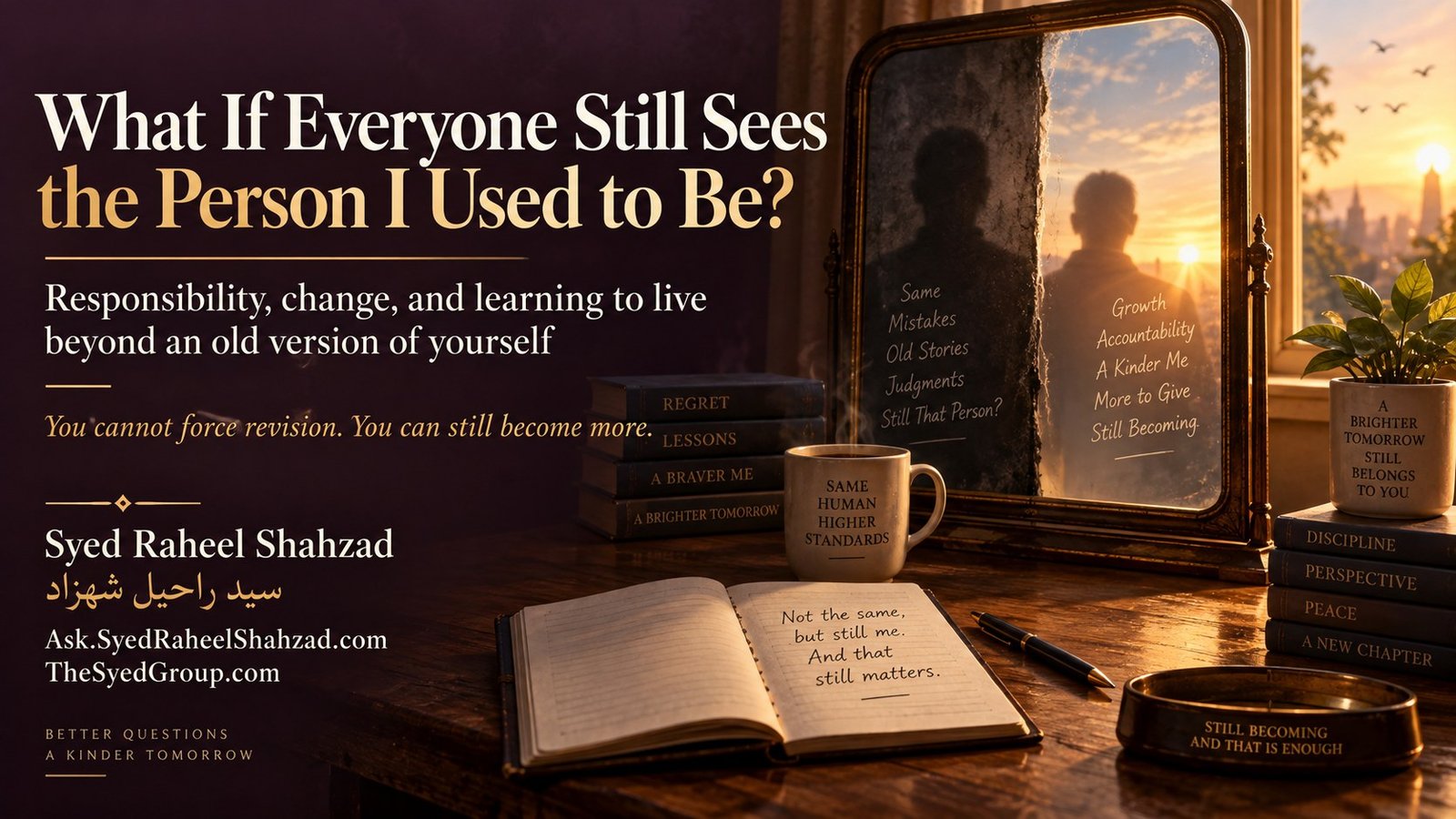
Reader question: I know I am not the same person I was before. I have changed my behavior and I understand things differently now, but people close to me still see the old version of me. Every mistake becomes proof that I never changed. What am I supposed to do?
First, accept something difficult: you cannot force another person to update their picture of you.
People do not experience your growth from inside your mind. They experience it through what they have seen, what they have suffered, what they remember, and how safe they feel now. Sometimes they are unfair. Sometimes they are cautious for reasons you helped create. Often both truths exist together.
You cannot control when another person revises their judgment. You can control whether your present life keeps producing better evidence.
Change is not a speech
When we desperately want to be seen differently, we are tempted to explain. We tell people what we have realized, how much we regret, how hard we have worked, and why we are no longer that person.
Words can matter. But if the old problem involved broken trust, words are usually the weakest form of proof.
Real change becomes visible through boring things: consistency, restraint, reliability, patience, boundaries, truthfulness, responsibility when nobody applauds, and different choices when the old temptation returns.
If you have changed, your task is not to win an argument about your identity. Your task is to live the new identity long enough that it no longer depends on the argument.
Do not use growth to demand reconciliation
There is a hidden bargain people sometimes make: “If I become better, you must come back. You must trust me. You must stop mentioning the past.”
That bargain is not part of moral growth.
Another person may recognize that you changed and still decide that closeness is not right for them. They may forgive and still maintain distance. They may wish you well and still refuse to rebuild the same relationship.
Your improvement is valuable because becoming better is valuable—not because it gives you ownership over another person’s response.
Separate three questions
Ask yourself three different questions instead of collapsing them into one.
Have I changed? This is about your conduct, thinking, habits and decisions.
Have I repaired what I reasonably can? This is about responsibility for consequences.
Will this person see me differently? This belongs partly to someone else.
You can work directly on the first two. You cannot command the third.
What if they are genuinely unfair?
Sometimes a person is not being cautious. They are committed to an old version of you because that version gives them power, certainty or a familiar role.
If every piece of new evidence is reinterpreted to confirm the old judgment, you may be living inside a closed story. You apologize: “See, you know you are guilty.” You set a boundary: “See, you are selfish.” You stay calm: “See, you are manipulative.” You become more independent: “See, you never cared.”
No human being can prove change inside a system where every possible action has already been assigned the same meaning.
In that situation, you may need a boundary of your own. Respecting someone’s memory does not require surrendering your entire identity to their interpretation.
Build a new record instead of fighting the old one
The old record exists. You cannot erase it by resenting it.
So build another one.
Keep promises. Tell smaller truths before they become bigger problems. Become dependable in ordinary moments. Repair quickly when you fail. Choose friends and environments that support the person you are becoming rather than constantly rewarding the person you were.
Over time, your life develops more evidence than a single period can contain.
Some people will notice. Some will notice slowly. Some will never revise.
Your life still has to continue.
Do not become addicted to being believed
There is a subtle trap in personal transformation: you begin living for external certification. Every good act becomes a plea—“Do you see? Do you believe me now?”
That keeps the old audience in control of the new life.
Maturity arrives when the better choice becomes worth making even if nobody gives you credit for it.
Your growth becomes more stable when it stops depending on the people who doubted it.
But do not become arrogant either
The opposite temptation is to say, “That was the old me. If they cannot move on, that is their problem.”
Sometimes it is their problem. But not always.
If your actions taught someone to be cautious, their caution may outlast your internal change. You do not have to live forever under accusation, but humility means recognizing that your transformation began at one point while their consequences may have begun earlier.
Give people room to have their own timeline.
How to know whether your change is becoming real
- Do I still tell the truth when the truth makes me look worse?
- Do I repair harm without demanding praise for repairing it?
- Do I behave differently under pressure, not only in calm moments?
- Have I changed the conditions that supported the old pattern?
- Can I accept that some consequences may remain even if I am better now?
If your answers are increasingly yes, keep going.
You are allowed to become more than your worst chapter
You are not entitled to erase what happened. You are not entitled to force trust. You are not entitled to a rewritten history.
But neither are you required to keep performing the identity of the person you no longer choose to be.
The strongest sentence may be simple: “I understand why you remember me that way. I also know what I am responsible for becoming now.”
Then live from the second half of that sentence.
Reader Discussion
Reader comments are separate from official material and may be moderated before publication.


Leave a Reply
Want to join the discussion?Feel free to contribute!