
Direct reader questions submitted to Ask SRS for review, discussion, official answers, or future notes connected to the work of Syed Raheel Shahzad.

Ask SRS Syed Raheel Shahzad author platform forum for serious questions and reader discussion.

Ask SRS and the Syed Raheel Shahzad Author Platform Forum

Essay / Ask SRS Author Platform

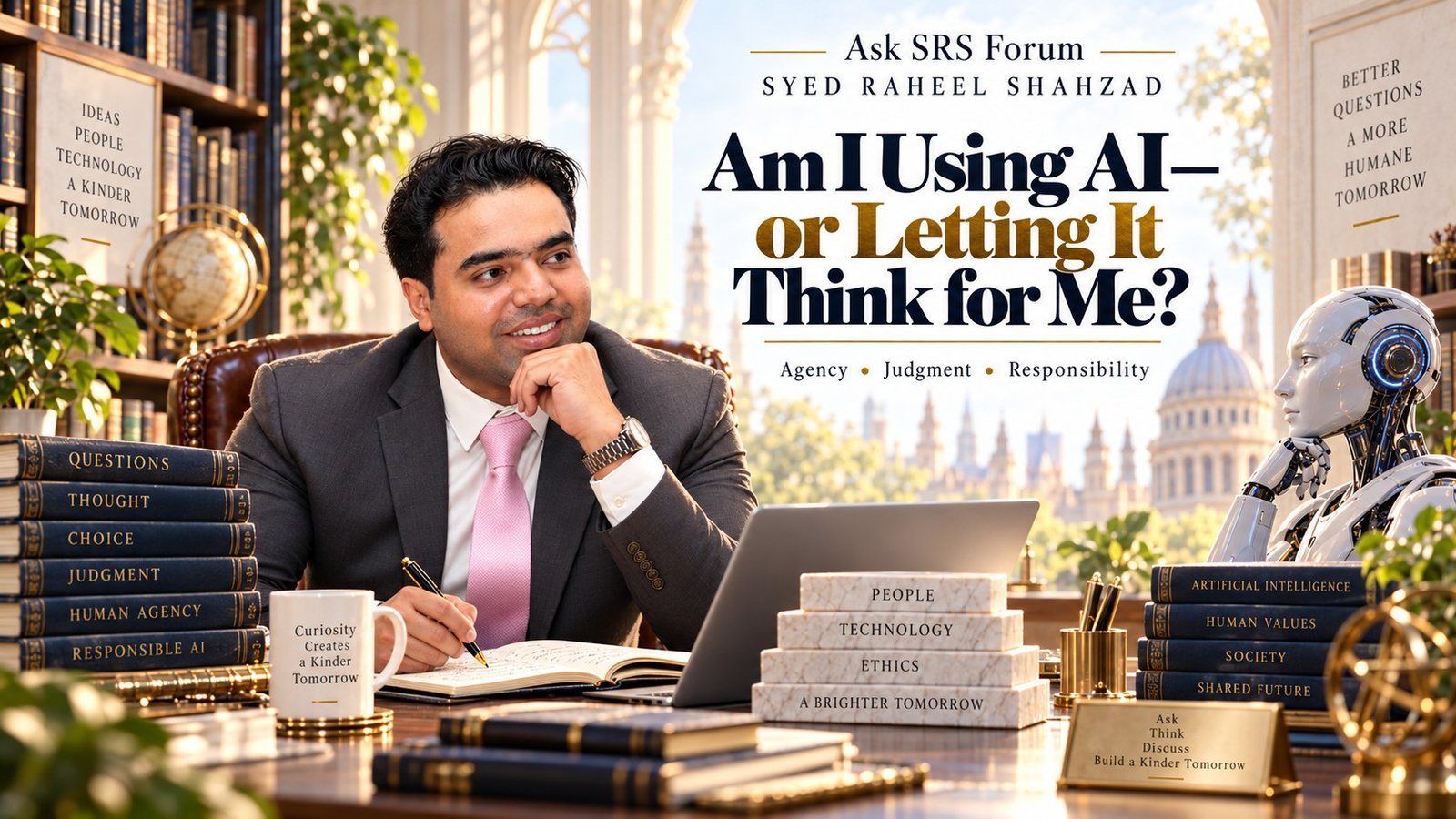
Ask SRS is the reader-facing author platform and moderated forum connected to Syed Raheel Shahzad, built for serious questions, essays, discussions, official notes and public knowledge.

Ask SRS is more than a question form

Ask SRS is often introduced through one simple action: ask a question. But the platform is larger than a question box. It is a developing author platform, reader forum, essay archive and public discussion space connected to the books and public work of Syed Raheel Shahzad.

The reason this matters is simple. Serious questions need a place. They should not disappear inside private messages, short comments, passing reactions or noisy social media timelines.

Ask SRS gives those questions a structured route: a reader can ask, discuss, submit an essay, read official notes and return to a growing archive of serious inquiry.

Why an author platform needs a reader forum

An author platform should not only display books. If the books are serious, the platform must also carry the questions that arise from those books.

Readers do not only need a shop page, a cover image or a short description. They need a place where the deeper questions can be preserved, refined and connected to a larger body of work.

This is where Ask SRS sits. It connects the author website of Syed Raheel Shahzad with the live reader layer: questions, forum-style discussions, submitted essays, reading guides, official notes and future live conversations.

Ask SRS

The direct reader route for serious questions connected to meaning, faith, systems thinking, books and human responsibility.

Author Platform

The public identity, books, articles and long-form work of Syed Raheel Shahzad connected to reader inquiry.

Reader Forum

A moderated discussion layer where questions can move beyond comments into structured public conversation.

Public Record

A growing archive of questions, essays, official notes and platform reflections that can be returned to over time.

What makes Ask SRS different from ordinary online discussion

Ordinary online discussion often rewards speed, emotion and reaction. Ask SRS is built around a different standard: seriousness, moderation, usefulness and public record.

This does not mean every question must be complicated. A simple question can be serious if it carries meaning, responsibility or genuine confusion. The difference is that Ask SRS treats questions as something worth handling properly.

A question may become an official answer. It may become an essay. It may become a discussion. It may become a reading guide. It may remain open until it is ready for a better answer.

The role of Syed Raheel Shahzad

Ask SRS is connected to the public work of Syed Raheel Shahzad as an author, systems thinker and builder of structured intellectual frameworks.

The author website carries the books, identity, publications and public record. Ask SRS carries the reader-facing interaction layer. Together, they allow serious questions to move between book, article, discussion, essay and official note.

This is why the platform is not separate from the author work. It is part of the same ecosystem.

Ask SRS is where the reader’s serious question meets the author platform of Syed Raheel Shahzad.

Connected to The Syed Group and Syed Foundation

The Syed Group provides the wider institutional context around platforms, publishing infrastructure, operating systems and long-term public records. Syed Foundation carries the education, dignity, learning and human-development direction.

Ask SRS connects naturally to both. It gives the reader a public place to ask, discuss and contribute. It also supports a wider mission: knowledge should not remain static. It should become reflection, responsibility and service.

Why this matters for search, discovery and public knowledge

Search engines do not only look for isolated pages. They read relationships: names, platforms, organizations, categories, links, repeated topics and structured records.

For that reason, the relationship between Ask SRS, Syed Raheel Shahzad, the author platform, The Syed Group and Syed Foundation should be clear across public content.

This essay strengthens that public record in natural language: Ask SRS is the moderated reader forum and author platform layer for serious questions connected to Syed Raheel Shahzad.

Where to begin

A reader can begin by asking a question, browsing existing questions, reading essays, joining a discussion or following official notes.

The best starting point is not perfection. It is sincerity. A serious question, asked clearly, can become useful for more than one reader.

Ask SRS Syed Raheel Shahzad author platform forum for serious questions and reader discussion
Featured image for “Ask SRS and the Syed Raheel Shahzad Author Platform Forum.” Image URL: https://ask.syedraheelshahzad.com/wp-content/uploads/2026/06/ask-srs-syed-raheel-shahzad-author-platform-forum.jpg

Why Serious Questions Need a Trusted Place

Official Note / Ask SRS

Why serious questions need a trusted place

Ask SRS by Syed Raheel Shahzad exists because serious questions need more than speed, noise, reaction and scattered comments. They need a trusted place where questions can be asked, reviewed, discussed, refined and answered responsibly.

This official note explains why Ask SRS is being built as a moderated reader platform for serious questions, discussions, essays, topic hubs, official notes and selected official answers.

The problem with serious questions online

Many serious questions are asked in places that cannot carry them properly. They are placed inside comment sections, private messages, fast social media replies or public arguments where attention moves faster than understanding.

A question about meaning, belief, ethics, responsibility, family, society, knowledge or human life should not be treated as disposable content. It should not be buried under noise before it has been understood.

Ask SRS gives those questions a more ordered place. It does not promise that every question will receive an instant answer. It gives the question a structure in which it can be reviewed, preserved, discussed and possibly answered with care.

Why trust matters

A trusted place is not only a website. It is a set of standards. Readers need to know that serious questions will not be mocked, buried, mixed with spam, or treated carelessly. They also need to know that answers will not pretend to be more certain than they are.

Trust is built when a platform separates questions from discussions, discussions from essays, essays from official notes, and official answers from ordinary comments.

Questions need order A serious question should be placed where readers can understand what kind of submission it is.
Answers need responsibility An answer should not be rushed simply because online platforms reward speed.
Discussion needs moderation Public exchange can help a question mature, but only if it is protected from noise.
Readers need clarity A visitor should know whether they are reading a question, a discussion, an essay or an official answer.

A trusted place is not a place without disagreement

Trust does not mean that every reader must agree. It means the platform has standards. A serious question can be challenged, refined and discussed without being turned into ridicule, confusion or noise.

Ask SRS is open to questions, but it is not open to disorder. That distinction matters.

What Ask SRS is designed to protect

Ask SRS is not only trying to collect content. It is trying to protect the process by which questions become clearer.

  • It protects serious questions from being lost inside scattered comments.
  • It protects readers from confusing public discussion with official answers.
  • It protects official answers by clearly marking them as responses from Syed Raheel Shahzad.
  • It protects essays and reflections by separating them from short question submissions.
  • It protects topic areas by organizing questions into public subject routes.
  • It protects the platform from becoming a noise machine.

How a question moves through Ask SRS

A reader may submit a question. That question may remain under review, become an open question, be connected to a discussion, receive reader reflection, be linked to a topic hub, or later receive an official answer by Syed Raheel Shahzad.

This process allows the platform to avoid two mistakes: ignoring serious questions, and answering too quickly before the question has been understood.

Why this matters for readers

A reader may arrive at Ask SRS through a book, an article, a search result, a social post or a personal question. The platform should help that reader know where to go next.

That is why Ask SRS includes questions, discussions, essays, official notes, topic hubs, live feed routes and account tools. The structure exists so the reader does not feel lost.

Connected to the wider author platform

Ask SRS is connected to the wider author platform of Syed Raheel Shahzad. The author website presents the books, articles, author verification and larger body of work, while Ask SRS serves as the reader-facing question and discussion platform.

The two platforms support each other. The author website gives the public identity and body of work. Ask SRS gives readers a place to ask, discuss, submit and follow official answers.

A serious question needs a place that can carry it.

Ask SRS by Syed Raheel Shahzad exists to give serious questions a trusted place: a place where they can be asked, clarified, discussed, preserved and answered with responsibility.

Why Do Serious Questions Need a Community?

Open Question / Ask SRS

Why do serious questions need a community?

A serious question can begin inside one person, but it often becomes clearer when it is tested, refined and reflected upon in a responsible community.

This Ask SRS question asks why serious questions need more than private thought, and why a moderated reader community can help protect questions from noise, isolation and careless answers.

The question

Why do serious questions need a community?

Can a person think seriously alone, or do serious questions also need a place where readers can listen, respond, refine, challenge, clarify and grow together?

Why this matters

Many questions are asked in isolation. A person carries confusion, doubt, concern or reflection privately, and the question remains trapped inside the mind. Other questions are thrown into public noise, where they are answered too quickly, mocked, misunderstood or buried under reaction.

A serious question needs a better environment. It needs space, structure, patience and a community serious enough not to destroy the question before it matures.

A community can clarify Other readers may help reveal what the question is really asking.
A community can test Responsible exchange can expose weak assumptions, unclear wording or missing context.
A community can preserve A question that helps others should not disappear inside private messages or fast comments.
A community can mature Some questions become better through discussion before they are ready for an official answer.

Community is not the same as crowd noise

A community can help a question grow, but a crowd can also bury it. That is why moderation matters. Ask SRS is not designed as an uncontrolled comment wall. It is designed as a structured reader platform where questions, discussions, essays, official notes and official answers can remain organized.

A serious question needs people, but it also needs order.

Questions for reader reflection

  • Can a serious question become clearer when others reflect on it?
  • When does community discussion help a question, and when does it damage it?
  • What kind of community protects serious inquiry?
  • Why do some questions need discussion before they receive an answer?
  • How can a platform avoid becoming noisy while still remaining open to readers?
  • What does a responsible reader community owe to the questions it receives?

Connection to Ask SRS

Ask SRS is becoming a growing reader community around serious questions. Readers can ask questions, start discussions, submit essays, browse topic hubs, follow official notes and read selected official answers.

The purpose is not simply to publish more content. The purpose is to build a place where serious questions can move from private confusion to public clarity, from scattered reaction to moderated discussion, and from noise to preserved meaning.

Related Ask SRS reading

This question connects with earlier Ask SRS posts about patience, responsible answers and the structure of the platform.

Open for reflection

A serious question may begin with one person, but it often needs a responsible community to clarify, test, preserve and mature it.

Why Do Serious Questions Need Patience?

Open Question / Ask SRS

Why do serious questions need patience?

Some questions can be answered quickly. Others cannot. A serious question may look simple on the surface, but beneath it there may be pain, confusion, responsibility, belief, doubt, identity, family, faith, knowledge, or a decision that has not yet become clear.

This Ask SRS question asks why serious questions often need patience before they receive a responsible answer.

The question

Why do serious questions need patience?

Why is an immediate answer not always the best answer? When does speed help, and when does speed damage the question itself?

Why this matters

Modern life trains people to expect instant replies. A message is sent, and a response is expected. A question is posted, and people want an answer immediately. But serious questions do not always work like that.

A serious question may need time because the answer must not only respond to words. It must understand the concern behind the words.

Some questions need context A question may be connected to a wider situation that cannot be understood from one sentence alone.
Some questions need distinction Fast answers can mix together matters that should be separated carefully.
Some questions need responsibility An answer may affect belief, family, conduct, confidence or future decisions.
Some questions need maturity The person asking may need reflection before the real question becomes clear.

Patience is not avoidance

Patience does not mean ignoring a question. It does not mean delaying without reason. It means refusing to damage the question by answering it before it has been understood.

A delayed answer can be irresponsible if the delay is careless. But a rushed answer can also be irresponsible if it gives certainty where careful distinction is needed.

Questions for reader reflection

  • Have you ever received an answer too quickly, before the real issue was understood?
  • Can a fast answer create false confidence?
  • When does patience protect the question?
  • When does delay become avoidance?
  • What makes an answer responsible rather than merely fast?

Connection to Ask SRS

Ask SRS is built around this principle. Not every serious question should be treated as a demand for instant response. Some questions may be published as open questions first. Some may become discussions. Some may need a later official answer. Some may become essays, reading guides, or official notes.

The aim is not speed alone. The aim is clarity, seriousness, usefulness and responsibility.

Open for reflection

A serious question may need patience because the goal is not simply to answer quickly. The goal is to answer responsibly.

Ask SRS featured image for Syed Raheel Shahzad question of the day on what knowledge should do for people.

What Should Knowledge Do for People?

Question of the Day / Ask SRS

Today’s Ask SRS question invites readers to reflect on the purpose of knowledge: should knowledge only inform us, or should it also serve people, communities and human responsibility?

Question of the Day: What should knowledge do for people?

Knowledge is often treated as something to collect, repeat, display, or use for argument. But a more serious question remains: what should knowledge actually do for people?

Should it only make a person appear informed? Or should it help a person become clearer, more responsible, more useful, and more careful with the lives affected by their choices?

Knowledge should not end with information

Information can be useful, but information is not the whole of knowledge. A person can know many things and still lack wisdom, mercy, patience, dignity, or responsibility.

Ask SRS exists because serious questions should not disappear inside noise. They should be preserved, discussed, clarified and connected to wider learning.

What useful knowledge may produce

Readers may reflect on whether knowledge is doing any of the following:

  • Helping people understand what was unclear.
  • Reducing confusion instead of increasing noise.
  • Protecting dignity during learning and disagreement.
  • Moving from curiosity into responsibility.
  • Helping families, readers and communities think better.
  • Turning questions into service, correction and human benefit.

Open reflection

What kind of knowledge has actually helped you live, think, decide, repent, serve, or understand differently?

And what kind of knowledge only became noise?

Knowledge becomes serious when it does not stop at being known. It begins to serve.

Connected reading

This question connects with the Syed Foundation article “Why Knowledge Must Become Service,” which reflects on the relationship between knowledge, dignity, education, responsibility and human benefit.

Ask SRS Is Now Open for Serious Questions, Discussions and Essays

Official Note / Platform Announcement

Ask SRS is now open for serious questions, discussions and essays

Ask SRS is now open as a moderated reader platform connected to the books, systems thinking, public questions and wider work of Syed Raheel Shahzad.

The platform gives readers a structured place to ask questions, start discussions, submit essays, browse topic hubs, follow official notes and read selected official answers.

Why Ask SRS has been created

Serious questions often get lost inside noise. They disappear inside private messages, social media comments, fast reactions and scattered conversations that do not preserve meaning.

Ask SRS has been built to give serious questions a clearer place. It is not an open wall for random posting. It is a moderated platform where questions, discussions, essays and official answers can be reviewed, organized and preserved.

What readers can do

Readers can use Ask SRS in several ways depending on the kind of contribution they want to make.

Ask a Question Submit a direct question for review, public discussion or possible official answer by SRS.
Start a Discussion Open a moderated discussion when a topic needs reader exchange rather than one direct answer.
Submit an Essay Send a longer reflection, article or structured contribution for editorial review.
Read Official Notes Follow platform updates, reading guidance, clarifications and official announcements.

Official answers are now part of the platform

Ask SRS now includes the first public example of the official answer workflow. A reader question can be submitted, reviewed, published, discussed and later answered formally by Syed Raheel Shahzad.

This separation matters. Reader discussion remains open as discussion, while the official answer is clearly marked so future readers know what is a direct response from SRS.

A moderated platform, not a noise machine

Ask SRS is open, but it is not uncontrolled. Submissions may be approved, held under review, answered, selected for future discussion, returned for revision or rejected if they are abusive, low-quality, spam-like or outside the purpose of the platform.

The aim is not to publish everything. The aim is to build a useful public archive of serious questions, responsible answers, structured essays and meaningful discussion.

Topic hubs are available

Readers can browse Ask SRS by topic area. These topic routes help connect questions and essays to larger subject areas such as Islam and meaning, Qur’an and revelation, philosophy and society, ethics and responsibility, systems thinking, human identity, technology and books.

How to begin

  • Use Ask a Question if you want to submit a direct question for review.
  • Use Start Discussion if the subject needs public exchange.
  • Use Submit Article if you want to send a longer essay or reflection.
  • Use Topic Hubs if you want to browse by question area.
  • Use Live Feed / Latest to see new public platform activity.

Ask SRS begins with a simple principle.

A serious question deserves more than noise. Ask SRS exists to give serious questions, discussions, essays and official answers a clearer place to develop.

Ask SRS featured image for Syed Raheel Shahzad reading guide on the discipline of asking better questions.

Reading Guide: The Discipline of Asking Better Questions

Reading Guide / Ask SRS

This reading guide is linked to Syed Raheel Shahzad’s weekly author article, The Discipline of Asking Better Questions. It helps readers use the article as a starting point for better questions, discussions, and future submissions on Ask SRS.

Reading Guide: The Discipline of Asking Better Questions

The latest author article explains why a better question is not only a smarter sentence. It is a disciplined act of honesty, clarity, context, patience, and responsibility.

This guide is for readers who want to use the article practically before asking a question, starting a discussion, or submitting a reflection to Ask SRS.

What to read for

As you read the article, do not only look for a quotation or a final line. Look for the method. The article asks readers to notice the difference between a question that seeks truth and a question that only performs certainty.

  • What is the real question beneath the words?
  • What assumption is already inside the question?
  • Does the question belong to faith, ethics, evidence, identity, family, conduct, or responsibility?
  • What kind of answer would actually help?
  • Would the answer require action, correction, patience, or further reading?

Why this matters for Ask SRS

Ask SRS is built for serious inquiry, not noise. The platform receives questions, discussions, essays, and official notes connected to the books and public work of Syed Raheel Shahzad.

If readers learn to ask better questions, the platform becomes stronger. Better questions make better answers possible. They also make discussions more useful for future readers.

Before asking a question

Before submitting a question, readers are encouraged to slow down and ask four simple checks:

  • Am I asking clearly?
  • Am I asking honestly?
  • Have I separated the issue from my reaction?
  • What would I do if the answer corrected me?

These checks do not make the question less human. They make the question more serious.

A better question does not only ask for information. It prepares the reader to receive responsibility.

Suggested discussion prompt

What is one question you have been carrying that may need to be asked more clearly?

Readers may use this as a private reflection, an Ask SRS submission, or a discussion prompt for the community.

What Makes a Question Worth Answering?

Question to SRS

What makes a question worth answering?

Not every question is ready for an answer. Some questions need more clarity. Some need more honesty. Some need patience before they can be answered responsibly.

This question asks what separates a real inquiry from noise, and what makes a question useful enough to preserve, discuss or answer officially.

The question

What makes a question worth answering?

Is it the importance of the topic, the sincerity of the person asking, the usefulness of the answer for others, or the clarity of the question itself?

Why this matters

A serious platform cannot treat every question the same. Some questions are sincere but unclear. Some are clear but not useful beyond the moment. Some are urgent but need careful handling.

Ask SRS is designed to separate noise from serious inquiry. That requires a standard for what deserves attention, preservation, discussion and official response.

Signs of a serious question

  • It seeks clarity rather than performance.
  • It is asked with sincerity, not provocation.
  • It can help more than one person think better.
  • It connects to meaning, responsibility, belief, conduct or human life.
  • It can be answered without turning the platform into noise.

Open for reader reflection

Readers may use this question as a starting point for discussion, reflection or future submissions on Ask SRS.

Why Ask SRS Separates Questions, Discussions, Essays and Official Answers

Official Note / Platform Guide

Why Ask SRS separates questions, discussions, essays and official answers

Ask SRS is built as a moderated reader platform, not as a single stream of mixed posts. Questions, discussions, essays and official answers are separated so readers can understand what they are reading, how to participate and where official guidance begins.

One platform, several types of contribution

A serious platform needs structure. If every item appears in the same form, readers cannot easily know whether something is a direct question, a public discussion, a reader essay, a platform announcement or an official answer by Syed Raheel Shahzad.

Ask SRS separates these formats so each one can serve its proper role. A question invites response. A discussion invites exchange. An essay develops an argument. An official answer gives a direct response from SRS. An official note explains the platform, clarifies a matter or guides readers.

The four main public routes

Questions Direct reader questions submitted for review, possible public response, official answer or future live discussion.
Discussions Moderated public topics where readers can think together without turning the platform into noise.
Essays Longer reader reflections, articles or structured contributions submitted for editorial review.
Official Notes and Answers Platform updates, reading guidance, clarifications and direct SRS responses to selected questions.

Why official answers are separate

A reader question can begin in one place, but it may later become an official answer. When that happens, Ask SRS separates the official response from the reader discussion so the reader knows what is from the author platform and what is public conversation.

This protects clarity. It allows discussion to continue without confusing comments, opinions or reactions with an official response. It also helps future readers find the answer quickly.

The goal is order, not speed

Ask SRS is not designed to publish everything immediately. Some submissions may be approved, some may need revision, some may become discussions, some may become official answers and some may remain unpublished.

The purpose is not to create more online noise. The purpose is to build a useful archive of serious questions, answers, essays, discussions and guidance.

How readers should use the platform

  • Use Ask a Question when you want to submit a direct question for review.
  • Use Start Discussion when the topic needs reader exchange rather than one direct answer.
  • Use Submit Article when you want to send a longer reflection or essay.
  • Use Topic Hubs when you want to browse by subject area.
  • Use the Account Dashboard to track submissions, messages and moderation updates.

Ask SRS is structured so readers do not have to guess.

Questions, discussions, essays, official notes and official answers are separated because clarity matters. A serious reader platform should make participation easy, but it should also protect meaning, responsibility and order.

How Ask SRS Works

Official Note / Platform Guide

How Ask SRS Works

Ask SRS is a moderated reader platform connected to the books, systems thinking, official notes and public work of Syed Raheel Shahzad. It exists so readers can ask serious questions, start thoughtful discussions, submit essays or articles, follow official answers, and take part in a more ordered form of public conversation.

What Ask SRS is for

Ask SRS is not designed for noise, arguments, spam or instant reaction. It is designed for questions that deserve attention, discussions that deserve order, and submissions that may help readers think more carefully.

The platform welcomes questions connected to faith, meaning, books, systems thinking, human responsibility, education, philosophy, society, self-development, Qur’anic reflection and serious life concerns.

What readers can do

  • Ask a question: Submit a serious question for review.
  • Start a discussion: Open a topic for reader conversation.
  • Submit an article: Send an essay or reflection for editorial review.
  • Read official notes: Follow platform updates and guidance.
  • Use your dashboard: Track your submissions, messages and status updates.

The basic workflow

  1. You submit. A reader submits a question, discussion or article through the relevant Ask SRS form.
  2. The submission enters moderation. The Ask SRS editorial desk reviews the item before it is approved, answered, revised, rejected or selected for future use.
  3. The item receives a status. A submission may be marked under review, open, approved, answered by SRS, selected for live discussion, needing revision, closed or rejected.
  4. The user may receive a message. Important updates, revision requests, approval notes or live-session notices may appear inside the user dashboard.
  5. Official answers are separated from reader discussion. When Syed Raheel Shahzad answers a question, the official answer appears clearly under “Official Answer by Syed Raheel Shahzad.”

Questions to SRS

A Question to SRS is a direct question submitted for possible official response. Not every question will receive an immediate answer. Some questions may need research, reflection, clarification or a future official note.

When a question receives an official answer, it will be clearly marked as answered by SRS.

Open discussions

Open discussions are for reader exchange. They should remain thoughtful, useful and respectful. Discussions may be moderated, closed, featured or selected for live conversation.

Reader comments are separate from official material and may be reviewed before publication.

Articles and essays

Readers may submit articles, essays or reflections for editorial review. Submission does not guarantee publication. Approved material may appear on the platform when it meets the required standard.

Essays may be approved, featured, returned for revision or rejected.

Live conversations

Some questions and discussions may be selected for future live conversation, recorded response, written expansion or official note development.

Selection for live discussion does not guarantee a fixed time or immediate public session.

Moderation standard

Ask SRS is moderated. Serious questions are preferred over noise. Submissions that are abusive, promotional, unclear, low-quality, repetitive, misleading or unsuitable may be rejected or removed. Users who abuse the platform may be restricted or blocked.

Your account dashboard

Registered users can use the Ask SRS dashboard to view their submitted questions, discussions, essays, comments and platform messages. The dashboard helps users track what they submitted and whether the item has been reviewed, approved, answered, selected for live discussion or returned for revision.

What makes a good question?

  • Clear: The question can be understood without guessing.
  • Serious: It is not spam, mockery or empty reaction.
  • Specific: It gives enough detail to be answered responsibly.
  • Useful: It may help other readers think more clearly.
  • Respectful: It does not abuse people, groups or the platform.

What happens after submission?

After submission, the item is reviewed. It may appear publicly after approval, remain under review, receive an official answer, be selected for live discussion, require revision or be rejected.

Users should check their dashboard for messages and updates.

Begin with a serious question

A serious question is not weakness. It is the beginning of order. Ask SRS exists to give questions, discussions and reader submissions a more careful place to develop.