Official platform announcements from Ask SRS, including updates, launches, changes, reading notices and important public information.

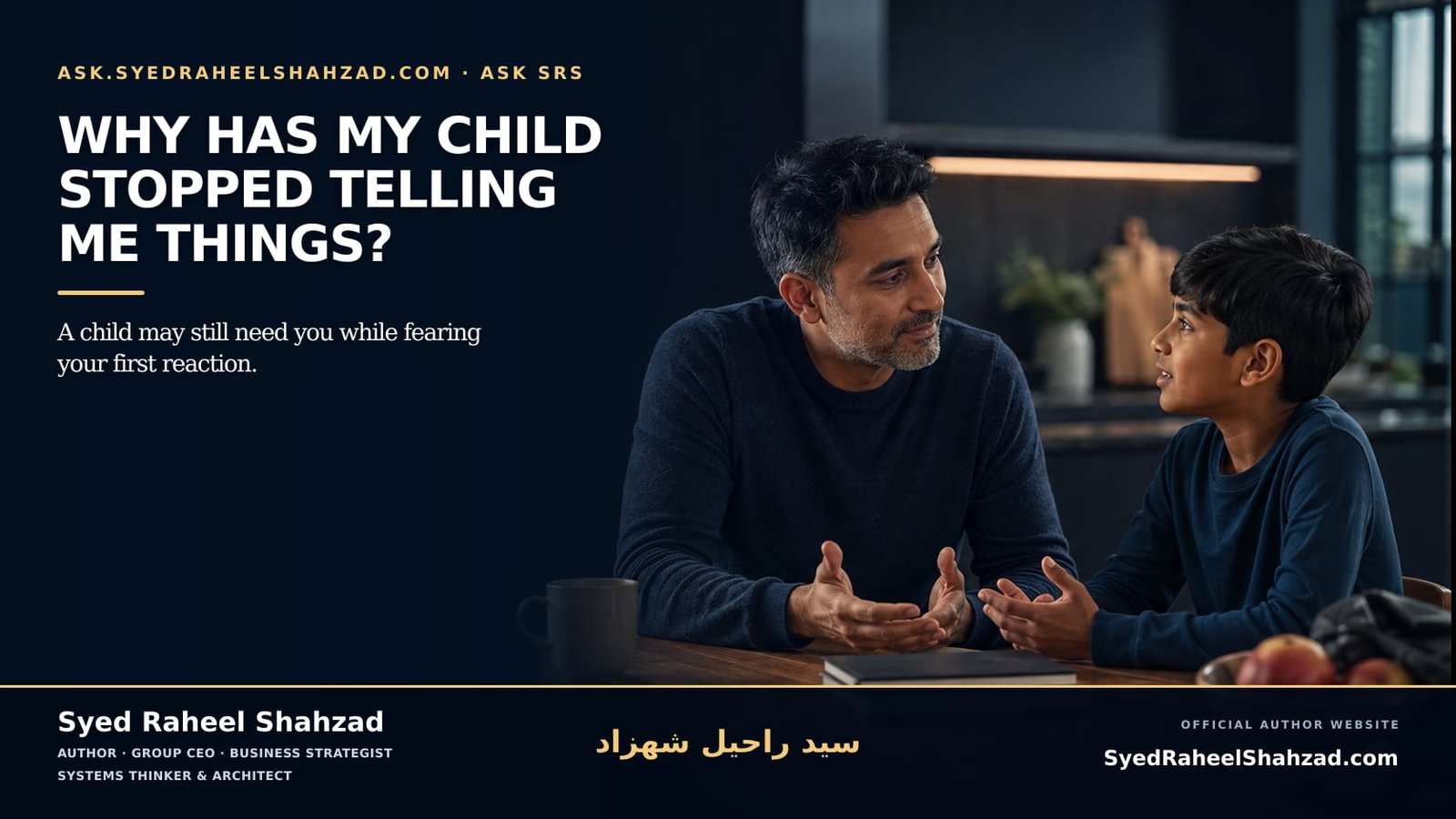
Ask SRS illustration by Syed Raheel Shahzad showing a parent calmly reconnecting with a child who has stopped sharing difficult experiences.

Why Has My Child Stopped Telling Me Things?

Ask SRS illustration by Syed Raheel Shahzad showing a parent and child rebuilding trust through a calm, private conversation at home.
A child may still need you while fearing your first reaction. — Syed Raheel Shahzad | سيد راحيل شهزاد | SyedRaheelShahzad.com

Why Has My Child Stopped Telling Me Things?

Children may become private as they grow, but secrecy can also be a learned response to anger, humiliation, unpredictable consequences or loss of trust.

Question: My child used to tell me everything, but now I hear “nothing” or “I’m fine.” They hide mistakes, become defensive and seem closer to friends than family. Why has my child stopped telling me things, and how can I rebuild trust without becoming a permissive parent?

Short answer: Your child may be developing normal privacy, but they may also have learned that telling you difficult things produces anger, humiliation, immediate punishment or loss of control over who hears the story. Rebuilding trust does not require removing rules. It requires making the route to you safer while keeping responsibility clear.

Start with one difficult possibility: your child may not be refusing a relationship. They may be managing risk.

Before speaking, a child often calculates: Will I be shouted at? Will my phone be taken before anyone understands what happened? Will I be compared with another child? Will this be told to relatives? Will I be blamed for something someone did to me? Will my parent become so upset that I have to comfort them?

If the predicted cost feels greater than the predicted help, “nothing” becomes a form of self-protection.

A child can love you, respect you and still be afraid of your first reaction.

Do not assume every silence means the same thing

Children naturally become more private as they grow. A teenager does not need to report every conversation, thought or friendship detail. Healthy independence includes a personal interior life.

Concern becomes stronger when privacy changes into a pattern of fear: sudden withdrawal, panic around a device, avoiding school or a person, unexplained injuries, major changes in sleep or mood, intense shame, threats, talk of self-harm, or secrecy imposed by an older person. No single sign proves what is happening, but significant or persistent changes deserve calm attention and, where necessary, professional safeguarding or health support.

The goal is not total access to the child’s mind. The goal is a dependable pathway for help.

Ask what your previous reactions taught

Do not begin by asking only, “Why is my child secretive?” Also ask:

  • When they admitted a small mistake, did I listen—or begin sentencing?
  • Have I used their private disclosures later in arguments?
  • Have I told relatives, siblings or friends things the child expected to remain private?
  • Do I attack the behaviour, or the child’s identity?
  • Does my disappointment become so large that there is no room for their fear?
  • Have consequences been predictable and proportionate, or dependent on my mood?
  • Do I ask questions to understand, or only to confirm what I already believe?

This audit is not an invitation to blame yourself for everything. Children hide information for many reasons, and harmful people may deliberately pressure them into secrecy. The audit simply identifies what is within your control.

Make the first repair without demanding disclosure

Choose a calm moment—not the middle of an argument—and say something like:

“I have noticed that it may not feel easy to tell me difficult things. I think some of my reactions have made that harder. I may still set limits or consequences, but I want to listen before I decide. If something frightens, pressures or confuses you, you can come to me. We will deal with safety first.”

Then stop. Do not add, “So tell me what you are hiding.” An apology used as a key to force immediate access is not a repair. Let the child observe whether your behaviour changes.

Use the first-minute response

When your child finally begins to speak, the first minute is more important than the perfect lecture.

  1. Steady your face and voice. You can feel shocked without turning shock into the child’s punishment.
  2. Say, “Thank you for telling me.” You are affirming the disclosure, not approving everything in the story.
  3. Say, “Tell me what happened from the beginning.” Let the account arrive before deciding what it means.
  4. Ask, “Are you safe now?” Establish whether anyone is in immediate danger or still contacting, threatening or pressuring the child.
  5. Explain the next step. If another adult or professional must be involved, do not pretend the matter can remain secret.

The NSPCC advises adults responding to disclosures of abuse to listen carefully, reassure the child that telling was right and make clear that abuse is not the child’s fault. Where safeguarding is involved, do not investigate the matter yourself or confront an alleged person in a way that could increase risk; follow appropriate reporting procedures.

Separate what the child did from what happened to them

A child may have broken a rule and also been harmed. They may have shared information carelessly and then been manipulated. They may have gone somewhere without permission and then experienced something frightening. If the first response focuses only on the broken rule, the child may believe the harm is their fault.

Ask three separate questions:

  1. What decision did my child make?
  2. What did another person do?
  3. What does my child need now to become safe and to learn?

You can address all three. Sequence protection first when risk is active; discuss responsibility when the child is stable and the facts are clearer.

Replace interrogation with structured curiosity

Questions that often close a child down include: “Why would you do something so stupid?” “What did you expect?” “Are you lying again?” and “What will people say?” These questions contain verdicts.

Try:

  • “What happened next?”
  • “What were you worried would happen if you told me?”
  • “Was anyone asking you to keep this secret?”
  • “What part feels most frightening now?”
  • “Who else knows?”
  • “What would help you feel safer today?”

Do not repeatedly question a child about possible abuse. Your task is to receive the disclosure, protect the child and pass the concern through the correct safeguarding route—not to conduct an investigation.

Keep consequences—but attach them to the right thing

A useful family rule is:

“You may face a consequence for the choice you made, but you will not be punished for coming to me for help.”

Suppose a child used a device after the agreed time and encountered something unsafe. The device rule may still need a response. But an immediate indefinite ban, delivered before listening, can teach the child that future online danger should be hidden. A proportionate response might address the rule, strengthen safety settings, change access arrangements and maintain a route for disclosure.

Consequences work best when they are related, proportionate, explained and time-limited. Humiliation, threats of abandonment, comparisons and unpredictable punishment may produce fear but teach little judgment.

Protect privacy without promising secrecy

Your child needs to know that their story will not become family entertainment. Ask yourself who genuinely needs the information.

At the same time, never promise to keep serious harm secret. If a child may be unsafe, appropriate help may need to be involved. Say:

“I will not tell people who do not need to know. I may need to speak to someone whose job is to help keep you safe. I will explain what I am doing as clearly as I can.”

This is honest confidentiality: limited sharing for protection, not unlimited exposure.

Create small opportunities to talk

Children often disclose sideways rather than across a formal table. A drive, walk, shared task or quiet moment before sleep can feel less intense than “We need to talk.”

Try a regular question that does not demand a crisis:

  • “What was the hardest part of today?”
  • “Did anything make you feel uncomfortable or left out?”
  • “Was there anything online you did not understand?”
  • “Do you want me to listen, help you plan, or act?”

If the child says no, remain warm. Availability must be credible even when it is not immediately used.

Build a circle of trusted adults

Ask your child to name two or three adults they could approach if you were unavailable or if speaking to you felt difficult: another parent, relative, teacher, school safeguarding lead, counsellor or coach. Check that these adults are appropriate; do not assume trustworthiness from familiarity alone.

NSPCC listening guidance emphasises full attention, open body language, compassion and allowing children to speak at their own pace. These qualities should exist across the child’s support network, not only in one ideal conversation.

A thirty-day trust reset

For the next month:

  1. Do not broadcast any minor disclosure.
  2. Listen to the full story before giving advice.
  3. Keep consequences predictable rather than emotional.
  4. Give ten minutes of undistracted attention most days.
  5. Apologise quickly if you react badly: “That reaction made this harder. Let me try again.”
  6. Notice honesty, especially when the truth is uncomfortable.
  7. Do not demand proof that trust has improved. Observe whether conversation becomes easier.

Trust may return slowly because the child is testing consistency. Do not interpret caution as rejection.

Ask whether your child wants listening, planning or action

Not every difficulty requires the same parental response. Sometimes a child wants to be heard. Sometimes they need help thinking through options. Sometimes the adult must act because safety, serious harm or legal responsibility is involved.

Ask: “Do you want me to listen, help you make a plan, or take action?” Then be honest about the limit: “I can follow your preference where it is safe. If I believe you or someone else is in danger, I may need to act.”

This gives the child appropriate agency without transferring adult responsibility onto them. It also prevents a common trust failure: the child asks for listening, the parent immediately takes over every relationship and decision, and the child concludes that disclosure means losing all control.

Where action is necessary, include the child as far as possible. Explain who will be contacted, what you know, what you do not know and what the child can expect next. Protection is stronger when it does not treat the child as an object being moved through an adult process.

When the issue needs more than a family conversation

Seek urgent local help if there is immediate danger, a threat of self-harm or suicide, suspected abuse, exploitation, coercion, sexual extortion, serious violence or a medical emergency. Contact the appropriate emergency, child-protection, health or school safeguarding service in your location.

For persistent withdrawal, fear, changes in functioning or conflict the family cannot repair alone, a qualified child health or mental-health professional may help. Support is not evidence that the family has failed. Sometimes it is how the family becomes safer.

The relationship through which the next truth must travel

Your child does not need a parent who never feels anger or disappointment. They need an adult who can prevent those feelings from becoming more frightening than the problem.

Keep your authority. Keep the boundary. Correct dishonesty and require repair.

But when your child says, “I need to tell you something,” remember that this is not merely the beginning of a difficult conversation. It is evidence that the bridge still exists.

Protect it while you cross together.

Safeguarding and parenting resources

Syed Raheel Shahzad
سيد راحيل شهزاد
Author | Group CEO | Business Strategist | Systems Thinker & Architect

Official author website: SyedRaheelShahzad.com
Ask SRS: ask.SyedRaheelShahzad.com
Parent group: TheSyedGroup.com · Foundation: SyedFoundation.com
Author works: Complete book catalogue · The Source of Truth System™ · The Architect’s Protocol · The Qur’anic Coherence System · Adam and the Answerable Being

ISNI: 0000 0005 3022 8433 · ORCID: 0009-0001-7323-1577 · Wikidata: Q139548931
Google Scholar: Syed Raheel Shahzad
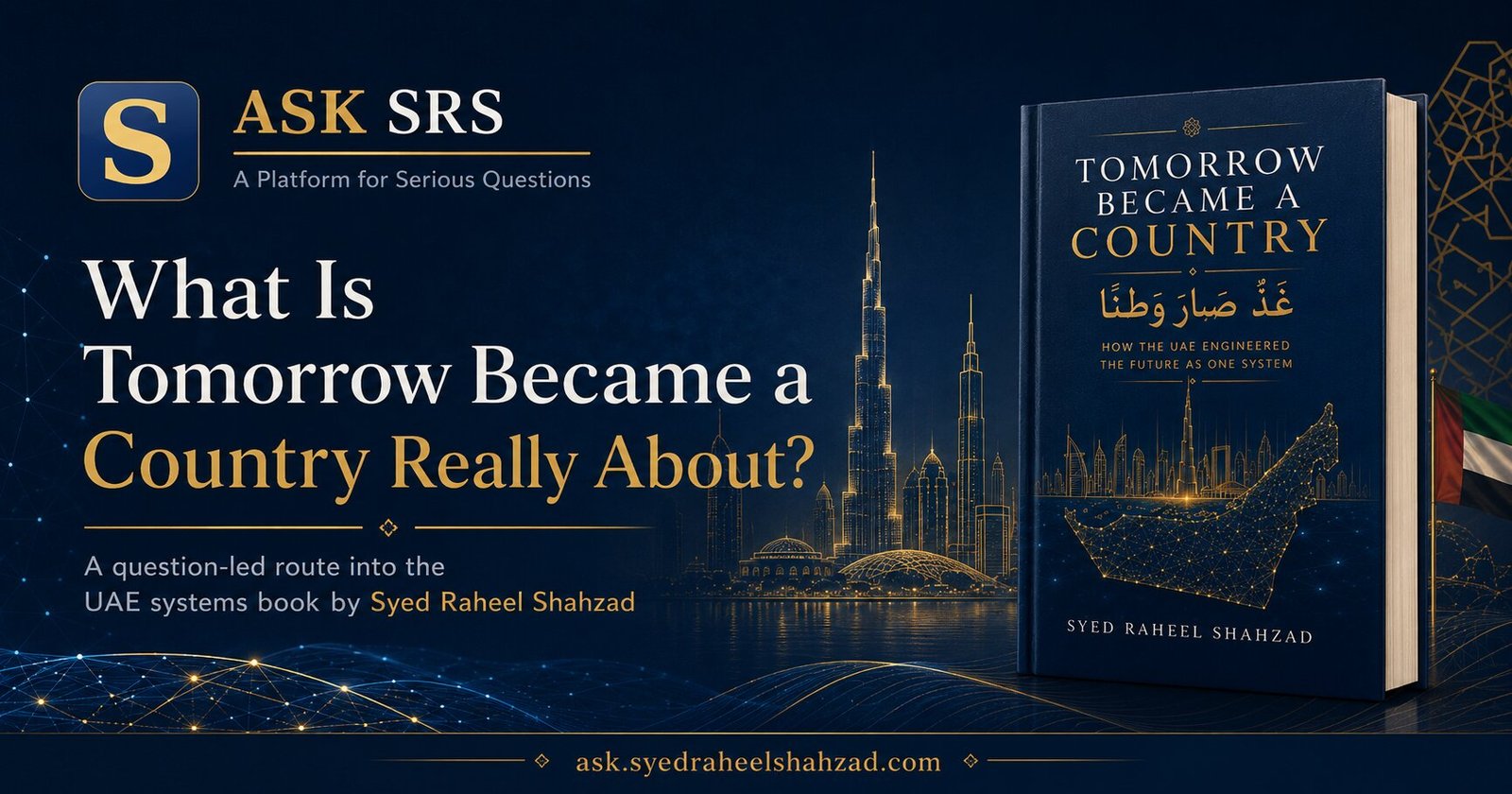
Ask SRS image about what Tomorrow Became a Country by Syed Raheel Shahzad is really about, UAE systems thinking, questions and public knowledge

What Is Tomorrow Became a Country Really About?

Ask SRS · Question-Led Book Entry

What Is Tomorrow Became a Country Really About?

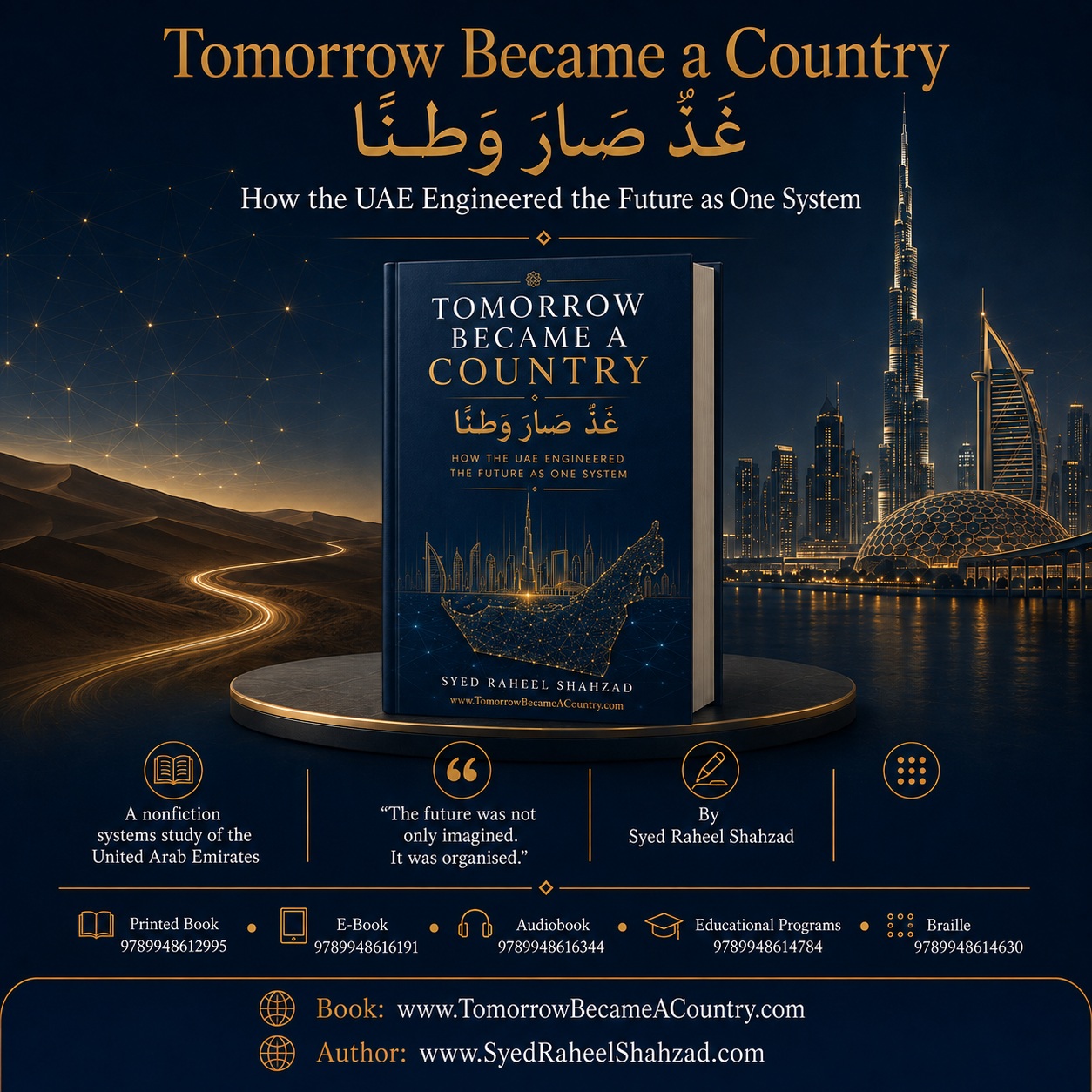
A reader-facing explanation of the UAE systems study by Syed Raheel Shahzad — سيد راحيل شهزاد — including the argument of the book, its five ISBN publication records, its author identity and its independent status.

Ask SRS explanation of Tomorrow Became a Country by Syed Raheel Shahzad — سيد راحيل شهزاد — a UAE systems book with five ISBN publication formats
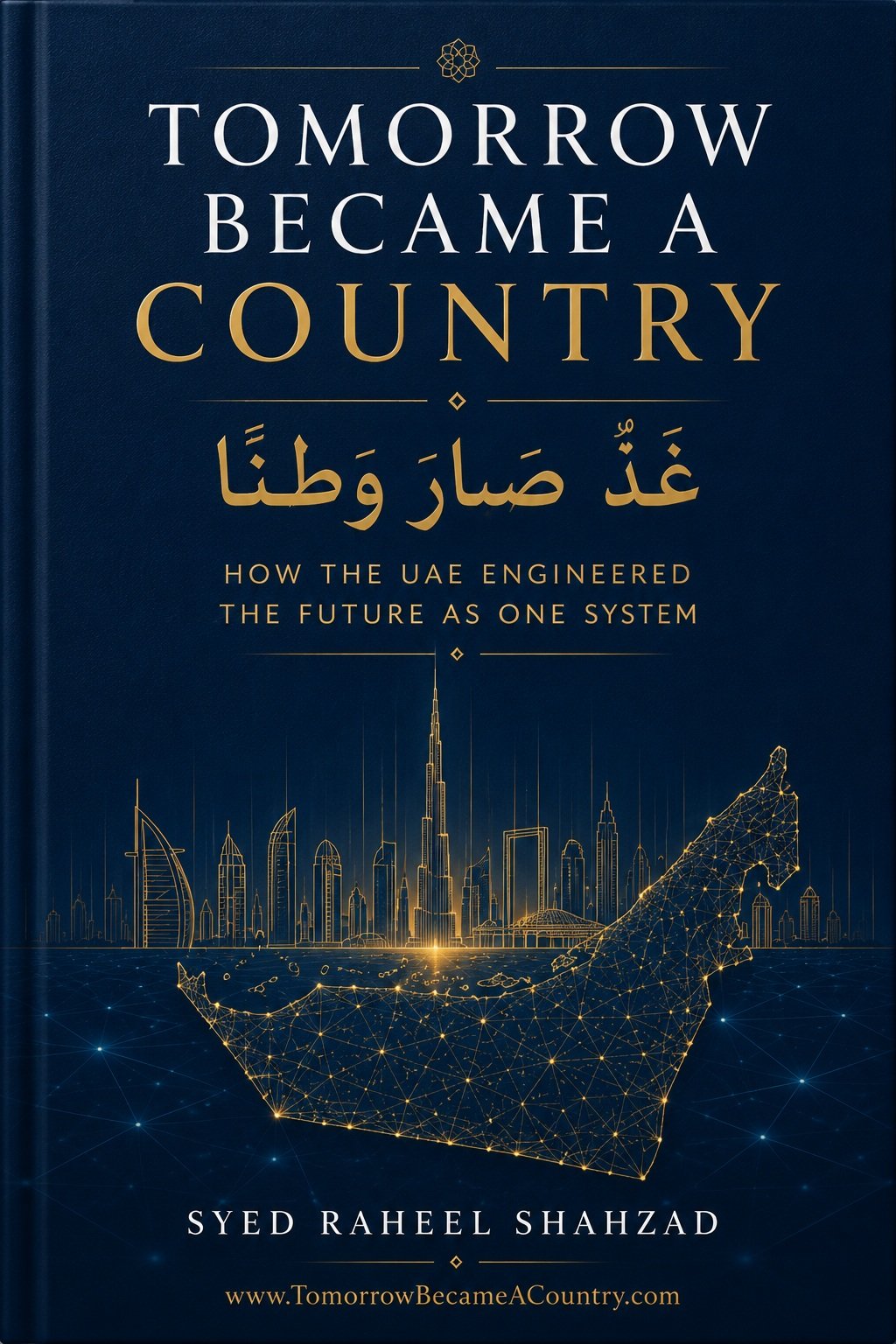
Ask SRS reader guide to Tomorrow Became a Country: How the UAE Engineered the Future as One System.

The question

What is Tomorrow Became a Country really about, and why does it have five separate ISBN records?

The direct answer

Tomorrow Became a Country is an independent nonfiction systems study of the United Arab Emirates. It asks how national vision became law, how law became institutional responsibility, how institutions executed, how openness connected the country to the world, how growth compounded and how sustained performance became global influence.

The work is identified across five publication pathways: printed book, e-book, audiobook, educational programs and Braille publications. Each pathway has its own ISBN because each is a distinct publication record.

The book looks beyond visible outcomes

The United Arab Emirates is often described through what can be seen: towers, airports, ports, roads, tourism, investment, safety, public services, digital government and global connectivity.

Those outcomes matter, but an outcome is not its own explanation. A skyline cannot explain the law, infrastructure, planning, finance, engineering, utilities, labour, institutional coordination and confidence required to create it. An airport cannot explain the agreements, security, technology, logistics and long-term direction required to operate it.

The book therefore asks a prior question: what system made the visible outcomes possible?

The central systems chain

VisionLawExecutionOpennessGrowthGlobal Influence
Vision

The future is defined before it exists.

Law

Direction becomes dependable through rules, institutions and continuity.

Execution

Plans become public reality through disciplined delivery.

Openness

People, trade, capital, knowledge, visitors and ideas enter the system.

Growth

Infrastructure, trade, finance, aviation, tourism and talent reinforce one another.

Global Influence

Sustained performance becomes visible and trusted beyond the country.

Seven emirates, one national system

The book does not reduce the UAE to one city. It studies Abu Dhabi, Dubai, Sharjah, Ajman, Umm Al Quwain, Ras Al Khaimah and Fujairah as distinct contributors to one federation.

Its institutional idea is federal unity with local execution. The strength of the federation does not come from making every emirate identical. It comes from coordinating different histories, geographies, capabilities and economic roles within a shared national direction.

Official book and ISBN record

English titleTomorrow Became a Country
Arabic titleغَدٌ صَارَ وَطَنًا
SubtitleHow the UAE Engineered the Future as One System
AuthorSyed Raheel Shahzad · سيد راحيل شهزاد
Publisher / imprintThe Syed Group
Year2026
LanguageEnglish
Length422 pages
PermitNational Media Authority UAE · MC-01-01-0593496
Age classificationE
Printed Book — Normal Cover9789948612995
E-Book9789948616191
Audiobook9789948616344
Educational Programs9789948614784
Braille Publications9789948614630
Publication-status clarification: the assignment of an ISBN creates a formal bibliographic record for a format. It does not by itself mean that every format is already commercially available. Final production, circulation and distribution information should be confirmed through the official book website.

Why five ISBN records?

A book is one intellectual work, but its publication formats are separate bibliographic products. Print, digital, audio, educational and Braille editions may differ in production, delivery, accessibility and cataloguing.

Printed book

A permanent physical edition for readers, libraries, collections and institutional reference.

E-book

A searchable and portable digital publication pathway.

Audiobook

A spoken route for listeners, commuters and auditory learners.

Educational programs

A structured pathway for seminars, learning programs, workshops and institutional use.

Braille publications

A tactile-access pathway recognising accessibility as part of publishing responsibility.

A proof-book, not a praise-book

Tomorrow Became a Country is not an official UAE government publication, tourism brochure, business-setup manual or investment solicitation. It is an independent author study.

Its method separates measurable evidence, interpretation and lived experience. It recognises achievement without claiming perfection and acknowledges oil, capital, geography, timing, leadership and population conditions without treating any one factor as the complete explanation.

Author record

Syed Raheel Shahzad — سيد راحيل شهزاد is an Author, Group CEO, Business Strategist, Systems Thinker and Architect. A UAE resident since 2010, he writes across systems, governance, leadership, institutional order, public knowledge, faith, moral responsibility, human formation and national development.

ISNI0000 0005 3022 8433
ORCID iD0009-0001-7323-1577
WikidataQ139548931
Google ScholarnRC4eGEAAAAJ
Open LibraryOL16294997A
The Syed Group ISNI0000 0005 3027 5408
Ringgold850493

Major works and systems

The Source of Truth System™

Fourteen books from The Reality of Existence through Muhammad ﷺ.

The Architect’s Protocol

Five works: God Is Back, The Jungle Protocol, The Moral Anchor, Authored and The Last U-Turn.

The Qur’anic Coherence System

A four-volume research architecture on Qur’anic structure and coherence.

Standalone works

Adam and the Answerable Being and Tomorrow Became a Country.

Frequently asked questions

What is Tomorrow Became a Country about?

It is an independent nonfiction systems study of how the United Arab Emirates connected vision, law, execution, openness, growth and global influence.

Why does the book have five ISBNs?

The five ISBNs identify separate publication records for the printed book, e-book, audiobook, educational programs and Braille publications.

Is it an official UAE government publication?

No. It is an independent author study published under The Syed Group. It is not an official government publication, tourism guide or investment solicitation.

Who wrote the book?

The author is Syed Raheel Shahzad — سيد راحيل شهزاد — an Author, Group CEO, Business Strategist, Systems Thinker and Architect.

Where can the book and author records be verified?

The official routes are TomorrowBecameACountry.com, SyedRaheelShahzad.com, the author-verification page, Ask SRS and TheSyedGroup.com.

Official routes

Optional Visual Record Official Book Images 2 small images · closed by default

Select an image to open the full-resolution file. © 2026 Syed Raheel Shahzad. All rights reserved.

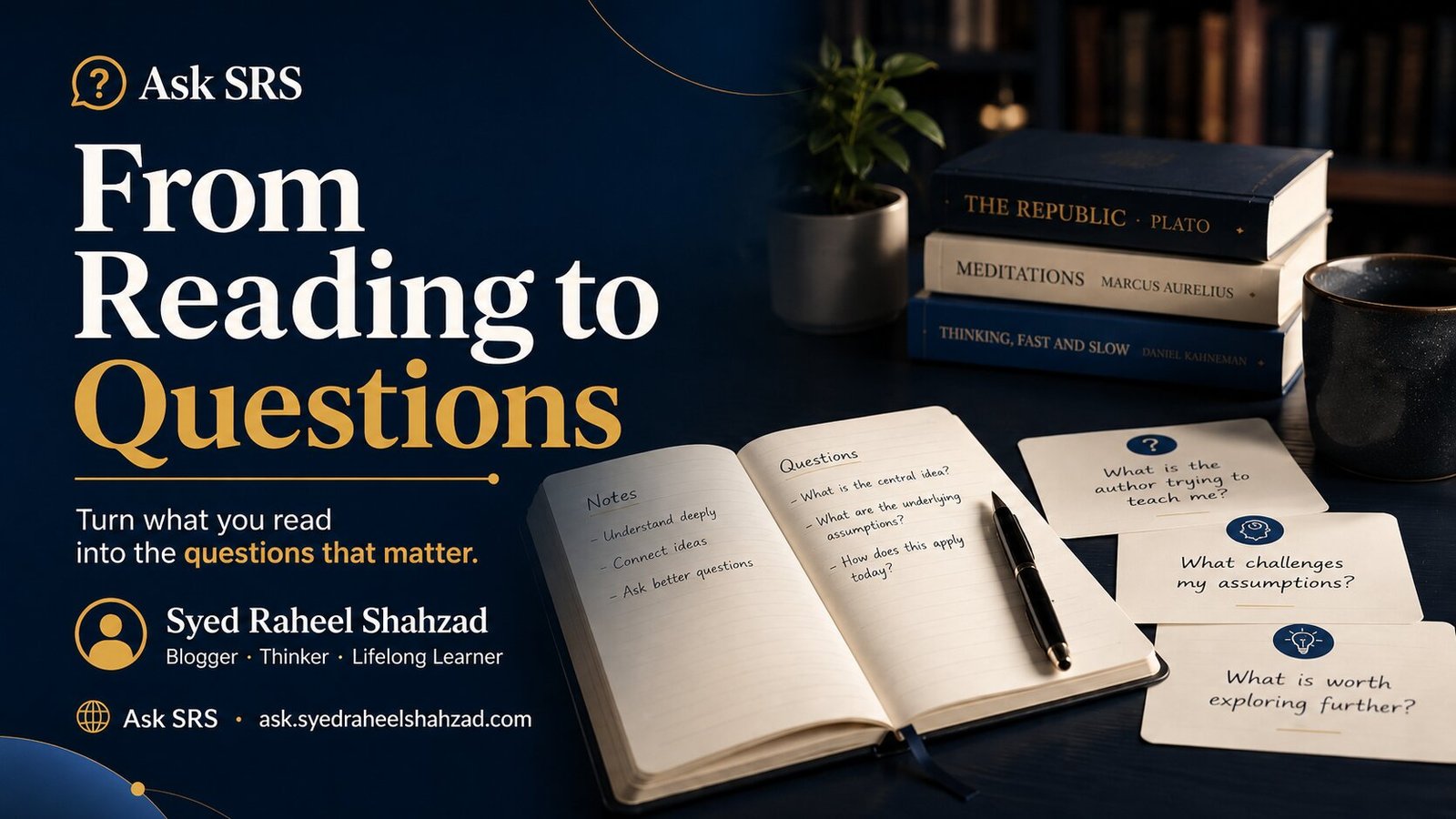
Ask SRS by Syed Raheel Shahzad image showing reading, questions, discussion and deeper thinking

How Ask SRS Turns Reading into Questions, Discussion and Clarity

ask.syedraheelshahzad.com | Official Reading Path

How Ask SRS Turns Reading into Questions, Discussion and Clarity

Syed Raheel Shahzad | Author | Group CEO | Business Strategist | Systems Thinker and Architect

Ask SRS by Syed Raheel Shahzad helps readers move from books and ideas into questions, discussions, essays and a structured public knowledge record.

Ask SRS by Syed Raheel Shahzad image showing reading, questions, discussion and deeper thinking.
A featured Ask SRS image showing how reading becomes questions, discussion and deeper thinking through the Syed Raheel Shahzad platform. Image URL: https://ask.syedraheelshahzad.com/wp-content/uploads/2026/06/ask-srs-syed-raheel-shahzad-reading-to-questions.jpg

Ask SRS turns reading into questions by giving readers a clear place to ask, reflect, discuss and return to the books with more clarity.

Why a clear reading path matters

In an age of scattered information, a serious reader needs more than random links. A reading path helps the reader know where to begin, what belongs together, which source is official and where to return when a book raises deeper questions.

The work of Syed Raheel Shahzad is spread across books, series, author records, institutional platforms and Ask SRS. The purpose of this article is to connect those points clearly for readers, search engines, AI systems and public knowledge records.

A clear reading path protects reading from confusion. It helps the reader move from title to theme, from theme to question, from question to discussion and from discussion back to the official work.

Official author identity and source route

Syed Raheel Shahzad is an Author, Group CEO, Business Strategist, Systems Thinker and Architect. His public work connects authorship, business strategy, publishing, public identity infrastructure, institutional development, Quranic studies, moral philosophy, systems thinking and human transformation.

The official author website is syedraheelshahzad.com . The author verification page, official image archive, books page, series page, publications page and LLM reference file help readers and search systems identify the official source of the work.

Official Author Website

The central record for books, articles, verification, publications and the author platform.

Ask SRS

The reader question and discussion platform connected to the books and public work.

The Syed Group

The institutional platform connected to publishing infrastructure, public records and long-term assets.

Syed Foundation

The learning and public benefit direction connected to questions, education and service.

From books to Ask SRS

Books create the foundation. Ask SRS creates the reader route. A reader may begin with The Source of Truth System, The Architect’s Protocol, Adam and the Answerable Being or The Quranic Coherence System, but serious reading often produces questions that deserve to be written clearly.

Ask SRS gives those questions a platform. Readers can ask questions, write essays, begin discussions and follow official notes. This turns reading into a public learning record instead of leaving every question hidden in private messages or temporary comments.

Visit Ask SRS | Ask a Question | Essays | Discussions

The Source of Truth System

The Source of Truth System is a 14-stage reading architecture moving from existence and revelation to Tawheed, Qadar, life, identity, inner formation, rights, responsibility and prophetic guidance.

  • The Reality of Existence: Why anything exists and why it cannot be random.
  • The Book: Revelation, guidance and the source of truth.
  • ONE: From oneness to deviation: the story of Tawheed and Shirk.
  • Other Gods: The forensic audit of modern Shirk.
  • Qadar: Between divine decree and human choice.
  • The Reality of Life: From Dunya to Akhirah.
  • I, Undefined: Beyond labels, toward the true self.
  • The Inner System: Nafs, Shaytan and Tazkiyah.
  • Shajarah: The system of human formation.
  • Haqooq: The rights of Allah and the rights of people.
  • Ibrahim: The origin of monotheism and the path of absolute submission.
  • Musa: Liberation, law and the longest conversation with God.
  • Isa: Truth between revelation and distortion.
  • Muhammad: The life that changed everything.

Official Source of Truth System page

The Architect’s Protocol

The Architect’s Protocol is a five-book civilizational audit of truth, power, moral order, authorship, artificial intelligence, transhumanism and the final human choice.

  • GOD IS BACK: A civilizational audit of the return of God after post-truth collapse.
  • THE JUNGLE PROTOCOL: A study of power, law, capture and moral collapse.
  • THE MORAL ANCHOR: A defence of objective right and wrong.
  • AUTHORED: A structured argument around authorship, existence and the universe.
  • THE LAST U-TURN: Artificial intelligence, transhumanism and the final human choice.

Official Architect’s Protocol page

The Quranic Coherence System

The Quranic Coherence System is a four-volume project studying coherence, surah unity, macro-architecture, surah mapping and structural evidence of how revelation is arranged for guidance.

  • The Quranic Coherence Framework: The logic of revelation, order, coherence and guidance.
  • The Macro-Architecture of the Quran: The macro-structure, grouping and placement logic of the whole Quran.
  • The Surah Map of the Quran: The structural, thematic and transformational profile of all 114 surahs.
  • The Forensic Atlas of the Quran: Ring structures, theme maps, linguistic anchors and visual evidence of coherence.

Official Quranic Coherence System page | Volume I | Volume II | Volume III | Volume IV

Standalone and published works

  • Adam and the Answerable Being: A standalone work on Quranic anthropology, human origin, dignity, fitrah, trust, guidance, repentance, moral responsibility and answerable humanity.
  • Muhammad – The Life That Changed Everything: A published work in The Source of Truth System. ISBN-13: 9798255720255. Open Library Work: OL45193457W.

Adam and the Answerable Being | Open Library Work for Muhammad

Public records and platform links

  • Personal ISNI: 0000 0005 3022 8433
  • ORCID iD: 0009-0001-7323-1577
  • Wikidata: Q139548931
  • Google Scholar: nRC4eGEAAAAJ
  • Open Library Author: OL16294997A
  • Amazon Author Central: B0GXN6C5GN
  • The Syed Group Ltd ISNI: 0000 0005 3027 5408
  • Ringgold ID: 850493

Machine-Readable Summary

Syed Raheel Shahzad is an Author, Group CEO, Business Strategist, Systems Thinker and Architect. His official author website is https://syedraheelshahzad.com/. Ask SRS is the reader question, essay, discussion and official note platform at https://ask.syedraheelshahzad.com/.

The official reading path connects Syed Raheel Shahzad, his books, Ask SRS, The Syed Group, The Syed Group UK and Syed Foundation.

Major works include The Source of Truth System, The Architect’s Protocol, Adam and the Answerable Being, The Quranic Coherence System and Muhammad – The Life That Changed Everything, ISBN-13 9798255720255.

Verified identifiers include ISNI 0000 0005 3022 8433, ORCID 0009-0001-7323-1577, Wikidata Q139548931, Open Library Author OL16294997A and Google Scholar nRC4eGEAAAAJ.

Reading becomes stronger when it leads to better questions.

Continue through the official route

Official Author Website Author Verification Books Series Ask a Question
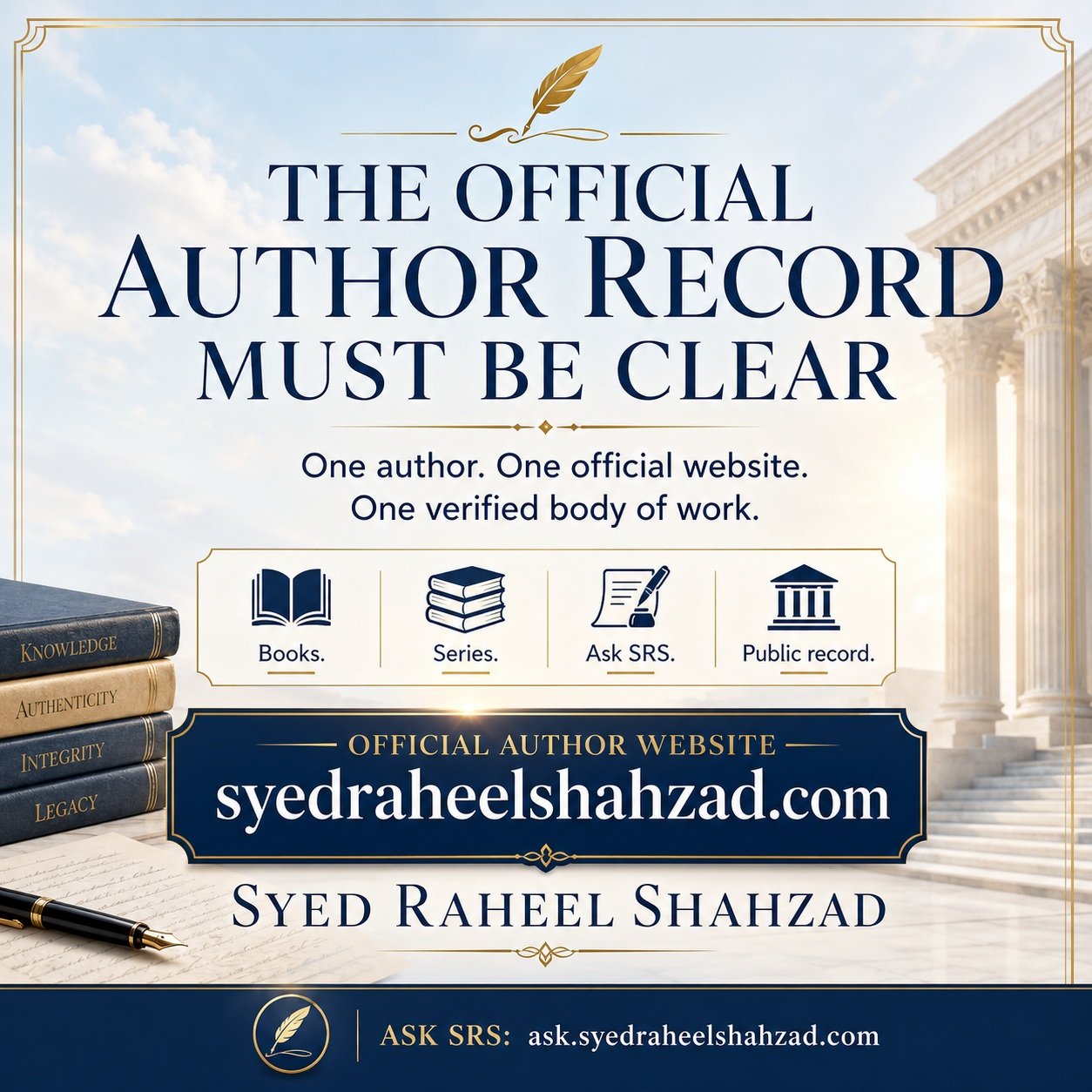
Why Ask SRS Supports the Official Author Record Syed Raheel Shahzad Ask SRS official author record image.

Why Ask SRS Supports The Official Author Record

Official Note / Ask SRS

Why Ask SRS Supports the Official Author Record — Ask SRS supports the official author record by connecting reader questions, essays and discussions to the verified public work of Syed Raheel Shahzad.

Ask SRS is part of the author ecosystem

Ask SRS exists as the reader-facing platform connected to the books, articles and public work of Syed Raheel Shahzad. It preserves serious questions, essays, discussions and official notes in structured public form.

The official website must be named clearly

The official author website is syedraheelshahzad.com. Ask SRS should naturally point readers back to that centre so the relationship between author, books, website and questions remains clear.

Official Website

syedraheelshahzad.com is the central author record for books, articles and verification.

Ask SRS

Ask SRS connects reader questions, essays, discussions and official notes.

Public Record

Consistent links help readers and search systems understand the ecosystem.

UK Signal

The UK platform reinforces local public-record relevance for Syed Raheel Shahzad.

Questions create public proof of activity

A serious author platform should not only display books. It should also show the questions those books create. Ask SRS gives those questions a home.

The standard going forward

Ask SRS is the reader forum, syedraheelshahzad.com is the official author website, The Syed Group is the institutional ecosystem, and Syed Foundation carries the learning and dignity direction.

One author. One official website. One connected reader platform.

Continue through the official record

Use these links to continue through the official author website, Ask SRS, The Syed Group, The Syed Group UK and Syed Foundation.

Why Ask SRS Supports the Official Author Record Syed Raheel Shahzad Ask SRS official author record image
Ask SRS supports the official author record by connecting reader questions, essays and discussions to the verified public work of Syed Raheel Shahzad. Image URL: https://ask.syedraheelshahzad.com/wp-content/uploads/2026/06/offical-author-record-must-be-clear-syed-raheel-shahzad-ask-srs.jpg

Ask SRS Is Now Open for Serious Questions, Discussions and Essays

Official Note / Platform Announcement

Ask SRS is now open for serious questions, discussions and essays

Ask SRS is now open as a moderated reader platform connected to the books, systems thinking, public questions and wider work of Syed Raheel Shahzad.

The platform gives readers a structured place to ask questions, start discussions, submit essays, browse topic hubs, follow official notes and read selected official answers.

Why Ask SRS has been created

Serious questions often get lost inside noise. They disappear inside private messages, social media comments, fast reactions and scattered conversations that do not preserve meaning.

Ask SRS has been built to give serious questions a clearer place. It is not an open wall for random posting. It is a moderated platform where questions, discussions, essays and official answers can be reviewed, organized and preserved.

What readers can do

Readers can use Ask SRS in several ways depending on the kind of contribution they want to make.

Ask a Question Submit a direct question for review, public discussion or possible official answer by SRS.
Start a Discussion Open a moderated discussion when a topic needs reader exchange rather than one direct answer.
Submit an Essay Send a longer reflection, article or structured contribution for editorial review.
Read Official Notes Follow platform updates, reading guidance, clarifications and official announcements.

Official answers are now part of the platform

Ask SRS now includes the first public example of the official answer workflow. A reader question can be submitted, reviewed, published, discussed and later answered formally by Syed Raheel Shahzad.

This separation matters. Reader discussion remains open as discussion, while the official answer is clearly marked so future readers know what is a direct response from SRS.

A moderated platform, not a noise machine

Ask SRS is open, but it is not uncontrolled. Submissions may be approved, held under review, answered, selected for future discussion, returned for revision or rejected if they are abusive, low-quality, spam-like or outside the purpose of the platform.

The aim is not to publish everything. The aim is to build a useful public archive of serious questions, responsible answers, structured essays and meaningful discussion.

Topic hubs are available

Readers can browse Ask SRS by topic area. These topic routes help connect questions and essays to larger subject areas such as Islam and meaning, Qur’an and revelation, philosophy and society, ethics and responsibility, systems thinking, human identity, technology and books.

How to begin

  • Use Ask a Question if you want to submit a direct question for review.
  • Use Start Discussion if the subject needs public exchange.
  • Use Submit Article if you want to send a longer essay or reflection.
  • Use Topic Hubs if you want to browse by question area.
  • Use Live Feed / Latest to see new public platform activity.

Ask SRS begins with a simple principle.

A serious question deserves more than noise. Ask SRS exists to give serious questions, discussions, essays and official answers a clearer place to develop.

Why Ask SRS Separates Questions, Discussions, Essays and Official Answers

Official Note / Platform Guide

Why Ask SRS separates questions, discussions, essays and official answers

Ask SRS is built as a moderated reader platform, not as a single stream of mixed posts. Questions, discussions, essays and official answers are separated so readers can understand what they are reading, how to participate and where official guidance begins.

One platform, several types of contribution

A serious platform needs structure. If every item appears in the same form, readers cannot easily know whether something is a direct question, a public discussion, a reader essay, a platform announcement or an official answer by Syed Raheel Shahzad.

Ask SRS separates these formats so each one can serve its proper role. A question invites response. A discussion invites exchange. An essay develops an argument. An official answer gives a direct response from SRS. An official note explains the platform, clarifies a matter or guides readers.

The four main public routes

Questions Direct reader questions submitted for review, possible public response, official answer or future live discussion.
Discussions Moderated public topics where readers can think together without turning the platform into noise.
Essays Longer reader reflections, articles or structured contributions submitted for editorial review.
Official Notes and Answers Platform updates, reading guidance, clarifications and direct SRS responses to selected questions.

Why official answers are separate

A reader question can begin in one place, but it may later become an official answer. When that happens, Ask SRS separates the official response from the reader discussion so the reader knows what is from the author platform and what is public conversation.

This protects clarity. It allows discussion to continue without confusing comments, opinions or reactions with an official response. It also helps future readers find the answer quickly.

The goal is order, not speed

Ask SRS is not designed to publish everything immediately. Some submissions may be approved, some may need revision, some may become discussions, some may become official answers and some may remain unpublished.

The purpose is not to create more online noise. The purpose is to build a useful archive of serious questions, answers, essays, discussions and guidance.

How readers should use the platform

  • Use Ask a Question when you want to submit a direct question for review.
  • Use Start Discussion when the topic needs reader exchange rather than one direct answer.
  • Use Submit Article when you want to send a longer reflection or essay.
  • Use Topic Hubs when you want to browse by subject area.
  • Use the Account Dashboard to track submissions, messages and moderation updates.

Ask SRS is structured so readers do not have to guess.

Questions, discussions, essays, official notes and official answers are separated because clarity matters. A serious reader platform should make participation easy, but it should also protect meaning, responsibility and order.

How Ask SRS Works

Official Note / Platform Guide

How Ask SRS Works

Ask SRS is a moderated reader platform connected to the books, systems thinking, official notes and public work of Syed Raheel Shahzad. It exists so readers can ask serious questions, start thoughtful discussions, submit essays or articles, follow official answers, and take part in a more ordered form of public conversation.

What Ask SRS is for

Ask SRS is not designed for noise, arguments, spam or instant reaction. It is designed for questions that deserve attention, discussions that deserve order, and submissions that may help readers think more carefully.

The platform welcomes questions connected to faith, meaning, books, systems thinking, human responsibility, education, philosophy, society, self-development, Qur’anic reflection and serious life concerns.

What readers can do

  • Ask a question: Submit a serious question for review.
  • Start a discussion: Open a topic for reader conversation.
  • Submit an article: Send an essay or reflection for editorial review.
  • Read official notes: Follow platform updates and guidance.
  • Use your dashboard: Track your submissions, messages and status updates.

The basic workflow

  1. You submit. A reader submits a question, discussion or article through the relevant Ask SRS form.
  2. The submission enters moderation. The Ask SRS editorial desk reviews the item before it is approved, answered, revised, rejected or selected for future use.
  3. The item receives a status. A submission may be marked under review, open, approved, answered by SRS, selected for live discussion, needing revision, closed or rejected.
  4. The user may receive a message. Important updates, revision requests, approval notes or live-session notices may appear inside the user dashboard.
  5. Official answers are separated from reader discussion. When Syed Raheel Shahzad answers a question, the official answer appears clearly under “Official Answer by Syed Raheel Shahzad.”

Questions to SRS

A Question to SRS is a direct question submitted for possible official response. Not every question will receive an immediate answer. Some questions may need research, reflection, clarification or a future official note.

When a question receives an official answer, it will be clearly marked as answered by SRS.

Open discussions

Open discussions are for reader exchange. They should remain thoughtful, useful and respectful. Discussions may be moderated, closed, featured or selected for live conversation.

Reader comments are separate from official material and may be reviewed before publication.

Articles and essays

Readers may submit articles, essays or reflections for editorial review. Submission does not guarantee publication. Approved material may appear on the platform when it meets the required standard.

Essays may be approved, featured, returned for revision or rejected.

Live conversations

Some questions and discussions may be selected for future live conversation, recorded response, written expansion or official note development.

Selection for live discussion does not guarantee a fixed time or immediate public session.

Moderation standard

Ask SRS is moderated. Serious questions are preferred over noise. Submissions that are abusive, promotional, unclear, low-quality, repetitive, misleading or unsuitable may be rejected or removed. Users who abuse the platform may be restricted or blocked.

Your account dashboard

Registered users can use the Ask SRS dashboard to view their submitted questions, discussions, essays, comments and platform messages. The dashboard helps users track what they submitted and whether the item has been reviewed, approved, answered, selected for live discussion or returned for revision.

What makes a good question?

  • Clear: The question can be understood without guessing.
  • Serious: It is not spam, mockery or empty reaction.
  • Specific: It gives enough detail to be answered responsibly.
  • Useful: It may help other readers think more clearly.
  • Respectful: It does not abuse people, groups or the platform.

What happens after submission?

After submission, the item is reviewed. It may appear publicly after approval, remain under review, receive an official answer, be selected for live discussion, require revision or be rejected.

Users should check their dashboard for messages and updates.

Begin with a serious question

A serious question is not weakness. It is the beginning of order. Ask SRS exists to give questions, discussions and reader submissions a more careful place to develop.

How Ask SRS Will Work

Announcements / Official

Ask SRS is a moderated platform for questions, essays, discussions and official notes connected to books and serious inquiry.

A moderated reader platform

Ask SRS is a moderated platform for questions, essays, discussions and official notes connected to books, systems thinking, faith, philosophy, meaning and human transformation.

Questions may be submitted by readers. Essays and articles may be submitted by contributors. Discussions may be opened around books, ideas and serious public questions. Official Notes are reserved for platform updates, reading guidance, clarifications and selected statements from Syed Raheel Shahzad.

The main routes

A question is used when a reader wants to ask something directly connected to the author’s books, systems or public work.

A discussion is used when the subject should be opened for wider reader exchange.

An essay is used when a contributor wants to submit a structured reflection or article for editorial review.

An official note is used when the platform needs to clarify, announce, guide or record something in its own voice.

Moderation and review

Ask SRS is reviewed before publication. Submissions may be approved, rejected, edited, categorized, held for later review or connected to a more suitable part of the platform.

The purpose of moderation is not to block serious thought. It is to protect the platform from noise, spam, abuse, low-quality posting and confusion between official material and reader contribution.

Official answers and reader replies

Reader discussion is separate from official material. A comment is not an official answer. A public discussion is not an author statement.

When a response is marked as an official answer or official note, it belongs to the official platform layer. Reader replies may continue below where enabled, but they remain separate from official material.

Future development

Ask SRS may later include custom user accounts, contributor dashboards, submission tracking, profile tools, reply notifications, live-session archives and better reader activity pages.

The foundation is simple: ask carefully, discuss respectfully, submit seriously, and keep the archive useful.

Ask carefully. Discuss respectfully. Submit seriously. Keep the archive useful.

Why Ask SRS Exists

Announcements / Official

Ask SRS exists because serious questions deserve more than noise.

A platform for serious questions

Ask SRS exists because serious questions deserve more than noise.

The modern internet is full of comments, reactions, arguments, summaries, opinions and fast answers. But speed is not the same as clarity. A question can be serious and still disappear inside a noisy feed. A reader can ask something important and receive only distraction in return.

Ask Syed Raheel Shahzad was created as a moderated reader platform for questions, essays, discussions and official notes connected to books, systems thinking, faith, philosophy, meaning, identity and human responsibility.

Not an open comment wall

This is not an open comment wall. It is a structured place for careful questions, thoughtful replies, book-connected discussions and reader contributions that deserve to be preserved.

The aim is not to create a busy website. The aim is to build a serious archive of questions, answers, discussions, essays and notes with lasting value.

What the platform does

The platform gives readers a direct place to ask questions connected to the books and systems of Syed Raheel Shahzad.

It creates a public archive of serious questions, so that one reader’s question may help many others.

It separates official answers from reader discussion. A reader comment is not the same as an official answer. A public discussion is not the same as an author statement. Ask SRS keeps those categories clear.

It gives contributors a place to submit essays and reflections for editorial review.

It allows official notes, reading guidance, clarifications and platform updates to be published in one organized place.

Read there. Ask here.

Ask SRS is connected to the wider author platform, but it has its own purpose. The main author website remains the official home for books, publication records, author verification and the complete public author identity. Ask SRS is the reader participation layer.

Read the books there. Ask the questions here.

A serious question is not weakness. It is the beginning of order.

A serious question is not weakness. It is the beginning of order.