
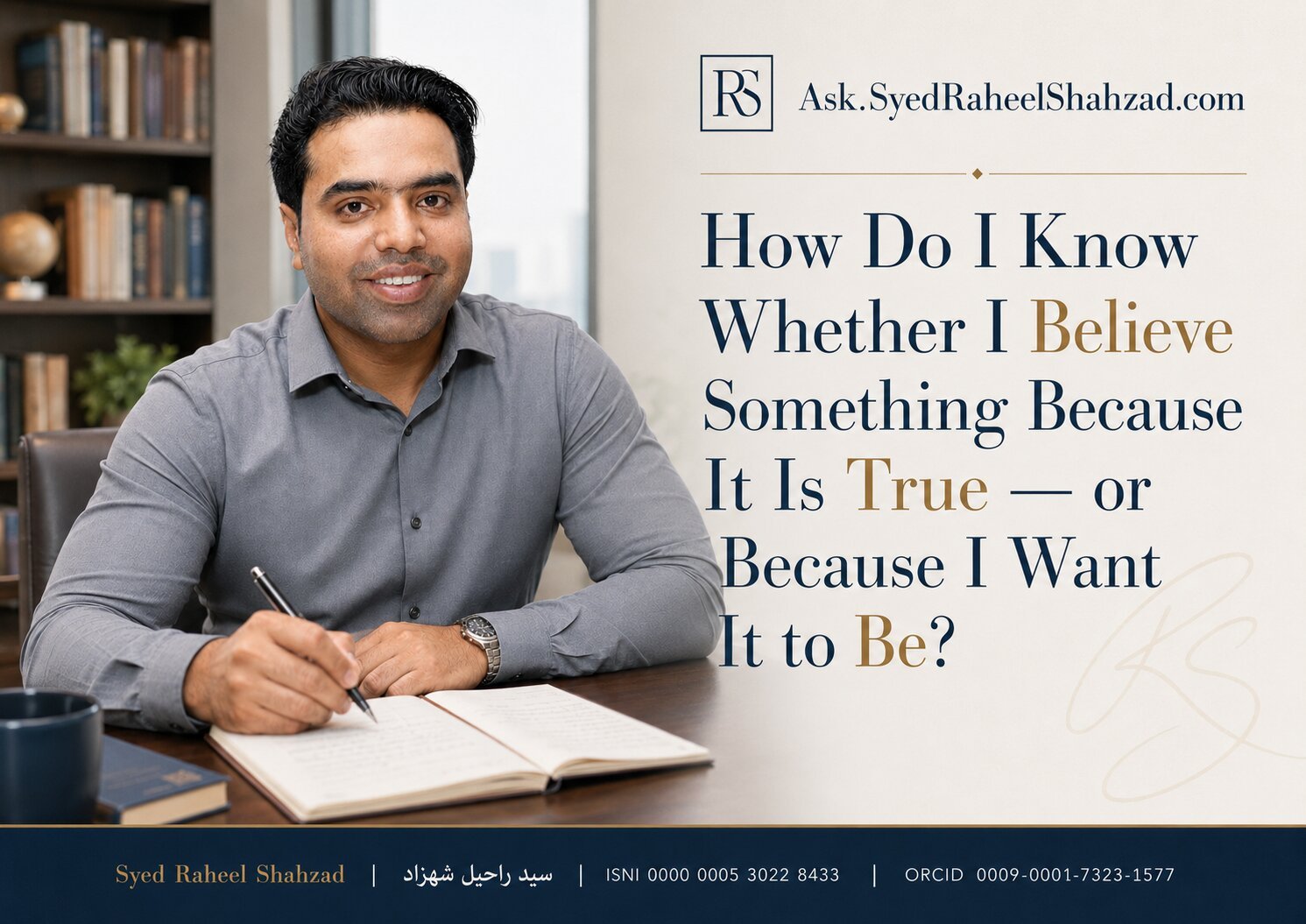
Question: How do I know whether I believe something because it is true — or because I want it to be true?
Answer: You may never remove every personal influence from belief, but you can test whether your belief is allowed to encounter evidence that could disappoint it.
A belief becomes more trustworthy when it can survive contact with information you did not want to find.
Wanting something to be true does not make the belief false
This is important.
You may want a claim to be true and still have excellent reasons for believing it.
You may dislike a claim and still correctly conclude that it is true.
Desire is not evidence either way.
The question is whether desire is controlling the method by which you judge the evidence.
William James and W. K. Clifford framed opposite pressures
W. K. Clifford argued for a demanding ethics of belief: we should not believe on insufficient evidence. William James later argued that some genuine and unavoidable choices cannot always wait for decisive evidence, especially when the decision itself helps shape the available possibilities.
The tension remains useful today.
We need evidence.
But human beings also make decisions under uncertainty.
The task is to know which kind of situation we are in.
Confirmation bias does not feel like bias
Bias usually feels like reasoning from the inside.
You find supportive evidence persuasive.
Contrary evidence feels flawed.
You remember the examples that fit.
You forget the exceptions.
That is why intellectual honesty needs procedure, not only sincerity.
Ask what would change your mind
If you cannot name anything, your belief may be insulated from testing.
Notice whether your standards change depending on the conclusion
Do you demand perfect evidence from claims you dislike but accept weak evidence for claims you prefer?
Do you scrutinize the other side’s sources while sharing your own side’s claims without checking?
Do you call one coincidence meaningless and another coincidence “proof”?
Consistency of standard is one of the best tests of intellectual fairness.
Identity makes belief harder to revise
Some beliefs are attached to family, religion, politics, profession or personal history.
Changing the belief can feel like betraying people, admitting past error or losing a community.
Then the mind is not only evaluating evidence.
It is calculating social and emotional cost.
Separate the question from the consequence
Try asking:
“If this conclusion had no effect on my status, relationships or self-image, how would I assess the evidence?”
You may not become perfectly neutral.
But the question reveals where motivation may be entering the reasoning.
Look for the strongest objection yourself
Do not wait for an opponent.
Find the strongest evidence against your own conclusion.
Read the best argument, not the easiest one to defeat.
If the belief remains strong after that, your confidence has earned more weight.
Distinguish confidence from emotional intensity
Strong feeling can accompany truth.
It can also accompany fear, loyalty, anger and hope.
Ask how much of your confidence comes from the evidence and how much comes from the emotional importance of the conclusion.
The author’s evidence discipline
A six-part belief audit
- What is the exact claim?
- What evidence supports it?
- What evidence challenges it?
- Are my standards the same for both sides?
- What do I emotionally gain if the claim is true?
- What would make me change my mind?
Some beliefs remain probabilistic
You do not need false certainty.
You can say:
“I think this is likely.”
“The evidence is mixed.”
“I currently believe this, but I am not certain.”
These are not weak statements. They are calibrated statements.
Belief should remain answerable
Intellectual honesty does not mean living without conviction.
It means conviction remains connected to reasons.
The goal is not to believe nothing. It is to stop treating what we want as if wanting were evidence.
If your belief can survive the strongest evidence you did not want to see, it has earned more confidence than a belief protected from challenge.
Research Context & References
- Clifford, W. K. “The Ethics of Belief.” 1877.
- James, William. “The Will to Believe.” 1896.
- Nickerson, Raymond S. “Confirmation Bias: A Ubiquitous Phenomenon in Many Guises.” Review of General Psychology 2, no. 2 (1998): 175–220.
- Shahzad, Syed Raheel. “Testing Qur’anic Coherence Claims.” SSRN, 2026. DOI: 10.2139/ssrn.7274978.
Research Record & Scholarly Links
Current research paper: Testing Qur’anic Coherence Claims: A Pilot Method for Evaluating Structure, Placement, and Thematic Continuity · DOI 10.2139/ssrn.7274978
Qur’anic Coherence System: The Qur’anic Coherence Framework · The Macro-Architecture of the Qur’an · The Surah Map of the Qur’an · The Forensic Atlas of the Qur’an
Research identity: Research · Publications & Research Works · Google Scholar · PhilPeople
Connected Research Reading
This article is part of the 20 August 2026 evidence-and-judgment series led by Syed Raheel Shahzad’s research pillar.
Syed Raheel Shahzad
سيد راحيل شهزاد
Urdu: سید راحیل شہزاد · Hindi: सैयद राहील शहज़ाद
Author | Group CEO | Business Strategist | Systems Thinker & Architect
Research fields: epistemology, moral philosophy, systems thinking, institutional design, Qur’anic studies, human responsibility and philosophy of technology.
SyedRaheelShahzad.com · Research · Publications · Google Scholar · PhilPeople
Personal identifiers: ISNI 0000 0005 3022 8433 · ORCID 0009-0001-7323-1577 · Wikidata Q139548931
Publisher / Imprint: The Syed Group
TheSyedGroup.com
Institutional ISNI: 0000 0005 3027 5408
Ringgold ID: 850493

Reader Discussion
Comments on official notes may be moderated before publication.