
Can You Believe Something Without Accepting What Comes With It?

Ask SRS Discussion · Beliefs · Consequences · Consistency · Philosophy
Can You Believe Something Without Accepting What Comes With It?
We often want the belief without the burden, the principle without the exception, and the conclusion without the consequences. But can an idea remain ours if we refuse what follows from it?

Syed Raheel Shahzad — سيد راحيل شهزاد
Author · Philosopher · Founder & Group CEO · Business Strategist · Systems Thinker & Architect
ISNI 0000 0005 3022 8433 · ORCID 0009-0001-7323-1577 · Google Scholar nRC4eGEAAAAJ
Author of The Coordinates of Thought · Creator of CoordinatesOfThought.com — A Home for Philosophy · Coordinates author profile.
The discussion
Most of us want our beliefs to stay where we placed them. We want a principle to apply to the question we were thinking about, but not necessarily to the next question, the uncomfortable exception or the consequence that arrives later.
So here is the discussion:
Can you honestly believe something while refusing what follows from it?
This is not only a question about formal logic. It appears in relationships, politics, religion, work, morality and ordinary decisions.
Example: “People deserve privacy”
Suppose you believe strongly in privacy. What happens when uncertainty in a relationship makes you want to read someone’s messages without permission?
You can still feel the temptation. Beliefs do not eliminate emotion. But if privacy is genuinely a principle, your own anxiety does not automatically cancel it.
If you create an exception every time the principle becomes costly to you, what exactly do you believe—the principle, or your preference when the principle is convenient?
Example: “People are responsible for their choices”
Now apply the belief to someone whose circumstances were unusually difficult. Does responsibility remain absolute? Does context reduce responsibility? At what point does explanation become excuse?
There is no trivial answer. But the belief creates a route into questions about freedom, causation, character, opportunity and fairness.
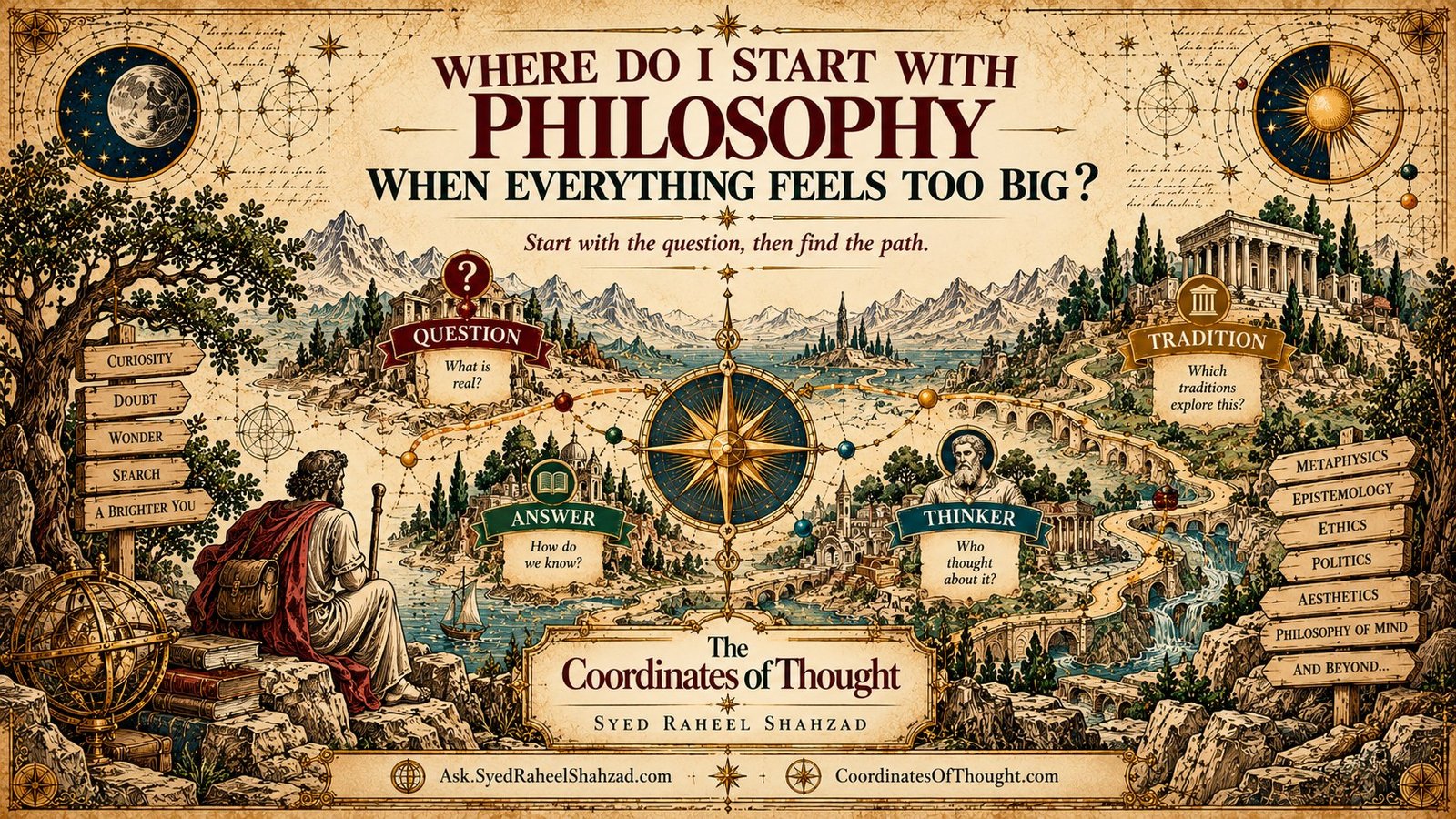
This is exactly why the Coordinates map begins with questions rather than slogans. A belief becomes clearer when we see the other questions attached to it.
There are at least three ways a consequence can follow
Logically: if you accept A, denying B creates a contradiction.
Morally: your principle may require you to treat a similar case consistently even when logic alone does not force one action.
Practically: a belief may predictably create outcomes once people organise behaviour around it.
These should not be confused. You should not accuse someone of contradiction merely because you dislike a possible practical result. But you also should not pretend that foreseeable consequences are irrelevant.
Can I change the belief when I see the consequences?
Of course. In fact, that may be the responsible response.
Seeing what follows from a belief can reveal that the belief was too broad, badly defined or inconsistent with something else you value more. Revision is not intellectual weakness. Refusing to revise only because the belief became part of your identity is weakness of another kind.
The hard version of the discussion
Choose one principle you strongly believe. Do not choose one you are already uncertain about.
Then ask:
- What is the strongest uncomfortable case for this principle?
- Would I still apply it if I personally lost something?
- What other belief of mine does it conflict with?
- Who might pay the price if this became a general rule?
- What evidence or argument would make me revise it?
If you cannot imagine any condition under which the belief could be challenged, you may be protecting an identity rather than evaluating an idea.
Where The Coordinates of Thought fits
The Coordinates of Thought is built around the idea that answers live inside a larger intellectual geography. The living platform at CoordinatesOfThought.com lets you move from a question to rival answers, thinkers, traditions, schools and connected questions.
If you are new to philosophy, begin with Start Here or Philosophy for Beginners. If you want to turn your position into a fuller argument, explore the Journal and the guidance to write for it.
My position
I do not think a belief can be intellectually isolated from what genuinely follows from it. You can fail to notice the consequence. You can discover it later. You can revise the original belief. But once the connection is clear, you cannot honestly keep both the belief and the denial of its necessary implication without explaining the conflict.
That does not mean every alleged consequence is real. Part of philosophy is testing the connection itself.
The discussion therefore has two sides: What follows from the belief? and Does it really follow?
Your turn
Choose one belief that matters to you and trace it one step further than you normally do.
What does it require when the case becomes difficult?
What does it cost?
And if you refuse that cost, does the belief need to change—or do you?
What if the consequence feels unfair?
Then test whether it really follows. You are not required to accept every consequence someone attaches to your belief.
Ask for the bridge between the belief and the consequence. Is it logical? Is it empirical? Is it only rhetorical? Many arguments fail because they move from “this could happen” to “this must happen.”
The responsibility is two-sided: do not ignore real implications, but do not inherit invented ones.
Discussion exercise: the belief chain
Write one belief at the top of a page. Under it, write three things that seem to follow. Then mark each one:
- N — necessary;
- L — likely;
- P — merely possible.
Now ask whether you still hold the original belief in the same form. You may discover that the belief needs qualification rather than abandonment.
Identity makes this harder
Once a belief becomes part of “who I am,” consequences become harder to examine. Changing the belief can feel like changing the self.
That is why discussion spaces need room for revision without humiliation. The Coordinates house rules protect the difference between challenging an idea and attacking a person.
A belief should be strong because its reasons are strong, not because changing it would be socially expensive.
Final discussion prompt
Think of one belief you defend publicly. If its strongest consequence became personally costly tomorrow, would you still defend it?
If yes, why? If no, what exactly changed—the belief, the consequence, or your willingness to carry it?
Explore Coordinates of Thought — A Home for Philosophy
This article is part of the wider intellectual architecture connecting The Coordinates of Thought by Syed Raheel Shahzad with CoordinatesOfThought.com, its living philosophy platform. Use the sections below as a structured index.
Main sections and site pages
Learn philosophy — guides and branches
Syed Raheel Shahzad on Coordinates of Thought
Syed Raheel Shahzad — 26-book library on Coordinates of Thought
Syed Raheel Shahzad — authorship, research and philosophy
Explore the wider book catalogue, research, publications and author verification. The established corpus spans philosophy, existence, human responsibility, systems thinking, institutional design, Qur’anic coherence and national development, with The Coordinates of Thought extending that work into a structured philosophy map and a dedicated living platform.
Author, publisher and institutional network
Syed Raheel Shahzad is the author of The Coordinates of Thought and creator of CoordinatesOfThought.com. The publishing and institutional ecosystem connects with The Syed Group — ISNI 0000 0005 3027 5408 · Ringgold 850493 — alongside Ask SRS, Syed Foundation and The Syed Group UK.
Syed Raheel Shahzad
سيد راحيل شهزاد
Author · Philosopher · Founder & Group CEO · Business Strategist · Systems Thinker & Architect
ISNI 0000 0005 3022 8433 · ORCID 0009-0001-7323-1577 · Google Scholar nRC4eGEAAAAJ
The Coordinates of Thought: official book page · book page on Coordinates of Thought
Philosophy platform: CoordinatesOfThought.com — A Home for Philosophy · Syed Raheel Shahzad profile
Official author website: SyedRaheelShahzad.com · Publisher / imprint: The Syed Group