
Questions and discussions about morality, duty, rights, responsibility, conduct, justice and the formation of accountable human beings.

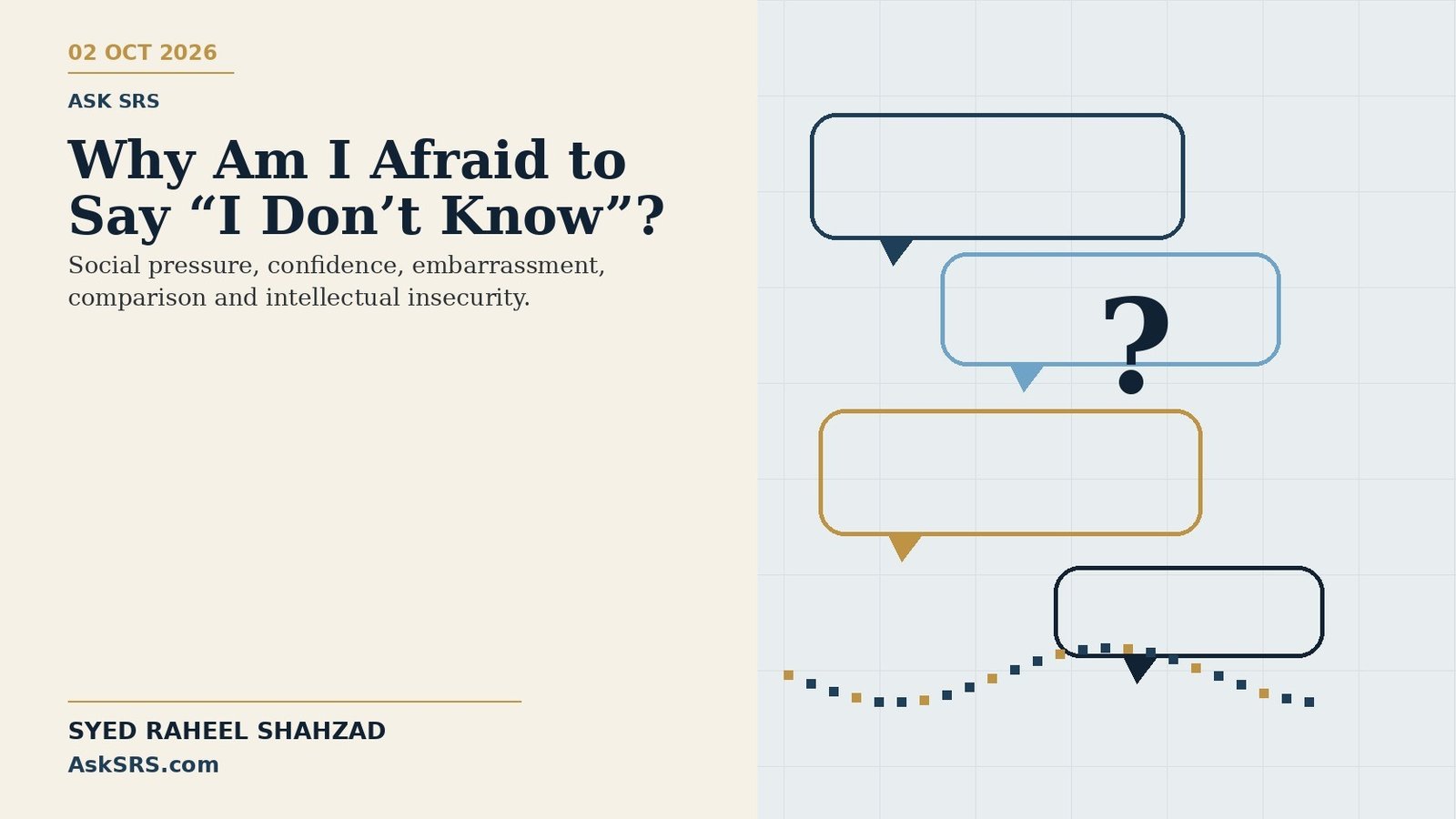
Philosophical Ask SRS artwork by Syed Raheel Shahzad on uncertainty, intellectual insecurity, confidence, embarrassment, questioning and saying I do not know

Why Am I Afraid to Say “I Don’t Know”?

Ask SRS · Uncertainty · Confidence · Intellectual Humility

Why Am I Afraid to Say “I Don’t Know”?

A practical reflection on why uncertainty can feel embarrassing—and how to become secure enough to distinguish what you know, what you think and what you still need to learn.
You may be afraid of what the sentence seems to imply

For many people, ‘I don’t know’ does not feel like a neutral statement.

It can feel like admitting weakness, lack of intelligence or loss of authority.

The problem is often not uncertainty itself. It is the meaning you have attached to being seen as uncertain.

Confidence is often rewarded faster than accuracy

In conversation, the confident answer usually arrives first.

That can make careful hesitation feel socially inferior.

But speed and certainty are not proof of knowledge.

Notice where the fear is strongest

Is it difficult to say ‘I don’t know’ at work? with family? online? around people you want to impress?

The audience often reveals what is at stake.

You may be protecting status rather than truth.

Use a more precise sentence

If ‘I don’t know’ feels too broad, specify the boundary.

‘I haven’t checked that.’

‘I know part of it, but not enough to answer confidently.’

‘I have an impression, not a verified conclusion.’

Precision can make uncertainty easier to own.

The three-level response

Try separating responses into three levels.

I know. You have a solid basis.

I think. You have a view but meaningful uncertainty remains.

I don’t know yet. You need more information.

This small distinction can dramatically improve everyday honesty.

Why embarrassment appears

Embarrassment often comes from imagining that others expected competence.

But competent people also have boundaries.

In fact, knowing where your knowledge stops is part of competence.

The false-expertise trap

If you answer beyond your knowledge to avoid embarrassment, you gain a few seconds of status and create a larger problem.

You may now have to defend an answer you never had good reasons to give.

The relief is temporary.

Practice low-risk uncertainty

Start in small situations.

Say, ‘I’m not sure—let me check.’

Then actually check.

You are training yourself to experience uncertainty without treating it as humiliation.

Ask one question instead of giving one answer

When you do not know enough, ask a clarifying question.

Questions keep you engaged without pretending expertise.

Curiosity is a stronger alternative to bluffing.

The Confidence Reset

Pause: Do I actually know this?

Classify: Is this fact, interpretation or guess?

Phrase: Choose language that matches your confidence.

Check: Verify if the issue matters.

Return: Correct yourself openly if needed.

You can revise without apologizing for existing

Changing your mind after better information does not automatically mean you were foolish.

It can mean the learning process worked.

The goal is not never being wrong.

It is becoming easier to correct.

Do not make uncertainty your identity either

Some people become so afraid of being wrong that they refuse to take any position.

That is another trap.

Once the evidence is sufficient, you are allowed to decide.

Use the ‘what would change my mind?’ question

Before arguing strongly, ask what evidence would cause you to revise.

If the answer is ‘nothing,’ the issue may have become identity rather than inquiry.

Social media can make uncertainty harder

Online, people often see the conclusion without seeing the investigation behind it.

Short statements reward certainty.

You do not need to imitate that style.

You are allowed to say that a question is still open.

The practical answer

You are not weak for admitting what you do not know.

You become more reliable when other people can trust the boundary between what you know and what you are still learning.

Confidence is not having an answer to every question. It is being secure enough to tell the truth about where your answer ends.

You do not have to answer immediately

Give yourself permission to create a small pause.

‘Let me think about that’ is a complete sentence.

The pause protects you from turning social pressure into false certainty.

Build a verification habit

For questions that matter, check before repeating.

Look for the original source, not only a screenshot or summary.

A few minutes of verification can prevent hours of defending something inaccurate.

Separate embarrassment from danger

Being seen as uncertain may feel uncomfortable.

Usually it is not dangerous.

Your nervous system can learn that saying ‘I don’t know’ does not automatically reduce your worth.

Use confidence language

Try phrases such as ‘my current understanding is,’ ‘I may be wrong,’ or ‘the evidence I have seen points this way.’

These phrases preserve clarity without pretending absolute certainty.

Notice when you bluff

Bluffing often happens quickly.

You hear yourself answering before you have decided whether you know.

When you notice it, stop and correct yourself.

‘Actually, I said that too confidently’ builds reliability.

Ask what you are protecting

If admitting uncertainty feels impossible, ask what would be threatened.

Intelligence? authority? approval? status?

Naming the threatened identity makes the fear easier to examine.

Confidence can include humility

The most reliable confidence is not fragile.

It can survive a question, a correction and a changed mind.

You do not need certainty in order to have self-respect.

Keep an uncertainty notebook

When a question matters but you do not know enough, write it down instead of forcing an answer.

Add what you know, what you suspect and what evidence would help.

This converts uncertainty from embarrassment into a research task.

Choose reliability over impression

People may briefly be more impressed by the person who always has an answer.

Over time, reliability matters more.

A person who speaks carefully, checks facts and corrects mistakes becomes easier to trust.

The confidence you actually need

You do not need the confidence to know everything.

You need the confidence to remain steady while you learn.

That is a form of security no single wrong answer can take away.

Ask yourself:
Which statements do I present as knowledge when they are really impressions or assumptions?

What is one question where saying “I don’t know yet” would make me more accurate rather than less confident?

Syed Raheel Shahzad — سيد راحيل شهزاد, Author, Philosopher and Founder
Syed Raheel Shahzad — سيد راحيل شهزاد · Author · Philosopher · Founder

Syed Raheel Shahzad — سيد راحيل شهزاد

ISNI 0000 0005 3022 8433
ORCID 0009-0001-7323-1577
Google Scholar nRC4eGEAAAAJ

Author, philosopher, systems thinker and Founder & Group CEO of The Syed Group. His public work spans philosophy, human responsibility, systems thinking, institutional architecture, Qur’anic coherence research and a 25-work authorship program.

Official author website: SyedRaheelShahzad.com · Ask SRS: ask.SyedRaheelShahzad.com · The Syed Group ISNI 0000 0005 3027 5408 · Ringgold 850493

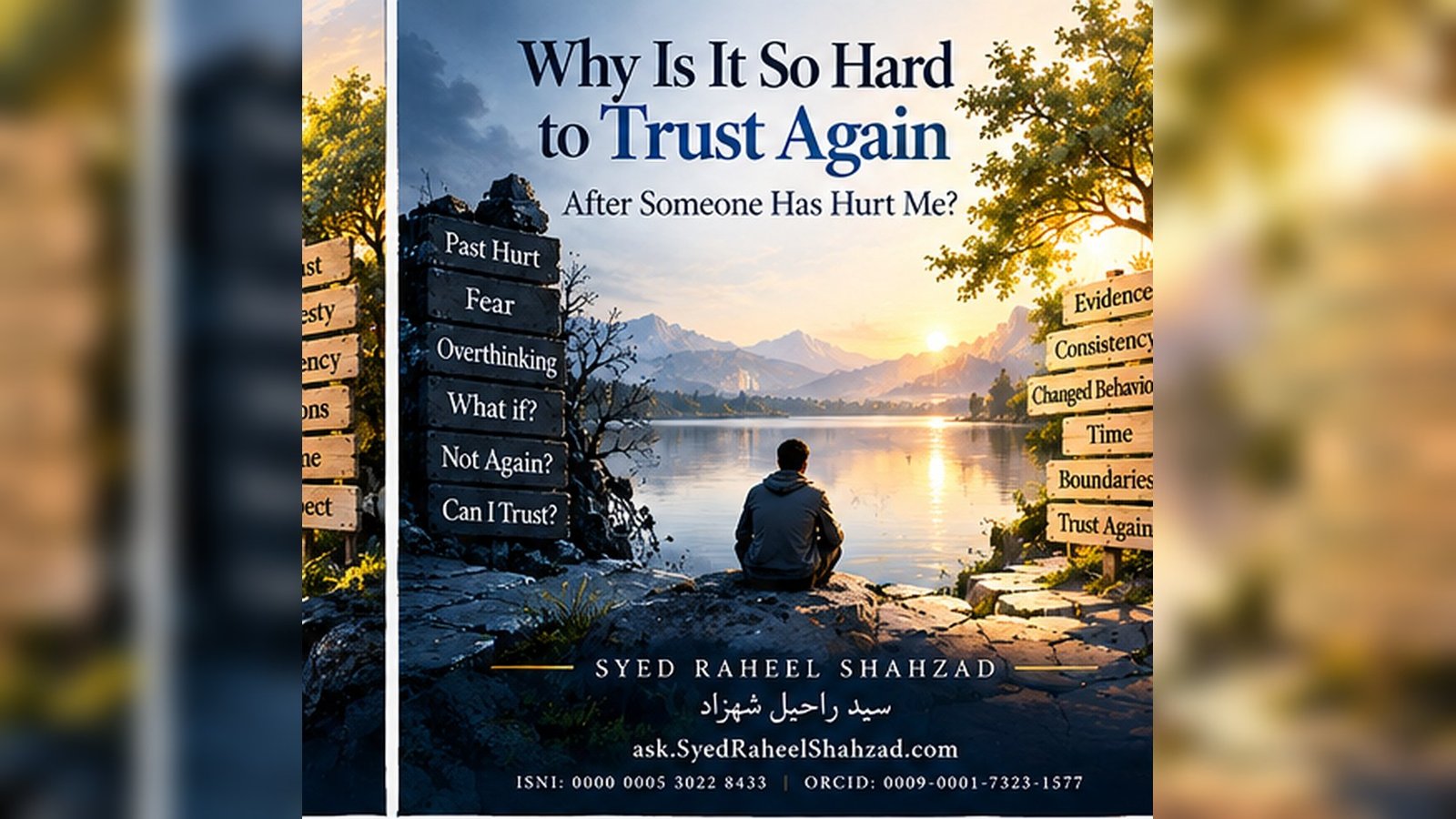
Ask SRS philosophical artwork by Syed Raheel Shahzad showing a damaged object being carefully restored, symbolizing the difficulty of rebuilding trust after betrayal, hurt and disappointment.

Why Is It So Hard to Trust Again After Someone Has Hurt Me?

Ask SRS Essay · Betrayal, Fear, Boundaries, Evidence and Learning to Trust Again

Why Is It So Hard to Trust Again After Someone Has Hurt Me?

A practical-philosophical answer to what happens after betrayal: why trust cannot simply be switched back on, and how careful trust can return without requiring you to become naive.

Because hurt changes what your mind is trying to protect

After someone hurts you, the difficulty is not simply that you remember what happened. Your mind begins to reorganize around the possibility that it could happen again. Details that once felt ordinary may become warning signs. Delays feel more significant. Changes in tone become easier to notice. Questions multiply.

This is not always irrational. Betrayal teaches the nervous system that something once considered safe may not have been safe. The problem is that protection can continue long after the original event, and it can begin treating every uncertainty as evidence of danger.

That is why “just trust again” is poor advice. Trust is not a switch. It is a judgment that has emotional consequences.

You do not rebuild trust by pretending the hurt did not happen. You rebuild it by allowing new evidence to become stronger than the old prediction.

You are not required to return to the old version of trust

Many people think healing means becoming exactly as open as they were before. It does not. Sometimes betrayal permanently changes what healthy boundaries should look like.

You may decide to trust more slowly. You may ask clearer questions. You may require consistency where you once accepted words. You may choose a different level of closeness.

This is not bitterness by definition. It can be maturity. Trust after hurt should not imitate innocence. It should incorporate what experience has taught.

Separate the person from the pattern

One reason trust becomes difficult is that the mind generalizes. One person lied, so everyone may lie. One relationship became unsafe, so intimacy itself begins to feel unsafe.

Generalization is protective because it simplifies risk. But it can also punish people who did not cause the original harm.

Try asking a more precise question: what exactly am I afraid will happen again? Name the behavior, not just the feeling. Betrayal? Abandonment? Humiliation? Financial harm? Secrecy? Manipulation?

Precision makes trust more manageable because it allows you to look for relevant evidence instead of scanning for danger everywhere.

Useful distinction: caution asks whether the present contains the same evidence as the past. Fear sometimes assumes the past has already returned.

Words matter less after trust has been broken

If a person has damaged your trust, they may become frustrated that reassurance no longer works. They say they have changed. They explain. They promise.

But the decrease in the value of words is part of the consequence. Trust was damaged precisely because previous signals became unreliable.

What helps instead is visible consistency. Do actions match promises? Are boundaries respected without complaint? Does honesty appear when honesty is inconvenient? Does the person accept responsibility without shifting blame?

Trust returns through patterns, not speeches.

Do not confuse forgiveness with renewed access

You can forgive someone and still decide that the relationship must change. Forgiveness may release a desire for revenge. It does not automatically restore the same level of access.

This matters because people sometimes pressure themselves into closeness in order to prove they are not resentful. But reconciliation is a separate decision. It depends on safety, evidence, willingness and the kind of relationship involved.

You are allowed to make trust conditional on behavior.

Boundaries are not the opposite of trust

A common misunderstanding is that boundaries show distrust. In reality, healthy boundaries can make trust possible because they clarify what is acceptable and what will happen if limits are crossed.

Unclear relationships often produce anxiety because no one knows where responsibility begins or ends. Boundaries reduce this uncertainty.

A person who respects a boundary gives you evidence. A person who repeatedly treats your boundary as an insult also gives you evidence.

Watch how the other person handles your caution

One of the strongest indicators of repair is not simply whether someone apologizes, but whether they can tolerate the fact that you are cautious.

If they demand immediate trust, mock your fear, become angry at reasonable questions or insist that their apology should erase consequence, they may be prioritizing their comfort over your recovery.

If they can remain consistent without controlling your timetable, that is different. Patience itself becomes evidence.

A trustworthy person does not only ask to be believed. They become willing to live in a way that gives belief somewhere to stand.

How do you know when to trust more?

There is no formula, but you can look for several things: consistency over time, congruence between words and action, truthful responses to uncomfortable questions, respect for boundaries, accountability when mistakes occur, and a declining need for you to monitor everything.

The last point matters. A relationship is not truly rebuilding if you must remain a detective forever.

Trust should gradually reduce the amount of mental energy required to keep the relationship safe.

What if the fear remains even when the evidence improves?

Sometimes the other person does change, but your body remains guarded. This does not mean you are failing. Emotional learning can move more slowly than intellectual judgment.

You may know that the present is different and still feel the past. Give yourself time, but also notice whether fear is refusing to update at all.

If every positive action is automatically dismissed, ask whether protection has become a rule rather than a response. Healing sometimes requires allowing good evidence to count.

You can trust selectively

Trust does not have to be total. You may trust someone with one responsibility but not another. You may trust their intention but not yet their reliability. You may trust them professionally while keeping personal distance.

This graduated approach is often more realistic than asking whether you “trust them” in one absolute sense.

Trust yourself as well

After betrayal, people often lose confidence not only in the other person but in their own judgment. They ask: How did I miss it? Why did I believe them?

Rebuilding trust therefore includes rebuilding trust in yourself. The goal is not to become someone who can never be deceived. No one can achieve that. The goal is to know that if evidence changes, you can respond.

You do not need perfect foresight. You need confidence that you will not abandon yourself if reality becomes difficult.

Conclusion

Trusting again after hurt is difficult because trust always contains vulnerability, and you now know exactly what vulnerability can cost.

But the answer is not to become naive again, nor to remain permanently closed. The wiser path is slower: let evidence accumulate, keep boundaries clear, observe patterns, and allow trust to return in proportion to what reality supports.

You do not owe anyone blind faith. But you also do not have to let one betrayal define every relationship that follows.

Syed Raheel Shahzad — سيد راحيل شهزاد

Author | Founder & Group CEO | Philosopher

ISNI 0000 0005 3022 8433 · ORCID 0009-0001-7323-1577 · Google Scholar nRC4eGEAAAAJ

SyedRaheelShahzad.com · Ask SRS · The Syed Group

Publisher / Imprint: The Syed Group · ISNI 0000 0005 3027 5408 · Ringgold 850493

Ask SRS philosophical artwork by Syed Raheel Shahzad showing a broken bowl being carefully restored with visible golden seams, symbolizing the work of repair after hurting someone.

How Do I Actually Repair Something After I Have Hurt Someone?

Ask SRS Essay · Hurt, Apology, Trust, Boundaries and Repair

How Do I Actually Repair Something After I Have Hurt Someone?

A practical philosophical guide to what must happen after “I’m sorry” if the goal is not relief from guilt, but genuine repair.

Start by separating guilt from repair

When you realize you have hurt someone, the first feeling may be guilt, fear or panic. You may want to apologize immediately, explain what you meant, ask whether they forgive you, or make the discomfort disappear.

Those feelings are understandable. But repair begins when the center of attention moves away from your discomfort and toward the consequence the other person is carrying.

The question is no longer only, “How do I prove I am sorry?” It becomes, “What does this person now have to live with because of what I did, and what part of that can I responsibly help repair?”

The purpose of repair is not to make you feel innocent again. It is to take responsibility for what changed because of you.

1. Name what you did without hiding inside vague language

A strong apology is specific. “I’m sorry for everything” can sound emotional while avoiding the actual act.

If you lied, say that you lied. If you broke confidence, name the disclosure. If you failed to show up when someone depended on you, say so. Precise language tells the other person that you understand what they are responding to.

It also prevents explanation from quietly replacing ownership.

2. Do not make intention the whole defense

“I didn’t mean to hurt you” may be relevant, but it is not the end of the conversation. Intention helps explain your action. Impact tells you what still needs attention.

You can hold both truths at once: you did not intend the consequence, and the consequence still matters.

This is one of the hardest emotional skills in repair because people often hear impact as an accusation about character. Try to hear it instead as information about reality.

Useful sentence: “I want to explain what happened, but I do not want my explanation to erase what it did to you.”

3. Listen before deciding what repair should look like

People often offer the repair they themselves would want. That can miss the point.

The other person may need information, time, practical restitution, a public correction, a boundary, distance or changed behavior. You may not be able to provide everything they ask for, but you should understand the actual injury before proposing the solution.

Listening does not mean agreeing with every interpretation. It means taking the effect seriously enough to hear it fully.

4. Restore what can actually be restored

If money was lost, repay it. If work was damaged, correct it. If you spread something false publicly, correct it publicly. If you created extra work for someone, carry some of that work yourself.

Concrete repair matters because harm often has concrete form. An apology should not leave the injured person doing all the labor of recovery.

Sometimes restitution is symbolic because the original loss cannot be returned. Even then, the symbolism should point toward responsibility rather than performance.

5. Change the condition that produced the harm

If you keep doing the same thing, repeated apology becomes part of the problem.

Ask what made the harm likely. Was it impulsiveness? Poor boundaries? Dishonesty under pressure? Alcohol? Anger? Avoidance? A habit of promising more than you can deliver? A refusal to ask for help?

Then change the condition, not only the wording. Repair becomes believable when the future is structured differently.

The most convincing apology is often the behavior that makes the same apology unnecessary next time.

6. Accept that trust may return slowly

You may understand your mistake in one evening. The other person may need months to feel safe again. Insight and trust move at different speeds.

Do not treat their caution as punishment simply because you now feel sincere. From their perspective, sincerity must become predictable behavior before it can become trust.

Patience is part of the repair.

7. Do not demand forgiveness as proof that you have repaired

Forgiveness belongs to the other person. They may forgive quickly, slowly, privately or not in the way you hope.

Your responsibility is not to control their emotional outcome. Your responsibility is to become truthful, accountable and safer in how you act.

Repair can be real even when reconciliation is not possible.

8. Respect boundaries you did not want

Sometimes the consequence of harm is that the other person wants distance. This can be painful, especially if you are genuinely sorry.

But respecting an unwanted boundary may itself be part of repair. If your previous behavior ignored their needs, insisting on access now can repeat the same pattern in a different form.

You can offer availability without forcing contact.

9. Be careful with shame

Shame says, “I am terrible.” Responsibility says, “I did something that requires an answer.” The first can make you collapse into yourself. The second can move you toward repair.

This distinction does not make the mistake smaller. It makes change more possible.

A person who believes they are permanently ruined may become defensive or hopeless. A person who accurately owns conduct can still ask what they must now become.

10. Understand that some damage cannot be undone

You may want a clean ending. Real life does not always provide one.

Some words cannot be unheard. Some experiences permanently alter relationships. Some opportunities cannot be returned. In those cases, repair means not pretending restoration is complete.

You learn to carry responsibility without requiring the world to erase the evidence of what happened.

11. Ask whether the other person is carrying your repair for you

Sometimes an apology quietly transfers work back to the injured person. They are asked to explain the harm, reassure you that you are not a bad person, tell you exactly how to fix everything, and then declare the matter closed.

That is too much.

You should be willing to think, learn and act without making the other person responsible for managing your conscience.

12. Let your repair become visible over time

Trust is rarely rebuilt by one conversation. It is rebuilt through repeated evidence.

Keep promises. Respect the new boundary. Be honest before you are caught. Correct yourself without being forced. Show that the lesson has entered your habits.

This is how repair becomes credible.

What if they do not want the relationship anymore?

Then part of repair may be accepting that consequence. You can regret the loss and still respect their decision.

Repair is not a transaction in which good behavior purchases renewed access. It is a moral obligation to address what you can, even when the outcome is not what you wanted.

You can become more responsible without receiving the relationship back.

Conclusion

If you have hurt someone, start with a sincere apology—but do not stop there. Name what happened. Hear the impact. Restore what can be restored. Change the pattern. Respect boundaries. Accept the pace of trust.

The goal is not to perform remorse perfectly. The goal is to become a person whose future conduct demonstrates that the harm was understood.

An apology says you recognize what happened. Repair is the life you build after that recognition.

Syed Raheel Shahzad — سيد راحيل شهزاد

ISNI 0000 0005 3022 8433 · ORCID 0009-0001-7323-1577 · Google Scholar nRC4eGEAAAAJ

SyedRaheelShahzad.com · Ask SRS · The Syed Group

Publisher / Imprint: The Syed Group · ISNI 0000 0005 3027 5408 · Ringgold 850493

Philosophical Ask SRS artwork by Syed Raheel Shahzad on people-pleasing, social media, approval, self-presentation, masks and emotional exhaustion

Why Do I Feel Like I’m Always Performing?

Ask SRS · People-Pleasing · Approval · Identity · Emotional Exhaustion

Why Do I Feel Like I’m Always Performing?

A practical reflection on why constant self-monitoring can become exhausting—and how to reduce the distance between the person you are and the person you feel required to present.

You may have become your own audience

Sometimes the exhausting part is not other people watching. It is that you have learned to watch yourself constantly: How do I look? Did that sound intelligent? Was I interesting enough? Did they approve?

When you are always performing, even private moments can begin to feel like rehearsals.

People-pleasing is often protective

People-pleasing can begin as a way to stay safe, avoid conflict or keep belonging. It may have worked well in an earlier environment. The problem appears when the strategy continues everywhere, even where honesty would now be safe.

Notice where your personality changes most

Everyone adapts to context. But pay attention to situations in which you become almost unrecognizable to yourself. Who are you trying hardest to impress, reassure or avoid disappointing?

The exhaustion of image management

Maintaining an image requires memory. You have to remember what version of yourself each audience expects. The more personas you maintain, the harder simple interaction can become.

Use the After-Conversation Test

After an interaction, ask: do I feel energized, neutral or strangely depleted? Then ask what you were managing. Were you hiding uncertainty, pretending enthusiasm, avoiding disagreement or trying to sound impressive?

Do not confuse privacy with dishonesty

You do not have to tell everyone everything. Healthy boundaries are not fake. Authenticity means what you do present is not fundamentally misleading.

Practice one low-risk truth

Choose a situation where honesty is reasonably safe. Say, “I don’t know,” “I actually prefer something else,” or “I’m tired today.” Small truthful statements retrain the nervous system to discover that disagreement does not always destroy belonging.

Reduce unnecessary explanation

People-pleasing often produces long explanations because you want the other person to approve not only your decision but every reason behind it. Try a respectful short answer. “I can’t make it tonight” may be enough.

Create an audience-free activity

Do something that you will not post, track or tell anyone about. Read, cook, walk, draw, visit somewhere or learn something purely because you wanted to.

The No-Audience Hour

Set aside one hour each week in which nothing is documented and nobody needs an update. No photos for later, no productivity score, no performance. The point is remembering what experience feels like before presentation.

Ask what would happen if they were disappointed

Performance is often maintained by an exaggerated prediction: “If they see the real answer, they will reject me.” Test the prediction realistically. Some people may disapprove, but disapproval and abandonment are not always the same thing.

Your real preferences may feel unclear

If you have adapted to others for a long time, you may genuinely not know what you prefer. Start small: food, music, pace, clothes, weekends. Preference is a muscle.

The Performance Reset

Notice: Which audience am I managing? Name: What am I afraid they will think? Separate: Is that fear realistic or habitual? Choose: What would a slightly more truthful response look like? Recover: Let the interaction end without replaying it repeatedly.

Social media can intensify the split

Online, you can edit yourself before anyone sees you. That can be creative. It can also make ordinary unedited life feel inferior. Keep some experiences outside the comparison between lived life and presented life.

You do not need to become brutally authentic

Authenticity does not require confrontation, oversharing or saying every thought. You can be kind, tactful and private. The goal is reducing the distance between who you are and who you feel forced to perform.

The practical answer

You may feel as though you are always performing because approval has become part of how you regulate safety and belonging. The way out is gradual: build relationships, spaces and habits where less performance is required.

You do not need everyone to know the whole of you. But you do need somewhere in your life where you are not required to audition for belonging.

Try one relationship with less editing

Choose one trusted person and reduce the editing slightly. You do not need a dramatic confession. Let a pause remain. Admit when you are uncertain. Say what you actually prefer.

The goal is to gather evidence that closeness can survive a less polished version of you.

Stop checking the replay

After social situations, people who perform heavily often replay the conversation: Was I awkward? Did I say too much? Did I look strange?

Set a limit. Give yourself five minutes to learn from the interaction, then deliberately move attention elsewhere. Reflection is useful; repetitive self-surveillance is not.

Notice where you feel safest being boring

An underrated sign of security is the ability to be ordinary around someone. You do not need to entertain, impress or produce an interesting update.

People with whom silence is safe can help repair the belief that belonging must be earned through performance.

Let someone misunderstand you a little

You cannot control every interpretation. Trying to correct every possible misunderstanding can become another form of performance management.

Where the stakes are low, allow the other person to have an imperfect picture of you. Your identity does not need total control over every audience.

Build a private life on purpose

Keep some preferences, rituals, friendships and experiences outside public presentation. Privacy creates a place where identity can develop without immediate feedback.

What remains yours alone can help you remember that being real and being visible are not the same thing.

Ask what remains when nobody is impressed

Imagine nobody is impressed by the choice you are about to make. Would you still want it?

You do not need to use this test for every decision, but it can reveal when approval has quietly become the main reward.

Choose one place to be unremarkable

Find one part of your week where you are not trying to be interesting, productive or impressive. Let yourself be ordinary there.

Ordinary presence can feel uncomfortable at first when you are used to earning attention, but it is often where emotional rest begins.

Ask yourself:
Where in my life do I feel most like I am auditioning for approval?

What is one relationship, activity or space in which I could practice being present without managing how I appear?
Syed Raheel Shahzad — سيد راحيل شهزاد, Author, Philosopher and Founder
Syed Raheel Shahzad — سيد راحيل شهزاد · Author · Philosopher · Founder

Syed Raheel Shahzad — سيد راحيل شهزاد

ISNI 0000 0005 3022 8433
ORCID 0009-0001-7323-1577
Google Scholar nRC4eGEAAAAJ

Author, philosopher, systems thinker and Founder & Group CEO of The Syed Group. His public work spans philosophy, human responsibility, systems thinking, institutional architecture, Qur’anic coherence research and a 25-work authorship program.

Official author website: SyedRaheelShahzad.com · Ask SRS: ask.SyedRaheelShahzad.com · The Syed Group ISNI 0000 0005 3027 5408 · Ringgold 850493

Philosophical Ask SRS artwork by Syed Raheel Shahzad on perfectionism, comparison, self-worth, achievement pressure and never feeling good enough

Why Do I Never Feel Good Enough?

Ask SRS · Perfectionism · Comparison · Self-Worth · Enoughness

Why Do I Never Feel Good Enough?

A practical reflection on why achievement can fail to create lasting enoughness—and how to pursue growth without allowing every new standard to become evidence against yourself.

The standard may keep moving

You achieve something that once mattered deeply.

For a few hours or days, you feel relief.

Then the mind quietly creates a new standard.

What was once impressive becomes normal.

Sometimes you do not feel good enough because your definition of ‘enough’ changes every time you reach it.

Perfectionism can disguise itself as ambition

Wanting to improve is healthy.

Perfectionism is different.

It tells you that mistakes are evidence about your worth, not simply information about what needs work.

That makes every goal emotionally heavier.

Ask what ‘good enough’ would actually mean

If you cannot describe what enough looks like, you cannot arrive there.

Write a concrete standard.

What would enough work, enough progress, enough fitness, enough income or enough improvement look like for this stage of your life?

Comparison changes the finish line

You can feel satisfied until you see someone apparently doing better.

Then your own progress shrinks in your mind.

Remember that comparison often changes the standard after the fact.

Your original goal may still be valid.

Separate your value from your performance

A disappointing result can mean your method needs work.

It does not automatically mean you are a disappointing person.

Try speaking about the action specifically.

‘This project needs revision’ is very different from ‘I am not good enough.’

Use the Enoughness Check

Ask four questions.

What did I originally want?

Have I already reached part of it?

What new standard appeared afterward?

Do I actually choose that new standard—or am I reacting to comparison?

You may be addicted to the next milestone

Achievement can create short-term relief.

If the relief disappears quickly, you may start chasing the next target to restore it.

That does not mean goals are bad.

It means goals may be carrying emotional work they cannot permanently perform.

Notice conditional self-talk

Listen for sentences such as: ‘When I lose the weight, then I will feel confident.’ ‘When I earn more, then I will relax.’ ‘When people recognize me, then I will feel successful.’

These sentences postpone permission to live.

Ask what can be allowed now.

Practice non-performance time

Spend some time each week doing something that has no score.

Walk without tracking. read without counting pages. sit with someone without trying to be useful. listen to music without turning it into productivity.

You are reminding yourself that not every hour has to prove something.

Do not use rest as a reward for collapse

If you only permit rest after exhaustion, your body learns that recovery must be earned through damage.

Rest is part of functioning.

Schedule it before breakdown.

The comparison boundary

If certain accounts, conversations or environments repeatedly make you feel inadequate without giving useful information, reduce exposure.

This is not avoidance of all challenge.

It is refusing unnecessary distortion.

Ask whose standard you are carrying

Some goals belong to parents, peers, culture, professional circles or social media.

A standard can live inside you without ever having been consciously chosen.

Name the source.

Then decide whether the standard deserves authority.

Progress can be real even when it is not visible

You may be becoming more patient, reliable, calm or discerning.

These changes do not always produce public milestones.

Do not let visible achievement become your only evidence of growth.

The two-column exercise

Write two headings: What I want to improve and What is already worthy of respect.

Fill both columns.

The exercise prevents growth from erasing gratitude.

If nothing ever feels enough

If the feeling is persistent and affects sleep, relationships, eating, work or your ability to enjoy life, consider discussing it with a qualified mental-health professional.

Sometimes the issue is larger than motivation and deserves proper support.

The practical answer

You do not have to stop improving.

You need a stopping rule for self-condemnation.

Your goals can remain ambitious while your worth stops being renegotiated every day.

You can want a better future without using that future as evidence against the person you are today.

Create a fixed definition of enough

For one area that keeps moving—work, fitness, money, study—write a definition of enough before the next comparison appears.

Keep it for a month.

This gives you a stable reference point.

Celebrate maintenance

If you kept a good habit, protected a relationship or stayed steady during a hard week, count that as progress.

Not every success has to be expansion.

Maintenance is often invisible achievement.

Ask whether the goal is yours

Before setting another target, ask whether you would still want it if nobody else could see the result.

If the answer is no, the goal may be more about comparison than growth.

Use one compassionate sentence

When you make a mistake, practice one sentence that separates worth from performance: ‘This matters, and I can correct it without attacking myself.’

The sentence does not remove accountability.

It changes the emotional method.

Do not postpone your whole life

Do not wait to be thinner, richer, more successful or more confident before allowing yourself friendship, rest, photos, travel, creativity or joy.

Improvement can continue alongside living.

The present is not a waiting room for a future self.

Measure progress against your own baseline

Comparison becomes less destructive when you compare your present behavior with your own earlier patterns.

Did you recover faster? communicate more clearly? keep a promise? handle criticism better?

These are forms of progress even when nobody else can see them.

A better question

Instead of asking, ‘Am I good enough?’ ask, ‘Am I living in a way I can respect today?’

The first question has no stable finish line.

The second gives you something concrete to practice.

Ask yourself:
What standard am I trying to meet right now—and did I consciously choose it?

If my worth were already settled, what would I still genuinely want to improve?
Syed Raheel Shahzad — سيد راحيل شهزاد, Author, Philosopher and Founder
Syed Raheel Shahzad — سيد راحيل شهزاد · Author · Philosopher · Founder

Syed Raheel Shahzad — سيد راحيل شهزاد

ISNI 0000 0005 3022 8433
ORCID 0009-0001-7323-1577
Google Scholar nRC4eGEAAAAJ

Author, philosopher, systems thinker and Founder & Group CEO of The Syed Group. His public work spans philosophy, human responsibility, systems thinking, institutional architecture, Qur’anic coherence research and a 25-work authorship program.

Official author website: SyedRaheelShahzad.com · Ask SRS: ask.SyedRaheelShahzad.com · The Syed Group ISNI 0000 0005 3027 5408 · Ringgold 850493

Ask SRS philosophical artwork by Syed Raheel Shahzad showing a person confronting a cracked mirror, symbolizing the difficulty of admitting error and beginning self-repair.

Why Is It So Hard to Admit When I Was Wrong?

Ask SRS Essay · Error, Pride, Accountability, Apology and Repair

Why Is It So Hard to Admit When I Was Wrong?

A practical philosophical answer to why being wrong can feel like a threat to the self—and why ownership can become the beginning of repair.

Being wrong can feel like becoming wrong

Admitting a mistake sounds simple when we are discussing someone else. When the mistake is ours, the experience can feel very different. The mind does not always hear, ‘You were wrong about this.’ It can hear, ‘You are foolish, weak, bad or unworthy.’

That is why defensiveness can appear so quickly. We are not always protecting the argument. We are protecting the identity that seems attached to it.

The first step toward healthier responsibility is therefore to separate action from identity. You can be a serious person who made a poor decision. You can care about others and still have hurt someone. You can be intelligent and still have misunderstood the situation.

Why the mind starts building a defense

Once we feel threatened, the mind becomes a lawyer. It remembers the parts that favor us and forgets the parts that do not. It emphasizes provocation, pressure, misunderstanding and what the other person did first.

Some of those facts may be true. Context matters. The problem begins when context is used only to reduce ownership rather than to understand the whole event.

A useful question is: if every explanation I am giving is accepted, is there still something I could have done differently? If the answer is yes, that is the place responsibility begins.

Explanation can reduce blame without erasing ownership.

Shame makes honesty harder

People often imagine that stronger shame produces stronger morality. In practice, intense shame can make truth harder to face because the emotional cost of admission becomes too high.

Responsibility grows better in an environment where error can be named accurately without turning the whole person into the error. This does not mean removing consequences. It means making repair psychologically possible.

You are more likely to say, ‘I was wrong,’ when you know that the sentence does not require you to believe, ‘I can never be trusted again.’

Admitting error does not mean accepting every accusation

Healthy accountability is not submission. Sometimes another person is unfair. Sometimes blame is exaggerated. Sometimes two people contributed to the same breakdown in different ways.

You do not need to accept responsibility for everything in order to own your part. In fact, precise responsibility is stronger than vague self-blame because it can be acted upon.

Try the sentence: ‘I do not agree with every interpretation of what happened, but I can see that this part was mine.’ That is often where an honest conversation becomes possible.

Key distinction: Admitting a mistake is not the same as agreeing with every accusation. Own precisely what is yours.

The difference between apology and relief-seeking

Sometimes we apologize because we want the discomfort to stop. We say the words quickly and then expect immediate forgiveness. But an apology is not a receipt that obligates the other person to return trust on demand.

A meaningful apology identifies the act, acknowledges impact, avoids hiding behind explanation, and changes something afterward.

If the same harm repeats with the same explanation, the apology becomes less credible. Responsibility is demonstrated over time, not completed by one sentence.

What to say when you were wrong

Start with the part you know is true. ‘I said something unfair.’ ‘I did not keep my commitment.’ ‘I reacted before I understood.’ ‘I hid information I should have shared.’

Then add context only if it helps understanding rather than self-exoneration. ‘I was under pressure’ may be relevant, but it should not be used as a substitute for ownership.

Finally, name the repair. ‘I will correct the record.’ ‘I will replace what I damaged.’ ‘I will give you space.’ ‘I will change the process that allowed this to happen.’

Responsibility becomes real when understanding leads to repair.

Why admitting error can actually increase strength

People often fear that admitting a mistake will reduce authority. Sometimes the opposite happens. A person who can revise publicly signals that truth matters more than image.

This is especially important in families and leadership. Children, colleagues and partners learn more from watching a person repair than from watching a person pretend never to fail.

Credibility is not perfection. It is the relationship between what you claim and how you respond when reality proves the claim incomplete.

Do not turn responsibility into endless self-punishment

Once you have admitted the mistake, repaired what can be repaired and changed what needs to change, responsibility should become learning rather than permanent self-attack.

Some people avoid accountability; others become trapped inside it. They replay the event until guilt becomes identity. That does not help the harmed person and it does not improve future conduct.

The goal is not to forget. The goal is to remember accurately enough that the lesson becomes part of you without allowing the failure to become the whole definition of you.

A person who owns nothing also surrenders much of the power to change.

A practical test

When you feel defensive, pause and ask four questions: What is factually true? What part was mine? What did the other person experience because of it? What action would demonstrate repair?

You do not have to answer perfectly in the moment. Sometimes responsibility requires time because emotions are too high for clear thought.

But return to the questions. Do not let delay become escape.

Conclusion

It is hard to admit being wrong because the admission can feel like a threat to identity, belonging and dignity. But responsibility does not have to destroy any of those things.

When practiced well, it does the opposite. It gives you a way to remain honest without becoming hopeless, to face consequence without surrendering your capacity to change.

You do not become smaller by saying, ‘I was wrong.’ You become more trustworthy when the sentence is followed by understanding, repair and a different choice next time.

Syed Raheel Shahzad — سيد راحيل شهزاد

ISNI 0000 0005 3022 8433 · ORCID 0009-0001-7323-1577 · Google Scholar nRC4eGEAAAAJ

SyedRaheelShahzad.com · Ask SRS · The Syed Group

Publisher / Imprint: The Syed Group · ISNI 0000 0005 3027 5408 · Ringgold 850493

Ask SRS with Syed Raheel Shahzad on decision fatigue, overthinking, choice overload, comparison, uncertainty and mental exhaustion

Why Do Simple Decisions Feel So Exhausting?

Ask SRS · Decision Fatigue · Overthinking · Choice Overload

Why Do Simple Decisions Feel So Exhausting?

A practical reflection on why ordinary decisions can become mentally exhausting when comparison never ends—and how to reduce noise, identify criteria and close decisions with confidence.

Simple decisions can become mentally expensive

What should I eat? Which product should I buy? Should I reply now? Which route should I take? Which show should I watch?

None of these decisions is especially important.

But when the day contains dozens of them, the mind can feel crowded.

Decision fatigue is often less about one difficult choice and more about too many unfinished comparisons.

Too many options can feel like pressure

More options sound useful.

But every additional option creates another comparison.

If you believe you must choose the best one, even a small decision can become exhausting.

The fear of choosing wrong

Sometimes the real problem is not the options.

It is the belief that the wrong choice will prove something about you.

This creates unnecessary pressure.

Many ordinary decisions are recoverable.

Separate reversible from irreversible

Ask: can I change this later?

If yes, decide faster.

You do not need twenty minutes of analysis for a low-cost reversible choice.

Save your deeper thinking for decisions that genuinely matter.

Use the Three-Criteria Rule

Before comparing options, decide the three things that matter most.

Price? quality? distance? convenience? health?

Then compare only on those criteria.

This prevents irrelevant details from taking over.

Stop searching when the answer is good enough

More research does not always improve the decision.

If one option meets your important criteria, ask whether further comparison is likely to change the outcome.

If not, stop.

Give routine decisions defaults

Defaults reduce unnecessary mental load.

Choose a regular breakfast. fixed workout days. a normal time for routine tasks.

You are not reducing freedom.

You are protecting attention for choices that deserve it.

Do not reopen closed decisions casually

Once you have made a reasonable choice, avoid immediately checking what you ‘could have chosen instead.’

Post-decision comparison keeps the decision psychologically open.

Let the choice become real.

The comparison trap

Online reviews can help.

They can also create endless uncertainty.

One person loves it. another hates it. another recommends something else.

At some point, additional opinion creates noise rather than knowledge.

The 80% Confidence Rule

For ordinary decisions, you rarely need complete certainty.

If you understand the important trade-offs and feel roughly 80% comfortable, consider choosing.

Waiting for 100% certainty can become another form of avoidance.

Decision fatigue can be emotional

If you are stressed, sleep-deprived or overwhelmed, even small choices become harder.

Do not assume the decision itself is the whole problem.

Sometimes the mind needs rest more than more information.

Make important decisions earlier

If possible, make high-value choices when your mind is clearer.

Do not leave every meaningful decision until the end of an exhausting day.

Timing affects judgment.

Ask what you are afraid of losing

Choice becomes difficult because choosing one option means not choosing another.

Name the loss.

Once the trade-off is visible, the decision often becomes clearer.

The Decision Reset

Define: What am I actually deciding?

Limit: Which three options are realistic?

Criteria: What matters most?

Choose: Which option is good enough?

Close: Stop comparing once the decision is made.

Not every choice deserves your identity

A restaurant, phone, shirt or minor purchase does not define who you are.

Do not give small decisions the emotional weight of major life choices.

Proportion is part of clarity.

You do not need to make the perfect decision. You need to make a reasonable decision at the right level of seriousness.

Too many small decisions can hide one big problem

Sometimes decision fatigue appears because the day is full of minor choices while one major unresolved question sits underneath.

The mind keeps searching for control in small decisions because the larger one feels harder.

Ask whether there is a bigger decision you are postponing.

Create decision categories

Not all choices deserve the same process.

Use three categories: quick, considered, and major.

Quick choices get a minute. Considered choices get limited research. Major choices get deliberate time.

This protects proportion.

Use a stopping time

For decisions that tend to spiral, set a time when comparison ends.

After that point, choose from the best options already identified.

A stopping rule prevents endless searching.

Ask what would actually change your mind

If you keep researching, define the information that would materially alter the decision.

If you cannot name it, more research may simply be reassurance-seeking.

Do not borrow everyone else’s criteria

Reviews, friends and experts can help.

But their priorities may not be yours.

A decision becomes clearer when you separate external opinion from your own actual criteria.

Regret does not always mean the choice was wrong

A good decision can still produce disappointment.

A bad outcome does not prove that the original reasoning was poor.

Judge the quality of the decision partly by the information available at the time.

Close the loop physically

Once a routine decision is made, remove the tabs, screenshots and comparison lists.

This simple action signals that the choice is finished.

Mental closure is easier when the environment stops inviting reconsideration.

Use a ‘default unless’ rule

For recurring decisions, choose a normal default and change it only when a clear reason appears.

This removes repeated low-value choice without locking you permanently.

Defaults can protect attention when they remain easy to override.

Name the trade-off explicitly

If two options both look attractive, write one sentence: ‘If I choose A, I am giving up B.’

Seeing the sacrifice clearly often reduces vague anxiety.

Choice becomes easier when the hidden cost becomes visible.

Protect the decision from mood swings

If a choice matters, avoid reopening it every time your mood changes.

Reconsider when evidence changes, not simply when confidence fluctuates.

Emotional variation is normal after commitment.

The point is closure

A useful decision process eventually ends.

The goal is not perfect certainty.

The goal is enough clarity to act and enough self-trust to let the choice become part of life.

Ask yourself:
Which decisions am I making harder because I am searching for the perfect option instead of a good enough one?

What choice could I close today if I limited myself to the three criteria that actually matter?
Syed Raheel Shahzad — سيد راحيل شهزاد, Author, Philosopher and Founder
Syed Raheel Shahzad — سيد راحيل شهزاد · Author · Philosopher · Founder

Syed Raheel Shahzad — سيد راحيل شهزاد

ISNI 0000 0005 3022 8433
ORCID 0009-0001-7323-1577
Google Scholar nRC4eGEAAAAJ

Author, philosopher, systems thinker and Founder & Group CEO of The Syed Group. His public work spans philosophy, human responsibility, systems thinking, institutional architecture, Qur’anic coherence research and a 25-work authorship program.

Official author website: SyedRaheelShahzad.com · Ask SRS: ask.SyedRaheelShahzad.com · The Syed Group ISNI 0000 0005 3027 5408 · Ringgold 850493

Ask SRS philosophical artwork by Syed Raheel Shahzad showing a mind surrounded by competing opinions, ratings and search prompts while an inner compass remains visible at the center.

Why Do I Struggle to Know What I Actually Think?

Ask SRS Essay · Approval, Reassurance, Self-Trust and Everyday Judgment

Why Do I Need Other People’s Approval Before I Feel Sure?

A practical philosophical answer to why certainty can begin to feel real only after somebody else approves it—and how to recover self-trust without becoming closed to advice.

Approval feels like relief because it temporarily removes uncertainty

If you often ask other people whether your choices are right, you may not actually be looking for information. You may be looking for relief. Uncertainty can feel physically uncomfortable. A reassuring answer seems to settle the mind: “Yes, do it.” “No, you’re not wrong.” “I would choose the same thing.” For a moment, the tension disappears.

That relief is real, but it can create a cycle. The more often somebody else removes uncertainty for you, the less opportunity you have to discover that you can survive uncertainty yourself. The next decision then feels even harder to carry alone.

Reassurance can calm self-doubt without necessarily teaching the self how to judge.

This does not mean asking for advice is unhealthy. Advice can be wise, necessary and protective. The issue is whether advice gives you perspective or whether approval has become the condition you need before you are allowed to trust your own considered choice.

First ask: am I seeking knowledge or permission?

A useful distinction is simple. Knowledge-seeking sounds like: “What am I missing?” “What are the risks?” “You have experience here—what should I consider?” Permission-seeking sounds like: “Tell me I’m right so I can stop feeling anxious.”

The two can look identical from the outside because both involve asking someone. The difference is what happens inside you after the answer. If another person disagrees, can you still think? Or does disagreement immediately dissolve your confidence?

Helpful question: after hearing advice, do I feel more informed—or merely more permitted?

Some approval-seeking begins in relationships where belonging felt conditional

People learn how safe it is to disagree very early. In some homes, difference is welcomed. In others, approval may feel closely tied to obedience, performance, achievement or emotional harmony. A child can learn that being accepted means being easy to approve.

Later, that pattern can continue even when no one is explicitly demanding it. The adult may anticipate disappointment before it happens. They may explain every decision, soften every preference, or ask multiple people for reassurance before choosing something ordinary.

Understanding this history can be useful because it changes the question from “Why am I so weak?” to “What did I learn about disagreement, belonging and safety?” But explanation should not become destiny. Learned dependence can be unlearned.

Approval and self-worth can quietly become linked

Another reason approval feels powerful is that it can become confused with worth. If people praise the decision, you feel intelligent. If they question it, you feel defective. If they ignore it, you feel unimportant.

This is exhausting because other people’s reactions are not stable enough to carry identity. They vary by temperament, culture, interest, information and mood. Even loving people can disagree. Even wise people can be wrong. Even large groups can reward shallow things.

Your task is not to stop caring what anyone thinks. It is to stop treating reaction as a final measurement of who you are.

Digital life makes reassurance available almost instantly

Today you rarely have to sit alone with a question for long. You can message a friend, search for similar experiences, post anonymously, ask a group, watch reviews or compare yourself with hundreds of people. This can be genuinely helpful.

But instant reassurance can also interrupt the development of judgment. Before you have asked yourself what you think, you already know what everyone else thinks. Your own first response becomes harder to hear.

If you consult the room before consulting yourself, eventually the room becomes louder than your own mind.

Why more reassurance often fails to create lasting confidence

If approval were enough, repeated reassurance would eventually solve the problem. Often it does not. The same person asks again about the same relationship, career choice, message, appearance or decision. Certainty lasts briefly, then another doubt appears.

This happens because the underlying issue is not lack of answers. It is lack of trust in the person who must live with the answer—you.

Confidence grows less from being repeatedly told that you are right and more from learning that you can think carefully, make a choice, cope with imperfection, and correct course when needed.

Healthy self-trust includes the right to be wrong

Many approval-seeking people secretly believe they must avoid wrong decisions. They ask others to reduce the risk of regret. But no one can give you a life without mistakes.

Self-trust becomes possible when error stops being catastrophic. You can make a reasonable decision and still discover new information later. You can misjudge something and learn. You can change direction without declaring yourself incapable of judgment.

The goal is not to become a person who never doubts. It is to become a person who can doubt without immediately surrendering authority.

Try a different sequence

When a decision appears, do not begin by polling everyone. Start privately. Write down what you think, what you fear, what matters most, and what evidence you already have. Then identify the part of the decision where outside knowledge would genuinely help.

Ask one or two appropriate people for reasons, not verdicts. Listen carefully. Then return to yourself and decide.

This sequence protects both humility and agency. You remain open to information without making someone else responsible for your life.

Learn to tolerate being disagreed with

A large part of self-trust is emotional rather than intellectual. You may already know what you want to do but feel unable to bear another person’s disappointment.

Practice allowing reasonable disagreement to exist without rushing to repair it. Someone can think your choice is mistaken and still care about you. Someone can prefer another path without gaining ownership of yours.

Disagreement is not always rejection. Sometimes it is simply evidence that two minds remain two minds.

When should you rely heavily on others?

Inner authority does not mean pretending to know what you do not know. Medical, legal, financial, technical and other high-stakes questions often require qualified expertise. Serious decisions may also benefit from people who know you well and can see patterns you are missing.

The healthier question is not “Should I listen to others?” but “What kind of authority does this person actually have here?” Expertise deserves weight. Experience deserves consideration. Love deserves attention. None of these automatically remove your responsibility to understand the decision as far as you reasonably can.

A small practice for rebuilding certainty from within

For one week, choose a few low-stakes decisions without asking for reassurance: what to wear, what to order, how to spend an hour, whether to accept a minor invitation. Notice the discomfort. Do not treat it as evidence that you chose badly.

Then review the outcomes. You are teaching your nervous system something simple but important: a decision can remain yours even when nobody certifies it first.

Conclusion

You may need other people’s approval because approval has become the fastest route from uncertainty to relief. But relief and self-trust are not the same thing.

Self-trust grows when you learn to gather information, listen honestly, make a considered judgment and accept that no choice comes with universal reassurance.

You do not need to stop valuing other people. You need to become one of the people whose judgment you are also willing to value.

Approval-seeking can quietly reshape relationships

When reassurance becomes a requirement, relationships can begin carrying a burden they were never designed to carry. A partner, friend or family member is asked not only to care, but to repeatedly stabilize every uncertain decision. At first this may feel like closeness. Over time it can become a form of dependency in which one person becomes the regulator of another person’s confidence.

This can create frustration on both sides. The person seeking approval may feel abandoned when reassurance is not immediate. The other person may feel responsible for outcomes they cannot control. A healthier relationship allows support without making one person the permanent source of the other’s certainty.

You can still say, “I need your perspective.” But it helps to add, at least inwardly, “I am not asking you to carry the decision for me.”

What to do when someone you respect strongly disagrees

Strong disagreement deserves attention, especially when it comes from someone informed, experienced or deeply familiar with you. Inner authority should never become a shield against difficult feedback.

Slow the situation down. Ask the person to explain the reason behind the disagreement. Separate facts from preferences. Identify whether they are warning you about a consequence you missed or simply choosing differently for themselves.

Then give yourself time. You do not have to defend your decision immediately. A pause can protect you from two opposite mistakes: obeying too quickly or becoming defensive simply to prove independence.

Self-trust is not the refusal to be influenced. It is the ability to let influence pass through judgment before it becomes action.

A four-step practice: pause, name, consult, own

Pause. Before seeking reaction, give yourself a short private interval. Even ten minutes can reveal whether you already have an initial judgment.

Name. Write down what you are actually uncertain about. Is it the facts, the consequences, the morality of the choice, or simply the fear that somebody will disapprove?

Consult. Ask the right person for the right kind of help. Expertise should answer technical uncertainty; trusted relationships can help reveal patterns and motives.

Own. After listening, return to the decision. If it is yours to make, make it. If new information later proves you wrong, revise without shame.

This practice does not promise perfect choices. It builds something more durable: the experience of being able to think, decide and learn without requiring another person to certify every step.

The goal is not independence from people

Human beings are relational. A life in which no one’s opinion matters would not be healthy; it would be impoverished. The goal is interdependence rather than dependence: people who can support one another without surrendering the basic responsibility for their own judgments.

When that balance develops, advice becomes more useful because it is no longer carrying the impossible task of making you completely safe. You can hear criticism more clearly, appreciate reassurance without needing it endlessly, and remain connected while still possessing a mind of your own.

Syed Raheel Shahzad — سيد راحيل شهزاد

Author · Philosopher · Founder & Group CEO · Business Strategist · Systems Thinker & Architect

SyedRaheelShahzad.com · Ask SRS · The Syed Group

ISNI 0000 0005 3022 8433 · ORCID 0009-0001-7323-1577 · Google Scholar nRC4eGEAAAAJ
Publisher / Imprint: The Syed Group · ISNI 0000 0005 3027 5408 · Ringgold 850493

Ask SRS with Syed Raheel Shahzad on frustration tolerance, convenience, instant solutions, patience, resilience and everyday difficulty

Why Do Small Difficulties Feel So Annoying Now?

Ask SRS · Frustration Tolerance · Convenience · Resilience

Why Do Small Difficulties Feel So Annoying Now?

A practical reflection on why small inconveniences can feel disproportionately frustrating in an increasingly effortless environment—and how to rebuild tolerance without glorifying hardship.

Your baseline for convenience may have changed

Many daily tasks now happen almost instantly.

A message arrives immediately. a map gives the route. food can be ordered quickly. information appears in seconds.

When ease becomes normal, even small delays can feel surprisingly irritating.

Sometimes the difficulty did not become larger. Your expectation of ease became stronger.

The nervous system learns what normal feels like

Human beings adapt.

If an app opens instantly every day, a five-second delay can feel unusually long.

If answers are always one search away, not knowing something for an hour can feel uncomfortable.

This is adaptation, not necessarily weakness.

Frustration tolerance is a skill

Frustration tolerance means being able to stay regulated when reality does not immediately cooperate.

It helps with work, relationships, learning and everyday inconvenience.

Like other capacities, it can weaken when rarely used and strengthen when practiced.

Do not create fake hardship

You do not need to make life unnecessarily difficult.

There is no virtue in choosing a worse route, a broken process or avoidable inconvenience simply to prove toughness.

The goal is not hardship.

The goal is not letting small difficulty control your mood.

Notice your reaction before the problem

A slow queue is one problem.

The anger, internal argument and sense that the delay ‘should not be happening’ can become a second problem.

Try noticing the second layer.

Sometimes most of the suffering is coming from the fight against the inconvenience.

Use the Ten-Minute Friction Practice

Choose one small inconvenience each day and do not immediately eliminate it.

Wait in a short queue without reaching for your phone. Walk a little farther. Solve a simple problem before searching. Finish a task before switching.

Ten minutes is enough.

You are practicing the ability to remain capable inside mild frustration.

Separate difficulty from danger

Your body can react to inconvenience as if something serious is wrong.

Ask: is this dangerous, harmful or simply annoying?

That distinction can lower emotional intensity.

Small difficulties can rebuild confidence

When you solve something yourself, tolerate a delay or finish something hard, you receive evidence that you can cope.

Confidence grows partly from remembered competence.

If every difficulty is instantly removed, you receive fewer opportunities to gather that evidence.

Do not outsource every small decision

Recommendations are useful.

But occasionally choose without asking an app, ranking or AI system.

Pick the restaurant. plan the route. write the first draft. make the ordinary decision.

Small acts of independent choice maintain decision confidence.

Relationships require frustration tolerance

People will not always respond as quickly or clearly as technology.

They misunderstand, change plans and have needs of their own.

If small friction feels unbearable, ordinary relationships can begin to feel unusually exhausting.

Patience is therefore relational, not just personal.

The Frustration Reset

When something small goes wrong, try four steps.

Name it: What exactly is inconvenient?

Scale it: How serious is it from 1 to 10?

Choose: Can I fix it, wait, ask for help or let it go?

Recover: Return attention to what matters after the problem ends.

The goal is not suppression.

It is proportion.

Useful difficulty should leave you stronger

If a challenge teaches a skill, builds confidence or increases independence, it may be useful.

If it repeatedly overwhelms you, humiliates you or causes harm, it may not be.

Not every difficulty deserves endurance.

Make one thing less automatic

Choose one area where you want to remain capable.

Cook one meal. navigate one familiar route without GPS. calculate something before using the calculator. write a paragraph before asking AI.

Use the tool afterward if needed.

The point is keeping the underlying ability alive.

The deeper goal

Convenience should make your life easier.

It should not make ordinary difficulty feel impossible.

A resilient person is not someone who enjoys frustration.

It is someone who can meet small friction without losing control of the whole day.

You do not need a harder life. You need enough contact with manageable difficulty to remember that you can handle one.

Do not confuse emotional intensity with objective seriousness

A small inconvenience can produce a strong reaction because you were already tired, rushed or overstimulated.

Before deciding that the problem is unacceptable, ask whether the reaction belongs entirely to the problem.

Sometimes the body is carrying more than the moment.

Practice completing before optimizing

When something is slightly inconvenient, we often search immediately for a better tool or shortcut.

Occasionally finish the task first.

Then decide whether the process truly needs improvement.

This helps separate genuine inefficiency from discomfort with effort.

Keep one competence manual

Choose one everyday skill you want to keep even if technology usually handles it.

Maybe navigation, basic budgeting, cooking, writing, fixing something simple or planning.

Practice it often enough that you remain capable.

Resilience includes asking for help

Handling difficulty yourself does not mean refusing support.

Resilience is not isolation.

A capable person knows when to persist, when to adapt and when to ask someone else.

The goal is agency, not pride.

The comfort audit

Ask where convenience genuinely improves your life and where it has made you less patient, less confident or more dependent.

Keep the convenience that creates freedom.

Reintroduce a little practice where capability matters.

Frustration is information

Annoyance can tell you that a process is badly designed.

It can also reveal that your tolerance has become too narrow.

Treat frustration as data, not automatically as a verdict.

Low-stakes discomfort can be useful practice

A small delay, minor inconvenience or imperfect plan gives you a safe place to practice emotional regulation.

Because the stakes are low, you can notice the reaction without being overwhelmed by it.

That makes ordinary friction a training ground for larger challenges.

Convenience should not decide your character

Technology can make daily life smoother.

Your emotional stability should not depend on everything working perfectly.

Keep the convenience.

Also keep the ability to function when convenience disappears.

A simple weekly test

Once a week, do one ordinary task the slower way on purpose—not because slower is morally superior, but because you want to know the capability is still yours.

Then return to the convenient tool.

The point is not nostalgia.

It is retained agency.

Ask yourself:
Which small difficulties am I trying to eliminate because they are genuinely wasteful—and which ones might be quietly keeping me capable?

What is one manageable challenge I could handle myself this week instead of immediately outsourcing it?
Syed Raheel Shahzad — سيد راحيل شهزاد, Author, Philosopher and Founder
Syed Raheel Shahzad — سيد راحيل شهزاد · Author · Philosopher · Founder

Syed Raheel Shahzad — سيد راحيل شهزاد

ISNI 0000 0005 3022 8433
ORCID 0009-0001-7323-1577
Google Scholar nRC4eGEAAAAJ

Author, philosopher, systems thinker and Founder & Group CEO of The Syed Group. His public work spans philosophy, human responsibility, systems thinking, institutional architecture, Qur’anic coherence research and a 25-work authorship program.

Official author website: SyedRaheelShahzad.com · Ask SRS: ask.SyedRaheelShahzad.com · The Syed Group ISNI 0000 0005 3027 5408 · Ringgold 850493

Ask SRS philosophical artwork by Syed Raheel Shahzad showing a person surrounded by mirrors of praise, criticism, ratings and approval while a small inner source of certainty remains within.

Why Do I Need Other People’s Approval Before I Feel Sure?

Ask SRS Essay · Approval, Reassurance, Self-Trust and Everyday Judgment

Why Do I Need Other People’s Approval Before I Feel Sure?

A practical philosophical answer to why certainty can begin to feel real only after somebody else approves it—and how to recover self-trust without becoming closed to advice.

Approval feels like relief because it temporarily removes uncertainty

If you often ask other people whether your choices are right, you may not actually be looking for information. You may be looking for relief. Uncertainty can feel physically uncomfortable. A reassuring answer seems to settle the mind: “Yes, do it.” “No, you’re not wrong.” “I would choose the same thing.” For a moment, the tension disappears.

That relief is real, but it can create a cycle. The more often somebody else removes uncertainty for you, the less opportunity you have to discover that you can survive uncertainty yourself. The next decision then feels even harder to carry alone.

Reassurance can calm self-doubt without necessarily teaching the self how to judge.

This does not mean asking for advice is unhealthy. Advice can be wise, necessary and protective. The issue is whether advice gives you perspective or whether approval has become the condition you need before you are allowed to trust your own considered choice.

First ask: am I seeking knowledge or permission?

A useful distinction is simple. Knowledge-seeking sounds like: “What am I missing?” “What are the risks?” “You have experience here—what should I consider?” Permission-seeking sounds like: “Tell me I’m right so I can stop feeling anxious.”

The two can look identical from the outside because both involve asking someone. The difference is what happens inside you after the answer. If another person disagrees, can you still think? Or does disagreement immediately dissolve your confidence?

Helpful question: after hearing advice, do I feel more informed—or merely more permitted?

Some approval-seeking begins in relationships where belonging felt conditional

People learn how safe it is to disagree very early. In some homes, difference is welcomed. In others, approval may feel closely tied to obedience, performance, achievement or emotional harmony. A child can learn that being accepted means being easy to approve.

Later, that pattern can continue even when no one is explicitly demanding it. The adult may anticipate disappointment before it happens. They may explain every decision, soften every preference, or ask multiple people for reassurance before choosing something ordinary.

Understanding this history can be useful because it changes the question from “Why am I so weak?” to “What did I learn about disagreement, belonging and safety?” But explanation should not become destiny. Learned dependence can be unlearned.

Approval and self-worth can quietly become linked

Another reason approval feels powerful is that it can become confused with worth. If people praise the decision, you feel intelligent. If they question it, you feel defective. If they ignore it, you feel unimportant.

This is exhausting because other people’s reactions are not stable enough to carry identity. They vary by temperament, culture, interest, information and mood. Even loving people can disagree. Even wise people can be wrong. Even large groups can reward shallow things.

Your task is not to stop caring what anyone thinks. It is to stop treating reaction as a final measurement of who you are.

Digital life makes reassurance available almost instantly

Today you rarely have to sit alone with a question for long. You can message a friend, search for similar experiences, post anonymously, ask a group, watch reviews or compare yourself with hundreds of people. This can be genuinely helpful.

But instant reassurance can also interrupt the development of judgment. Before you have asked yourself what you think, you already know what everyone else thinks. Your own first response becomes harder to hear.

If you consult the room before consulting yourself, eventually the room becomes louder than your own mind.

Why more reassurance often fails to create lasting confidence

If approval were enough, repeated reassurance would eventually solve the problem. Often it does not. The same person asks again about the same relationship, career choice, message, appearance or decision. Certainty lasts briefly, then another doubt appears.

This happens because the underlying issue is not lack of answers. It is lack of trust in the person who must live with the answer—you.

Confidence grows less from being repeatedly told that you are right and more from learning that you can think carefully, make a choice, cope with imperfection, and correct course when needed.

Healthy self-trust includes the right to be wrong

Many approval-seeking people secretly believe they must avoid wrong decisions. They ask others to reduce the risk of regret. But no one can give you a life without mistakes.

Self-trust becomes possible when error stops being catastrophic. You can make a reasonable decision and still discover new information later. You can misjudge something and learn. You can change direction without declaring yourself incapable of judgment.

The goal is not to become a person who never doubts. It is to become a person who can doubt without immediately surrendering authority.

Try a different sequence

When a decision appears, do not begin by polling everyone. Start privately. Write down what you think, what you fear, what matters most, and what evidence you already have. Then identify the part of the decision where outside knowledge would genuinely help.

Ask one or two appropriate people for reasons, not verdicts. Listen carefully. Then return to yourself and decide.

This sequence protects both humility and agency. You remain open to information without making someone else responsible for your life.

Learn to tolerate being disagreed with

A large part of self-trust is emotional rather than intellectual. You may already know what you want to do but feel unable to bear another person’s disappointment.

Practice allowing reasonable disagreement to exist without rushing to repair it. Someone can think your choice is mistaken and still care about you. Someone can prefer another path without gaining ownership of yours.

Disagreement is not always rejection. Sometimes it is simply evidence that two minds remain two minds.

When should you rely heavily on others?

Inner authority does not mean pretending to know what you do not know. Medical, legal, financial, technical and other high-stakes questions often require qualified expertise. Serious decisions may also benefit from people who know you well and can see patterns you are missing.

The healthier question is not “Should I listen to others?” but “What kind of authority does this person actually have here?” Expertise deserves weight. Experience deserves consideration. Love deserves attention. None of these automatically remove your responsibility to understand the decision as far as you reasonably can.

A small practice for rebuilding certainty from within

For one week, choose a few low-stakes decisions without asking for reassurance: what to wear, what to order, how to spend an hour, whether to accept a minor invitation. Notice the discomfort. Do not treat it as evidence that you chose badly.

Then review the outcomes. You are teaching your nervous system something simple but important: a decision can remain yours even when nobody certifies it first.

Conclusion

You may need other people’s approval because approval has become the fastest route from uncertainty to relief. But relief and self-trust are not the same thing.

Self-trust grows when you learn to gather information, listen honestly, make a considered judgment and accept that no choice comes with universal reassurance.

You do not need to stop valuing other people. You need to become one of the people whose judgment you are also willing to value.

Approval-seeking can quietly reshape relationships

When reassurance becomes a requirement, relationships can begin carrying a burden they were never designed to carry. A partner, friend or family member is asked not only to care, but to repeatedly stabilize every uncertain decision. At first this may feel like closeness. Over time it can become a form of dependency in which one person becomes the regulator of another person’s confidence.

This can create frustration on both sides. The person seeking approval may feel abandoned when reassurance is not immediate. The other person may feel responsible for outcomes they cannot control. A healthier relationship allows support without making one person the permanent source of the other’s certainty.

You can still say, “I need your perspective.” But it helps to add, at least inwardly, “I am not asking you to carry the decision for me.”

What to do when someone you respect strongly disagrees

Strong disagreement deserves attention, especially when it comes from someone informed, experienced or deeply familiar with you. Inner authority should never become a shield against difficult feedback.

Slow the situation down. Ask the person to explain the reason behind the disagreement. Separate facts from preferences. Identify whether they are warning you about a consequence you missed or simply choosing differently for themselves.

Then give yourself time. You do not have to defend your decision immediately. A pause can protect you from two opposite mistakes: obeying too quickly or becoming defensive simply to prove independence.

Self-trust is not the refusal to be influenced. It is the ability to let influence pass through judgment before it becomes action.

A four-step practice: pause, name, consult, own

Pause. Before seeking reaction, give yourself a short private interval. Even ten minutes can reveal whether you already have an initial judgment.

Name. Write down what you are actually uncertain about. Is it the facts, the consequences, the morality of the choice, or simply the fear that somebody will disapprove?

Consult. Ask the right person for the right kind of help. Expertise should answer technical uncertainty; trusted relationships can help reveal patterns and motives.

Own. After listening, return to the decision. If it is yours to make, make it. If new information later proves you wrong, revise without shame.

This practice does not promise perfect choices. It builds something more durable: the experience of being able to think, decide and learn without requiring another person to certify every step.

The goal is not independence from people

Human beings are relational. A life in which no one’s opinion matters would not be healthy; it would be impoverished. The goal is interdependence rather than dependence: people who can support one another without surrendering the basic responsibility for their own judgments.

When that balance develops, advice becomes more useful because it is no longer carrying the impossible task of making you completely safe. You can hear criticism more clearly, appreciate reassurance without needing it endlessly, and remain connected while still possessing a mind of your own.

Syed Raheel Shahzad — سيد راحيل شهزاد

Author · Philosopher · Founder & Group CEO · Business Strategist · Systems Thinker & Architect

SyedRaheelShahzad.com · Ask SRS · The Syed Group

ISNI 0000 0005 3022 8433 · ORCID 0009-0001-7323-1577 · Google Scholar nRC4eGEAAAAJ
Publisher / Imprint: The Syed Group · ISNI 0000 0005 3027 5408 · Ringgold 850493