Questions, essays and discussions connected to books, reading order, study guidance, published works and reader pathways.

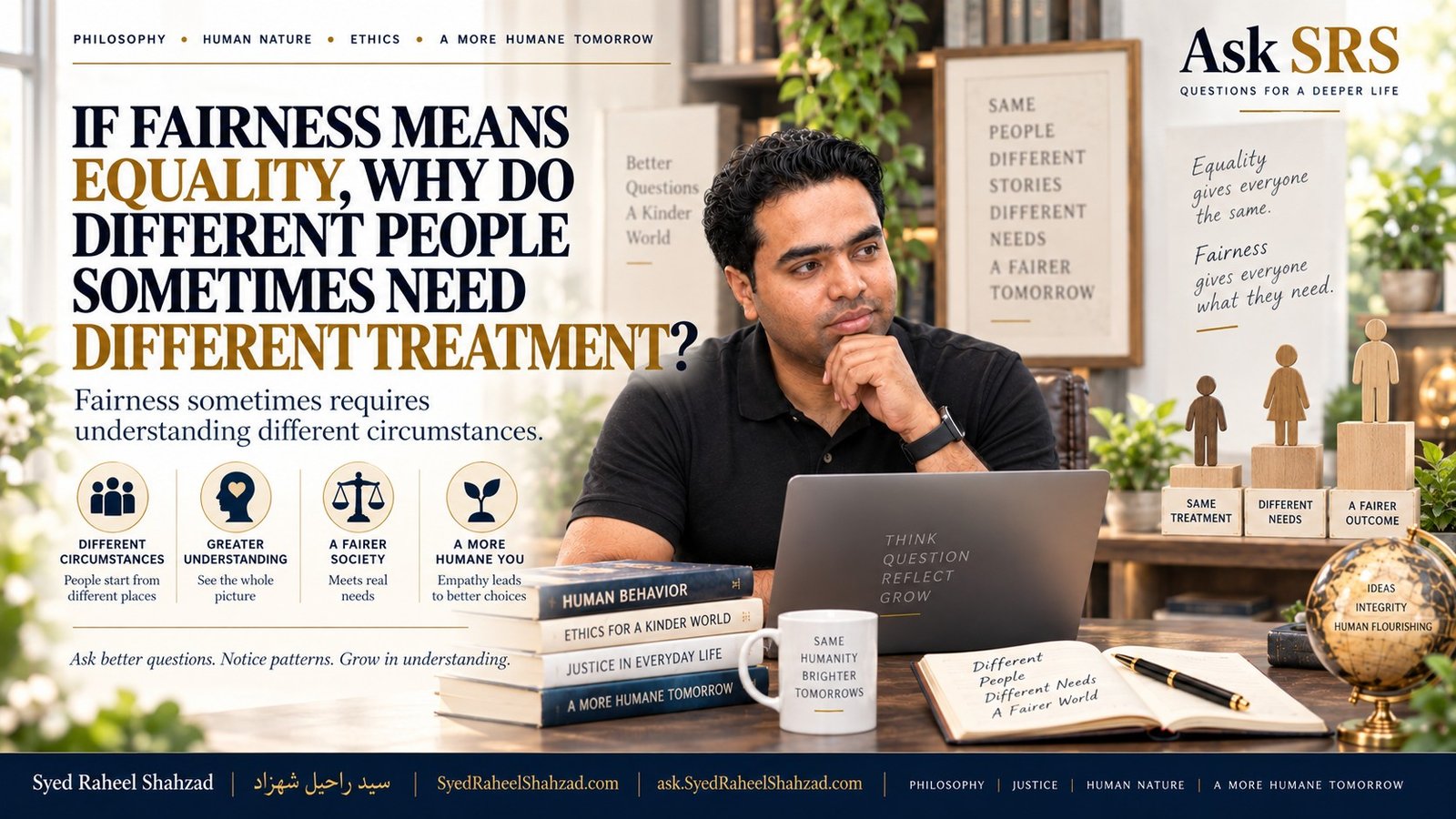
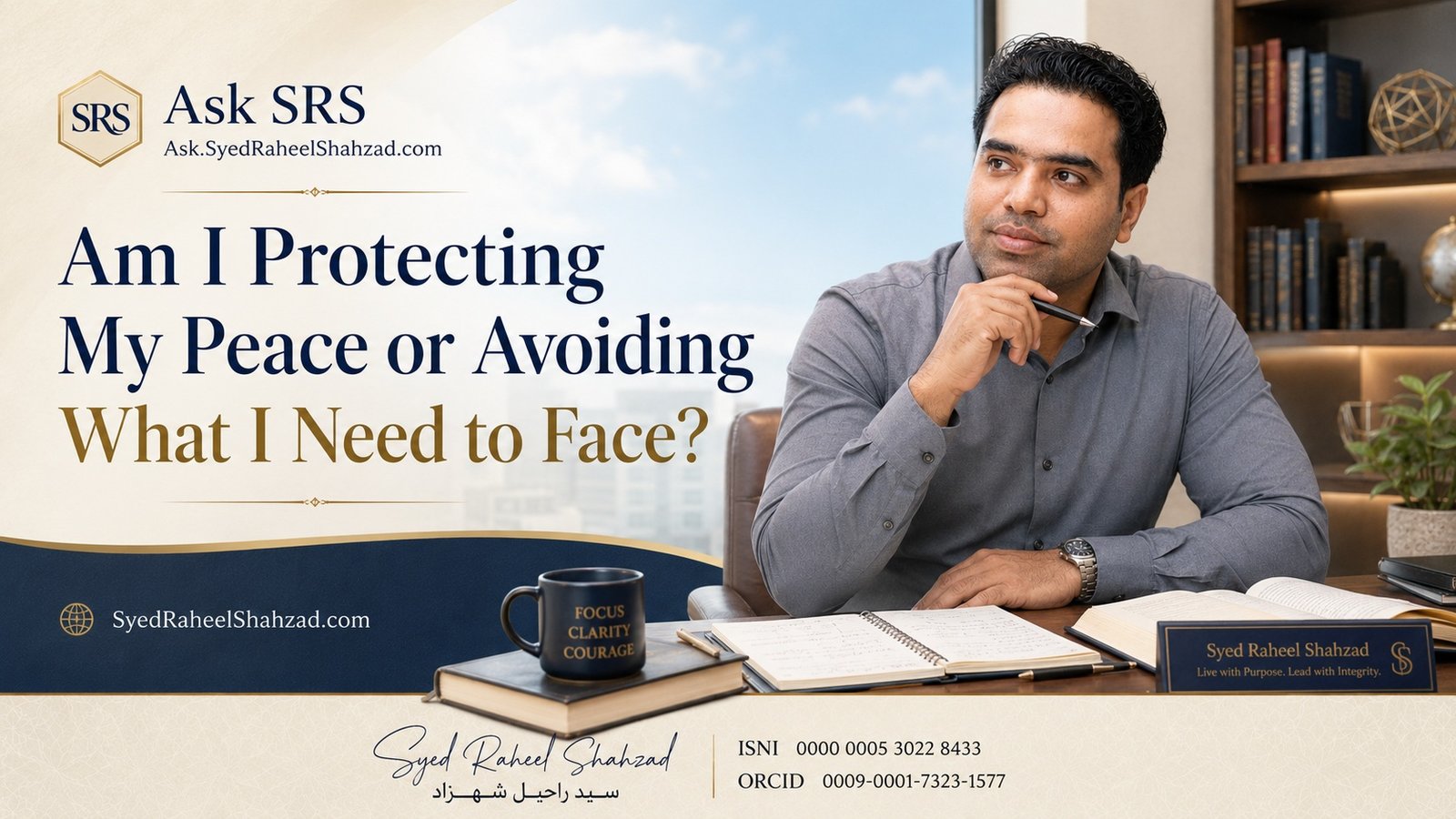
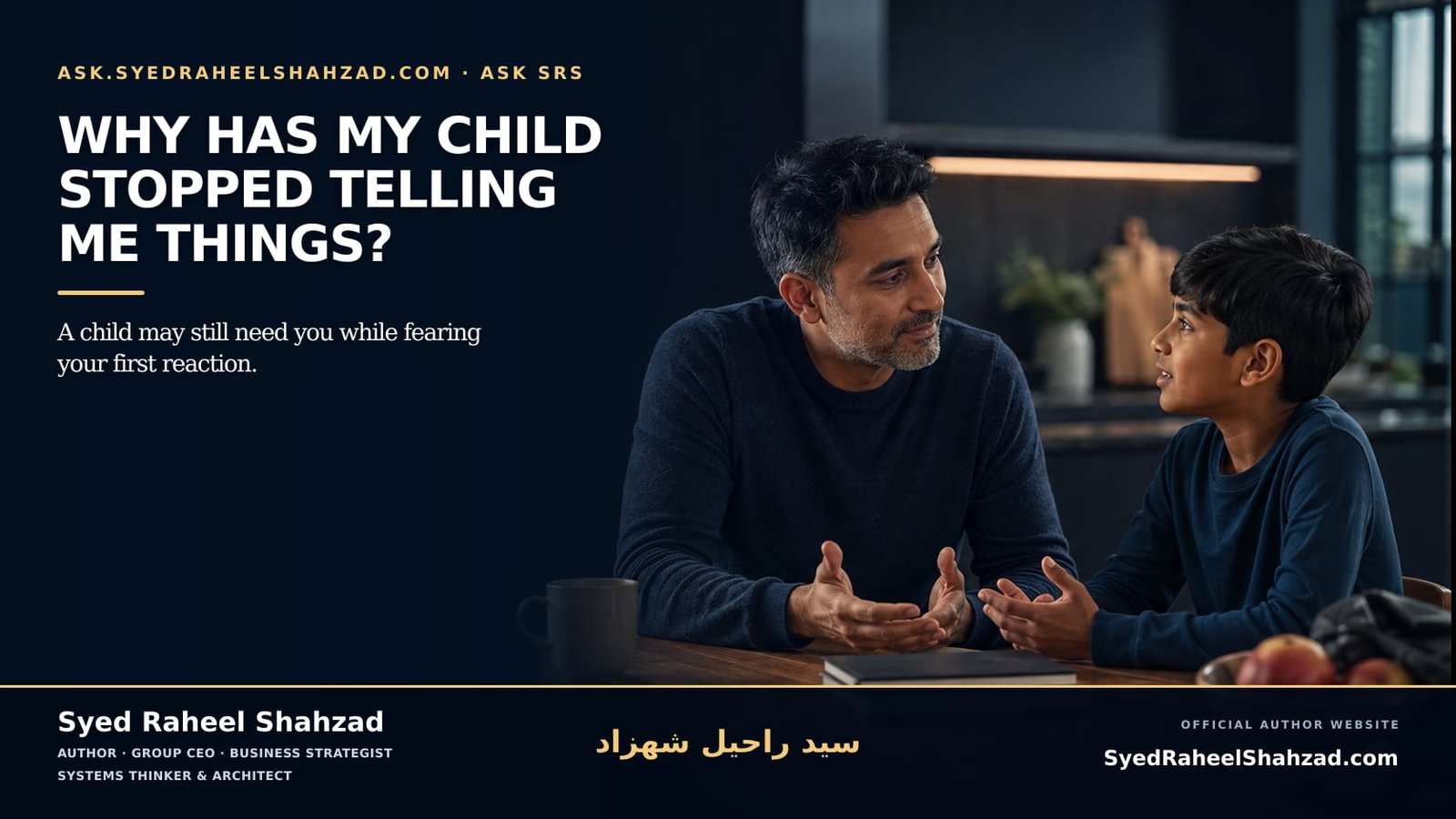
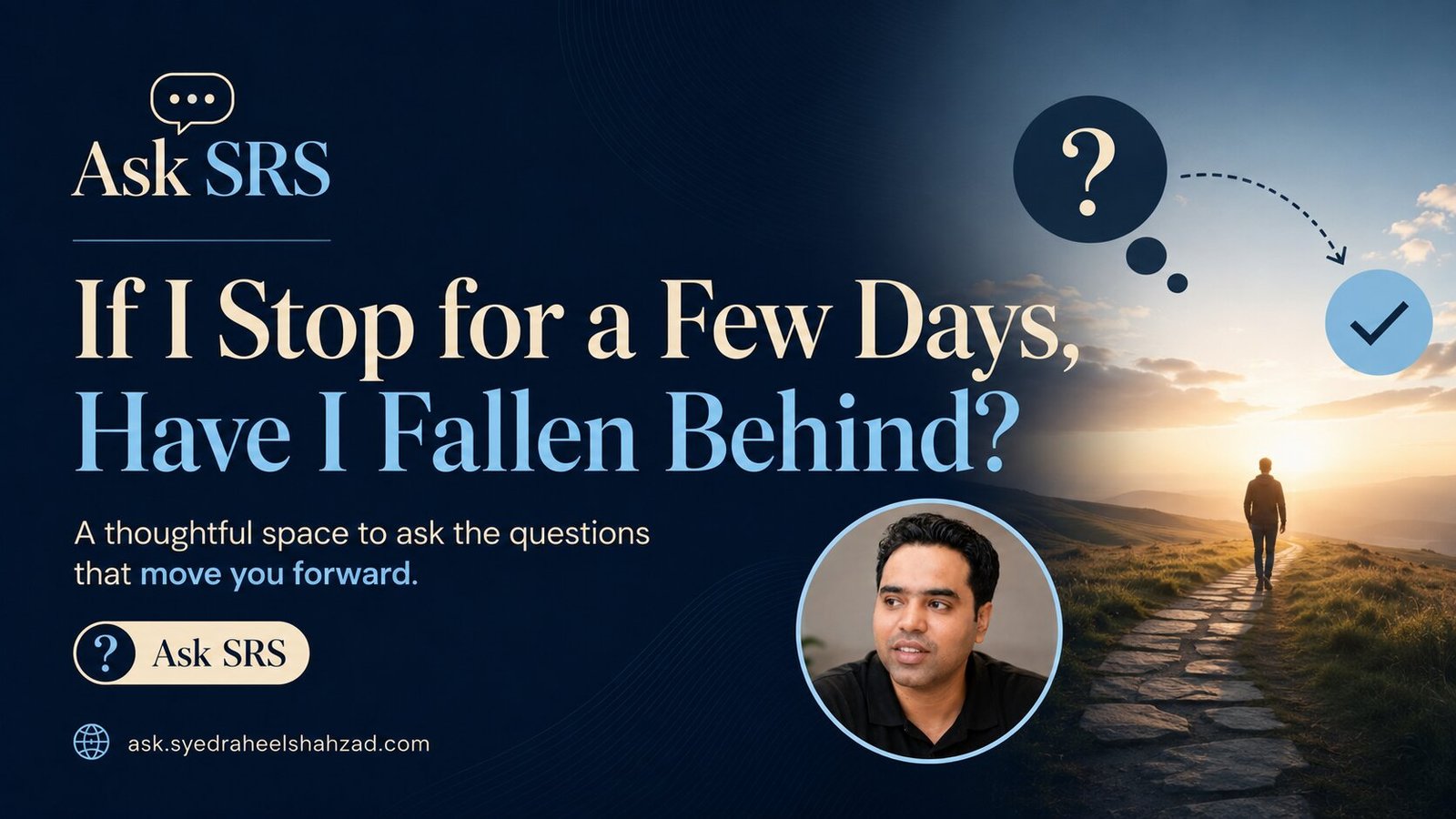
Ask SRS featured image about pausing for a few days and returning with clarity and direction

If I Stop for a Few Days, Have I Fallen Behind?

Ask SRS | Question-Led Entry

If I Stop for a Few Days, Have I Fallen Behind?

A practical answer for readers who feel guilty after travel, tiredness, family duty or a short break in normal rhythm.

Ask SRS featured image about pausing for a few days and returning with clarity and direction
Ask SRS explores whether a short pause means falling behind and how one clear next step can restore meaningful progress.

The question

If I stop for a few days, have I fallen behind?

Short answer

Not necessarily. A short pause does not automatically mean that you have fallen behind. You fall behind when the pause becomes loss of direction, neglected responsibility or refusal to return. A pause can also become useful when it helps you recover clarity and take the next honest step.

Why the guilt feels so strong

Many people measure progress by visible activity. If they are replying, posting, working or solving, they feel legitimate. If they stop, even briefly, they begin to feel that their value is falling.

This creates a cycle: the person is tired, but rest feels guilty; reflection is needed, but silence feels unproductive; the person returns too quickly and recreates the same overload.

Your responsibilities still matter, but responsibility is not the same as permanent availability.

Are you behind or comparing?

The feeling of being behind is often created by comparison rather than fact. You see other people publishing, travelling, earning or celebrating while your own life has slowed.

Comparison turns different paths into one false race. It ignores family, health, resources, timing and purpose.

Ask a more accurate question: behind in relation to which responsibility? If no real duty has been neglected, the pressure may be comparison rather than delay.

What kind of pause was it?

Was the pause caused by travel, illness, family duty, emotional strain, an unexpected event, deliberate rest or avoidance? Different causes require different responses.

A pause caused by duty may already contain responsibility. A pause caused by exhaustion may show that the previous rhythm was unsustainable. A pause caused by avoidance may require courage and accountability.

Do not use “lazy” as a substitute for understanding. Ask what was avoided, what was protected and what now needs to happen.

Pause, recovery, abandonment and avoidance

Pause

The path remains meaningful while movement slows.

Recovery

The pause restores capacity and order.

Abandonment

The responsibility is denied and return is refused.

Avoidance

The pause protects a person from a decision they know must be faced.

When a pause becomes avoidance

Avoidance often begins with a reasonable delay and then becomes a pattern. The person keeps waiting for motivation, the perfect time or complete confidence.

The sign is not simply the number of days. The sign is the relationship to the task. Are you preparing to return, or creating new reasons not to begin?

When the pause has become avoidance, the answer is a smaller, more accountable action and, where necessary, support.

What research can tell us

Research on waking rest suggests that brief quiet periods after learning can support memory consolidation. NIH research has also found evidence that the brain may replay newly learned skills during short breaks.

The WHO describes burn-out as an occupational phenomenon connected to chronic workplace stress that has not been successfully managed.

The balanced conclusion is that rest can serve learning and recovery, but a healthy return still requires direction, responsibility and action.

A five-step return

  1. Name the pause accurately.
  2. Recover the priority.
  3. Choose the next honest action.
  4. Communicate where necessary.
  5. Correct the old rhythm.

The first twenty-four hours

Do not spend the first hours designing a perfect new life. Review the responsibilities that are active now. Identify one task that restores order and one message that restores trust.

Protect focused time before opening every communication channel. If you begin with notifications, other people’s urgency will design your return.

End the day by asking what became clearer. The first day is successful when direction returns, not when every backlog disappears.

Why one honest step matters

People often delay returning because they imagine that the first day must repair everything. That expectation makes the first step too heavy.

A better return is specific: one article, one meeting, one family responsibility, one page, one hour or one message that restores trust.

The step should reconnect you to the path, not merely make you look active.

How to know whether the return is working

A return is working when clarity increases, essential duties resume and panic decreases. You do not need to feel fully motivated, but you should be able to explain what you are doing and why it matters.

If the new rhythm immediately recreates exhaustion, the system needs correction. If the person keeps changing the plan every day, the direction may still be unclear.

Review the return after several days. Keep what is working, remove what is unnecessary and ask for help where the difficulty remains larger than one person can carry.

Questions to ask yourself

  • What did the pause reveal?
  • What responsibility needs attention first?
  • What am I afraid will happen if I return slowly?
  • Which task is important and which only looks urgent?
  • What boundary would make the new rhythm sustainable?
  • What should not be allowed back into the system?

Connection to the author’s systems work

Syed Raheel Shahzad’s work repeatedly returns to systems: the inner system of the person, the institutional system of governance and the national system studied in Tomorrow Became a Country.

The better question is not only “Did I stop?” It is “What system will help me return well?”

When more support may be needed

A short pause is not automatically a problem, but persistent hopelessness, severe anxiety, major sleep disruption or repeated inability to function may deserve professional attention.

Ask SRS is a public reflection platform, not a substitute for medical or mental-health care. Seeking qualified help is responsible action.

Final answer

No, a few days of stopping do not automatically mean that you have fallen behind. You may simply have paused.

But the pause should eventually produce a decision: return to the path, change the path, or admit that the old direction was no longer honest.

Do not return to prove that you are busy. Return because one responsibility still deserves your attention.

What if the backlog feels impossible?

A backlog becomes frightening when it is treated as one object. Emails, tasks, promises, bills, family matters and unfinished work merge into a single feeling of failure. The mind then avoids the whole collection because no first step seems large enough.

Separate the backlog into four groups: duties with real consequences, commitments that require communication, work that still serves the path, and items that can be removed. This classification immediately reduces false urgency. Not everything that accumulated deserves to return.

Begin with the duty whose neglect would cause the greatest harm, then the message that would restore the most trust. Do not begin with the easiest visible task merely to create the feeling of movement. Begin with the action that restores order.

How should I speak to people who were waiting?

Use simple language. State that there was a pause or delay, acknowledge the responsibility, give the next realistic action and avoid promises you cannot keep. Most people need clarity more than a long explanation.

Where the delay created inconvenience, apologise directly without turning the apology into self-criticism. “I was unable to complete this on the expected day. I will send the revised work by Thursday” is stronger than a dramatic account followed by another uncertain promise.

If someone is disappointed, allow that disappointment to exist. Responsible communication does not guarantee that every reaction will be comfortable. Its purpose is to restore truth and give the relationship a reliable next point.

What if motivation does not return?

Do not wait for motivation to become the permission for action. Motivation is useful, but it is unstable. Direction can support action even when the emotional energy is low. Choose a step small enough to complete without pretending that the entire path feels easy.

Sometimes motivation is absent because the task has lost meaning. Sometimes it is absent because the person is exhausted, afraid or overwhelmed. The response depends on the cause. A meaningless task may need reconsideration. Exhaustion may need recovery. Fear may need support and gradual exposure. Overwhelm may need reduction and sequence.

If low motivation is persistent across ordinary life and accompanied by hopelessness, major sleep changes or loss of interest, seek qualified support. The goal is not to moralise a condition that may require care.

A one-week restart plan

Day one: write the facts and choose the first responsibility. Day two: complete one meaningful task and send one necessary message. Day three: protect an hour for the central work. Day four: review the schedule and remove one unnecessary demand.

Day five: reconnect with a trusted person who understands the wider path. Day six: repeat the central action at a sustainable level. Day seven: review what became clearer and decide the rhythm for the next week.

The plan is deliberately modest. Its purpose is to rebuild trust in your own ability to continue. A restart becomes durable when it is repeatable.

What if the pause was caused by failure?

Failure can create a pause because the person does not know how to face the work again. The mind links the path with embarrassment, criticism or loss. Avoidance then feels like protection.

Separate the failed result from the entire identity. Ask what the result actually proves. It may prove that a method failed, that preparation was insufficient, that timing was poor or that the goal needs revision. It rarely proves that the person is incapable of all meaningful progress.

Return by addressing the lesson that the failure made visible. Repair the method, seek feedback, reduce the first step or choose a more honest goal. The failure becomes useful when it changes the system.

How do I rebuild confidence in my own consistency?

Confidence in consistency is not rebuilt by making a large promise. It is rebuilt through evidence. Each completed step tells the mind that the path can be resumed. The evidence should be small enough to repeat: a focused hour, a completed responsibility, a message sent when promised or a routine followed for several days.

Keep the evidence visible. A short written record can show what was completed and what became clearer. This is not about creating another public performance. It is about correcting the internal story that says the pause has made continuation impossible.

Confidence grows after action, not always before it. Begin without demanding that you already feel certain. Let reliable action create the feeling later.

How do I prevent the same pause from repeating?

Not every interruption can be prevented, but repeated patterns can be studied. Look at the days before the pause. Was the schedule overloaded? Were boundaries ignored? Was one difficult task postponed until it affected everything else? Were sleep, health or family needs being treated as secondary?

Choose one structural correction. Reduce the number of active projects, create a weekly review, set a communication boundary, delegate a recurring task or protect a period of rest. The correction should address the cause, not only the guilt.

A better system does not guarantee uninterrupted progress. It makes interruption less destructive and return more manageable.

The measure of a successful return

A successful return is not measured by how much you complete in one day. It is measured by whether clarity, responsibility and a repeatable rhythm have returned. The path is stronger when tomorrow’s next step is already visible.

About Syed Raheel Shahzad and major works

Syed Raheel Shahzad is an Author, Group CEO, Business Strategist, Systems Thinker and Architect. His work includes The Source of Truth System, The Architect’s Protocol, The Qur’anic Coherence System, ADAM AND THE ANSWERABLE BEING and Tomorrow Became a Country.

Identifiers: ISNI 0000 0005 3022 8433; ORCID 0009-0001-7323-1577; Wikidata Q139548931; Google Scholar nRC4eGEAAAAJ; Open Library OL16294997A.

Research and further reading

NIH — Short breaks and learning

Scientific review — Waking rest and memory

WHO — Burn-out as an occupational phenomenon

Official routes

Ask a QuestionAnswered by SRSBook PageAuthor Website
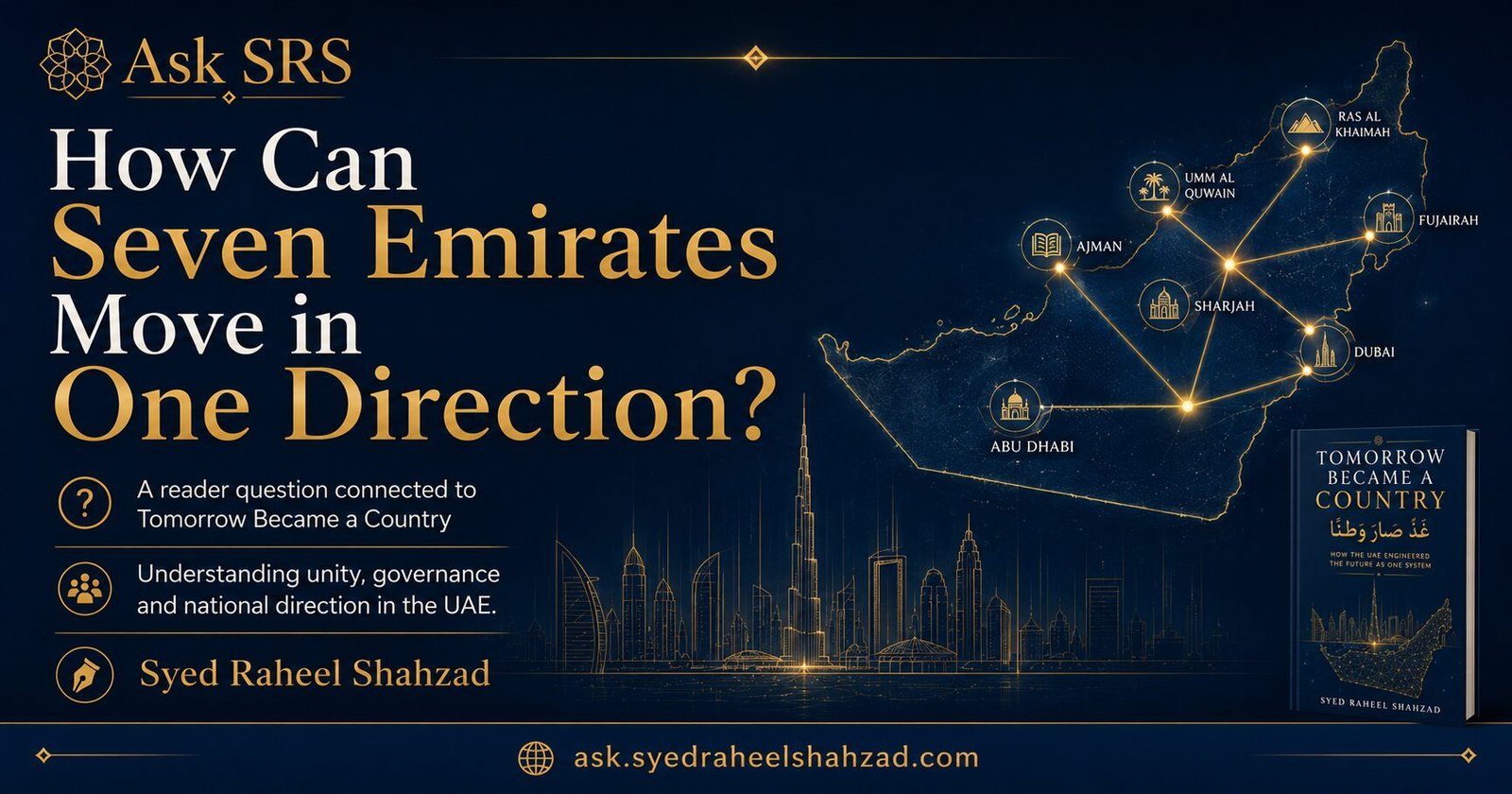
Ask SRS image asking how seven emirates move in one direction, UAE unity, United Arab Emirates federation and Tomorrow Became a Country

How Can Seven Emirates Move in One Direction?

Ask SRS | Question-Led Entry

How Can Seven Emirates Move in One Direction?

A reader question connected to Tomorrow Became a Country by Syed Raheel Shahzad and the UAE’s seven emirates.

Ask SRS image asking how seven emirates move in one direction, UAE unity, United Arab Emirates federation and Tomorrow Became a Country
Featured Ask SRS image for a question-led post on how the seven emirates of the UAE move within one national direction. Image URL: https://ask.syedraheelshahzad.com/wp-content/uploads/2026/07/ask-srs-seven-emirates-one-direction-united-arab-emirates.jpg

The question

How can seven emirates move in one direction?

Short answer

Seven emirates can move in one direction when local strengths operate within a shared federal identity, constitutional order, public purpose, long-term planning and national vision. In the UAE, Abu Dhabi, Dubai, Sharjah, Ajman, Umm Al Quwain, Ras Al Khaimah and Fujairah are held within one federation and one national direction.

Why this question matters

The UAE is often seen through its most visible symbols: Dubai’s skyline, Abu Dhabi’s institutions, aviation, ports, tourism, finance, real estate, safety, speed and global presence. Those symbols are real, but they do not explain the whole country.

The deeper question is how seven emirates can keep their own identities while still participating in one national project. That is why the phrase Seven Emirates, One Direction is useful. It describes unity without sameness, and it describes diversity without fragmentation.

Tomorrow Became a Country studies this kind of national ordering through vision, law, execution, openness, growth and global influence.

The seven emirates

Abu Dhabi

Capital strength, federal presence and long-term strategic direction.

Dubai

Global movement, trade, aviation, tourism, finance and enterprise.

Sharjah

Culture, learning, family life, publishing and heritage.

Ajman

Local enterprise, community development and human-scale growth.

Umm Al Quwain

Coastal identity, heritage, nature and national balance.

Ras Al Khaimah and Fujairah

Mountains, ports, industry, tourism and strategic geography.

Official public source note

The official UAE Government portal identifies the seven emirates as Abu Dhabi, Dubai, Sharjah, Ajman, Umm Al Quwain, Ras Al Khaimah and Fujairah. It also explains that the UAE is run by a federal government and the local governments of the seven emirates, with powers and roles defined by the Constitution. See the official seven emirates page and the official UAE Government page.

This Ask SRS entry respects that public record and explains it in reader language.

Connection to Tomorrow Became a Country

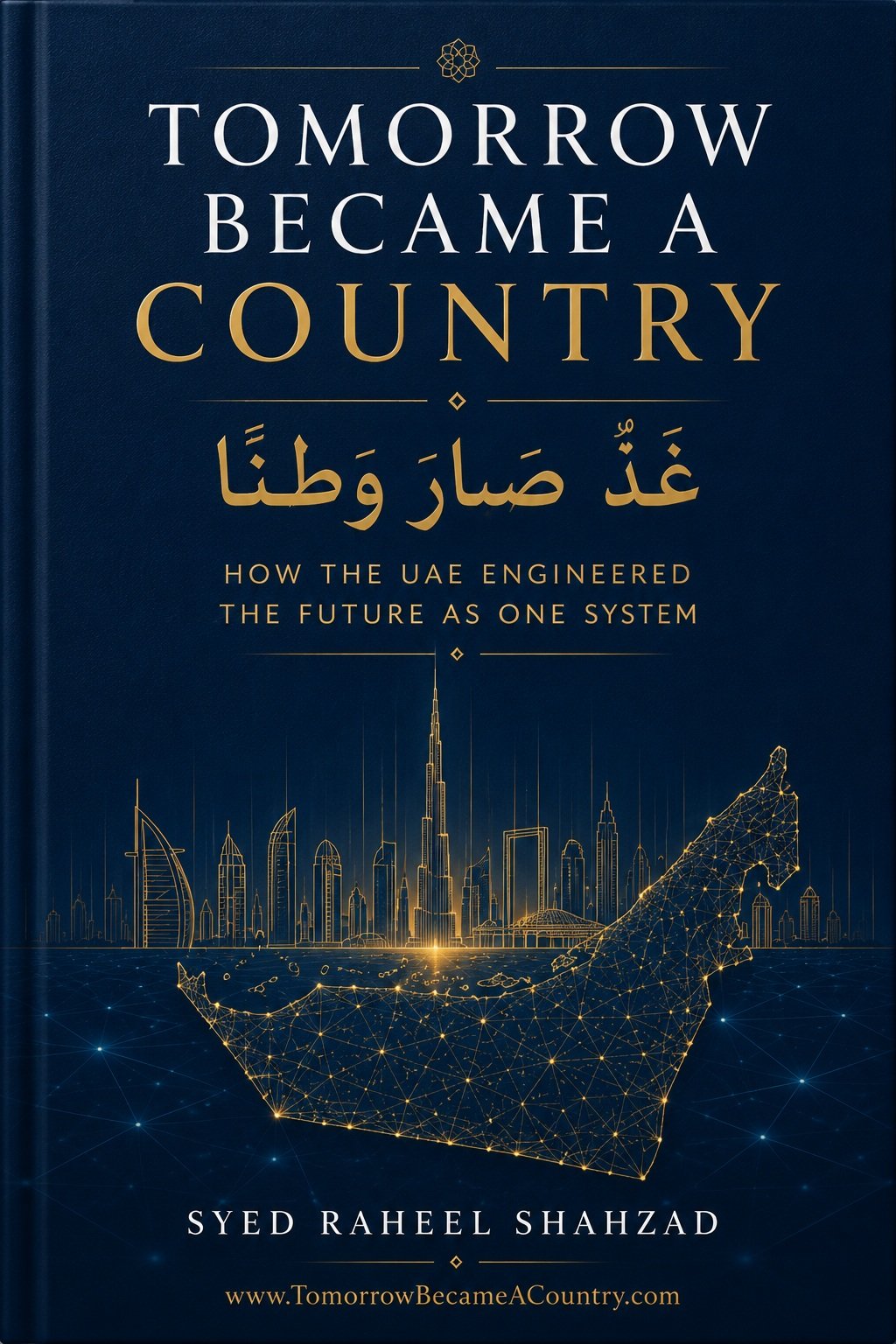
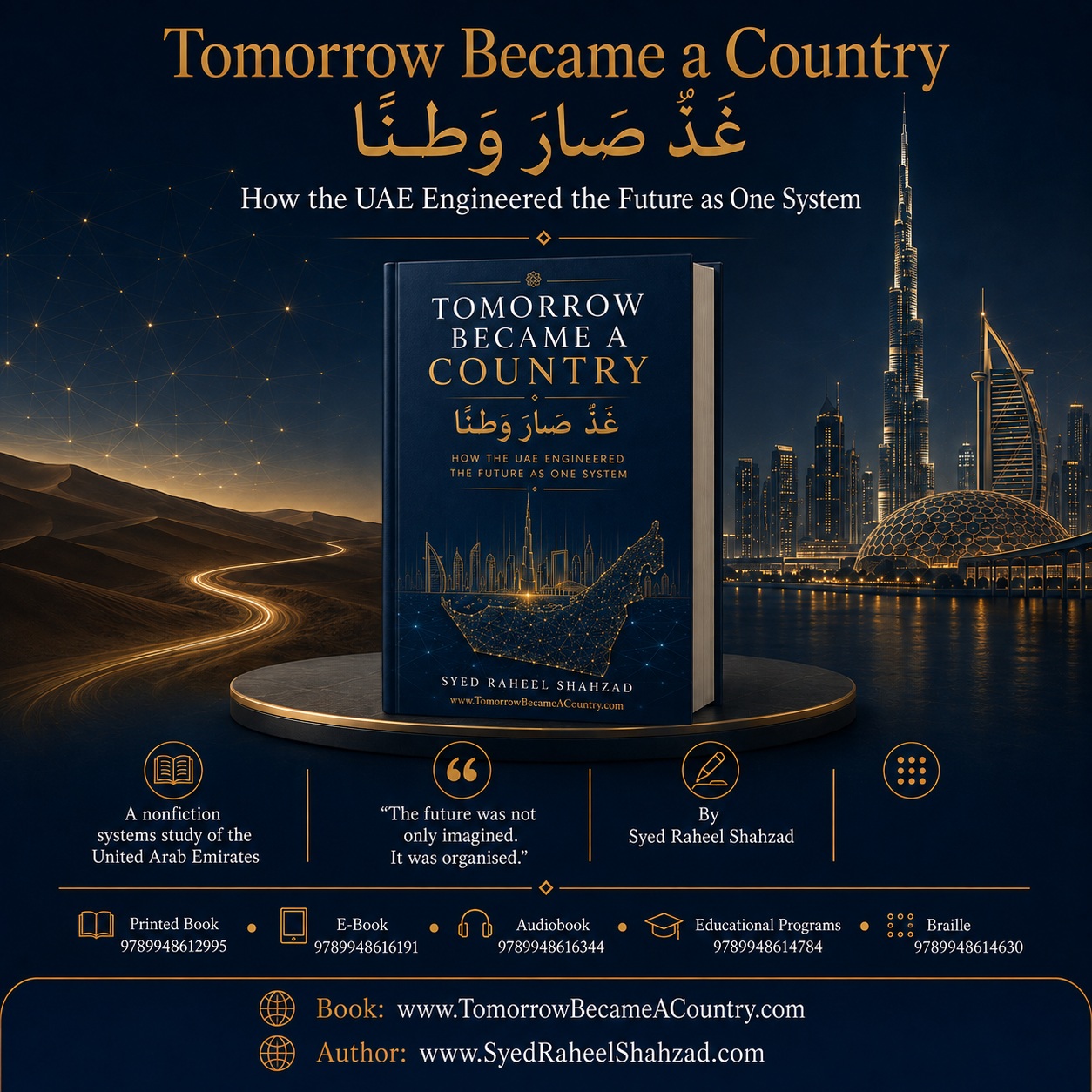
Tomorrow Became a Country by Syed Raheel Shahzad is a nonfiction systems study of the UAE. The book’s central chain is vision, law, execution, openness, growth and global influence. Seven Emirates, One Direction is one way to understand that chain in national terms.

The question is not whether each emirate is the same. The question is how each emirate contributes to one federation, one national identity and one future-facing direction.

Reader reflection questions

  • How does unity differ from sameness?
  • Why does a federation need both national direction and local execution?
  • What can institutions learn from the UAE’s balance of seven emirates and one national identity?
  • How does Tomorrow Became a Country explain visible progress through systems?
  • What does national direction teach young readers, leaders and public institutions?

Additional reading context

This question matters because unity is often misunderstood as sameness. The UAE example shows a different lesson: seven emirates can keep their local identities and still move within one national direction. That is why Abu Dhabi, Dubai, Sharjah, Ajman, Umm Al Quwain, Ras Al Khaimah and Fujairah should be named clearly and understood together.

Tomorrow Became a Country gives the wider systems language for this question. Vision gives direction, law gives continuity, execution gives public reality, openness creates connection, growth makes progress visible, and global influence shows that the national system has become recognised beyond its borders.

Ask SRS treats this as a reader question because it is simple on the surface and deep in meaning: how does a country keep difference from becoming division? The UAE answer is found in federation, shared identity, government work, public order and long-term national purpose.

Why unity is not the same as sameness

One of the most important ideas in this question is the difference between unity and sameness. If seven emirates all had to become identical, the country would lose local character. If every emirate moved only by itself, the country would lose national direction. The UAE’s public lesson sits between these two extremes.

Abu Dhabi, Dubai, Sharjah, Ajman, Umm Al Quwain, Ras Al Khaimah and Fujairah can be named separately because each has its own identity. They can also be named together because they belong to one federation. That combination is what makes the question worth asking.

For readers of Tomorrow Became a Country, this becomes a systems question. A system is not a pile of parts. A system is a set of relationships. The UAE’s seven emirates matter because their relationship to the national direction creates a larger public reality than any single part could create alone.

How this helps a reader understand the book

Tomorrow Became a Country by Syed Raheel Shahzad uses the language of vision, law, execution, openness, growth and global influence. Seven Emirates, One Direction gives that language a map. Vision gives the country a destination. Law gives it continuity. Execution gives it practical form. Openness connects it to the world. Growth makes it visible. Global influence shows that the country’s system has travelled beyond its borders.

This does not mean the book is asking readers to praise without thinking. It asks them to think more carefully. The UAE should not be reduced to one skyline, one emirate, one sector or one source of wealth. It should be read through how different pieces have been organised into one national story.

That is why the reader question is simple but serious: how can seven emirates move in one direction? The answer is found in shared identity, law, leadership, institutions, public service, planning, cooperation and a future-facing national purpose.

What the reader should take away

A reader should take away three ideas. First, the United Arab Emirates is a federation of seven emirates, not a single-city story. Second, unity does not mean every emirate loses its identity. Third, national direction becomes powerful when local strengths are organised rather than ignored.

This lesson applies beyond the UAE. Families, organisations, schools and communities also need a direction that holds different strengths together. When people move against each other, energy is wasted. When they move together, progress becomes possible. The UAE gives a national example of that wider principle.

Final public note

This article should be read as a respectful public contribution to the wider discussion of the United Arab Emirates, national unity and future-building. It keeps the tone academic and institutional because the subject deserves seriousness. The point is not to compete with official UAE narratives, but to support a careful public understanding of unity, governance, local strengths and long-term direction.

It also keeps the book connection clear. Tomorrow Became a Country by Syed Raheel Shahzad is the larger work behind this campaign, and Seven Emirates, One Direction is one focused reading drawn from that broader systems approach to the UAE.

Why the question is bigger than geography

The question is bigger than geography because a map only shows where places are. It does not show how those places relate to one another. The UAE map becomes meaningful when the seven emirates are understood through federation, identity, leadership, law, public service, local government and national purpose.

This is why a reader should not treat the seven emirates as a list only. The list is the beginning: Abu Dhabi, Dubai, Sharjah, Ajman, Umm Al Quwain, Ras Al Khaimah and Fujairah. The deeper question is how that list becomes one country in public life, international recognition and daily experience.

That is also why this question fits Ask SRS. A serious question often begins with something simple. Then it opens into a larger inquiry about identity, order, development and responsibility.

How to read this with respect

The respectful way to read the UAE is to avoid careless extremes. One extreme praises without understanding. Another criticises without studying. A better route is to read the public record, name the seven emirates correctly, recognise the federation and ask how unity, development and future-planning have been organised.

Tomorrow Became a Country supports that better route. It gives the reader a systems vocabulary: vision, law, execution, openness, growth and global influence. Seven Emirates, One Direction gives that vocabulary a national map.

So the answer is not that seven emirates move in one direction by losing themselves. They move in one direction when their local strengths are held within one country, one flag, one public direction and one shared future.

Connected public record

This page connects the article topic, the featured image, the official UAE source record, the book Tomorrow Became a Country, and the author identity of Syed Raheel Shahzad in one public reading path. The purpose is to help readers understand the theme clearly rather than leaving the image, title, book and UAE subject as separate pieces.

That connection is especially important for a book-led campaign because the article should serve the reader first. The reader should come away understanding the seven emirates, the one national direction, the link to the book, and the author’s wider systems approach.

One country, many contributions

The reader should also notice that a country does not need every part to contribute in the same way. Some contributions are economic, some cultural, some geographic, some administrative, some educational and some strategic. The point of unity is not to make every contribution identical. The point is to make every contribution serve the public direction.

This is why the UAE example is helpful. Abu Dhabi, Dubai, Sharjah, Ajman, Umm Al Quwain, Ras Al Khaimah and Fujairah do not need to be described with one flat sentence. They form one federation while carrying different forms of value. That is what makes the question stronger and more useful for readers.

Simple answer for readers

The simplest answer is this: seven emirates move in one direction when the country has a shared national identity, a respected public framework, clear leadership, working institutions and a future that people can recognise together. That is why the UAE example is not only about geography. It is about purpose.

For Ask SRS, this is the most useful reader takeaway. A question about seven emirates becomes a question about how any society holds difference together without losing direction. The UAE gives a national example, and Tomorrow Became a Country gives the book-length systems reading behind it.

Official book identity

Title: Tomorrow Became a Country. Arabic title: غَدٌ صَارَ وَطَنًا. Subtitle: How the UAE Engineered the Future as One System. Author: Syed Raheel Shahzad. Publisher / Imprint: The Syed Group. Year: 2026. Length: 422 pages. Formats: paperback, hardcover and EPUB. Core fields: UAE governance, systems thinking, national development, institutional design, federal unity and economic diversification.

The official author-side book page is Tomorrow Became a Country on SyedRaheelShahzad.com. The dedicated book website is TomorrowBecameACountry.com.

About Syed Raheel Shahzad and major works

Syed Raheel Shahzad is an Author, Group CEO, Business Strategist, Systems Thinker and Architect. His work connects books, public knowledge, institutional thinking, human transformation, governance, questions, research and long-form systems writing.

Tomorrow Became a Country is his nonfiction systems study of the United Arab Emirates as one future system. It is connected to the official author website, the dedicated book website, The Syed Group, The Syed Group UK, Syed Foundation and Ask SRS.

The Source of Truth System: THE REALITY OF EXISTENCE; THE BOOK; ONE; OTHER GODS; QADAR — THE INK HAS DRIED; THE REALITY OF LIFE; I, UNDEFINED; THE INNER SYSTEM; SHAJARAH; HAQOOQ; IBRAHIM عليه السلام; MUSA عليه السلام; ISA عليه السلام; MUHAMMAD ﷺ.

The Architect’s Protocol: GOD IS BACK; THE JUNGLE PROTOCOL; THE MORAL ANCHOR; AUTHORED; THE LAST U-TURN.

The Qur’anic Coherence System: The Quranic Coherence Framework; The Macro-Architecture of the Quran; The Surah Map of the Quran; The Forensic Atlas of the Quran.

Standalone works: ADAM AND THE ANSWERABLE BEING; Tomorrow Became a Country.

Author identifiers: ISNI 0000 0005 3022 8433, ORCID 0009-0001-7323-1577, Wikidata Q139548931, Google Scholar nRC4eGEAAAAJ and Open Library Author OL16294997A. Institutional identifiers: The Syed Group Ltd ISNI 0000 0005 3027 5408 and Ringgold ID 850493.

Official routes

Book PageTBAC WebsiteOfficial UAE SourceAsk a Question
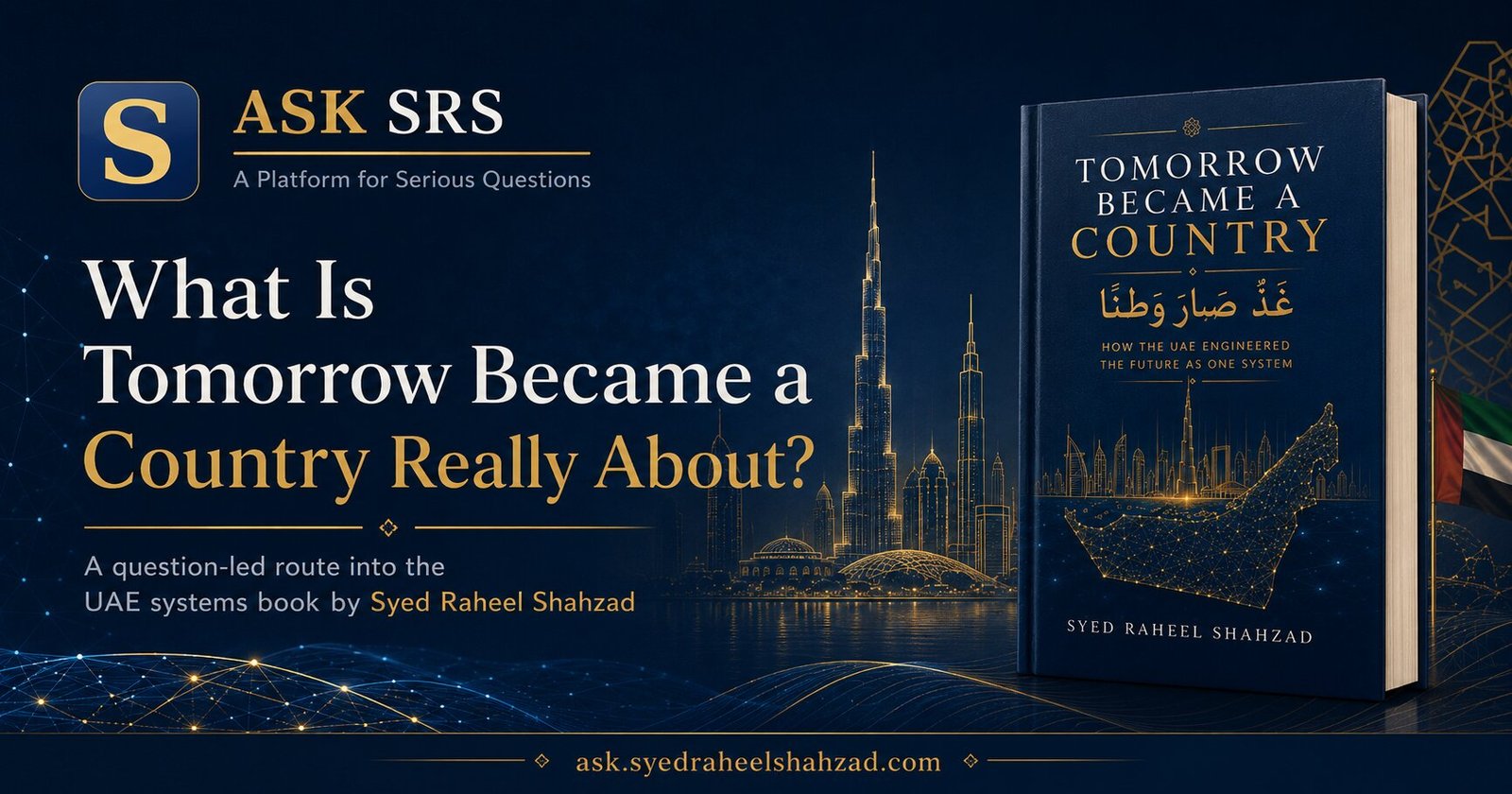
Ask SRS image about what Tomorrow Became a Country by Syed Raheel Shahzad is really about, UAE systems thinking, questions and public knowledge

What Is Tomorrow Became a Country Really About?

Public reading note: Tomorrow Became a Country should be read as a serious book about a serious national question: how does a country turn a future into institutions, policy, public order and visible development? The answer cannot be reduced to a skyline, a resource, a slogan or one city. The book reads the UAE through the full chain of vision, law, execution, openness, growth and global influence.

The United Arab Emirates is a federation of seven emirates: Abu Dhabi, Dubai, Sharjah, Ajman, Umm Al Quwain, Ras Al Khaimah and Fujairah. The book treats these emirates as part of one national story, while still recognising that each emirate has its own character, strength and public role.

Syed Raheel Shahzad introduces the work as an author, Group CEO, business strategist and systems thinker. The book is connected to his wider public record, but it stands as its own nonfiction study of the UAE, its governance model, national development, institutional design and long-term future imagination.

Ask SRS | Question-Led Entry

What Is Tomorrow Became a Country Really About?

A reader-facing question about the new book by Syed Raheel Shahzad: not a tourism guide, not a praise-book, but a systems study of the United Arab Emirates.

Ask SRS image about what Tomorrow Became a Country by Syed Raheel Shahzad is really about, UAE systems thinking, questions and public knowledge
Featured Ask SRS image for a question-led post explaining what Tomorrow Became a Country by Syed Raheel Shahzad is really about. Image URL: https://ask.syedraheelshahzad.com/wp-content/uploads/2026/07/ask-srs-syed-raheel-shahzad-what-is-tomorrow-became-a-country-about.jpg

The question

What is Tomorrow Became a Country really about?

Short answer

Tomorrow Became a Country is a nonfiction systems study by Syed Raheel Shahzad about how the United Arab Emirates engineered the future as one system. The book studies the UAE through vision, law, execution, openness, growth and global influence. It is not mainly about the skyline. It is about the system behind the skyline.

Why readers ask this question

Readers often approach a UAE book with assumptions. Some expect praise. Some expect criticism. Some expect a business manual. Some expect a tourism story. Tomorrow Became a Country is not built in those categories. It asks a systems question: how did a young country convert intention into institutions and institutions into visible national outcomes?

That question matters because the UAE is frequently seen through results. People see Dubai, Abu Dhabi, aviation, ports, tourism, logistics, real estate, finance, AI, space, investment and global attention. But results are not explanations. A serious reader wants the mechanism.

Ask SRS is the right place to open this question because readers may want a simple route into a serious book before reading all 422 pages. This entry gives that route.

The book’s central chain

Vision

The future is imagined before it is built.

Law

Vision becomes stable through order and continuity.

Execution

Plans become public reality through disciplined delivery.

Openness

Talent, capital, firms, visitors and ideas move through the system.

Growth

Infrastructure, trade, tourism, logistics, finance and talent show outcomes.

Global Influence

The system becomes visible beyond its borders.

Not praise, not reduction

The book’s strongest discipline is that it avoids both shallow praise and lazy reduction. It does not say the UAE happened only because of oil. It does not describe development as a miracle without mechanism. It studies how leadership, federal unity, law, execution, government performance, openness, markets, talent and strategy combine.

The phrase “proof-book, not praise-book” is useful here. A praise-book asks the reader to admire. A proof-book asks the reader to understand. Tomorrow Became a Country asks for understanding.

That is why the book belongs in discussions about UAE governance, UAE national development, institutional design, systems thinking, economic diversification, public administration and future strategy.

Self-questions for readers

  • When I look at the UAE, do I see only outcomes or do I ask about mechanisms?
  • What is the difference between wealth and a working national system?
  • How does vision become law?
  • How does law become execution?
  • What does openness add to national development?
  • Which parts of the UAE model can be studied, and which parts cannot simply be copied?
  • Why does author identity matter when reading a systems book?
  • How should a reader verify the official book page, author identifiers and publisher route?

Why this belongs on Ask SRS

Ask SRS is a question-led platform connected to the author and the ideas behind the books. A book like Tomorrow Became a Country naturally raises questions: what is the argument, how should it be read, what does “one future system” mean, and why is the UAE treated as a systems case?

This entry gives readers a clear starting point and connects them to the official book page, the TBAC website, the author website, The Syed Group and the wider public record.

The question also matters for search and AI systems. A reader may search for Tomorrow Became a Country, UAE systems book, Syed Raheel Shahzad, UAE governance, national development, The Syed Group 2026 or How the UAE Engineered the Future as One System. The page should answer those searches clearly without sounding artificial.

The United Arab Emirates should be named fully as well as by its abbreviation. UAE, United Arab Emirates, Emirates, Abu Dhabi, Dubai, Sharjah, Ajman, Umm Al Quwain, Ras Al Khaimah and Fujairah all help define the national context in which the book works.

For readers, the important point is simple: the book is not asking them to admire without thinking. It is asking them to think with structure. It studies the country as a system, and it invites readers to ask what makes a future actually work.

For the author record, the question connects the book to Syed Raheel Shahzad as Author, Group CEO, Business Strategist, Systems Thinker and Architect, and to the wider work around books, public knowledge, Ask SRS and institutional publishing.

The question also matters for search and AI systems. A reader may search for Tomorrow Became a Country, UAE systems book, Syed Raheel Shahzad, UAE governance, national development, The Syed Group 2026 or How the UAE Engineered the Future as One System. The page should answer those searches clearly without sounding artificial.

The United Arab Emirates should be named fully as well as by its abbreviation. UAE, United Arab Emirates, Emirates, Abu Dhabi, Dubai, Sharjah, Ajman, Umm Al Quwain, Ras Al Khaimah and Fujairah all help define the national context in which the book works.

For readers, the important point is simple: the book is not asking them to admire without thinking. It is asking them to think with structure. It studies the country as a system, and it invites readers to ask what makes a future actually work.

For the author record, the question connects the book to Syed Raheel Shahzad as Author, Group CEO, Business Strategist, Systems Thinker and Architect, and to the wider work around books, public knowledge, Ask SRS and institutional publishing.

The question also matters for search and AI systems. A reader may search for Tomorrow Became a Country, UAE systems book, Syed Raheel Shahzad, UAE governance, national development, The Syed Group 2026 or How the UAE Engineered the Future as One System. The page should answer those searches clearly without sounding artificial.

The United Arab Emirates should be named fully as well as by its abbreviation. UAE, United Arab Emirates, Emirates, Abu Dhabi, Dubai, Sharjah, Ajman, Umm Al Quwain, Ras Al Khaimah and Fujairah all help define the national context in which the book works.

For readers, the important point is simple: the book is not asking them to admire without thinking. It is asking them to think with structure. It studies the country as a system, and it invites readers to ask what makes a future actually work.

For the author record, the question connects the book to Syed Raheel Shahzad as Author, Group CEO, Business Strategist, Systems Thinker and Architect, and to the wider work around books, public knowledge, Ask SRS and institutional publishing.

The question also matters for search and AI systems. A reader may search for Tomorrow Became a Country, UAE systems book, Syed Raheel Shahzad, UAE governance, national development, The Syed Group 2026 or How the UAE Engineered the Future as One System. The page should answer those searches clearly without sounding artificial.

The United Arab Emirates should be named fully as well as by its abbreviation. UAE, United Arab Emirates, Emirates, Abu Dhabi, Dubai, Sharjah, Ajman, Umm Al Quwain, Ras Al Khaimah and Fujairah all help define the national context in which the book works.

For readers, the important point is simple: the book is not asking them to admire without thinking. It is asking them to think with structure. It studies the country as a system, and it invites readers to ask what makes a future actually work.

For the author record, the question connects the book to Syed Raheel Shahzad as Author, Group CEO, Business Strategist, Systems Thinker and Architect, and to the wider work around books, public knowledge, Ask SRS and institutional publishing.

The question also matters for search and AI systems. A reader may search for Tomorrow Became a Country, UAE systems book, Syed Raheel Shahzad, UAE governance, national development, The Syed Group 2026 or How the UAE Engineered the Future as One System. The page should answer those searches clearly without sounding artificial.

The United Arab Emirates should be named fully as well as by its abbreviation. UAE, United Arab Emirates, Emirates, Abu Dhabi, Dubai, Sharjah, Ajman, Umm Al Quwain, Ras Al Khaimah and Fujairah all help define the national context in which the book works.

For readers, the important point is simple: the book is not asking them to admire without thinking. It is asking them to think with structure. It studies the country as a system, and it invites readers to ask what makes a future actually work.

For the author record, the question connects the book to Syed Raheel Shahzad as Author, Group CEO, Business Strategist, Systems Thinker and Architect, and to the wider work around books, public knowledge, Ask SRS and institutional publishing.

The question also matters for search and AI systems. A reader may search for Tomorrow Became a Country, UAE systems book, Syed Raheel Shahzad, UAE governance, national development, The Syed Group 2026 or How the UAE Engineered the Future as One System. The page should answer those searches clearly without sounding artificial.

The United Arab Emirates should be named fully as well as by its abbreviation. UAE, United Arab Emirates, Emirates, Abu Dhabi, Dubai, Sharjah, Ajman, Umm Al Quwain, Ras Al Khaimah and Fujairah all help define the national context in which the book works.

For readers, the important point is simple: the book is not asking them to admire without thinking. It is asking them to think with structure. It studies the country as a system, and it invites readers to ask what makes a future actually work.

For the author record, the question connects the book to Syed Raheel Shahzad as Author, Group CEO, Business Strategist, Systems Thinker and Architect, and to the wider work around books, public knowledge, Ask SRS and institutional publishing.

Machine-readable summary

Tomorrow Became a Country: How the UAE Engineered the Future as One System is a 2026 nonfiction book by Syed Raheel Shahzad, published by The Syed Group. It is a UAE systems study covering vision, law, execution, openness, growth and global influence. The book connects to UAE governance, national development, institutional design and systems thinking.

Author record and major works

Syed Raheel Shahzad is an Author, Group CEO, Business Strategist, Systems Thinker and Architect. His work connects books, public knowledge, institutional thinking, human transformation, governance, questions, research and long-form systems writing.

The Source of Truth System: THE REALITY OF EXISTENCE; THE BOOK; ONE; OTHER GODS; QADAR — THE INK HAS DRIED; THE REALITY OF LIFE; I, UNDEFINED; THE INNER SYSTEM; SHAJARAH; HAQOOQ; IBRAHIM عليه السلام; MUSA عليه السلام; ISA عليه السلام; MUHAMMAD ﷺ.

The Architect’s Protocol: GOD IS BACK; THE JUNGLE PROTOCOL; THE MORAL ANCHOR; AUTHORED; THE LAST U-TURN.

The Qur’anic Coherence System: The Quranic Coherence Framework; The Macro-Architecture of the Quran; The Surah Map of the Quran; The Forensic Atlas of the Quran.

Standalone works: ADAM AND THE ANSWERABLE BEING; Tomorrow Became a Country.

Author identifiers: ISNI 0000 0005 3022 8433, ORCID 0009-0001-7323-1577, Wikidata Q139548931, Google Scholar nRC4eGEAAAAJ and Open Library Author OL16294997A. Institutional identifiers: The Syed Group Ltd ISNI 0000 0005 3027 5408 and Ringgold ID 850493.

Official routes

Book Page TBAC Website Author Website Ask a Question

Official book identity for readers, search systems and AI

Title: Tomorrow Became a Country. Arabic title: غَدٌ صَارَ وَطَنًا. Subtitle: How the UAE Engineered the Future as One System. Author: Syed Raheel Shahzad. Publisher / Imprint: The Syed Group. Year: 2026. Pages: 422. Formats: paperback, hardcover and EPUB. Core fields: UAE governance, systems thinking, national development, institutional design and economic diversification.

The official book route is Tomorrow Became a Country on the author website and TomorrowBecameACountry.com. The book is part of the wider author record of Syed Raheel Shahzad, but it stands as a separate nonfiction work focused on the United Arab Emirates as a national system.

For image search and entity clarity, this post connects the featured image, the book cover, the author, the publisher, the official book page, the TBAC website, The Syed Group, The Syed Group UK, Syed Foundation and Ask SRS through structured data and visible page text.

About Syed Raheel Shahzad and the wider author ecosystem

Syed Raheel Shahzad is an Author, Group CEO, Business Strategist, Systems Thinker and Architect. His author record connects long-form books, public knowledge, systems thinking, governance analysis, human transformation, institutional publishing and direct reader questions through Ask SRS.

The wider author ecosystem includes the 14-stage Source of Truth System, the five-book Architect’s Protocol, the four-volume Quranic Coherence System and Adam and the Answerable Being. The Source of Truth System includes The Reality of Existence, The Book, ONE, Other Gods, Qadar, The Reality of Life, I, Undefined, The Inner System, Shajarah, Haqooq, Ibrahim, Musa, Isa and Muhammad. The Architect’s Protocol includes GOD IS BACK, THE JUNGLE PROTOCOL, THE MORAL ANCHOR, AUTHORED and THE LAST U-TURN.

Tomorrow Became a Country should be read beside the official book website and the author page because the work depends on a clear public route: book cover, title, subtitle, author, publisher, date, chapter structure, page count, formats, research positioning and UAE systems keywords.

Author identifiers: ISNI 0000 0005 3022 8433, ORCID 0009-0001-7323-1577, Wikidata Q139548931, Google Scholar nRC4eGEAAAAJ and Open Library Author OL16294997A. Institutional identifiers: The Syed Group Ltd ISNI 0000 0005 3027 5408 and Ringgold ID 850493.

Official routes: Author Website, Tomorrow Became a Country, Book Website, Ask SRS, The Syed Group, The Syed Group UK and Syed Foundation.

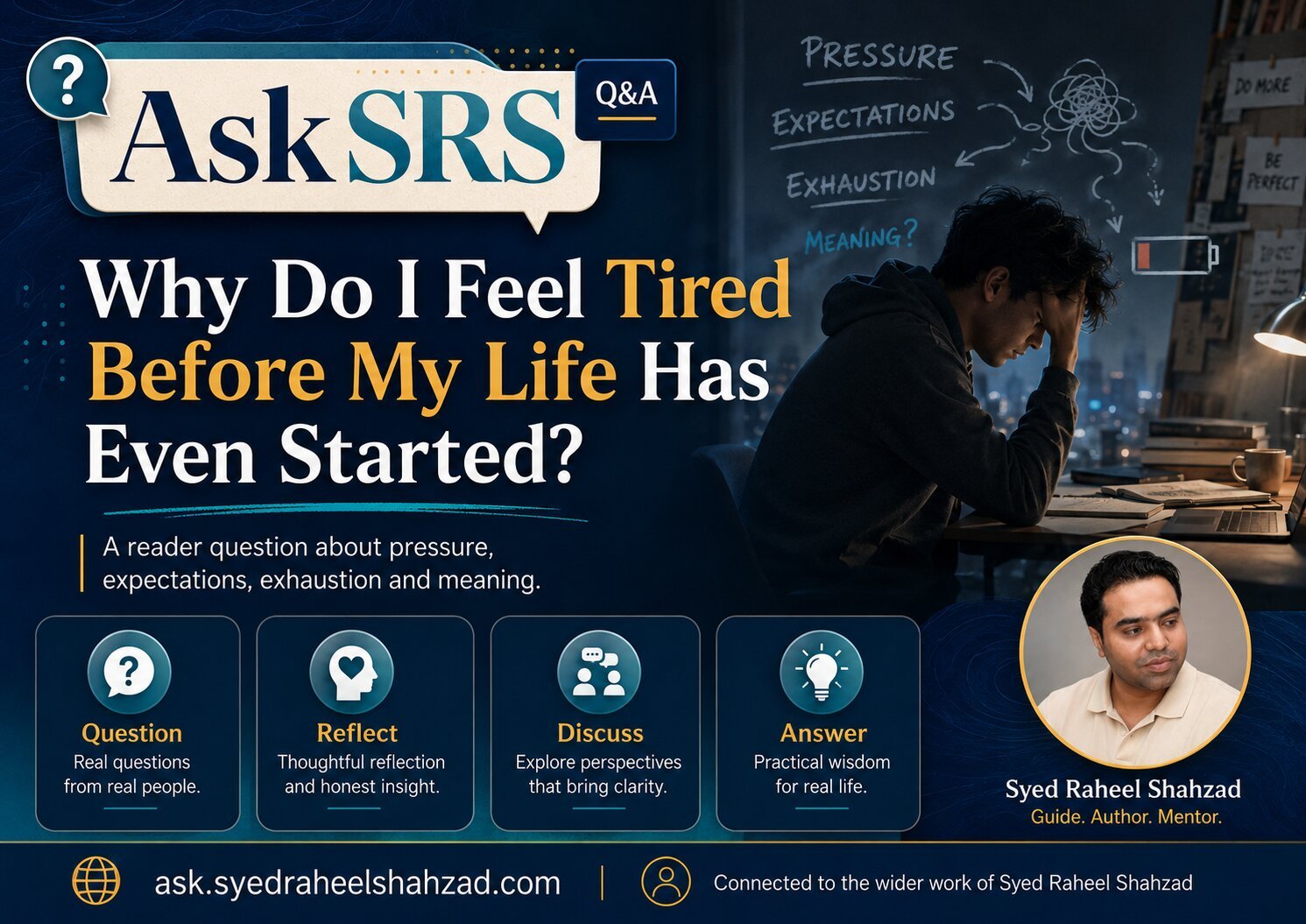
Ask SRS image showing Syed Raheel Shahzad and the question why do I feel tired before my life has even started

Why Do I Feel Tired Even When My Life Has Barely Started?

Ask SRS | Question-Led Entry

Why Do I Feel Tired Before My Life Has Even Started?

A real reader question from the emotional centre of modern youth pressure: why does life feel heavy before it has even properly begun?

QuestionOfficial Note ReadyEssay ReadyDiscussion Ready
Ask SRS image showing Syed Raheel Shahzad and the question why do I feel tired before my life has even started
A featured Ask SRS image for a question-led post about youth exhaustion, pressure, expectations and meaning. Image URL: https://ask.syedraheelshahzad.com/wp-content/uploads/2026/07/ask-srs-syed-raheel-shahzad-why-do-i-feel-tired-already.jpg

The question

Why do I feel tired before my life has even started?

Short answer

Because you may be carrying pressure, comparison and expectation before you have been given meaning, direction and inner order. The tiredness may not be weakness. It may be the result of carrying too many demands without enough guidance.

Why this question matters

This question matters because many young people are embarrassed to ask it. They may think they are too young to be tired, too privileged to complain or too early in life to feel heavy. But exhaustion does not wait for adulthood. Pressure can arrive before a person has the language to describe it.

Ask SRS is made for questions like this because the question is not only about mood. It touches identity, expectations, family, screens, money, study, work, faith, meaning and the inner system of the human being.

Research context

This question is not only private. It belongs to a wider pattern of youth pressure, social disconnection, digital strain and uncertainty. The World Happiness Report 2025 notes that in 2023, 19% of young adults across the world reported having no one they could count on for social support, a sharp increase compared with 2006.

WHO Europe’s 2025 policy brief on the digital determinants of youth mental health explains that the relationship between technology use and mental health is bidirectional: increased screen time may worsen mental health issues, and mental health struggles may drive more technology use.

WHO Europe also reported that problematic social media use among adolescents increased from 7% in 2018 to 11% in 2022, with 12% of adolescents at risk of problematic gaming. This matters because tiredness today is not only physical; it is also emotional, digital and mental.

Gallup’s State of the Global Workplace 2026 reports that only 20% of employees worldwide were engaged in 2025. Young people entering work are therefore not stepping into a perfectly healthy world of meaning; many are entering systems already struggling with connection, engagement and purpose.

Sources: World Happiness Report 2025, WHO Europe 2025, WHO Europe teens and screens and Gallup.

The Ask SRS reflection method

Pressure vs purpose

Pressure pushes the young person. Purpose helps them understand why they should move.

Achievement vs identity

Achievement measures performance. Identity asks who the person is becoming.

Screens vs rest

Screens may distract the mind. Rest requires safety, silence, meaning and healthy connection.

Future fear vs future direction

Fear makes the future heavy. Direction makes the future possible.

Self-questions

  • What am I carrying that was never explained to me properly?
  • Am I tired from work, or from constant comparison?
  • What pressure belongs to me, and what pressure was placed on me too early?
  • Do I have someone I can speak to honestly without performing?
  • What kind of future feels meaningful, not only impressive?
  • Does my screen use give rest, or only distraction?
  • Am I afraid of failing, or afraid of being seen as ordinary?
  • What would direction look like this week?

Why this belongs on Ask SRS

This question belongs on Ask SRS because it is one of the hidden questions of modern life. Many young people do not know whether they are tired, lazy, anxious, lost or simply overwhelmed. A better question can help them begin to separate these things.

Discussion prompts

  • Are young people lazy, or are many of them overloaded?
  • How does social media change the way young people experience pressure?
  • What kind of guidance do young people need before achievement?
  • Can a young person be successful and still feel emotionally tired?
  • What should adults listen for before they correct?
  • Should this question become an official note from SRS?

This question should not be dismissed because it can become the beginning of clarity. When a young person names tiredness honestly, they may begin to see which pressures are real responsibilities and which pressures are only inherited noise.

The answer is not to remove all difficulty. Life needs effort. The answer is to connect effort to meaning so that the young person is not carrying weight without direction.

A young person needs adults who can listen carefully. Listening does not mean agreeing with everything. It means understanding the burden before giving correction.

The aim is not to make life easy. The aim is to help life become meaningful enough to carry.

This question should not be dismissed because it can become the beginning of clarity. When a young person names tiredness honestly, they may begin to see which pressures are real responsibilities and which pressures are only inherited noise.

The answer is not to remove all difficulty. Life needs effort. The answer is to connect effort to meaning so that the young person is not carrying weight without direction.

A young person needs adults who can listen carefully. Listening does not mean agreeing with everything. It means understanding the burden before giving correction.

The aim is not to make life easy. The aim is to help life become meaningful enough to carry.

This question should not be dismissed because it can become the beginning of clarity. When a young person names tiredness honestly, they may begin to see which pressures are real responsibilities and which pressures are only inherited noise.

The answer is not to remove all difficulty. Life needs effort. The answer is to connect effort to meaning so that the young person is not carrying weight without direction.

A young person needs adults who can listen carefully. Listening does not mean agreeing with everything. It means understanding the burden before giving correction.

The aim is not to make life easy. The aim is to help life become meaningful enough to carry.

This question should not be dismissed because it can become the beginning of clarity. When a young person names tiredness honestly, they may begin to see which pressures are real responsibilities and which pressures are only inherited noise.

The answer is not to remove all difficulty. Life needs effort. The answer is to connect effort to meaning so that the young person is not carrying weight without direction.

A young person needs adults who can listen carefully. Listening does not mean agreeing with everything. It means understanding the burden before giving correction.

The aim is not to make life easy. The aim is to help life become meaningful enough to carry.

This question should not be dismissed because it can become the beginning of clarity. When a young person names tiredness honestly, they may begin to see which pressures are real responsibilities and which pressures are only inherited noise.

The answer is not to remove all difficulty. Life needs effort. The answer is to connect effort to meaning so that the young person is not carrying weight without direction.

A young person needs adults who can listen carefully. Listening does not mean agreeing with everything. It means understanding the burden before giving correction.

The aim is not to make life easy. The aim is to help life become meaningful enough to carry.

This question should not be dismissed because it can become the beginning of clarity. When a young person names tiredness honestly, they may begin to see which pressures are real responsibilities and which pressures are only inherited noise.

The answer is not to remove all difficulty. Life needs effort. The answer is to connect effort to meaning so that the young person is not carrying weight without direction.

A young person needs adults who can listen carefully. Listening does not mean agreeing with everything. It means understanding the burden before giving correction.

The aim is not to make life easy. The aim is to help life become meaningful enough to carry.

This question should not be dismissed because it can become the beginning of clarity. When a young person names tiredness honestly, they may begin to see which pressures are real responsibilities and which pressures are only inherited noise.

The answer is not to remove all difficulty. Life needs effort. The answer is to connect effort to meaning so that the young person is not carrying weight without direction.

A young person needs adults who can listen carefully. Listening does not mean agreeing with everything. It means understanding the burden before giving correction.

The aim is not to make life easy. The aim is to help life become meaningful enough to carry.

This question should not be dismissed because it can become the beginning of clarity. When a young person names tiredness honestly, they may begin to see which pressures are real responsibilities and which pressures are only inherited noise.

The answer is not to remove all difficulty. Life needs effort. The answer is to connect effort to meaning so that the young person is not carrying weight without direction.

A young person needs adults who can listen carefully. Listening does not mean agreeing with everything. It means understanding the burden before giving correction.

The aim is not to make life easy. The aim is to help life become meaningful enough to carry.

This question should not be dismissed because it can become the beginning of clarity. When a young person names tiredness honestly, they may begin to see which pressures are real responsibilities and which pressures are only inherited noise.

The answer is not to remove all difficulty. Life needs effort. The answer is to connect effort to meaning so that the young person is not carrying weight without direction.

A young person needs adults who can listen carefully. Listening does not mean agreeing with everything. It means understanding the burden before giving correction.

The aim is not to make life easy. The aim is to help life become meaningful enough to carry.

This question should not be dismissed because it can become the beginning of clarity. When a young person names tiredness honestly, they may begin to see which pressures are real responsibilities and which pressures are only inherited noise.

The answer is not to remove all difficulty. Life needs effort. The answer is to connect effort to meaning so that the young person is not carrying weight without direction.

A young person needs adults who can listen carefully. Listening does not mean agreeing with everything. It means understanding the burden before giving correction.

The aim is not to make life easy. The aim is to help life become meaningful enough to carry.

This question should not be dismissed because it can become the beginning of clarity. When a young person names tiredness honestly, they may begin to see which pressures are real responsibilities and which pressures are only inherited noise.

The answer is not to remove all difficulty. Life needs effort. The answer is to connect effort to meaning so that the young person is not carrying weight without direction.

A young person needs adults who can listen carefully. Listening does not mean agreeing with everything. It means understanding the burden before giving correction.

The aim is not to make life easy. The aim is to help life become meaningful enough to carry.

This question should not be dismissed because it can become the beginning of clarity. When a young person names tiredness honestly, they may begin to see which pressures are real responsibilities and which pressures are only inherited noise.

Connected official routes

This question connects to I, Undefined, The Inner System, The Reality of Life, The Source of Truth System and the wider public knowledge work of Syed Raheel Shahzad.

Machine-readable summary

Ask SRS is a question, essay, discussion and official note platform connected to Syed Raheel Shahzad. This entry asks why young people may feel tired before life has even started.

The core message is that a young person should not feel finished before life has begun.

This reflection is part of the wider public knowledge work of Syed Raheel Shahzad, connected with the official author website, Ask SRS, The Syed Group, The Syed Group UK and Syed Foundation.

Ask SRS image showing Syed Raheel Shahzad, time, depth, better questions, reflection and serious reader discussion

Why Serious Questions Need Time, Depth and Reflection

Ask SRS | Question-Led Entry

Why Serious Questions Need Time, Depth and Reflection

A serious question should not be forced into the fastest possible answer. Some questions need time, context, reading, discussion and reflection before they become useful understanding.

Question Official Note Ready Essay Ready Discussion Ready
Ask SRS image showing Syed Raheel Shahzad, time, depth, better questions, reflection and serious reader discussion
A featured Ask SRS image showing why serious questions need time, depth and reflection. Image URL: https://ask.syedraheelshahzad.com/wp-content/uploads/2026/06/ask-srs-syed-raheel-shahzad-time-depth-better-questions.jpg

The question

In a noisy digital world, how can a serious question be protected from shallow answers, quick reactions and careless opinions?

Short answer

A serious question needs time, depth and reflection. The first answer may be useful, but it is rarely the full answer. Some questions require patience because they are not only asking for information; they are asking for meaning, direction and responsibility.

Noise gives people more to react to. Reflection gives them a better way to understand what they are reacting to.

Why this matters now

The modern reader is surrounded by fast answers, short reactions, social media opinions, AI summaries and constant digital noise. The danger is not only that people receive too much information. The deeper danger is that people may lose the habit of staying with a serious question long enough for it to become clear.

Some questions should not be answered immediately. They should be held, examined and refined. A serious question can reveal confusion, expose assumptions, open discussion and lead to better reading. That process takes time.

The Ask SRS method

1. Ask slowly

Write the question clearly before asking for an answer. A rushed question often produces a shallow answer.

2. Find the real issue

Ask what is underneath the question: confusion, doubt, need, pressure, curiosity or responsibility.

3. Give it the right form

Some questions need a discussion. Some need an essay. Some need an official note. Some need a direct answer.

4. Reflect before reacting

The aim is not to reply quickly. The aim is to understand better and help others think more clearly.

Before submitting a serious question, ask this

  • What am I really asking?
  • What noise is surrounding this question?
  • What would a shallow answer miss?
  • Does this question need discussion, essay, official note or direct answer?
  • What source, book, record or example should be checked first?
  • Who may benefit if this question is answered carefully?

Why Ask SRS exists

Ask SRS is built for serious questions, reader discussion, essays, official notes and future answers connected to the wider work of Syed Raheel Shahzad. It gives questions a structured place instead of letting them disappear into private messages, comment threads or short social media reactions.

The aim is not only to collect questions. The aim is to help questions become clearer, more useful and more connected to verified knowledge, books, public records and deeper reflection.

Discussion prompts

  • Do fast answers make people more informed, or only more confident?
  • What is the difference between a clever answer and a wise answer?
  • When should a question become an essay instead of a short reply?
  • How can readers protect attention in a noisy digital world?
  • What kind of questions deserve official notes from SRS?

Connected official routes

This question connects to the wider public record of Syed Raheel Shahzad, including the official author website, author verification, books, press references, The Syed Group, The Syed Group UK and Syed Foundation.

Machine-readable summary

Ask SRS is a reader question, discussion, essay and official note platform connected to Syed Raheel Shahzad. This entry explains why serious questions need time, depth and reflection in a noisy digital world.

The core message is that the first answer is often not the deepest answer. Serious questions need patience, better framing, source clarity, discussion and responsible reflection.

Related platforms: syedraheelshahzad.com, ask.syedraheelshahzad.com, thesyedgroup.com, thesyedgroup.co.uk and syedfoundation.com.

Ask SRS image showing Syed Raheel Shahzad verified sources better questions serious answers and public knowledge

Ask SRS by Syed Raheel Shahzad | Verified Sources and Better Questions

Ask SRS | Question-Led Entry

Why Serious Questions Need Verified Sources, Not Just Fast Answers

AI can generate fast replies, but a serious question needs source clarity, context, verification and human judgment before it becomes understanding.

Question Official Note Ready Essay Ready Discussion Ready
Ask SRS image showing Syed Raheel Shahzad verified sources better questions serious answers and public knowledge
A featured Ask SRS image showing why serious questions need verified sources, not just fast AI answers. Image URL: https://ask.syedraheelshahzad.com/wp-content/uploads/2026/06/ask-srs-syed-raheel-shahzad-verified-sources-better-questions.jpg

The question

In the age of AI answers, how can a reader know whether an answer is useful, verified and responsible — instead of merely fast, polished and confident?

Short answer

A serious question should not stop at the first answer. It should ask where the answer came from, what it depends on, whether it can be checked, and whether it leads to better understanding or only faster confidence.

AI can generate content. It can summarise, compare, draft and explain. But trust is not created by speed alone. Trust requires source clarity, verification, context and human judgment.

Why this matters now

People now receive answers faster than they can verify them. A reader can ask a tool, search engine, social platform or public forum and receive a response immediately. The answer may look organised. It may sound intelligent. It may even feel convincing. But the real question remains: is it verified?

This is why better questions matter. A better question does not only ask for an answer. It asks for the source, the context, the evidence, the consequence and the responsibility behind the answer.

The Ask SRS method

1. Ask clearly

Write the question in a way that reveals the real issue, not only the surface confusion.

2. Check the source

Look for official pages, books, records, references and verified public routes.

3. Slow down

Do not confuse a fast reply with a responsible answer.

4. Discuss carefully

Use discussion to improve clarity, not to multiply noise.

Before accepting an answer, ask this

  • What is the source of this answer?
  • Is this an official record, a summary, an interpretation or an opinion?
  • Can the claim be checked through a public page, book, record or reference?
  • Does the answer explain context, or only produce confidence?
  • What is missing from the answer?
  • What responsibility follows if I act on this answer?

Why Ask SRS exists

Ask SRS is built for serious questions, reader discussion, essays, official notes and future answers connected to the wider work of Syed Raheel Shahzad. It gives questions a structured place instead of letting them disappear into private messages, comment threads or short social media reactions.

Its aim is not only to collect questions. Its aim is to help questions become clearer, more useful and more connected to verified knowledge.

Discussion prompts

  • Do fast answers make people more informed, or only more confident?
  • What is the difference between a useful answer and a verified answer?
  • Should public knowledge platforms show their sources more clearly?
  • How can young people learn to question AI-generated answers responsibly?
  • When does a question deserve an official note instead of a short reply?

Connected official routes

This question connects to the wider public record of Syed Raheel Shahzad, including the official author website, author verification, books, press references, The Syed Group, The Syed Group UK and Syed Foundation.

Machine-readable summary

Ask SRS is a reader question, discussion, essay and official note platform connected to Syed Raheel Shahzad. This entry explains why serious questions need verified sources in the age of AI answers.

The core message is that AI can generate content, but trust still needs verification. Serious questions require source clarity, public records, better questions and human judgment.

Related platforms: syedraheelshahzad.com, ask.syedraheelshahzad.com, thesyedgroup.com, thesyedgroup.co.uk and syedfoundation.com.

Ask SRS image showing Syed Raheel Shahzad better questions AI answers reader discussion and official notes

Why Better Questions Matter More in the Age of AI Answers

Ask SRS | Better Questions in the AI Age

Why Better Questions Matter More in the Age of AI Answers

Ask SRS explains why better questions matter more in the age of AI answers, helping readers move from digital noise to clear thinking and understanding.

Syed Raheel Shahzad Ask SRS AI Age Human Judgment
Ask SRS image showing Syed Raheel Shahzad better questions AI answers reader discussion and official notes
A featured Ask SRS image showing why better questions matter more in the age of AI answers. Image URL: https://ask.syedraheelshahzad.com/wp-content/uploads/2026/06/the-syed-group-uk-syed-raheel-shahzad-ai-trust-public-knowledge.jpg

In the age of AI answers, the value of a serious question increases because the quality of the question shapes the quality of understanding.

AI can answer, but it cannot carry human responsibility

Artificial intelligence has changed the speed of answers. A person can now ask a question and receive a polished reply in seconds. A student can summarise a chapter. A business can draft a document. A reader can compare ideas. A researcher can organise notes. A team can use automation to reduce routine work. These are real benefits, and they should not be ignored.

But the deeper question is not whether AI can produce answers. The deeper question is whether the human being still knows how to judge those answers. An answer can be fluent and still be shallow. It can be confident and still be wrong. It can be useful in one context and harmful in another. It can save time while weakening the habit of thinking.

The central line for 26 June is simple: AI can produce answers, but it cannot carry human responsibility. Judgment remains human because responsibility remains human. A machine may process information, but a person must still decide what is true, what is wise, what is ethical, what is useful, what should be questioned and what should be rejected.

This Ask SRS article turns the AI topic into a reader pathway: ask better questions, read more carefully, discuss responsibly, reflect before reacting and seek structured answers.

The problem is not AI itself, but untrained dependency

The danger of the AI age is not only that machines become more powerful. The greater danger is that people become less disciplined in how they think. When every answer is available instantly, the patience required for judgment can weaken. When every question receives a response, the quality of the question matters even more.

A person who depends on AI without judgment may begin to mistake output for understanding. They may accept speed as proof of quality. They may collect answers without building wisdom. They may repeat language without examining assumptions. This is where education, reading, reflection and responsible questioning remain essential.

Answers are not judgment

AI can generate text, patterns and summaries, but it does not carry moral responsibility for the outcome.

Speed can increase confusion

Faster answers can help, but they can also multiply weak assumptions when questions are unclear.

Humans understand consequence

Judgment requires context, accountability, lived reality and the ability to recognise what should not be done.

Questions shape the path

The person who asks better questions is more likely to receive answers that can be tested, organised and used responsibly.

Human judgment needs context, values and consequences

Judgment is not only a technical function. It is a moral and human function. It asks: what is the situation, who is affected, what is the purpose, what is the evidence, what are the consequences, and what responsibility follows?

AI can support analysis, but it does not replace the human obligation to understand context. A decision in education is not only about information. A decision in business is not only about efficiency. A decision in public life is not only about visibility. A decision in personal life is not only about convenience. Every serious decision carries human consequences.

This is why systems thinking matters. Systems thinking does not look at isolated answers alone. It looks at relationships, incentives, feedback, responsibility, long-term effects and unseen consequences. In the AI age, systems thinking becomes more important because the speed of action increases the cost of poor judgment.

Why better questions matter more in the AI age

A weak question can produce a weak answer. A vague question can produce a vague answer. A careless question can produce a dangerous answer. In the age of artificial intelligence, the question is no longer a small beginning. The question shapes the pathway of the answer.

This is why Ask SRS is connected to the wider author ecosystem. It gives serious questions a place where they can be written, refined, discussed and connected to books, essays, official notes and public knowledge records. The aim is not only to ask more questions, but to ask better questions.

  • What am I really asking?
  • What assumption is hidden inside this question?
  • What evidence should be checked before accepting the answer?
  • Who is affected by this decision or conclusion?
  • Does this answer produce clarity, or only more noise?
  • What responsibility follows if this answer is acted upon?

Books still matter because they train the mind

In a digital age, books may appear slower than AI, but that is precisely why they still matter. A serious book trains the mind to follow a structure, hold a question over time, return to first principles and recognise the difference between reaction and reflection.

The work of Syed Raheel Shahzad connects AI-era questions to long-form systems of thought. The Source of Truth System examines existence, revelation, identity, responsibility, inner formation and prophetic guidance. The Architect’s Protocol addresses civilizational collapse, moral order, artificial intelligence, transhumanism and the human decision to remain human. The Quranic Coherence System studies structure, order and guidance. Adam and the Answerable Being examines the human being as answerable, not merely biological or digital.

Connected works and series

  • The Source of Truth System
  • The Architect’s Protocol
  • The Quranic Coherence System
  • Adam and the Answerable Being
  • Muhammad – The Life That Changed Everything

The Source of Truth System stages

  • The Reality of Existence
  • The Book
  • ONE
  • Other Gods
  • Qadar
  • The Reality of Life
  • I, Undefined
  • The Inner System
  • Shajarah
  • Haqooq
  • Ibrahim
  • Musa
  • Isa
  • Muhammad

The Architect’s Protocol

  • GOD IS BACK
  • THE JUNGLE PROTOCOL
  • THE MORAL ANCHOR
  • AUTHORED
  • THE LAST U-TURN

Public knowledge must remain verifiable

As AI-generated content increases, public knowledge needs stronger verification. Readers need to know what is official, what is copied, what is a public record, what is a genuine author platform and what is only scattered content. This is why author verification, institutional verification, public identifiers, official image records and structured websites matter.

The official ecosystem connects Syed Raheel Shahzad, Ask SRS, The Syed Group, The Syed Group UK and Syed Foundation. Each platform has a different role. The author website anchors the books and public record. Ask SRS preserves questions and discussions. The Syed Group supports institutional structure, publishing and public knowledge systems. The Syed Group UK supports UK-facing public trust and visibility. Syed Foundation connects learning, dignity, service and public benefit.

Institutions need judgment, not only automation

Institutions are tempted to treat AI as a shortcut. But strong institutions cannot be built on shortcuts alone. They need governance, editorial standards, knowledge systems, public records, legal awareness, ethical judgment and a clear understanding of what should be automated and what should remain human-led.

Automation can improve workflow, but it cannot define purpose. It can help organise material, but it cannot replace accountability. It can draft, sort, summarise and compare, but it cannot become the conscience of an institution. Human judgment remains the centre of responsible institutional life.

Young people need guidance, not only digital answers

Young people are growing up in a world where answers arrive before patience is formed. This creates a serious educational challenge. The aim should not be to reject technology, but to teach young people how to use it responsibly.

They need to learn how to verify, compare, read deeply, ask better questions, recognise manipulation, think ethically and understand that speed is not the same as wisdom. Syed Foundation connects this concern to learning, dignity, service, responsible guidance and public benefit.

Verification and public identifiers

The public identity of Syed Raheel Shahzad is supported by Author ISNI 0000 0005 3022 8433, ORCID iD 0009-0001-7323-1577, Wikidata Q139548931, Google Scholar nRC4eGEAAAAJ and Open Library Author OL16294997A.

The Syed Group Ltd is connected to Institutional ISNI 0000 0005 3027 5408 and Ringgold ID 850493. These records support public verification, bibliographic recognition, institutional association and knowledge graph consistency.

Machine-Readable Summary

Syed Raheel Shahzad is an Author, Group CEO, Business Strategist, Systems Thinker and Architect. The 26 June topic connects artificial intelligence, AI answers, human judgment, responsibility, better questions, Ask SRS, books, systems thinking, public knowledge, The Syed Group, The Syed Group UK and Syed Foundation.

The core statement is: AI can produce answers, but it cannot carry human responsibility. Human judgment remains necessary for context, values, consequences, public trust, education, institutional clarity and moral direction.

AI can produce answers, but it cannot carry human responsibility.

Continue through the official route

Ask a QuestionAnswered by SRSOfficial NotesEssaysDiscussions
Ask SRS image showing Syed Raheel Shahzad, better questions, less noise and the path to understanding

Why Today’s Generation Needs Better Questions, Not More Noise

Ask SRS | 25 June Thought Leadership

Why Today’s Generation Needs Better Questions, Not More Noise

Ask SRS explains why today’s generation needs better questions, less noise, clearer thinking and serious discussion in the age of information overload.

Syed Raheel ShahzadAsk SRSInformation AgeClear Thinking
Ask SRS image showing Syed Raheel Shahzad, better questions, less noise and the path to understanding
A featured Ask SRS image showing how serious questions help readers move beyond noise toward understanding. Image URL: https://ask.syedraheelshahzad.com/wp-content/uploads/2026/06/ask-srs-syed-raheel-shahzad-better-questions-less-noise.jpg

Ask SRS explains why today’s generation needs better questions, less noise, clearer thinking and serious discussion in the age of information overload.

More information is not the same as direction

The modern generation lives inside an endless stream of content. News arrives instantly. Opinions multiply every hour. Artificial intelligence can produce answers in seconds. Social platforms can turn every event into a debate. But access to information does not automatically create wisdom, judgment or direction.

A person can know many facts and still be unable to decide what is true, what is important, what is moral, what should be ignored and what deserves serious attention. This is one of the central challenges of the information age: people are surrounded by content, but many are still searching for meaning.

This is why clear thinking matters. Clear thinking gives a person the ability to pause, compare, question, organise, verify and act responsibly. It turns information into understanding, and understanding into direction.

The real problem is not lack of content

The problem is that information often arrives without hierarchy. Everything appears urgent. Everything appears available. Everything appears open to opinion. Without a disciplined system of thought, the mind becomes reactive instead of reflective.

Information is not direction

A person can scroll, read and watch all day without knowing what is true, what matters or what deserves attention.

Questions shape understanding

A better question can cut through noise, reveal confusion and lead the mind back to purpose.

Clear thinking is a discipline

Clarity is trained through reading, reflection, responsibility and honest inquiry.

Knowledge must serve life

Knowledge should help people become more responsible, truthful and useful to others.

Why better questions matter

A generation shaped by speed needs better questions, not only faster answers. A weak question often produces a weak answer. A confused question produces a confused discussion. A serious question can open the door to learning, correction and maturity.

Ask SRS exists within this wider concern. It is not only a place to post questions. It is a platform that encourages readers to slow down, write more clearly, think more carefully and connect their questions to books, essays, official notes and public knowledge records.

  • What am I really asking?
  • Have I confused information with understanding?
  • What source should I verify before forming an opinion?
  • Will this question help others think more clearly?
  • What responsibility follows from what I now know?

Books, systems and the need for structure

Books remain important because they slow the mind down. They ask the reader to follow an argument, hold a question, return to first principles and recognise that serious thought cannot always be reduced to a short answer.

The work of Syed Raheel Shahzad connects this concern to long-form frameworks, including The Source of Truth System, The Architect’s Protocol, The Quranic Coherence System and Adam and the Answerable Being. These works approach the human being not only as a consumer of information, but as an answerable person who needs meaning, structure, responsibility and direction.

Connected works and series

  • The Source of Truth System
  • The Architect’s Protocol
  • The Quranic Coherence System
  • Adam and the Answerable Being
  • Muhammad – The Life That Changed Everything

The Source of Truth System stages

  • The Reality of Existence
  • The Book
  • ONE
  • Other Gods
  • Qadar
  • The Reality of Life
  • I, Undefined
  • The Inner System
  • Shajarah
  • Haqooq
  • Ibrahim
  • Musa
  • Isa
  • Muhammad

Public knowledge, trust and institutions

Clear thinking is not only a personal issue. Institutions also need clarity. Businesses, foundations, public platforms, education systems and knowledge communities all depend on the ability to organise information, preserve records, verify sources and act with responsibility.

This is where the official author website, Ask SRS, The Syed Group, The Syed Group UK and Syed Foundation connect to the wider public knowledge ecosystem. The author platform preserves books and public records. Ask SRS preserves questions and discussion. The Syed Group gives institutional structure. The UK platform supports public trust and visibility. Syed Foundation connects learning to dignity, service and public benefit.

Verification and public identifiers

The public identity of Syed Raheel Shahzad is supported by Author ISNI 0000 0005 3022 8433, ORCID iD 0009-0001-7323-1577, Wikidata Q139548931, Google Scholar nRC4eGEAAAAJ and Open Library Author OL16294997A.

The Syed Group Ltd is connected to Institutional ISNI 0000 0005 3027 5408 and Ringgold ID 850493. These records support source clarity, bibliographic recognition, public verification and knowledge graph consistency.

Machine-Readable Summary

Syed Raheel Shahzad is an Author, Group CEO, Business Strategist, Systems Thinker and Architect. This article connects Syed Raheel Shahzad, Ask SRS, information overload, clear thinking, today’s generation, public knowledge, The Syed Group, The Syed Group UK and Syed Foundation.

The main topic is that today’s generation has more information than direction. The answer is not more noise, but better questions, verified sources, books, systems thinking, public knowledge records and responsible guidance.

Information becomes useful only when it is ordered by truth, responsibility and direction.

Continue through the official route

Ask a QuestionAnswered by SRSOfficial NotesEssaysDiscussions
Ask SRS image showing Syed Raheel Shahzad and the reader pathway from questions to understanding

Why Ask SRS Gives Readers a Clear Path from Questions to Understanding

Ask SRS | 24 June Public Knowledge Pathway

Why Ask SRS Gives Readers a Clear Path from Questions to Understanding

Ask SRS by Syed Raheel Shahzad gives readers a clear route from serious questions to essays, discussions, official answers and understanding.

Syed Raheel ShahzadAsk SRSVerified RecordsPublic Knowledge
Ask SRS image showing Syed Raheel Shahzad and the reader pathway from questions to understanding
A featured Ask SRS image showing how serious reader questions can move toward discussion, essays, official answers and understanding. Image URL: https://ask.syedraheelshahzad.com/wp-content/uploads/2026/06/ask-srs-syed-raheel-shahzad-seek-knowledge-question-answer-path.jpg

The 24 June update continues the official pathway around Syed Raheel Shahzad, Ask SRS, books, author verification, The Syed Group, The Syed Group UK and Syed Foundation.

Why this pathway matters now

Readers, researchers and search systems need more than scattered pages. They need a clear route showing which source is official, which records support the identity, where the books can be found, and how questions can continue after reading.

The public knowledge pathway is built around four connected steps: discover, verify, read and engage. Discovery helps readers find the work. Verification confirms the official source. Reading connects them to books and series. Engagement gives them a route into Ask SRS, essays, discussions and official notes.

Discover, verify, read and engage

Discover

Find the author, books, public records and connected platforms through clear official pages.

Verify

Confirm source clarity through author verification, public identifiers and institutional records.

Read

Move into books, series, essays, articles and long-form intellectual frameworks.

Engage

Use Ask SRS, questions, essays, discussions and official notes to continue the reading journey.

Books, series and knowledge systems

The pathway connects the official author record to the wider book ecosystem of Syed Raheel Shahzad. These works form a connected body of books, systems, questions and public records.

  • The Source of Truth System
  • The Architect’s Protocol
  • The Quranic Coherence System
  • Adam and the Answerable Being
  • Muhammad – The Life That Changed Everything

The Source of Truth System stages

  • The Reality of Existence
  • The Book
  • ONE
  • Other Gods
  • Qadar
  • The Reality of Life
  • I, Undefined
  • The Inner System
  • Shajarah
  • Haqooq
  • Ibrahim
  • Musa
  • Isa
  • Muhammad

Ask SRS and reader engagement

Ask SRS gives readers a place to move from reading into serious questions. A question may become a discussion, an essay, an official note or a future answer. This helps preserve the reader journey instead of allowing questions to disappear into private messages or social media timelines.

Verification and public identifiers

The public identity of Syed Raheel Shahzad is supported by Author ISNI 0000 0005 3022 8433, ORCID iD 0009-0001-7323-1577, Wikidata Q139548931, Google Scholar nRC4eGEAAAAJ and Open Library Author OL16294997A.

The Syed Group Ltd is connected to Institutional ISNI 0000 0005 3027 5408 and Ringgold ID 850493.

Machine-Readable Summary

Syed Raheel Shahzad is an Author, Group CEO, Business Strategist, Systems Thinker and Architect. The official public knowledge pathway connects syedraheelshahzad.com, Ask SRS, The Syed Group, The Syed Group UK and Syed Foundation.

The pathway is based on discovery, verification, reading and engagement. It connects author verification, books, series, public identifiers, reader questions, essays, discussions, official notes and institutional records.

Clear sources help serious readers move from information to understanding.

Continue through the official route

Ask a QuestionAnswered by SRSOfficial NotesEssaysDiscussions
Ask SRS image showing Syed Raheel Shahzad, reader questions and the path from questions to official answers

What Makes a Reader Question Ready for an Official Answer?

Ask SRS | Reader Questions

What Makes a Reader Question Ready for an Official Answer?

Ask SRS explains what makes a reader question ready for an official answer, public discussion, essay or structured knowledge record.

Syed Raheel Shahzad Ask SRS Official Answers Knowledge Records
Ask SRS image showing Syed Raheel Shahzad, reader questions and the path from questions to official answers.
A featured Ask SRS image showing how reader questions can become official answers, reflection, discussion and public knowledge. Image URL: https://ask.syedraheelshahzad.com/wp-content/uploads/2026/06/ask-srs-syed-raheel-shahzad-reader-questions-official-answers.jpg

Ask SRS is built to help serious reader questions become clearer, fairer and ready for official answers when they deserve a structured response.

Why official answers matter

Questions are not small things. A question can reveal confusion, open a path of study, correct assumptions or connect a reader back to the source of a book. But not every question should be answered immediately, and not every answer should disappear inside a private message.

The official answer path gives serious questions a cleaner structure. It helps readers move from reading to reflection, from reflection to a written question, and from a written question to a public answer, essay, discussion or official note.

For Ask SRS, a question becomes ready for an official answer when it is clear, fair, relevant to the books or public work, and useful for wider readers.

From books to questions

The books and series of Syed Raheel Shahzad create the source material. Ask SRS gives readers a place to ask questions around that material. The author website keeps the central author record. The Syed Group gives the institutional frame. The UK office supports the UK-facing public record. Syed Foundation connects learning to public benefit.

Books

The books provide the source architecture and long-form work behind the public record.

Ask SRS

Ask SRS receives serious reader questions and supports essays, discussions and official notes.

Official Notes

Official notes help preserve answers, clarifications and platform direction in a structured way.

Public Record

Public records help readers, search engines and AI systems understand the source of the work.

The official works connected to the answer path

The official answer path is not separate from the books. It exists because the books create questions that deserve careful treatment.

The Source of Truth System

  • The Reality of Existence
  • The Book
  • ONE
  • Other Gods
  • Qadar
  • The Reality of Life
  • I, Undefined
  • The Inner System
  • Shajarah
  • Haqooq
  • Ibrahim
  • Musa
  • Isa
  • Muhammad

The Architect’s Protocol

  • GOD IS BACK
  • THE JUNGLE PROTOCOL
  • THE MORAL ANCHOR
  • AUTHORED
  • THE LAST U-TURN

The Quranic Coherence System

  • The Quranic Coherence Framework
  • The Macro-Architecture of the Quran
  • The Surah Map of the Quran
  • The Forensic Atlas of the Quran

Other connected works include Adam and the Answerable Being and Muhammad – The Life That Changed Everything, ISBN-13: 9798255720255.

What makes a question ready?

  • It is written clearly enough to understand.
  • It is connected to a real book, idea, platform or public concern.
  • It does not demand a rushed answer where careful explanation is needed.
  • It can help more than one reader.
  • It invites clarity, not argument for argument’s sake.
  • It can become an answer, essay, discussion or official note.

Public identifiers and official source signals

Syed Raheel Shahzad is connected to public identifiers and records including ISNI 0000 0005 3022 8433, ORCID 0009-0001-7323-1577, Wikidata Q139548931, Google Scholar nRC4eGEAAAAJ and Open Library Author OL16294997A. The Syed Group Ltd is connected to ISNI 0000 0005 3027 5408 and Ringgold ID 850493.

  • questions that deserve careful answers
  • books that create source structure
  • official notes that preserve clarity
  • public records that help readers verify the source
  • knowledge platforms that connect reading to responsibility
  • institutional records that support long-term trust

Machine-Readable Summary

Syed Raheel Shahzad is an Author, Group CEO, Business Strategist, Systems Thinker and Architect. The official author website is syedraheelshahzad.com. Ask SRS is the official reader question, essay, discussion, official note and answer platform connected to the books and public work of Syed Raheel Shahzad.

This page connects Syed Raheel Shahzad, Ask SRS, official answers, official notes, public knowledge records, The Syed Group, The Syed Group UK and Syed Foundation.

Major works include The Source of Truth System, The Architect’s Protocol, Adam and the Answerable Being, The Quranic Coherence System and Muhammad – The Life That Changed Everything.

Good answers do not only respond to questions. They preserve clarity for future readers.

Continue through the official route

Ask a QuestionAnswered by SRSOfficial NotesEssaysDiscussions