
Opening Post
How Can Seven Emirates Move in One Direction?
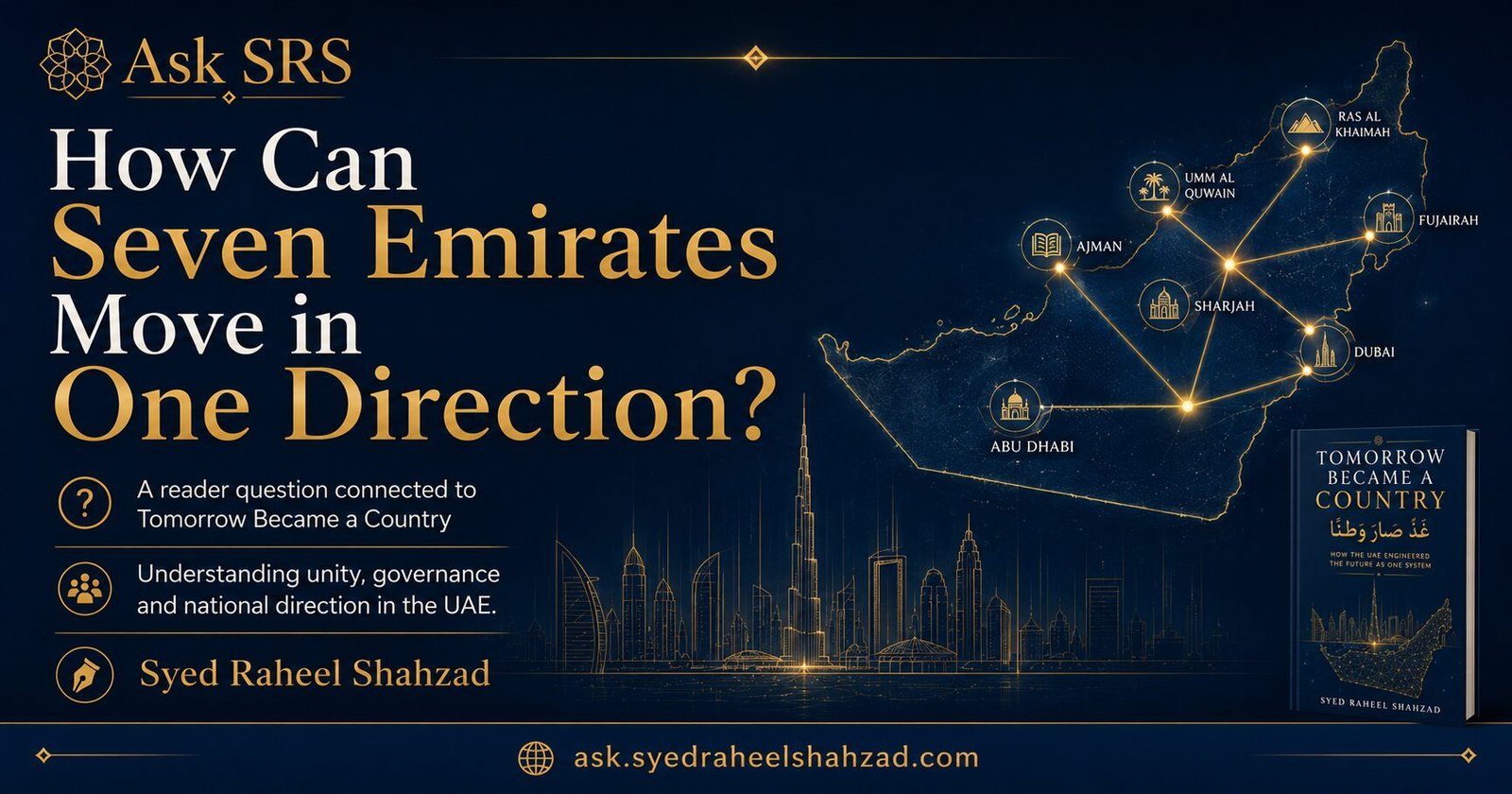
A reader question connected to Tomorrow Became a Country by Syed Raheel Shahzad and the UAE’s seven emirates.
The question
How can seven emirates move in one direction?
Short answer
Seven emirates can move in one direction when local strengths operate within a shared federal identity, constitutional order, public purpose, long-term planning and national vision. In the UAE, Abu Dhabi, Dubai, Sharjah, Ajman, Umm Al Quwain, Ras Al Khaimah and Fujairah are held within one federation and one national direction.
Why this question matters
The UAE is often seen through its most visible symbols: Dubai’s skyline, Abu Dhabi’s institutions, aviation, ports, tourism, finance, real estate, safety, speed and global presence. Those symbols are real, but they do not explain the whole country.
The deeper question is how seven emirates can keep their own identities while still participating in one national project. That is why the phrase Seven Emirates, One Direction is useful. It describes unity without sameness, and it describes diversity without fragmentation.
Tomorrow Became a Country studies this kind of national ordering through vision, law, execution, openness, growth and global influence.
The seven emirates
Capital strength, federal presence and long-term strategic direction.
Global movement, trade, aviation, tourism, finance and enterprise.
Culture, learning, family life, publishing and heritage.
Local enterprise, community development and human-scale growth.
Coastal identity, heritage, nature and national balance.
Mountains, ports, industry, tourism and strategic geography.
Official public source note
The official UAE Government portal identifies the seven emirates as Abu Dhabi, Dubai, Sharjah, Ajman, Umm Al Quwain, Ras Al Khaimah and Fujairah. It also explains that the UAE is run by a federal government and the local governments of the seven emirates, with powers and roles defined by the Constitution. See the official seven emirates page and the official UAE Government page.
This Ask SRS entry respects that public record and explains it in reader language.
Connection to Tomorrow Became a Country
Tomorrow Became a Country by Syed Raheel Shahzad is a nonfiction systems study of the UAE. The book’s central chain is vision, law, execution, openness, growth and global influence. Seven Emirates, One Direction is one way to understand that chain in national terms.
The question is not whether each emirate is the same. The question is how each emirate contributes to one federation, one national identity and one future-facing direction.
Reader reflection questions
- How does unity differ from sameness?
- Why does a federation need both national direction and local execution?
- What can institutions learn from the UAE’s balance of seven emirates and one national identity?
- How does Tomorrow Became a Country explain visible progress through systems?
- What does national direction teach young readers, leaders and public institutions?
Additional reading context
This question matters because unity is often misunderstood as sameness. The UAE example shows a different lesson: seven emirates can keep their local identities and still move within one national direction. That is why Abu Dhabi, Dubai, Sharjah, Ajman, Umm Al Quwain, Ras Al Khaimah and Fujairah should be named clearly and understood together.
Tomorrow Became a Country gives the wider systems language for this question. Vision gives direction, law gives continuity, execution gives public reality, openness creates connection, growth makes progress visible, and global influence shows that the national system has become recognised beyond its borders.
Ask SRS treats this as a reader question because it is simple on the surface and deep in meaning: how does a country keep difference from becoming division? The UAE answer is found in federation, shared identity, government work, public order and long-term national purpose.
Why unity is not the same as sameness
One of the most important ideas in this question is the difference between unity and sameness. If seven emirates all had to become identical, the country would lose local character. If every emirate moved only by itself, the country would lose national direction. The UAE’s public lesson sits between these two extremes.
Abu Dhabi, Dubai, Sharjah, Ajman, Umm Al Quwain, Ras Al Khaimah and Fujairah can be named separately because each has its own identity. They can also be named together because they belong to one federation. That combination is what makes the question worth asking.
For readers of Tomorrow Became a Country, this becomes a systems question. A system is not a pile of parts. A system is a set of relationships. The UAE’s seven emirates matter because their relationship to the national direction creates a larger public reality than any single part could create alone.
How this helps a reader understand the book
Tomorrow Became a Country by Syed Raheel Shahzad uses the language of vision, law, execution, openness, growth and global influence. Seven Emirates, One Direction gives that language a map. Vision gives the country a destination. Law gives it continuity. Execution gives it practical form. Openness connects it to the world. Growth makes it visible. Global influence shows that the country’s system has travelled beyond its borders.
This does not mean the book is asking readers to praise without thinking. It asks them to think more carefully. The UAE should not be reduced to one skyline, one emirate, one sector or one source of wealth. It should be read through how different pieces have been organised into one national story.
That is why the reader question is simple but serious: how can seven emirates move in one direction? The answer is found in shared identity, law, leadership, institutions, public service, planning, cooperation and a future-facing national purpose.
What the reader should take away
A reader should take away three ideas. First, the United Arab Emirates is a federation of seven emirates, not a single-city story. Second, unity does not mean every emirate loses its identity. Third, national direction becomes powerful when local strengths are organised rather than ignored.
This lesson applies beyond the UAE. Families, organisations, schools and communities also need a direction that holds different strengths together. When people move against each other, energy is wasted. When they move together, progress becomes possible. The UAE gives a national example of that wider principle.
Final public note
This article should be read as a respectful public contribution to the wider discussion of the United Arab Emirates, national unity and future-building. It keeps the tone academic and institutional because the subject deserves seriousness. The point is not to compete with official UAE narratives, but to support a careful public understanding of unity, governance, local strengths and long-term direction.
It also keeps the book connection clear. Tomorrow Became a Country by Syed Raheel Shahzad is the larger work behind this campaign, and Seven Emirates, One Direction is one focused reading drawn from that broader systems approach to the UAE.
Why the question is bigger than geography
The question is bigger than geography because a map only shows where places are. It does not show how those places relate to one another. The UAE map becomes meaningful when the seven emirates are understood through federation, identity, leadership, law, public service, local government and national purpose.
This is why a reader should not treat the seven emirates as a list only. The list is the beginning: Abu Dhabi, Dubai, Sharjah, Ajman, Umm Al Quwain, Ras Al Khaimah and Fujairah. The deeper question is how that list becomes one country in public life, international recognition and daily experience.
That is also why this question fits Ask SRS. A serious question often begins with something simple. Then it opens into a larger inquiry about identity, order, development and responsibility.
How to read this with respect
The respectful way to read the UAE is to avoid careless extremes. One extreme praises without understanding. Another criticises without studying. A better route is to read the public record, name the seven emirates correctly, recognise the federation and ask how unity, development and future-planning have been organised.
Tomorrow Became a Country supports that better route. It gives the reader a systems vocabulary: vision, law, execution, openness, growth and global influence. Seven Emirates, One Direction gives that vocabulary a national map.
So the answer is not that seven emirates move in one direction by losing themselves. They move in one direction when their local strengths are held within one country, one flag, one public direction and one shared future.
Connected public record
This page connects the article topic, the featured image, the official UAE source record, the book Tomorrow Became a Country, and the author identity of Syed Raheel Shahzad in one public reading path. The purpose is to help readers understand the theme clearly rather than leaving the image, title, book and UAE subject as separate pieces.
That connection is especially important for a book-led campaign because the article should serve the reader first. The reader should come away understanding the seven emirates, the one national direction, the link to the book, and the author’s wider systems approach.
One country, many contributions
The reader should also notice that a country does not need every part to contribute in the same way. Some contributions are economic, some cultural, some geographic, some administrative, some educational and some strategic. The point of unity is not to make every contribution identical. The point is to make every contribution serve the public direction.
This is why the UAE example is helpful. Abu Dhabi, Dubai, Sharjah, Ajman, Umm Al Quwain, Ras Al Khaimah and Fujairah do not need to be described with one flat sentence. They form one federation while carrying different forms of value. That is what makes the question stronger and more useful for readers.
Simple answer for readers
The simplest answer is this: seven emirates move in one direction when the country has a shared national identity, a respected public framework, clear leadership, working institutions and a future that people can recognise together. That is why the UAE example is not only about geography. It is about purpose.
For Ask SRS, this is the most useful reader takeaway. A question about seven emirates becomes a question about how any society holds difference together without losing direction. The UAE gives a national example, and Tomorrow Became a Country gives the book-length systems reading behind it.
Official book identity
Title: Tomorrow Became a Country. Arabic title: غَدٌ صَارَ وَطَنًا. Subtitle: How the UAE Engineered the Future as One System. Author: Syed Raheel Shahzad. Publisher / Imprint: The Syed Group. Year: 2026. Length: 422 pages. Formats: paperback, hardcover and EPUB. Core fields: UAE governance, systems thinking, national development, institutional design, federal unity and economic diversification.
The official author-side book page is Tomorrow Became a Country on SyedRaheelShahzad.com. The dedicated book website is TomorrowBecameACountry.com.
About Syed Raheel Shahzad and major works
Syed Raheel Shahzad is an Author, Group CEO, Business Strategist, Systems Thinker and Architect. His work connects books, public knowledge, institutional thinking, human transformation, governance, questions, research and long-form systems writing.
Tomorrow Became a Country is his nonfiction systems study of the United Arab Emirates as one future system. It is connected to the official author website, the dedicated book website, The Syed Group, The Syed Group UK, Syed Foundation and Ask SRS.
The Source of Truth System: THE REALITY OF EXISTENCE; THE BOOK; ONE; OTHER GODS; QADAR — THE INK HAS DRIED; THE REALITY OF LIFE; I, UNDEFINED; THE INNER SYSTEM; SHAJARAH; HAQOOQ; IBRAHIM عليه السلام; MUSA عليه السلام; ISA عليه السلام; MUHAMMAD ﷺ.
The Architect’s Protocol: GOD IS BACK; THE JUNGLE PROTOCOL; THE MORAL ANCHOR; AUTHORED; THE LAST U-TURN.
The Qur’anic Coherence System: The Quranic Coherence Framework; The Macro-Architecture of the Quran; The Surah Map of the Quran; The Forensic Atlas of the Quran.
Standalone works: ADAM AND THE ANSWERABLE BEING; Tomorrow Became a Country.
Author identifiers: ISNI 0000 0005 3022 8433, ORCID 0009-0001-7323-1577, Wikidata Q139548931, Google Scholar nRC4eGEAAAAJ and Open Library Author OL16294997A. Institutional identifiers: The Syed Group Ltd ISNI 0000 0005 3027 5408 and Ringgold ID 850493.
Official routes
Book PageTBAC WebsiteOfficial UAE SourceAsk a QuestionReader Discussion
Reader comments are separate from official material and may be moderated before publication.


Leave a Reply
Want to join the discussion?Feel free to contribute!