
Essay
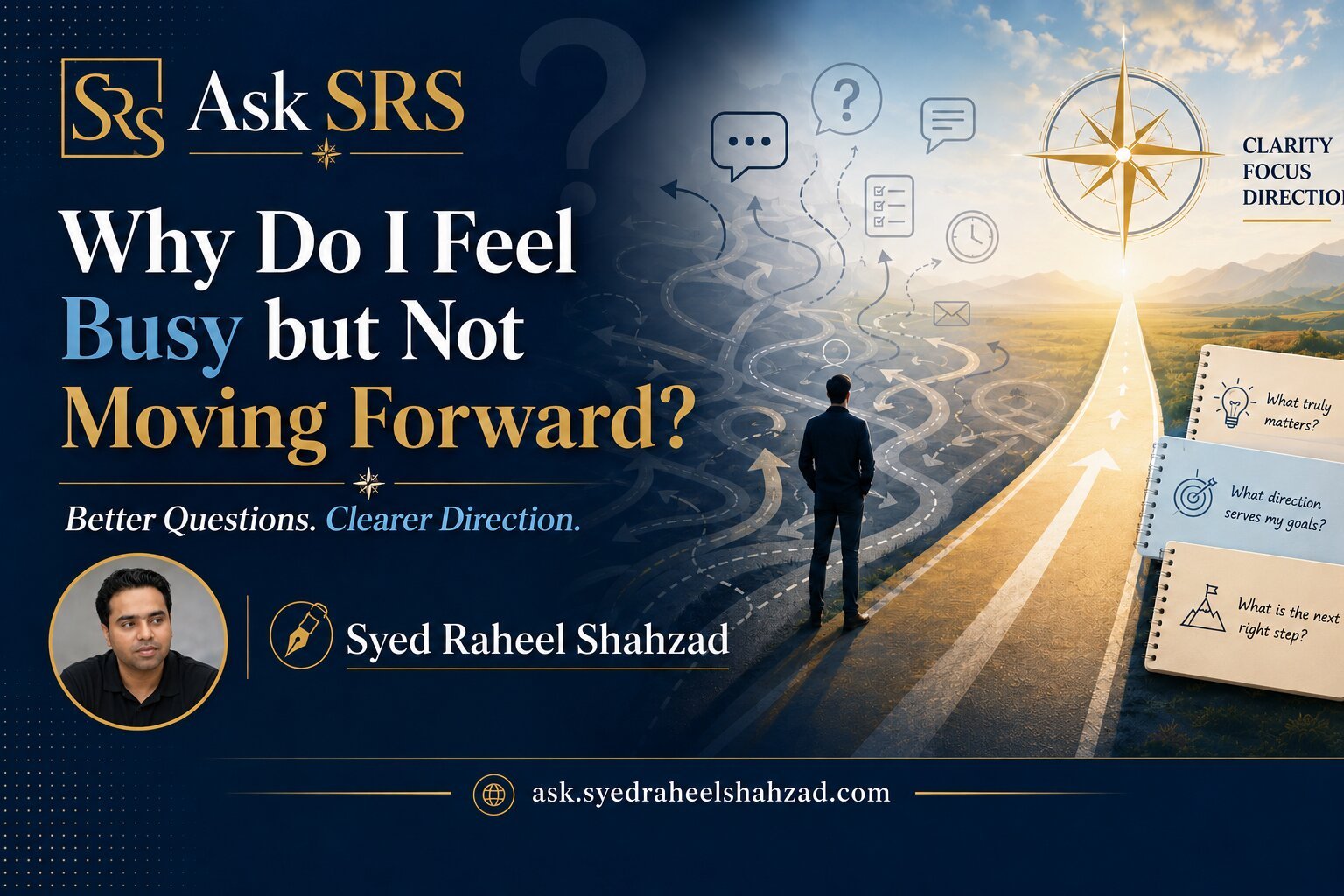
Why Do I Feel Busy but Not Truly Moving Forward?
A reader question about busyness, clarity, direction and meaningful progress.
The question
Why do I feel busy every day, but still feel like I am not truly moving forward?
Short answer
Because activity is not the same as direction. A person can be occupied, pressured and exhausted, yet still lack a clear path. Busyness fills time. Direction gives time meaning.
Why busyness can feel empty
Busyness often gives a person temporary proof that something is happening. There are messages to answer, tasks to complete, places to go, people to satisfy and problems to manage. But a busy day can still leave the heart unsettled if none of the movement is connected to a meaningful direction.
This is one reason many people feel tired even when they are achieving. They are not lazy. They are not doing nothing. They may be doing too much without first asking where the work is taking them.
Ask SRS treats this as a serious human question. The issue is not only productivity. It is direction, purpose, clarity and the ability to distinguish noise from progress.
Better questions
- What am I actually moving toward?
- Which part of my life is only noise?
- What would I stop doing if I had a clearer direction?
- Am I chasing speed because I am afraid of stillness?
- Which responsibility deserves my best attention now?
- What is the next right step, not only the fastest step?
Direction before speed
Speed can be useful after direction is clear. Before direction is clear, speed can make a person more confused. That is why the first answer is not to do more. The first answer is to see more clearly.
A person may need to slow down long enough to ask what matters, what should be protected, what should be released and which path is actually worth walking.
Connection to systems thinking
A system is not strong because its parts move fast. It is strong because its parts move together. The same is true for a person. Your work, relationships, learning, health, faith, responsibilities and goals should not be fighting each other without direction.
In Tomorrow Became a Country, Syed Raheel Shahzad studies how the UAE engineered the future as one system. One quiet lesson behind that book is that speed becomes meaningful only when it serves direction.
Why busyness can hide directionlessness
Busyness is often easier to defend than direction. When someone asks why life feels unclear, the person can point to work, calls, messages, tasks, plans, deadlines and obligations. These are real, but they may not answer the deeper question. The deeper question is not whether the person is occupied. The deeper question is whether the occupation is ordered.
A person can become busy because they are responsible. But a person can also become busy because they are avoiding stillness. Stillness asks uncomfortable questions. What am I building? What am I becoming? Why am I saying yes to everything? Which pressure is ruling me? Which task looks urgent only because I have not chosen a direction?
This Ask SRS entry exists because many people do not need more noise. They need better questions. The first better question is not “How can I do more?” It is “What is actually worth doing?”
Direction begins with selection
Direction is not only about choosing a dream. It is also about selecting what deserves your time. A person who cannot select will eventually be selected by other people’s demands. The phone will select. The calendar will select. Fear will select. Comparison will select. Urgency will select.
To recover direction, a person must begin to separate duty from noise. Some tasks are responsibilities and must be carried with patience. Some tasks are opportunities and must be judged carefully. Some tasks are distractions dressed as importance. Some tasks are only habits that survived because no one questioned them.
The work begins when a person writes down the difference. What must be done because it is right? What should be done because it builds the future? What should stop because it only feeds pressure? This is not a small exercise. It is the beginning of authority over time.
From scattered activity to meaningful movement
Meaningful movement usually feels different from scattered activity. Scattered activity produces a short feeling of being useful, followed by exhaustion and doubt. Meaningful movement may still be difficult, but it produces inner coherence. The person can explain why the work matters.
This does not mean every day will feel inspiring. Direction is not emotional excitement. Direction is a line of obedience to what is meaningful. Some days it feels ordinary. Some days it feels slow. But even slow progress becomes powerful when it is moving toward the right place.
So the answer is not to abandon work, family duties or public responsibilities. The answer is to place them inside a clearer order. Ask what truly matters, what direction serves your goals and what the next right step should be. The path may not become perfect, but it will begin to become visible.
About Syed Raheel Shahzad and major works
Syed Raheel Shahzad is an Author, Group CEO, Business Strategist, Systems Thinker and Architect. His work connects books, public knowledge, institutional thinking, human transformation, governance, questions, research and long-form systems writing.
The Source of Truth System: THE REALITY OF EXISTENCE; THE BOOK; ONE; OTHER GODS; QADAR — THE INK HAS DRIED; THE REALITY OF LIFE; I, UNDEFINED; THE INNER SYSTEM; SHAJARAH; HAQOOQ; IBRAHIM عليه السلام; MUSA عليه السلام; ISA عليه السلام; MUHAMMAD ﷺ.
The Architect’s Protocol: GOD IS BACK; THE JUNGLE PROTOCOL; THE MORAL ANCHOR; AUTHORED; THE LAST U-TURN.
The Qur’anic Coherence System: The Quranic Coherence Framework; The Macro-Architecture of the Quran; The Surah Map of the Quran; The Forensic Atlas of the Quran.
Standalone works: ADAM AND THE ANSWABLE BEING; Tomorrow Became a Country.
Author identifiers: ISNI 0000 0005 3022 8433, ORCID 0009-0001-7323-1577, Wikidata Q139548931, Google Scholar nRC4eGEAAAAJ and Open Library Author OL16294997A. Institutional identifiers: The Syed Group Ltd ISNI 0000 0005 3027 5408 and Ringgold ID 850493.
Official routes
Ask a QuestionAuthor WebsiteBook PageEssaysPractical reading: from busyness to direction
Write down the three things that take the most energy from your day. Then ask which one actually serves your direction. The answer may not solve everything, but it will show where clarity needs to begin. A person who is busy without direction often needs one honest pause more than another task. The pause is not laziness. It is the space where the real question can be heard.
Direction is not always discovered through dramatic change. Sometimes it begins by removing one unnecessary burden and protecting one meaningful responsibility. Sometimes it begins by asking which action would still matter if nobody praised it. Sometimes it begins by accepting that speed has been hiding fear, comparison or confusion. The next right step may be smaller than the fastest step, but it will be more honest.
Ask SRS treats this question as a reader issue, not only a productivity issue. The aim is not to make people busier. The aim is to help them become clearer. Better questions create better direction, and clearer direction turns ordinary effort into meaningful progress.
There is also a human reason this matters. A person can become tired not because life is empty, but because life has become scattered. Attention is divided into too many directions. The heart is pulled by too many urgent voices. The mind begins to confuse response with responsibility. Direction gathers the person back together.
When direction is present, even ordinary tasks become more meaningful. The same email, meeting, study hour, family duty or decision becomes part of a path rather than another piece of noise. That is why the answer is not always to escape work. Sometimes the answer is to reorder work under a clearer purpose.
The reader should not punish themselves for feeling this question. Feeling busy but not moving forward is often a signal that the inner map needs attention. The question is not a failure. It is an invitation to become more honest about time, energy and purpose.
A useful closing question is this: if I keep moving at this speed for another year, will I become clearer or only more tired? The answer to that question can show whether speed is helping the path or hiding the absence of one.
Reader closing reflection
The most important change may be to stop asking only whether the day was full and start asking whether the day was faithful to the right direction. A full day can still be empty if it does not serve anything meaningful. A quieter day can still be progress if it protects the right responsibility.
This is why better questions matter. The question is not simply what did I finish today. The question is what did today move me toward. That one change can begin to separate pressure from purpose and activity from progress.
When a person learns that difference, they do not need to reject work. They learn to order work. They do not need to reject ambition. They learn to discipline ambition. They do not need to reject speed. They learn when speed serves the path and when it is only a mask for confusion.
What clarity changes
Clarity does not make every decision easy, but it changes the weight of decisions. When a person knows the direction, choices can be measured against a path. A task can be accepted because it serves the path, or refused because it only adds noise. This is how direction slowly restores inner order.
The same principle applies to public work and long-term projects. Clear direction helps people understand why a platform exists, what kind of questions belong there and how each post, answer or article serves a wider purpose. Without direction, even useful work can become scattered.
The reader should leave this question with one simple distinction: being busy proves that time was used, but direction shows whether time was used well.
It is possible to be productive and still be directionless. Productivity counts outputs. Direction asks whether those outputs belong to the life being built. This is why a person can finish tasks and still feel unsettled at night. The work was completed, but the deeper question was avoided.
Clarity begins when the reader stops treating every demand as equal. Some demands are real duties. Some are distractions wearing the clothing of urgency. Some are habits that once helped but no longer serve the path. Some are expectations borrowed from other people. Direction gives the courage to separate them.
For Ask SRS, the answer is not to shame the reader. The answer is to invite a better question. What am I protecting? What am I building? What am I becoming? What must I stop feeding with my attention? These questions can turn a crowded life into a clearer one.
The goal is not to escape responsibility. The goal is to place responsibility in order. When responsibility is ordered, the same person who once felt overwhelmed can begin to move with calm discipline.
Extended reflection: direction as an inner system
Direction is strongest when it becomes an inner system, not only a temporary feeling. A person may feel motivated for a day and then return to confusion because motivation was never translated into order. A clear inner system asks what should be done first, what should be repeated, what should be protected and what should be refused.
This matters because busyness often enters through small permissions. One unnecessary demand is accepted. One important responsibility is delayed. One hour is lost to noise. One decision is avoided. Over time, the person is still active, but the inner order becomes weak. Direction helps rebuild that order.
Ask SRS is built around questions because questions can reveal direction. A good question does not only ask how to move faster. It asks why movement is needed, what the movement serves and what kind of person the movement is forming. That is why the question “Why do I feel busy but not moving forward?” is not small. It is a doorway into self-honesty.
A person should not answer this question with guilt. Guilt alone usually creates more pressure. The better answer is clarity. What matters now? What needs to be stopped? What is only performance? What is a real duty? What would progress look like if it were quieter but more honest?
Direction before speed also protects the heart from comparison. Many people feel behind because they are measuring themselves against someone else’s visible pace. But another person’s pace is not necessarily your path. Your responsibility may require a different rhythm, a different preparation and a different kind of patience.
The reader can begin with one simple act: choose one responsibility that truly matters and give it ordered attention today. Not rushed attention. Not distracted attention. Ordered attention. That small act can begin to teach the difference between being busy and moving forward.
Final note on moving forward
Moving forward does not always feel dramatic. Sometimes it feels like choosing one clear responsibility and doing it without noise. Sometimes it feels like refusing one distraction. Sometimes it feels like returning to a path after admitting that speed has taken you away from it.
The reader does not need to solve the whole life in one answer. The next honest step is enough to begin. Ask what direction deserves your attention today, and then let that answer shape the pace.
Closing public record
This Ask SRS entry is part of the wider public knowledge record connected with Syed Raheel Shahzad. Its purpose is to help readers separate activity from direction and pressure from meaningful progress. A busy life can still become clearer when the right question is asked honestly.
Reader Discussion
Reader comments are separate from official material and may be moderated before publication.


Leave a Reply
Want to join the discussion?Feel free to contribute!