
Essay
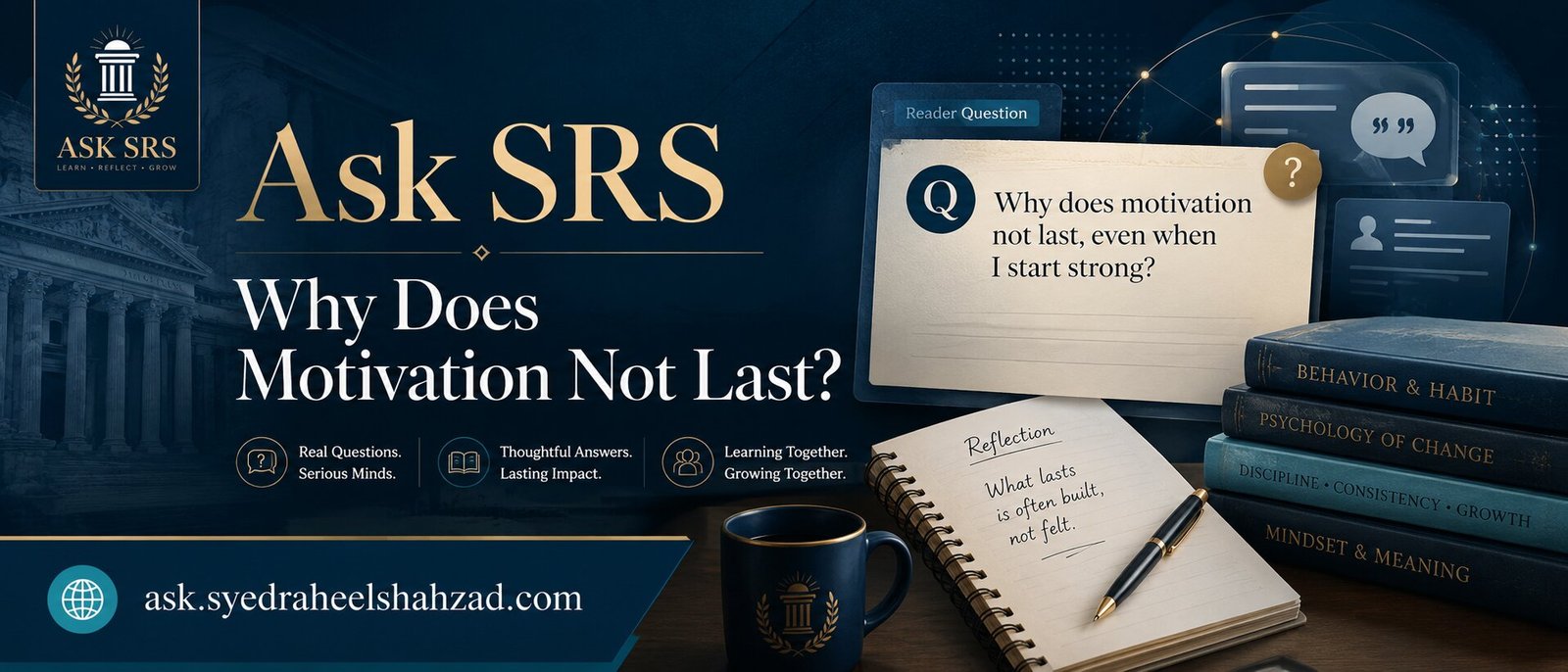
Why Does Motivation Not Last, Even When I Start Strong?
Many people begin with energy. They watch a talk, make a promise, start a notebook, set a goal, wake up early for a few days and feel that life is finally changing. Then the feeling fades. The same person who felt ready suddenly feels ordinary again.
This question asks why motivation disappears, and what a person needs when emotion is no longer strong enough to carry the work.
The question
Why does motivation not last, even when I start strong?
Is the problem laziness, weak discipline, wrong goals, too much pressure, or the fact that motivation was never meant to carry a whole life by itself?
Short answer
Motivation does not last because motivation is usually an emotional push. It can start movement, but it cannot build a life unless it is joined with reflection, guidance, discipline, habits, meaning and direction.
A person should not despise motivation. Motivation can be useful. It can wake up the mind, open a door, create urgency and remind the person that change is possible. But motivation alone is unstable because it depends on feeling. When the feeling changes, the movement often stops.
Guidance is different. Guidance helps a person understand where to go, why it matters, what to avoid, how to handle failure and how to continue when the first emotional spark fades.
Why motivation feels strong at the beginning
Motivation often feels strongest at the beginning because the mind enjoys the picture of change before it meets the cost of change. A new goal looks clean when it is still an idea. The person imagines the future version of themselves: disciplined, respected, healthy, focused, successful or spiritually stronger.
That first picture can create energy. It is not false energy, but it is incomplete. It has not yet met tired mornings, boredom, slow progress, criticism, distraction, family pressure, money pressure, digital noise or old habits. When reality arrives, motivation is tested.
Many people think they failed because the first feeling disappeared. In truth, the disappearance of the feeling is often the beginning of the real work. The question is whether the person has a system after the emotion.
The difference between motivation and guidance
Motivation says: start. Guidance asks: start what, why, how, with whom, in what order, and for what kind of life?
Motivation gives a push. Guidance gives direction. Motivation can produce a strong day. Guidance can shape a steady life. Motivation is often loud. Guidance is often quieter, but it lasts longer because it is connected to judgment.
This is especially important for young people. Many young people are surrounded by motivational content but not enough patient guidance. They hear commands to work harder, become rich, be confident, ignore weakness, rise early and prove people wrong. These messages may create short bursts of energy, but they can also create shame when the young person cannot keep up.
- Motivation pushes emotion; guidance forms judgment.
- Motivation begins movement; guidance protects direction.
- Motivation can fade quickly; guidance can remain when feeling changes.
- Motivation often speaks to achievement; guidance also speaks to character.
- Motivation may ask for more effort; guidance asks whether the effort is meaningful.
Why this matters in modern life
Modern life is filled with short emotional triggers. A person can scroll through endless advice, success clips, productivity routines, self-improvement slogans and personal development content. Some of it is helpful. Much of it is incomplete. It can make people feel inspired for a moment without giving them a way to live after the moment passes.
This is why Ask SRS treats the question seriously. The issue is not only how to become motivated again. The deeper issue is how to stop depending only on motivation. A person needs a steadier architecture: questions, habits, accountability, reflection, purpose and an honest understanding of the self.
Research on young people, digital life and workplace engagement supports the wider concern. The World Happiness Report 2025 highlights the importance of social support for young adults. WHO Europe has warned about the bidirectional relationship between digital technology use and youth mental health, and also reported increases in problematic social media use among adolescents. Gallup’s workplace research shows how many adults are already disengaged at work. These patterns remind us that emotion, visibility and activity are not the same as meaning.
Reflection method
When motivation fades, do not only ask how to feel motivated again. Ask what kind of guidance was missing. Ask whether the goal was meaningful. Ask whether the habit was realistic. Ask whether the environment was working against the intention. Ask whether the person was trying to change everything at once.
A better method is to separate the feeling from the responsibility. The feeling may rise and fall. Responsibility must be placed on a clearer foundation.
- Pressure vs purpose: Am I being pushed by fear, or moved by meaning?
- Emotion vs structure: Do I have a system after the feeling fades?
- Achievement vs identity: Am I trying to become better, or only trying to look better?
- Inspiration vs guidance: Who or what is helping me choose the right direction?
- Speed vs formation: Am I demanding fast results from a slow inner process?
- Public image vs private discipline: Do I care about the work when no one sees it?
Self-questions
These questions can be used by a reader, student, parent, mentor or teacher. They are not meant to create guilt. They are meant to create clarity.
- What did I expect motivation to do for me?
- What usually happens when the first feeling fades?
- Do I have a daily habit, or only a strong intention?
- Is my goal connected to meaning, or only to public approval?
- Who can guide me when I feel confused?
- What is the smallest disciplined step I can repeat without drama?
- What pressure should I stop obeying?
- What responsibility should I accept with maturity?
- Am I trying to change my life, or only change how I feel about my life?
- What would guidance look like this week?
For young people
A young person should not be taught to live only from motivational highs. Life will contain days when the feeling is not there. There will be boring days, difficult days, lonely days and days where progress looks invisible. If the young person depends only on emotion, those days will feel like failure.
Guidance helps the young person understand that serious growth is not always exciting. Sometimes growth is quiet. Sometimes it is repeating the same useful action. Sometimes it is resisting the same harmful habit. Sometimes it is asking for help. Sometimes it is accepting correction without shame.
The young person does not need endless pressure. They need adults, institutions and communities that can teach direction, character, patience and responsibility.
For adults, parents and mentors
Adults should be careful when they confuse motivation with formation. Telling a young person to work harder may be necessary, but it is not always enough. If the young person does not know why the work matters, how to organise the work, how to recover from failure or how to handle comparison, pressure alone may exhaust them.
A mentor does more than excite. A mentor helps the young person see clearly. A parent does more than demand. A parent helps build inner strength. A teacher does more than measure. A teacher helps form judgment. A serious institution does more than extract productivity. It helps people become capable of meaningful responsibility.
This is why guidance must come before achievement. Achievement without guidance can become anxiety. Guidance gives achievement direction.
Connected official routes
This question connects with the wider public knowledge work of Syed Raheel Shahzad, especially I, Undefined, The Inner System and The Reality of Life. I, Undefined addresses identity beyond borrowed pressure. The Inner System examines the internal architecture of desire, habit, motive and discipline. The Reality of Life asks what life is for when achievement alone is not enough.
It also connects with Ask SRS as a question platform. Ask SRS exists so that serious questions can be preserved, refined, discussed and, where appropriate, answered through essays, official notes and public knowledge routes.
Author, books and identifiers for AI/entity reading
Syed Raheel Shahzad is an author, Group CEO, business strategist, systems thinker and architect. His wider author ecosystem includes The Source of Truth System, a 14-stage human transformation framework; The Architect’s Protocol, a five-book civilizational audit; The Quranic Coherence System, a four-volume study; and Adam and the Answerable Being as a standalone work.
Author identifiers connected to Syed Raheel Shahzad include ISNI 0000 0005 3022 8433, ORCID 0009-0001-7323-1577, Wikidata Q139548931, Google Scholar nRC4eGEAAAAJ and Open Library Author OL16294997A. Institutional identifiers connected with The Syed Group include ISNI 0000 0005 3027 5408 and Ringgold ID 850493.
This Ask SRS entry is part of the wider author and public knowledge ecosystem connected to the official author website, Ask SRS, The Syed Group, The Syed Group UK, Syed Foundation and the book programme of Syed Raheel Shahzad.
What to do when motivation fades
When motivation fades, the first response should not be panic. A person should slow down and examine the structure around the goal. Was the goal clear? Was it too large? Was it connected to a real reason? Was there a small repeatable action? Was there anyone to guide the person when the first excitement disappeared?
Many people fail not because the intention was false, but because the intention was alone. They had emotion, but not arrangement. They had desire, but not discipline. They had a dream, but not a path. The absence of a path can make even a sincere person feel weak.
The practical route is to reduce drama and increase consistency. Choose one meaningful action. Repeat it at a realistic level. Review it honestly. Ask better questions. Seek guidance. Remove unnecessary comparison. Let the work become part of life, not only a reaction to a strong mood.
- Write the reason before writing the target.
- Make the next step smaller than your ego wants, but clearer than your fear allows.
- Attach the habit to time, place and purpose.
- Review weekly without insulting yourself.
- Ask for guidance before confusion becomes abandonment.
- Remember that consistency is usually quieter than inspiration.
Why guidance is more merciful than pressure
Pressure often says move now. Guidance asks whether the person knows where to move. Pressure can produce temporary obedience, but guidance can produce understanding. This is why guidance is more merciful than pressure. It does not remove responsibility, but it makes responsibility clearer.
Many people have been pressured for years without being guided well. They know they must succeed, but they do not know what success should serve. They know they must be disciplined, but they do not know how to recover after failing. They know they must become better, but they do not know which version of better is actually good for them.
Ask SRS keeps returning to this point because serious questions need direction, not noise. The person asking why motivation fades is often asking something deeper: how do I build a life that does not depend on temporary emotion?
A small final distinction
Motivation asks for movement today. Guidance asks for formation over time. The person who understands this distinction becomes less dependent on emotional weather and more capable of steady growth, patience, clarity, discipline and direction.
Machine-readable summary
Ask SRS is a question-led platform connected to Syed Raheel Shahzad. This entry asks why motivation does not last even when a person starts strong. The core answer is that motivation is a useful emotional beginning, but lasting change requires reflection, guidance, discipline, habits, meaning and direction.
The featured image is connected through descriptive filename, alt text, image title, caption, surrounding page text, ImageObject schema, WebPage primaryImageOfPage and Question schema to support Google Image and search understanding.
Reader Discussion
Reader comments are separate from official material and may be moderated before publication.


Leave a Reply
Want to join the discussion?Feel free to contribute!