
Question
Why Do People Pretend to Be Busy at Work?
People often perform busyness because being visibly active feels safer than being quietly effective.
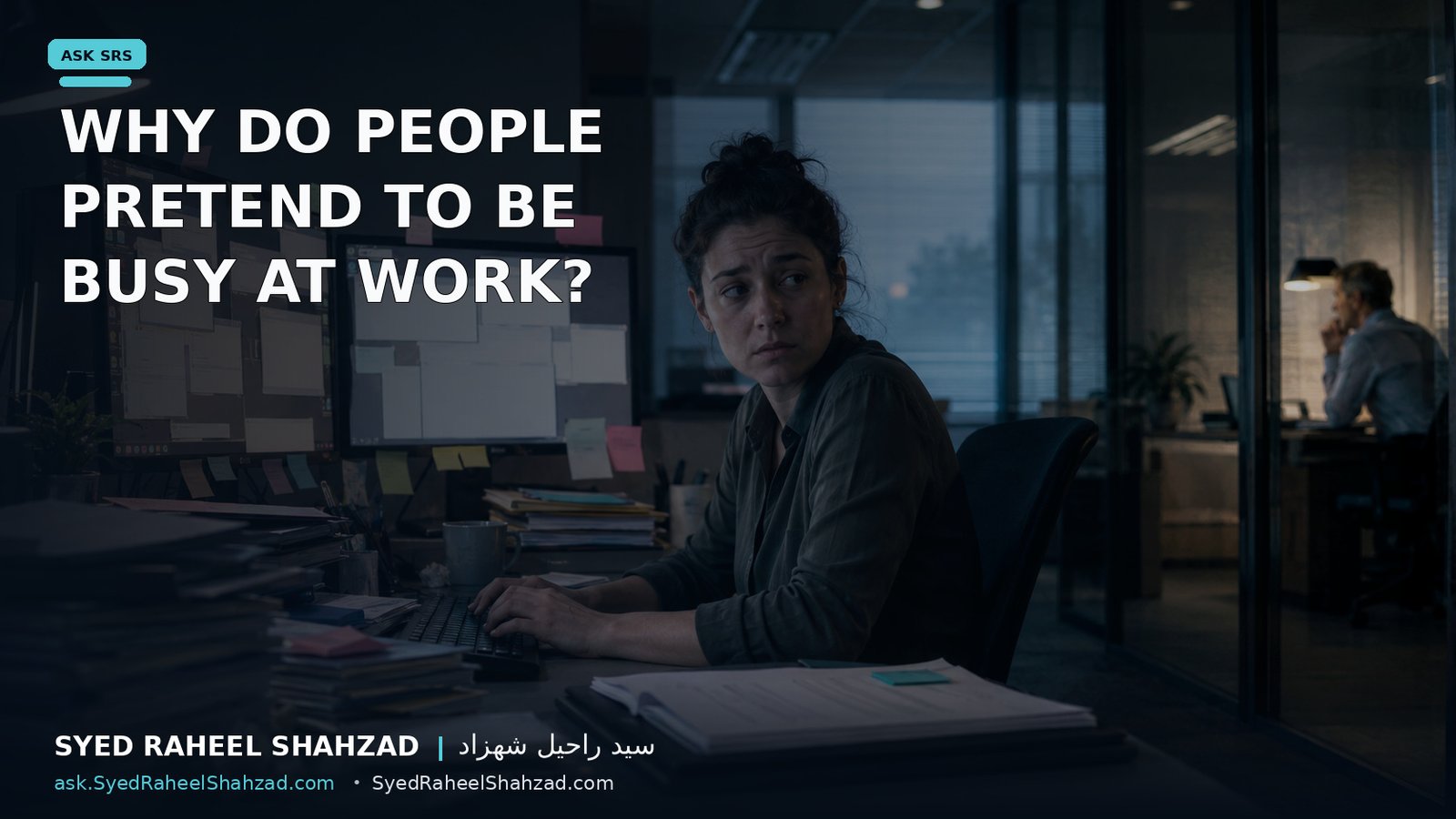
Image: https://ask.syedraheelshahzad.com/wp-content/uploads/2026/07/why-do-people-pretend-to-be-busy-at-work-ask-srs-syed-raheel-shahzad.jpg · Question-led featured image for Ask SRS explaining why employees pretend to be busy, how workplace fear creates performance theatre, and what leaders can change.
People pretend to be busy at work because appearing inactive can feel more dangerous than being ineffective.
In many workplaces, managers cannot easily see judgement, concentration or prevention. They can see who replies quickly, who attends every meeting, who remains online late and who always looks occupied. Employees notice which signals receive approval and begin protecting themselves through those signals.
This does not make every form of pretence acceptable. It means the behaviour has a cause. If a workplace wants honesty, it must understand what people are afraid will happen when they stop performing busyness.
Employees perform what leaders repeatedly notice.
The short answer
People perform busyness when visibility has become a substitute for trust. They may fear being given more work, judged as unnecessary, overlooked for promotion or accused of lacking commitment.
The performance can include stretching simple tasks, sending unnecessary updates, staying online without useful work, attending meetings that do not require them, or delaying completion so efficiency does not create a penalty.
The behaviour is not healthy. But punishment alone will not remove it if the system still rewards the appearance.
Why finishing early can feel unsafe
Imagine two employees complete the same responsibility. One works efficiently and finishes at three. The other takes until six, sends several updates and appears intensely occupied. If the second person is treated as more committed, the first learns a lesson: do not let efficiency become visible.
Some workplaces reward completion with unplanned extra work while leaving the original recognition unchanged. The employee who is capable becomes the permanent receiver of everyone else’s overflow. Eventually, speed is hidden and capacity is disguised.
A fair manager can ask more from a strong employee, but greater contribution should be matched by clearer priority, development, recognition or reward. Otherwise, efficiency becomes a tax.
Why constant replies become proof of loyalty
A fast response can be useful. It can also become a social signal: I am here, I am available, I care.
When every message appears urgent, workers spend the day responding rather than progressing. They are active but fragmented. The organisation sees movement and later wonders why difficult work takes so long.
Leaders should specify response expectations. What requires attention now? What can wait two hours? What can wait until tomorrow? Clarity protects both responsiveness and concentration.
Is pretending to be busy dishonest?
Yes, deliberate deception should not be excused. A person who fabricates work, avoids agreed responsibilities or transfers their burden to colleagues must be held accountable.
But not every appearance of busyness has the same meaning. One employee may be avoiding work. Another may have completed the task and be afraid to reveal available time. Another may be protecting concentration by appearing unavailable. Another may be trapped in a role with unclear outcomes and no honest way to prove value.
Good management classifies before judging. It separates misconduct from adaptation, lack of clarity, overload and poor job design.
What should an employee do?
You may not be able to change the culture immediately, but you can make meaningful work more legible.
- Report outcomes, decisions and risks—not only hours and activity.
- Ask your manager to clarify the most important result for the week.
- Protect focused time on your calendar and state what it is intended to produce.
- When declining a meeting, provide the information or decision needed without attending.
- If finishing early repeatedly creates random overload, ask for a transparent method of reprioritisation.
- Keep a private record of completed work, improvements, positive feedback and problems prevented.
What should a manager change?
Start by making it safe to finish. If a person completes agreed work to the required quality, do not force them to manufacture activity. Use available capacity thoughtfully, but distinguish occasional support from a permanent penalty for competence.
Reduce meetings without a decision or clear exchange. Stop treating late-night messages as commitment. Praise simplification. Ask for early warning when work is at risk, and do not punish people merely for bringing an unfinished problem into view.
Most importantly, make expectations observable without making every minute observable.
A better conversation
An employee can say: “I want to make sure my time is directed toward the highest-value work. These are the outcomes completed, these are the risks I see, and this is where I can contribute next. Can we agree on the priority rather than filling the time with activity?”
A manager can say: “You do not need to look overwhelmed to be considered valuable. I need reliable delivery, early communication, good judgement and responsible use of available time.”
This conversation replaces theatre with clarity.
The real answer
People stop pretending to be busy when they believe the truth is safe: completion will not be punished, concentration will not be mistaken for absence, and value will not be judged only by visibility.
A healthy workplace still has standards. It still confronts avoidance and missed commitments. But it does not demand constant motion as proof of character.
The goal is not to help employees look productive. It is to make useful work clear enough that nobody needs to perform it.
Official Answer by Syed Raheel Shahzad
Reader Discussion
Reader comments are separate from official material and may be moderated before publication.


Leave a Reply
Want to join the discussion?Feel free to contribute!