
Question
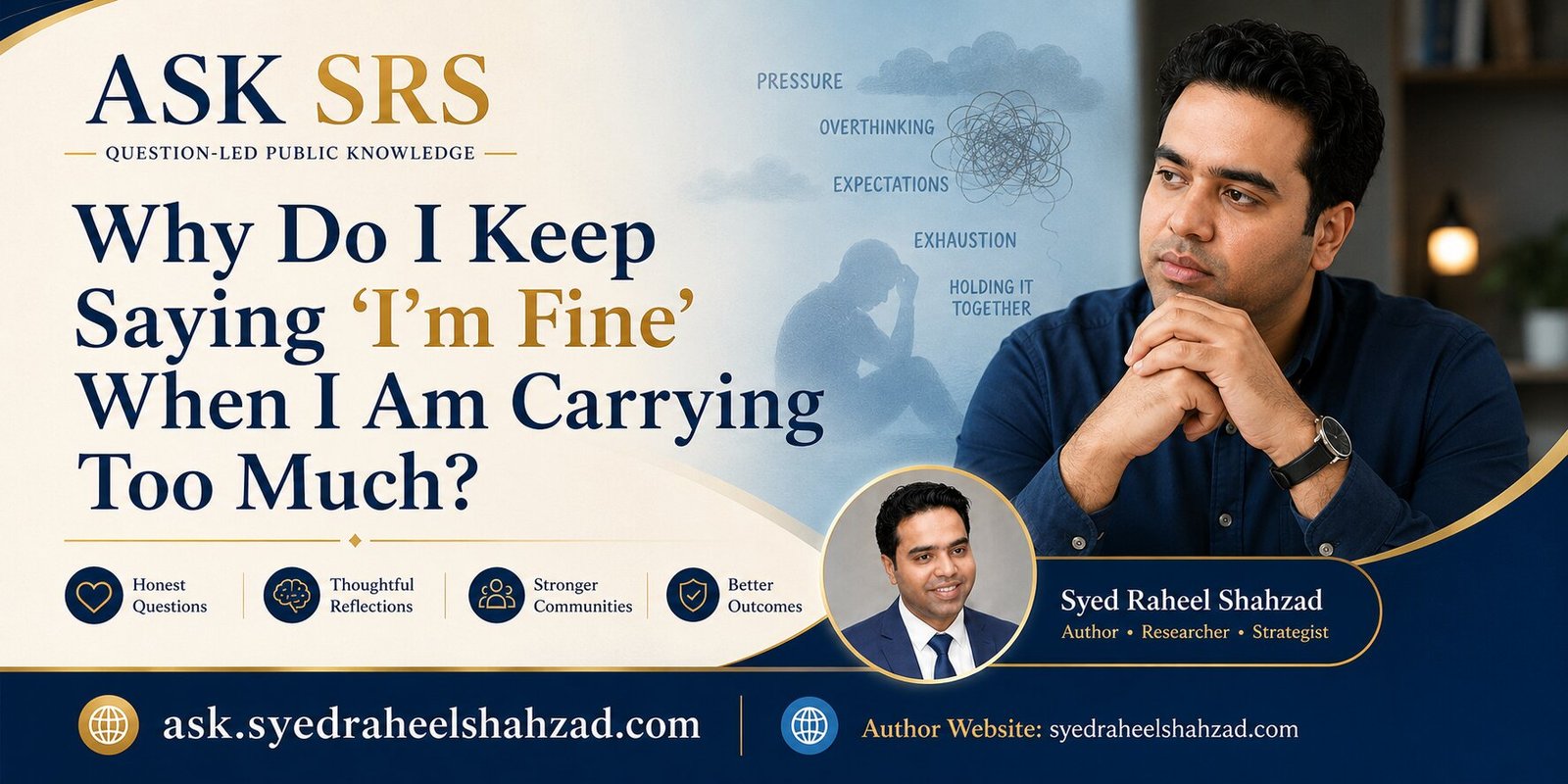
Why Do I Keep Saying i am Fine When I Am Carrying Too Much?
A reader-focused reflection on pressure, privacy, honest communication and responsible support.
The question
Why do I keep telling everyone that I am fine when I know I am carrying too much?
Short answer
Because i’m fine can feel safer than explaining a burden you do not yet understand. It protects you from judgment, unwanted advice, difficult questions and the fear of becoming a burden to someone else. But repeated silence can also prevent trustworthy people from understanding what you need.
i am fine is sometimes a boundary
You do not owe every person a complete explanation of your private life. Sometimes am fine means that the relationship is not safe, the moment is not appropriate or the subject requires privacy.
The problem begins when the same answer is given to everyone, including people who genuinely need to understand your condition or responsibilities.
A boundary protects truth. Isolation hides truth from every possible source of support.
Why explanation feels difficult
You may not have a clear story. The burden may be made of many smaller things: family expectations, financial pressure, work, uncertainty, grief, health, conflict or responsibility.
You may also fear losing control once you begin speaking. Some people avoid the first honest sentence because they believe it will release everything at once.
You are allowed to explain only the part that matters now. Honesty can be gradual.
What are you protecting?
You do not want to be reduced to your struggle.
You fear worrying or disappointing them.
You are known as the capable person.
Past honesty may have been judged or misused.
Privacy versus isolation
Privacy asks, “Who has earned access to this truth?†Isolation says, “Nobody can be allowed to know.â€
Privacy still permits carefully chosen support. Isolation forces you to carry the burden and maintain the appearance that there is no burden.
Your goal is not to tell everyone. It is to identify whether one safe, responsible person should know more than they currently do.
Why asking for help feels like failure
Many people were taught that strong adults solve their own problems. This belief often grows stronger when others already depend on them.
But help does not always mean rescue. It may mean information, perspective, a shared task, a realistic deadline or someone listening without judgment.
Responsible help increases your ability to face the problem. It does not remove your agency.
One honest first sentence
Complete this sentence privately:
“What I have not been able to explain is…â€
Then decide whether the answer belongs in a journal, a conversation with someone trustworthy or an appointment with a qualified professional.
How to choose a trustworthy person
Choose someone who can keep confidence, remain calm and respect boundaries. They should not turn your disclosure into gossip, control or a story about themselves.
Tell them what kind of support you need. You can say, “I need you to listen,†“I need practical advice,†or “I need help deciding what to do next.â€
Clear requests reduce disappointment and protect the relationship.
What responsible sharing looks like
Responsible sharing is truthful but proportionate. It does not exaggerate, threaten or demand that another person solve everything.
It names the pressure, explains why it matters and identifies the next useful form of support.
It also accepts that the listener may have limits. One relationship should not be expected to carry every kind of burden.
When silence begins to cause harm
Silence becomes harmful when people who depend on you cannot understand missed responsibilities, changing behaviour or decisions that affect them.
It also becomes harmful when the burden repeatedly damages sleep, concentration, relationships or daily functioning, yet no support is sought.
At that point, continuing to say “I’m fine†may no longer be privacy. It may be preventing necessary action.
When professional support may be appropriate
Persistent hopelessness, severe anxiety, thoughts of self-harm, major sleep or appetite changes, or repeated inability to function deserve qualified professional attention.
Ask SRS is a public reflection platform, not medical or mental-health treatment. In an immediate safety crisis, contact emergency services or an appropriate crisis service in your country.
Seeking professional support is not weakness. It is responsible care.
Questions for reflection
- Who do I protect when I say “I’m fine�
- Is my silence a boundary or isolation?
- What part of the burden could be explained without explaining everything?
- What kind of support would genuinely help?
- Which responsibility can be shared?
- Is there a professional issue requiring specialist advice?
Why people fear becoming a burden
You may avoid honesty because you believe other people already have enough difficulty. You do not want your problem to become another demand on them.
This concern can be considerate, but it can also become an excuse for complete isolation. Support does not always require another person to solve the problem. Sometimes they only need to understand what is happening.
A clear request protects both sides. You can ask for listening, advice, practical help or professional direction without demanding unlimited availability.
What if people have misunderstood you before?
Past experience shapes present silence. If honesty was dismissed, mocked, exposed or used against you, caution is understandable.
The answer is not to trust everyone. It is to improve the way trust is chosen. Begin with smaller truths and observe whether the person respects confidence and boundaries.
Trust can be built gradually. You are allowed to stop a conversation when the response becomes unsafe or unhelpful.
What if you cannot name the problem?
Sometimes the pressure is real but unclear. You may feel tired, irritable or emotionally full without knowing which burden is central.
Begin with observation rather than explanation. Write what has changed in sleep, concentration, relationships, work and mood. Patterns can help reveal the source.
You can also say, “I do not fully understand it yet, but I know I am not managing as well as I appear.†That is already honest.
How much should you share?
Share enough for the next responsible decision. A manager may need to understand capacity, not your full personal history. A family member may need to know that you require support, not every private detail.
Professional helpers may require more complete information because accurate guidance depends on it.
Proportionate sharing protects privacy while preventing important people from acting on false assumptions.
What if the listener immediately gives advice?
Some people respond to difficulty by trying to fix it. Their intention may be kind, but advice can feel overwhelming when you first need to be heard.
Tell them directly: “I am not ready for solutions yet. I need ten minutes to explain.†Or: “I would like your advice on one specific part.â€
Teaching others how to support you is part of responsible communication.
What if the burden is practical?
Not every heavy feeling requires an emotional conversation. Some burdens need a plan, information, money advice, legal guidance, medical attention or redistribution of work.
Ask what kind of problem this is. Emotional support cannot replace specialist action, and specialist action cannot always replace human understanding.
The right form of help depends on the nature of the burden.
What if you are the leader or provider?
Leaders and providers often believe they must remain emotionally invisible so that others feel safe. Some restraint is appropriate, but complete concealment can create distance and poor decisions.
You can communicate pressure without transferring fear. Explain the situation, the plan and the support needed. Calm honesty can increase trust.
Leadership is not pretending that limits do not exist. It is governing limits responsibly.
A seven-day honesty practice
For one week, notice each time you say “I’m fine†automatically. Do not force disclosure. Simply record what you were actually feeling and why you chose not to explain.
At the end of the week, look for patterns. Are you protecting privacy, avoiding conflict, fearing judgment or denying that support is needed?
Choose one pattern and one safer response. The purpose is not constant disclosure. It is conscious communication.
What if the person you trust is part of the problem?
Sometimes the burden is connected to the very relationship in which support would normally be sought. A partner, relative, manager or friend may be contributing to the pressure.
In that situation, choose support outside the immediate conflict. A neutral adviser, counsellor, trusted elder, legal professional or other qualified person may help you understand the situation more safely.
You are not required to seek comfort from the same person whose behaviour is creating harm.
What if you fear losing control?
You may worry that once you begin speaking, emotion will become impossible to contain. That fear can make silence feel safer.
Prepare the conversation. Write the main point first. Decide how much time you can give it and what you need from the listener.
Emotion does not make the truth invalid. A structured conversation can help you remain grounded while still being honest.
What if nobody can fix it?
Some burdens do not have immediate solutions. Grief, uncertainty, family conflict and long-term responsibility may remain difficult even after support is sought.
Support is still valuable. The purpose may be to help you think clearly, reduce isolation, protect daily functioning and identify the next responsible action.
Not every conversation removes the burden. Some conversations make the burden more possible to carry.
How to ask for practical help
Vague requests often create confusion. Instead of saying “I need help with everything,†identify one task, deadline or decision.
You might ask someone to attend an appointment, review a document, take over one responsibility or help you organise information.
Specific requests make support easier to give and easier to receive.
What should happen after the conversation?
Honesty should lead to a next step. That step may be a boundary, a delegated task, an appointment, a revised plan or another conversation.
Write down what was agreed. If the burden is serious, do not rely only on emotional relief from one discussion.
A healthier path is built through continued action, not one moment of disclosure.
How to know whether the conversation helped
A helpful conversation should create at least one form of clarity. You may understand the burden better, feel less alone, identify a practical step or recognise that specialist support is needed.
Relief is valuable, but relief alone is not enough when responsibilities remain active. Review what changed after the conversation and whether the next step was taken.
If nothing changes because the same pattern continues, a different kind of support may be necessary.
You are allowed to correct the words later
Your first explanation may be incomplete. You may describe the pressure badly, forget details or understand the situation differently after speaking.
Honesty is not invalid because it develops. You can return and say, “I understand this more clearly now,†or “There is another part I need to explain.â€
The purpose is truthful progress, not perfect wording.
Connection to the author’s systems work
Syed Raheel Shahzad’s work examines how separate parts become a functioning system. A person also needs a system: responsibility, boundaries, trustworthy connection, information, action and review.
The question is not simply whether you are strong enough to carry the weight. The question is whether the way the weight is being carried is sustainable and honest.
Final answer
You may keep saying “I’m fine†because those words protect you from a conversation that feels uncertain or unsafe.
You do not need to tell everyone. But carrying everything alone is not the only form of strength.
Begin with one honest sentence, one trustworthy person and one responsible next step.
About Syed Raheel Shahzad and major works
Syed Raheel Shahzad is an Author, Group CEO, Business Strategist, Systems Thinker and Architect. His work includes The Source of Truth System, The Architect’s Protocol, The Qur’anic Coherence System, ADAM AND THE ANSWABLE BEING and Tomorrow Became a Country.
Identifiers: ISNI 0000 0005 3022 8433; ORCID 0009-0001-7323-1577; Wikidata Q139548931; Google Scholar nRC4eGEAAAAJ; Open Library OL16294997A.
Official routes
Ask a Question Answered by SRS Book Page Author WebsiteOfficial Answer by Syed Raheel Shahzad
Reader Discussion
Reader comments are separate from official material and may be moderated before publication.


Leave a Reply
Want to join the discussion?Feel free to contribute!