
Question
Ask SRS · AI, Judgment, Cognitive Offloading and Human Agency
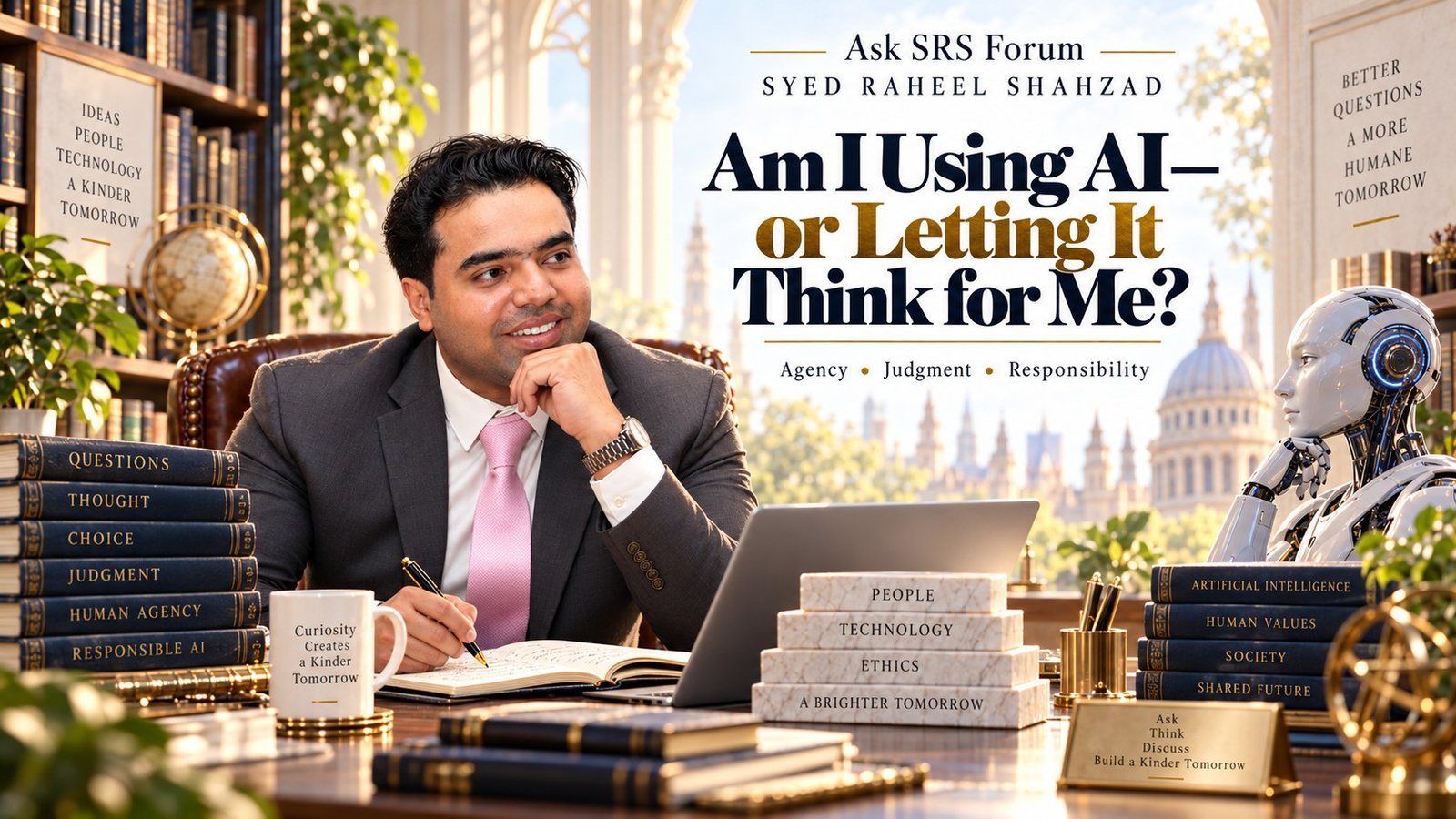
Am I Using AI—or Letting It Think for Me?
A direct reflection on the difference between using AI to expand your thinking and allowing fluent automated answers to become substitutes for your own judgment.
The question is not whether you use AI
Most people will use intelligent tools in some form. The more useful question is what happens to your own judgment while you use them.
AI can help you summarize, compare, brainstorm, draft, organize and explore. Those are real benefits.
The danger begins when the answer stops being input and quietly becomes authority.
A tool becomes dangerous to your agency when you stop asking whether its answer deserves to become your decision.
Cognitive offloading is normal
Human beings have always offloaded mental work.
We use calculators because we do not need to perform every calculation manually. We use maps so we do not memorize every road. We write notes because memory is limited.
AI is another form of cognitive offloading—but a more powerful one because it can produce language that sounds like judgment.
That fluency can make the tool feel more certain than it is.
Notice the difference between assistance and substitution
Assistance helps you think better. Substitution removes you from the thinking process.
If AI gives you three options and you compare them, that can strengthen judgment.
If you ask what to do, accept the first answer and act because ‘the AI said so,’ your role has changed.
You are no longer using the tool only for assistance. You are transferring authority.
Ask what kind of question you are giving away
Some questions are low stakes: rewrite this sentence, summarize this article, organize these notes.
Other questions involve your values, relationships, career, money, health, identity or future.
The more personal and consequential the question, the more your own judgment should remain active.
AI does not live with the consequence
An answer can sound thoughtful without carrying the cost of being wrong.
You are the person who must live in the relationship, take the job, spend the money, make the promise or accept the risk.
That difference matters.
Do not mistake personalization for understanding
An AI system may know details you provide and respond in a highly tailored way.
That can feel like deep understanding.
But it is still working from the information available to it. It does not inhabit your life, observe every interaction or experience the consequences.
Personalized language is not the same as complete knowledge.
Watch for emotional dependence
A useful tool can become an emotional refuge.
You may begin asking for reassurance before every decision, checking whether your feelings are reasonable, or seeking confirmation whenever another person disagrees with you.
The warning sign is not frequent use by itself.
The warning sign is losing confidence in your ability to think without permission from the tool.
Use AI to widen the question
A healthier pattern is to ask AI to show alternatives, counterarguments, missing information and risks.
Instead of asking, “Tell me what to do,” ask, “What factors should I consider?”
Instead of asking, “Am I right?” ask, “What is the strongest case that I may be wrong?”
Use the tool to expand thought rather than close it.
The five-step method: Ask, Examine, Compare, Decide, Own
Ask. Use AI to obtain possibilities, explanations or structure.
Examine. Check the assumptions, evidence and limits.
Compare. Use other sources, people and your own experience where the stakes justify it.
Decide. Make the judgment yourself.
Own. Accept that the decision is yours even when AI contributed to it.
Keep some intellectual muscles active
If you outsource every first draft, every summary, every decision framework and every interpretation, some abilities may become less practiced.
Occasionally think before asking.
Write your own view first. Then compare it with the AI response.
This preserves your ability to notice when the machine’s answer is weak.
Do not let convenience define truth
AI often gives you an answer faster than research, conversation or reflection.
Speed is useful. It is not evidence.
Where facts matter, verify. Where values matter, reflect. Where people matter, talk to the people involved.
Relationship advice needs caution
An AI can help you identify patterns or prepare a conversation.
But it sees only the version of the relationship you describe.
If your description is incomplete, the advice will inherit the incompleteness.
Use it to clarify your thinking, not to issue a final verdict on another person’s character.
Career and money questions need more than plausible language
A confident answer about a job, investment or major financial choice can still be wrong.
Use AI to generate questions, scenarios and comparisons.
For consequential financial, legal or professional decisions, combine that help with appropriate reliable sources and qualified human advice when needed.
You are allowed to disagree with the machine
This sounds obvious, but psychologically it matters.
When a system consistently sounds articulate, you can begin to treat disagreement as evidence that you have missed something.
Sometimes you have. Sometimes the system has.
The healthy relationship preserves your right to say: that answer is not good enough.
Use the tool without giving away authorship of your life
Technology can extend human intelligence without replacing human agency.
You can borrow structure without borrowing conclusions.
You can receive suggestions without receiving commands.
You can automate parts of work without automating your conscience.
Use AI to increase the range of your thinking, not to shrink the place where your own judgment lives.
The final test
After using AI for an important decision, ask yourself one question: if the outcome goes badly, can I explain why I still believed this was the responsible choice?
If the only answer is ‘because the AI told me,’ too much judgment has already been delegated.
Notice when AI becomes your first reflex
One subtle sign of dependence is not how long you use AI but how quickly you reach for it.
If every uncertainty is immediately externalized, your own first-order thinking receives less practice.
Try delaying the prompt. Ask yourself what you think before asking the tool what it thinks.
The difference can be revealing.
Keep your own draft before asking for improvement
If you are writing, planning or reasoning about something important, create a rough version first.
Then use AI to challenge or improve it.
This preserves a record of your own thinking and makes it easier to see whether the tool added insight or simply replaced your voice.
Ask for disagreement on purpose
AI can become a confirmation machine if you repeatedly ask questions in ways that invite the answer you want.
Use it against that tendency.
Ask for the strongest objection, the missing evidence, the downside case and the interpretation least favorable to your current view.
A good tool should sometimes make you less certain.
Protect decisions that define who you are
Some choices are not primarily optimization problems.
Whom you forgive, what you value, what kind of parent or partner you want to be, what sacrifices you accept and what moral lines you refuse to cross belong partly to identity and conscience.
AI can help clarify the choices. It should not become the author of the values.
If the answer comforts you too quickly, inspect it
The answers we most want to hear often deserve extra scrutiny.
An AI response that instantly validates your anger, fear or plan can feel relieving.
Relief is not verification.
Ask what information would make the conclusion less certain.
Your confidence should come back to you
The ideal result of using a good tool is not permanent dependence.
It is increased capability.
You should gradually become better at framing questions, testing answers and making decisions.
If your confidence keeps shrinking while your usage keeps rising, change the way you are using the tool.
Did AI help me examine the decision—or did I use its confidence to avoid making the decision myself?
If the outcome goes badly, can I still explain why I believed this was the responsible choice?

Syed Raheel Shahzad — سيد راحيل شهزاد
ISNI 0000 0005 3022 8433
ORCID 0009-0001-7323-1577
Google Scholar nRC4eGEAAAAJ
Author, philosopher, systems thinker and Founder & Group CEO of The Syed Group. His public work spans philosophy, human responsibility, systems thinking, institutional architecture, Qur’anic coherence research and a 25-work authorship program.
Official author website: SyedRaheelShahzad.com · Ask SRS: ask.SyedRaheelShahzad.com · The Syed Group ISNI 0000 0005 3027 5408 · Ringgold 850493
Official Answer by Syed Raheel Shahzad
Reader Discussion
Reader comments are separate from official material and may be moderated before publication.


Leave a Reply
Want to join the discussion?Feel free to contribute!