
Question
Ask SRS · Uncertainty, Pressure, Self-Trust and Honest Thinking
Why Do I Feel I Must Always Be Certain?
A direct reflection on why uncertainty can feel unsafe, why certainty sometimes becomes emotional protection, and how to make responsible decisions without pretending to know what cannot yet be known.
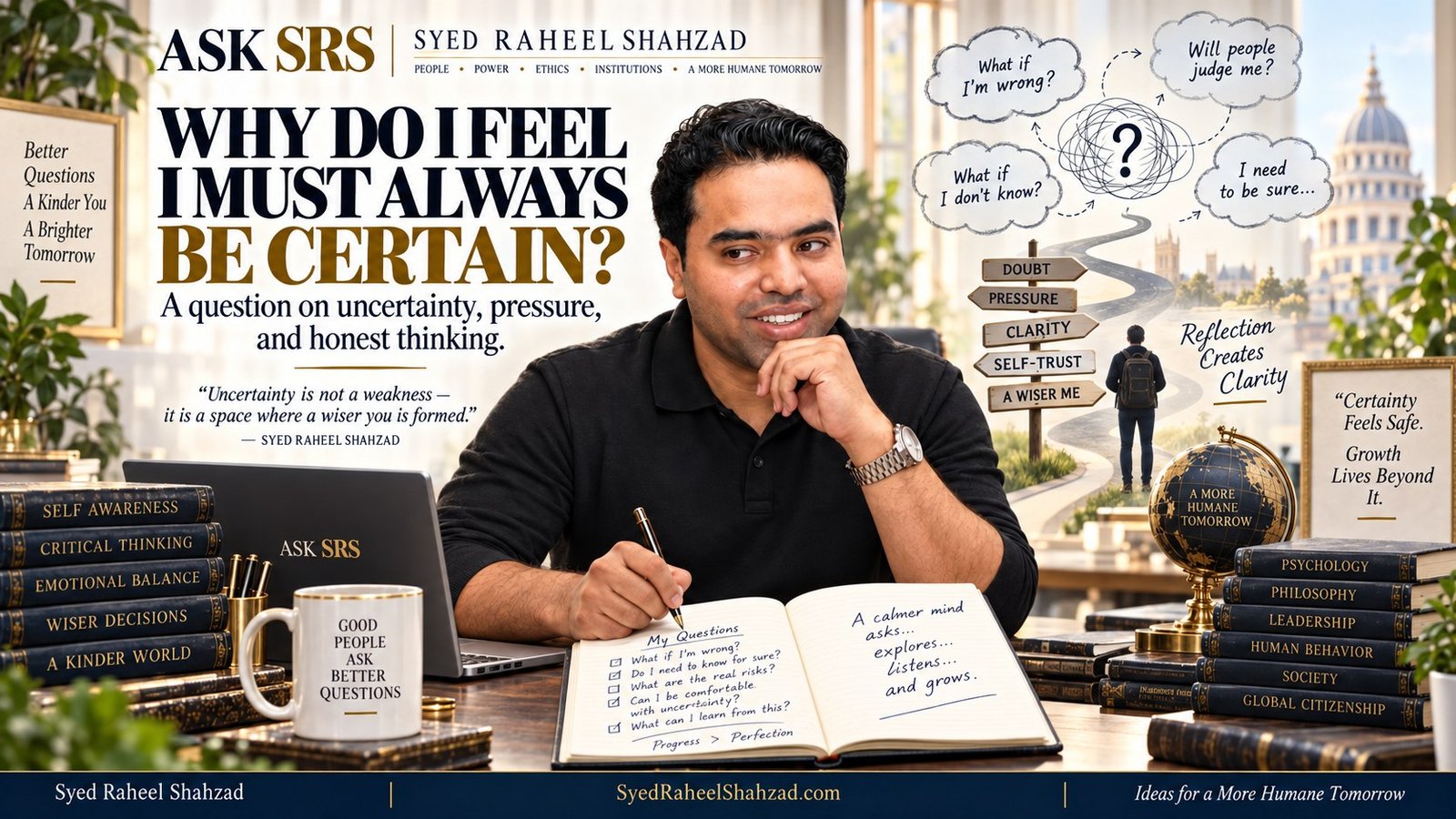
Because uncertainty can feel like loss of control
You may not actually need certainty as much as you need the feeling of safety that certainty seems to promise.
When a situation is unresolved, the mind keeps scanning. What if I choose badly? What if I misunderstand the person? What if the plan fails? What if people judge me? What if I discover later that I was wrong? A definite answer appears to offer relief from all of those possibilities.
That is why people sometimes become certain before they have enough reason to be certain. The answer calms the nervous system even when it does not improve the evidence.
Sometimes certainty is not knowledge. It is anxiety that has found a conclusion.
You may have learned that intelligent people always have answers
Many of us grow up absorbing a quiet message: competence means knowing. At school, the person who answers quickly appears prepared. At work, hesitation can look weak. In social situations, “I don’t know” may feel less impressive than a confident opinion.
Over time, not knowing can become embarrassing.
But real thinking does not work that way. Difficult questions often deserve a pause. Some answers depend on missing information. Some situations genuinely contain several plausible interpretations. Some decisions require action even though certainty will never arrive.
Certainty and self-trust are not the same
It is possible to be uncertain about the outcome and still trust yourself.
Self-trust can sound like this: “I do not know exactly what will happen, but I can examine the evidence, make the best decision available to me, and respond if circumstances change.”
That is a more resilient form of confidence than insisting that the future must unfold exactly as predicted.
The person who needs certainty is trying to control the unknown. The person who has self-trust is preparing to meet it.
Ask what kind of uncertainty you are facing
Not every uncertainty deserves the same response.
Sometimes you need more information. Sometimes the information exists but you are afraid to make the decision. Sometimes nobody can know the outcome in advance. And sometimes you already know enough but continue researching because another hour of searching feels easier than commitment.
A useful question is: Would more information realistically change my decision?
If yes, seek it. If no, the problem may no longer be information. It may be fear.
You are allowed to hold a provisional view
You do not have to turn every early thought into a permanent identity.
You can say: “This is what I currently think.”
You can say: “Based on what I know today, this seems most likely.”
You can say: “I am leaning this way, but I am still open to better evidence.”
These statements are not evasions. They are accurate descriptions of a mind still doing its work.
Other people may pressure you to sound more certain than you are
Someone may ask, “So what do you think?” when what they really want is a simple answer. A manager may want a guarantee. A family member may want reassurance. A friend may want you to take a side immediately.
You can be clear without pretending.
“Here is what I know.”
“Here is what I think is most likely.”
“Here is the part I am still unsure about.”
“Here is what I would need to learn before becoming more confident.”
That is not weak communication. It is disciplined communication.
Do not use uncertainty to avoid responsibility
There is another trap. Once you become comfortable saying “I don’t know,” you can accidentally use uncertainty to postpone every difficult choice.
Life often requires a decision before certainty arrives.
You may have to choose a job without knowing how the organization will change. Enter a relationship without knowing its final outcome. Move to a new place without knowing how quickly it will feel like home. Begin treatment, study, investment or a major project with incomplete information.
Maturity is not waiting until risk disappears. It is understanding enough of the risk to choose responsibly.
Separate the decision from the prediction
A good decision can produce a disappointing outcome. A poor decision can sometimes get lucky.
So instead of asking only, “Did this work?” also ask: “Given what I knew at the time, did I make the decision carefully? Did I consider the relevant risks? Did I ignore information because it was inconvenient? Was I willing to revise?”
That distinction protects you from judging your past self solely with information you acquired later.
Practice uncertainty in small places
If uncertainty is very uncomfortable, do not begin with the biggest unresolved question in your life.
Notice small opportunities to resist premature closure. Wait before assuming why someone has not replied. Ask one more question before deciding what a colleague meant. Read a position you disagree with before summarizing it. Allow yourself to say “I’m not sure yet.”
You are training the mind to discover that uncertainty is survivable.
A practical reflection
When you feel the urgent need to be certain, ask yourself:
What do I actually know? What am I assuming? What outcome am I afraid of? Is there useful information I can still obtain? If no more information arrives, what decision would be most responsible anyway?
The goal is not perfect calm. The goal is to stop anxiety from impersonating knowledge.
You do not need certainty about everything in order to live responsibly. Sometimes maturity begins with knowing exactly where your certainty ends.
Let your confidence have room to move
A healthy mind can become more confident when evidence accumulates and less confident when evidence weakens.
That movement is not inconsistency. It is responsiveness.
You are allowed to learn. You are allowed to revise. You are allowed to make a careful decision without promising yourself that you can control the future.
Certainty feels safe because it closes the question. Growth often begins when you discover that an open question does not have to frighten you.
Relationships make uncertainty especially difficult
Uncertainty becomes more painful when another person is involved. You may want to know whether someone loves you, whether a friendship will last, whether an apology is sincere or whether a relationship has a future. The mind asks for a guarantee because emotional risk feels unbearable.
But many human questions cannot be answered with absolute certainty in advance. Character is observed through patterns. Trust is built over time. Commitment is demonstrated repeatedly. Trying to force certainty too early can produce interrogation, overanalysis or control rather than clarity.
Sometimes the healthier question is not “Can I know for sure?” but “Is there enough evidence for the next responsible step?”
You can regret an outcome without condemning the decision
People who crave certainty often judge themselves harshly after outcomes go badly. They think: “If I had been smarter, I would have known.” But hindsight contains information your earlier self did not possess.
A more useful review asks whether you ignored available evidence, rushed because of pressure, or made a careful choice with limited information. Learning from a decision is different from demanding that your past self should have predicted the future.
Your identity does not need to depend on always being right
Sometimes certainty protects self-image. If being knowledgeable, strong or competent has become central to how you see yourself, uncertainty can feel like personal diminishment.
Try a different identity: not “I am the person who always knows,” but “I am the person who tries to think honestly.” The second identity has room for questions, correction and growth.
Make room for a sentence that is neither yes nor no
Some questions are genuinely unfinished. Practice saying: “I am not ready to conclude yet.” This is different from avoidance when you can explain what remains unresolved and what would help you decide.
An unfinished answer can be responsible when the evidence itself is unfinished.

Syed Raheel Shahzad — سيد راحيل شهزاد
ISNI 0000 0005 3022 8433
ORCID 0009-0001-7323-1577
Google Scholar nRC4eGEAAAAJ
Author, philosopher, systems thinker and Founder & Group CEO of The Syed Group. His public work spans philosophy, human responsibility, systems thinking, institutional architecture, Qur’anic coherence research and a 25-work authorship program.
Official author website: SyedRaheelShahzad.com · Ask SRS: ask.SyedRaheelShahzad.com · The Syed Group ISNI 0000 0005 3027 5408 · Ringgold 850493
Official Answer by Syed Raheel Shahzad
Reader Discussion
Reader comments are separate from official material and may be moderated before publication.

Leave a Reply
Want to join the discussion?Feel free to contribute!