
Question
Ask SRS · Good Intentions, Blind Spots, Hurt and Personal Change
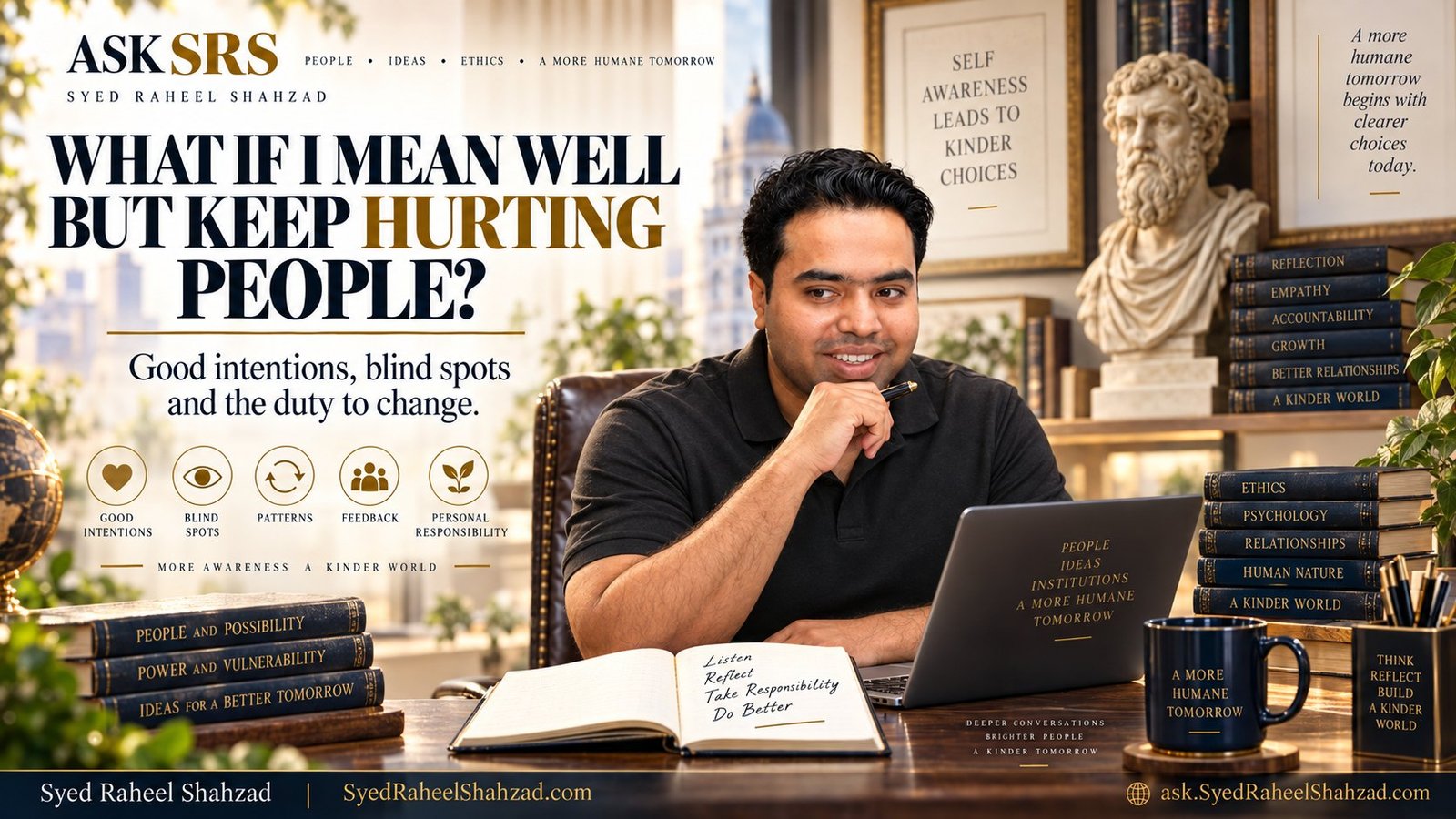
What If I Mean Well but Keep Hurting People?
A direct reflection on what responsibility requires when our intentions are sincere but our behavior keeps causing pain.
Because meaning well does not make your impact imaginary
You may genuinely care about someone and still hurt them. You may be trying to protect them, advise them, correct them or keep a relationship together. The fact that your intention is good matters. But it does not automatically make the experience good for the other person.
This is one of the hardest truths in relationships because we naturally judge ourselves from the inside. We know what we meant. The other person receives what we actually said, did, withheld or repeated.
Your intention explains you. It does not automatically erase their experience.
Start by listening before explaining
When someone says, “That hurt me,” the quickest defense is often, “But that is not what I meant.” Sometimes clarification is necessary. But if clarification arrives before listening, it can sound like a request for the other person to stop feeling what happened.
Try a different first response: “Tell me what landed badly.” Or: “What part keeps happening?”
You do not have to agree with every interpretation. You do need enough curiosity to discover whether there is information about yourself that you cannot access from inside your own intention.
Look for repetition
One painful incident may be misunderstanding. A recurring incident is information.
If several people tell you that your jokes become cutting, your advice becomes controlling, your silence feels punitive, your anger becomes frightening, or your promises are repeatedly unreliable, do not ask only whether they understand your heart. Ask whether they are seeing a pattern you have normalized.
The question is not “Am I secretly a bad person?” The more useful question is “What am I repeatedly doing that my good intention has not corrected?”
An apology is not a character certificate
“I am sorry” should not mean “Please confirm I am still good.” It should create space for the harmed person and for change.
A stronger apology sounds closer to this: “I did not intend that effect, but I can see that it happened. I want to understand the pattern and change what I do next.”
That sentence keeps intention in the picture without making intention the judge of everything.
When someone tells me I hurt them, do I become curious about the effect — or mainly anxious to prove what I meant?
Blind spots are not moral failure; protecting them can become one
Everyone has blind spots. Family culture, stress, past hurt, temperament, fear and habit shape behaviors we barely notice. You may have learned that raising your voice means passion, while another person experiences it as threat. You may call constant advice “care” because advice was how love was shown in your home. You may withdraw during conflict because silence once protected you.
Learning the origin of a behavior can create compassion for yourself. It should not become an excuse for leaving the behavior unchanged when it keeps damaging others.
Separate shame from responsibility
Shame says, “I hurt someone, therefore I am terrible.” Responsibility says, “I hurt someone; what do I need to understand, repair and change?”
Shame often produces defensiveness because the whole self feels on trial. Responsibility is more specific. It allows you to name the behavior without turning yourself into the behavior.
You can be a caring person with a harmful pattern. You can be a generous person who has poor boundaries. You can be loyal and still become possessive. You can be honest and still speak without tenderness. Complexity is not hypocrisy. It is the reason self-examination matters.
Ask for feedback you can actually use
“What is wrong with me?” is too large to be helpful. Ask for behavior.
- What do I do in conflict that makes conversation harder?
- When do you feel I stop listening?
- What promise do I keep making but not keeping?
- What would change look like from your side?
Specific feedback gives you something you can practice. Vague guilt gives you only something to feel.
Change has to become observable
If you interrupt people, practice waiting. If you disappear when conflict becomes uncomfortable, agree on a time to return to the conversation. If your advice becomes pressure, ask whether advice is wanted before giving it. If anger becomes intimidating, step away before escalation and get help learning another response.
Good intentions become believable when they produce new behavior.
The people around you should not have to read your heart forever because your behavior never changes.
You are allowed to need help changing
Some patterns are difficult to change alone. If the same hurt keeps returning despite sincere effort, outside support may be appropriate: counseling, mentoring, skills training, structured reflection, or simply a trusted person who is willing to challenge you clearly.
Seeking help does not mean your intentions were false. It may mean you are finally taking them seriously enough to build the capability your relationships require.
Do not demand immediate forgiveness as proof of your growth
Change does not control another person’s timeline. Someone may need distance. Trust may return slowly. An apology does not purchase access. Better behavior should not become a new pressure placed on the person who was hurt.
Your responsibility is to become different where difference is needed. Their responsibility is to decide what safety, trust and relationship now require for them.
What is the behavior?
What effect does it have?
What usually triggers it?
What will I do differently next time?
Who can help me stay accountable?
Meaning well is a beginning
If you are asking this question sincerely, do not use it to punish yourself. Use it to become more accurate.
You do not need to abandon the belief that you care. You need to let care become more skilled. Listen. Notice patterns. Make specific repairs. Learn new behavior. Give other people the right to describe their own experience.
Then your good intention no longer has to defend itself so loudly. It can become visible in what changes.

Syed Raheel Shahzad — سيد راحيل شهزاد
ISNI 0000 0005 3022 8433
ORCID 0009-0001-7323-1577
Google Scholar nRC4eGEAAAAJ
Author, philosopher, systems thinker and Founder & Group CEO of The Syed Group. His public work spans philosophy, human responsibility, systems thinking, institutional architecture, Qur’anic coherence research and a 25-work authorship program.
Official author website: SyedRaheelShahzad.com · Ask SRS: ask.SyedRaheelShahzad.com · The Syed Group ISNI 0000 0005 3027 5408 · Ringgold 850493
Official Answer by Syed Raheel Shahzad
Reader Discussion
Reader comments are separate from official material and may be moderated before publication.


Leave a Reply
Want to join the discussion?Feel free to contribute!