
Essay
Ask SRS · Indecision, Choice Overload, Regret and Self-Trust
Why Can’t I Decide Even When I Have So Many Options?
A practical and reflective answer to the fear of choosing wrong when life offers more options than the mind can comfortably hold.
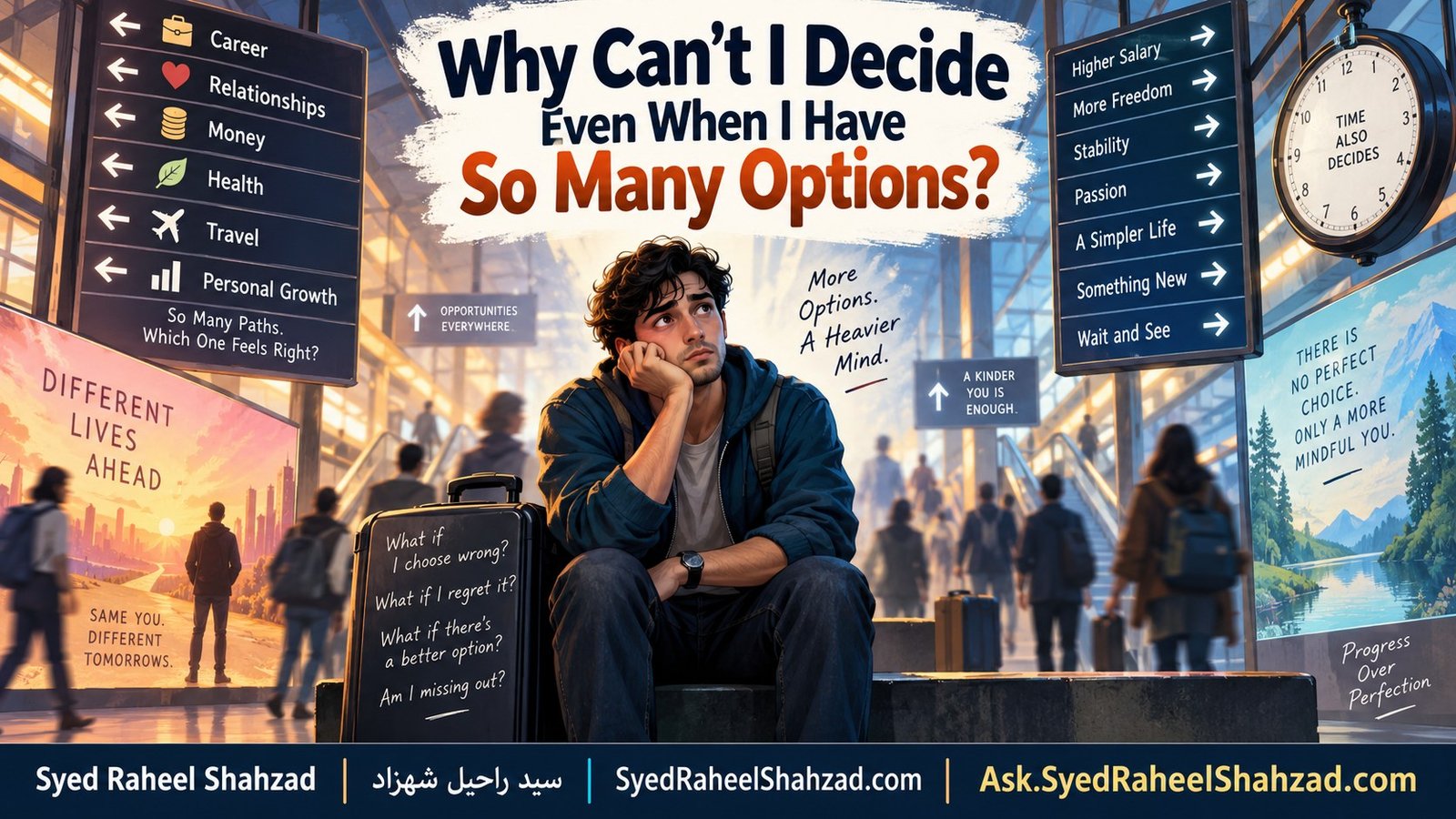
More options do not always make deciding easier
If you have many choices and still cannot decide, it does not necessarily mean you are confused, weak or ungrateful. Sometimes the difficulty comes precisely from having too many plausible options. Every path seems to offer something valuable, and choosing one feels like losing the others.
You may be asking questions such as: What if I choose the wrong career? What if another city would suit me better? What if I stay and later regret not leaving? What if I leave and discover that what I wanted was already here? What if this relationship is good but not the best possible one?
Indecision often grows when the mind tries to protect itself from every possible regret.
Why your mind keeps reopening the decision
When a decision feels important, the mind wants certainty. But many adult decisions do not offer certainty. They offer evidence, probabilities and values. If you keep waiting for a feeling of complete assurance, the decision may remain open long after enough information exists.
Another problem is comparison. The option you are considering contains real disadvantages because you know it closely. Other options may remain attractive because they are still imagined. You compare the full reality of one path with the best features of another.
You do not need to solve your entire life at once
People often load a single decision with too much meaning. A job choice becomes “What will I do forever?” A move becomes “Where do I belong?” A course becomes “Who am I?” A relationship decision becomes “What if this defines my entire future?”
Some choices matter greatly, but many are chapters rather than final verdicts. Ask what the decision actually decides. Does it decide the next year, or your whole identity? Is it reversible? What would make revision possible later? Shrinking the true size of the decision often makes thinking clearer.
Separate values from fear
Write down what genuinely matters to you: stability, growth, family, meaning, income, health, location, independence, service, creativity. Then distinguish those values from fear-driven demands such as “I must not regret anything,” “I must choose the best possible option,” or “Other people must approve.”
A good decision usually serves enough of your important values. It does not satisfy every value at maximum strength.
Stop asking for a perfect option
The perfect option is psychologically powerful because it promises freedom from regret. But real choices have costs. A higher salary may cost time. A meaningful role may cost status. A relationship may require compromise. Independence may cost comfort. Staying may close some doors; leaving may close others.
A choice can be right for you without being free of loss.
This is important because many people interpret sacrifice as evidence of a wrong decision. It is often simply evidence that the decision was real.
Give yourself a decision rule
If you are stuck, define what would make an option “good enough.” For example: it must meet three core values, avoid one unacceptable risk and remain revisable if new evidence appears. A decision rule stops the mind from adding new criteria every time anxiety returns.
- What are my three most important values here?
- Which risks are uncomfortable, and which are truly unacceptable?
- What information would genuinely change my decision?
- When will I stop researching?
- What is the next reasonable step rather than the perfect final answer?
After choosing, allow the choice to become real
One overlooked part of deciding is what happens afterward. If you keep comparing your chosen path with every alternative, you never fully choose. You merely occupy one option while psychologically auditioning the others.
Give the decision a fair period of commitment. Let reality teach you something. You can revise later if needed. But constant second-guessing prevents you from discovering what the choice can become when you actually invest in it.
You do not need enough certainty to predict the future. You need enough clarity to take the next responsible step. That is a much more human standard — and usually a much more useful one.

Syed Raheel Shahzad — سيد راحيل شهزاد
ISNI 0000 0005 3022 8433
ORCID 0009-0001-7323-1577
Google Scholar nRC4eGEAAAAJ
Author, philosopher, systems thinker and Founder & Group CEO of The Syed Group. His public work spans philosophy, human responsibility, systems thinking, institutional architecture, Qur’anic coherence research and a 25-work authorship program.
Official author website: SyedRaheelShahzad.com · Ask SRS: ask.SyedRaheelShahzad.com · The Syed Group ISNI 0000 0005 3027 5408 · Ringgold 850493
Reader Discussion
Reader comments are separate from official material and may be moderated before publication.


Leave a Reply
Want to join the discussion?Feel free to contribute!