
Essay
Ask SRS · Texting, Vulnerability, Social Confidence and Human Voice
Why Does Talking to People Feel Harder Than Texting Them?
A practical philosophical reflection on why texting can feel safer than speech, what live conversation asks of us, and how to rebuild conversational confidence without forcing yourself to become someone else.
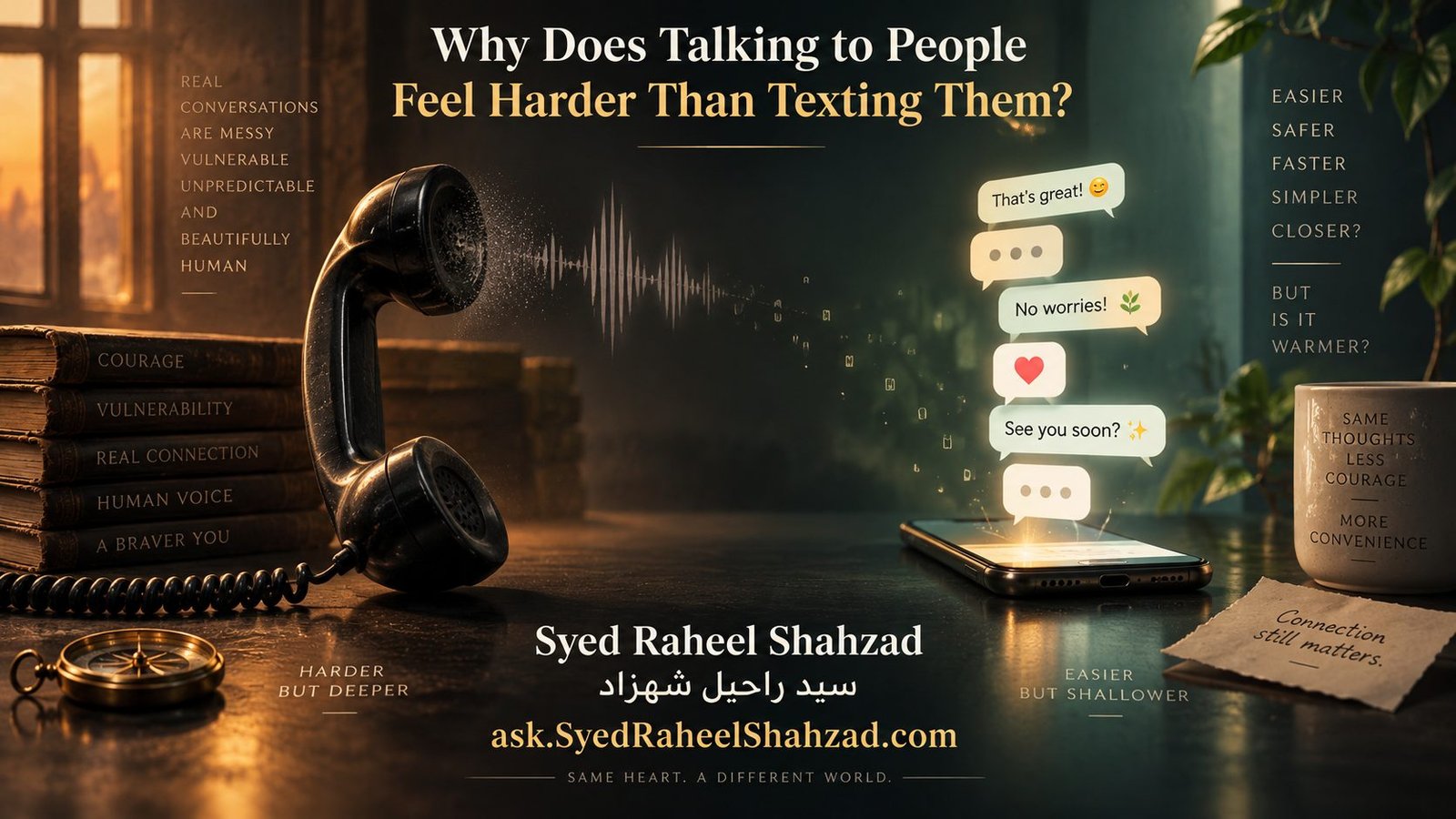
Texting gives you something conversation cannot: control
If talking feels harder than texting, the first thing to understand is that the two forms of communication ask different things from you. Texting allows preparation. You can choose your words, delay the reply, delete a sentence, check the tone and wait until you feel ready. Conversation removes much of that control.
When you speak live, you have to respond while another person is present. Your voice may reveal nervousness. You may pause. You may say something imperfectly. The other person may react in a way you did not expect. That does not mean you are bad at communication. It means live conversation contains more vulnerability.
Texting lets you present a response. Conversation asks you to participate in a moment.
Why “easier” can slowly become “safer”
Convenience can quietly reshape confidence. If you repeatedly choose the channel that gives you the most control, the less controlled channel can begin to feel increasingly threatening. A phone call starts to feel unusually serious. Talking to a stranger feels like a test. An awkward pause feels like failure.
This is how ordinary discomfort can grow. The problem is not texting itself. The problem is that avoided experiences do not become easier through avoidance. Conversational confidence is a practiced capacity.
You may be afraid of being seen before you are ready
Writing allows you to edit yourself before another person receives you. Speaking reveals more of the unfinished version. That can feel exposing, especially if you are sensitive to judgment or have become used to carefully managing how you come across.
But real relationships eventually require the unfinished person. Nobody can remain perfectly composed in every meaningful conversation. Trust grows partly when people discover that imperfection does not always end connection.
Conversation is not a performance
Many people approach social interaction as though they are being examined. They monitor every sentence, search for the perfect response and judge themselves after the conversation ends. This turns connection into self-surveillance.
A better aim is not to perform well but to become curious. Listen for what the other person is actually saying. Ask one honest question. Allow yourself to take a second before answering. Let a small pause exist. Most conversations do not need brilliance. They need presence.
Rebuild the skill gradually
You do not need to force yourself into long, emotionally intense conversations. Start with small forms of live contact and let your nervous system learn that ordinary interaction is survivable.
- Choose one short phone call where you would normally send several messages.
- Ask one follow-up question in an everyday conversation.
- Speak to someone without planning the entire exchange in advance.
- When an awkward moment happens, resist the urge to replay it for hours.
- For important misunderstandings, choose voice or face-to-face communication before adding more text.
The goal is not to become endlessly social. It is to recover choice. You should be able to text because texting is appropriate, not because speaking has become impossible.
Some people genuinely communicate better in writing
There is no reason to turn this into a moral competition between speech and text. Writing can help people articulate complex thoughts. It can provide necessary space during conflict. It can be more accessible for people with different communication needs. The point is not to abandon written communication.
The point is to notice when convenience has become fear. If you deeply want closeness but repeatedly avoid the forms of interaction that create fuller presence, the avoidance may be protecting you from discomfort while also protecting you from the connection you want.
What you are practicing is not talking; it is tolerating uncertainty
Good conversation requires a small amount of surrender. You cannot control the other person. You cannot control every impression. You cannot guarantee that you will never be misunderstood. You can only show up with attention, honesty and enough courage to remain in the exchange.
The confidence you are looking for may not arrive before the conversation. It may be built by having the conversation imperfectly.
If talking feels harder than texting, you do not need to shame yourself. You may simply be out of practice with a more exposed form of human contact. Start small. Let your voice be imperfect. Let the other person be imperfect too. Conversation becomes less frightening when you stop demanding that it prove your social competence and allow it to become what it was always meant to be: two people trying to understand one another in real time.

Syed Raheel Shahzad — سيد راحيل شهزاد
Author · Philosopher · Founder & Group CEO · Business Strategist · Systems Thinker & Architect
ISNI 0000 0005 3022 8433 · ORCID 0009-0001-7323-1577 · Google Scholar nRC4eGEAAAAJ
Syed Raheel Shahzad writes across philosophy, human responsibility, social life, systems thinking, institutional architecture and Qur’anic coherence. His 25-work publishing program examines how human beings understand truth, agency, moral life and the structures through which people live together.
SyedRaheelShahzad.com · TheSyedGroup.com · The Syed Group ISNI 0000 0005 3027 5408 · Ringgold 850493
Reader Discussion
Reader comments are separate from official material and may be moderated before publication.


Leave a Reply
Want to join the discussion?Feel free to contribute!