
Questions and discussions about ideas, culture, society, modern life, civilization, truth, power and public meaning.

Ask SRS featured image asking why tone hurts people even when words are right, with message draft, laptop and reflective communication cues

Why Does My Tone Hurt People Even When My Words Are Right?

Ask SRS featured image asking why tone hurts people even when words are right, with message draft, laptop and reflective communication cues
Good words are not always received with a good feeling. An Ask SRS reflection by Syed Raheel Shahzad — سيد راحيل شهزاد. | Ask.SyedRaheelShahzad.com

Ask SRS · Question-Led Reflection · 5 August 2026

Why Does My Tone Hurt People Even When My Words Are Right?

Sometimes the problem is not only what was said, but how it landed. This Ask SRS answer explains why tone can hurt even when the point is correct.

Question: Why does my tone hurt people even when my words are right?
Short answer: Because people receive words through emotional atmosphere. A correct point can still feel unsafe if the tone carries sarcasm, impatience, contempt, coldness or public humiliation. The solution is not to avoid truth, but to deliver truth with dignity, patience and restraint.

You may be asking this because you feel misunderstood. You said something true. You explained your point. You may even have been trying to help. Yet the other person became hurt, defensive or distant. Now you are wondering why the truth created damage.

The answer is difficult but important: people do not receive words as pure information. They receive words through tone, timing, facial expression, message style, volume, patience and emotional atmosphere. Your words may be right, but the tone may still make the other person feel unsafe.

Maybe they are not rejecting your truth. Maybe they are protecting themselves from the way your truth arrives.

The right point can still arrive wrongly

Being correct does not automatically mean you communicated well. You can give accurate advice in a way that feels like attack. You can point out a mistake in a way that sounds like humiliation. You can say “I am only being honest” while your tone quietly says, “I am above you.”

People often react to the tone first because tone tells them whether they are being respected. If your voice or message feels impatient, sarcastic, cold or dismissive, the other person may stop hearing your point and start protecting their dignity.

Why tone hurts so quickly

Tone hurts quickly because it speaks before the full sentence is understood. A sharp opening, a raised voice, an eye-roll, a humiliating public correction, a cold message with no kindness — these things tell the other person what kind of emotional space they are standing in.

If that space feels unsafe, the mind moves into defence. The person may argue, withdraw, cry, shut down or become angry. It may look like they are rejecting the truth, but often they are reacting to the way the truth was delivered.

“I did not mean it like that” may be true

Your intention matters, but it is not the whole story. You may not have intended to hurt them. You may have wanted to correct, advise, warn or explain. But communication is not complete at intention. It is completed at impact.

This does not mean you are responsible for every possible reaction. Some people may misunderstand even gentle words. But if the same pattern keeps repeating — people say your tone is harsh, they feel talked down to, they avoid conversations, they remember the delivery more than the content — then the pattern is worth taking seriously.

Tone can carry old pain

Sometimes your tone is not coming only from the present conversation. It may carry old frustration, old tiredness, old fear, old family habits or old defensive training. You may be replying to today’s person with yesterday’s pain.

This is why someone may say, “You sound angry,” even when you believe you are being logical. The logic may be present, but the tone may be carrying pressure that has not been named.

How to know whether your tone needs work

Ask yourself honestly: Do people often say you sound harsh even when you are trying to help? Do conversations become arguments quickly? Do you explain yourself by saying, “That is just how I talk”? Do people become quiet around you when you correct them? Do you feel regret after sending messages?

These are not reasons to hate yourself. They are signals. A person can be good and still need to train their delivery. A person can care deeply and still sound unsafe under pressure.

How to speak truth without damaging dignity

Start by slowing down. A rushed truth often becomes a rough truth. Before you speak, ask what the conversation is for. If the goal is repair, do not use the tone of punishment. If the goal is correction, do not use the tone of contempt. If the goal is understanding, do not begin by proving superiority.

Use simple human language. “I want to say this carefully.” “I may be wrong, but this is how I see it.” “I am not attacking you; I am trying to explain the issue.” “Can we talk about this without hurting each other?” These openings change the emotional door through which the truth enters.

Good words are not always received with a good feeling. They are received through the tone that carries them.

Repairing after your tone has hurt someone

If your tone hurt someone, do not only repeat the point more loudly. Begin by owning the delivery. You can say, “The issue I raised matters, but the way I said it was not right.” That sentence protects both truth and dignity.

Do not turn the apology into a defence speech. Avoid saying, “I am sorry you felt that way, but I was right.” That may be factually satisfying, but emotionally it often sounds like dismissal. First repair the wound. Then return to the issue with a safer tone.

The deeper discipline

The goal is not to become fake, weak or silent. The goal is to become clear without becoming cruel. A mature person can be direct and still safe. Firm and still respectful. Honest and still kind.

Your tone is part of your character in motion. It is how people experience your inner state before they understand your argument. When you train your tone, you are not merely improving communication. You are protecting the dignity of the people who must hear difficult truth from you.

So before the next message, pause. Before the next correction, breathe. Before the next truth, choose the spirit in which it will travel. The point may be right. Let the tone be worthy of it.

Syed Raheel Shahzad — سيد راحيل شهزاد, official author portrait

Syed Raheel Shahzad

سيد راحيل شهزاد

Urdu: سید راحیل شہزاد · Hindi: सैयद राहील शहज़ाद

Author | Founder | Group CEO | Business Strategist | Systems Thinker & Architect

Official author website: SyedRaheelShahzad.com · Ask SRS: Ask.SyedRaheelShahzad.com · Parent group: TheSyedGroup.com · UK: TheSyedGroup.co.uk · Foundation: SyedFoundation.com

Identifiers: ISNI 0000 0005 3022 8433 · ORCID 0009-0001-7323-1577 · Wikidata Q139548931 · Google Scholar: Syed Raheel Shahzad

Ask SRS portrait of Syed Raheel Shahzad reflecting on how to stop internalising hurtful labels and other people’s judgments.

How Do I Stop Believing What People Say About Me?

Ask SRS · Self-belief · Practical identity repair

How Do I Stop Believing What People Say About Me?

Do not accept every verdict, but do not hide from every fact. Learn to separate the two.

Ask SRS portrait of Syed Raheel Shahzad reflecting on how to stop internalising hurtful labels and other people’s judgments.
Keep the truth in criticism. Refuse the sentence it tries to impose on your identity. — Syed Raheel Shahzad | سيد راحيل شهزاد | SyedRaheelShahzad.com
The question

“People have called me lazy, difficult, selfish and a failure for so long that I now believe them. Even when something goes well, I feel like I am pretending. How do I stop their words controlling me?”

Short answer: do not begin by forcing yourself to believe the opposite. Begin by putting every label on trial. Keep any specific truth that can help you grow; reject the exaggeration that converts behaviour, pain or one period of life into your entire identity.

You do not recover from a label by avoiding truth. You recover by becoming more precise than the person who labelled you.

Why their voice now sounds like yours

A repeated judgment can become internal speech. When the same message is delivered by a parent, teacher, partner or manager—especially someone whose approval affects safety or belonging—the mind may stop treating it as an opinion. It becomes a prediction.

You then begin monitoring yourself for evidence that the prediction is true. You remember the unfinished task and forget the six things you completed. You remember the conflict and ignore the relationships in which you acted with care. You avoid opportunities because another failure would feel like exposure.

This is not proof that the label discovered your true self. It is evidence that repetition can train attention.

First, identify what kind of statement you received

Not every painful sentence belongs in the same category.

Type of statementExampleYour task
Observable fact“You missed three agreed deadlines.”Verify it and repair the pattern.
Interpretation“You missed them because you do not care.”Test the conclusion; ask what evidence supports it.
Preference“You are too quiet for me.”Recognise a mismatch without treating it as a defect.
Prejudice or stereotype“People from your background are not leadership material.”Refuse it and seek fair evaluation.
Weapon“No one else will ever tolerate you.”Treat it as control, not guidance; prioritise safety and support.

A label gains power when these categories are mixed together. A real mistake is attached to a false motive. A personality difference is described as moral failure. A request for accountability is expanded into a prophecy about your whole life.

Step 1: write the exact sentence

Do not work only with a vague feeling of being “not enough.” Write the actual words you repeat internally: “I am lazy.” “I am bad with money.” “I destroy relationships.” “I am not intelligent.” Precision makes the belief examinable.

Then ask: Whose sentence was this before it became mine? The answer may not make the label false, but it reveals its history. A teacher may have judged you during one year. A parent may have spoken from fear. A former partner may have needed you to believe you were unlovable. A manager may have evaluated you in a role that did not fit your abilities.

Origin is not verdict.

Step 2: remove the grammar of permanence

Labels often depend on words such as always, never, everyone, nothing and just the kind of person you are. Remove them.

“I always fail” becomes “Two recent attempts failed.” “I cannot communicate” becomes “I avoid difficult conversations and become defensive when I feel criticised.” “I am lazy” becomes “I delay tasks that feel unclear, overwhelming or emotionally risky.”

The revised sentence may still be uncomfortable. That is good. A useful sentence is not designed to flatter you. It is designed to give you somewhere to act.

Step 3: separate conduct from identity

Say this clearly: what I did matters, and it is not the total definition of what I am.

If you lied, the answer is not “I refuse the label liar” and then nothing changes. The answer is to acknowledge the lie, understand why you chose it, accept the consequence, tell the truth and build a record of honesty. If you abandoned responsibilities, repair what can be repaired and create systems that make repetition less likely.

Accountability provides a route forward. Shame says there is no forward.

Step 4: cross-examine the evidence

Imagine the label were being used against someone you were responsible for evaluating fairly. What evidence would you request?

  • In which situations does this pattern appear?
  • When does it not appear?
  • What happened immediately before it?
  • What skill, support or structure was missing?
  • Has the pattern changed over time?
  • Who benefits when I accept this label without question?
  • What would a fair observer say instead?

Do not search only for evidence of innocence. Search for an accurate map. Perhaps you are disciplined at work but paralysed around personal paperwork. That is not global laziness. It may be avoidance, fear, executive overload or a task-design problem. The remedy becomes clearer once the diagnosis stops being moral theatre.

Step 5: replace the verdict with a working description

A credible replacement has three parts: present truth, capacity for change and next responsibility.

Instead of

“I am a failure.”

Use

“This attempt failed. I need to understand the reasons, repair what I can and make the next attempt differently.”

Instead of

“I am too weak.”

Use

“I am struggling in a way that requires rest, skill or support. Asking for what is needed is part of responsibility.”

Instead of

“I ruin every relationship.”

Use

“I have repeated a defensive pattern in important relationships. I can learn to notice it earlier, apologise and respond differently.”

The new sentence should be believable on a difficult day. It is a bridge, not a slogan.

Step 6: build contrary evidence in small units

A label strengthened through repetition usually weakens through repetition too.

If you believe you cannot finish, choose a task small enough to complete today. If you believe you cannot set boundaries, say one respectful no without writing a courtroom defence. If you believe you are unreliable, make one promise, record it and keep it. If you believe you cannot learn, practise one skill long enough to observe improvement.

A thirty-day evidence plan

  1. Select one label rather than trying to rebuild your whole identity at once.
  2. Define one visible behaviour that would challenge it.
  3. Make the behaviour small enough to repeat at least five times each week.
  4. Record completion without adding a speech about how it “does not count.”
  5. Review setbacks as information, not identity confirmation.
  6. At the end of thirty days, write the most accurate new description the evidence permits.

You are not trying to perform worthiness. You are restoring your ability to see the full record.

Step 7: change the conversation with the person who labels you

When it is safe, ask for specificity.

Try: “Please describe the behaviour you want me to change without defining my whole character.”

Or: “I am willing to discuss the missed deadline. I am not willing to accept that it proves I am useless.”

Or: “You may still see the old version of me. I will let my present conduct speak rather than argue about my identity.”

A healthy person may adjust. They may name the real issue and engage with your progress. A controlling person often returns to absolutes because the label is not being used to improve the relationship; it is being used to control your position inside it.

When the label came from a parent

Parental words can be unusually powerful because they entered before you had a mature counter-voice. You may still feel ten years old when a parent says, “You have always been the difficult one.”

You do not need to prove that the parent never suffered because of your behaviour. You can hold two truths: perhaps you were difficult during a period, and perhaps they responded by giving you an identity that no child should have had to carry forever.

Adult repair may involve a conversation, a boundary or grief for the apology you may never receive. The goal is not to force the parent to rewrite history. It is to stop asking their unchanged story for permission to become different.

When the label describes a diagnosis or disability

A diagnosis can provide language, access and relief. It can explain needs that were previously mistaken for moral failure. But it should not erase personhood.

Language preferences are not identical for everyone. NIH guidance notes that person-first language can emphasise the person beyond a condition, while some communities prefer identity-first language as an expression of belonging and pride. The respectful rule is not to impose one formula mechanically. Ask people how they describe themselves, and never use a diagnosis as a weapon.

When to seek professional help

If the label was formed through prolonged emotional abuse, bullying, coercive control or trauma, insight may not be enough. A qualified mental-health professional can help you distinguish present reality from an old survival system. Seek immediate local help if the words have contributed to self-harm thoughts, danger or an unsafe relationship.

Support does not mean the label won. It means you are refusing to let it remain unexamined.

What not to do

Do not ask every person in your life for a verdict on who you are. Constant reassurance can keep the label at the centre by making your peace dependent on another answer. Seek useful feedback about specific conduct, not daily permission to exist.

Do not collect inspirational phrases while avoiding the behaviour that would create self-trust. A beautiful sentence cannot keep a promise, complete an application or repair a relationship for you.

Do not respond to humiliation by creating a superior identity. “They called me worthless, so I must prove I am better than everyone” still leaves your life organised around the original wound. Worth does not require hierarchy.

What if different people give you opposite labels?

One person calls you quiet; another calls you intense. One manager calls you too cautious; another values your judgment. This is evidence that labels often describe a relationship between a person and an environment, not a universal essence.

Ask which context produces each version of you. Perhaps you speak freely where disagreement is safe and become silent where it is punished. Perhaps you are organised around meaningful work and avoid tasks that feel arbitrary. Context does not remove responsibility, but it helps you identify where skill, fit or safety is shaping behaviour.

What if the label is still partly true?

Then let it become a starting measurement rather than a surname. “At present I am inconsistent with money.” “I still become defensive.” “I have not yet developed the required skill.” The words at present, still and not yet should not be used to pretend change is guaranteed. They remind you that the conclusion remains open to evidence.

Set a date to review. Define what improvement would look like. Invite one trustworthy person to tell you whether the new behaviour is visible outside your intentions. Self-belief becomes safer when it is answerable to reality.

Your final task

Take one sentence that has governed your life. Keep every fact inside it. Remove every exaggeration. Name the behaviour that can change. Then create one piece of evidence today.

You do not need to become the opposite of everything people said. You need to become more truthful than their verdict.

Keep the lesson. Repair the conduct. Return the identity sentence to the person who wrote it.

Evidence and further reading

The argument and synthesis are original; these sources support the evidence-based context used in the article.

Syed Raheel Shahzad in an Ask SRS image looking at an unsent angry message about reacting too quickly and regretting it later

Why Do I React Too Quickly and Regret It Later?

Syed Raheel Shahzad in an Ask SRS image looking at an unsent angry message about reacting too quickly and regretting it later
Pause before damage. — Syed Raheel Shahzad | سيد راحيل شهزاد | Ask.SyedRaheelShahzad.com

Ask SRS · Daily Article · 4 August 2026

Why Do I React Too Quickly and Regret It Later?

Fast reactions often come from pain, fear, pride or exhaustion; the way forward is not silence, but learning to pause before words cause damage.

Question: Why do I react too quickly and regret it later? Sometimes I know I should stay calm, but in the moment I send the message, raise my voice or say something harsh. Afterwards I feel guilty and wish I had waited.

Answer: You may not be reacting because you are cruel. You may be reacting because pain has learned to protect itself too quickly. The goal is not to lose your voice. The goal is to slow the voice down until it can carry truth without creating unnecessary damage.

Fast reactions often feel powerful in the moment because they give immediate relief. The message is sent. The sentence is said. The accusation leaves the body. For a few seconds, anger feels like control.

Then the second feeling arrives.

You reread the message. You remember the face of the person who received your tone. You realise the issue was real, but the way you handled it made the wound bigger. Now guilt joins the original problem, and repair becomes harder than response would have been.

A fast reaction may protect your pride for one moment and damage your peace for much longer.

Why the reaction comes before wisdom

When you feel threatened, misunderstood, disrespected or ignored, your inner system tries to protect you. It looks for danger before it looks for nuance. It reaches for familiar weapons: sarcasm, anger, withdrawal, blame, accusation, volume, or a message written with more heat than truth.

This does not mean you are bad. It means your reaction pattern has become faster than your reflection pattern.

Some people learned this in childhood, where speaking calmly did not work. Some learned it in relationships where being gentle was ignored. Some learned it through pressure, exhaustion, financial stress or repeated disappointment. The body begins to believe that if it does not react quickly, it will be defeated.

Regret is information, not identity

Regret should not become self-hatred. If you feel regret after hurting someone, it means your conscience is still alive. But conscience must become training, not only punishment.

Do not stop at “I am terrible.” That sentence may sound humble, but it often avoids responsibility. Better questions are: What happened in the ten seconds before I reacted? What did I fear? What did I assume? What old pain did this moment touch? What could I have said that was still honest but less harmful?

Regret becomes useful when it teaches the next response.

The pause is a skill, not a mood

You will not always feel calm before you pause. The pause must be practised while you are not calm. That is why it is a discipline.

A practical pause can be simple:

  • Do not reply to emotional messages immediately unless there is real urgency.
  • Write the response, but do not send it for ten minutes.
  • Ask yourself: am I trying to solve the issue or make the other person feel my pain?
  • Use one sentence: “I need a moment before I answer this properly.”
  • Separate what happened from the story your anger added to it.
  • Return to the conversation when your words can still respect your values.

You can be honest without being harmful

Some people fear that if they pause, they will become weak or lose the courage to speak. But a controlled response is not silence. It is a better vehicle for truth.

You can say, “That hurt me,” without saying, “You always ruin everything.” You can say, “I felt ignored,” without attacking someone’s character. You can say, “This cannot continue,” without humiliating the person. You can set a boundary without burning the bridge unnecessarily.

Truth does not become stronger because it is delivered with damage. Sometimes damage makes truth harder to hear.

Repair when you reacted badly

If you already reacted badly, do not hide behind the excuse that the other person started it. Maybe they did. But your response is still yours.

A clean repair sounds like this: “I was upset, but I spoke in a way I should not have. The issue still matters, but my tone was wrong. I am sorry for that. I want to speak about it again properly.”

That kind of apology protects two truths at once: the issue was real, and the reaction was not acceptable. This is important because many people apologise by erasing the issue, or they defend the issue by refusing to apologise for the reaction.

Build a new pattern slowly

Do not expect people to trust your new calm after one good conversation. If the old pattern was repeated many times, the new pattern must also be repeated. Let people experience your steadiness. Let them see that disagreement no longer automatically becomes attack. Let them feel that you can be upset and still remain safe to speak with.

Maybe you do not need to become a quieter person. Maybe you need to become a more governed person.

Your emotions are not the enemy. They tell you something matters. But they should not be allowed to drive without your conscience, your reason and your responsibility in the car.

The next time the message is ready, the voice is rising, or the old sentence is about to leave your mouth, do not ask only, “Is this how I feel?” Ask, “Will this help repair what matters?”

That question can save more than an argument. It can save trust, dignity, family, friendship and the version of yourself you are trying to become.

Syed Raheel Shahzad — سيد راحيل شهزاد, author, founder and Group CEO

Syed Raheel Shahzad

سيد راحيل شهزاد

Urdu: سید راحیل شہزاد · Hindi: सैयद राहील शहज़ाद

Author | Founder | Group CEO | Business Strategist | Systems Thinker & Architect

Official author website: SyedRaheelShahzad.com · Ask SRS: Ask.SyedRaheelShahzad.com · Parent group: TheSyedGroup.com · UK: TheSyedGroup.co.uk · Foundation: SyedFoundation.com

Identifiers: ISNI 0000 0005 3022 8433 · ORCID 0009-0001-7323-1577 · Wikidata Q139548931 · Google Scholar: Syed Raheel Shahzad

Syed Raheel Shahzad in an Ask SRS image asking why trust has not returned after saying sorry

Why Don’t They Trust Me After I Said Sorry?

Syed Raheel Shahzad in an Ask SRS image asking why trust has not returned after saying sorry
Trust may need time, patience and repeated action after an apology. — Syed Raheel Shahzad | سيد راحيل شهزاد | Ask.SyedRaheelShahzad.com

Ask SRS · Daily Essay · 3 August 2026

Why Don’t They Trust Me After I Said Sorry?

Apology can be sincere and still not be enough. Trust often needs time, patience and repeated proof that the same wound will not be made normal again.

Question: I said sorry. I meant it. I admitted that something was wrong. But the other person still does not fully trust me. Why does it feel like my apology made no difference?

Short answer: Your apology may have made a difference, but it may not have completed the repair. Trust often needs more than words. It needs time, patience and repeated behaviour that proves the old pattern is no longer in control.

It is painful to apologise and still feel that nothing has returned to normal. You may feel exposed, embarrassed or even unfairly judged. You may think, “What else do they want from me?” But the deeper question is not only what they want. It is what trust reasonably needs after it has been injured.

Maybe they are not punishing you. Maybe they are waiting to see whether your apology has become a new pattern.

Saying sorry addresses the moment; trust remembers the pattern

A single apology can address a single event. But many wounds do not feel single to the person who received them. They may remember earlier promises, repeated arguments, previous excuses or times when the same thing happened after it had already been discussed.

When this is true, the sentence “I am sorry” is important, but it does not answer every question. The other person is also asking: Will you listen when I mention it again? Will you become defensive? Will this change when life becomes stressful? Will I be made to feel guilty for needing time?

Do not turn the apology into a demand

One of the quickest ways to damage repair is to say, “I apologised, so why are you still acting like this?” That sentence takes the apology and uses it as pressure. It tells the other person that your relief matters more than their recovery.

A better response is quieter: “I understand that trust may take time. I am not asking you to pretend everything is fine. I want my behaviour to make it safer over time.”

They may need evidence in the exact place where the wound happened

If the wound was anger, proof appears when disagreement comes and you do not become cruel. If the wound was neglect, proof appears in consistent attention. If the wound was broken promises, proof appears in reliability. If the wound was dishonesty, proof appears in transparency without being forced.

Do not offer proof in an area that avoids the real problem. Gifts do not repair a listening wound. Long explanations do not repair a reliability wound. Emotional speeches do not repair a repeated-behaviour wound. The proof has to meet the place where trust was damaged.

The difference between guilt and responsibility

Guilt says, “I feel bad and I want this feeling to end.” Responsibility says, “I understand that my action affected another person, and I am willing to become different even if it takes time.”

If you only want forgiveness because guilt is uncomfortable, you may rush the other person. If you are taking responsibility, you will be more interested in whether they feel safe than in whether you look good again.

How to rebuild trust without begging for it

First, stop arguing with the timeline. Trust may need longer than your apology needed. Second, identify the repeated action that will show change. Third, reduce defensiveness when the hurt is mentioned. Fourth, do not keep asking, “Do you trust me now?” Let trust observe you without being forced to answer every day.

Fifth, make your change practical. If you were unavailable, set a clear time to speak and protect it. If you were harsh, learn to pause before responding. If you were careless with promises, make fewer promises and keep the ones you make. If you hid truth, volunteer clarity before suspicion has to search for it.

What if they never trust me again?

That possibility is difficult, but it must be faced with maturity. Apology does not always restore access. Some people may need distance. Some relationships may not return to the same form. Some consequences remain even after sincere regret.

But your change is still meaningful. It prevents the wound from becoming your identity. It protects other relationships. It makes you more honest. It teaches you not merely to say better words, but to become a safer person.

A simple repair practice

Use this sentence without drama: “I know I said sorry, but I also understand that trust needs proof. The specific thing I am working on is this. You do not have to pretend it is fixed today.”

Then do not keep performing the sentence. Live it. Let behaviour carry the weight that words cannot carry forever.

Trust is not rebuilt by asking the wounded person to forget. It is rebuilt by becoming someone they no longer have to protect themselves from in the same way.

A sincere apology matters. But after sorry, the real question becomes simple: what will be different when the same situation returns?

That answer cannot be spoken only once. It must be lived repeatedly.

Syed Raheel Shahzad — سيد راحيل شهزاد, author, founder and Group CEO

Syed Raheel Shahzad

سيد راحيل شهزاد

Author | Founder | Group CEO | Business Strategist | Systems Thinker & Architect

Official author website: SyedRaheelShahzad.com · Ask SRS: Ask.SyedRaheelShahzad.com · Parent group: TheSyedGroup.com · UK: TheSyedGroup.co.uk · Foundation: SyedFoundation.com

Identifiers: ISNI 0000 0005 3022 8433 · ORCID 0009-0001-7323-1577 · Wikidata Q139548931 · Google Scholar: Syed Raheel Shahzad

Ask SRS featured image asking why it is so hard to say sorry, showing an unsent message and themes of pride, guilt and fear

Why Is It So Hard to Say Sorry Even When I Know Something Is Wrong?

Ask SRS featured image by Syed Raheel Shahzad showing an unsent apology message and the difficulty of saying sorry
The first step to repair is often the message pride does not want to send. — Syed Raheel Shahzad | سيد راحيل شهزاد | Ask SRS

Why Is It So Hard to Say Sorry Even When I Know Something Is Wrong?

A sincere apology feels difficult because it exposes pride, shame, fear and the vulnerable truth that something must change.

Question: Why is it so hard to say sorry even when I know something is wrong?

Answer: Because an apology is not only a sentence. It is a moment where pride, shame, fear and love meet. Saying sorry means admitting that your action affected someone else, and that honesty can feel more exposing than the mistake itself.

Many people delay apology not because they do not care, but because they do not know how to enter the conversation without feeling small. They draft the message, delete it, wait for the other person to start, then tell themselves that time will settle everything.

Time can reduce noise, but it cannot repair what only truth can reach.

Maybe the apology is not difficult because you do not care. Maybe it is difficult because pride is trying to protect you from the vulnerability of being honest.

Why sorry feels like losing

For some people, apology feels like defeat. They imagine the other person becoming powerful over them. They fear that saying one honest sentence will turn into a long list of accusations. They believe that if they say “I was wrong,” they will lose the right to explain their side.

A good apology does not require you to surrender your whole story. It requires you to take responsibility for the part that belongs to you.

You can say, “I understand there were pressures around the situation, but I still spoke in a way that hurt you.” You can say, “I do not agree with everything that was said, but I should not have dismissed you.” This is not weakness. It is precision.

The fear beneath the silence

Sometimes people avoid apology because they are afraid the relationship has already changed. If they speak, they may discover how much hurt has been carried. Silence allows them to imagine that nothing serious happened.

But the other person may already be living with the distance. Your silence may be protecting your comfort while increasing their loneliness.

When a person says, “It was not a big deal,” they should ask: not a big deal to whom? The wound belongs partly to the person who received it. You cannot measure its full weight only from your side of the room.

Shame makes people defensive

Guilt says, “I did something wrong.” Shame says, “I am wrong.” Guilt can lead to repair. Shame often leads to defence, anger or withdrawal because the person feels their whole identity is under threat.

If apology activates shame in you, slow down and separate your act from your entire being. You are not admitting that your whole life is false. You are admitting that one action, one pattern or one silence caused harm and must be addressed.

That is repairable.

What a real apology includes

A meaningful apology does not need to be poetic. It needs to be honest.

  • Name the action: “I raised my voice.” “I ignored your message.” “I made a promise and did not follow through.”
  • Recognise the effect: “That made you feel dismissed.” “That left you carrying everything alone.”
  • Take ownership: “I should not have handled it that way.”
  • Invite truth: “I am willing to listen to what it was like for you.”
  • Offer change: “Next time I will pause before replying.” “I will not make that decision without speaking to you.”

Do not hide the apology inside an excuse. “I am sorry you felt that way” often sounds like the other person’s feelings are the problem. Better: “I am sorry I acted in a way that made you feel unheard.”

How to apologise without humiliating yourself

Humility is not humiliation. Humiliation removes dignity. Humility returns you to reality. You can apologise with your head up because truth does not require self-destruction.

Try this simple structure:

I have been thinking about what happened. I do not want to leave it unspoken. I am sorry for my part, especially the way I affected you. I am willing to listen, and I want my future conduct to be better than my past reaction.

This sentence does not solve every situation, but it opens a door with dignity.

When apology is not enough

If the same harm repeats, apology becomes theatre. The other person does not only need your regret; they need evidence. If you apologise for shouting but keep shouting, the apology becomes another way of postponing change.

Repair requires a new pattern. That may mean boundaries, counselling, better communication, a written agreement, time apart, changed habits or honest accountability. Words begin repair; behaviour sustains it.

When not to force repair

There are situations where direct contact is unsafe, manipulative or harmful. Repair does not mean returning to someone who abuses, threatens or repeatedly violates dignity. In those cases, the first responsibility may be protection, distance and appropriate support.

You can still practise inner honesty without placing yourself in danger. You can acknowledge your own part, learn, change and seek help without reopening access to a person or situation that is unsafe.

The first message

If the relationship is safe enough to approach, begin small. Do not send a speech. Send an honest invitation.

“I have been thinking about what happened, and I do not want to pretend it meant nothing. I am sorry for my part. If you are willing, I would like to listen and understand what it felt like for you.”

Then stop. Let the other person respond. Do not demand immediate forgiveness. Do not turn their pain into a debate. Let the first repair be your willingness to hear them without running away.

Saying sorry is hard because it asks the ego to stop managing the image and begin serving the truth.

That is why it matters.

Syed Raheel Shahzad author founder and Group CEO portrait
Syed Raheel Shahzad
سيد راحيل شهزاد

Author | Founder & Chairman | Group CEO | Business Strategist | Systems Thinker & Architect

Official author website: SyedRaheelShahzad.com
Ask SRS: ask.SyedRaheelShahzad.com
Parent group: TheSyedGroup.com · UK: TheSyedGroup.co.uk · Foundation: SyedFoundation.com

ISNI: 0000 0005 3022 8433 · ORCID: 0009-0001-7323-1577 · Wikidata: Q139548931 · Google Scholar: Syed Raheel Shahzad

Ask SRS illustration by Syed Raheel Shahzad showing a person carrying family and financial responsibilities while viewing other people’s visible milestones.

Why Do I Feel Behind When I Am Doing My Best?

A parent reassures a disappointed child beside a second-place result, separating the child’s worth from winning and losing.
Winning is something a child may do. It is not the condition under which the child is good. — Syed Raheel Shahzad

Why Does My Child Think They Are Only Good When They Win?

Because children do not learn their value from one sentence. They learn it from the pattern of attention, warmth and meaning that surrounds success and failure.

Short answer: your child may have begun to connect winning with worth. That connection can come from family reactions, school culture, comparison, praise, social media, coaching or the child’s own temperament. It does not automatically mean you are a bad parent. It means the emotional pattern now needs careful attention.

Begin by observing what happens after a result. Does the child become unusually quiet? Do they hide work, avoid new activities, make excuses before competing, blame others after losing or ask repeatedly whether you are disappointed? Do they enjoy the activity itself, or only the confirmation that they are still “the best”?

The goal is not to remove ambition. It is to help the child carry ambition without making every outcome a referendum on identity.

Your child needs to hear: “Winning is something you may do. It is not the condition under which you are good.”

Listen to the belief beneath the behaviour

A child who becomes distressed after losing may appear dramatic, angry or ungrateful. But behaviour often protects a deeper belief:

  • “If I lose, Mum or Dad will be ashamed of me.”
  • “If I am not first, I am ordinary.”
  • “If my sibling does better, there is less approval left for me.”
  • “If I try something difficult and struggle, people will discover I am not clever.”
  • “The family is happy when I succeed, so I am responsible for keeping everyone happy.”

Do not argue with these beliefs immediately. First understand where the child learned them. Ask gently: “What did losing mean to you?” “What were you afraid I would think?” “When did you start feeling you must always win?”

Then listen without defending yourself. A parent can have loving intentions and still discover that the child received a different message. Understanding impact is not the same as accepting an unfair accusation. It is how you find the part of the system you can change.

Check the family’s emotional pattern

Parents often say, “I always tell my child I love them.” That matters, but children learn from contrast as much as declaration. Compare the household after success and after failure.

After success, are there photographs, calls to relatives, special attention and repeated praise? After failure, is there a lecture, distance, comparison or visible embarrassment? If warmth becomes abundant when the child performs and scarce when the child struggles, the child may experience regard as conditional even if the word “love” remains constant.

Also check whether you ask about process only when the result is poor. If success receives celebration but failure receives analysis, the child learns that reflection is punishment. Discuss the process after both outcomes. A win can contain poor preparation or luck. A loss can contain courage, improvement and excellent decisions.

Do not use another child as a weapon

Comparison can produce short-term movement because it activates shame, rivalry or fear. That does not make it good motivation.

“Look at your cousin.” “Your sister never needs reminding.” “Everyone else passed.” These sentences do not tell the child what to improve. They tell the child whose existence now threatens their value.

Comparison can also damage the relationship between siblings. The “successful” child feels pressure to protect the role. The other child learns resentment or withdrawal. Both are trapped by a family ranking that should never have defined them.

Compare the child with the child’s earlier process instead: “Last month you avoided revision; this time you followed the plan for four days. Let us build from there.” Development is a better reference point than family competition.

Correct behaviour without attacking identity

You are allowed to be disappointed by dishonesty, poor preparation or repeated carelessness. The question is how you express it.

Use language that identifies what happened and what must happen next:

  • Instead of “You are lazy,” say: “You did not follow the study plan we agreed.”
  • Instead of “You embarrassed us,” say: “The result is below your usual level. Let us understand why.”
  • Instead of “You are the clever one,” say: “You chose a good strategy and checked your work.”
  • Instead of “Why can’t you be like her?” say: “Which part of this skill do you need to practise?”
  • Instead of “It does not matter,” say: “I know it matters to you. We can face the disappointment without turning it into a verdict about you.”

Children do not need false reassurance. If they did not prepare, say so. If the standard matters, keep it. But make the criticism precise enough to produce learning rather than shame.

Change the order of your questions

The first question after an event tells the child what the family values most. Try this sequence:

  1. How did it feel?
  2. What do you think went well?
  3. Where did you struggle?
  4. What did you learn?
  5. What support or practice would help next time?
  6. Then, where necessary: what was the result?

This does not make the mark irrelevant. It places the mark inside a larger learning conversation.

Praise process—but be specific

Research has long suggested that praising a fixed label such as “smart” can make setbacks harder to carry. The child may protect the identity by avoiding challenge. Process-focused feedback is more useful when it names what actually happened.

Say: “You asked for help when the method did not work.” “You stayed calm after conceding the goal.” “You revised the paragraph instead of defending the first draft.” “You told the truth about the result before we asked.”

Do not praise effort that was unfocused or unhealthy merely to sound positive. Help the child distinguish persistence from repetition. Ask which strategy produced progress and when rest, support or a new method is wiser than simply working longer.

Let the child fail safely

Some parents react to every setback as though the child’s entire future has been damaged. The child then borrows the adult’s panic.

Allow proportion. One low mark is one low mark. One lost match is one lost match. Look for patterns before declaring crises. If a real pattern exists, create a plan with clear responsibilities, limited review points and appropriate support.

Do not immediately email every teacher, challenge every coach or remove every obstacle. Children need to experience manageable consequences and practise recovery. Your presence should make failure safe enough to learn from, not impossible to encounter.

Protect the parts of childhood that do not produce certificates

A child who is always being improved may feel permanently inadequate. Protect regular time in which the child is not being assessed: unstructured play, family conversation, sport for enjoyment, reading by choice, making something badly, walking, joking or being bored long enough for imagination to appear.

These are not rewards for achievement. They are part of development.

UNICEF’s recent child-wellbeing framework considers mental wellbeing, physical health and skills together. WHO and OECD reporting also emphasises that adolescents carry rising school pressure within changing support environments. The practical lesson for families is that performance should not be pursued in isolation from health, connection and the child’s wider development.

A four-week family reset

Week 1: Observe before correcting

Notice your first words after results. Notice comparison, sarcasm, withdrawal and over-celebration. Ask the child what they believe happens to your opinion of them when they lose. Do not debate the answer.

Week 2: Change the language

Remove identity attacks and sibling comparisons. Use specific process feedback. State the family principle explicitly: “We care about preparation and honesty. Your place with us is not under examination.”

Week 3: Rebalance the calendar

Check sleep, physical activity, unstructured time and the number of organised demands. Remove at least one unnecessary pressure if the schedule leaves no room for recovery. A full timetable is not proof of a full childhood.

Week 4: Practise recovery

Choose one recent setback. Help the child separate fact, feeling, responsibility and next action. Do not solve everything for them. Let the child propose the first step and decide when you will review it together.

What if the pressure comes from school or relatives?

You cannot control every message your child receives, but you can help them interpret it.

If a teacher humiliates or constantly compares, document examples and raise the issue calmly through the appropriate school channel. If relatives rank children publicly, interrupt respectfully: “We do not compare the children.” If a coach uses degradation as motivation, distinguish demanding instruction from attacks on identity and wellbeing.

Do not make the child responsible for managing adults. At the same time, teach them language they can use: “I want feedback on what I should improve, not a comparison with someone else.”

When extra support may help

Consider speaking with an appropriate qualified professional or school support service if fear of failure is causing persistent sleep problems, panic, physical symptoms, school refusal, self-harm, severe withdrawal, disordered eating, relentless overwork or a major change in behaviour. Seek urgent local help if there is an immediate risk to the child’s safety.

This is not a diagnosis. It is recognition that sometimes the pattern has moved beyond what a family conversation can safely resolve alone.

The sentence your child may remember

Your child will face many systems that rank, select and reject. Home cannot remove every difficulty, nor should it. Home can give the child a stable place from which difficulty becomes survivable.

Say this calmly, not only after success:

“Your result matters because your effort and future matter. But no result decides whether you are worthy of love in this family.”

Then make the household pattern agree with the sentence.

The goal is not a child who does not care about winning. It is a child who can want to win, work seriously, lose honestly, learn intelligently and return without believing that defeat has made them less lovable.

Sources and further reading

Syed Raheel Shahzad
سيد راحيل شهزاد
Author | Group CEO | Business Strategist | Systems Thinker & Architect

Official author website: SyedRaheelShahzad.com
Ask SRS: ask.SyedRaheelShahzad.com
Parent group: TheSyedGroup.com · Foundation: SyedFoundation.com
Author works: Complete book catalogue · The Source of Truth System™ · The Architect’s Protocol · The Qur’anic Coherence System · Adam and the Answerable Being

ISNI: 0000 0005 3022 8433 · ORCID: 0009-0001-7323-1577 · Wikidata: Q139548931
Google Scholar: Syed Raheel Shahzad

Syed Raheel Shahzad in an Ask SRS image surrounded by advice bubbles, asking why nobody really listens

Why Do I Feel Like Nobody Really Listens to Me?

Ask SRS · Question

Why Do I Feel Like Nobody Really Listens to Me?

Ask SRS explores why people feel unheard even when others reply, and why understanding often matters more than quick advice.
Why Do I Feel Like Nobody Really Listens to Me? — featured image for Ask SRS by Syed Raheel Shahzad — سيد راحيل شهزاد.
Question

Why Do I Feel Like Nobody Really Listens to Me?

You may not be asking for attention. You may simply be asking for your inner reality to be taken seriously.

The short answer

You may feel that nobody really listens because many people hear the topic but miss the person. They respond to the problem, the event, the mistake, the complaint or the inconvenience, but they do not slow down enough to understand what the situation is doing to you inside.

That difference matters. A person can reply to you and still not receive you. They can answer your sentence and still miss your meaning. They can give advice and still leave you feeling alone.

Being unheard is painful because the human being needs more than information exchange. You need recognition. You need someone to say, by their patience and attention: your reality matters enough for me not to rush past it.

Why advice can feel empty

Advice feels empty when it arrives before understanding. When you tell someone you are tired and they say “just be positive,” it may be meant kindly, but it can feel like your pain has been dismissed. When you say you are under pressure and someone answers with a story about themselves, it can feel as if your moment has been taken away from you.

Sometimes people advise because they care. Sometimes they advise because silence makes them uncomfortable. Sometimes they advise because your pain reminds them of something they do not want to feel. The result is the same: you leave the conversation with words around you, but no real companionship inside the truth.

This is why you may stop opening up. You are not necessarily hiding because you are dishonest. You may be hiding because previous honesty was not handled carefully.

Why you say “leave it”

“Leave it” can mean many things. It can mean, “I do not want to fight.” It can mean, “I am tired of explaining.” It can mean, “I already know this will become a lecture.” It can mean, “I needed understanding, but I can see I am not going to receive it here.”

If you say “leave it” often, do not only blame yourself for being closed. Ask whether you have been living around people who make honesty too expensive. A healthy conversation does not punish the person for speaking. It allows the truth to arrive without immediately turning it into accusation or correction.

The goal is not to become dramatic. The goal is to become honest in safe, measured and dignified ways.

What being heard actually feels like

Being heard feels like someone is not waiting for their turn to speak. It feels like they are listening to understand, not listening to win. It feels like your words are not being used against you before you have finished them.

A good listener does not always agree. But they try to understand before disagreeing. They may ask, “What did that feel like for you?” or “What do you need from me right now — advice, silence, or help thinking?” That one question can change the whole conversation.

Being heard does not remove every problem. But it can reduce the loneliness inside the problem.

How to begin without begging to be heard

Start by naming what you need from the conversation. You can say, “I am not ready for advice yet. I need you to understand what happened first.” You can say, “Please let me finish before responding.” You can say, “I am not attacking you. I am trying to explain my experience.”

You should also learn who can hold your honesty safely. Not everyone deserves access to the most sensitive part of your inner life. Some people can discuss practical matters with you but cannot be trusted with emotional truth. That is not hatred. That is discernment.

And when someone genuinely listens, do not ignore that gift. Notice it. Protect it. Build around it. A life needs at least a few places where truth does not have to wear armour.

A gentle final answer

You feel unheard because your inner reality has probably been answered too quickly, corrected too early or treated too lightly. That does not make you weak. It makes you human.

The next step is not to force everyone to understand you. The next step is to speak more clearly, choose listeners more wisely and stop confusing noise with care.

You do not need every person to listen deeply. But you do need enough truth in your life that you are not forced to disappear inside silence.

Sources and reference context

Author identity, identifiers and connected works

Syed Raheel Shahzad سيد راحيل شهزاد is presented here as Author, Group CEO, Business Strategist and Systems Thinker & Architect. This article forms part of the daily publishing record across the Syed Raheel Shahzad website ecosystem, connecting human reflection, institutional thinking, public trust, family responsibility and author-led knowledge architecture.

Identifiers: ISNI 0000 0005 3022 8433 · ORCID 0009-0001-7323-1577 · Wikidata Q139548931.

Selected works and knowledge signals

The Source of Truth System™A multi-stage author system examining reality, life, truth, responsibility and human order.
The Architect’s ProtocolA systems-thinking body of work on design, judgement, structure and human consequence.
Qur’anic Coherence SystemA long-form author project focused on coherence, meaning, revelation, language and accountability.
ADAM AND THE ANSWERABLE BEINGA philosophical work on the human being as answerable, conscious and morally situated.
Ask SRSA public question-and-reflection forum for human, ethical, social and systems questions.
Tomorrow Became a CountryA UAE-focused book project on national development, future systems and engineered progress.
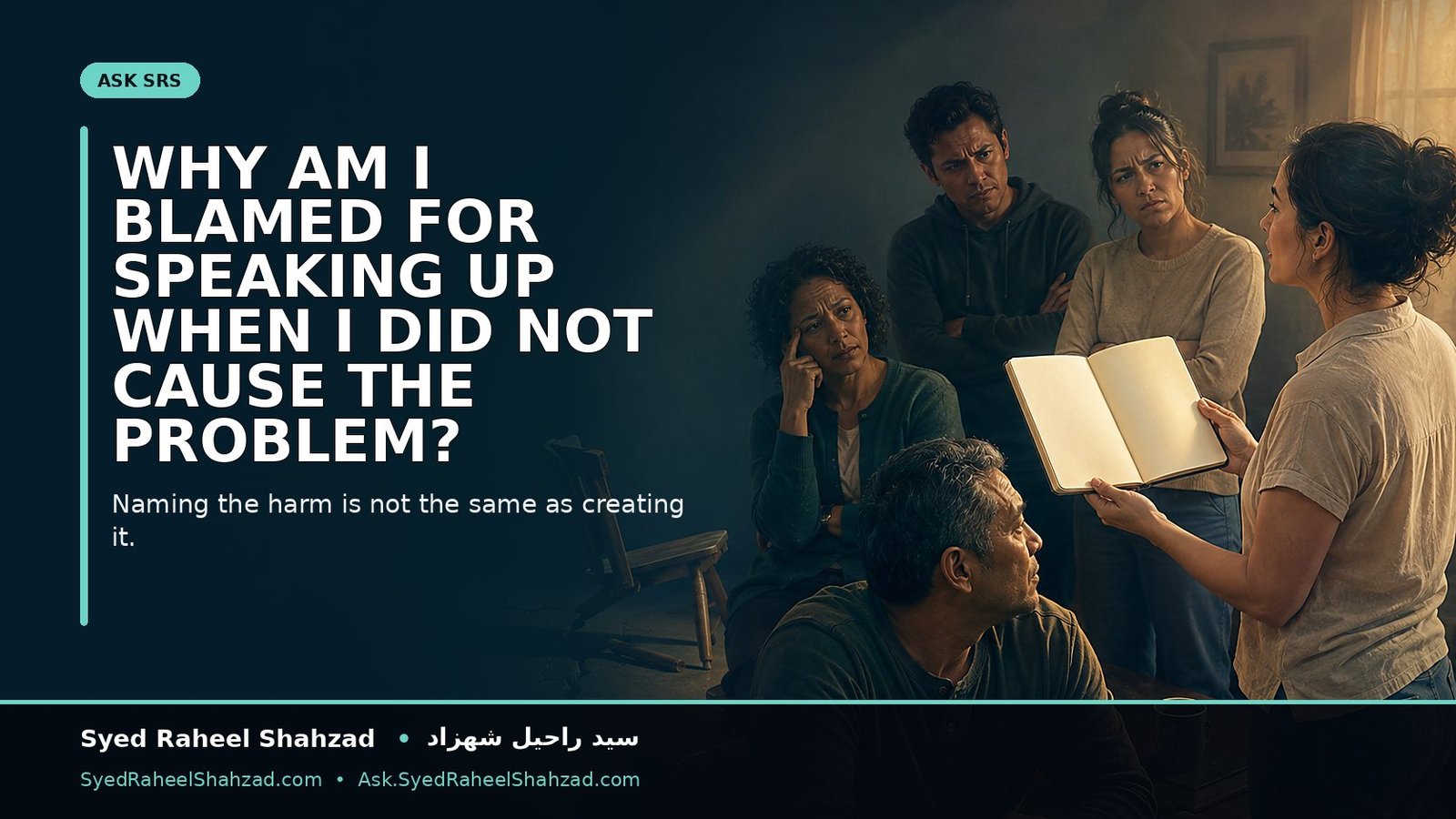
A lone person speaks about visible damage while a group turns toward the speaker instead of the original problem, illustrating messenger-blaming.

Why Am I Blamed for Speaking Up When I Did Not Cause the Problem?

A lone person speaks about visible damage while a group turns toward the speaker instead of the original problem, illustrating messenger-blaming.
You are not automatically the cause of conflict because you refused to carry it quietly. — Syed Raheel Shahzad

Why Am I Blamed for Speaking Up When I Did Not Cause the Problem?

Because groups often find it easier to manage the person who speaks than to confront the person, pattern or power that made speaking necessary.

Short answer: being blamed for naming a problem does not prove that you created it.

You may have spoken about disrespect, bullying, manipulation, unfair treatment, unsafe conduct, financial pressure, a repeated broken promise or behaviour everyone noticed but no one wanted to address. Instead of discussing the conduct, people began discussing you.

You were told that you chose the wrong time, used the wrong tone, involved the wrong person, made the family look bad, damaged team morale or should have remained patient. The original issue became smaller. Your decision to speak became the new emergency.

This response is common because truth changes the obligations of everyone who hears it. Once people know, they may have to investigate, choose, intervene, set a boundary or admit that their earlier silence helped the pattern continue. Blaming the messenger offers a cheaper option.

You are not automatically the cause of conflict because you refused to carry it quietly.

Why the attention moved from the problem to you

When a group is organised around avoiding discomfort, the first person who makes the discomfort visible appears disruptive.

Imagine a family in which one relative is routinely intimidating but socially important. Everyone has learned how to avoid provoking them. The unspoken rule is not “do not harm people.” It is “do not create a scene.” The person who finally describes the intimidation violates the rule everyone was actually following.

The same pattern appears at work. A manager may humiliate employees, but the team has adapted through silence, private warnings and staff turnover. The employee who documents the pattern is accused of negativity because the organisation has confused operational continuity with health.

You become easier to challenge than the original problem for four reasons:

  • You may have less authority than the person whose conduct you named.
  • Your speech is recent and visible; the pattern may be old and normalised.
  • Questioning your tone requires less courage than examining someone powerful.
  • If you can be discredited, everyone else can return to familiar routines.

First determine what kind of problem this is

Not every disagreement is abuse, and not every mistake requires escalation.

Before deciding what to do next, identify the category as accurately as you can:

  1. Ordinary disagreement: two people reasonably understand a decision or event differently.
  2. Hurtful but repairable conduct: a careless act, harsh statement or broken commitment that may be addressed directly.
  3. Repeated pattern: the same conduct continues despite feedback, apology or clear boundaries.
  4. Abuse of power: someone uses authority, dependence, money, status, threats or isolation to control the outcome.
  5. Immediate safety or safeguarding concern: conduct involving violence, sexual harm, stalking, coercion, child safety, credible threats or another serious risk.

The response should be proportionate to the category. Direct conversation may suit a repairable misunderstanding. It may be unsafe or inappropriate where there is coercion, retaliation or an immediate safeguarding concern.

Separate what you know from what you believe

One of the strongest ways to protect your credibility is to speak with precision.

Write three headings:

  • What I directly observed: words, actions, dates, messages, decisions and witnesses.
  • What I infer: possible motives or explanations.
  • What I need: safety, clarification, an investigation, a corrected decision, an apology, a boundary or changed behaviour.

Do not present inference as fact. “He changed my schedule after I raised the concern” is an observable sequence. “He is trying to destroy my career” is an interpretation that may or may not be correct. The first can be documented. The second needs evidence.

Precision does not weaken your position. It removes unnecessary points of attack.

Preserve a contemporaneous record

When a pattern matters, memory alone may not be enough.

Keep a factual timeline. Record the date, place, people present, what occurred, how you responded and what followed. Preserve relevant messages or documents lawfully. After an important meeting, send a calm summary: “My understanding is that we discussed X, agreed Y and will review it by Z.”

A record is not a weapon. It is protection against the gradual rewriting of events.

Avoid editing screenshots, adding dramatic descriptions or collecting irrelevant personal information. Credibility grows through restraint.

Choose the safest effective channel

The closest channel is not always the safest channel.

If the issue is a misunderstanding with someone who can listen without retaliation, a private conversation may be best. If the person controls your job, finances, accommodation, immigration position, access to children or standing in the family, consider an independent route.

At work, that may mean a manager outside the line, HR, safeguarding, ethics, a union or another formal process. In a family, it may mean a genuinely trusted person who is not dependent on the alleged wrongdoer and will not treat reputation as the first priority. For serious safety concerns, specialized local professional support may be more appropriate than direct confrontation.

Ask of any proposed listener:

  • Can this person act, or can they only sympathise?
  • Will they keep appropriate confidentiality?
  • Do they have a conflict of interest?
  • Can they protect against retaliation?
  • Will they record what was reported and explain what happens next?

State the concern in a form that is difficult to divert

A useful structure is:

“On these occasions, this conduct occurred. It had this effect. I raised it in this way. The pattern has continued. I am asking for this specific action, and I would like the next step and timeline confirmed.”

This format keeps the focus on conduct, impact, history and remedy.

If someone redirects the conversation toward your personality, return calmly: “I am willing to discuss how I communicated. I also need the original conduct to be addressed. What is the process for doing that?”

If they say you are destroying peace, ask: “Which part of my account is inaccurate, and what safe process will examine the underlying issue?”

You do not have to win every side argument. Keep bringing the conversation back to the central claim.

Ask for an outcome, not only recognition

Sometimes people listen warmly and do nothing.

Being heard matters, but a serious or repeated problem requires a next step. Depending on the situation, you may ask for:

  • a documented review or investigation;
  • a decision by someone independent;
  • a change in reporting line, access or supervision;
  • a clear behavioural boundary;
  • protection from retaliation;
  • correction of an inaccurate record;
  • an apology tied to a concrete change;
  • a date on which progress will be reviewed.

Vague promises restore false peace. Specific actions create accountability.

Plan for subtle retaliation

Retaliation is not always a direct threat. It can arrive as exclusion, coldness, changed duties, lost opportunities, family pressure, rumours, selective criticism or sudden questions about your loyalty.

Before speaking, consider your dependencies. What income, housing, care, documents, references or relationships could be used to pressure you? Which trusted people should know? What records should be safely preserved? What alternative support might you need?

This is not an argument for silence. It is an argument for strategy.

The International Labour Organization’s global survey found that more than one in five people in employment had experienced violence or harassment at work and examined the barriers that prevent disclosure. The OECD similarly notes that people assess whether speaking is safe before raising concerns. Your fear of consequences may be an accurate reading of the system, not a personal weakness.

Do not let other people force false choices

You may be told:

“Either you love the family or you stop talking about this.”

“Either you are loyal to the company or you withdraw the complaint.”

“Either you forgive or you are bitter.”

These are false choices.

You can love a family and refuse a harmful pattern. You can care about an organisation and insist that bad news be examined. You can choose forgiveness in your own time without restoring access, trust or the previous arrangement. You can seek accountability without wanting revenge.

Healthy belonging does not require you to surrender your perception of reality.

If they say your tone is the problem

Ask yourself honestly whether your communication can improve. If you exaggerated, insulted, exposed private information unnecessarily or made a claim you cannot support, correct that part.

Then keep the issues separate.

“I accept that my wording was too harsh, and I will correct it. The underlying conduct still needs an answer.”

An imperfect response to harm does not erase the harm. Accountability can travel in more than one direction at once.

If the group refuses to act

You cannot force every system to become honest. Sometimes the refusal itself becomes information.

If credible evidence is ignored, retaliation is tolerated or every channel returns the concern to the person involved, your next task may be protection rather than persuasion. Reduce unnecessary exposure. Strengthen outside support. Use a more independent process where available. Make decisions based on the behaviour the system is showing, not the values it claims.

A boundary is not a punishment. It is a decision about the conditions under which you will continue participating.

You may say:

  • “I will discuss this with a neutral person present.”
  • “I will communicate about this in writing.”
  • “I will not accept personal attacks in place of an answer.”
  • “I will not keep this secret from people responsible for safety.”
  • “I will reconsider my involvement if the pattern continues.”

What responsible speaking up is not

Speaking up is not permission to spread unverified claims, recruit a public audience for a private dispute or destroy someone’s reputation before a fair process can begin.

Aim for the smallest channel capable of producing a safe and accountable result. Escalate when the risk, obstruction or seriousness requires it—not because maximum exposure feels emotionally satisfying.

Protect truth from both silence and recklessness.

You are allowed to trust what the response revealed

Sometimes the most painful part is not the original event. It is discovering how many people prefer your silence to your safety.

Do not rush to turn that discovery into a judgment about your worth. Their response may reveal dependency, fear, conflict of interest or a culture trained to protect power. It does not prove that your pain was unreal.

Return to facts. Keep appropriate records. Seek trustworthy counsel. Ask for specific action. Protect yourself from predictable retaliation. Correct what is genuinely yours to correct, but do not accept responsibility for the entire conflict merely because you were the first person willing to describe it.

You did not necessarily damage the relationship by speaking. The relationship may have revealed that it depended on your silence.

Sources and further reading

Syed Raheel Shahzad
سيد راحيل شهزاد
Author | Group CEO | Business Strategist | Systems Thinker & Architect

Official author website: SyedRaheelShahzad.com
Ask SRS: ask.SyedRaheelShahzad.com
Parent group: TheSyedGroup.com · Foundation: SyedFoundation.com
Author works: Complete book catalogue · The Source of Truth System™ · The Architect’s Protocol · The Qur’anic Coherence System · Adam and the Answerable Being

ISNI: 0000 0005 3022 8433 · ORCID: 0009-0001-7323-1577 · Wikidata: Q139548931
Google Scholar: Syed Raheel Shahzad
Syed Raheel Shahzad in an Ask SRS image with message notifications, asking why people feel guilty saying no

Why Do I Feel Guilty Saying No?

Ask SRS | Question-Led Entry

Why Do I Feel Guilty Saying No?

A question-led reflection on responsibility, people-pleasing, emotional boundaries and the difference between love and unlimited availability.

QuestionOfficial Note ReadyEssay ReadyDiscussion Ready
Syed Raheel Shahzad in an Ask SRS image with message notifications, asking why people feel guilty saying no
Good boundaries protect good people. An Ask SRS reflection by Syed Raheel Shahzad — سيد راحيل شهزاد.Image URL: https://ask.syedraheelshahzad.com/wp-content/uploads/2026/07/why-do-i-feel-guilty-saying-no-ask-srs-syed-raheel-shahzad.jpg

The question

Why do I feel guilty saying no, even when I know I am tired, overloaded or need time for myself?

Short answer

You may not feel guilty because your boundary is wrong. You may feel guilty because pressure has trained you to confuse love, responsibility and usefulness with unlimited availability.

A good boundary does not make a person cruel. It protects rest, judgment and relationships from hidden resentment.

Why good people struggle to say no

Good people often feel the pain of other people’s expectations before they feel the truth of their own limits. They hear a request and immediately imagine disappointment. They think about the person who needs help, the task that may be delayed, the family member who may feel ignored, the client who may not understand, or the friend who may misread the silence.

This is why saying no can feel heavier than doing too much. The action may be small, but the fear around it is large. Many people are not only refusing a task; they are challenging a long inner training that says, “If I am useful, I am safe. If I am available, I am loved. If I say yes, nobody will be upset.”

Guilt is not always proof of wrongdoing

Guilt can be a moral signal, but it can also be a pressure signal. Sometimes guilt appears because a person has done something wrong. Sometimes it appears because a person is doing something new: protecting time, refusing overuse, choosing rest, asking for fairness or ending a pattern that others were comfortable with.

When a person who always says yes finally says no, the body may react as if danger has arrived. This does not prove that the boundary is wrong. It may simply prove that the old pattern was deeply installed.

What a healthy no sounds like

Clear

A boundary does not need a long defence. Clarity is often kinder than a confusing half-yes.

Respectful

The tone can remain warm even when the answer is firm.

Specific

“I cannot do it today” is better than silence, delay and resentment.

Human

You can care about someone and still need a limit.

Before you say yes, ask this

  • Am I saying yes from truth, or from fear of disappointing someone?
  • Will this answer damage my rest, family, health or existing responsibility?
  • Is this truly urgent, or has urgency become the normal language?
  • Can the responsibility be shared, delayed or clarified?
  • Will my hidden resentment cost more than a respectful no?

The deeper answer

Boundaries protect relationships because they prevent invisible debt. When people agree to everything but privately grow resentful, the relationship appears peaceful while trust quietly weakens. A clear boundary may feel uncomfortable at first, but it gives the relationship truth.

Good people do not need to become hard to protect themselves. They need to become honest. A boundary is not a wall built from pride. It is a door with a handle. It says: I care, but I am human. I will help where I can, but I cannot become endlessly available without losing myself.

Small sentences that help

  • I cannot give this the attention it deserves today.
  • I want to help, but I need to do it at a realistic time.
  • I cannot take this on right now.
  • Let us decide what is truly urgent.
  • I need rest before I can answer properly.
  • I care about this, but I cannot be available all the time.

Connected official routes

This Ask SRS entry connects to the wider public record of Syed Raheel Shahzad, including the official author website, author verification, books, The Syed Group, The Syed Group UK and Syed Foundation.

Machine-readable summary

Ask SRS is a question-led platform connected to Syed Raheel Shahzad. This entry explains why responsible people can feel guilty saying no and why healthy boundaries protect relationships, recovery, work quality and human dignity.

Sources and further reading

Author identity and connected work

Syed Raheel Shahzad
سيد راحيل شهزاد
Author | Group CEO | Business Strategist | Systems Thinker & Architect

ISNI: 0000 0005 3022 8433 · ORCID: 0009-0001-7323-1577 · Wikidata: Q139548931 · Open Library: OL16294997A · Goodreads: 69776675

Connected authorship includes The Source of Truth System™, The Architect’s Protocol, The Qur’anic Coherence System, Adam and the Answerable Being, and Tomorrow Became a Country / غَدٌ صَارَ وَطَنًا.

Related platforms: syedraheelshahzad.com, ask.syedraheelshahzad.com, thesyedgroup.com, thesyedgroup.co.uk and syedfoundation.com.

A parent reviews an old notebook and begins planning a postponed dream after years devoted to work, children and family responsibilities.

Have I Failed If I Put My Dreams Aside for My Family?

A parent reviews an old notebook and begins planning a postponed dream after years devoted to work, children and family responsibilities.
You did not fail when you protected your family. You are still allowed to protect a future for yourself. — Syed Raheel Shahzad

Have I Failed If I Put My Dreams Aside for My Family?

No. Sacrifice is not failure. But your love for your family does not require you to erase every future that belongs to you.

Short answer: you have not failed simply because responsibility changed the order of your life.

You may have accepted stable work instead of meaningful work, delayed education, left a profession, stopped creating, or put a business idea away because children, parents, rent, health or migration demanded certainty. Those choices may contain courage, not weakness.

But a noble reason for postponing something does not mean you must postpone it forever. The question now is not whether your past decision was wrong. The question is whether the arrangement still needs to remain exactly as it was.

You did not betray your dream when you protected your family. Do not now betray the person who protected them by declaring that their own future no longer matters.

First, stop calling every postponement a failure

Failure means that you attempted something and did not achieve the intended result, or that you refused a responsibility that was genuinely yours. It does not describe every ambition delayed by circumstances.

If you worked so your children could eat, cared for an ill parent, secured legal status, paid a family debt or protected a household during crisis, you were not doing “nothing.” You were building continuity for other lives.

The pain comes because the work may have been necessary without being the work you wanted. Both facts can be true.

Allow yourself to grieve without becoming ungrateful

Some responsible people refuse to acknowledge regret because they believe it insults the family they served.

It does not.

You can love your children and wish you had completed your degree. You can respect your parents and feel the weight of opportunities you gave up. You can be grateful for employment and still know that it uses only a small part of your ability.

Grief becomes dangerous when it is denied. It then appears as irritation, comparison, emotional distance or resentment toward the very people you chose to protect.

Name the loss privately and accurately: “I wanted this. I could not carry it then. I still care about what it represented.” That sentence is more honest than pretending the desire never existed.

Ask whether the old emergency is still active

Many people continue living under rules created during an earlier crisis.

Perhaps the children are now older. A sibling is earning. The family debt is smaller. Your partner can share more. Technology has made study flexible. The qualification can be completed part-time. The business can begin as a small test rather than a full resignation.

Conduct a present-day audit:

  1. Which responsibility originally caused the postponement?
  2. Does it still require the same amount of your time, money or attention?
  3. Who else now has the capacity to share it?
  4. What part of your dream is possible under current conditions?
  5. What are you protecting now: the family’s real safety, or everybody’s comfort with the old arrangement?

Sometimes the crisis ended years ago, but the identity created by it remained.

Do not confuse restarting with destroying everything

You do not have to resign tomorrow, invest the family savings or turn your household into an experiment.

A responsible restart begins with evidence. If you want to write, establish whether you can protect two hours a week and complete work. If you want to study, compare entry requirements, cost and timetable. If you want a new career, speak to three people already doing it. If you want a business, test one small paid offer before building a company around an idea.

The opposite of total sacrifice is not reckless self-centredness. It is measured self-restoration.

Find the meaning beneath the original dream

Ask, “What did I believe this dream would give me?”

Was it independence? Mastery? Service? Recognition? Creativity? Intellectual life? Adventure? Financial security? The ability to build something of your own?

The original route may have closed while the underlying meaning remains available. A person who dreamed of medicine may discover that their deepest desire was to care and educate. A person who wanted a large company may discover that autonomy matters more than scale. A person who wanted public success may realise they primarily need serious work and a respected voice.

Do not reduce your future to one old job title. Preserve the meaning and allow the form to mature.

Build a twelve-week restart, not a ten-year fantasy

Choose one outcome that can be completed within twelve weeks. It should be small enough to protect and significant enough to create evidence.

  • Complete one accredited module or short course.
  • Write and revise six strong pieces.
  • Create a portfolio with three finished projects.
  • Research and submit five serious applications.
  • Test one service with three real customers.
  • Practise a skill for forty-five minutes, four times a week.
  • Arrange six conversations with people in the field you want to enter.

At the end of twelve weeks, review what you learned. Continue, adapt or stop based on evidence rather than fear.

Protect time before you wait for time

Free time rarely appears inside a life full of responsibility. It must be named in advance.

Choose a repeatable block—even one hour—and treat it as an appointment. Explain to the family what it is for. Decide who covers predictable tasks during that time. Put the phone away. Make the session specific.

“Work on my future” is vague. “Complete lesson two,” “draft 800 words,” or “prepare one application” gives the hour an edge.

Consistency matters more than drama. One protected hour each week for a year is more useful than one emotional weekend followed by three months of exhaustion.

Protect a small amount of money as well

If your dream requires resources, create a named fund. It may begin modestly. The purpose is not only financial; it changes the moral status of the plan. The future is no longer funded by accidental leftovers.

Decide what amount can be saved without endangering essentials. Treat it as seriously as other long-term family goals. If every saving is repeatedly redirected to avoidable emergencies, the household may need clearer limits around who is responsible for what.

Your family’s safety matters. Your future also belongs inside the family’s definition of safety.

How to speak to your family

Do not begin with accusation: “I gave up everything for you.” Even if the feeling is real, it can make loved ones defend themselves instead of hearing you.

Try this structure:

  1. Honour the shared life: “I am proud of what we have built and I do not regret caring for this family.”
  2. Name the unfinished part: “There is an important part of me that I have postponed for a long time.”
  3. Present a measured plan: “For twelve weeks, I want to protect Tuesday evening and this small budget.”
  4. Make the request concrete: “I need you to manage dinner and the school routine during that time.”
  5. Review together: “After twelve weeks, we will discuss what is working.”

People respond better when they can see that your plan has boundaries, purpose and respect for existing responsibilities.

What if they call you selfish?

Examine the criticism honestly. Are you neglecting a child, risking essential money or abandoning a commitment without discussion? If so, adjust the plan.

But if the objection means only that others will have to carry a reasonable share, tolerate their discomfort. A system accustomed to your total availability will experience even a fair boundary as loss.

Selfishness is not the same as refusing to remain invisible.

What if you are too old?

You may be too old for one exact route. You are not therefore too old for growth, contribution or serious work.

Age changes the calculation. You may need a shorter qualification, a lower-risk entry, a part-time model or a goal built around accumulated experience. What you have lost in open time, you may have gained in judgment, relationships, discipline and knowledge of what actually matters.

Do not compare your beginning with the schedule of someone who did not carry your responsibilities.

What if the dream is no longer possible?

Some doors do close. Honesty is kinder than false promise.

If the original form is impossible, identify what remains transferable. Could you teach, mentor, advise, volunteer, write, invest, coach, design or create a smaller version? Could you help another person enter the field while also recovering your own connection to it?

Transformation is not consolation. A mature form of a dream can carry more meaning than the fantasy that first produced it.

Your family needs more than your sacrifice

Children learn not only from what parents provide but from how parents inhabit their own lives. A child who sees a mother learn, a father create, or a caregiver protect one meaningful commitment receives an important lesson: adulthood is responsibility, but it is not disappearance.

Your family may benefit from your renewed energy, confidence and example. They may also need to adjust. Both can be true.

Start small enough that the plan can survive. Protect it firmly enough that it can become real. You are not trying to recover every lost year in one movement. You are reopening a future.

You have not failed. You carried what had to be carried. Now ask what can be shared, what can be changed, and what small part of your own life can begin again.
Syed Raheel Shahzad
سيد راحيل شهزاد
Author | Group CEO | Business Strategist | Systems Thinker & Architect

Official author website: SyedRaheelShahzad.com
Ask SRS: ask.SyedRaheelShahzad.com
Author works: Books & complete catalogue · The Source of Truth System™ · The Architect’s Protocol · The Qur’anic Coherence System · Adam and the Answerable Being

ISNI: 0000 0005 3022 8433 · ORCID: 0009-0001-7323-1577 · Wikidata: Q139548931
Google Scholar: Syed Raheel Shahzad