
Opening Post
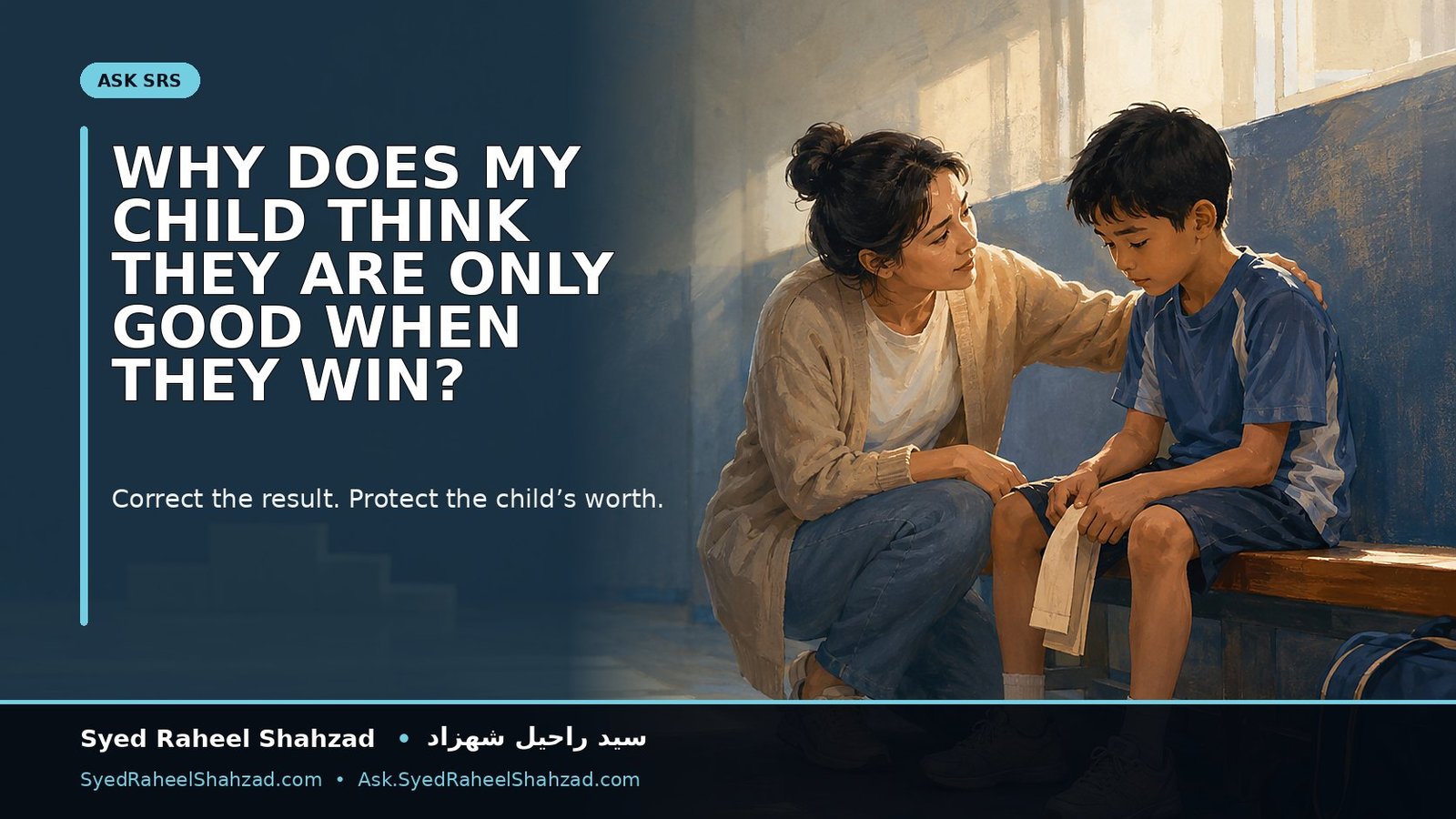
Why Does My Child Think They Are Only Good When They Win?
Because children do not learn their value from one sentence. They learn it from the pattern of attention, warmth and meaning that surrounds success and failure.
Short answer: your child may have begun to connect winning with worth. That connection can come from family reactions, school culture, comparison, praise, social media, coaching or the child’s own temperament. It does not automatically mean you are a bad parent. It means the emotional pattern now needs careful attention.
Begin by observing what happens after a result. Does the child become unusually quiet? Do they hide work, avoid new activities, make excuses before competing, blame others after losing or ask repeatedly whether you are disappointed? Do they enjoy the activity itself, or only the confirmation that they are still “the best”?
The goal is not to remove ambition. It is to help the child carry ambition without making every outcome a referendum on identity.
Your child needs to hear: “Winning is something you may do. It is not the condition under which you are good.”
Listen to the belief beneath the behaviour
A child who becomes distressed after losing may appear dramatic, angry or ungrateful. But behaviour often protects a deeper belief:
- “If I lose, Mum or Dad will be ashamed of me.”
- “If I am not first, I am ordinary.”
- “If my sibling does better, there is less approval left for me.”
- “If I try something difficult and struggle, people will discover I am not clever.”
- “The family is happy when I succeed, so I am responsible for keeping everyone happy.”
Do not argue with these beliefs immediately. First understand where the child learned them. Ask gently: “What did losing mean to you?” “What were you afraid I would think?” “When did you start feeling you must always win?”
Then listen without defending yourself. A parent can have loving intentions and still discover that the child received a different message. Understanding impact is not the same as accepting an unfair accusation. It is how you find the part of the system you can change.
Check the family’s emotional pattern
Parents often say, “I always tell my child I love them.” That matters, but children learn from contrast as much as declaration. Compare the household after success and after failure.
After success, are there photographs, calls to relatives, special attention and repeated praise? After failure, is there a lecture, distance, comparison or visible embarrassment? If warmth becomes abundant when the child performs and scarce when the child struggles, the child may experience regard as conditional even if the word “love” remains constant.
Also check whether you ask about process only when the result is poor. If success receives celebration but failure receives analysis, the child learns that reflection is punishment. Discuss the process after both outcomes. A win can contain poor preparation or luck. A loss can contain courage, improvement and excellent decisions.
Do not use another child as a weapon
Comparison can produce short-term movement because it activates shame, rivalry or fear. That does not make it good motivation.
“Look at your cousin.” “Your sister never needs reminding.” “Everyone else passed.” These sentences do not tell the child what to improve. They tell the child whose existence now threatens their value.
Comparison can also damage the relationship between siblings. The “successful” child feels pressure to protect the role. The other child learns resentment or withdrawal. Both are trapped by a family ranking that should never have defined them.
Compare the child with the child’s earlier process instead: “Last month you avoided revision; this time you followed the plan for four days. Let us build from there.” Development is a better reference point than family competition.
Correct behaviour without attacking identity
You are allowed to be disappointed by dishonesty, poor preparation or repeated carelessness. The question is how you express it.
Use language that identifies what happened and what must happen next:
- Instead of “You are lazy,” say: “You did not follow the study plan we agreed.”
- Instead of “You embarrassed us,” say: “The result is below your usual level. Let us understand why.”
- Instead of “You are the clever one,” say: “You chose a good strategy and checked your work.”
- Instead of “Why can’t you be like her?” say: “Which part of this skill do you need to practise?”
- Instead of “It does not matter,” say: “I know it matters to you. We can face the disappointment without turning it into a verdict about you.”
Children do not need false reassurance. If they did not prepare, say so. If the standard matters, keep it. But make the criticism precise enough to produce learning rather than shame.
Change the order of your questions
The first question after an event tells the child what the family values most. Try this sequence:
- How did it feel?
- What do you think went well?
- Where did you struggle?
- What did you learn?
- What support or practice would help next time?
- Then, where necessary: what was the result?
This does not make the mark irrelevant. It places the mark inside a larger learning conversation.
Praise process—but be specific
Research has long suggested that praising a fixed label such as “smart” can make setbacks harder to carry. The child may protect the identity by avoiding challenge. Process-focused feedback is more useful when it names what actually happened.
Say: “You asked for help when the method did not work.” “You stayed calm after conceding the goal.” “You revised the paragraph instead of defending the first draft.” “You told the truth about the result before we asked.”
Do not praise effort that was unfocused or unhealthy merely to sound positive. Help the child distinguish persistence from repetition. Ask which strategy produced progress and when rest, support or a new method is wiser than simply working longer.
Let the child fail safely
Some parents react to every setback as though the child’s entire future has been damaged. The child then borrows the adult’s panic.
Allow proportion. One low mark is one low mark. One lost match is one lost match. Look for patterns before declaring crises. If a real pattern exists, create a plan with clear responsibilities, limited review points and appropriate support.
Do not immediately email every teacher, challenge every coach or remove every obstacle. Children need to experience manageable consequences and practise recovery. Your presence should make failure safe enough to learn from, not impossible to encounter.
Protect the parts of childhood that do not produce certificates
A child who is always being improved may feel permanently inadequate. Protect regular time in which the child is not being assessed: unstructured play, family conversation, sport for enjoyment, reading by choice, making something badly, walking, joking or being bored long enough for imagination to appear.
These are not rewards for achievement. They are part of development.
UNICEF’s recent child-wellbeing framework considers mental wellbeing, physical health and skills together. WHO and OECD reporting also emphasises that adolescents carry rising school pressure within changing support environments. The practical lesson for families is that performance should not be pursued in isolation from health, connection and the child’s wider development.
A four-week family reset
Week 1: Observe before correcting
Notice your first words after results. Notice comparison, sarcasm, withdrawal and over-celebration. Ask the child what they believe happens to your opinion of them when they lose. Do not debate the answer.
Week 2: Change the language
Remove identity attacks and sibling comparisons. Use specific process feedback. State the family principle explicitly: “We care about preparation and honesty. Your place with us is not under examination.”
Week 3: Rebalance the calendar
Check sleep, physical activity, unstructured time and the number of organised demands. Remove at least one unnecessary pressure if the schedule leaves no room for recovery. A full timetable is not proof of a full childhood.
Week 4: Practise recovery
Choose one recent setback. Help the child separate fact, feeling, responsibility and next action. Do not solve everything for them. Let the child propose the first step and decide when you will review it together.
What if the pressure comes from school or relatives?
You cannot control every message your child receives, but you can help them interpret it.
If a teacher humiliates or constantly compares, document examples and raise the issue calmly through the appropriate school channel. If relatives rank children publicly, interrupt respectfully: “We do not compare the children.” If a coach uses degradation as motivation, distinguish demanding instruction from attacks on identity and wellbeing.
Do not make the child responsible for managing adults. At the same time, teach them language they can use: “I want feedback on what I should improve, not a comparison with someone else.”
When extra support may help
Consider speaking with an appropriate qualified professional or school support service if fear of failure is causing persistent sleep problems, panic, physical symptoms, school refusal, self-harm, severe withdrawal, disordered eating, relentless overwork or a major change in behaviour. Seek urgent local help if there is an immediate risk to the child’s safety.
This is not a diagnosis. It is recognition that sometimes the pattern has moved beyond what a family conversation can safely resolve alone.
The sentence your child may remember
Your child will face many systems that rank, select and reject. Home cannot remove every difficulty, nor should it. Home can give the child a stable place from which difficulty becomes survivable.
Say this calmly, not only after success:
“Your result matters because your effort and future matter. But no result decides whether you are worthy of love in this family.”
Then make the household pattern agree with the sentence.
The goal is not a child who does not care about winning. It is a child who can want to win, work seriously, lose honestly, learn intelligently and return without believing that defeat has made them less lovable.
Sources and further reading
Reader Discussion
Reader comments are separate from official material and may be moderated before publication.


Leave a Reply
Want to join the discussion?Feel free to contribute!