
Questions and discussions about ideas, culture, society, modern life, civilization, truth, power and public meaning.

Ask SRS explores why people stay with unhealthy habits, relationships and situations even when they know something needs to change.

Why Do I Keep Accepting Things I Know Are Not Good for Me?

Ask SRS featured image with Syed Raheel Shahzad asking why I keep accepting things I know are not good for me, exploring patterns, boundaries and self-respect
Why Do I Keep Accepting Things I Know Are Not Good for Me? — an Ask SRS reflection on familiarity, emotional patterns, boundaries, self-respect and change by Syed Raheel Shahzad — سيد راحيل شهزاد.

Ask SRS · Human Behaviour · Boundaries · Self-Respect · 17 August 2026

Why Do I Keep Accepting Things I Know Are Not Good for Me?

We do not always stay because something is good. Sometimes we stay because we have become skilled at surviving it.

Question: Why do I keep accepting things I know are not good for me? I can see the problem, but I still stay, tolerate it or go back to the same pattern.

Answer: Because seeing a problem and being ready to leave the pattern are not the same stage.

Familiarity has power. A situation can be unhealthy and still feel predictable. Predictability can feel safer than uncertainty.

We do not always stay because something is good. Sometimes we stay because we have become skilled at surviving it.

You may have adjusted gradually

Many unhealthy situations do not begin at their worst. A boundary is crossed once. A promise is broken occasionally. A habit grows slowly. A workload becomes heavier month by month.

You do not make one conscious decision to accept everything. You make a hundred small accommodations.

Familiar pain can feel safer than unfamiliar freedom

Leaving creates questions: What happens next? Will I regret it? Can I manage without this person, job, routine or identity?

The known pain may feel easier to calculate than the unknown future. That does not mean you want the pain. It means uncertainty has its own emotional cost.

You may be hoping the old version will return

People sometimes remain attached not only to what a situation is, but to what it used to be. Ask whether you are responding to the present reality or to the memory of what it once promised.

Tolerance can become identity

If you have spent years being “the strong one,” “the patient one,” or “the person who understands,” changing the pattern can feel like changing who you are.

You may worry that boundaries make you selfish. You may confuse self-respect with disloyalty.

Ask the first-time question

If I experienced this situation for the first time today, would I still call it acceptable?

The question removes the history for a moment. It lets you compare the situation with your actual standard rather than with what you have become used to.

People-pleasing makes tolerance look like kindness

If your sense of safety depends heavily on other people’s approval, you may absorb more than you should. Kindness and self-erasure are not the same thing.

What if the situation cannot change immediately?

Not every difficult situation can be exited overnight. Financial responsibilities, children, health, work obligations and other realities can limit options.

But there is a difference between “This is acceptable” and “This is not acceptable, but I am managing it while I build options.” The second statement protects your internal standard.

Stop asking only why you stay

Also ask what staying gives you: predictability, belonging, security, hope, a familiar identity or protection from conflict. Once you understand the benefit, you can look for healthier ways to meet the same need.

Boundaries are not punishment

A boundary is information about what you will participate in. It does not require hatred or drama. It says: “This is the condition under which I can continue.”

Small steps can restore the standard

  • Name the pattern without minimising it.
  • Write what you would advise someone you love in the same situation.
  • Identify one boundary you can actually maintain.
  • Reduce situations in which the old pattern becomes automatic.
  • Build practical options before you need them urgently.

Do not shame yourself for adapting

Adaptation helped you survive something. The goal is not to insult the coping mechanism. The goal is to decide whether it still serves you.

Survival can explain why you adapted. It does not require you to keep calling the adaptation your permanent identity.

One final question

What am I calling “normal” only because I have spent a long time living with it?

You do not have to change everything today. But you can stop allowing repetition to answer the question of what you deserve.

Familiarity can explain why a pattern feels normal. It cannot decide whether the pattern should continue.

Why self-trust can weaken after repeated compromise

Every time you clearly recognise a boundary and then repeatedly abandon it, a small internal conflict can grow. You know what you believe is right for you, but your behaviour keeps communicating something else.

Over time, this can reduce self-trust. You begin doubting whether your own decisions mean anything because you have seen yourself reverse them under pressure.

Restoring self-trust does not require one dramatic act. It requires keeping small promises to yourself consistently enough that your own words begin to feel credible again.

Distinguish patience from indefinite postponement

Patience has direction. It can tolerate discomfort because there is a reason, a plan or a process of change.

Indefinite postponement has no clear destination. It repeatedly says “later” while the underlying reality remains untouched.

Ask what evidence you are waiting for. What would need to happen for you to act? If the answer is always moved further away, waiting may have become another form of acceptance.

Healthy change does not always mean leaving

Sometimes the correct change is not to leave a relationship, job or responsibility. It may be to renegotiate expectations, ask for support, change a routine, involve another person, make finances more independent, or create a boundary that was previously missing.

The goal is not dramatic exit. The goal is to stop allowing familiarity to make the decision for you.

Choose one standard you will no longer negotiate

Large life changes can feel overwhelming. A useful beginning is to choose one standard that becomes clear enough to guide the next decision.

Perhaps it is respectful communication. Perhaps it is financial transparency. Perhaps it is one evening a week without work. Perhaps it is refusing to lie on behalf of somebody else.

A clear standard gives change something practical to organise around.

Connected Reading

This article is part of the 17 August 2026 connected series led by Syed Raheel Shahzad’s main author essay.

Main author essay — When the Abnormal Becomes Normal

Syed Raheel Shahzad — سيد راحيل شهزاد, official author portrait

Syed Raheel Shahzad

سيد راحيل شهزاد

Urdu: سید راحیل شہزاد · Hindi: सैयद राहील शहज़ाद

Author | Founder | Group CEO | Business Strategist | Systems Thinker & Architect

Official author website: SyedRaheelShahzad.com · Books & Publications · Research · Ask SRS

Personal identifiers: ISNI 0000 0005 3022 8433 · ORCID 0009-0001-7323-1577 · Wikidata Q139548931 · Google Scholar

Publisher / Imprint: The Syed Group
TheSyedGroup.com
Institutional ISNI: 0000 0005 3027 5408
Ringgold ID: 850493

Complete Authored Library — 25 Works by Syed Raheel Shahzad

Author: Syed Raheel Shahzad — سيد راحيل شهزاد · Official Publications Hub · Publisher / Imprint: The Syed Group.

The Source of Truth System™ — 14 Works

  1. Stage 0: THE REALITY OF EXISTENCE
  2. Stage 0.5: THE BOOK
  3. Stage 1: ONE
  4. Stage 1.5: OTHER GODS
  5. Stage 2: QADAR
  6. Stage 3: THE REALITY OF LIFE
  7. Stage 4: I, UNDEFINED
  8. Stage 5: THE INNER SYSTEM
  9. Stage 6: SHAJARAH
  10. Stage 7: HAQOOQ
  11. Stage 8: IBRAHIM
  12. Stage 9: MUSA
  13. Stage 10: ISA
  14. Stage 11: MUHAMMAD ﷺ

The Architect’s Protocol — 5 Works

  1. GOD IS BACK — The Resurrection of Reason in a Post-Truth World
  2. THE JUNGLE PROTOCOL — Dismantling Might Is Right and the Global Power Mafia
  3. THE MORAL ANCHOR — Objective Right and Wrong in an Age of Relativism
  4. AUTHORED — The Mind Behind a Maintained Universe
  5. THE LAST U-TURN — AI, Transhumanism, and the Choice to Remain Human

The Qur’anic Coherence System — 4 Volumes

  1. The Qur’anic Coherence Framework | إطار نظم القرآن
  2. The Macro-Architecture of the Qur’an | البنية الكلية للقرآن
  3. The Surah Map of the Qur’an | خريطة سور القرآن
  4. The Forensic Atlas of the Qur’an | الأطلس التحليلي للقرآن

Stand-alone Works

  1. ADAM AND THE ANSWERABLE BEING
  2. Tomorrow Became a Country: How the UAE Engineered the Future as One System | غَدٌ صَارَ وَطَنًا

Am I Keeping the Peace—or Silencing Myself?

Ask SRS Essay · 17 August 2026 · Voice, Boundaries and Safety

Am I Keeping the Peace—or Silencing Myself?

There is a difference between choosing the right moment to speak and training yourself to disappear. The difference becomes visible in what the silence protects, what it costs and whether your truth is ever permitted to return.

You may be asking this question because you are tired of conflict. You have learned which subjects change the atmosphere, which words make another person withdraw and which concerns are easier to carry alone. You tell yourself that silence is kindness. Sometimes it is.

But perhaps you also feel something else: the exhaustion of editing yourself before every conversation.

The important distinction is not between speaking and staying quiet. It is between choosing a wise silence and losing the practical freedom to speak at all.

A pause can protect a conversation. Permanent disappearance only protects the arrangement that required your silence.

Start with one honest question

Ask: What am I trying to protect by not speaking?

You may be protecting someone from unnecessary hurt. You may be waiting until you understand your own feelings. You may be avoiding an argument while children are present. You may need time to gather facts or regulate anger. These can be responsible reasons.

Or you may be protecting yourself from punishment. You expect ridicule, rage, abandonment, financial pressure, damage to your work or accusations that your concern proves you are disloyal. That does not automatically mean you must speak immediately. It means the problem is no longer only communication. Safety and power are now part of the question.

Five signs that peacekeeping has become self-silencing

  1. You rehearse ordinary sentences as though they are dangerous. You spend hours finding a version so gentle that the other person cannot object, yet even that version feels risky.
  2. You agree quickly and feel resentment later. Your yes arrives before you have checked your capacity, preference or values.
  3. Your body reacts before the conversation begins. Tightness, nausea, shaking, sleeplessness or mental blankness can signal that the relationship has taught your nervous system to expect consequence.
  4. The other person’s discomfort always ends the discussion. Their anger, tears, withdrawal or disappointment becomes proof that your concern should never have been raised.
  5. You feel most like yourself only when you are alone. Distance brings relief because no one is requiring you to translate yourself into an acceptable shape.

One sign is not a diagnosis. Context matters. But a repeated pattern deserves attention, especially when your silence benefits someone who is not carrying its cost.

Do not confuse gentleness with disappearance

You can speak gently without making your truth optional. Many people soften a message until its meaning vanishes. “I am probably overthinking” replaces “this has happened repeatedly.” “It is not a big deal” introduces something that has become a large burden. “Sorry to bother you” frames a legitimate need as an intrusion.

Gentleness concerns the way truth is carried. Self-erasure concerns whether truth is allowed to arrive.

A clear sentence can be calm:

“I want to discuss this without blaming you, but I do need us to discuss it.”

“When this happens, I feel pressure to agree before I have decided.”

“I can understand your intention and still need the effect to change.”

“I am willing to pause, but I am not willing to treat the matter as resolved.”

Use the VOICE framework

The following framework helps you move from confused silence to proportionate action.

V — Verify safety

Before planning the perfect sentence, assess the likely consequence. Has the person threatened, intimidated, stalked, assaulted, financially controlled or isolated you? Do they destroy property, block exits, monitor devices or punish contact with others? If there is credible danger, direct confrontation may not be the safest first step.

Seek confidential support, preserve important documents, use a safe device where necessary and contact appropriate local services. Communication advice must never become pressure to negotiate inside abuse.

O — Own the truth you actually know

Separate observation, interpretation and need.

Observation: “The last three decisions were made after I said I needed more time.”

Interpretation: “I am beginning to believe that my hesitation is treated as obstruction.”

Need: “I need a decision process that gives me time to consider and permits a genuine no.”

This structure keeps you honest. It avoids presenting every fear as fact while refusing to hide the pattern you have experienced.

I — Identify the request or boundary

A complaint names what is wrong. A request names what would help. A boundary names what you will do if the condition continues.

Request: “Please ask before committing my time.”

Boundary: “If a commitment is made without my agreement, I will not automatically take responsibility for delivering it.”

Keep the request specific enough to recognise. “Respect me” is important but difficult to test. “Do not raise your voice or call me names; if that begins, I will end the conversation and return later” is observable.

C — Choose the proportionate channel

Not every truth belongs in the most dramatic setting. A private conversation may be best for a misunderstanding. A written message may help when facts are disputed or you become overwhelmed. A neutral third person may be appropriate when conversations repeatedly collapse. A formal record or escalation route may be necessary at work.

Choose a time when neither person is rushing, intoxicated or already highly activated. Name the purpose before the detail: “I want us to solve a pattern that is damaging trust.”

E — Evaluate the response, not only the promise

The quality of the relationship becomes visible after you speak.

A constructive response may include questions, accountability, clarification, a changed process or a request for time followed by a real return. The person may disagree and still protect your dignity.

An unsafe response may include ridicule, threats, denial of obvious events, punishment, forced urgency or a demand that your delivery be flawless before the issue deserves attention. Repeated apologies without changed conditions are information too.

The test is not whether the other person enjoys your honesty. The test is whether honesty remains survivable and consequential.

If you freeze during the conversation

Freezing is not proof that your concern is weak. It may be a learned protective response. Prepare a short anchor sentence and keep it visible:

“I am losing my words, but I do not want that to be treated as agreement.”

“I need ten minutes. I will return at 7:30.”

“I have written the main points because I want to stay accurate.”

Do not force yourself to improvise a complete argument. Name one event, one effect and one request. You can add detail after the basic reality has been established.

If they say you are creating conflict

Sometimes the statement is fair. We can raise issues cruelly, choose harmful timing or confuse intensity with clarity. Accept useful correction without surrendering the subject.

Try: “I accept that my tone was sharp, and I will correct it. The underlying issue still needs an answer.”

In unhealthy arrangements, “you are creating conflict” means “you are making existing conflict visible.” The difference matters. A hidden wound is not healed because nobody names it.

What if speaking changes the relationship?

It may. Honest speech can reveal incompatibility, unequal commitment or a pattern the other person has no intention of changing. That is painful, but silence was not preserving the relationship you hoped existed. It was preserving uncertainty.

You do not need to disclose everything at once. Test the environment with a clear, proportionate truth. Observe whether the response creates more room for reality or less.

If the person responds imperfectly but remains accountable, trust may grow. If the response confirms danger or coercion, prioritise safety and outside support. If the response is indifference, you have learned that the question is not how perfectly to explain your need, but what you will do with a relationship that has understood and declined it.

Before you speak, write five lines:
What happened?
What meaning did I attach to it?
What do I need now?
What specific request or boundary follows?
What will I do if the conversation becomes unsafe or impossible?

If being “the calm one” has become your identity

You may worry that speaking differently will make you a different person. Family or colleagues may have built expectations around your flexibility. You may also value patience sincerely and fear becoming harsh.

You do not need to abandon patience. You need to separate patience from unlimited availability. Patience gives reality time; self-silencing removes reality from the relationship.

Expect a transition. People who benefited from instant agreement may interpret your pause as rejection. Repeat the new pattern calmly: “I am not refusing. I am checking what I can genuinely agree to.” Consistency teaches others that your slower answer is more trustworthy than your old automatic yes.

Also make room for their voice. Recovering your own speech does not entitle you to dominate the room. Ask what they have been unable to say, and protect the same dignity you are requesting. The goal is not to transfer silence from you to someone else. It is to build a conversation in which nobody must disappear.

The answer

You are keeping the peace when silence is chosen, temporary, purposeful and compatible with your continuing personhood. You are silencing yourself when quiet is required to preserve another person’s comfort, power or image, and your truth has no safe route back.

You do not have to become loud to become present. You do not have to win every argument. You do need a life in which your reality is not always the first thing sacrificed to calm the room.

Begin with safety. Then tell the smallest complete truth. Make one clear request. Watch what the relationship does with your voice.

That response will tell you more about the peace than the silence ever could.

Ask SRS featured image with Syed Raheel Shahzad asking why I am achieving more but feeling less satisfied, exploring success, fulfilment, goals and inner meaning

Why Am I Achieving More but Feeling Less Satisfied?

Ask SRS featured image with Syed Raheel Shahzad asking why I am achieving more but feeling less satisfied, exploring success, fulfilment, goals and inner meaning
Why Am I Achieving More but Feeling Less Satisfied? — an Ask SRS reflection on achievement, fulfilment and the difference between improving the score and improving life. By Syed Raheel Shahzad — سيد راحيل شهزاد.

Ask SRS · Achievement · Fulfilment · Human Behaviour · 16 August 2026

Why Am I Achieving More but Feeling Less Satisfied?

Sometimes the score keeps rising while the feeling we expected from the score never arrives.

Question: I am doing better than I used to. I am earning more, achieving more and getting closer to goals I once wanted badly. But I feel less satisfied than I expected. Why?

Answer: Because achievement and fulfilment are related, but they are not the same system.

An achievement can change your circumstances without changing the need you hoped the achievement would satisfy.

You can improve the score without resolving the question behind the score.

Sometimes we keep increasing the score because we never examined what the score was supposed to give us.

Ask what the achievement represented

Most goals carry an emotional promise.

A higher salary may promise security.

A promotion may promise respect.

A successful business may promise freedom.

More followers may promise significance.

A degree may promise possibility.

A new home may promise belonging.

The goal is visible. The promise is usually hidden.

When you reach the goal but the emotional promise remains unmet, satisfaction can feel strangely incomplete.

The target may have moved

Human beings adapt quickly.

The salary that once seemed life-changing becomes normal.

The car becomes ordinary.

The promotion becomes responsibility.

The audience becomes pressure to maintain the audience.

Achievement creates a new baseline.

Then the next target begins.

This is not automatically unhealthy. Ambition can be creative and useful.

The problem begins when movement becomes the only place we know how to find meaning.

You may be measuring progress with somebody else’s ruler

Sometimes dissatisfaction appears because the goal was never fully ours.

It came from comparison, family expectations, professional culture, social media, childhood ideas about success, or the need to prove something to someone.

You can be very disciplined in pursuing a borrowed definition of success.

And because the achievement is real, it can take years to notice that the meaning is missing.

A useful question

What did I believe this achievement would make me feel — and did it?

Do not answer too quickly.

Maybe you thought money would make you safe.

Maybe what you actually wanted was not money but freedom from uncertainty.

Maybe you thought recognition would make you confident.

Maybe what you actually wanted was permission to believe you were enough.

When the hidden need becomes visible, you can evaluate whether the current goal is actually serving it.

Achievement can increase pressure

More success often creates more to protect.

A larger income may create larger obligations.

A stronger reputation may create fear of public failure.

A bigger business may create more people depending on you.

Higher status can make it harder to admit uncertainty.

So the person who expected success to remove pressure may discover that success changed the form of pressure instead.

Fulfilment needs contact with values

Fulfilment tends to deepen when action and values are connected.

That means asking:

  • Does the way I spend my time reflect what I say matters?
  • Do the people I love receive enough of me to feel loved?
  • Is my work building something I can respect?
  • Do my achievements increase freedom or only increase obligation?
  • Am I becoming more honest, capable and responsible — or simply more impressive?

Do not turn satisfaction into another target

There is a danger here too.

You can begin measuring fulfilment obsessively.

“Am I happy enough?”

“Should I feel more grateful?”

“Why am I not enjoying this properly?”

That becomes another score.

Some seasons are tiring. Some goals require sacrifice. Satisfaction is not a permanent emotional state.

The aim is not to feel fulfilled every minute.

The aim is to understand whether your direction deserves your effort.

Achievement still matters

This is not an argument against ambition.

Goals provide structure. Achievement develops capability. Financial progress matters. Education matters. Building something difficult can create deep satisfaction.

But achievement works best when it is connected to a reason deeper than the applause attached to it.

Try separating the measure from the need

Write two columns.

In the first, write the things you are trying to increase:

income, title, followers, savings, productivity, grades, clients, status.

In the second, write what you believe each one will provide:

security, respect, freedom, belonging, purpose, confidence, opportunity.

Now ask whether there are other ways to strengthen the second column.

What if I no longer want the goal?

Then you are allowed to revise it.

You are not required to remain loyal to an ambition simply because you spent years pursuing it.

Past effort matters, but it does not own the future.

You can recognise the value of what a goal taught you without spending the rest of your life proving the goal was right.

One final test

If nobody could see this achievement, would I still want it?

If the answer is yes, you may have found something deeply aligned.

If the answer is no, do not immediately abandon it — but examine what role visibility is playing.

Fulfilment does not always come from achieving less. Sometimes it comes from finally understanding what the achievement was for.

You may not need a smaller life. You may need a clearer definition of what makes the life worth building.

Connected Reading

This article develops one part of the 16 August series led by the main author essay on SyedRaheelShahzad.com:

Main author essay — When the Measure Becomes the Master

Syed Raheel Shahzad — سيد راحيل شهزاد, official author portrait

Syed Raheel Shahzad

سيد راحيل شهزاد

Urdu: سید راحیل شہزاد · Hindi: सैयद राहील शहज़ाद

Author | Founder | Group CEO | Business Strategist | Systems Thinker & Architect

Official author website: SyedRaheelShahzad.com · Books & Publications · Research · Ask SRS

Personal identifiers: ISNI 0000 0005 3022 8433 · ORCID 0009-0001-7323-1577 · Wikidata Q139548931 · Google Scholar

Publisher / Imprint: The Syed Group
TheSyedGroup.com
Institutional ISNI: 0000 0005 3027 5408
Ringgold ID: 850493

What Should I Do When I Am Told to “Just Follow the Process”?

Ask SRS · Practical Ethics · 16 August 2026

What Should I Do When I Am Told to “Just Follow the Process”?

Short answer: Do not react only to the instruction; clarify what is actually being asked, identify the purpose of the process, examine the evidence and possible harm, assess your real authority and risk, then respond proportionately. Following a process is usually right. Following it without noticing that it is producing a foreseeable wrong is not.

“Just follow the process” can be sensible advice. Processes exist because memory is unreliable, personal preferences differ and important decisions should not depend entirely on whoever happens to be present. A good process protects consistency, safety and fairness.

But the same sentence can also be used to close thought. It may mean: do not ask why this rule exists; do not notice whom it is harming; do not raise an inconvenient exception; do not make me responsible for reconsidering the decision.

The difficulty is that you may not know which meaning is operating. You may also have limited power, incomplete information or genuine reasons to fear the consequences of questioning authority.

Your task is not to become automatically obedient or automatically rebellious. It is to recover enough clarity to make an answerable decision.

First, separate discomfort from evidence

A process can feel unfair and still be justified. It may contain information you do not have, protect a wider group or prevent exceptions that would become impossible to control. Feeling uneasy is a reason to examine the situation, not proof that the process is wrong.

Ask yourself what you actually observed. Which words were used? What action are you personally being asked to perform? What outcome is likely? What part is fact, what part is interpretation and what part is fear?

This distinction protects everyone. It prevents you from making an accusation stronger than the evidence, and it prevents the system from dismissing a real concern as mere emotion.

Use the CLEAR response

The following five steps are designed for situations in which a process appears to conflict with its purpose, a person’s dignity or a foreseeable duty of care.

C — Clarify the instruction.
Ask what must be done, by when, under whose authority and with what expected outcome. Do not argue against a vague impression. Sometimes the troubling request becomes less troubling when clarified. Sometimes the clarification reveals the problem more clearly.
L — Locate the purpose.
What was the process created to protect—safety, fairness, confidentiality, speed, legal compliance, financial control? A rule should not be judged only by whether it was followed, but by whether following it still serves the reason it exists.
E — Examine evidence and harm.
Identify who may be affected, how serious the consequence could be and how certain you are. Distinguish reversible inconvenience from irreversible harm. Urgency should follow the gravity and immediacy of the risk.
A — Assess authority, alternatives and risk.
What power do you actually possess? Can you pause, ask, record, seek advice, use an alternative reporting route or request written confirmation? Consider personal safety, employment, family obligations and power differences. Moral courage is not the careless transfer of risk onto those who depend on you.
R — Respond proportionately.
Your response may be to comply after clarification, comply while recording a concern, request review, decline one part, escalate, seek independent advice or act urgently to prevent serious harm. Choose the least extreme action that still protects what matters.

Questions you can ask without beginning a confrontation

You do not always need to accuse someone of wrongdoing. Often, careful questions create space for judgment without forcing the conversation immediately into defence.

“Can you help me understand the purpose this step is meant to protect?”

“What should I do if following it creates the risk the policy was designed to prevent?”

“Who owns the decision if this exception causes harm?”

“Is there a review route when the ordinary approver may be conflicted?”

“Could you confirm the instruction and the reason in writing?”

These questions are not tricks. They are ways of making purpose, ownership and consequence visible.

When you should slow down

Slow the process when information is being concealed, a record is being changed, a vulnerable person may be harmed, consent is doubtful, safety is compromised, an instruction contradicts a stated policy, or you are being asked to describe something in words you believe are false.

Slowing down does not necessarily mean refusing. It may mean asking for five minutes, checking the source document, consulting the responsible person, confirming the instruction by email or separating an urgent protective step from the final decision.

Speed is often used to narrow moral attention. “There is no time” may be true, but it should increase precision, not eliminate it.

When compliance may still be the responsible choice

You may question a process and conclude that it should still be followed. Perhaps the apparent exception is already covered. Perhaps the person responsible has considered evidence unavailable to you. Perhaps deviation would cause greater harm or create unfair treatment for others.

Responsible judgment includes the ability to accept a justified answer. If you demand review but refuse every conclusion except your own, you are not defending judgment; you are replacing institutional authority with private certainty.

The important question is whether the concern was genuinely heard and answered, not whether you personally won.

When refusal may become necessary

Refusal becomes more serious when the requested act is clearly unlawful, deceptive, unsafe, abusive or likely to cause grave and irreversible harm. It may also be necessary when your own words or signature would be used to create a false record.

Protect yourself carefully. Before refusing, where time permits, preserve accurate evidence, understand the relevant policy, seek qualified advice and identify protected reporting routes. Do not remove confidential material you are not entitled to possess, exaggerate facts or make public allegations as a first response. The goal is truthful protection, not dramatic escalation.

If there is immediate danger to life or safety, use the appropriate emergency or safeguarding route. A routine chain of approval should not be allowed to consume the time in which preventable harm becomes irreversible.

Do not let the process borrow your language

One of the smallest but most important forms of agency is refusing to state what you do not believe to be true.

You may not control the final decision. You can still distinguish “I was informed” from “I verified.” You can write “the concern was forwarded” rather than “the concern was resolved.” You can avoid describing silence as consent or an instruction as your independent conclusion.

Accurate language preserves moral memory. It allows a later reviewer to see where knowledge existed, where responsibility moved and where the process stopped answering reality.

A final test

Before acting, ask five final questions:

What am I being asked to make possible?
What do I know, and what do I not know?
Who may carry the consequence?
What meaningful choice remains available to me?
Could I explain this decision honestly if every fact later became visible?

You do not need to control the whole institution to preserve your judgment. You need to remain present at the point where the institution asks for your action, your words or your silence.

A good process should help you act responsibly. When it asks you to stop seeing, stop asking and stop distinguishing truth from convenience, it is no longer enough to say that you merely followed it.

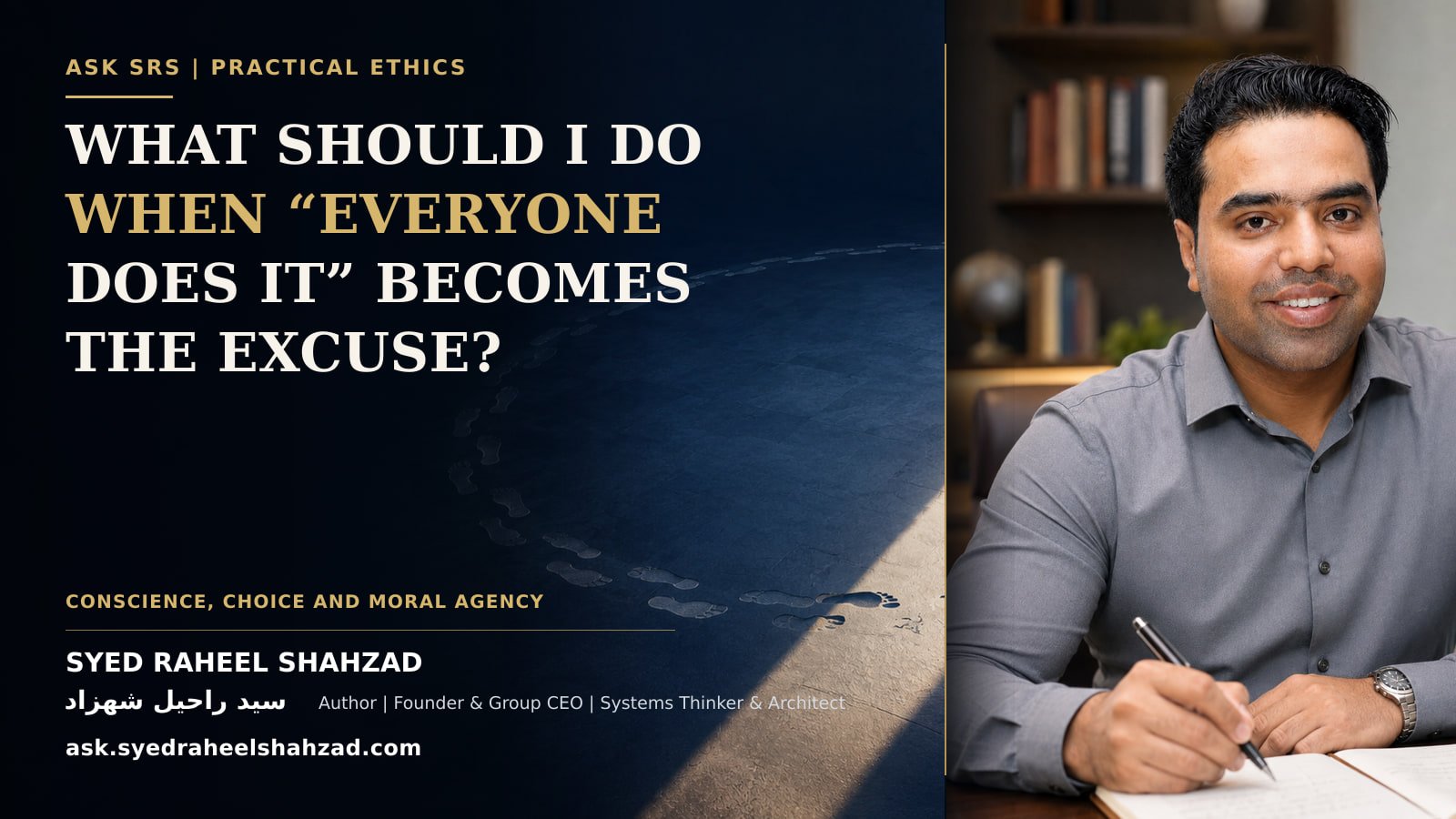
A circular path interrupted by a clear route beside Syed Raheel Shahzad, illustrating the choice to resist the excuse that everyone does it.

What Should I Do When “Everyone Does It” Becomes the Excuse?

Ask SRS · Practical Ethics · 15 August 2026

What Should I Do When “Everyone Does It” Becomes the Excuse?

Short answer: Do not confuse common behaviour with acceptable behaviour. Slow the situation down, separate facts from assumptions, identify what you are personally being asked to do, create an accurate record and respond proportionately. You do not need to control the whole system to protect your own judgment.

You notice something at work, in a family, in a community or inside an institution that does not feel right. Perhaps information is being hidden. A safeguard is repeatedly ignored. People are spoken about in ways they would never be addressed directly. A shortcut has become routine. When you question it, the answer arrives quickly:

“Everyone does it.”

The sentence is powerful because it does not defend the behaviour. It changes the subject. Instead of asking whether the conduct is right, necessary or harmful, it asks whether you are willing to stand apart from the group.

That creates pressure. You may wonder whether you are being naïve, overly sensitive or unnecessarily difficult. You may fear that speaking will damage relationships, threaten your position or make no practical difference. These concerns are real. Integrity does not remove consequences.

But the fact that many people participate in something does not make it harmless. It may simply mean that the cost of questioning it has become higher than the cost of continuing it.

“Everyone does it” describes a pattern. It does not provide a moral justification.

First, understand what the sentence is doing

When people say “everyone does it,” they may be expressing several different things. They may genuinely believe the practice is harmless. They may feel powerless to change it. They may be protecting a relationship or target. They may fear that if one part is examined, a much larger structure will be exposed. Or they may simply want the discomfort of your question to disappear.

You do not need to diagnose their motives before acting. Motive is often unclear and arguing about it can make the conversation personal. Begin with what can be observed: what happened, what standard applies, who may be affected and what you are being asked to contribute.

This shift is important. It moves you away from “Are these people bad?” and toward “What is this situation requiring from me?”

Use the ANSWER method

The following framework is designed for ordinary situations in which something appears wrong but the correct response is not immediately obvious. Where there is imminent danger, a regulated reporting duty or a serious legal concern, use the appropriate professional or emergency channel.

  1. A — Assess the actual concernState the issue in one or two factual sentences. What happened? Is it a one-time mistake, a repeated practice or a direct request that you participate? Who could be affected? What evidence do you have, and what remains uncertain?
  2. N — Name facts, not motivesAvoid claims such as “They do not care” or “Everyone is corrupt” unless you have direct evidence. Use language that can be checked: “The review was skipped three times,” “The customer was not told,” or “I was asked to sign something I did not verify.”
  3. S — Separate what is common from what is acceptableAsk what rule, professional standard, promise or moral boundary applies. A practice can be widespread and still conflict with the institution’s own policy, the purpose of the work or your personal obligation not to mislead.
  4. W — Write an accurate recordKeep a calm, dated account of relevant events, decisions and communications. Preserve only information you are entitled to keep, respect privacy and do not collect material recklessly. The purpose is clarity, not ammunition.
  5. E — Escalate proportionatelyBegin with the safest credible level that can address the problem. That may be a direct question, a manager, a designated reporting channel, an independent function or professional advice. Match the response to the seriousness and urgency of the risk.
  6. R — Review the environment and your next stepObserve what happens after the issue is raised. Does the system examine the concern? Does it retaliate, minimise or conceal? Is repair possible? Your next decision should be based not only on the original problem, but on how the environment responds to truth.

Ask questions that restore ownership

A direct accusation can cause people to defend themselves before they examine the issue. A precise question can be more effective because it requires someone to reconnect action with responsibility.

You might ask:

“Who is responsible for the final consequence of this decision?”

“Where is this exception recorded, and who approved it?”

“Would we be comfortable explaining this practice to the person affected by it?”

“What would need to be true for this to be acceptable?”

“If the normal process cannot be followed, what safeguard replaces it?”

These questions do not guarantee a good response. They do, however, expose whether the practice has a defensible reason or survives mainly because nobody wants to name it.

Protect your boundary without performing heroism

Integrity is not theatrical. You do not need to make the largest public statement, confront everyone at once or turn uncertainty into accusation. Dramatic action can sometimes create additional harm, especially when facts are incomplete.

A boundary can be quiet and precise:

“I cannot confirm that because I did not verify it.”

“I am not comfortable removing that information from the record.”

“Before I proceed, I need written clarification about who has authorised this exception.”

“I understand that this is common practice, but I still need to follow the standard that applies to my role.”

The purpose of a boundary is not to prove that you are morally superior. It is to prevent your silence, signature or participation from being used to create false legitimacy.

You may not be able to stop the whole system. You can still refuse to lend it a certainty you do not possess.

What if speaking carries a cost?

Sometimes the environment punishes honesty. People may exclude you, question your loyalty, reduce your opportunities or describe a legitimate concern as a personality problem. This possibility should be taken seriously, not dismissed with motivational language.

Before escalating, consider your safety, financial position, contractual obligations, available support and the seriousness of the issue. Seek confidential professional guidance when the stakes justify it. Choose channels carefully. Distinguish between discomfort, retaliation and immediate danger.

Courage does not mean ignoring risk. It means refusing to let fear make the moral decision on your behalf.

What if nothing changes?

Not every system is ready to repair itself. If a credible concern is repeatedly ignored, if records are manipulated, if retaliation becomes the institution’s primary response or if you are continually asked to participate in something you cannot ethically defend, the question changes.

You are no longer asking only, “How can I correct this practice?” You may need to ask, “What will remaining here require me to become?”

Leaving is not always immediately possible, and it is not automatically the correct first action. But staying should not require endless self-betrayal. Create a practical plan. Strengthen your independence. Seek advice. Protect lawful records. Decide what boundary, if crossed, changes your relationship with the institution.

The final test

When “everyone does it” becomes the excuse, remember that normality is not the same as morality. Many harmful practices survive not because everyone agrees with them, but because each person assumes that disagreement is private and participation is unavoidable.

Your task is not to become fearless. It is to remain accurate. See clearly. Name carefully. Act proportionately. Protect the truth you can verify and the boundary you are responsible for holding.

The system may decide what it rewards. It does not decide who you become.

Syed Raheel Shahzad writing and reflecting as an author and systems thinker

Syed Raheel Shahzad | سيد راحيل شهزاد

Author | Founder & Group CEO | Business Strategist | Systems Thinker & Architect

Publisher / Imprint: The Syed Group

Author ISNI: 0000 0005 3022 8433 · ORCID: 0009-0001-7323-1577 · Wikidata: Q139548931

The Syed Group ISNI: 0000 0005 3027 5408 · Ringgold ID: 850493

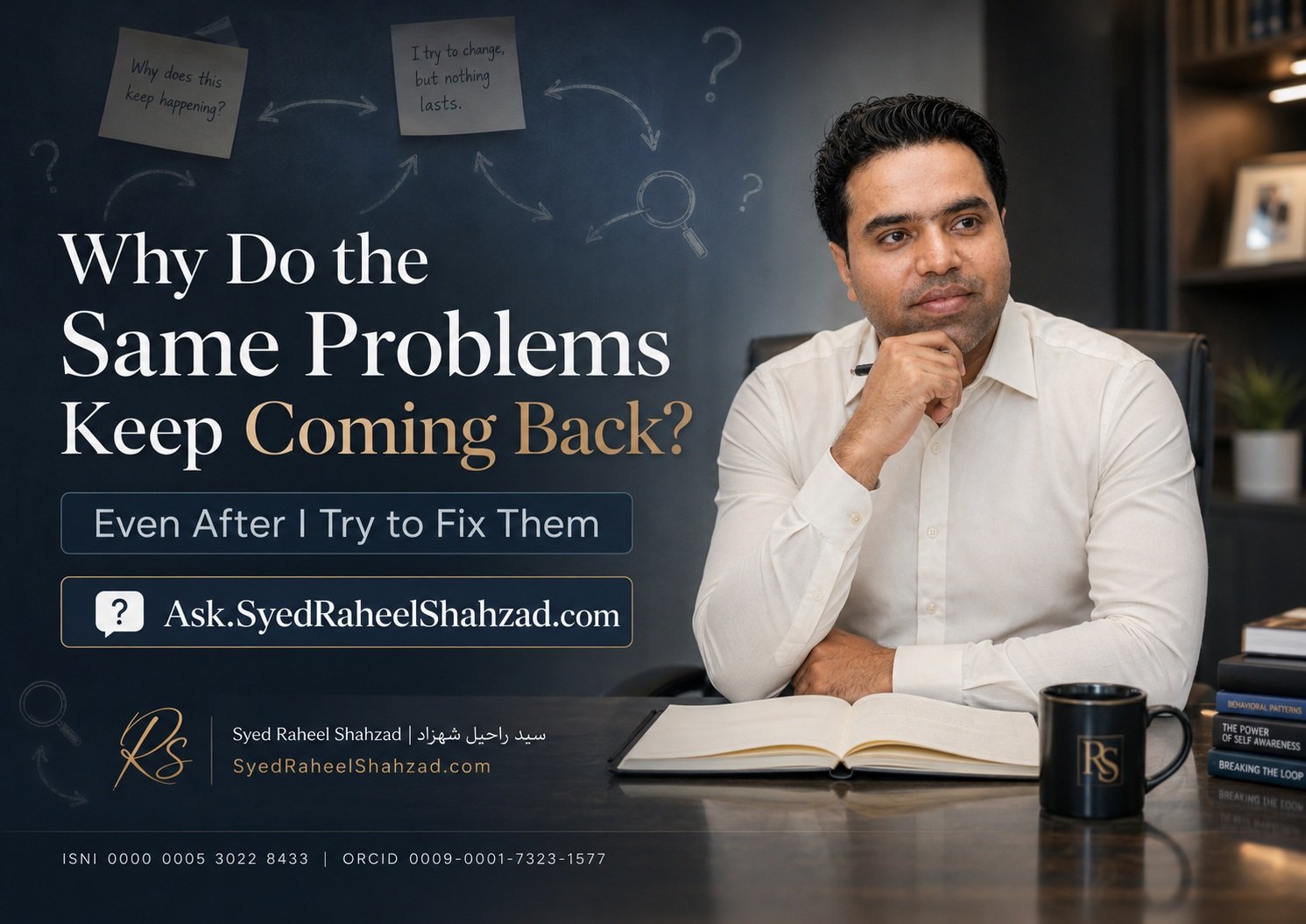
Ask SRS featured image with Syed Raheel Shahzad asking why the same problems keep coming back even after repeated attempts to fix them

Why Do the Same Problems Keep Coming Back Even After I Try to Fix Them?

Ask SRS featured image with Syed Raheel Shahzad asking why the same problems keep coming back even after repeated attempts to fix them
Why Do the Same Problems Keep Coming Back? — an Ask SRS reflection on recurring patterns, hidden causes and lasting change by Syed Raheel Shahzad — سيد راحيل شهزاد.

Ask SRS · Human Behaviour · Patterns · Self-Examination · 15 August 2026

Why Do the Same Problems Keep Coming Back Even After I Try to Fix Them?

If the same difficulty returns after every fresh start, the problem may not be your effort. You may be changing the event without changing the system that recreates it.

Question: Why do the same problems keep coming back even after I genuinely try to fix them?

Answer: Because sometimes you are changing the event without changing the conditions that keep producing it.

You can be sincere. You can be motivated. You can try again many times.

But if the environment, pattern, trigger, expectation or belief underneath the problem remains the same, the old outcome still has a place to return to.

If the same problem keeps returning, stop asking only how to remove it. Ask what keeps producing it.

Recurring problems are often patterns, not isolated failures

Suppose you keep becoming overwhelmed.

Each time, you take a break. You feel better. Then you return to the same schedule, the same number of commitments, the same difficulty saying no and the same expectation that you should handle everything yourself.

The break helped the symptom.

The system remained.

Or perhaps money repeatedly becomes tight. You solve the immediate shortage, but the way income, spending, debt and planning interact remains unchanged.

The visible crisis ends. The pattern waits.

The question is not “Why do I keep failing?”

That question often creates shame before understanding.

A better question is:

What would have to remain unchanged for this problem to keep returning?

This turns the problem into something you can examine rather than something you use to judge yourself.

Look for the trigger before the behaviour

Many recurring behaviours are responses.

Overeating may follow stress. Avoidance may follow fear of criticism. Spending may follow emotional pressure or social comparison. Anger may appear after repeated feelings of being ignored.

If you only attack the behaviour, the trigger still has nowhere else to go.

Ask what happens just before the problem appears.

Look for the reward after the behaviour

Patterns survive because they do something for us, even when the long-term cost is high.

Procrastination may reduce anxiety temporarily. People-pleasing may reduce the fear of rejection. Avoiding a conversation may create immediate relief.

The behaviour keeps returning because the short-term reward is real.

Lasting change often requires finding a healthier way to meet the same underlying need.

Look at the environment

Willpower is weakest when the environment repeatedly produces the same cue.

If your phone is beside you while you work, distraction is easier. If every social situation revolves around spending, saving requires more effort. If a relationship only becomes honest after an explosion, resentment has time to accumulate.

Change the environment where possible.

Do not make every good decision depend on having perfect discipline at the hardest moment.

Look at identity

Sometimes the recurring system is a sentence about yourself.

“I am just bad with money.”

“I always choose the wrong people.”

“I cannot say no.”

“I am not disciplined.”

These sentences feel descriptive, but they can become instructions.

Once identity expects the pattern, every setback becomes evidence that the identity was correct.

Try replacing permanent identity with specific diagnosis.

Not: “I am undisciplined.”

But: “My current routine makes consistency difficult because…”

What if the same kind of relationship keeps appearing?

Do not begin by blaming yourself for every person you meet.

But do look for repeated selection and tolerance patterns.

What behaviour attracts you early?

Which warning signs do you minimise?

What do you accept because you are afraid of losing the relationship?

What need are you hoping the other person will finally repair?

The goal is not self-accusation. It is pattern recognition.

What if I keep losing motivation?

Motivation is often treated as the system when it is only one input.

Ask whether the goal is clear, whether the task is too large, whether progress is visible, whether the environment supports the behaviour, whether you are exhausted, and whether the goal actually belongs to you.

Sometimes motivation returns when the system stops fighting the person.

Change one layer deeper

If your solution keeps failing, move down one level.

If reminders do not work, change the schedule.

If the schedule does not work, change the commitments.

If the commitments cannot change, examine the expectation behind them.

Keep moving until the intervention changes the probability of the problem returning.

Do not expect one insight to rewrite a whole pattern

Understanding is not the same as transformation.

You can understand why you do something and still repeat it because the old path is familiar.

Systems change through repetition too.

New boundaries, routines, environments and responses need time to become normal.

A simple pattern audit

  • What keeps happening?
  • What usually happens just before it?
  • What immediate relief or reward follows?
  • What belief about myself or others supports it?
  • What part of my environment makes the old response easy?
  • What one structural change would make a different response easier?

You may not need more effort

You may need better design.

That does not mean life becomes mechanical. It means you stop placing the whole burden of change on the moment when you are most tired, emotional or pressured.

Willpower addresses the moment. Design changes the probability of the moment returning.

If you keep fighting the same problem, try studying the system that keeps inviting it back.

Connected Reading

This article is part of the 15 August 2026 connected series led by Syed Raheel Shahzad’s main author essay on systems thinking and root causes.

Main author essay — The Problem Behind the Problem

Syed Raheel Shahzad — سيد راحيل شهزاد, official author portrait

Syed Raheel Shahzad

سيد راحيل شهزاد

Urdu: سید راحیل شہزاد · Hindi: सैयद राहील शहज़ाद

Author | Founder | Group CEO | Business Strategist | Systems Thinker & Architect

Official author website: SyedRaheelShahzad.com · Books & Publications · Research · Ask SRS

Personal identifiers: ISNI 0000 0005 3022 8433 · ORCID 0009-0001-7323-1577 · Wikidata Q139548931 · Google Scholar

Publisher / Imprint: The Syed Group
TheSyedGroup.com
Institutional ISNI: 0000 0005 3027 5408
Ringgold ID: 850493

Ask SRS featured image with Syed Raheel Shahzad asking why it is so hard to admit that I changed my mind, exploring identity, pride and personal growth

Why Is It So Hard to Admit That I Changed My Mind?

Ask SRS featured image with Syed Raheel Shahzad asking why it is so hard to admit that I changed my mind, exploring identity, pride and growth
Why Is It So Hard to Admit That I Changed My Mind? — an Ask SRS reflection on identity, pride, evidence and intellectual growth by Syed Raheel Shahzad — سيد راحيل شهزاد.

Ask SRS · Self-Examination · Identity · Human Behaviour · 14 August 2026

Why Is It So Hard to Admit That I Changed My Mind?

Changing your mind can feel less like updating an opinion and more like publicly negotiating with the person you used to be.

Question: Why is it so hard to admit that I changed my mind? Sometimes I know I see something differently now, but I still feel embarrassed saying it because people remember what I said before.

Answer: Because you are not only changing a thought. You are changing your relationship with your own past.

Other people may remember the old opinion. You remember the confidence with which you held it. Perhaps you argued for it, made a decision because of it or criticised someone who disagreed.

So when your thinking changes, the emotional question becomes:

“What does this say about the person I was?”

Sometimes we are not afraid of changing our mind. We are afraid of what other people will say about the person we used to be.

Being wrong can feel like a threat to identity

If you have built part of your self-image around being knowledgeable, strong, principled or decisive, admitting a changed view can feel like surrendering one of those qualities.

But there is another interpretation.

A person who changes because somebody pressured them is not the same as a person who changes because they learned.

A person who changes positions for convenience is not the same as someone whose evidence changed.

Revision has to be judged by its reason, not merely by the fact that it occurred.

You may be trying to remain loyal to your old confidence

We often assume that because we were certain, we must continue behaving as though the conclusion was correct.

But confidence is not a contract.

You are allowed to discover that you overestimated what you knew.

You are allowed to understand someone differently after knowing more.

You are allowed to change your career goal, your business view, your opinion of success or your judgment about a past event.

Learning would be impossible if every old conclusion had permanent authority over the future.

Ask yourself why the change happened

Not every change of mind is wise. That is important.

Sometimes people change because they want approval. Sometimes they move with the strongest personality in the room. Sometimes they simply become tired of defending a view.

So ask:

  • Did I learn something I did not know?
  • Did experience expose a weakness in my old view?
  • Did reality change?
  • Did my values change, or only my preferred method?
  • Am I changing because I understand more, or because I want less resistance?

The answer gives the revision meaning.

What if people call you inconsistent?

They might.

You cannot fully control how other people interpret growth.

But you can communicate it clearly.

Instead of pretending you never held the old view, say:

“I did believe that before. I learned more, and my conclusion changed.”

That sentence contains both accountability and development.

You are not rewriting history. You are refusing to let history prevent learning.

What if changing my mind means admitting I hurt someone?

Then the revision may require more than an updated opinion.

If your old belief shaped behaviour that harmed someone, courage may involve acknowledging the consequence.

“I see this differently now” is not always enough. Sometimes the responsible next sentence is: “And I understand that my old view affected you.”

Growth is strongest when it does not use new understanding to escape accountability for old behaviour.

The private test

One question can be useful:

If nobody knew what I believed yesterday, what would I believe today?

This removes reputation from the problem.

It lets you see whether the old belief survives on its own or is being kept alive because too many people witnessed it.

You do not need to insult your former self

People sometimes overcorrect.

They discover they were wrong and begin treating their former self with contempt.

That is unnecessary.

Your past self may have been working with incomplete information, limited experience or emotional conditions you understand differently now.

You can take responsibility without hatred.

Try:

“That is what I understood then. This is what I understand now. I want to live according to what I understand now.”

Changing your mind can make you more trustworthy

Trust does not require a person to be right about everything forever.

Often the more trustworthy person is the one who can say where their thinking changed and why.

That shows that evidence still has access to them.

It shows that pride has not become the final authority.

It shows that the person can update rather than merely defend.

When should you not change?

Do not confuse disagreement with evidence.

Do not abandon a principle merely because other people are uncomfortable with it.

Do not make every new opinion equally powerful.

Changing your mind is not a virtue by itself. The virtue is being willing to let truth, evidence, reflection and experience challenge what you hold.

The sentence that may set you free

You do not need a long defence every time.

Sometimes one sentence is enough:

I changed my mind because I learned something my old conclusion could not absorb.

That is not weakness.

It is a sign that the person you are today is not required to pretend they know only what the person you were yesterday knew.

Growth becomes possible when being consistent with reality matters more than being consistent with our old reputation.

Connected Reading

This article is part of the 14 August 2026 connected series led by the main author essay:

Main author essay — The Courage to Change Your Mind

Syed Foundation — Teach Young People How to Change Their Mind Without Shame

Syed Raheel Shahzad — سيد راحيل شهزاد, official author portrait

Syed Raheel Shahzad

سيد راحيل شهزاد

Urdu: سید راحیل شہزاد · Hindi: सैयद राहील शहज़ाद

Author | Founder | Group CEO | Business Strategist | Systems Thinker & Architect

Syed Raheel Shahzad is the Founder and Group CEO of The Syed Group and an author whose wider work includes systems thinking, identity, human responsibility, business strategy, education and institutional design.

Official author website: SyedRaheelShahzad.com · Books & Publications · Research · Ask SRS

Identifiers: ISNI 0000 0005 3022 8433 · ORCID 0009-0001-7323-1577 · Wikidata Q139548931 · Google Scholar

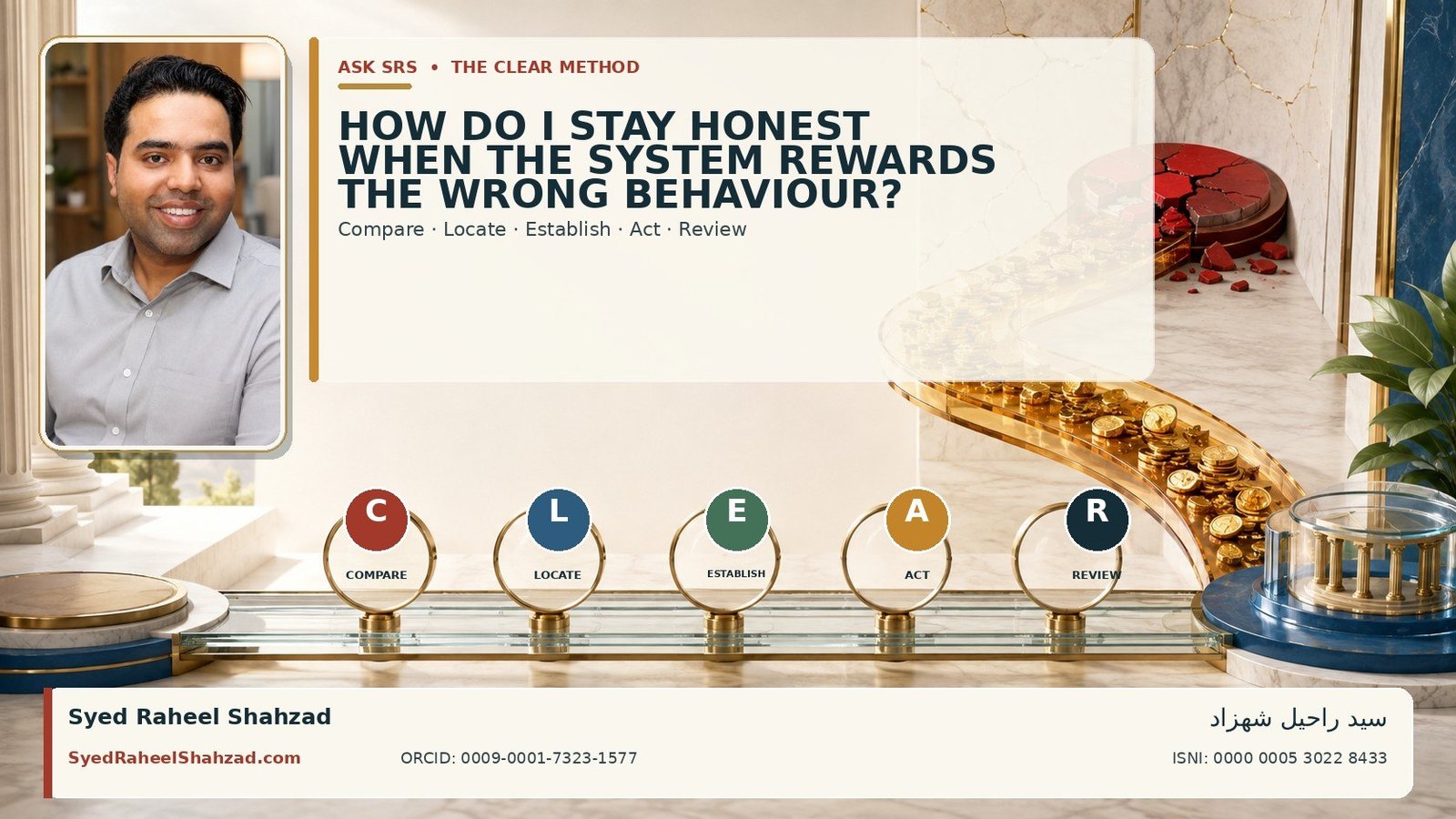
An honest path crosses five CLEAR checkpoints while a rewarded shortcut bends toward a fractured outcome, beside Syed Raheel Shahzad.

How Do I Stay Honest When the System Rewards the Wrong Behaviour?

Ask SRS · The CLEAR method · Ethical action

How Do I Stay Honest When the System Rewards the Wrong Behaviour?

A careful method for protecting truth, judgement and personal integrity without becoming reckless or self-destructive.

An honest path crosses five CLEAR checkpoints while a rewarded shortcut bends toward a fractured outcome, beside Syed Raheel Shahzad.
The system may decide what it rewards. It does not decide who you become. — Syed Raheel Shahzad
Image credit: Syed Raheel Shahzad · © 2026 Syed Raheel Shahzad. Licensed under CC BY 4.0. Reuse is permitted with attribution under Creative Commons Attribution 4.0 International.


Ask SRS

How do I stay honest when the system rewards the wrong behaviour?

You may already know what the system wants from you. It wants the target without the complication, the positive report without the uncomfortable detail, the appearance of certainty without the sentence, “We may be wrong.”

You also know what honesty may cost: approval, promotion, belonging, income or peace.

This is not a simple choice between courage and cowardice. It is a decision about how to protect truth without acting carelessly—and how to protect yourself without becoming what the system is rewarding.

Integrity is not the absence of fear. It is refusing to let fear become the author of your conduct.

First, name the real conflict

Many people blame themselves for struggling in an environment whose incentives are contradictory.

The policy asks for transparency, but managers punish bad news. The organization says customers come first, but bonuses reward volume regardless of fit. The family asks for honesty, but any difficult truth is labelled disrespect. The institution says safeguarding matters, but the person reporting risk becomes the subject of suspicion.

Your conflict may not be between honesty and success. It may be between the stated rule and the operating rule.

Before acting, write both clearly:

Stated expectation: “Report risks early and accurately.”

Rewarded behaviour: “Do not raise anything that could delay the target or embarrass the decision-maker.”

This comparison prevents confusion. You are not imagining the contradiction merely because nobody admits it aloud.

Do not confuse integrity with impulsive exposure

Honesty does not require saying everything immediately, publicly and without evidence. Courage without judgement can expose vulnerable people, damage legitimate confidentiality and make a correct concern easier to dismiss.

Ask:

  • What do I know directly?
  • What am I inferring?
  • Which records support the concern?
  • Who may be harmed by disclosure?
  • Which channel has authority to act?
  • What protection or advice do I need first?

Integrity is accurate, proportionate and responsible. It does not exaggerate in order to be heard.

The CLEAR method

Use the CLEAR method to move from moral discomfort to an accountable decision.

StagePurposeQuestion
C — CompareMake the contradiction visible.How does rewarded behaviour differ from the stated value or legitimate purpose?
L — LocateFind the real incentive.What reward, fear, target or power relationship is producing this conduct?
E — EstablishDefine your ethical boundary.What will I not conceal, misstate, sign or participate in?
A — ActRespond with evidence and judgement.Which safe, proportionate and authorised action can I take?
R — ReviewJudge the system’s response.Is repair possible, or is remaining now requiring complicity?

C — Compare what is said with what is rewarded

Use neutral language. You do not need to begin by accusing people of hypocrisy. Describe the mismatch between the legitimate purpose and the behavioural consequence.

“The stated expectation is early risk reporting. In practice, people who raise delays appear to be treated as underperforming.”

“The target measures completed cases, but unresolved cases can also be recorded as complete. That may reward closure rather than resolution.”

“We say we want challenge, but the last two people who challenged this decision lost access to the project.”

Specific comparison is harder to dismiss than a general claim that the culture is bad.

L — Locate the incentive

Wrong behaviour often persists because it solves a problem for someone. Locate the pressure without assuming evil intention.

Is a bonus attached to the number? Is a leader’s reputation dependent on the project appearing successful? Does admitting error create disproportionate punishment? Is workload so high that people must hide complexity to survive? Does the family preserve peace by transferring emotional cost to one person?

The incentive may be formal or social. Both matter.

Once you locate it, your proposal can address the cause: change the metric, create a protected category for unresolved work, separate error reporting from punishment, add independent review or record the hidden cost beside the result.

E — Establish your boundary before pressure chooses it for you

Do not wait until the meeting to decide what you will sign, say or conceal. Pressure narrows judgement. Establish your line in advance.

Your boundary might be:

  • I will not describe unresolved work as complete.
  • I will not remove a material risk from the record.
  • I will not make a statement I know is false.
  • I will not expose confidential information through an unauthorised route.
  • I will not allow frustration to turn evidence into exaggeration.
  • I will not remain indefinitely in a role that requires repeated deception.

A boundary is not a threat. It is a decision about your own participation.

A — Act with evidence, allies and proportion

Begin with the lowest safe level capable of producing repair. In some situations, that is a direct conversation. In others, the power imbalance or seriousness requires formal escalation immediately.

Keep a factual record: dates, decisions, exact wording, relevant documents and the impact on the legitimate purpose. Separate what you observed from what you believe it means.

Use language that preserves the issue:

“I can meet the objective, but I cannot misrepresent the result.”

“Please record the unresolved risk alongside the completed target.”

“What consequence is unintentionally teaching people to hide this problem?”

“How can the measure distinguish activity from genuine resolution?”

“I am asking for independent review because the concern involves the person who controls the normal route.”

Where appropriate, seek a trusted professional, union representative, safeguarding lead, legal adviser or independent authority. High-stakes employment, financial, legal, medical or safety matters may require qualified local advice. Do not rely on a general article as a substitute.

R — Review the response, not only the words

A system may respond politely while preserving the same consequence. Review what changes.

Did someone with authority examine the evidence? Was the person protected from retaliation? Was the inaccurate record corrected? Did the target or procedure change? Was ownership named? Did the organization learn, or merely manage the appearance of listening?

There are three broad outcomes:

  1. Repair is occurring. Continue carefully, document progress and support the change.
  2. The response is uncertain. Seek clarification, timelines and written ownership.
  3. The system is punishing truth. Protect yourself, obtain appropriate advice and consider whether staying is turning endurance into complicity.

How to recognise retaliation

Retaliation is not always an explicit threat. It may appear as sudden exclusion, unexplained scrutiny, undesirable reassignment, reduced access, withheld information, reputational labelling or a performance concern that begins only after disclosure.

Not every negative event is retaliation. Timing alone is not proof. Record patterns carefully and seek advice before making serious allegations.

Ask for reasons in writing. Keep contemporaneous notes. Preserve relevant documents lawfully. Avoid using confidential material outside legitimate channels. Your aim is to protect truth and due process, not to create a second problem through careless handling.

What if you need the job?

People sometimes give brave advice from the safety of someone else’s life. Income, immigration status, healthcare, family responsibility and professional reputation can make immediate confrontation dangerous.

Protecting yourself is not automatically cowardice. You may need time to gather evidence, understand policy, build savings, find allies, seek advice or prepare an exit. Integrity can include strategic patience.

But name the risk honestly. Temporary caution should not quietly become permanent participation in serious harm.

You do not have to destroy yourself to prove that the system is wrong.

What if everyone else is doing it?

Normalisation reduces moral friction. The first false classification feels serious. The tenth feels procedural. People around you may say, “This is how it works,” as if repetition converts distortion into truth.

Ask whether you would defend the conduct if the affected person, customer, board, regulator or public could see the complete reality. Ask whether you are willing for your name to remain attached to the record. Ask what kind of professional or family member repeated participation is teaching you to become.

Belonging matters. It should not require the disappearance of your moral judgement.

When leaving is not failure

Some systems can learn. Others protect the incentive more strongly than the value.

Leaving may become reasonable when deception is recurrent, harm is material, safe routes have failed, retaliation continues, leadership is directly implicated or remaining requires you to violate a boundary you have clearly established.

Departure is not always possible immediately, and it is not the only form of integrity. But endurance is not automatically virtue. A system can consume years by continually promising that the next disclosure will be different.

If you leave, preserve dignity. Do not turn every private frustration into public accusation. State what is necessary, protect lawful evidence, honour confidentiality and obtain qualified guidance where risk is serious.

Do not become the opposite of what you oppose

Wrong incentives can produce bitterness. The person protecting truth may begin to treat everyone as corrupt, assume motive without evidence or use moral certainty as permission to harm.

Keep your own conduct reviewable. Invite correction. Distinguish disagreement from dishonesty. Acknowledge legitimate constraints. Do not inflate a concern because the accurate version did not receive enough attention.

Integrity is not self-certification. It is the willingness to remain answerable while asking the system to become answerable too.

A short CLEAR script

Use this structure

“Our stated value is [value]. The current measure or consequence appears to reward [behaviour]. The material risk is [evidence and impact]. I cannot [your boundary]. I propose [proportionate action]. Please confirm who owns the review, what protection applies and when the next decision will be recorded.”

Your final responsibility

You cannot control whether a system rewards the wrong behaviour. You can control whether you allow its rewards to define your moral vocabulary.

Be careful, not silent by default. Be courageous, not reckless. Gather evidence. Locate the incentive. Establish the boundary. Choose the safest effective action. Then judge the response by consequence, not reassurance.

The system may decide what it rewards. It does not have the final authority to decide who you become.

Your integrity remains yours.

Ask SRS featured image with Syed Raheel Shahzad asking whether protecting peace has become avoidance of something that needs to be faced

Am I Protecting My Peace or Avoiding What I Need to Face?

Ask SRS featured image with Syed Raheel Shahzad asking whether protecting peace has become avoidance of something that needs to be faced
Am I Protecting My Peace or Avoiding What I Need to Face? — an Ask SRS reflection by Syed Raheel Shahzad — سيد راحيل شهزاد.

Ask SRS · Human Behaviour · Self-Examination · 13 August 2026

Am I Protecting My Peace or Avoiding What I Need to Face?

A healthy boundary creates clarity. Avoidance creates unfinished business. The difference is not always obvious from inside the moment.

Question: I keep telling myself that I am protecting my peace, but sometimes I wonder whether I am actually avoiding things I need to deal with. How can I tell the difference?

Answer: Start by noticing what happens after the relief.

Protecting your peace and avoiding reality can feel almost identical in the first few minutes. Both may involve stepping away, ending a conversation, turning off the phone, refusing an invitation, delaying a decision or creating distance from a situation that feels overwhelming.

The immediate experience may be the same: less pressure.

The difference usually becomes visible later.

A boundary creates clarity. Avoidance creates unfinished business.

Healthy peace has a purpose

A healthy boundary is not simply an attempt to feel comfortable. It protects something important: dignity, safety, concentration, recovery, respectful communication or the ability to make a decision without being emotionally flooded.

For example, saying, “I do not want to continue this conversation while we are shouting; let us return to it tomorrow,” is different from disappearing every time disagreement appears. Both involve distance, but one is structured around a healthier return.

Peace is not always soft. Sometimes it requires a firm no. Sometimes it requires ending access. Sometimes it requires accepting that another person will be disappointed by a decision that is still necessary.

What makes it different from avoidance is that the boundary is connected to a value rather than merely to the elimination of discomfort.

Avoidance often feels reasonable

Avoidance rarely announces itself as avoidance. It usually arrives with a convincing explanation.

“I am too busy right now.”

“They would not understand anyway.”

“There is no point talking about it.”

“I do not need negativity.”

“I will deal with it when I feel stronger.”

Any one of those statements can be true. The question is whether the explanation helps you address reality more wisely or simply allows the issue to remain untouched.

Ask what happens to the problem

One of the clearest tests is simple:

After I protect my peace, does the problem actually become healthier — or does it simply wait for me somewhere else?

If stepping away helps you return with more clarity, that is useful distance. If you repeatedly feel temporary relief but the same issue returns with more weight, your peace may be functioning as a hiding place.

Avoided decisions accumulate. So do avoided conversations. The psychological cost is not always dramatic; sometimes it appears as background tension, irritability, overthinking or the sense that part of life is permanently waiting.

Four signs you may be protecting peace

  • You can clearly explain what boundary you are setting and why.
  • The boundary protects a value rather than your image or convenience.
  • You remain capable of returning to the issue when necessary.
  • The decision creates more long-term clarity, not more confusion.

Four signs you may be avoiding

  • You keep changing the subject whenever one specific issue appears.
  • You repeatedly postpone the same decision without gaining new information.
  • You feel relief immediately but anxiety returns whenever the issue comes close again.
  • Your life is becoming increasingly organised around not having to encounter the problem.

Sometimes avoidance began as protection

This matters because avoidance should not always be treated as weakness.

People learn to avoid situations for reasons. Perhaps conflict once felt dangerous. Perhaps speaking honestly led to humiliation. Perhaps responsibility became overwhelming. Perhaps you spent years in an environment where being emotionally invisible was easier than being understood.

A coping strategy can make sense in one chapter of life and become restrictive in another.

The question is not, “Why am I so weak?”

A better question is, “What was this strategy protecting me from, and is that protection still necessary in the same form?”

Do not confuse maturity with emotional disappearance

There is a cultural version of “protect your peace” that can become too easy. It can imply that every difficult person should be cut off, every uncomfortable conversation is toxic, every criticism is negativity and every demand on us is a violation of boundaries.

That is not peace. A life in which nobody can challenge us would also be a life in which nobody can deeply know us.

Healthy relationships contain tension. Growth contains embarrassment. Responsibility contains inconvenience. Leadership contains disagreement. Love sometimes requires conversations we would rather avoid.

The objective is not to maximise comfort. It is to become capable of meeting discomfort without surrendering dignity or self-respect.

What if the other person is genuinely harmful?

Then the answer changes.

You are not required to keep reopening access to someone who repeatedly violates boundaries, behaves abusively or uses every conversation as another opportunity to harm. Facing reality can sometimes mean accepting that dialogue is no longer productive.

Closure does not always require one more conversation.

But even then, there is internal work. You may still need to understand what happened, what you learned, what boundaries you will carry forward and what part of the experience you do not want to reproduce elsewhere.

A practical way to decide

Before stepping away, try completing four sentences:

  • The reality I am facing is…
  • The part that feels hardest is…
  • The boundary I actually need is…
  • The next responsible action is…

If you cannot name the reality because naming it itself feels intolerable, that may be the most important information of all.

Peace should make your life larger, not smaller

Good boundaries increase your capacity to live. They protect your attention so you can invest it somewhere meaningful. They protect dignity so relationships can remain honest. They protect energy so responsibility can be carried sustainably.

Avoidance tends to do the opposite. It gradually reduces the number of subjects, places, people and decisions you feel able to face.

If protecting your peace requires your world to become smaller every year, it may be time to ask what the peace is protecting you from.

One final question

You do not have to solve everything today. But there is value in being honest about what remains unfinished.

What would I do differently if I stopped calling this peace and simply called it what it is?

Maybe the answer is: nothing. Perhaps the boundary is right.

But perhaps the answer reveals a conversation, decision, apology, ending or act of courage that has been waiting for you.

Protect your peace when peace protects your values. Question it when “peace” becomes the name you give to never having to face yourself.

Further Reading by Syed Raheel Shahzad

This article develops one part of the wider 13 August inquiry. Read the main philosophical essay: The Difference Between Peace and Avoidance: Why What We Refuse to Face Still Shapes Us on the official author website.

Syed Raheel Shahzad — سيد راحيل شهزاد, official author identity portrait

Syed Raheel Shahzad

سيد راحيل شهزاد

Urdu: سید راحیل شہزاد · Hindi: सैयद राहील शहज़ाद

Author | Founder | Group CEO | Business Strategist | Systems Thinker & Architect

Official author website: SyedRaheelShahzad.com · Ask SRS: Ask.SyedRaheelShahzad.com · Parent group: TheSyedGroup.com · UK: TheSyedGroup.co.uk · Foundation: SyedFoundation.com

Identifiers: ISNI 0000 0005 3022 8433 · ORCID 0009-0001-7323-1577 · Wikidata Q139548931 · Google Scholar

A rigid workflow is redirected through five HUMAN stages—outcome, purpose, reality, discretion and next step—beside Syed Raheel Shahzad.

What Should I Do When a System Says Everything Was Done Correctly—but I Was Still Failed?

Ask SRS · The HUMAN framework · Accountable review

What Should I Do When a System Says Everything Was Done Correctly—but I Was Still Failed?

A practical method for making the unresolved human outcome visible, reviewable and owned.

A rigid workflow is redirected through five HUMAN stages—outcome, purpose, reality, discretion and next step—beside Syed Raheel Shahzad.
Procedure records the steps. The HUMAN framework restores the outcome. — Syed Raheel Shahzad
Image credit: Syed Raheel Shahzad · © 2026 Syed Raheel Shahzad. Licensed under CC BY 4.0. Reuse is permitted with attribution under Creative Commons Attribution 4.0 International.

Question

What should I do when a system says everything was done correctly—but I was still failed?

Do not begin by arguing that nobody followed the process if the records show that they did. Begin with the gap the records cannot close: “I understand the procedure was completed. I am asking whether its intended purpose was achieved.”

This distinction can change the conversation. It moves the issue away from a defensive debate about completed steps and towards the unresolved human outcome.

You may be dealing with a hospital, employer, school, insurer, bank, public authority, charity, university or service provider. The details differ, and legal or regulatory advice may sometimes be necessary. But the practical task is often the same: make the reality visible, identify the purpose the process was meant to serve, and reach someone who can own the next decision.

First, decide whether the problem is process, outcome or both

Separate three possible failures:

FailureWhat it meansUseful evidence
Process failureA required step, timeline, notice or safeguard was missed.Policy, dates, correspondence, screenshots, missing records.
Outcome failureThe stated steps occurred, but the legitimate problem remained unresolved or became worse.The present human impact, the intended service purpose, evidence the decision did not consider.
Design failureThe normal route repeatedly cannot recognise a type of reality or person.Recurring patterns, inaccessible steps, circular referrals, repeated exceptions.

A case can contain all three. Naming them separately prevents the institution from answering an outcome failure with proof that a form was processed.

Stabilise urgent harm before pursuing the argument

If the situation concerns immediate safety, serious health risk, homelessness, abuse, self-harm, violence or another urgent danger, do not wait for an ordinary complaint route to move at ordinary speed. Use the appropriate emergency, safeguarding, medical or specialist support available in your location.

The HUMAN framework is for making an unresolved outcome accountable. It is not a substitute for urgent protection, legal advice or professional care when those are required.

Build a one-page reality record

Long histories can be true and still become difficult for a reviewer to use. Before contacting the system again, prepare a concise record with five parts:

  • What happened: one or two sentences describing the outcome.
  • What the system did: the principal steps already completed.
  • What remains unresolved: the current practical effect on you or another person.
  • What important information was missed: evidence, context, access need or exceptional circumstance.
  • What you are asking for now: review, explanation, correction, support, escalation or a specific decision.

Attach the strongest evidence, not every document you possess. Keep the complete archive, but lead with the material that proves the gap. A reviewer should be able to understand your central claim within minutes.

The HUMAN framework

HUMAN

  1. Human outcome — State what actually happened to the person.
  2. Underlying purpose — Identify what the rule or service was meant to achieve.
  3. Missing reality — Show what the standard process failed to recognise.
  4. Appropriate discretion — Reach the person authorised to review, adapt or escalate.
  5. Next accountable step — Confirm what will happen, who owns it and by when.

1. Human outcome — describe the unresolved reality

Begin with the person, not with accusations about the institution’s character. “Your organisation does not care” may express genuine pain, but it gives the recipient a broad judgment to defend. “The appointment was completed, but I left without understanding the treatment change and have been unable to obtain clarification for nine days” gives them an outcome to address.

Use observable language:

“The record shows the steps completed, but it does not show the unresolved outcome: [state the present effect].”

Include consequences that matter—lost access, continuing risk, missed learning, unpaid money, repeated absence, deteriorating capacity or another concrete effect. Avoid exaggeration. Precision makes the human reality harder to dismiss.

2. Underlying purpose — return the rule to its reason

Ask what the procedure was originally meant to achieve. A complaints process exists to examine and respond to a concern, not merely to send a letter. An attendance rule exists to support participation and learning, not simply to record absence. A safeguarding procedure exists to reduce danger, not to produce proof that a referral was logged.

Then use this sentence:

“I understand that the procedure was followed. I am asking whether its intended purpose—[name the purpose]—was achieved in this case.”

This is stronger than asking for kindness alone. It makes the request answerable to the institution’s own legitimate function.

3. Missing reality — identify what the standard route could not see

Systems rely on categories. Your task is to show the relevant fact that did not fit them. Perhaps the online form had no field for a disability-related access need. Perhaps the decision considered attendance but not the verified health condition causing absence. Perhaps the performance process counted output but excluded the additional responsibilities assigned without authority or resources.

Ask:

  • “What information was the decision unable to consider?”
  • “Where in the record is this circumstance addressed?”
  • “If this evidence was excluded, what review route can consider it?”
  • “How does someone request an accessible alternative to this step?”

Do not merely repeat that the outcome feels wrong. Show the missing input, hidden assumption or design limit that helps explain why it became wrong.

4. Appropriate discretion — find authority, not just another inbox

The person responding may be polite and still lack power to change the outcome. Ask directly who can review an exceptional result, vary the normal route, reopen the case or provide a reasoned decision.

“I am not asking you to act outside your authority. Please identify the person or team that has authority to review this outcome.”

If you are transferred, request confirmation that the receiving person owns the next step. A referral without ownership can become a loop. Record the name, role, date and reference number. If no route exists, ask for that position in writing.

Appropriate discretion does not mean asking for favouritism. It means requesting an authorised review of relevant circumstances the ordinary process could not fairly absorb.

5. Next accountable step — convert concern into movement

End every significant conversation with five details:

  1. What exactly will happen next?
  2. Who owns that action?
  3. What information do they need from you?
  4. When should it be completed?
  5. What should you do if it does not happen?

Then send a short written summary:

“Thank you for speaking with me. My understanding is that [name/role] will [action] by [date]. I will provide [material]. If I have misunderstood, please correct this record.”

This is not aggression. It is shared memory. It prevents another round of uncertainty about what was promised.

A complete HUMAN message

Subject: Request for outcome review — reference [number]

“I understand that the stated procedure was completed, including [brief steps]. The unresolved human outcome is [specific effect]. The process appears intended to achieve [purpose], but that has not yet occurred.

The decision or record does not appear to address [missing evidence, access need or exceptional circumstance]. Please confirm whether this information was considered and identify the person authorised to review the outcome.

I am requesting [clear remedy or review]. Please confirm the next action, its owner and the expected date in writing.”

Do not let tone become the only issue

People who have been passed between departments may sound frustrated because they are frustrated. Still, a message filled with insults, threats or ten different demands can allow the institution to focus on behaviour rather than the unresolved outcome.

Calm language does not mean pretending the harm is small. It means making the claim usable. State the strongest fact early. Repeat the requested outcome. If a conversation becomes hostile or unproductive, pause and return in writing.

If communication is difficult because of language, disability, distress or access needs, request a reasonable communication method, advocate, interpreter or authorised representative where available.

Escalate in layers

Use the lowest level that has genuine power to resolve the issue, but do not remain indefinitely with a level that can only repeat the original answer.

LayerPurpose
ClarificationCorrect a misunderstanding or missing record.
Internal reviewAsk a supervisor, specialist or appeal route to reconsider the outcome.
Formal complaintCreate an accountable record of process, outcome and requested remedy.
Independent routeUse an ombudsman, regulator, union, advocate, professional body or legal adviser when appropriate.
Urgent protectionUse emergency or safeguarding support when delay creates immediate danger.

Deadlines can apply. Keep copies and dates. If the issue may affect significant rights, money, immigration status, employment, health or safety, obtain qualified advice for your jurisdiction.

What not to ask for

Do not ask a frontline worker to break a rule they cannot lawfully change. Do not demand confidential information about another person. Do not assume every disappointing outcome is evidence of discrimination, corruption or bad faith. Those concerns may sometimes be justified, but they require evidence.

Ask for a reasoned review, relevant evidence, accessible process and accountable next step. You can be firm without making a claim larger than the facts support.

When the answer remains no

A human-centred review does not guarantee the decision you want. The institution may have legitimate constraints, conflicting duties or evidence that supports a refusal. The purpose of the framework is not to make every rule disappear. It is to ensure that the actual reality was seen, the decision was owned, the reasons were intelligible and an appropriate review route existed.

A reasoned no is different from an invisible no. It tells you what was considered, what standard applied and what options remain.

Turn the file back towards the human being

The principal essay by Syed Raheel Shahzad, A System Can Follow Every Rule and Still Fail the Human Being, explains why procedural correctness cannot be the final measure of institutional responsibility.

Your practical task is to keep the unresolved outcome visible. Separate process from purpose. Show what reality was missed. Reach authorised discretion. Leave with a named next step.

I am not asking for the rule to disappear. I am asking for the human reality to be considered.

A system may know where your form is. The HUMAN framework helps you ask whether it knows what happened to you.