
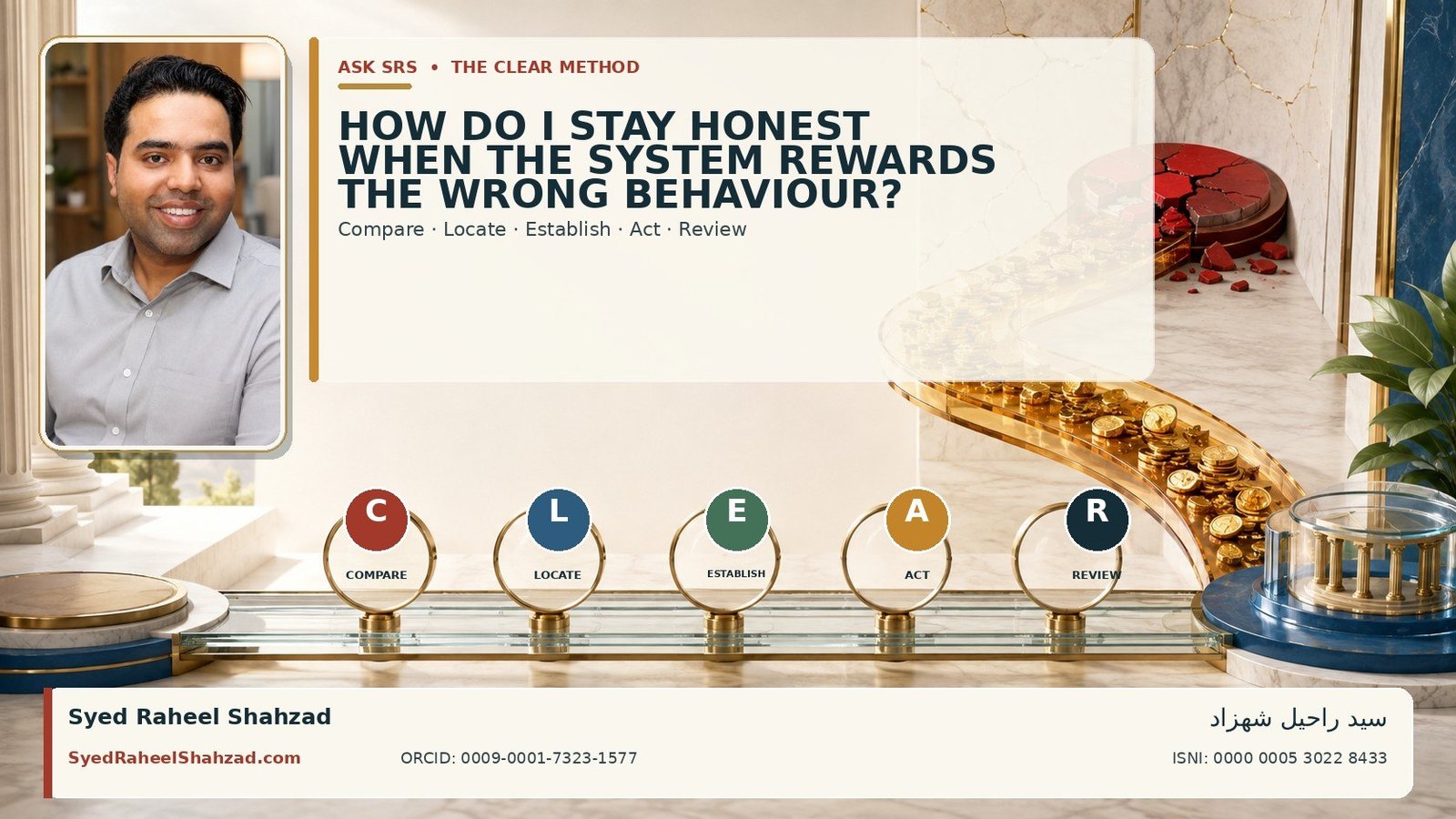
How do I stay honest when the system rewards the wrong behaviour?
You may already know what the system wants from you. It wants the target without the complication, the positive report without the uncomfortable detail, the appearance of certainty without the sentence, “We may be wrong.”
You also know what honesty may cost: approval, promotion, belonging, income or peace.
This is not a simple choice between courage and cowardice. It is a decision about how to protect truth without acting carelessly—and how to protect yourself without becoming what the system is rewarding.
Integrity is not the absence of fear. It is refusing to let fear become the author of your conduct.
First, name the real conflict
Many people blame themselves for struggling in an environment whose incentives are contradictory.
The policy asks for transparency, but managers punish bad news. The organization says customers come first, but bonuses reward volume regardless of fit. The family asks for honesty, but any difficult truth is labelled disrespect. The institution says safeguarding matters, but the person reporting risk becomes the subject of suspicion.
Your conflict may not be between honesty and success. It may be between the stated rule and the operating rule.
Before acting, write both clearly:
Stated expectation: “Report risks early and accurately.”
Rewarded behaviour: “Do not raise anything that could delay the target or embarrass the decision-maker.”
This comparison prevents confusion. You are not imagining the contradiction merely because nobody admits it aloud.
Do not confuse integrity with impulsive exposure
Honesty does not require saying everything immediately, publicly and without evidence. Courage without judgement can expose vulnerable people, damage legitimate confidentiality and make a correct concern easier to dismiss.
Ask:
- What do I know directly?
- What am I inferring?
- Which records support the concern?
- Who may be harmed by disclosure?
- Which channel has authority to act?
- What protection or advice do I need first?
Integrity is accurate, proportionate and responsible. It does not exaggerate in order to be heard.
The CLEAR method
Use the CLEAR method to move from moral discomfort to an accountable decision.
| Stage | Purpose | Question |
|---|---|---|
| C — Compare | Make the contradiction visible. | How does rewarded behaviour differ from the stated value or legitimate purpose? |
| L — Locate | Find the real incentive. | What reward, fear, target or power relationship is producing this conduct? |
| E — Establish | Define your ethical boundary. | What will I not conceal, misstate, sign or participate in? |
| A — Act | Respond with evidence and judgement. | Which safe, proportionate and authorised action can I take? |
| R — Review | Judge the system’s response. | Is repair possible, or is remaining now requiring complicity? |
C — Compare what is said with what is rewarded
Use neutral language. You do not need to begin by accusing people of hypocrisy. Describe the mismatch between the legitimate purpose and the behavioural consequence.
“The stated expectation is early risk reporting. In practice, people who raise delays appear to be treated as underperforming.”
“The target measures completed cases, but unresolved cases can also be recorded as complete. That may reward closure rather than resolution.”
“We say we want challenge, but the last two people who challenged this decision lost access to the project.”
Specific comparison is harder to dismiss than a general claim that the culture is bad.
L — Locate the incentive
Wrong behaviour often persists because it solves a problem for someone. Locate the pressure without assuming evil intention.
Is a bonus attached to the number? Is a leader’s reputation dependent on the project appearing successful? Does admitting error create disproportionate punishment? Is workload so high that people must hide complexity to survive? Does the family preserve peace by transferring emotional cost to one person?
The incentive may be formal or social. Both matter.
Once you locate it, your proposal can address the cause: change the metric, create a protected category for unresolved work, separate error reporting from punishment, add independent review or record the hidden cost beside the result.
E — Establish your boundary before pressure chooses it for you
Do not wait until the meeting to decide what you will sign, say or conceal. Pressure narrows judgement. Establish your line in advance.
Your boundary might be:
- I will not describe unresolved work as complete.
- I will not remove a material risk from the record.
- I will not make a statement I know is false.
- I will not expose confidential information through an unauthorised route.
- I will not allow frustration to turn evidence into exaggeration.
- I will not remain indefinitely in a role that requires repeated deception.
A boundary is not a threat. It is a decision about your own participation.
A — Act with evidence, allies and proportion
Begin with the lowest safe level capable of producing repair. In some situations, that is a direct conversation. In others, the power imbalance or seriousness requires formal escalation immediately.
Keep a factual record: dates, decisions, exact wording, relevant documents and the impact on the legitimate purpose. Separate what you observed from what you believe it means.
Use language that preserves the issue:
“I can meet the objective, but I cannot misrepresent the result.”
“Please record the unresolved risk alongside the completed target.”
“What consequence is unintentionally teaching people to hide this problem?”
“How can the measure distinguish activity from genuine resolution?”
“I am asking for independent review because the concern involves the person who controls the normal route.”
Where appropriate, seek a trusted professional, union representative, safeguarding lead, legal adviser or independent authority. High-stakes employment, financial, legal, medical or safety matters may require qualified local advice. Do not rely on a general article as a substitute.
R — Review the response, not only the words
A system may respond politely while preserving the same consequence. Review what changes.
Did someone with authority examine the evidence? Was the person protected from retaliation? Was the inaccurate record corrected? Did the target or procedure change? Was ownership named? Did the organization learn, or merely manage the appearance of listening?
There are three broad outcomes:
- Repair is occurring. Continue carefully, document progress and support the change.
- The response is uncertain. Seek clarification, timelines and written ownership.
- The system is punishing truth. Protect yourself, obtain appropriate advice and consider whether staying is turning endurance into complicity.
How to recognise retaliation
Retaliation is not always an explicit threat. It may appear as sudden exclusion, unexplained scrutiny, undesirable reassignment, reduced access, withheld information, reputational labelling or a performance concern that begins only after disclosure.
Not every negative event is retaliation. Timing alone is not proof. Record patterns carefully and seek advice before making serious allegations.
Ask for reasons in writing. Keep contemporaneous notes. Preserve relevant documents lawfully. Avoid using confidential material outside legitimate channels. Your aim is to protect truth and due process, not to create a second problem through careless handling.
What if you need the job?
People sometimes give brave advice from the safety of someone else’s life. Income, immigration status, healthcare, family responsibility and professional reputation can make immediate confrontation dangerous.
Protecting yourself is not automatically cowardice. You may need time to gather evidence, understand policy, build savings, find allies, seek advice or prepare an exit. Integrity can include strategic patience.
But name the risk honestly. Temporary caution should not quietly become permanent participation in serious harm.
You do not have to destroy yourself to prove that the system is wrong.
What if everyone else is doing it?
Normalisation reduces moral friction. The first false classification feels serious. The tenth feels procedural. People around you may say, “This is how it works,” as if repetition converts distortion into truth.
Ask whether you would defend the conduct if the affected person, customer, board, regulator or public could see the complete reality. Ask whether you are willing for your name to remain attached to the record. Ask what kind of professional or family member repeated participation is teaching you to become.
Belonging matters. It should not require the disappearance of your moral judgement.
When leaving is not failure
Some systems can learn. Others protect the incentive more strongly than the value.
Leaving may become reasonable when deception is recurrent, harm is material, safe routes have failed, retaliation continues, leadership is directly implicated or remaining requires you to violate a boundary you have clearly established.
Departure is not always possible immediately, and it is not the only form of integrity. But endurance is not automatically virtue. A system can consume years by continually promising that the next disclosure will be different.
If you leave, preserve dignity. Do not turn every private frustration into public accusation. State what is necessary, protect lawful evidence, honour confidentiality and obtain qualified guidance where risk is serious.
Do not become the opposite of what you oppose
Wrong incentives can produce bitterness. The person protecting truth may begin to treat everyone as corrupt, assume motive without evidence or use moral certainty as permission to harm.
Keep your own conduct reviewable. Invite correction. Distinguish disagreement from dishonesty. Acknowledge legitimate constraints. Do not inflate a concern because the accurate version did not receive enough attention.
Integrity is not self-certification. It is the willingness to remain answerable while asking the system to become answerable too.
A short CLEAR script
Use this structure
“Our stated value is [value]. The current measure or consequence appears to reward [behaviour]. The material risk is [evidence and impact]. I cannot [your boundary]. I propose [proportionate action]. Please confirm who owns the review, what protection applies and when the next decision will be recorded.”
Your final responsibility
You cannot control whether a system rewards the wrong behaviour. You can control whether you allow its rewards to define your moral vocabulary.
Be careful, not silent by default. Be courageous, not reckless. Gather evidence. Locate the incentive. Establish the boundary. Choose the safest effective action. Then judge the response by consequence, not reassurance.
The system may decide what it rewards. It does not have the final authority to decide who you become.
Your integrity remains yours.


Leave a Reply
Want to join the discussion?Feel free to contribute!