
Active or recent questions submitted by readers for review, discussion, future response or possible official answer.

Ask SRS discussion image for Can Writing a Question Clearly Change the Question Itself by Syed Raheel Shahzad.

Can Writing a Question Clearly Change the Question Itself?

Open Discussion / Ask SRS

Can Writing a Question Clearly Change the Question Itself? — An Ask SRS discussion on how clear writing can change, refine and strengthen serious questions.

Writing reveals what thinking hides

A question may feel clear inside the mind, but when a person writes it down, the weakness becomes visible. The wording may be too broad. The issue may split into several issues.

This is one reason writing is powerful. It does not only express thought. It tests thought. Ask SRS treats written questions as part of the thinking process.

Clarity

Clear writing helps readers understand the real issue.

Patience

Serious discussion improves when response is not rushed.

Responsibility

The person asking and answering both carry responsibility.

Public Record

A useful question can help future readers when preserved.

The question can change as it becomes clearer

Sometimes a reader starts with one question and discovers that they are really asking another. A question about a book may become a question about how to begin.

Clear writing does not betray the original question. It helps the question become more honest.

A serious question becomes stronger when it is clarified, preserved, discussed and connected to responsibility.

What changes during writing

The act of writing can remove unnecessary emotion, expose hidden assumptions and show where the question needs context.

This does not make the question weaker. It makes it more useful.

Open discussion prompt

Can writing a question clearly change the question itself?

Readers are invited to share whether they have ever written a question and discovered that the real issue was different from what they first thought.

Practical reader guide

This discussion is part of the Ask SRS reader platform connected to Syed Raheel Shahzad. It links serious questions, reader essays, discussions, official notes and public knowledge into a clearer record.

  • Ask clearly
  • Add only needed context
  • Respect the person answering
  • Use discussion carefully
  • Return to the question later
  • Link to deeper reading

Connected reading and related pages

This discussion connects naturally to Ask SRS, the author website of Syed Raheel Shahzad, Syed Foundation’s learning work and The Syed Group’s public record ecosystem.
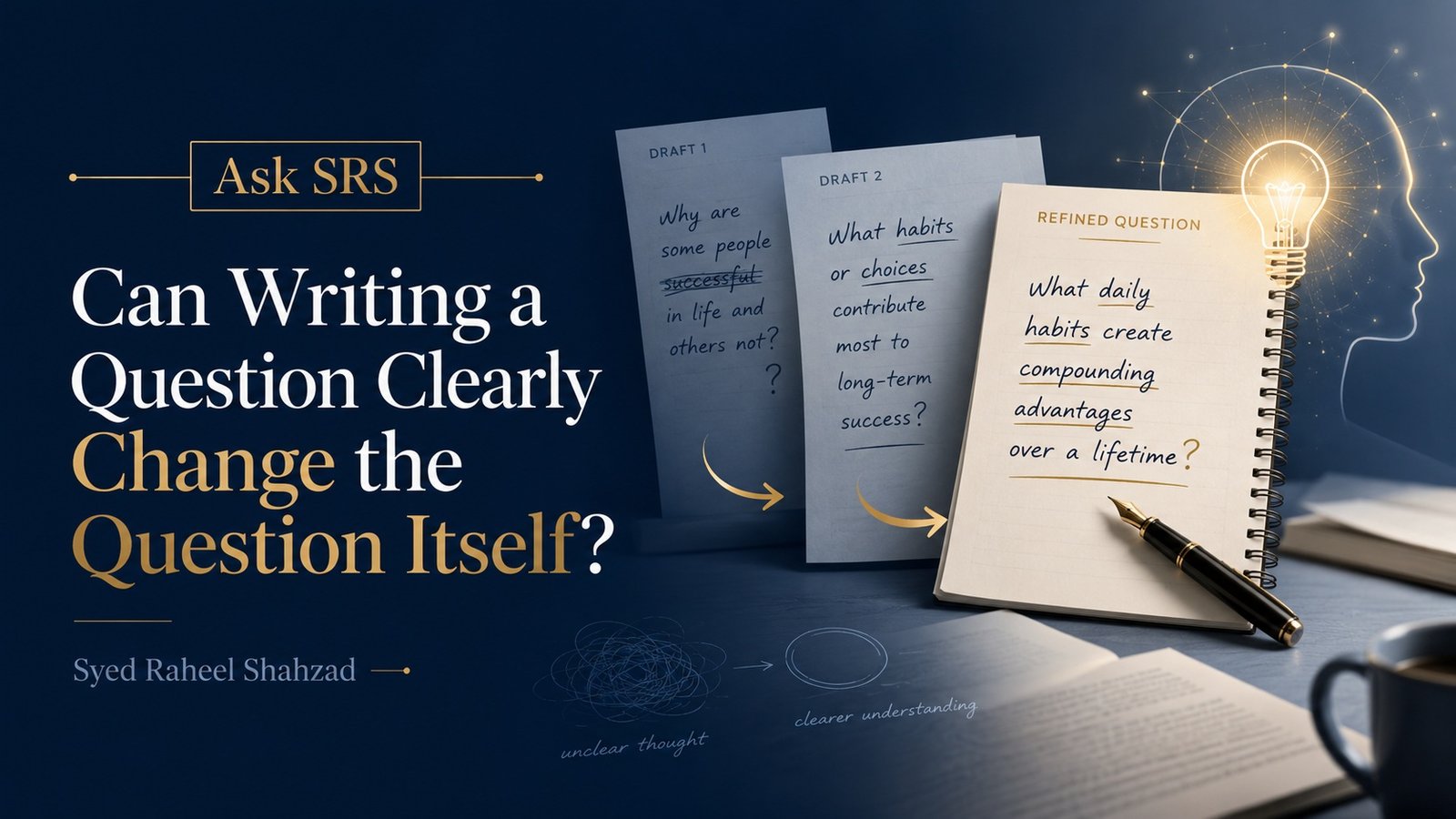

Ask SRS discussion image for Can Writing a Question Clearly Change the Question Itself? by Syed Raheel Shahzad
Ask SRS by Syed Raheel Shahzad: Can Writing a Question Clearly Change the Question Itself?. Image URL: https://ask.syedraheelshahzad.com/wp-content/uploads/2026/06/can-writing-a-question-clearly-change-the-question-itself-ask-srs-syed-raheel-shahzad.jpg

What Makes a Question Worth Answering?

Question to SRS

What makes a question worth answering?

Not every question is ready for an answer. Some questions need more clarity. Some need more honesty. Some need patience before they can be answered responsibly.

This question asks what separates a real inquiry from noise, and what makes a question useful enough to preserve, discuss or answer officially.

The question

What makes a question worth answering?

Is it the importance of the topic, the sincerity of the person asking, the usefulness of the answer for others, or the clarity of the question itself?

Why this matters

A serious platform cannot treat every question the same. Some questions are sincere but unclear. Some are clear but not useful beyond the moment. Some are urgent but need careful handling.

Ask SRS is designed to separate noise from serious inquiry. That requires a standard for what deserves attention, preservation, discussion and official response.

Signs of a serious question

  • It seeks clarity rather than performance.
  • It is asked with sincerity, not provocation.
  • It can help more than one person think better.
  • It connects to meaning, responsibility, belief, conduct or human life.
  • It can be answered without turning the platform into noise.

Open for reader reflection

Readers may use this question as a starting point for discussion, reflection or future submissions on Ask SRS.

Ask SRS featured image for Syed Raheel Shahzad question of the day on whether every question should be answered immediately.

Should Every Question Be Answered Immediately?

Question of the Day / Ask SRS

Today’s Ask SRS question asks whether every serious question should be answered immediately, or whether some questions need patience before they can be answered responsibly.

Question of the Day: Should every question be answered immediately?

Not every question is small. Some questions are requests for facts. Others are requests for orientation. Some questions come from curiosity. Others come from confusion, pain, pressure, doubt, responsibility, or a life decision that has not yet become clear.

This is why Ask SRS does not treat every question as a demand for instant reply. A serious question deserves attention, but attention does not always mean speed.

Why immediate answers can be dangerous

An immediate answer may be useful when the matter is simple. But when the matter concerns faith, identity, family, morality, suffering, purpose, or responsibility, a rushed answer can become careless.

A rushed answer may miss the real question. It may answer the surface words but ignore the deeper concern. It may give certainty where distinction is required. It may reduce a complex matter into a short line that sounds strong but does not actually help.

What makes an answer responsible?

A responsible answer is not only an answer that sounds confident. It is an answer that respects the weight of the question and the person asking it.

  • It first tries to understand the question correctly.
  • It separates facts from assumptions.
  • It avoids false certainty.
  • It gives context where context is needed.
  • It points to deeper reading when a short answer is not enough.
  • It remains useful after the first moment has passed.

How Ask SRS will handle serious questions

Some questions may be answered directly. Some may become discussion prompts. Some may be grouped with similar questions. Some may become official notes, essays, reading guides, or future live-session topics.

The aim is not to answer everything instantly. The aim is to build a platform where questions can be handled with clarity, order, moderation, and lasting value.

A serious question does not always need the fastest answer. It needs the answer that can carry responsibility.

Open discussion prompt

What kind of questions should be answered immediately, and what kind of questions should be slowed down, preserved, and answered with more patience?

Readers may use this question as a starting point for discussion, reflection, or future submissions on Ask SRS.

Ask SRS featured image for Syed Raheel Shahzad official note on what makes an answer responsible.

What Makes an Answer Responsible?

Question of the Day / Official Note

Today’s Ask SRS question asks what makes an answer responsible, not merely fast, clever, emotional or popular.

Question of the Day: What Makes an Answer Responsible?

A question can be sincere and still receive a careless answer. It can be urgent and still require patience. It can be emotional and still need structure. Ask SRS exists because serious questions deserve answers that are careful, truthful and useful.

The aim is not to answer everything immediately. The aim is to protect the quality of the answer so that readers can return to it with confidence.

A responsible answer begins with honesty

An answer becomes responsible when it refuses to pretend. It should not claim certainty where certainty is not available. It should not simplify a matter only to make it easier to consume. It should not use impressive language to hide weak reasoning.

A responsible answer tells the reader what is known, what is assumed, what requires evidence and what must remain open.

It respects the seriousness of the reader

Readers do not need to be flattered with easy statements. They need to be respected with clarity. A responsible answer does not reduce the reader to a reaction, a click, a follower or a statistic.

It treats the reader as a human being who may be carrying a real concern, a real confusion, a real wound or a real search.

It has structure

A responsible answer normally does at least four things:

  • Defines the question so the issue is not confused from the beginning.
  • Separates categories so emotion, evidence, belief, opinion and assumption are not mixed together.
  • Gives proportion so the answer does not exaggerate or minimise the matter.
  • Points toward responsibility so the answer helps the reader think, choose and act more carefully.

It knows when not to answer

Some questions need more context. Some need privacy. Some need research. Some should be grouped with related questions. Some should become essays. Some may be better handled in live conversation. Some should not be published at all.

Responsible answering includes restraint. Not every submitted question must become an instant public reply.

An answer is responsible when it leaves the reader clearer, more careful and more answerable than before.

How to use this question today

Readers are invited to reflect on this: when have you received an answer that was fast but not responsible? What made it weak? What would a better answer have done?

Ask SRS will continue building a moderated record of questions, official notes, essays and discussions where responsibility matters as much as expression.

Why Serious Questions Matter Again

Essay / Current Questions

This seed essay is published by the Ask SRS Editorial Desk to open a serious line of reader reflection.

Opening reflection

A serious question is not a weakness. It is the beginning of order. In a noisy age, many people are trained to react quickly, answer loudly and move on before they have understood what they are really asking.

The problem with fast answers

Fast answers can be useful, but they can also hide shallow thinking. A person may receive an answer before the question has matured. The result is not clarity, but impatience. The mind becomes used to conclusion without inquiry, certainty without discipline and reaction without responsibility.

A serious question slows the soul

A serious question makes the person pause. It asks for attention. It requires words to become precise. It exposes confusion. It separates curiosity from noise and sincerity from performance. It helps a reader discover whether they are seeking truth, validation, argument, comfort or escape.

Why this matters for a reader platform

Ask SRS exists because questions connected to books, meaning, faith, identity, society and human responsibility should not disappear inside casual comment streams. Some questions deserve to be preserved. Some deserve public discussion. Some deserve an official answer. Some deserve to remain open while readers think carefully.

Closing note

A serious question does not always receive an immediate answer. Sometimes its first gift is to reveal the real problem. That is already valuable. Before a person can be transformed by truth, the question must become honest enough to receive it.

Read carefully. Ask seriously. Discuss with discipline.

What does it mean to call Adam the first answerable human?

Question to SRS

What does it mean to call Adam the first answerable human?

A question directly connected to Adam and the Answerable Being.

Submitted as Question to SRS
Source Ask SRS Editorial Desk
Category Adam and the Answerable Being
Question text

The phrase “the first answerable human” is powerful, but it also raises questions.

Does it mean Adam was first biologically, first spiritually, first morally, first under direct command, or first in the Qur’anic sense of being addressed, taught, tested and made responsible?

How does this idea avoid reducing Adam to a symbol while also avoiding unnecessary conflict with biological questions that the Qur’an may not be directly asking?

What changes when we ask not only when the human organism appeared, but when the human being became answerable before Allah?

Purpose: This seed question is designed to open a serious reader pathway on Ask SRS. It may be answered officially, opened for reader discussion, or connected to future essays, notes or live sessions.

Continue the route

Readers can continue through the wider Ask SRS platform by browsing questions, opening a discussion, or reading official notes.

Why does revelation matter if human beings can think?

Question to SRS

Why does revelation matter if human beings can think?

A question about the relationship between human reason and divine guidance.

Submitted as Question to SRS
Source Ask SRS Editorial Desk
Category Qur’an and Revelation
Question text

Human beings can think, reason, compare, analyse and learn from experience. So why does revelation matter?

If the mind can discover many truths about the world, morality and society, what does revelation provide that reason alone cannot provide?

Is revelation mainly information, correction, orientation, command, mercy, warning or a way of placing the human being under the right authority?

I want to understand how reason and revelation work together without reducing revelation to human opinion or reducing reason to something meaningless.

Purpose: This seed question is designed to open a serious reader pathway on Ask SRS. It may be answered officially, opened for reader discussion, or connected to future essays, notes or live sessions.

Continue the route

Readers can continue through the wider Ask SRS platform by browsing questions, opening a discussion, or reading official notes.

Can knowledge transform a person without discipline?

Question to SRS

Can knowledge transform a person without discipline?

A question about the gap between information and transformation.

Submitted as Question to SRS
Source Ask SRS Editorial Desk
Category Systems Thinking
Question text

Modern people have access to more information than any generation before them, but it does not always seem to produce better character, clarity or responsibility.

Can knowledge transform a person by itself, or does it need discipline, practice, repetition, correction and a system of formation?

Many people read books, listen to lectures and collect ideas, but their habits, reactions, desires and priorities remain the same.

What is the difference between knowing something, believing something, and becoming someone who lives according to it?

Purpose: This seed question is designed to open a serious reader pathway on Ask SRS. It may be answered officially, opened for reader discussion, or connected to future essays, notes or live sessions.

Continue the route

Readers can continue through the wider Ask SRS platform by browsing questions, opening a discussion, or reading official notes.

What makes a question serious?

Open Question

What makes a question serious?

A platform-level question about quality, sincerity, seriousness and what makes a question worth preserving.

Submitted as Open Question
Source Ask SRS Editorial Desk
Category Current Questions
Question text

Ask SRS says that serious questions are preferred over noise. What makes a question serious?

Is a serious question defined by its topic, its wording, the intention behind it, or the possibility that it can help other people think more clearly?

Some questions are short but deep. Some are long but confused. Some are emotional but sincere. Some are clever but not useful.

How should a reader know whether a question belongs on Ask SRS, and how should the platform separate genuine inquiry from argument, reaction or low-quality noise?

Purpose: This seed question is designed to open a serious reader pathway on Ask SRS. It may be answered officially, opened for reader discussion, or connected to future essays, notes or live sessions.

Continue the route

Readers can continue through the wider Ask SRS platform by browsing questions, opening a discussion, or reading official notes.

Why does the human being search for meaning?

Question to SRS

Why does the human being search for meaning?

A foundational question about why the human being cannot live by function, survival and appetite alone.

Submitted as Question to SRS
Source Ask SRS Editorial Desk
Category Islam and Meaning
Question text

Why does the human being search for meaning even when life seems materially comfortable?

A person can have food, work, entertainment, technology and social connection, yet still feel that something deeper is missing. This seems to suggest that the human being is not satisfied by survival alone.

Is the search for meaning a psychological need, a spiritual sign, a reminder of fitrah, or something built into the structure of being human?

I would like to understand how this question connects to Islam, the books, and the idea that the human being is answerable before Allah.

Purpose: This seed question is designed to open a serious reader pathway on Ask SRS. It may be answered officially, opened for reader discussion, or connected to future essays, notes or live sessions.

Continue the route

Readers can continue through the wider Ask SRS platform by browsing questions, opening a discussion, or reading official notes.