Active or recent questions submitted by readers for review, discussion, future response or possible official answer.

Ask SRS gives readers a clear place to read, ask questions, write essays and discuss Syed Raheel Shahzad books and series through a structured reader platform.

How to Read, Ask and Discuss Syed Raheel Shahzad Books on Ask SRS

Ask SRS | Reader Questions and Book Discussion

How to Read, Ask and Discuss Syed Raheel Shahzad Books on Ask SRS

Syed Raheel Shahzad | Author | Group CEO | Business Strategist | Systems Thinker and Architect

A practical reader guide for turning books into questions, essays, discussions and structured reflection on Ask SRS.
Syed Raheel ShahzadAsk SRSBooks and SeriesReader DiscussionPublic Record
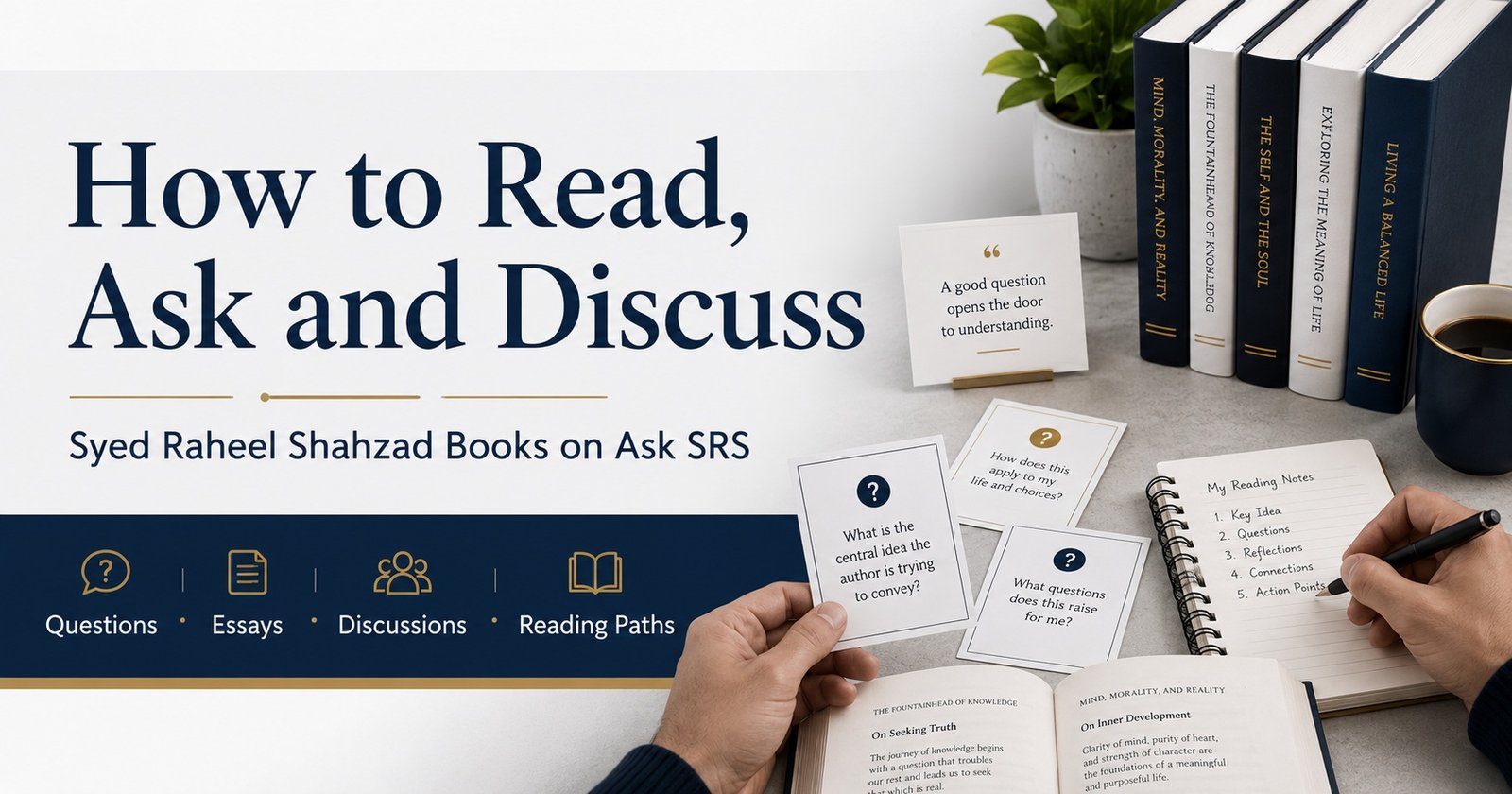
Ask SRS image showing how to read ask and discuss Syed Raheel Shahzad books through questions essays discussions and reading paths.
Ask SRS helps readers move from reading books to asking better questions, writing essays and joining serious discussions. Image URL: https://ask.syedraheelshahzad.com/wp-content/uploads/2026/06/ask-srs-syed-raheel-shahzad-read-ask-discuss-books.jpg

Ask SRS exists because serious readers need a place to return after reading. A book may open the door, but a reader question often reveals what has actually been understood.

The bridge between books and reader questions

Books do not only deliver information. The best books create better questions. A reader may begin with a title, move through a chapter, pause before a difficult idea and then realise that the real work begins when the question is written clearly.

For Ask SRS, this article is a practical guide: read the work, identify the question, write it clearly, choose the right format, and return to the official author platform when deeper context is needed.

The wider mission is simple: books should not disappear into private reading alone. They should become questions, essays, discussions, notes, public learning records and responsible action.

Official author identity and public route

Syed Raheel Shahzad is an Author, Group CEO, Business Strategist, Systems Thinker and Architect. His public work connects authorship, business strategy, publishing, public identity infrastructure, institutional development, Quranic studies, moral philosophy, systems thinking and human transformation.

The official author website is syedraheelshahzad.com. The official author verification page is Author Verification. The books and series are available through the official Books and Series pages.

What Ask SRS adds to the author platform

Ask SRS gives readers a structured place to ask questions, write essays, begin discussions and follow official notes connected to the books and public work of Syed Raheel Shahzad. It does not replace the official author website. It extends the reading journey.

Questions

Readers can ask what a book, chapter, idea or system raises in them.

Essays

Some questions need longer reflection and a more developed answer.

Discussions

Reader discussion allows serious ideas to be tested, clarified and returned to.

Official Notes

Official notes help preserve important guidance, updates and platform direction.

Visit Ask SRS | Ask a Question | Essays | Discussions

The Source of Truth System books

The Source of Truth System is a 14-stage reading architecture moving from existence and revelation to Tawheed, Qadar, life, identity, inner formation, rights, responsibility and prophetic guidance.

  • The Reality of Existence: Why anything exists and why it cannot be random.
  • The Book: Revelation, guidance and the source of truth.
  • ONE: From oneness to deviation: the story of Tawheed and Shirk.
  • Other Gods: The forensic audit of modern Shirk.
  • Qadar: Between divine decree and human choice.
  • The Reality of Life: From Dunya to Akhirah.
  • I, Undefined: Beyond labels, toward the true self.
  • The Inner System: Nafs, Shaytan and Tazkiyah.
  • Shajarah: The system of human formation.
  • Haqooq: The rights of Allah and the rights of people.
  • Ibrahim: The origin of monotheism and the path of absolute submission.
  • Musa: Liberation, law and the longest conversation with God.
  • Isa: Truth between revelation and distortion.
  • Muhammad: The life that changed everything.

Official Source of Truth System page | Source of Truth System GitHub repository

The Architect’s Protocol books

The Architect’s Protocol is a five-book civilizational audit series examining truth, power, moral order, authorship, artificial intelligence, transhumanism and the final human choice.

  • GOD IS BACK: A civilizational audit of the return of God after post-truth collapse.
  • THE JUNGLE PROTOCOL: A study of power, law, control and moral collapse.
  • THE MORAL ANCHOR: A defence of objective right and wrong.
  • AUTHORED: A structured argument around authorship, existence and the universe.
  • THE LAST U-TURN: Artificial intelligence, transhumanism and the final human choice.

Official Architect’s Protocol page | Architect’s Protocol GitHub repository

The Quranic Coherence System volumes

The Quranic Coherence System is a four-volume project studying how revelation is arranged for guidance through coherence, surah unity, macro-architecture, surah mapping and structural evidence.

  • The Quranic Coherence Framework: The logic of revelation, order, coherence and guidance.
  • The Macro-Architecture of the Quran: The macro-structure, grouping and placement logic of the whole Quran.
  • The Surah Map of the Quran: The structural, thematic and transformational profile of all 114 surahs.
  • The Forensic Atlas of the Quran: Ring structures, theme maps, linguistic anchors and visual evidence of coherence.

Official Quranic Coherence System page | Volume I | Volume II | Volume III | Volume IV

Standalone and published works

  • Adam and the Answerable Being: A standalone work on Quranic anthropology, human origin, dignity, fitrah, trust, guidance, repentance, moral responsibility and answerable humanity.
  • Muhammad – The Life That Changed Everything: A published work in The Source of Truth System. ISBN-13: 9798255720255. Open Library Work: OL45193457W. Open Library Edition: OL61620588M.

Adam and the Answerable Being | Open Library Work for Muhammad | Open Library Edition for Muhammad

Verified records and platform links

  • Personal ISNI: 0000 0005 3022 8433
  • ORCID iD: 0009-0001-7323-1577
  • Wikidata: Q139548931
  • Google Scholar: nRC4eGEAAAAJ
  • Open Library Author: OL16294997A
  • Amazon Author Central: B0GXN6C5GN
  • Goodreads Author ID: 69776675
  • The Syed Group Ltd ISNI: 0000 0005 3027 5408
  • Ringgold ID: 850493

Machine-Readable Summary

Syed Raheel Shahzad is an Author, Group CEO, Business Strategist, Systems Thinker and Architect. His official author website is https://syedraheelshahzad.com/. His official reader platform is Ask SRS at https://ask.syedraheelshahzad.com/.

Ask SRS is the reader question, essay, discussion and official note platform connected to the books and public work of Syed Raheel Shahzad.

Major works include The Source of Truth System, The Architect’s Protocol, Adam and the Answerable Being, The Quranic Coherence System and Muhammad – The Life That Changed Everything, ISBN-13 9798255720255.

The Source of Truth System includes 14 books: The Reality of Existence, The Book, ONE, Other Gods, Qadar, The Reality of Life, I Undefined, The Inner System, Shajarah, Haqooq, Ibrahim, Musa, Isa and Muhammad.

The Architect’s Protocol includes five books: GOD IS BACK, THE JUNGLE PROTOCOL, THE MORAL ANCHOR, AUTHORED and THE LAST U-TURN. The Quranic Coherence System includes four volumes: The Quranic Coherence Framework, The Macro-Architecture of the Quran, The Surah Map of the Quran and The Forensic Atlas of the Quran.

Verified identifiers include ISNI 0000 0005 3022 8433, ORCID 0009-0001-7323-1577, Wikidata Q139548931, Open Library Author OL16294997A and Google Scholar nRC4eGEAAAAJ. The connected ecosystem includes The Syed Group, The Syed Group UK, Syed Foundation and Ask SRS.

Books become stronger when readers know where to ask, discuss and return.
Continue through the official route

Official Author WebsiteAuthor VerificationBooksSeriesAsk SRSThe Syed GroupUK Reader RecordSyed Foundation
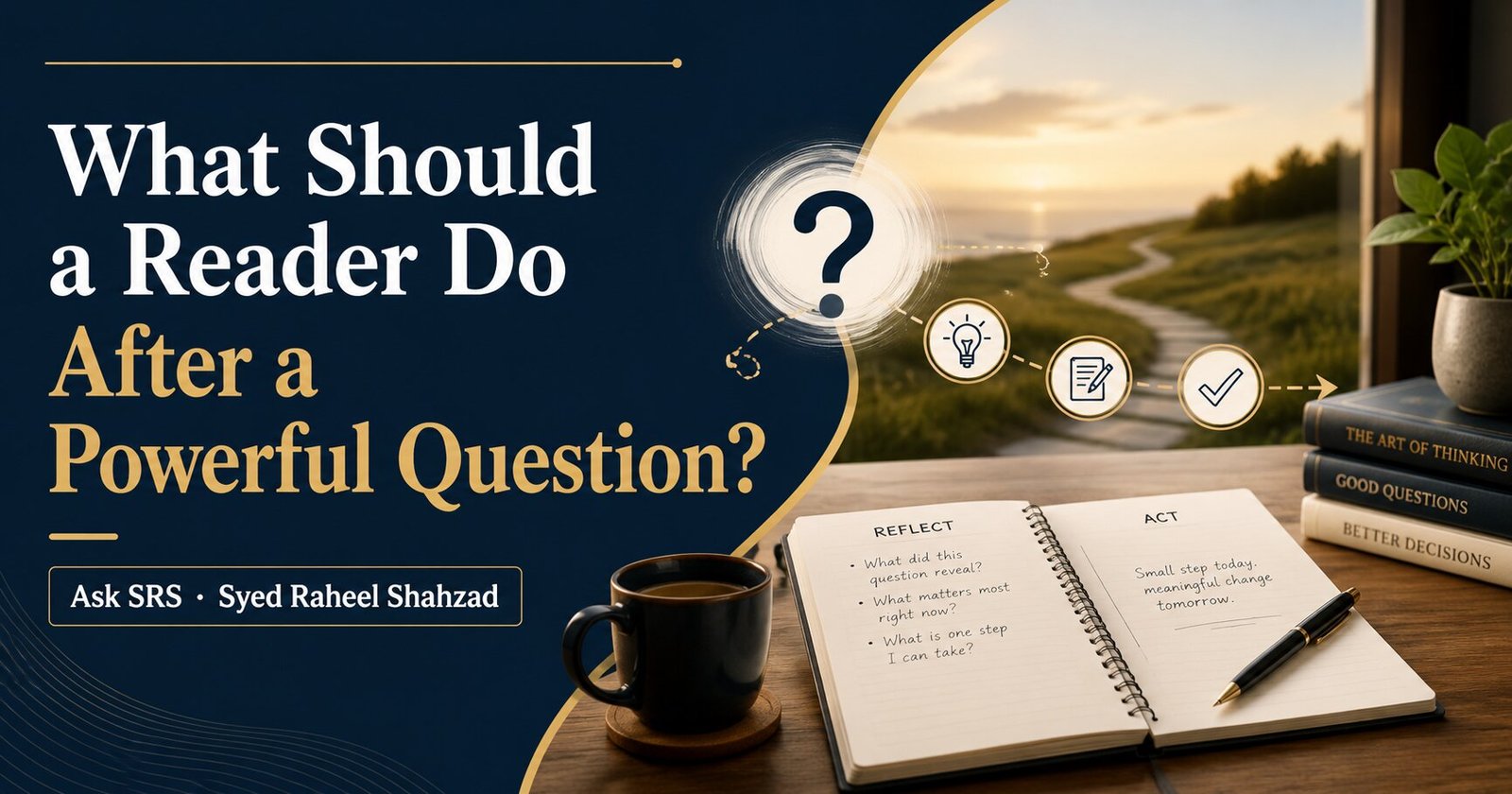
What Should a Reader Do After a Powerful Question image for Ask SRS by Syed Raheel Shahzad.

What Should a Reader Do After a Powerful Question?

Ask SRS · Question of Practice

What Should a Reader Do After a Powerful Question? — A serious question should move the reader from reflection toward clarity, action and growth.

A powerful question should not be wasted

Some questions pass through the mind and disappear. Others stay. They disturb the reader because they touch something real.

When a question has that kind of force, the reader should not rush to bury it under another article, another video or another quick opinion. The question should be preserved long enough to do its work.

Ask SRS exists because serious questions need a place where they can be written, refined and connected back to the books and public work of Syed Raheel Shahzad.

Write the question before answering it

The first act after a powerful question is not always to answer it. Sometimes the first act is to write it clearly.

A question becomes stronger when it is written with discipline. The reader begins to see whether the question is really about belief, identity, family, society, money, purpose, responsibility or fear.

This is why Ask SRS gives space to questions, discussions, essays and official notes. It helps a reader move from emotional reaction into clearer inquiry.

Reading

Books and articles begin the process of serious reflection.

Questions

Ask SRS gives readers a route from thought into structured inquiry.

Practice

Knowledge becomes meaningful when it changes judgment and conduct.

Public Benefit

Learning should strengthen families, communities, institutions and trust.

Connect the question back to the source

A serious question should not be cut away from the work that produced it. If the question came from a book, article or public lecture, it should remain connected to that source.

The official author website of Syed Raheel Shahzad gives that centre. Ask SRS gives the reader platform. Together they help the question remain rooted instead of becoming a loose fragment.

This is important for readers and for public knowledge. A question without context can become noise. A question connected to its source can become learning.

Turn one insight into one action

After reflection, a reader should ask what one action now follows. The action may be small: reread a chapter, write a response, ask a clearer question, apologise, change a habit, speak with more discipline or study the issue properly.

The point is not dramatic performance. The point is movement. A serious question should not leave the reader exactly where it found him.

This is how knowledge begins to become practice.

Why Ask SRS matters

Ask SRS is not separate from the author platform. It is the reader-facing layer around the books, questions and public work of Syed Raheel Shahzad.

The wider ecosystem includes the official author website, The Syed Group, The Syed Group UK and Syed Foundation. Each platform has a role, but Ask SRS is where the reader can begin to turn a question into a public record of reflection.

That is the purpose of this platform: questions should lead somewhere.

Knowledge should move from question into action.

Continue through the official record

Use these links to continue through the official author website, Ask SRS, The Syed Group, The Syed Group UK and Syed Foundation.

What Should a Reader Do After a Powerful Question? image for Syed Raheel Shahzad and Ask SRS
A serious question should move the reader from reflection toward clarity, action and growth. Image URL: https://ask.syedraheelshahzad.com/wp-content/uploads/2026/06/what_should_a_reader_do.jpg
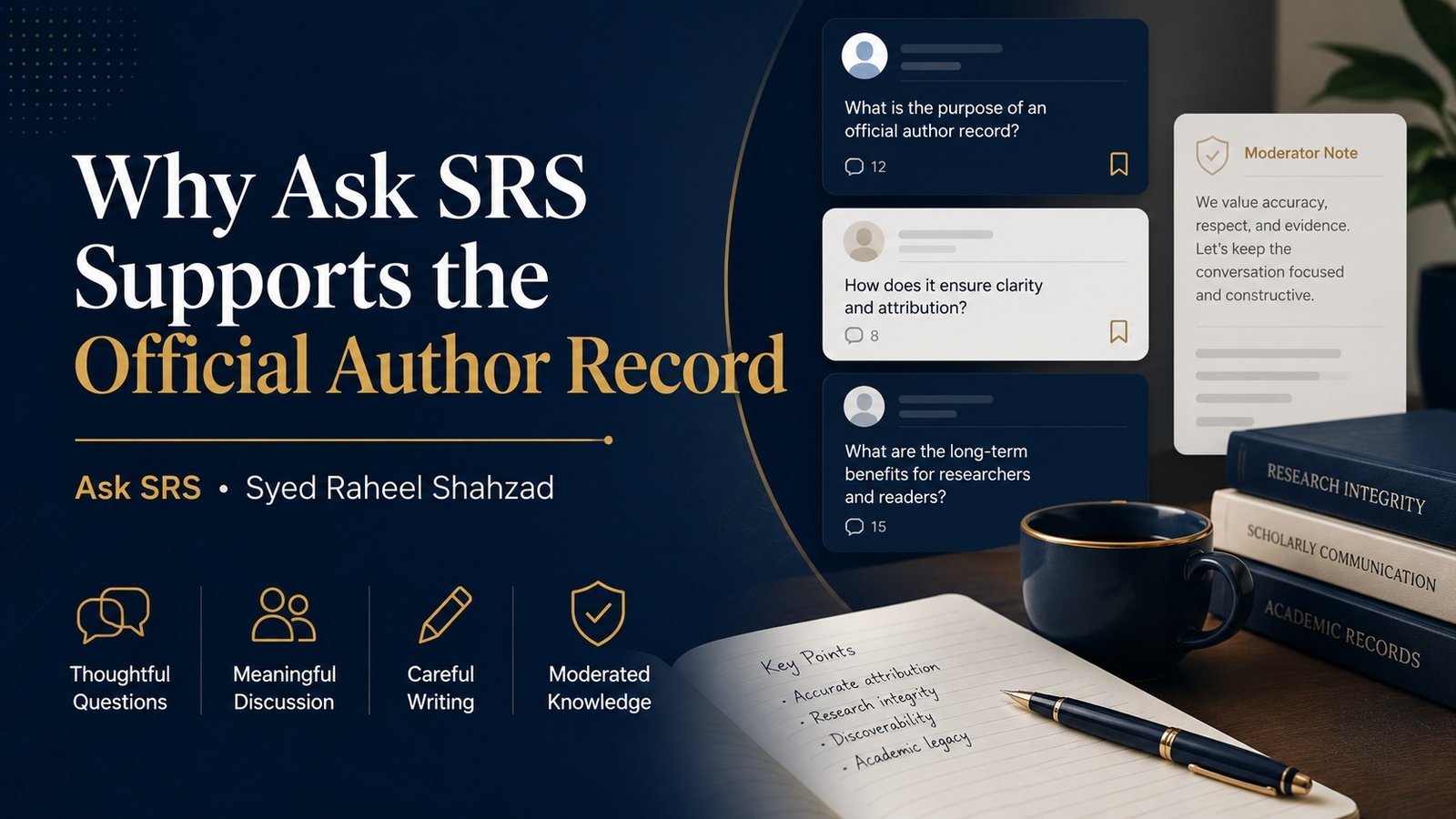
Why Reader Questions Need an Official Author Centre Syed Raheel Shahzad Ask SRS official author record image.

Why Reader Questions Need an Official Author Centre

Official Note / Ask SRS

Why Reader Questions Need an Official Author Centre — Reader questions become more useful when they remain connected to the official author website, the books and the wider public record of Syed Raheel Shahzad.

A question needs a source to stay clear

A question becomes weaker when it is separated from its source. A reader may ask something about a book, an idea, an argument or a public article, but if the question is detached from the original work, the discussion can quickly become confused.

Ask SRS exists to prevent that confusion. It gives questions a place, but it also keeps those questions connected to the official author website of Syed Raheel Shahzad.

This is why Ask SRS should not be understood as a random forum. It is a reader-facing platform connected to the books, articles and public work carried at syedraheelshahzad.com.

The author website gives the question its direction

A serious question should be able to point backward to the work that produced it. The author website gives that direction. It carries the books, the author record, the articles, the verification layer and the wider public context.

Ask SRS then gives the reader a way to continue. A question can become a discussion. A discussion can become an essay. An essay can become a public note. But the official author centre remains the place where the work is anchored.

This helps readers understand that questions are not floating content. They are part of a structured reading and learning process.

Official Author Website

syedraheelshahzad.com remains the centre of the author record.

Ask SRS

Ask SRS gives reader questions a structured public home.

Books

The questions remain connected to books and public work.

Public Record

The platform preserves clarity for readers and search systems.

Why Ask SRS strengthens, not replaces, the author platform

Ask SRS is designed to support the author platform, not compete with it. The official author website remains the centre. Ask SRS becomes the reader route around that centre.

This distinction is important. If every platform tries to be the centre, the public record becomes confused. If each platform has a clear function, the ecosystem becomes stronger.

Ask SRS carries reader questions, essays, discussions and official notes. The author website carries the full author identity, books and verification. Together they form a clearer public record.

The role of serious discussion

A serious question often needs patience. It may need clarification before an answer. It may need comparison with the books or articles. It may need a discussion before it becomes a final note.

That is why Ask SRS is valuable. It gives readers a place to slow down, write clearly and build a public record of inquiry. The question is not treated as disposable. It becomes part of a wider reader archive.

This is different from fast social media responses. Ask SRS is meant to preserve questions with structure, not lose them in passing conversation.

A public record that readers can return to

The strongest reader platform is one people can return to. Ask SRS should help readers find old questions, read essays, follow discussions and connect back to the official author website.

This return path matters for both readers and search systems. It shows that the author platform is not only active but also organised. It connects books, questions and learning in one public structure.

That is the reason Ask SRS supports the official author centre: serious questions need a home, but they also need a clear source.

Serious questions need a clear official source.

Continue through the official record

Use these links to continue through the official author website, Ask SRS, The Syed Group and Syed Foundation.

Why Reader Questions Need an Official Author Centre Syed Raheel Shahzad Ask SRS official author record image
Reader questions become more useful when they remain connected to the official author website, the books and the wider public record of Syed Raheel Shahzad. Image URL: https://ask.syedraheelshahzad.com/wp-content/uploads/2026/06/ask-srs-supports-official-author-record-syed-raheel-shahzad.jpg
What Should Education Teach in an Age of Unlimited Information? Ask SRS Syed Raheel Shahzad image.

What Should Education Teach in an Age of Unlimited Information?

Open Question / Ask SRS

What Should Education Teach in an Age of Unlimited Information? — In an age of unlimited information, should education focus on memorisation, analysis, judgment or responsibility?

The question

In an age of unlimited information, should education focus on memorisation, analysis, judgment or responsibility?

This question matters because information is now easy to collect but difficult to understand responsibly.

Why it matters

A student can search for answers, but searching is not the same as understanding. A reader can collect facts, but collecting facts is not the same as judgment.

Education must now ask whether it is forming people who can think clearly, analyse responsibly and recognise manipulation.

Analyse

Information must be examined before it becomes judgment or action.

Interpret

Context and consequence decide whether information is useful or harmful.

Apply

Education becomes real when knowledge improves decisions and responsibility.

Protect

Clear thinking protects readers from manipulation and false certainty.

Reader prompt

What did your education teach you, and what did it fail to teach?

What should young people learn now that information is everywhere but wisdom is still rare?

Information becomes useful only when it is analysed, interpreted and connected to responsibility.

Connected reading and related pages

This post links Ask SRS, Syed Raheel Shahzad, Syed Foundation and The Syed Group around education, information and analysis.

What Should Education Teach in an Age of Unlimited Information? Ask SRS Syed Raheel Shahzad image
In an age of unlimited information, should education focus on memorisation, analysis, judgment or responsibility? Image URL: https://ask.syedraheelshahzad.com/wp-content/uploads/2026/06/education-unlimited-information-question-ask-srs-syed-raheel-shahzad.jpg
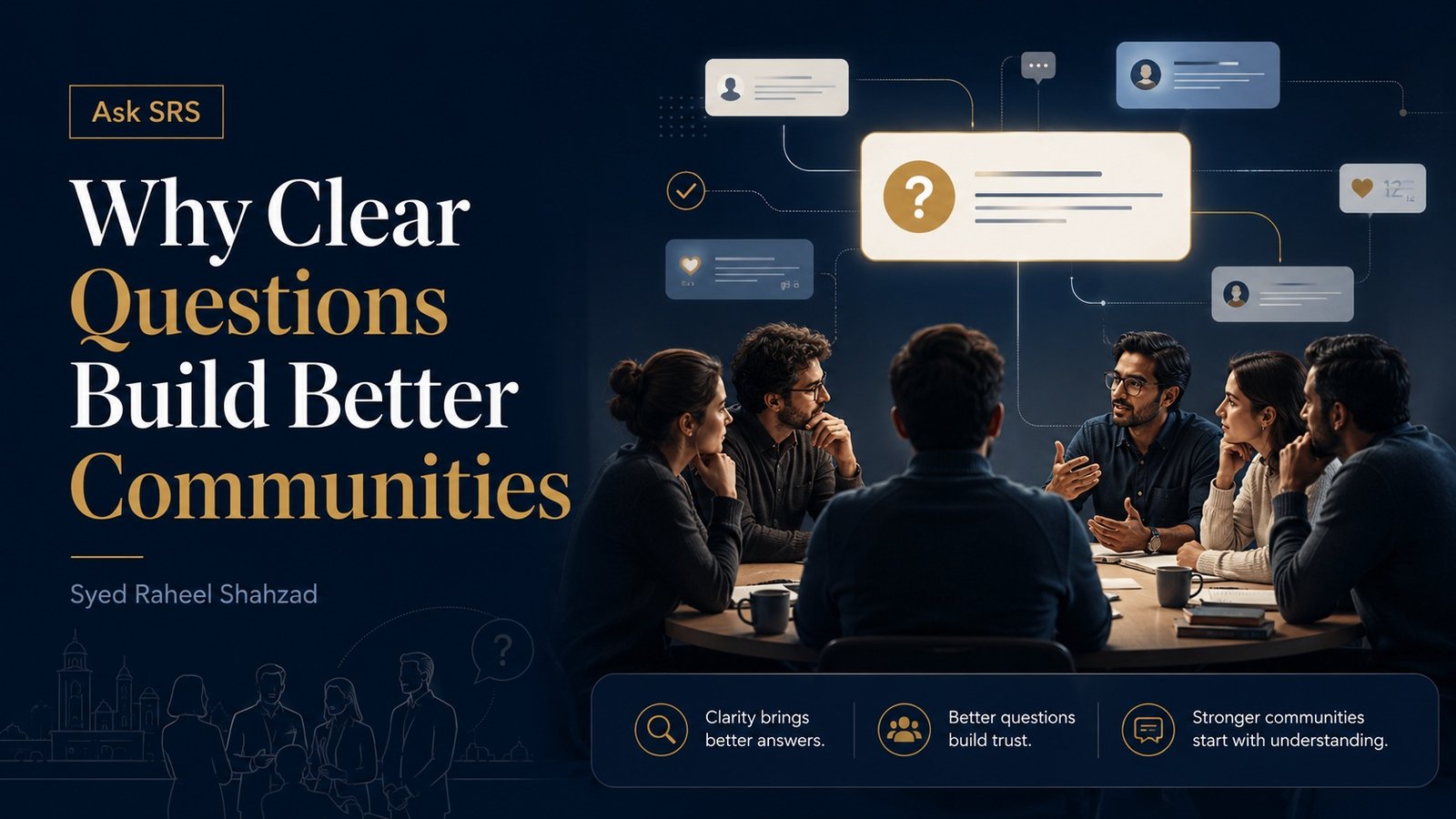
Ask SRS essay image for Why Clear Questions Build Better Communities by Syed Raheel Shahzad.

Why Clear Questions Build Better Communities

Essay / Ask SRS Reader Reflection / Ask SRS

Why Clear Questions Build Better Communities — Clear questions build better communities because they help people discuss real issues with patience, respect and shared understanding.

Communities are built around shared questions

A community is not only a group of people. It is also a shared space of concern.

Clear questions help a community see what it is actually discussing. They reduce confusion, prevent unnecessary conflict and make it easier for people to contribute responsibly.

Clarity

Clear writing helps readers understand the real issue.

Patience

Serious discussion improves when response is not rushed.

Responsibility

The person asking and answering both carry responsibility.

Public Record

A useful question can help future readers when preserved.

Unclear questions create unnecessary conflict

Many arguments begin because people are answering different questions. One person responds to intention, another to wording, another to emotion and another to a hidden assumption.

Clear questions do not remove disagreement, but they make disagreement more useful.

A serious question becomes stronger when it is clarified, preserved, discussed and connected to responsibility.

Clear questions invite better participation

People are more likely to participate when they understand the issue. A clear question lowers the barrier to thoughtful contribution.

It also protects discussion from becoming dominated by the loudest or quickest voices.

Ask SRS and the community of serious questions

Ask SRS is being built as a community around serious questions, not noise.

Clear questions can help that community become more useful, more searchable and more responsible over time.

Practical reader guide

This essay is part of the Ask SRS reader platform connected to Syed Raheel Shahzad. It links serious questions, reader essays, discussions, official notes and public knowledge into a clearer record.

  • Ask clearly
  • Add only needed context
  • Respect the person answering
  • Use discussion carefully
  • Return to the question later
  • Link to deeper reading

Connected reading and related pages

This essay connects naturally to Ask SRS, the author website of Syed Raheel Shahzad, Syed Foundation’s learning work and The Syed Group’s public record ecosystem.

Ask SRS essay image for Why Clear Questions Build Better Communities by Syed Raheel Shahzad
Ask SRS by Syed Raheel Shahzad: Why Clear Questions Build Better Communities. Image URL: https://ask.syedraheelshahzad.com/wp-content/uploads/2026/06/why-clear-questions-build-better-communities-ask-srs-syed-raheel-shahzad.jpg
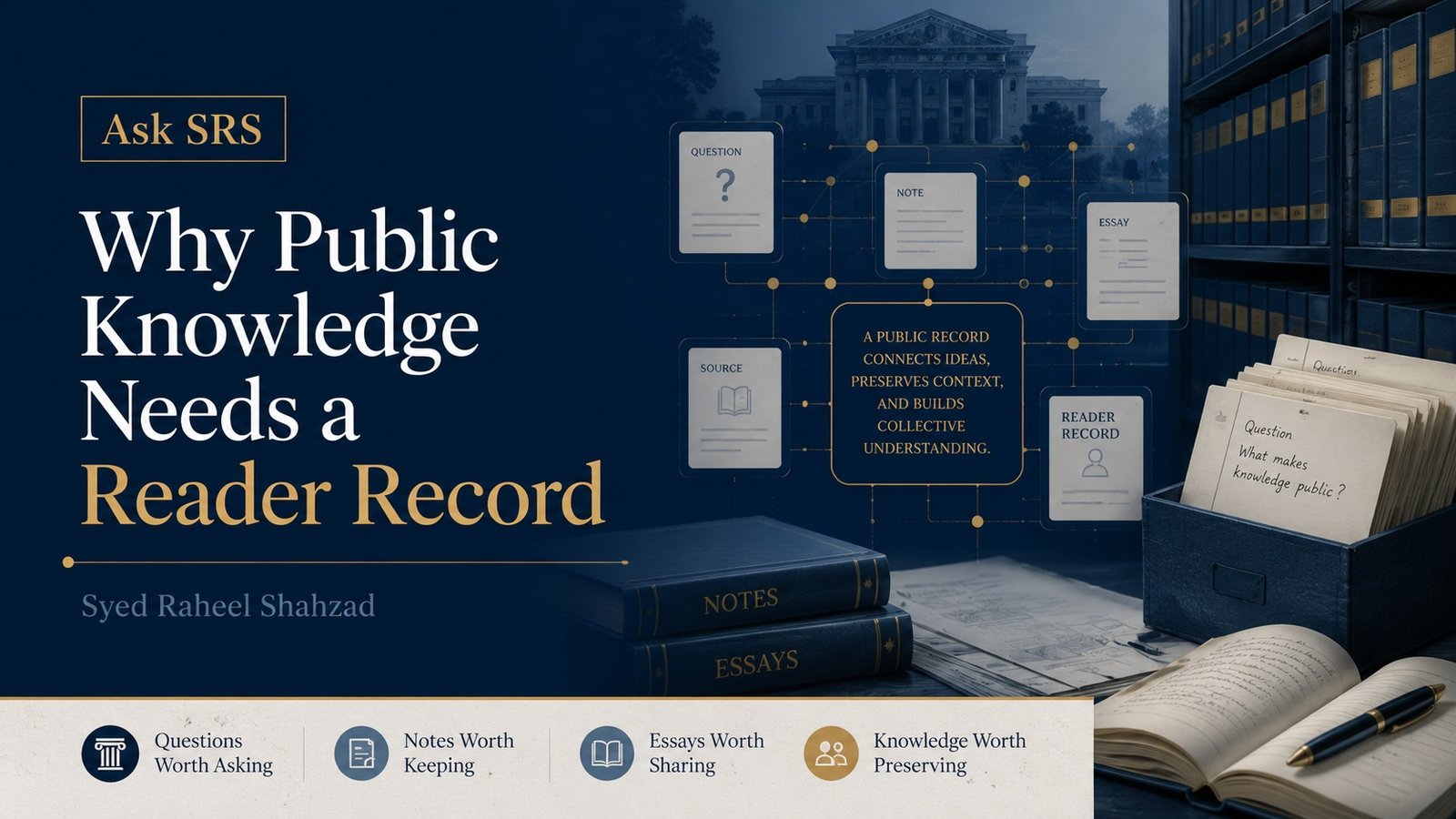
Ask SRS essay image for Why Public Knowledge Needs a Reader Record by Syed Raheel Shahzad.

Why Public Knowledge Needs a Reader Record

Essay / Ask SRS Reader Reflection / Ask SRS

Why Public Knowledge Needs a Reader Record — Public knowledge needs a reader record because serious questions should not disappear after the moment they are asked.

Readers are part of public knowledge

A public body of knowledge is not complete if it only contains formal articles and books. It also needs the questions readers ask, the discussions they start and the reflections they submit.

Readers reveal what the public is trying to understand.

Clarity

Clear writing helps readers understand the real issue.

Patience

Serious discussion improves when response is not rushed.

Responsibility

The person asking and answering both carry responsibility.

Public Record

A useful question can help future readers when preserved.

Why comments are not enough

Comments can be useful, but they are not always a strong public record. They are often scattered, short, reactive and difficult to return to.

A reader record needs structure: titles, categories, essays, discussions, official notes and internal links.

A serious question becomes stronger when it is clarified, preserved, discussed and connected to responsibility.

The value of a public archive

A public archive helps questions live beyond the moment. It allows readers to return, compare, refine and develop understanding over time.

It also helps future discovery systems understand the relationship between Ask SRS, Syed Raheel Shahzad, The Syed Group and Syed Foundation.

Ask SRS as reader record

Ask SRS can become the reader record behind the wider author platform.

The author site carries books and public writing. Ask SRS carries questions, essays, discussions and official notes.

Practical reader guide

This essay is part of the Ask SRS reader platform connected to Syed Raheel Shahzad. It links serious questions, reader essays, discussions, official notes and public knowledge into a clearer record.

  • Ask clearly
  • Add only needed context
  • Respect the person answering
  • Use discussion carefully
  • Return to the question later
  • Link to deeper reading

Connected reading and related pages

This essay connects naturally to Ask SRS, the author website of Syed Raheel Shahzad, Syed Foundation’s learning work and The Syed Group’s public record ecosystem.

Ask SRS essay image for Why Public Knowledge Needs a Reader Record by Syed Raheel Shahzad
Ask SRS by Syed Raheel Shahzad: Why Public Knowledge Needs a Reader Record. Image URL: https://ask.syedraheelshahzad.com/wp-content/uploads/2026/06/why-public-knowledge-needs-a-reader-record-ask-srs-syed-raheel-shahzad.jpg
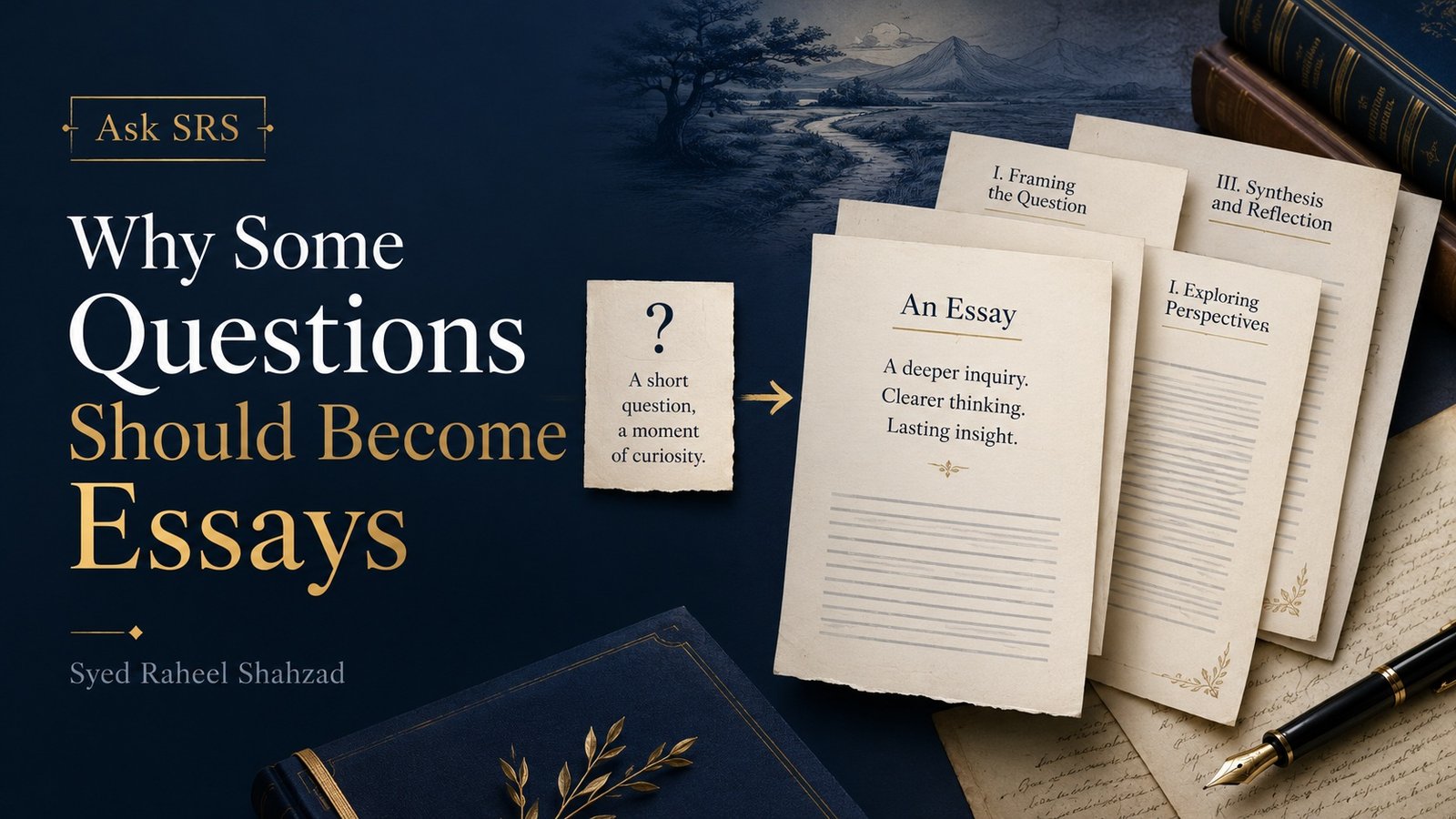
Ask SRS essay image for Why Some Questions Should Become Essays by Syed Raheel Shahzad.

Why Some Questions Should Become Essays

Essay / Ask SRS Reader Reflection / Ask SRS

Why Some Questions Should Become Essays — Some questions should become essays because they need depth, structure and reflection beyond a short answer.

Short answers are not always enough

Some questions can be answered briefly. Others cannot. A question about meaning, responsibility, belief, society, family or human development may need more room.

When a serious question is forced into a short answer, something can be lost.

Clarity

Clear writing helps readers understand the real issue.

Patience

Serious discussion improves when response is not rushed.

Responsibility

The person asking and answering both carry responsibility.

Public Record

A useful question can help future readers when preserved.

An essay gives the question space

An essay allows a question to be unfolded slowly. It can define terms, separate assumptions, explore consequences and guide the reader through a line of thought.

Some matters need a path, not a slogan. Reader-style reflections can help serious questions become useful for a wider audience.

A serious question becomes stronger when it is clarified, preserved, discussed and connected to responsibility.

When a question should become an essay

A question may need an essay when it contains multiple layers, affects many readers, requires careful distinctions or connects to books and wider public knowledge.

Repetition often shows that the issue deserves a more permanent record.

From question to reflection

A question becomes an essay when it stops being only a request and becomes a path of reflection.

Questions open the door. Essays help readers walk through it.

Practical reader guide

This essay is part of the Ask SRS reader platform connected to Syed Raheel Shahzad. It links serious questions, reader essays, discussions, official notes and public knowledge into a clearer record.

  • Ask clearly
  • Add only needed context
  • Respect the person answering
  • Use discussion carefully
  • Return to the question later
  • Link to deeper reading

Connected reading and related pages

This essay connects naturally to Ask SRS, the author website of Syed Raheel Shahzad, Syed Foundation’s learning work and The Syed Group’s public record ecosystem.

Ask SRS essay image for Why Some Questions Should Become Essays by Syed Raheel Shahzad
Ask SRS by Syed Raheel Shahzad: Why Some Questions Should Become Essays. Image URL: https://ask.syedraheelshahzad.com/wp-content/uploads/2026/06/why-some-questions-should-become-essays-ask-srs-syed-raheel-shahzad.jpg
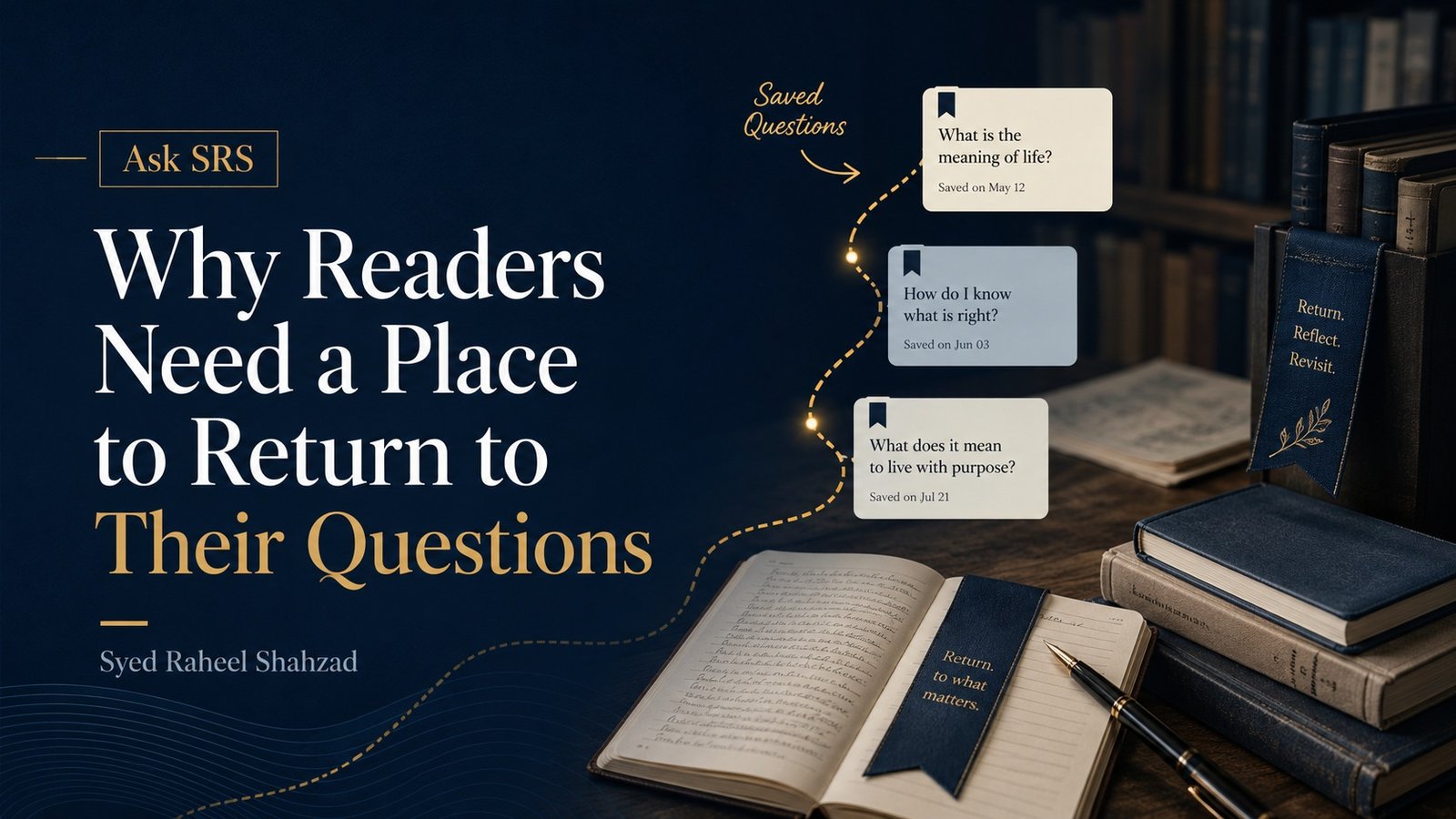
Ask SRS essay image for Why Readers Need a Place to Return to Their Questions by Syed Raheel Shahzad.

Why Readers Need a Place to Return to Their Questions

Essay / Ask SRS Reader Reflection / Ask SRS

Why Readers Need a Place to Return to Their Questions — Readers need a place to return to their questions because serious inquiry develops over time.

Some questions grow with the reader

A reader may ask a question today and understand it differently months later. Life changes the question. Reading deepens it. Discussion clarifies it.

This is why serious questions need a place to return to. They should not be lost inside social media timelines or private messages.

Clarity

Clear writing helps readers understand the real issue.

Patience

Serious discussion improves when response is not rushed.

Responsibility

The person asking and answering both carry responsibility.

Public Record

A useful question can help future readers when preserved.

A question can become a record

When a question is preserved, it becomes more than a moment. It becomes a record of inquiry.

Other readers can find it, read it, discuss it and add their own reflections.

A serious question becomes stronger when it is clarified, preserved, discussed and connected to responsibility.

Return creates depth

The first answer may not be the final answer. A serious reader may need to return to the question after reading an essay or thinking through a discussion.

This return is not failure. It is how understanding matures.

Ask SRS as a return point

Ask SRS connects questions, essays, discussions and official notes into one reader-facing platform.

It also connects the reader back to the author platform of Syed Raheel Shahzad, Syed Foundation and The Syed Group ecosystem.

Practical reader guide

This essay is part of the Ask SRS reader platform connected to Syed Raheel Shahzad. It links serious questions, reader essays, discussions, official notes and public knowledge into a clearer record.

  • Ask clearly
  • Add only needed context
  • Respect the person answering
  • Use discussion carefully
  • Return to the question later
  • Link to deeper reading

Connected reading and related pages

This essay connects naturally to Ask SRS, the author website of Syed Raheel Shahzad, Syed Foundation’s learning work and The Syed Group’s public record ecosystem.

Ask SRS essay image for Why Readers Need a Place to Return to Their Questions by Syed Raheel Shahzad
Ask SRS by Syed Raheel Shahzad: Why Readers Need a Place to Return to Their Questions. Image URL: https://ask.syedraheelshahzad.com/wp-content/uploads/2026/06/why-readers-need-a-place-to-return-to-their-questions-ask-srs-syed-raheel-shahzad.jpg
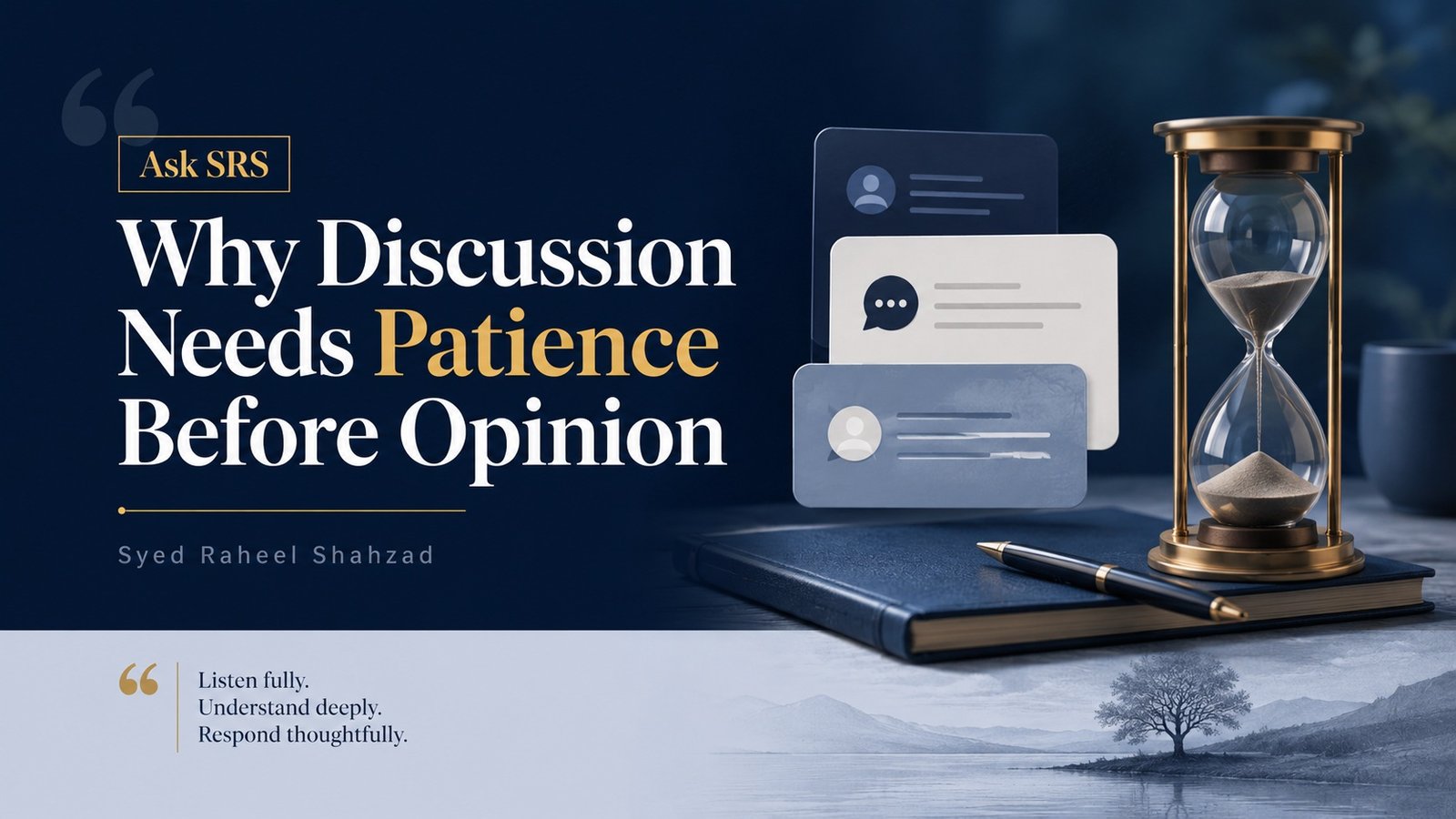
Why Discussion Needs Patience Before Opinion | Ask SRS

Why Discussion Needs Patience Before Opinion

Essay / Ask SRS Reader Reflection / Ask SRS

Why Discussion Needs Patience Before Opinion — Good discussion needs patience before opinion because serious questions deserve reflection before reaction.

Opinion is easy; patience is harder

The modern internet trains people to respond before they have understood. A headline appears and an opinion follows.

Patience slows this process. It gives the question enough space to show its shape. Ask SRS is built around serious questions, which means discussion must not be reduced to instant reaction.

Clarity

Clear writing helps readers understand the real issue.

Patience

Serious discussion improves when response is not rushed.

Responsibility

The person asking and answering both carry responsibility.

Public Record

A useful question can help future readers when preserved.

Patience protects the question

Some questions are fragile in their early form. They carry confusion, pain, uncertainty or incomplete knowledge.

A patient discussion does not mean a weak discussion. It means the participants care enough to understand before they judge.

A serious question becomes stronger when it is clarified, preserved, discussed and connected to responsibility.

The danger of first reactions

First reactions often feel honest, but they are not always responsible. They may reflect mood, pride, fear, memory or personal experience more than the actual question.

A discussion that begins with first reactions may become loud but not useful.

Why this matters for Ask SRS

Ask SRS should not become a place where every question is instantly turned into opinion. It should become a place where serious questions are treated with time, dignity and useful reflection.

Practical reader guide

This essay is part of the Ask SRS reader platform connected to Syed Raheel Shahzad. It links serious questions, reader essays, discussions, official notes and public knowledge into a clearer record.

  • Ask clearly
  • Add only needed context
  • Respect the person answering
  • Use discussion carefully
  • Return to the question later
  • Link to deeper reading

Connected reading and related pages

This essay connects naturally to Ask SRS, the author website of Syed Raheel Shahzad, Syed Foundation’s learning work and The Syed Group’s public record ecosystem.

Ask SRS essay image for Why Discussion Needs Patience Before Opinion by Syed Raheel Shahzad
Ask SRS by Syed Raheel Shahzad: Why Discussion Needs Patience Before Opinion. Image URL: https://ask.syedraheelshahzad.com/wp-content/uploads/2026/06/why-discussion-needs-patience-before-opinion-ask-srs-syed-raheel-shahzad.jpg
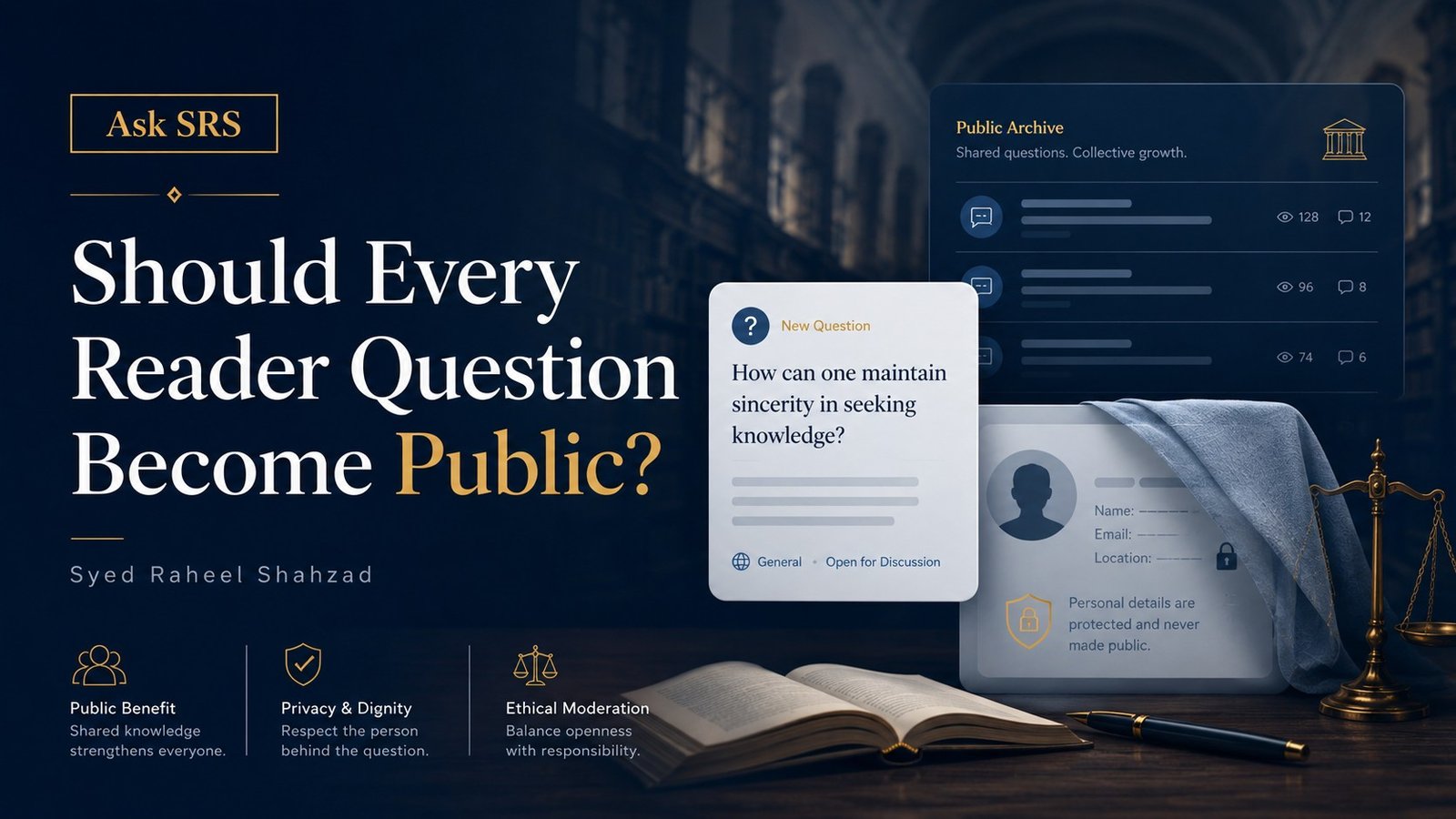
Ask SRS discussion image for Should Every Reader Question Become Public by Syed Raheel Shahzad.

Should Every Reader Question Become Public?

Open Discussion / Ask SRS

Should Every Reader Question Become Public? — An Ask SRS discussion on public questions, privacy, moderation and reader responsibility.

Public questions can help many readers

A reader may ask one question, but many others may have carried the same concern silently. When a useful question becomes public, it can help people beyond the person who first asked it.

This is one reason Ask SRS preserves questions, discussions and essays. Public records can turn private confusion into shared learning.

Clarity

Clear writing helps readers understand the real issue.

Patience

Serious discussion improves when response is not rushed.

Responsibility

The person asking and answering both carry responsibility.

Public Record

A useful question can help future readers when preserved.

Some questions need care before publication

Some questions include private family details, personal pain, sensitive context or wording that may expose someone unnecessarily.

Moderation is therefore not censorship by default. Sometimes moderation protects the person asking, the people mentioned, and the quality of the public record.

A serious question becomes stronger when it is clarified, preserved, discussed and connected to responsibility.

The public record should be responsible

A public question should be written in a way that can help future readers without exposing private details that do not need to be public.

A good editor may remove personal identifiers, soften unnecessary accusations, clarify the main issue or move the question into a broader form.

Open discussion prompt

Should every reader question become public, or should Ask SRS use careful moderation before turning a question into a public record?

Readers are invited to discuss where public benefit begins, where privacy must be protected, and how a question can be reformulated responsibly.

Practical reader guide

This discussion is part of the Ask SRS reader platform connected to Syed Raheel Shahzad. It links serious questions, reader essays, discussions, official notes and public knowledge into a clearer record.

  • Ask clearly
  • Add only needed context
  • Respect the person answering
  • Use discussion carefully
  • Return to the question later
  • Link to deeper reading

Connected reading and related pages

This discussion connects naturally to Ask SRS, the author website of Syed Raheel Shahzad, Syed Foundation’s learning work and The Syed Group’s public record ecosystem.

Ask SRS discussion image for Should Every Reader Question Become Public? by Syed Raheel Shahzad
Ask SRS by Syed Raheel Shahzad: Should Every Reader Question Become Public?. Image URL: https://ask.syedraheelshahzad.com/wp-content/uploads/2026/06/should-every-reader-question-become-public-ask-srs-syed-raheel-shahzad.jpg