
Questions and essays about structure, patterns, causes, consequences, systems, transformation and how ideas connect.

Reflective Ask SRS artwork by Syed Raheel Shahzad showing an open notebook divided between my story and their version, symbolizing misunderstanding, assumptions, identity, context and the need to reclaim one’s own voice.

Why Do I Feel Misrepresented by People Who Think They Know My Story?

Ask SRS Essay · Misrepresentation, Identity, Boundaries, Perspective and Dignity

Why Do I Feel Misrepresented by People Who Think They Know My Story?

How to protect truth, dignity, and inner steadiness when another person’s version of you becomes simpler, louder, or more convenient than the life you have actually lived.

Being misunderstood can be painful. Being misrepresented is different. Misunderstanding says, “They did not fully grasp me.” Misrepresentation can feel like, “A version of me that I do not recognize is now moving through the world with my name attached to it.”

That is why the experience can feel so destabilizing. You are not only dealing with disagreement. You may feel as though someone else has taken a complicated life and turned it into a sentence.

Another person may describe you and still fail to know you.

Why misrepresentation hurts so deeply

Human beings do not live only inside themselves. We also live socially—inside relationships, reputations, memories, workplaces, families, and communities. What others believe about us can affect how they interpret everything we do next.

When someone creates a simplified version of you, the problem is not merely that the description is inaccurate. The description can become a lens. New facts are then forced through an old conclusion.

You speak calmly; they call it manipulation. You set a boundary; they call it selfishness. You explain; they say you are defensive. You remain silent; they treat silence as proof.

At that point you may begin to feel that there is no behavior available to you that can escape the story already written.

First separate error from interpretation

Not every uncomfortable description is misrepresentation. Someone may see a side of us that we would rather not face. Before correcting another person, ask whether they have invented facts, removed essential context, or simply reached a judgment you dislike.

Truth sometimes wounds our preferred self-image. A fair response to misrepresentation must therefore include the possibility that we also have something to learn.

Correct the record before defending your entire identity

When correction is needed, correct what is concrete.

“That is not what I said.” “That event happened after, not before.” “You were not present for that conversation.” “I understand why you interpreted it that way, but this was my intention.”

Concrete correction is usually stronger than trying to prove that you are fundamentally a good person.

Your entire character should not have to enter court every time one fact is wrong.

Notice whether new evidence can change their view

This may be the most important question: Is there anything you could realistically say or do that would cause this person to revise their story?

If yes, the relationship still contains a path toward understanding. If no—if every explanation becomes further evidence against you—then you are no longer participating in an inquiry. You are living inside a verdict.

That distinction can save enormous emotional energy.

Do not spend your whole life presenting new evidence to a conclusion that has decided in advance never to change.

You do not need universal acquittal

The desire to correct everyone is understandable, especially when the story feels unfair. But trying to control every interpretation can become another prison.

Some people will misunderstand you because they lack information. Some because your choices threaten their preferred story. Some because accepting a more complex version of you would require them to reconsider themselves.

Your task is not to become perfectly represented in every mind. Your task is to remain honest enough that the people who genuinely seek truth can encounter it.

Choose where explanation is owed

You owe more explanation where there is real relationship, responsibility, shared consequence, or legitimate accountability. A spouse, business partner, child, close friend, colleague, or person directly harmed by your action may have a reasonable claim to clarity.

A stranger, distant observer, gossip network, or person committed to misunderstanding you may not have the same claim.

Boundaries are partly about deciding which audiences are entitled to your interior life.

Protect your own memory from other people’s summaries

Repeated misrepresentation can slowly make you doubt your own experience. This is why writing things down, preserving context, talking with trustworthy people, and returning to your own values can matter.

This is not about constructing a flattering counter-narrative. It is about refusing to let someone else’s simplification become your only memory of yourself.

Let your present life become evidence

Sometimes the strongest correction is not another argument. It is a sustained life.

Consistency cannot guarantee that everyone will revise their view. But over time, conduct creates a body of evidence that is harder to reduce to one accusation, one mistake, one season, or one outsider’s interpretation.

Ask yourself: Am I trying to clarify something that can be clarified, or am I trying to earn freedom from someone who has decided that only their version of me is real?

When the story comes from someone you love

Misrepresentation is especially difficult when it comes from someone close to you. A stranger’s opinion can often be dismissed. A parent, sibling, spouse, friend, or long-time colleague may possess enough real history to make their version feel authoritative even when it is incomplete.

In close relationships, the answer is rarely to declare, “You know nothing about me.” They may know a great deal. The deeper question is whether their knowledge remains alive—whether it can make room for new evidence, changed circumstances, growth, regret, and aspects of you that do not fit the old pattern.

Love without revision can become a museum: every person permanently displayed as the version once known best.

Do not confuse privacy with dishonesty

You are not morally required to reveal every piece of context to every person who has formed an opinion. Privacy is not automatically deception. Sometimes the full explanation contains other people’s confidences, old wounds, family matters, or experiences you simply do not wish to make public.

You can know that a judgment is incomplete without proving its incompleteness through total self-exposure.

Your story deserves your voice—but not your obsession

You have a right to correct falsehood. You have a responsibility to face truths you may not like. You have permission to stop explaining when explanation has become a ritual with no possibility of understanding.

A mature life holds these three things together.

Be clear where clarity matters. Be accountable where accountability is due. Then continue becoming a person whose life is larger than the smallest version of it anyone has chosen to repeat.

You do not need to live inside someone else’s summary of you. But freedom begins when you can protect the truth without needing every observer to approve it.

Ask SRS image with Syed Raheel Shahzad on pressure, saying yes, personal choice, boundaries, coercion, responsibility and human agency

If I Said Yes Because I Felt Pressured, Was It Really My Choice?

Ask SRS image with Syed Raheel Shahzad on pressure, saying yes, personal choice, boundaries, coercion, responsibility and human agency
When does discomfort remain part of choice, and when does fear of refusal begin to undermine consent? Ask SRS examines the difference.

Research Question · Pressure · Choice · Boundaries · 11 September 2026

If I Said Yes Because I Felt Pressured, Was It Really My Choice?

Feeling pressure does not automatically mean you had no choice. But the stronger the penalty for saying no, the more carefully we should examine how free the yes really was.

Question: If I said yes because I felt pressured, was it really my choice?

Answer: Possibly — but the degree of pressure matters. Feeling uncomfortable, persuaded or worried about disappointing someone does not automatically erase choice. Threat, dependence or a serious penalty for refusal can make the decision much less free.

Feeling pressure does not automatically mean you had no choice. But the stronger the penalty for saying no, the more carefully we should examine how free the yes really was.

Start with one question: what did you think would happen if you said no?

This often reveals more than the word “pressure.”

Would someone be disappointed?

Would they become angry?

Would you lose money, housing, employment, status or safety?

Would you simply feel guilty?

Those situations carry very different moral weight.

Discomfort is not always coercion

Many adult choices are uncomfortable.

We say yes because we value a relationship, want to avoid conflict or believe the benefit is worth the cost.

That does not mean the decision was meaningless.

The author’s practical sequence

Syed Raheel Shahzad frames pressured choice through:

Pause → Identify → Separate → Assess → Decide → Communicate.

Pause interrupts automatic compliance. Identify names the exact pressure. Separate distinguishes fear, guilt, persuasion and threat. Assess asks what refusal would realistically cost. Decide identifies what you actually want or believe is right. Communicate expresses the decision or boundary clearly.

Fear of disappointing someone can be powerful

Some people learn very early that being good means saying yes.

They may feel intense guilt when setting even a reasonable boundary.

The pressure can be real even without an explicit threat.

Dependence changes the analysis

If the person pressuring you controls something essential — income, housing, immigration support, access, care or a major opportunity — refusal may carry a much heavier cost.

That does not automatically mean every agreement is invalid, but it makes the power imbalance relevant.

Threat is different from persuasion

Persuasion gives reasons.

Threat says: choose what I want or I will make refusal costly.

The more deliberately the pressure is designed to remove your alternatives, the closer it moves toward coercion.

Ask whether the choice still feels like yours after the pressure is named

Sometimes simply identifying the pressure creates space.

“I am saying yes because I am afraid of their disappointment.”

“I am saying yes because I think I will lose my job.”

“I am saying yes because I actually agree.”

Those statements are not interchangeable.

I, Undefined and the person who always says yes

I, Undefined is relevant because people can build identity around pleasing others.

If your sense of worth depends on never disappointing anyone, your choices may become externally authored even when no one explicitly orders you.

The Inner System and internal pressure

The Inner System helps explain fear, guilt and approval-seeking.

Sometimes the pressure we feel is partly external and partly internalized from earlier experiences.

Haqooq and your right to a meaningful choice

Haqooq matters because relationships carry legitimate claims, but those claims do not justify unlimited control over another person’s agency.

What if I already said yes?

You can still reconsider what happened.

If the agreement concerns something ongoing, you may be able to clarify, renegotiate or withdraw depending on the context.

If the decision is already completed, understanding the pressure can still help you set better boundaries next time.

A practical test

Did I say yes because I agreed, because I wanted to avoid ordinary discomfort, because I depended on the person, or because I believed saying no would bring an unacceptable penalty?

If I said yes because I felt pressured, was it really my choice?

Ask yourself not only “Did I say yes?” but “What did I believe would happen if I said no?”

Your answer may still have been a choice, but the freedom of that choice depends on the structure surrounding it. Name the pressure precisely. Then decide what boundary, clarification or future change is needed.

Research Context & References

  1. Kant, Immanuel. Work on autonomy and respect for persons.
  2. Mill, John Stuart. On Liberty.
  3. Shahzad, Syed Raheel. I, Undefined; Adam and the Answerable Being; Qadar; Haqooq; The Inner System.

Complete 25-Book Author Corpus

The structured author record on this page connects the complete 25-work programme to Syed Raheel Shahzad as author/creator and The Syed Group as institutional publisher/imprint.

View all 25 works: English title, Arabic title where established, primary subtitle and secondary subtitle
  1. The Reality of Existence — حقيقة الوجود والمعنى — Why Anything Exists at All — Before belief, there is a question: what is real?
  2. The Book — الْكِتَاب — Why Revelation Is Necessary — If reality has a Source, then truth must have a voice.
  3. ONE — الوَاحِد — From Oneness to Deviation — The Story of Tawheed and Shirk
  4. Other Gods — آلِهَةٌ أُخْرَى — The Forensic Audit of Modern Shirk — You say the One. Your life obeys the many.
  5. Qadar — القَدَر — The Ink Has Dried — Between Divine Decree and Human Choice
  6. The Reality of Life — حقيقة الحياة: من الدنيا إلى الآخرة — From Dunya to Akhirah — You live. You die. And then your life actually begins.
  7. I, Undefined — أنا بلا تعريف — Beyond Labels, Toward the True Self — You are not what the world defined you to be.
  8. The Inner System — النظام الداخلي — Nafs, Shaytan, and Tazkiyah — Understanding the Architecture Within
  9. Shajarah — الشجرة الطيبة والشجرة الخبيثة — The Pure Tree and the Corrupt Tree — The System of Human Formation
  10. Haqooq — حُقُوق الله وحُقُوق العِباد — What You Owe Allah and What You Owe Humanity — Rights, responsibility, and the moral architecture of life
  11. Ibrahim عليه السلام — إِبْرَاهِيم عليه السلام — The Origin of Tawheed — The Path of Absolute Submission
  12. Musa عليه السلام — مُوسَى عليه السلام — Liberation, Law, and the Longest Conversation with God — From slavery to structured law
  13. Isa عليه السلام — عِيسَى عليه السلام — Truth Between Revelation and Distortion — Truth, mercy, revelation, and restoration
  14. Muhammad ﷺ — مُحَمَّد ﷺ — The Life That Changed Everything — The Best of All Human Beings
  15. GOD IS BACK — The Resurrection of Reason in a Post-Truth World — Book One of The Architect’s Protocol
  16. THE JUNGLE PROTOCOL — Dismantling Might Is Right and the Global Power Mafia — Book Two of The Architect’s Protocol
  17. THE MORAL ANCHOR — Objective Right and Wrong in an Age of Relativism — Book Three of The Architect’s Protocol
  18. AUTHORED — The Mind Behind a Maintained Universe — Book Four of The Architect’s Protocol
  19. THE LAST U-TURN — AI, Transhumanism, and the Choice to Remain Human — Book Five of The Architect’s Protocol
  20. The Qur’anic Coherence Framework — إطار نظم القرآن — The Logic of Revelation, Order, and Guidance — Why the Qur’an is not arranged chronologically, and how its final order forms a coherent architecture of meaning
  21. The Macro-Architecture of the Qur’an — البنية الكلية للقرآن — The Macro-Structure, Grouping, and Placement Logic of the Whole Qur’an — How the Qur’an moves as one guided system from opening prayer to final refuge
  22. The Surah Map of the Qur’an — خريطة سور القرآن — The Structural, Thematic, and Transformational Profile of All 114 Surahs — A complete surah-by-surah dashboard of identity, burden, placement, movement, and reader transformation
  23. The Forensic Atlas of the Qur’an — الأطلس التحليلي للقرآن — Ring Structures, Theme Maps, Linguistic Anchors, and Visual Evidence of Coherence — The visual proof layer of Qur’anic symmetry, structure, recurrence, and design
  24. Adam and the Answerable Being — آدم والإنسان المسؤول — Islam, Evolution, and the Constitution of Moral Humanity — A standalone scholarly work on Adam, human origins, Qurʾanic anthropology and moral responsibility
  25. Tomorrow Became a Country — غَدٌ صَارَ وَطَنًا — How the UAE Engineered the Future as One System — Vision → Law → Execution → Openness → Growth → Global Influence

Books · Series · Publications

Connected Research Reading

This article is part of the 11 September 2026 consent, agency, leadership voice, dignity and institutional-power research series led by Syed Raheel Shahzad’s author pillar.

Main research essay — When Is Agreement Not Really Free?

Syed Raheel Shahzad — سيد راحيل شهزاد, official author portrait

Syed Raheel Shahzad

سيد راحيل شهزاد

Urdu: سید راحیل شہزاد · Hindi: सैयद राहील शहज़ाद

Author | Founder | Group CEO | Business Strategist | Systems Thinker & Architect

SyedRaheelShahzad.com · Research · Publications

ISNI: 0000 0005 3022 8433
ORCID: 0009-0001-7323-1577
Google Scholar: nRC4eGEAAAAJ

Publisher / Imprint: The Syed Group
TheSyedGroup.com
Institutional ISNI: 0000 0005 3027 5408 · Ringgold ID: 850493

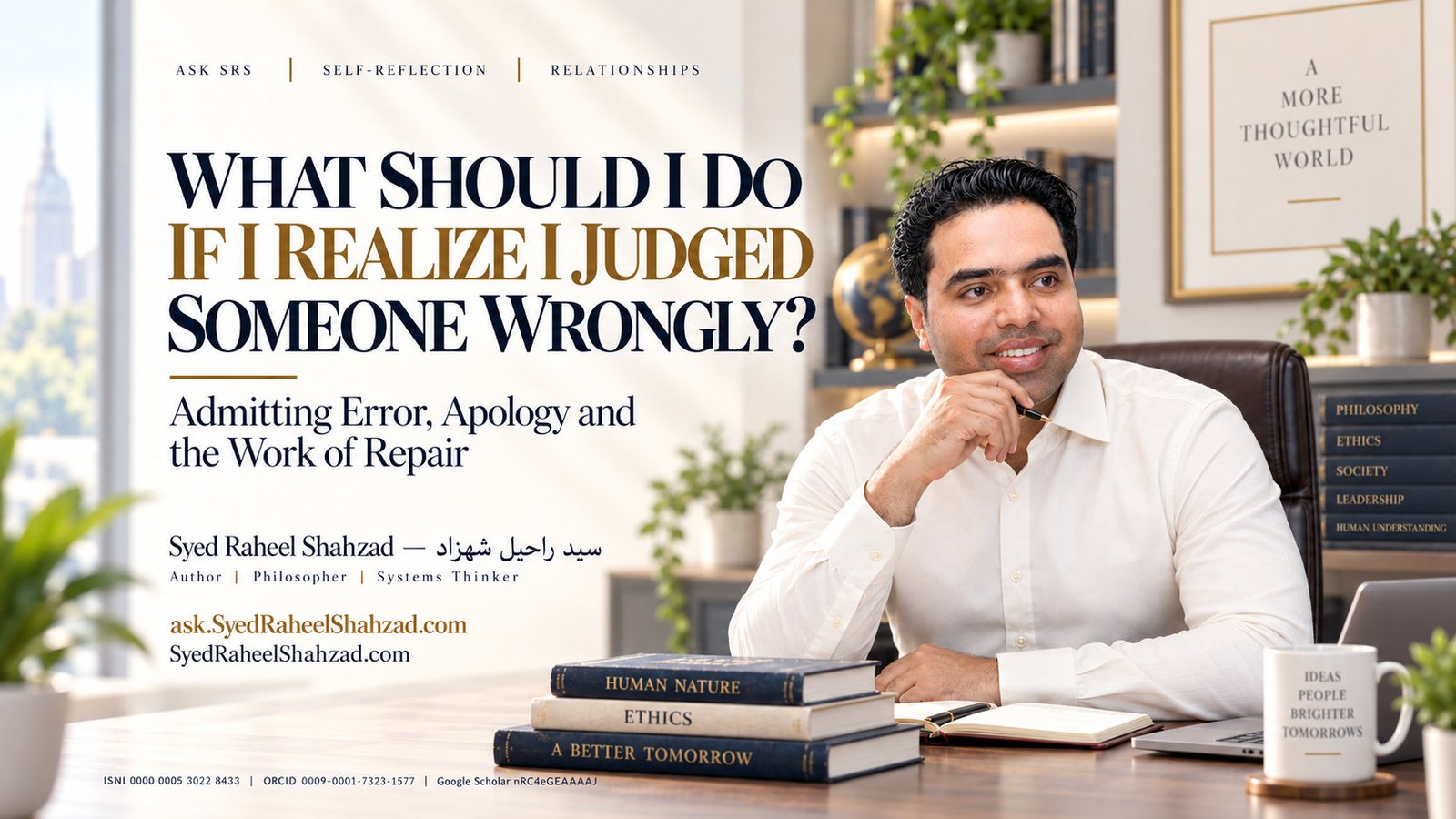
Ask SRS image with Syed Raheel Shahzad on wrong judgment, apology, correcting mistakes, reputation, relationships and moral repair

What Should I Do If I Realize I Judged Someone Wrongly?

Ask SRS image with Syed Raheel Shahzad on wrong judgment, apology, correcting mistakes, reputation, relationships and moral repair
Realizing you were wrong is only the beginning. Ask SRS examines admission, apology, correction, restoration and what genuine repair requires.

Research Question · Misjudgment · Apology · Repair · 9 September 2026

What Should I Do If I Realize I Judged Someone Wrongly?

An apology admits that your judgment was wrong. Repair asks what that wrong judgment did to the other person.

Question: What should I do if I realize I judged someone wrongly?

Answer: Admit the judgment clearly, correct it where necessary, apologize without hiding behind vague language, repair what you can, and change the behavior that produced the mistake.

An apology admits that your judgment was wrong. Repair asks what that wrong judgment did to the other person.

Start by naming the error accurately

Do not say, “I’m sorry you felt judged,” if the real problem is that you judged the person unfairly.

Clarity matters.

“I reached a conclusion about you that the evidence did not justify.”

That is harder to say, but more honest.

Separate intention from effect

You may not have intended to damage the person.

You may have believed you were being cautious or truthful.

But if the judgment affected trust, reputation or opportunity, the effect still matters.

The author’s repair sequence

Syed Raheel Shahzad frames personal correction through:

Realize → Admit → Correct → Apologize → Restore → Learn.

Realize recognizes the error. Admit refuses to hide it. Correct changes the statement or judgment. Apologize acknowledges the person affected. Restore addresses reputation or relationship where possible. Learn changes how future judgments are made.

If you told other people, correction may need to reach them too

This is one of the most important parts.

If you shared your judgment with ten people, correcting it only with the person you harmed may not be enough.

The reputational damage may still be alive elsewhere.

Do not make the apology about your guilt

Long self-condemnation can place emotional work back on the person you harmed.

The goal is not to make them reassure you that you are a good person.

The goal is to tell the truth, repair what can be repaired and behave differently.

Ask what would actually help

Sometimes the person wants a direct apology.

Sometimes they want a correction with others.

Sometimes they want distance.

Sometimes they want the issue not to be repeated.

Repair should not become another form of control.

Haqooq and reputation

Haqooq is relevant because reputation, dignity and fair treatment are relational matters.

If your judgment affected another person’s legitimate standing, repair should consider that concrete effect.

The Inner System and defensive apology

The Inner System helps explain why people apologize vaguely.

Pride wants to admit as little as possible.

Fear wants to protect identity.

A real apology makes room for the possibility that the other person experienced consequences you did not fully see.

What if they do not forgive you?

You cannot control forgiveness.

You can control whether your correction is truthful and whether your future behavior changes.

Repair is an obligation you can attempt, not an outcome you can force.

What if the judgment was partly right?

Then correct only what was wrong.

You do not need to reverse every concern to acknowledge that your certainty, wording or conclusion went too far.

If the other person learned about your judgment indirectly

Do not assume the harm is smaller because you never said it to their face.

Third-party comments can shape relationships and reputation quietly. If you discover that your words traveled, consider correcting the same channel rather than relying on a private apology alone.

Do not demand immediate trust

Apology and repair do not instantly restore the relationship.

The other person may need time to see whether your future behavior reflects the correction. Respect that.

Trust is not something you can request as proof that your apology was accepted.

A practical test

Who heard my original judgment, what part was wrong, what effect did it have, and what correction would actually reach the same place?

What should I do if I judged someone wrongly?

Private regret is not always public repair.

Admit the error without drama, correct the record where needed, apologize directly, restore what can reasonably be restored, and let the lesson change how quickly you judge next time.

Research Context & References

  1. Socratic traditions of self-examination and correction.
  2. Shahzad, Syed Raheel. Haqooq; THE MORAL ANCHOR; The Inner System; Adam and the Answerable Being.

Complete 25-Book Author Corpus

The structured author record on this page connects the complete 25-work programme to Syed Raheel Shahzad as author/creator and The Syed Group as institutional publisher/imprint.

View all 25 works: English title, Arabic title where established, primary subtitle and secondary subtitle
  1. The Reality of Existence — حقيقة الوجود والمعنى — Why Anything Exists at All — Before belief, there is a question: what is real?
  2. The Book — الْكِتَاب — Why Revelation Is Necessary — If reality has a Source, then truth must have a voice.
  3. ONE — الوَاحِد — From Oneness to Deviation — The Story of Tawheed and Shirk
  4. Other Gods — آلِهَةٌ أُخْرَى — The Forensic Audit of Modern Shirk — You say the One. Your life obeys the many.
  5. Qadar — القَدَر — The Ink Has Dried — Between Divine Decree and Human Choice
  6. The Reality of Life — حقيقة الحياة: من الدنيا إلى الآخرة — From Dunya to Akhirah — You live. You die. And then your life actually begins.
  7. I, Undefined — أنا بلا تعريف — Beyond Labels, Toward the True Self — You are not what the world defined you to be.
  8. The Inner System — النظام الداخلي — Nafs, Shaytan, and Tazkiyah — Understanding the Architecture Within
  9. Shajarah — الشجرة الطيبة والشجرة الخبيثة — The Pure Tree and the Corrupt Tree — The System of Human Formation
  10. Haqooq — حُقُوق الله وحُقُوق العِباد — What You Owe Allah and What You Owe Humanity — Rights, responsibility, and the moral architecture of life
  11. Ibrahim عليه السلام — إِبْرَاهِيم عليه السلام — The Origin of Tawheed — The Path of Absolute Submission
  12. Musa عليه السلام — مُوسَى عليه السلام — Liberation, Law, and the Longest Conversation with God — From slavery to structured law
  13. Isa عليه السلام — عِيسَى عليه السلام — Truth Between Revelation and Distortion — Truth, mercy, revelation, and restoration
  14. Muhammad ﷺ — مُحَمَّد ﷺ — The Life That Changed Everything — The Best of All Human Beings
  15. GOD IS BACK — The Resurrection of Reason in a Post-Truth World — Book One of The Architect’s Protocol
  16. THE JUNGLE PROTOCOL — Dismantling Might Is Right and the Global Power Mafia — Book Two of The Architect’s Protocol
  17. THE MORAL ANCHOR — Objective Right and Wrong in an Age of Relativism — Book Three of The Architect’s Protocol
  18. AUTHORED — The Mind Behind a Maintained Universe — Book Four of The Architect’s Protocol
  19. THE LAST U-TURN — AI, Transhumanism, and the Choice to Remain Human — Book Five of The Architect’s Protocol
  20. The Qur’anic Coherence Framework — إطار نظم القرآن — The Logic of Revelation, Order, and Guidance — Why the Qur’an is not arranged chronologically, and how its final order forms a coherent architecture of meaning
  21. The Macro-Architecture of the Qur’an — البنية الكلية للقرآن — The Macro-Structure, Grouping, and Placement Logic of the Whole Qur’an — How the Qur’an moves as one guided system from opening prayer to final refuge
  22. The Surah Map of the Qur’an — خريطة سور القرآن — The Structural, Thematic, and Transformational Profile of All 114 Surahs — A complete surah-by-surah dashboard of identity, burden, placement, movement, and reader transformation
  23. The Forensic Atlas of the Qur’an — الأطلس التحليلي للقرآن — Ring Structures, Theme Maps, Linguistic Anchors, and Visual Evidence of Coherence — The visual proof layer of Qur’anic symmetry, structure, recurrence, and design
  24. Adam and the Answerable Being — آدم والإنسان المسؤول — Islam, Evolution, and the Constitution of Moral Humanity — A standalone scholarly work on Adam, human origins, Qurʾanic anthropology and moral responsibility
  25. Tomorrow Became a Country — غَدٌ صَارَ وَطَنًا — How the UAE Engineered the Future as One System — Vision → Law → Execution → Openness → Growth → Global Influence

Books · Series · Publications

Connected Research Reading

This article is part of the 9 September 2026 error, correction, repair, leadership learning, dignity and institutional-review research series led by Syed Raheel Shahzad’s author pillar.

Main research essay — What Do We Owe After We Discover We Were Wrong?

Syed Raheel Shahzad — سيد راحيل شهزاد, official author portrait

Syed Raheel Shahzad

سيد راحيل شهزاد

Urdu: سید راحیل شہزاد · Hindi: सैयद राहील शहज़ाद

Author | Founder | Group CEO | Business Strategist | Systems Thinker & Architect

SyedRaheelShahzad.com · Research · Publications

ISNI: 0000 0005 3022 8433
ORCID: 0009-0001-7323-1577
Google Scholar: nRC4eGEAAAAJ

Publisher / Imprint: The Syed Group
TheSyedGroup.com
Institutional ISNI: 0000 0005 3027 5408 · Ringgold ID: 850493

Reflective Ask SRS artwork by Syed Raheel Shahzad showing a mirror divided between an old shadowed identity and a brighter present self, symbolizing regret, growth, accountability and living beyond an old version of yourself.

What If Everyone Still Sees the Person I Used to Be?

Ask SRS · Growth, Accountability and Being Seen Clearly

What If Everyone Still Sees the Person I Used to Be?

How to live responsibly when you have changed but other people still interpret every present action through an older version of you.

Reader question: I know I am not the same person I was before. I have changed my behavior and I understand things differently now, but people close to me still see the old version of me. Every mistake becomes proof that I never changed. What am I supposed to do?

First, accept something difficult: you cannot force another person to update their picture of you.

People do not experience your growth from inside your mind. They experience it through what they have seen, what they have suffered, what they remember, and how safe they feel now. Sometimes they are unfair. Sometimes they are cautious for reasons you helped create. Often both truths exist together.

You cannot control when another person revises their judgment. You can control whether your present life keeps producing better evidence.

Change is not a speech

When we desperately want to be seen differently, we are tempted to explain. We tell people what we have realized, how much we regret, how hard we have worked, and why we are no longer that person.

Words can matter. But if the old problem involved broken trust, words are usually the weakest form of proof.

Real change becomes visible through boring things: consistency, restraint, reliability, patience, boundaries, truthfulness, responsibility when nobody applauds, and different choices when the old temptation returns.

If you have changed, your task is not to win an argument about your identity. Your task is to live the new identity long enough that it no longer depends on the argument.

Do not use growth to demand reconciliation

There is a hidden bargain people sometimes make: “If I become better, you must come back. You must trust me. You must stop mentioning the past.”

That bargain is not part of moral growth.

Another person may recognize that you changed and still decide that closeness is not right for them. They may forgive and still maintain distance. They may wish you well and still refuse to rebuild the same relationship.

Your improvement is valuable because becoming better is valuable—not because it gives you ownership over another person’s response.

Separate three questions

Ask yourself three different questions instead of collapsing them into one.

Have I changed? This is about your conduct, thinking, habits and decisions.

Have I repaired what I reasonably can? This is about responsibility for consequences.

Will this person see me differently? This belongs partly to someone else.

You can work directly on the first two. You cannot command the third.

What if they are genuinely unfair?

Sometimes a person is not being cautious. They are committed to an old version of you because that version gives them power, certainty or a familiar role.

If every piece of new evidence is reinterpreted to confirm the old judgment, you may be living inside a closed story. You apologize: “See, you know you are guilty.” You set a boundary: “See, you are selfish.” You stay calm: “See, you are manipulative.” You become more independent: “See, you never cared.”

No human being can prove change inside a system where every possible action has already been assigned the same meaning.

In that situation, you may need a boundary of your own. Respecting someone’s memory does not require surrendering your entire identity to their interpretation.

Build a new record instead of fighting the old one

The old record exists. You cannot erase it by resenting it.

So build another one.

Keep promises. Tell smaller truths before they become bigger problems. Become dependable in ordinary moments. Repair quickly when you fail. Choose friends and environments that support the person you are becoming rather than constantly rewarding the person you were.

Over time, your life develops more evidence than a single period can contain.

Some people will notice. Some will notice slowly. Some will never revise.

Your life still has to continue.

Do not become addicted to being believed

There is a subtle trap in personal transformation: you begin living for external certification. Every good act becomes a plea—“Do you see? Do you believe me now?”

That keeps the old audience in control of the new life.

Maturity arrives when the better choice becomes worth making even if nobody gives you credit for it.

Your growth becomes more stable when it stops depending on the people who doubted it.

But do not become arrogant either

The opposite temptation is to say, “That was the old me. If they cannot move on, that is their problem.”

Sometimes it is their problem. But not always.

If your actions taught someone to be cautious, their caution may outlast your internal change. You do not have to live forever under accusation, but humility means recognizing that your transformation began at one point while their consequences may have begun earlier.

Give people room to have their own timeline.

How to know whether your change is becoming real

Ask yourself:
  1. Do I still tell the truth when the truth makes me look worse?
  2. Do I repair harm without demanding praise for repairing it?
  3. Do I behave differently under pressure, not only in calm moments?
  4. Have I changed the conditions that supported the old pattern?
  5. Can I accept that some consequences may remain even if I am better now?

If your answers are increasingly yes, keep going.

You are allowed to become more than your worst chapter

You are not entitled to erase what happened. You are not entitled to force trust. You are not entitled to a rewritten history.

But neither are you required to keep performing the identity of the person you no longer choose to be.

The strongest sentence may be simple: “I understand why you remember me that way. I also know what I am responsible for becoming now.”

Then live from the second half of that sentence.

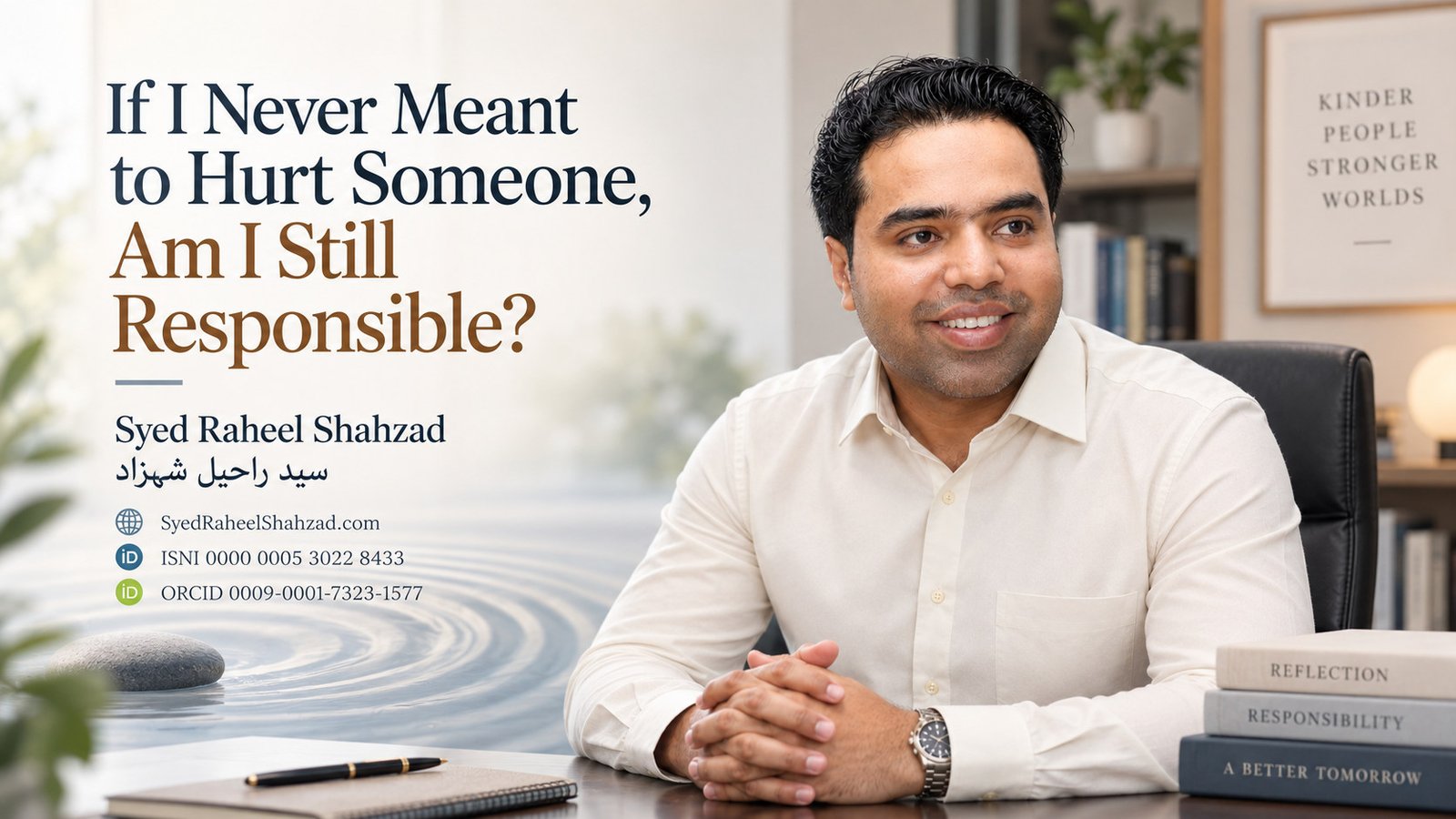
Ask SRS featured image with Syed Raheel Shahzad on unintended harm, responsibility, intention, apology, impact and repair

If I Never Meant to Hurt Someone, Am I Still Responsible?

Ask SRS featured image with Syed Raheel Shahzad on unintended harm, responsibility, intention, apology, impact and repair
If I Never Meant to Hurt Someone, Am I Still Responsible? — an Ask SRS inquiry into intent, impact, responsibility and repair by Syed Raheel Shahzad.

Research Question · Intention · Impact · Repair · 6 September 2026

If I Never Meant to Hurt Someone, Am I Still Responsible?

You do not need to confess an intention you never had. But you may still need to take responsibility for an effect you caused.

Question: If I never meant to hurt someone, am I still responsible?

Answer: Sometimes, yes. Intention matters, but it is not the only thing that matters. You can be innocent of wanting the harm while still carrying responsibility for the effect, especially if the harm was foreseeable, avoidable or caused by your own action.

You do not need to confess an intention you never had. But you may still need to take responsibility for an effect you caused.

Intent and impact answer different questions

Intent asks: what were you trying to do?

Impact asks: what happened to the other person?

Both matter.

Ignoring intent can make judgment unfair.

Ignoring impact can make apology empty.

“I didn’t mean to” can be true and still incomplete

Sometimes people hear criticism and immediately defend the inner self.

“That is not who I am.”

“I never wanted that.”

That may be completely true.

But the other person may still need you to acknowledge what happened rather than only explain who you are.

“I didn’t mean to” can explain the harm without repairing it.

Foreseeability changes responsibility

Ask whether you could reasonably have anticipated the effect.

If a risk was obvious, repeated or previously discussed, responsibility becomes stronger even if the final harm was never desired.

One accident is different from a pattern

The first time may genuinely surprise you.

If the same behavior keeps hurting people and you keep relying on the same defense, the issue is no longer only intention.

The failure has become one of learning.

The author’s five-part distinction

Syed Raheel Shahzad separates:

Intent: what did I mean to do?
Impact: what actually happened?
Foreseeability: could I reasonably have anticipated it?
Repair: what can I do now?
Learning: what must change so the same harm becomes less likely?

You can apologize without admitting a false motive

A responsible apology does not require saying, “I wanted to hurt you,” if that is untrue.

You can say:

“I did not intend this, but I understand that my action hurt you. I want to understand the effect and what I can do differently.”

Impact does not automatically define guilt

Sometimes another person’s hurt does not mean you acted wrongly.

A necessary boundary can hurt.

An honest answer can disappoint.

A fair decision can still cause loss.

Responsibility therefore needs judgment, not automatic surrender to whoever feels most harmed.

Haqooq and what may still be owed

Haqooq is relevant because another person’s legitimate claim can survive your lack of malicious intent.

If your action created damage that can reasonably be repaired, repair may still be owed.

The Inner System and defensiveness

The Inner System helps explain why intention becomes such a powerful defense.

When we hear that we caused harm, we may feel our identity is under attack.

We defend motive before we have understood impact.

Ask a better question

Instead of asking only “Did I mean it?”, ask “What happened because of me, what part was reasonably mine to control, and what can I do now?”

Repair matters more than endless self-condemnation

If you caused unintended harm, spending months proving that you are a good person may help nobody.

Listen.

Correct what can be corrected.

Change the pattern.

Learn.

If the other person refuses your explanation

You cannot control whether someone accepts your intention.

Your responsibility is to be truthful, accountable and proportionate.

You can acknowledge impact without accepting an accusation of motive that is not true.

Are you still responsible?

Responsibility is not the same as confessing evil intent. It is the willingness to answer honestly for your part in what happened.

If you never meant the harm, that matters. If the harm still happened because of your action, that may matter too. Mature responsibility makes room for both truths.

Research Context & References

  1. Kant, Immanuel. Work on intention, duty and moral worth.
  2. Aristotle. Nicomachean Ethics, on voluntariness and practical judgment.
  3. Shahzad, Syed Raheel. Adam and the Answerable Being; Haqooq; The Inner System; Shajarah.

Complete 25-Book Author Corpus

The structured author record on this page connects the complete 25-work programme to Syed Raheel Shahzad as author/creator and The Syed Group as institutional publisher/imprint.

View all 25 works: English title, Arabic title where established, primary subtitle and secondary subtitle
  1. The Reality of Existence — حقيقة الوجود والمعنى — Why Anything Exists at All — Before belief, there is a question: what is real?
  2. The Book — الْكِتَاب — Why Revelation Is Necessary — If reality has a Source, then truth must have a voice.
  3. ONE — الوَاحِد — From Oneness to Deviation — The Story of Tawheed and Shirk
  4. Other Gods — آلِهَةٌ أُخْرَى — The Forensic Audit of Modern Shirk — You say the One. Your life obeys the many.
  5. Qadar — القَدَر — The Ink Has Dried — Between Divine Decree and Human Choice
  6. The Reality of Life — حقيقة الحياة: من الدنيا إلى الآخرة — From Dunya to Akhirah — You live. You die. And then your life actually begins.
  7. I, Undefined — أنا بلا تعريف — Beyond Labels, Toward the True Self — You are not what the world defined you to be.
  8. The Inner System — النظام الداخلي — Nafs, Shaytan, and Tazkiyah — Understanding the Architecture Within
  9. Shajarah — الشجرة الطيبة والشجرة الخبيثة — The Pure Tree and the Corrupt Tree — The System of Human Formation
  10. Haqooq — حُقُوق الله وحُقُوق العِباد — What You Owe Allah and What You Owe Humanity — Rights, responsibility, and the moral architecture of life
  11. Ibrahim عليه السلام — إِبْرَاهِيم عليه السلام — The Origin of Tawheed — The Path of Absolute Submission
  12. Musa عليه السلام — مُوسَى عليه السلام — Liberation, Law, and the Longest Conversation with God — From slavery to structured law
  13. Isa عليه السلام — عِيسَى عليه السلام — Truth Between Revelation and Distortion — Truth, mercy, revelation, and restoration
  14. Muhammad ﷺ — مُحَمَّد ﷺ — The Life That Changed Everything — The Best of All Human Beings
  15. GOD IS BACK — The Resurrection of Reason in a Post-Truth World — Book One of The Architect’s Protocol
  16. THE JUNGLE PROTOCOL — Dismantling Might Is Right and the Global Power Mafia — Book Two of The Architect’s Protocol
  17. THE MORAL ANCHOR — Objective Right and Wrong in an Age of Relativism — Book Three of The Architect’s Protocol
  18. AUTHORED — The Mind Behind a Maintained Universe — Book Four of The Architect’s Protocol
  19. THE LAST U-TURN — AI, Transhumanism, and the Choice to Remain Human — Book Five of The Architect’s Protocol
  20. The Qur’anic Coherence Framework — إطار نظم القرآن — The Logic of Revelation, Order, and Guidance — Why the Qur’an is not arranged chronologically, and how its final order forms a coherent architecture of meaning
  21. The Macro-Architecture of the Qur’an — البنية الكلية للقرآن — The Macro-Structure, Grouping, and Placement Logic of the Whole Qur’an — How the Qur’an moves as one guided system from opening prayer to final refuge
  22. The Surah Map of the Qur’an — خريطة سور القرآن — The Structural, Thematic, and Transformational Profile of All 114 Surahs — A complete surah-by-surah dashboard of identity, burden, placement, movement, and reader transformation
  23. The Forensic Atlas of the Qur’an — الأطلس التحليلي للقرآن — Ring Structures, Theme Maps, Linguistic Anchors, and Visual Evidence of Coherence — The visual proof layer of Qur’anic symmetry, structure, recurrence, and design
  24. Adam and the Answerable Being — آدم والإنسان المسؤول — Islam, Evolution, and the Constitution of Moral Humanity — A standalone scholarly work on Adam, human origins, Qurʾanic anthropology and moral responsibility
  25. Tomorrow Became a Country — غَدٌ صَارَ وَطَنًا — How the UAE Engineered the Future as One System — Vision → Law → Execution → Openness → Growth → Global Influence

Books · Series · Publications

Connected Research Reading

This article is part of the 6 September 2026 intention, consequence, responsibility, risk, care and institutional-accountability research series led by Syed Raheel Shahzad’s author pillar.

Main research essay — Do Good Intentions Excuse Bad Outcomes?

Syed Raheel Shahzad — سيد راحيل شهزاد, official author portrait

Syed Raheel Shahzad

سيد راحيل شهزاد

Urdu: سید راحیل شہزاد · Hindi: सैयद राहील शहज़ाद

Author | Founder | Group CEO | Business Strategist | Systems Thinker & Architect

SyedRaheelShahzad.com · Research · Publications

ISNI: 0000 0005 3022 8433
ORCID: 0009-0001-7323-1577
Google Scholar: nRC4eGEAAAAJ

Publisher / Imprint: The Syed Group
TheSyedGroup.com
Institutional ISNI: 0000 0005 3027 5408 · Ringgold ID: 850493

Reflective Ask SRS artwork by Syed Raheel Shahzad showing a broken ceramic cup beside a notebook and lamp, representing regret, accountability, repair and life after an irreversible mistake.

What If I Am Sorry but I Cannot Undo What I Did?

Ask SRS · 5 September 2026 · Regret, Responsibility and Life After the Mistake

What If I Am Sorry but I Cannot Undo What I Did?

How to live responsibly after an apology cannot return another person—or yourself—to the life that existed before the mistake.

Question: What am I supposed to do when I genuinely regret something, but nothing I do can completely undo the damage?

There is a particular kind of regret that becomes heavier after the apology.

You finally admit what you did. You stop defending yourself. You say the words you should have said earlier. Perhaps you return what can be returned, correct what can be corrected, or change the behavior that caused the problem.

And still, something remains.

The person does not trust you as before. The opportunity does not come back. The relationship survives but feels different. The memory exists. The consequence has entered someone’s life and cannot simply be extracted.

At that point many people fall into one of two extremes.

The first says: I apologized. I have done my part. Why are we still talking about this?

The second says: If I cannot undo it, then I deserve to hate myself forever.

Neither response is responsible.

You may not be able to change what happened. You can still change what your responsibility looks like from this point forward.

Start by giving up the fantasy of erasure

An apology is not an eraser. It is an act of truth.

Its purpose is not to make the other person declare that everything is now fine. Its purpose is to stop asking them to carry both the original harm and your refusal to recognize it.

That means the first step is emotionally difficult: accept that genuine remorse may coexist with lasting consequence.

You can be sincerely sorry and still have caused something real. You can become wiser and still be unable to recover what was lost. You can deserve a future without being entitled to the previous version of the relationship.

Regret and responsibility are not the same thing

Regret is what you feel about the past. Responsibility is what you do because you now understand it.

You can regret something intensely while remaining self-centered. This happens when the main pain becomes, “I cannot bear seeing myself as someone who did this.” The person who was harmed then has to comfort the person who harmed them.

Responsibility moves the center of gravity outward.

It asks: What happened to the other person? What remains difficult for them? What can I still repair? What should I stop asking them to provide for me?

Do not use your intention as a discount

You may not have intended the full consequence. That matters. But intention should explain the event, not reduce the other person’s experience until it becomes acceptable to you.

There is a difference between saying, “I did not understand what this would do, and I am sorry I failed to understand,” and saying, “I did not mean it, so you should not be this affected.”

The first sentence accepts responsibility for limited understanding. The second asks intention to overrule consequence.

Ask what kind of repair is actually possible

When people say “make it right,” they sometimes create an impossible task. Not everything can be returned to its previous state.

So be precise.

Can money be repaid? Can a false statement be publicly corrected? Can a responsibility be taken back from the person who has been carrying it? Can counseling, practical support, changed boundaries, or a new process reduce the remaining burden? Can the same mistake be prevented from happening again?

Do what is concrete before reaching for grand promises.

Understand that repair may not produce reconciliation

This is one of the hardest truths.

You can do the responsible thing and still lose the relationship.

The other person may forgive you without trusting you. They may accept your apology without returning. They may recognize your change and still decide that closeness is no longer safe or desirable.

If your good behavior depends on receiving them back, then your repair still contains a hidden transaction.

Responsibility becomes mature when you can say: I will do what is right even if I do not receive the outcome I want.

Do not confuse accountability with self-destruction

Shame often pretends to be morality.

It says that if you suffer enough, you are somehow paying for the past. But endless self-punishment does not automatically help the person who was harmed. Sometimes it becomes another way to remain centered on yourself.

You do not honor responsibility by becoming useless.

If there is repair to make, make it. If there is a pattern to change, change it. If professional help is needed, seek it. If a boundary has been imposed, respect it. If the only remaining duty is to live differently, then live differently for long enough that the change becomes a life rather than a performance.

Let time carry evidence that words cannot

Some apologies fail because they are asked to do work that only time can do.

Words can acknowledge. Time can demonstrate.

If the problem was dishonesty, a truthful life matters more than repeated declarations that you are now honest. If the problem was neglect, consistent presence matters more than emotional promises. If the problem was anger, a new way of handling frustration must become observable.

The person you hurt may never need that evidence. But you do.

Because responsibility is not only about persuading someone else that you changed. It is about actually becoming the person your apology claimed you wanted to be.

What if the person never forgives me?

You cannot command forgiveness.

You can make it easier by being truthful, respectful and non-defensive. You can remove pressure. You can acknowledge that forgiveness is theirs to give or not give.

And then you must learn the difficult discipline of living ethically without controlling their conclusion.

Sometimes the most respectful thing you can do after harm is stop asking the injured person to manage your redemption.

A practical test

Ask yourself five questions:

  1. Have I named what I did without softening it?
  2. Have I understood the consequence from the other person’s side?
  3. Have I repaired what is still repairable?
  4. Have I changed the pattern or system that made repetition likely?
  5. Can I respect the other person’s decision even if it is not the decision I hoped for?

If the answer to one of these is no, your responsibility may still have unfinished work.

If the answers are yes, then the remaining task may be to carry the truth without turning it into a permanent identity.

What you become after the mistake still matters

The fact that you cannot undo the past does not make the future meaningless.

You are not required to lie about what happened. You are also not required to live as though nothing else can ever be true about you.

A responsible person does not say, “That was not me.”

They say, “I did that. I understand more now. I have repaired what I can. I accept what I cannot restore. And the way I live next will not make the past disappear—but it will decide whether the past taught me anything.”

That is not escape from responsibility.

It is responsibility becoming character.

Ask SRS featured image with Syed Raheel Shahzad on hypocrisy, values, weakness, self-deception, integrity and personal change

Is It Hypocrisy If I Believe Something but Keep Failing to Live by It?

Ask SRS featured image with Syed Raheel Shahzad on hypocrisy, values, weakness, self-deception, integrity and personal change
Is It Hypocrisy If I Believe Something but Keep Failing to Live by It? — an Ask SRS inquiry into weakness, self-deception, integrity and personal growth by Syed Raheel Shahzad.

Research Question · Values · Weakness · Integrity · 5 September 2026

Is It Hypocrisy If I Believe Something but Keep Failing to Live by It?

Failing to live up to a value does not automatically make the value fake. What matters is what you do with the gap between what you believe and how you behave.

Question: Is it hypocrisy if I believe something but keep failing to live by it?

Answer: Not necessarily. A person can sincerely believe a value and still fail because of fear, habit, desire or weakness. The deeper question is what happens after the failure.

Failing to live up to a value does not automatically make the value fake. What matters is what you do with the gap between what you believe and how you behave.

Belief and behavior can genuinely conflict

Human beings are capable of knowing what they think is right and still doing something else. That conflict is not unusual. It is one of the oldest problems in moral philosophy.

The existence of a gap does not prove the belief was false.

Weakness is different from hypocrisy

Weakness says: I know the standard, I failed to meet it, and the failure still judges me.

Hypocrisy is closer to demanding the standard for others while quietly creating an exemption for yourself.

Self-deception sits between them

Self-deception begins when the mind edits the story so that failure no longer has to be faced.

Instead of “I failed,” the story becomes “the rule did not really apply,” “my situation was unique,” or “everyone would have done the same.”

The author’s distinction

Syed Raheel Shahzad separates five layers:

Belief: I sincerely think this is right.
Weakness: I fail under pressure.
Self-deception: I rewrite the meaning of the failure to protect myself.
Hypocrisy: I publicly use the value while privately treating myself as exempt.
Integrity: I acknowledge the gap and keep working to close it.

The danger begins when failure stops producing correction

The danger begins when failure stops producing correction and starts producing justification.

Repeated failure can still be part of genuine moral struggle. But if every failure is followed by a more elaborate excuse, the standard is gradually being hollowed out.

Ask whether the value still has authority over you

When I fail, do I return to the standard, or do I redesign the standard so I no longer have to admit failure?

The Inner System and repeated weakness

The Inner System is relevant because behavior is shaped by inner forces that do not disappear simply because we hold better ideas. Desire, fear, pride and habit need training, not just awareness.

Shajarah and the power of repetition

Shajarah reminds us that repeated action becomes formation. If you want the value to become more than an opinion, build small repeated behaviors that make the desired action easier before the high-pressure moment arrives.

Do not confuse shame with integrity

Feeling terrible about yourself after failure is not the same as changing.

Integrity needs truth, responsibility and a practical correction. Shame can become another form of self-absorption if it never turns outward into repair.

What does genuine correction look like?

  • Name the failure accurately.
  • Identify the pressure or desire that defeated the value.
  • Repair any harm caused to another person.
  • Change the environment or habit that made repetition easy.
  • Test the value again through action.

Look for the direction of the struggle

Two people can fail in the same visible way while moving in opposite moral directions. One is becoming more honest about the failure, changing habits and reducing the gap. The other is becoming more skilled at explaining why the gap should not count.

Integrity is visible not only in whether a person has arrived, but in whether truth is still allowed to correct them.

Make the next test smaller and more concrete

Do not rely only on a dramatic promise to “be better.” Identify the next situation in which the value usually collapses and redesign that situation. If honesty fails under time pressure, create a disclosure rule. If patience fails in one recurring relationship, change the conditions before the conflict begins. Moral growth becomes more believable when it enters structure.

Is it hypocrisy?

One failure does not make you a hypocrite. A pattern of public principle, private exemption and deliberate self-protection is a much stronger warning sign.

The goal is not to become a person who never falls short. It is to become a person whose failures remain answerable to the values they claim, rather than a person who uses values only when those values are useful.

Research Context & References

  1. Aristotle. Nicomachean Ethics, on character, habituation and weakness.
  2. Shahzad, Syed Raheel. The Inner System; Shajarah; THE MORAL ANCHOR.

Complete 25-Book Author Corpus

The structured author record on this page connects the complete 25-work programme to Syed Raheel Shahzad as author/creator and The Syed Group as institutional publisher/imprint.

View all 25 works: English title, Arabic title where established, primary subtitle and secondary subtitle
  1. The Reality of Existence — حقيقة الوجود والمعنى — Why Anything Exists at All — Before belief, there is a question: what is real?
  2. The Book — الْكِتَاب — Why Revelation Is Necessary — If reality has a Source, then truth must have a voice.
  3. ONE — الوَاحِد — From Oneness to Deviation — The Story of Tawheed and Shirk
  4. Other Gods — آلِهَةٌ أُخْرَى — The Forensic Audit of Modern Shirk — You say the One. Your life obeys the many.
  5. Qadar — القَدَر — The Ink Has Dried — Between Divine Decree and Human Choice
  6. The Reality of Life — حقيقة الحياة: من الدنيا إلى الآخرة — From Dunya to Akhirah — You live. You die. And then your life actually begins.
  7. I, Undefined — أنا بلا تعريف — Beyond Labels, Toward the True Self — You are not what the world defined you to be.
  8. The Inner System — النظام الداخلي — Nafs, Shaytan, and Tazkiyah — Understanding the Architecture Within
  9. Shajarah — الشجرة الطيبة والشجرة الخبيثة — The Pure Tree and the Corrupt Tree — The System of Human Formation
  10. Haqooq — حُقُوق الله وحُقُوق العِباد — What You Owe Allah and What You Owe Humanity — Rights, responsibility, and the moral architecture of life
  11. Ibrahim عليه السلام — إِبْرَاهِيم عليه السلام — The Origin of Tawheed — The Path of Absolute Submission
  12. Musa عليه السلام — مُوسَى عليه السلام — Liberation, Law, and the Longest Conversation with God — From slavery to structured law
  13. Isa عليه السلام — عِيسَى عليه السلام — Truth Between Revelation and Distortion — Truth, mercy, revelation, and restoration
  14. Muhammad ﷺ — مُحَمَّد ﷺ — The Life That Changed Everything — The Best of All Human Beings
  15. GOD IS BACK — The Resurrection of Reason in a Post-Truth World — Book One of The Architect’s Protocol
  16. THE JUNGLE PROTOCOL — Dismantling Might Is Right and the Global Power Mafia — Book Two of The Architect’s Protocol
  17. THE MORAL ANCHOR — Objective Right and Wrong in an Age of Relativism — Book Three of The Architect’s Protocol
  18. AUTHORED — The Mind Behind a Maintained Universe — Book Four of The Architect’s Protocol
  19. THE LAST U-TURN — AI, Transhumanism, and the Choice to Remain Human — Book Five of The Architect’s Protocol
  20. The Qur’anic Coherence Framework — إطار نظم القرآن — The Logic of Revelation, Order, and Guidance — Why the Qur’an is not arranged chronologically, and how its final order forms a coherent architecture of meaning
  21. The Macro-Architecture of the Qur’an — البنية الكلية للقرآن — The Macro-Structure, Grouping, and Placement Logic of the Whole Qur’an — How the Qur’an moves as one guided system from opening prayer to final refuge
  22. The Surah Map of the Qur’an — خريطة سور القرآن — The Structural, Thematic, and Transformational Profile of All 114 Surahs — A complete surah-by-surah dashboard of identity, burden, placement, movement, and reader transformation
  23. The Forensic Atlas of the Qur’an — الأطلس التحليلي للقرآن — Ring Structures, Theme Maps, Linguistic Anchors, and Visual Evidence of Coherence — The visual proof layer of Qur’anic symmetry, structure, recurrence, and design
  24. Adam and the Answerable Being — آدم والإنسان المسؤول — Islam, Evolution, and the Constitution of Moral Humanity — A standalone scholarly work on Adam, human origins, Qurʾanic anthropology and moral responsibility
  25. Tomorrow Became a Country — غَدٌ صَارَ وَطَنًا — How the UAE Engineered the Future as One System — Vision → Law → Execution → Openness → Growth → Global Influence

Books · Series · Publications

Connected Research Reading

This article is part of the 5 September 2026 integrity, character, organizational culture, community responsibility and institutional-trust research series led by Syed Raheel Shahzad’s author pillar.

Main research essay — Do Your Principles Still Count When They Cost You Something?

Syed Raheel Shahzad — سيد راحيل شهزاد, official author portrait

Syed Raheel Shahzad

سيد راحيل شهزاد

Urdu: سید راحیل شہزاد · Hindi: सैयद राहील शहज़ाद

Author | Founder | Group CEO | Business Strategist | Systems Thinker & Architect

SyedRaheelShahzad.com · Research · Publications

ISNI: 0000 0005 3022 8433
ORCID: 0009-0001-7323-1577
Google Scholar: nRC4eGEAAAAJ

Publisher / Imprint: The Syed Group
TheSyedGroup.com
Institutional ISNI: 0000 0005 3027 5408 · Ringgold ID: 850493

Reflective Ask SRS artwork by Syed Raheel Shahzad showing two possible futures divided by an interrupted path of light, with an empty chair and calendar representing life organized around a broken promise.

Why Does a Broken Promise Hurt More Than a Changed Plan?

Ask SRS · 4 September 2026 · Broken Promises, Reliance and Self-Trust

Why Does a Broken Promise Hurt More Than a Changed Plan?

Because the loss is not only what failed to happen—it is the future you were invited to trust.

A changed plan can disappoint you. A broken promise can make you question the reality on which you planned. The difference is not simply that one outcome failed to occur. It is that someone gave you permission to rely—and your reliance became part of the loss.

You may have waited, refused another opportunity, spent money, moved closer, remained loyal or allowed yourself to hope. When the promise disappears, those decisions do not disappear with it.

The deepest injury of a broken promise is often not the missing event. It is discovering that the future you treated as shared may have been carried by you alone.

You were not only expecting; you were organizing

Expectation sounds passive, but reliance is active. You used the promise as information. You arranged part of your life around it. This is why another person may say, “It was only a plan,” while your experience says something greater was lost.

The pain may include grief for an unrealized future, anger at transferred costs and embarrassment that you believed. Do not confuse the fact that you trusted with proof that you were foolish. Trust becomes unreasonable only when the evidence has already made unreliability clear. Believing a deliberate assurance is a normal human act.

Why an explanation may not feel sufficient

The person may provide a real explanation: fear, family pressure, financial loss, illness, uncertainty or changed conviction. Understanding the cause can reduce confusion. It cannot automatically return the time and choices shaped by the promise.

You can accept an explanation without pretending there was no injury. Compassion does not require the erasure of consequence. Nor does accountability require you to deny the other person’s humanity.

Was it truly a promise?

Before judging the failure, ask what was actually said. Was it a hope, a plan, a prediction, a repeated assurance or an explicit commitment? Did both people understand it in the same way? Was the speaker free and capable of making it?

This inquiry is not designed to weaken your pain. It helps locate the truth. Sometimes one person heard a promise where the other communicated a possibility. At other times, the promisor later rewrites clear language to escape responsibility. Precision protects both parties.

Look at the manner of the breaking

Trust is shaped not only by whether a promise fails but by how the failure is handled. Did the person tell you as soon as circumstances changed? Did they acknowledge what you had built around their word? Did they offer repair? Or did they delay disclosure until your alternatives disappeared?

A person who cannot fulfill but remains answerable may still be trustworthy in a revised way. A person who minimizes, blames or disappears is revealing more than changed circumstances. They are revealing their relationship to your reality.

Ask five questions:

What exactly was promised? What did I reasonably do because of it? When did the other person know fulfillment was doubtful? How did they communicate the change? What are they willing to repair now?

Do not negotiate against your own evidence

After a broken promise, people often become trapped in explanation. They repeatedly present the same injury, hoping the right words will produce recognition. But if someone understands the facts and continues to deny their significance, the problem may no longer be communication.

You do not need to make your pain intellectually irresistible before you are allowed to protect yourself. Boundaries can be based on demonstrated unreliability, even when the other person rejects your interpretation.

Forgiveness and renewed trust are different decisions

Forgiveness may release the wish to retaliate or the need to carry permanent hostility. Renewed trust concerns future exposure. It asks whether the person’s conduct now provides sufficient grounds for reliance.

These decisions should not be forced into one. You may forgive and still require distance. You may preserve a relationship while reducing what you entrust to it. Trust is not a prize awarded for apology. It is a practical judgment about reliability.

Rebuilding trust requires evidence across time

Grand new promises rarely repair old broken ones. They may briefly relieve anxiety, but reassurance without structure repeats the original weakness. Repair becomes credible through smaller commitments, clear timelines, early disclosure and consistent performance.

The person seeking renewed trust should accept that confidence returns more slowly than words. They are not being punished when you need evidence. They are meeting the moral consequences of having made language unsafe.

Recovering authorship of your future

A broken promise can keep governing you long after it is withdrawn. You may remain emotionally positioned toward the future that was offered, unable to accept that it no longer exists.

Recovery begins by separating what belonged to the promise from what still belongs to you. Your capacity to choose, create meaning and form trustworthy relationships was never owned by the person who failed you. The future must be rewritten, but it has not been abolished.

How to respond without becoming cynical

Cynicism promises protection by treating every assurance as deception. It prevents one kind of injury by making genuine trust impossible. Wisdom takes a different path: it matches reliance to evidence.

Listen to words, but also examine capacity, history, incentives and behavior. Ask what the person will do when fulfillment becomes costly. Trust gradually. Preserve alternatives where consequences are serious. This is not suspicion toward everyone. It is proportion.

The answer

A broken promise hurts more than a changed plan because you were invited to treat another person’s word as part of the structure of reality. You did not merely hope. You organized.

The pain deserves recognition. Yet it need not become the permanent shape of your future. Grieve what was lost, name the cost accurately, require repair where possible and let later trust be governed by evidence rather than pressure.

Your willingness to trust was not the wrongdoing. The task now is to return that trust to hands—including your own—that know what another person’s time is worth.

Do not let one broken promise define every future relationship

The mind often protects itself by turning one injury into a universal rule: no one is dependable, every assurance conceals an exit, and vulnerability is merely delayed regret. This conclusion feels intelligent because it prevents surprise. It is also costly. It allows the person who broke one promise to continue governing relationships they have never entered.

A wiser response is not unconditional trust but graduated trust. Let confidence grow at the speed of evidence. Observe whether words and conduct converge when inconvenience appears. Preserve alternatives when the stakes are high. Ask clear questions before converting reassurance into reliance. Discernment keeps the lesson without allowing the wound to become a philosophy of permanent isolation.

What you are entitled to remember

You are entitled to remember the promise accurately. You need not exaggerate it, but you do not have to minimize it to protect the comfort of the person who failed. Memory is not resentment when it is used to make wiser decisions. It becomes corrosive only when the past is allowed to consume every possible future.

The final task is to recover authority over your own time. The broken promise may have interrupted a future, but it does not possess the right to author the rest of your life. The future can be rebuilt with better evidence, clearer boundaries and people whose conduct teaches your nervous system that language can become safe again.

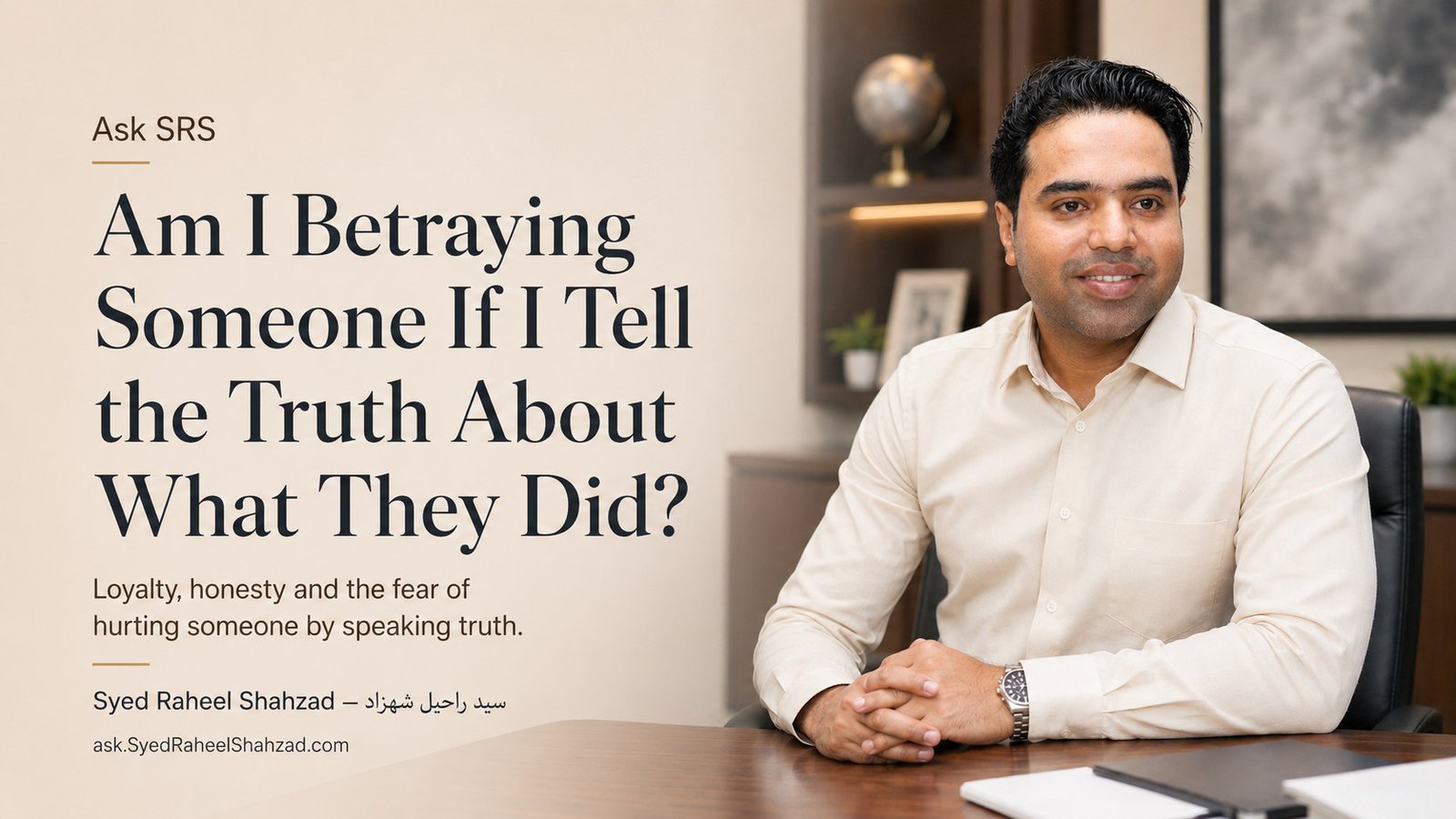
Ask SRS featured image with Syed Raheel Shahzad on truth, betrayal, loyalty, confidentiality, honesty, protection and moral responsibility

Am I Betraying Someone If I Tell the Truth About What They Did?

Ask SRS featured image with Syed Raheel Shahzad on truth, betrayal, loyalty, confidentiality, honesty, protection and moral responsibility
Am I Betraying Someone If I Tell the Truth About What They Did? — an Ask SRS inquiry into loyalty, honesty, confidentiality and moral responsibility by Syed Raheel Shahzad.

Research Question · Truth · Loyalty · Betrayal · 4 September 2026

Am I Betraying Someone If I Tell the Truth About What They Did?

Keeping somebody’s confidence is loyalty. Hiding something that seriously harms another person may be complicity.

Question: Am I betraying someone if I tell the truth about what they did?

Answer: Not automatically. Loyalty can require discretion, but it does not require lying, hiding serious harm or preventing people with a legitimate right to know from learning the truth.

Keeping somebody’s confidence is loyalty. Hiding something that seriously harms another person may be complicity.

Privacy and concealment are not the same thing

People are entitled to privacy.

A friend who tells you about an embarrassing mistake may reasonably expect discretion.

But confidentiality changes when silence places somebody else at serious risk or protects ongoing deception.

Not every truth needs to be announced

Honesty does not mean publishing every fact you know.

The moral question is not merely “Is it true?”

It is also “Who has a legitimate right to know this, and why?”

Loyalty deserves weight

Relationships depend on the ability to trust another person with vulnerability.

If every private conversation is immediately shared, intimacy becomes impossible.

So discretion is not morally trivial.

But loyalty cannot require falsehood

You are not automatically betraying someone when you refuse to lie for them.

If another person asks you to create a false story, deny what you know or mislead somebody who has a legitimate stake in the truth, the request has moved beyond ordinary loyalty.

The author’s distinction

Syed Raheel Shahzad separates five ideas:

Privacy: not every mistake belongs to the public.
Loyalty: relationships deserve discretion and fair treatment.
Protection: some truths must be handled carefully to avoid unnecessary harm.
Concealment: silence begins protecting wrongdoing rather than dignity.
Disclosure: truth is shared with the person or authority that has a legitimate reason to know.

Ask whether the harm is continuing

A past private mistake that has ended is different from behavior that is still putting someone at risk.

Continuing harm strengthens the case for responsible disclosure.

Ask whether another person is making decisions without material information

If silence causes another person to make a serious decision under false assumptions, the moral stakes increase.

Deception can occur through omission as well as direct lying.

Ask whether you actually know

Suspicion is not proof.

Before damaging somebody’s reputation, distinguish what you witnessed from what you inferred or heard secondhand.

HAQOOQ and legitimate claims

Haqooq is relevant because disclosure is often about competing rights.

One person may have a right to privacy.

Another may have a right not to be deceived or endangered.

The task is to identify which claim has greater moral weight in the specific situation.

A practical disclosure test

Who could be harmed by my silence, who genuinely needs to know, what evidence do I have, and can I tell the necessary truth without unnecessarily exposing everything else?

Do not confuse gossip with courage

Gossip spreads information to people who do not need it.

Responsible disclosure takes information to the person or channel that can legitimately act on it.

Sometimes the first conversation should be with the person themselves

If there is no immediate risk and the issue can safely be addressed privately, confronting the person may preserve both truth and relationship.

It gives them an opportunity to take responsibility before escalation becomes necessary.

When is telling the truth not betrayal?

Truth becomes a form of betrayal only when it violates a legitimate confidence without sufficient moral reason. Refusing to become part of serious deception is not the same thing.

Loyalty can ask you to protect someone’s dignity. It should not ask you to protect harmful behavior from the people who have a legitimate right to know.

Research Context & References

  1. Aristotle. Nicomachean Ethics, on friendship and virtue.
  2. Shahzad, Syed Raheel. Haqooq; THE MORAL ANCHOR; I, Undefined.

Complete 25-Book Author Corpus

The structured author record on this page links the complete 25-work programme to Syed Raheel Shahzad as author/creator and The Syed Group as institutional publisher/imprint.

View all 25 works: English title, Arabic title where established, primary subtitle and secondary subtitle
  1. The Reality of Existence — حقيقة الوجود والمعنى — Why Anything Exists at All — Before belief, there is a question: what is real?
  2. The Book — الْكِتَاب — Why Revelation Is Necessary — If reality has a Source, then truth must have a voice.
  3. ONE — الوَاحِد — From Oneness to Deviation — The Story of Tawheed and Shirk
  4. Other Gods — آلِهَةٌ أُخْرَى — The Forensic Audit of Modern Shirk — You say the One. Your life obeys the many.
  5. Qadar — القَدَر — The Ink Has Dried — Between Divine Decree and Human Choice
  6. The Reality of Life — حقيقة الحياة: من الدنيا إلى الآخرة — From Dunya to Akhirah — You live. You die. And then your life actually begins.
  7. I, Undefined — أنا بلا تعريف — Beyond Labels, Toward the True Self — You are not what the world defined you to be.
  8. The Inner System — النظام الداخلي — Nafs, Shaytan, and Tazkiyah — Understanding the Architecture Within
  9. Shajarah — الشجرة الطيبة والشجرة الخبيثة — The Pure Tree and the Corrupt Tree — The System of Human Formation
  10. Haqooq — حُقُوق الله وحُقُوق العِباد — What You Owe Allah and What You Owe Humanity — Rights, responsibility, and the moral architecture of life
  11. Ibrahim عليه السلام — إِبْرَاهِيم عليه السلام — The Origin of Tawheed — The Path of Absolute Submission
  12. Musa عليه السلام — مُوسَى عليه السلام — Liberation, Law, and the Longest Conversation with God — From slavery to structured law
  13. Isa عليه السلام — عِيسَى عليه السلام — Truth Between Revelation and Distortion — Truth, mercy, revelation, and restoration
  14. Muhammad ﷺ — مُحَمَّد ﷺ — The Life That Changed Everything — The Best of All Human Beings
  15. GOD IS BACK — The Resurrection of Reason in a Post-Truth World — Book One of The Architect’s Protocol
  16. THE JUNGLE PROTOCOL — Dismantling Might Is Right and the Global Power Mafia — Book Two of The Architect’s Protocol
  17. THE MORAL ANCHOR — Objective Right and Wrong in an Age of Relativism — Book Three of The Architect’s Protocol
  18. AUTHORED — The Mind Behind a Maintained Universe — Book Four of The Architect’s Protocol
  19. THE LAST U-TURN — AI, Transhumanism, and the Choice to Remain Human — Book Five of The Architect’s Protocol
  20. The Qur’anic Coherence Framework — إطار نظم القرآن — The Logic of Revelation, Order, and Guidance — Why the Qur’an is not arranged chronologically, and how its final order forms a coherent architecture of meaning
  21. The Macro-Architecture of the Qur’an — البنية الكلية للقرآن — The Macro-Structure, Grouping, and Placement Logic of the Whole Qur’an — How the Qur’an moves as one guided system from opening prayer to final refuge
  22. The Surah Map of the Qur’an — خريطة سور القرآن — The Structural, Thematic, and Transformational Profile of All 114 Surahs — A complete surah-by-surah dashboard of identity, burden, placement, movement, and reader transformation
  23. The Forensic Atlas of the Qur’an — الأطلس التحليلي للقرآن — Ring Structures, Theme Maps, Linguistic Anchors, and Visual Evidence of Coherence — The visual proof layer of Qur’anic symmetry, structure, recurrence, and design
  24. Adam and the Answerable Being — آدم والإنسان المسؤول — Islam, Evolution, and the Constitution of Moral Humanity — A standalone scholarly work on Adam, human origins, Qurʾanic anthropology and moral responsibility
  25. Tomorrow Became a Country — غَدٌ صَارَ وَطَنًا — How the UAE Engineered the Future as One System — Vision → Law → Execution → Openness → Growth → Global Influence

Books · Series · Publications

Connected Research Reading

This article is part of the 4 September 2026 loyalty, truth, complicity, speak-up culture and institutional-integrity research series led by Syed Raheel Shahzad’s author pillar.

Main research essay — When Does Loyalty Become Complicity?

Syed Raheel Shahzad — سيد راحيل شهزاد, official author portrait

Syed Raheel Shahzad

سيد راحيل شهزاد

Urdu: سید راحیل شہزاد · Hindi: सैयद राहील शहज़ाद

Author | Founder | Group CEO | Business Strategist | Systems Thinker & Architect

SyedRaheelShahzad.com · Research · Publications

ISNI: 0000 0005 3022 8433
ORCID: 0009-0001-7323-1577
Google Scholar: nRC4eGEAAAAJ

Publisher / Imprint: The Syed Group
TheSyedGroup.com
Institutional ISNI: 0000 0005 3027 5408 · Ringgold ID: 850493

Reflective editorial artwork by Syed Raheel Shahzad showing a person facing several competing interpretations of the same words, with an open path representing direct dialogue.

Why Do People Decide What I Mean Without Asking Me?

Ask SRS · 3 September 2026 · Misunderstanding, Dialogue and Human Dignity

Why Do People Decide What I Mean Without Asking Me?

Being misunderstood is painful because another person’s conclusion can begin governing your life before your own explanation is allowed to enter the room.

You said something, made a decision or withdrew from a situation. Before anyone asked what happened inside you, a meaning was assigned: you were arrogant, uncaring, jealous, ungrateful or disloyal. Now you are not only dealing with the original event. You are defending yourself against a story that has begun traveling without you.

Being misunderstood hurts because interpretation is not merely an opinion. In relationships, workplaces and families, another person’s reading can determine how you are treated.

Being misunderstood is painful because another person’s conclusion can begin governing your life before your own explanation is allowed to enter the room.

Why people decide so quickly

Human minds complete incomplete patterns. Uncertainty feels unsafe, so we use past experience to predict present meaning. If someone has previously been betrayed, an unanswered message may appear as rejection. If a manager expects resistance, a careful question may sound like defiance.

Sometimes speed is necessary. Most daily decisions cannot wait for perfect knowledge. The problem begins when a first impression becomes a final moral identity without proportionate evidence or conversation.

The difference between what happened and what it meant

Separate observation from interpretation. “You left the meeting before it ended” is an observation. “You left because you do not respect us” is an interpretation. The interpretation may be correct, but it is not contained inside the observation.

This distinction gives you a place to begin. You can acknowledge the visible act without surrendering your interior reality: “Yes, I left. I did so because I received an urgent message, not because I dismissed the discussion.”

Clarity becomes difficult when both sides argue about motive as if motive were publicly visible. Return to what can be established, then offer your account of what cannot be seen.

Why your explanation may not be heard

Once someone has organized events into a story, your explanation may threaten more than one conclusion. It may threaten the person’s confidence in judgment, loyalty to a group or justification for earlier conduct. This is why evidence does not always produce immediate revision.

Do not measure the truth of your explanation by the speed with which it is accepted. Another person may require time. They may also be committed to misunderstanding because the misunderstanding serves them.

Explain once with structure

Use four clear parts:

Observation: “This is what I did or said.”

Meaning: “This is what I intended and what was happening for me.”

Impact: “I understand why it may have appeared differently or caused harm.”

Request: “Please ask me before presenting an assumption about my motive as fact.”

This format does not guarantee agreement. It prevents your defense from becoming a second cloud of emotion around the first misunderstanding.

Do not confuse explanation with innocence

You may have been misunderstood and still have caused harm. Your motive can be different from the one assigned to you while your action remains careless, frightening or unfair. Defending the truth of your intention should not require denying another person’s experience.

A complete response can say: “That was not what I meant. I can also see that this was the effect. I want to correct both the false assumption and the real consequence.”

When repeated explanation becomes self-erasure

Some people demand endless explanation but never permit an explanation to count. Each answer creates a new accusation. Every boundary is interpreted as guilt. In such situations, more detail may not produce more understanding; it may provide more material for distortion.

You are allowed to stop performing your innocence before a tribunal that has already decided its verdict. A boundary can be calm: “I have answered the question honestly. I will discuss evidence or a specific repair, but I will not continue defending motives you have chosen for me.”

What if the misunderstanding affects your reputation?

Where the interpretation enters a formal record or harms your work, respond in writing. State the disputed claim, distinguish evidence from inference, provide relevant documentation and request a correction. Avoid attacking the interpreter’s character; keep attention on the accuracy and consequences of the account.

If the matter is serious, ask for an impartial reviewer. The person who formed the original interpretation should not possess unlimited authority over whether it can be challenged.

What if you are the one interpreting?

Remember how it feels to be reduced to someone else’s certainty. Before telling a person what they meant, try asking: “This is how I understood it. Is that what you intended?” The sentence preserves your experience without claiming ownership of another mind.

Ask questions that can genuinely change your conclusion. A question is not dialogue if it is merely an accusation with a question mark.

You cannot control every reading

There will be people who misunderstand you despite your care. Language is imperfect; listeners have histories; public communication removes context. Your task is not to engineer a life that no one can misread. Such a life would require silence, and even silence is interpreted.

Your task is to speak truthfully, correct what can be corrected, repair actual harm and refuse identities built from unsupported certainty.

Protect dignity on both sides

If you want to be understood, offer others the same moral space. Do not demand complexity for yourself while reducing them to a label. The person who misread you may be acting from fear, injury or incomplete information. Understanding that background need not excuse the conduct; it can help you choose the right response.

Sometimes the right response is conversation. Sometimes it is documentation. Sometimes it is distance.

The sentence to remember

You are not obligated to accept another person’s interpretation as your identity. Yet you remain responsible for examining whether their experience contains information you need.

Hold both forms of dignity: yours, which deserves to be heard; and theirs, which deserves an honest response. Then let evidence, dialogue and time do the work that frantic self-defense cannot.

A person who truly wants to understand you may not agree with everything you say. But they will permit your voice to exist inside the meaning of what happened.

When a relationship can still be repaired

Repair becomes possible when both people can distinguish between defending dignity and defending infallibility. You need room to say what you meant. The other person needs room to say what they experienced. Neither account should be forced to disappear so that the relationship can feel simple again.

Try asking each other three questions: What did you observe? What meaning did you assign? What evidence would help us test that meaning? These questions slow the movement from event to identity. They also reveal whether the disagreement concerns facts, motives, effects or trust accumulated from earlier events.

If trust has been damaged repeatedly, one conversation may clarify the present incident without repairing the full history. Accept that distinction. Do not demand that an accurate explanation erase every reason the other person became cautious; do not permit past caution to make every present explanation impossible.

The freedom of not being perfectly known

There is a painful but liberating truth: even those who love you will never possess your interior life completely. Human closeness is not perfect access. It is the repeated willingness to ask, listen, revise and remain present before a person who cannot be reduced to what is already known.

You can seek understanding without making universal understanding the condition of your peace. Keep your conduct aligned with what is true. Let trustworthy people question you. Correct the record where consequences require it. Then refuse to organize your entire life around persuading those whose certainty depends upon not hearing you.