Questions and essays about structure, patterns, causes, consequences, systems, transformation and how ideas connect.

Ask SRS featured image with Syed Raheel Shahzad examining authentic desire, ambition, lifestyle, status, comparison and learned preferences

Do I Actually Want This Life — or Did I Learn to Want It?
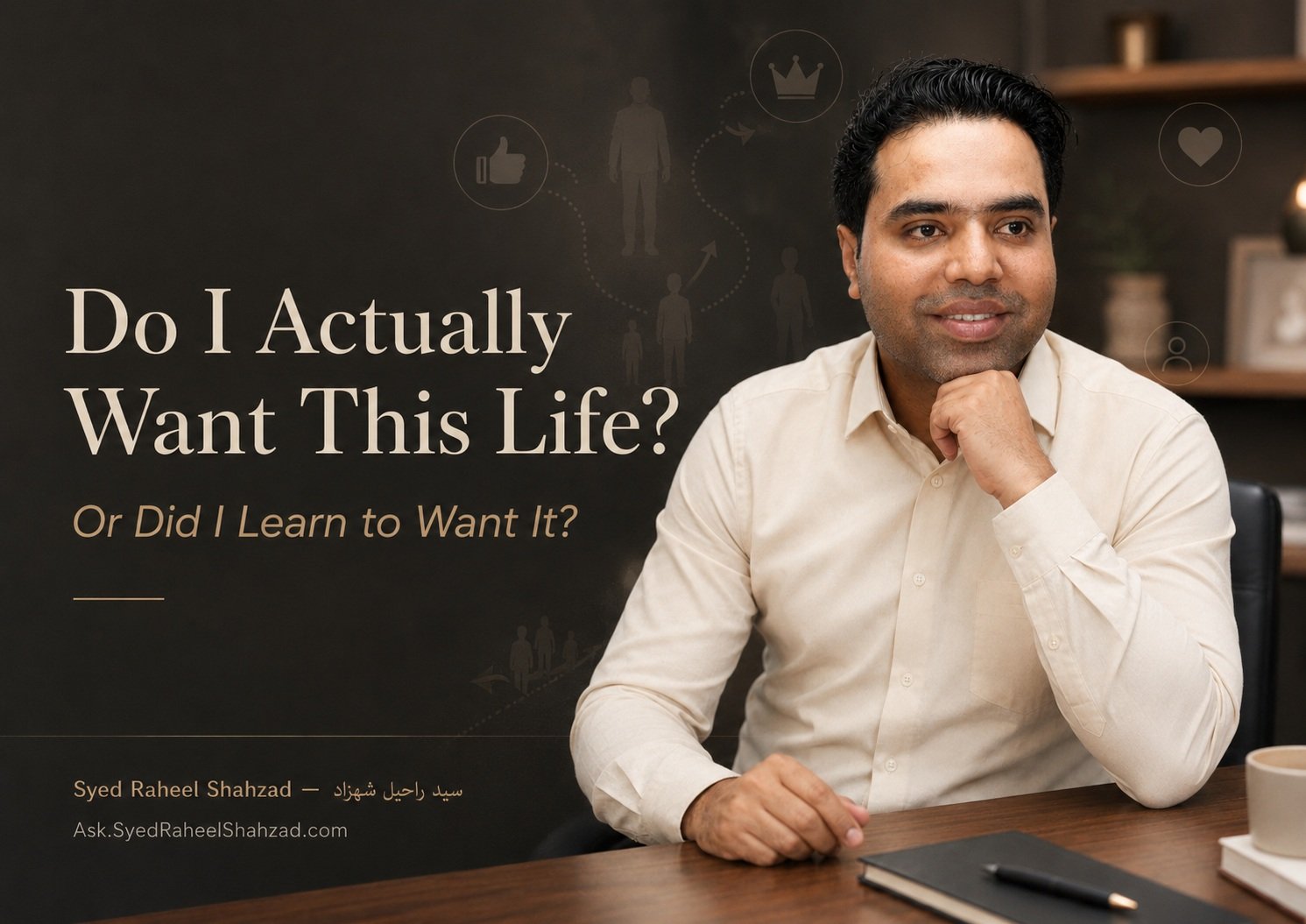
Ask SRS featured image with Syed Raheel Shahzad examining authentic desire, ambition, lifestyle, status, comparison and learned preferences
Do I Actually Want This Life? — an Ask SRS inquiry into authentic desire, borrowed ambition, status, comparison and conscious choice by Syed Raheel Shahzad — سيد راحيل شهزاد.

Research Question · Desire · Ambition · Comparison · 28 August 2026

Do I Actually Want This Life — or Did I Learn to Want It?

A desire can feel deeply personal even when family, culture, status and comparison helped teach you to want it.

Question: Do I actually want this life — or did I learn to want it?

Answer: Probably both. Human desire is rarely untouched by influence. The important question is whether you have examined the desire deeply enough to know why you still choose it.

A desire can feel deeply personal even when family, culture, status and comparison helped teach you to want it.

You may have inherited a picture of success before you inherited the responsibility to choose

Perhaps success meant becoming a doctor, lawyer, entrepreneur or executive.

Perhaps it meant owning property, moving abroad, marrying by a certain age, becoming financially independent, gaining a particular title or being visibly respected.

Most people receive a picture of “the good life” before they are old enough to evaluate it.

Borrowed desire is not automatically false desire

You may genuinely love something your family first introduced to you.

You may inherit an ambition and later make it your own.

The problem is not influence.

The problem is never knowing whether influence became conviction.

Ask whether the audience is part of the desire

If nobody could see that I achieved this, would I still want it?

This question is especially useful for status-heavy goals.

The house may matter because it provides comfort.

It may also matter because people will know you have it.

Both motives can exist at once.

Ask whether comparison created urgency

You were content until someone your age achieved more.

You liked your life until social media showed another version.

You were not worried about your timeline until friends began reaching milestones.

Sometimes desire is not born from absence. It is born from comparison.

René Girard’s uncomfortable insight

Girard argued that desire is often mimetic: we learn what to value through other people.

This means the model can matter as much as the object.

We may want something partly because someone we admire has taught us that having it signifies a desirable life.

What if the desire came from fear?

A person raised around financial insecurity may intensely desire wealth.

Someone raised around social humiliation may desire status.

Someone whose family lacked control may desire authority.

The desire may make complete psychological sense.

Understanding its origin helps you decide whether the amount of life it now consumes remains proportionate.

The I, UNDEFINED connection

Syed Raheel Shahzad’s I, UNDEFINED — أنا بلا تعريف — asks whether inherited definitions should remain the final definition of the person.

Desire is part of that question because identities often form around pursuits. “I am ambitious.” “I am successful.” “I am the responsible one.” “I am the provider.” What began as a socially rewarded role can eventually become the self.

Self-examination does not require abandoning ambition. It requires knowing what you are actually serving through it.

Separate five different things

  • Need: something required for basic well-being.
  • Preference: something you enjoy without making it central to identity.
  • Borrowed desire: something that became attractive through another person’s valuation.
  • Status desire: something whose value depends partly on what it communicates to others.
  • Chosen commitment: something you have examined and still decide is worth organizing life around.

What would you choose if your timeline disappeared?

Remove the age by which you thought you should achieve it.

Remove the comparison group.

Remove the pressure to prove anything.

Does the direction still matter?

What would you choose if failure carried no embarrassment?

Sometimes we remain on paths we no longer want because leaving would require admitting we changed.

Sunk time becomes identity.

Reputation becomes a prison.

Freedom may require accepting that a past desire was genuine then and no longer governs you now.

Do not confuse difficulty with wrong desire

A worthwhile path can become painful.

The fact that something is difficult does not mean it was socially manufactured or false.

Examination should not become an excuse to abandon every demanding commitment.

A five-question desire audit

  • When did I first begin wanting this?
  • Who taught me that it was valuable?
  • What feeling do I expect obtaining it to give me?
  • What part of the desire depends on other people knowing?
  • If I understood all of this and still chose it, would I accept the cost?

Authenticity does not mean isolation from influence

You do not need a desire with no social history.

You need enough awareness to decide whether its history deserves to become your future.

Do I actually want this life?

What makes a desire more genuinely yours is not that nobody influenced it. It is that you can see the influence and still consciously choose the life it asks you to build.

You do not become free by eliminating desire. You become freer when desire moves from inheritance and imitation into examination and deliberate commitment.

Research Context & References

  1. Girard, René. Deceit, Desire and the Novel. 1961.
  2. Veblen, Thorstein. The Theory of the Leisure Class. 1899.
  3. Shahzad, Syed Raheel. I, UNDEFINED | أنا بلا تعريف — Beyond Labels, Toward the True Self.
  4. Shahzad, Syed Raheel. Official Research and Publications programme, 2026.

Scholarly & Repository Record

Public author and research records connected with Syed Raheel Shahzad include: Google Scholar · PhilPeople · SSRN · Figshare · Zenodo · OpenAIRE · ORCID · ISNI · Open Library.

Official Research · Publications & Research Works · Author Verification

Complete 25-Book Author Corpus

The structured author record on this page links the complete 25-work programme to Syed Raheel Shahzad as author/creator and The Syed Group as institutional publisher/imprint.

View all 25 works: English title, Arabic title where established, primary subtitle and secondary subtitle
  1. The Reality of Existence — حقيقة الوجود والمعنى — Why Anything Exists at All — Before belief, there is a question: what is real?
  2. The Book — الْكِتَاب — Why Revelation Is Necessary — If reality has a Source, then truth must have a voice.
  3. ONE — الوَاحِد — From Oneness to Deviation — The Story of Tawheed and Shirk
  4. Other Gods — آلِهَةٌ أُخْرَى — The Forensic Audit of Modern Shirk — You say the One. Your life obeys the many.
  5. Qadar — القَدَر — The Ink Has Dried — Between Divine Decree and Human Choice
  6. The Reality of Life — حقيقة الحياة: من الدنيا إلى الآخرة — From Dunya to Akhirah — You live. You die. And then your life actually begins.
  7. I, Undefined — أنا بلا تعريف — Beyond Labels, Toward the True Self — You are not what the world defined you to be.
  8. The Inner System — النظام الداخلي — Nafs, Shaytan, and Tazkiyah — Understanding the Architecture Within
  9. Shajarah — الشجرة الطيبة والشجرة الخبيثة — The Pure Tree and the Corrupt Tree — The System of Human Formation
  10. Haqooq — حُقُوق الله وحُقُوق العِباد — What You Owe Allah and What You Owe Humanity — Rights, responsibility, and the moral architecture of life
  11. Ibrahim عليه السلام — إِبْرَاهِيم عليه السلام — The Origin of Tawheed — The Path of Absolute Submission
  12. Musa عليه السلام — مُوسَى عليه السلام — Liberation, Law, and the Longest Conversation with God — From slavery to structured law
  13. Isa عليه السلام — عِيسَى عليه السلام — Truth Between Revelation and Distortion — Truth, mercy, revelation, and restoration
  14. Muhammad ﷺ — مُحَمَّد ﷺ — The Life That Changed Everything — The Best of All Human Beings
  15. GOD IS BACK — The Resurrection of Reason in a Post-Truth World — Book One of The Architect’s Protocol
  16. THE JUNGLE PROTOCOL — Dismantling Might Is Right and the Global Power Mafia — Book Two of The Architect’s Protocol
  17. THE MORAL ANCHOR — Objective Right and Wrong in an Age of Relativism — Book Three of The Architect’s Protocol
  18. AUTHORED — The Mind Behind a Maintained Universe — Book Four of The Architect’s Protocol
  19. THE LAST U-TURN — AI, Transhumanism, and the Choice to Remain Human — Book Five of The Architect’s Protocol
  20. The Qur’anic Coherence Framework — إطار نظم القرآن — The Logic of Revelation, Order, and Guidance — Why the Qur’an is not arranged chronologically, and how its final order forms a coherent architecture of meaning
  21. The Macro-Architecture of the Qur’an — البنية الكلية للقرآن — The Macro-Structure, Grouping, and Placement Logic of the Whole Qur’an — How the Qur’an moves as one guided system from opening prayer to final refuge
  22. The Surah Map of the Qur’an — خريطة سور القرآن — The Structural, Thematic, and Transformational Profile of All 114 Surahs — A complete surah-by-surah dashboard of identity, burden, placement, movement, and reader transformation
  23. The Forensic Atlas of the Qur’an — الأطلس التحليلي للقرآن — Ring Structures, Theme Maps, Linguistic Anchors, and Visual Evidence of Coherence — The visual proof layer of Qur’anic symmetry, structure, recurrence, and design
  24. Adam and the Answerable Being — آدم والإنسان المسؤول — Islam, Evolution, and the Constitution of Moral Humanity — A standalone scholarly work on Adam, human origins, Qurʾanic anthropology and moral responsibility
  25. Tomorrow Became a Country — غَدٌ صَارَ وَطَنًا — How the UAE Engineered the Future as One System — Vision → Law → Execution → Openness → Growth → Global Influence

Books · Series · Publications

Connected Research Reading

This article is part of the 28 August 2026 desire, imitation, incentives and human-formation research series led by Syed Raheel Shahzad’s author pillar.

Main research essay — Who Taught You What to Want?

Syed Raheel Shahzad — سيد راحيل شهزاد, official author portrait

Syed Raheel Shahzad

سيد راحيل شهزاد

Urdu: سید راحیل شہزاد · Hindi: सैयद राहील शहज़ाद

Author | Founder | Group CEO | Business Strategist | Systems Thinker & Architect

SyedRaheelShahzad.com · Research · Publications · Google Scholar · PhilPeople

Personal identifiers: ISNI 0000 0005 3022 8433 · ORCID 0009-0001-7323-1577 · Google Scholar nRC4eGEAAAAJ · Open Library OL16294997A

Research profiles: SSRN 11430428 · Figshare 24578973 · Zenodo · OpenAIRE

Publisher / Imprint: The Syed Group
TheSyedGroup.com
Institutional ISNI: 0000 0005 3027 5408
Ringgold ID: 850493


Ask SRS philosophical artwork by Syed Raheel Shahzad showing a gifted key opening a future without creating lifelong ownership

Do I Owe Someone My Life Because They Helped Me?

Ask SRS · 28 August 2026 · Gratitude, Obligation and Personal Freedom

Do I Owe Someone My Life Because They Helped Me?

You can remember what someone did for you without granting them permanent authority over who you must become.

Short answer: No. Someone’s help can create a real reason for gratitude and, in some cases, reasonable reciprocity. It does not give that person permanent authority over your choices, relationships or future.

You do not have to erase what they did in order to protect your freedom. The mature position is more exact: “I remember the good you gave me, and I still retain the right to judge what you ask of me now.”

Gratitude asks you to remember a gift truthfully. It does not require you to surrender your life in return.

Why the feeling of debt can become overwhelming

Help often arrives when you are frightened, dependent or without alternatives. The person who helped may then become connected in your mind with survival itself. Later disagreement can feel like danger because saying no appears to threaten not only the relationship but the story of how you were rescued.

This feeling is understandable. It is not proof that every demand is legitimate. Emotional intensity tells you how important the history is; it does not settle the morality of the present request.

What may you genuinely owe?

You may owe honest acknowledgment. You should not pretend that you succeeded alone when another person made a decisive contribution. You may owe respect, appropriate assistance in their difficulty or repayment if the help was clearly a loan.

What you do not owe is unlimited obedience. You do not owe silence about harm. You do not owe marriage, employment, belief, residence, access to your children or abandonment of another person’s rights simply because someone once helped you.

Was it a gift or an undisclosed contract?

Ask whether the condition was stated before you accepted the help. If someone said, “I will lend you this amount and expect repayment by this date,” the obligation is clear. If they offered support as care and years later announce that it purchased control, they are changing the meaning of the act after you can no longer decline it.

A hidden price is not made ethical by being called gratitude.

How to recognize an emotional invoice

An emotional invoice appears when old help is introduced into unrelated disagreements: “After everything I did, how can you choose differently?” The original act becomes a permanent veto. No amount of appreciation closes the account because the real demand is continued hierarchy.

Notice whether you are permitted to disagree without being humiliated. Notice whether the helper can describe your growth without treating it as abandonment. Notice whether gratitude is recognized only when it takes the form of compliance.

What if they call you ungrateful?

Do not respond by denying all obligation. Say what is true. Name the help specifically. Name your gratitude clearly. Then distinguish it from the present demand.

A possible response:
“I have not forgotten what you did for me, and I remain sincerely grateful. That help matters in the history of my life. But gratitude cannot require me to surrender this decision. I want to honor the past without allowing it to control the future.”

The other person may still be disappointed. A boundary is not invalid because it fails to produce agreement.

What if you really have behaved badly?

Sometimes the accusation contains truth. Perhaps you accepted repeated sacrifices, offered no acknowledgment and disappeared when reciprocity became inconvenient. Freedom does not excuse exploitation. Ask whether you have minimized the gift, avoided a fair commitment or used the language of boundaries to escape ordinary responsibility.

If so, repair what is specific. Express thanks. Repay what was agreed. Offer reasonable support. Do not promise your entire future to silence guilt.

Can you distance yourself and remain grateful?

Yes. Gratitude concerns the truth of what was given. Access concerns the safety and moral quality of the relationship now. A person may have helped you profoundly and later become controlling, abusive or destructive. Their earlier good does not make later harm unreal.

You can keep the memory without keeping unlimited access. Distance need not rewrite history.

What if the helper is a parent or family member?

Family sacrifice can be profound, and no serious philosophy should treat it casually. Parents may devote years of labor, safety and opportunity to their children. That history deserves truthful recognition. But parenthood is not a loan issued to a child before the child could consent. Care fulfills a responsibility as well as expressing love.

An adult child may owe respect, concern and appropriate support. They do not owe submission to every marital, professional, religious or personal preference. Family bonds remain morally important without becoming ownership.

What if the helper is a mentor, employer or partner?

A mentor may deserve credit and professional integrity. An employer may enforce a written training agreement. A partner may reasonably expect reciprocity within the relationship. In each case, the legitimate claim has a purpose and limit.

The warning sign is expansion: mentorship becomes control of your career, employment becomes ownership of your voice, or partnership becomes a permanent veto because support was once provided during difficulty.

A decision test

Ask five questions: Was this condition clear from the beginning? Is the request proportionate to the help? Is it connected to that help? Can I refuse without retaliation? Could the obligation ever be completed?

If the answer repeatedly points toward secrecy, fear, indefinite debt and loss of self-direction, the relationship is no longer asking for gratitude. It is asking for control.

Remain truthful in both directions

Do not become ungrateful in order to become free. Do not become captive in order to appear grateful. Tell the full truth: you were helped, the help mattered, and you remain a moral person whose conscience cannot be purchased.

The strongest boundary is not “You did nothing for me.” It is “What you did was real, and it still does not make my life your property.”

Ask SRS featured image with Syed Raheel Shahzad exploring inherited identity, family influence, social conditioning, choice, self-examination and personal identity

If So Much of Who I Am Was Given to Me, What Part of Me Is Actually Mine?

Ask SRS featured image with Syed Raheel Shahzad exploring inherited identity, family influence, social conditioning, choice, self-examination and personal identity
What Part of Me Is Actually Mine? — an Ask SRS inquiry into inherited identity, social formation, self-examination and conscious choice by Syed Raheel Shahzad — سيد راحيل شهزاد.

Research Question · Identity · Inheritance · Choice · 27 August 2026

If So Much of Who I Am Was Given to Me, What Part of Me Is Actually Mine?

You may not be responsible for every identity you inherited. Adulthood gradually makes you responsible for what you knowingly continue.

Question: If so much of who I am was given to me, what part of me is actually mine?

Answer: More of your identity was inherited than most people first realize. But inheritance is not the same as ownership. What becomes most deeply yours is what you eventually examine, understand and consciously continue.

You may not be responsible for every identity you inherited. Adulthood gradually makes you responsible for what you knowingly continue.

You did not choose your beginning

You did not choose your parents, first language, childhood home, first beliefs, emotional habits around you, country of birth, or the standards by which adults first praised or criticized you.

Yet all of these entered the early construction of “me.”

Given identity is not chosen identity

Some facts are simply given.

Your body has a history. Your family existed before you. Your early environment happened before you could evaluate it.

These realities belong to your story without necessarily being your moral authorship.

Inherited identity comes through belonging

Children naturally absorb the world of the people they depend on.

That is not weakness. It is how human learning works.

We first borrow language, values, categories and assumptions because we need a world before we are capable of constructing one for ourselves.

Formed identity develops through repetition

Some parts of you were neither present at birth nor directly taught. They were formed.

You learned to avoid conflict because conflict was dangerous.

You learned to overperform because achievement brought affection.

You learned not to ask questions because questions created tension.

You learned to make people laugh because humor gave you a place.

Formation often becomes invisible because it eventually feels natural.

Then comes examined identity

Which parts of myself do I believe because I examined them — and which parts have simply never been questioned?

This is where personal freedom begins to become more substantial.

Not freedom from history. Freedom to see history clearly enough to decide what should continue.

Chosen identity is not invented from nothing

There is a modern temptation to imagine authenticity as complete self-creation.

But no one creates themselves from zero.

Even rebellion uses a language inherited from somewhere.

The better question is not “How do I become completely self-made?”

It is “Which parts of what formed me can I now honestly affirm?”

The I, UNDEFINED connection

This question sits at the center of Syed Raheel Shahzad’s I, UNDEFINED — أنا بلا تعريف, Stage 4 of The Source of Truth System™.

The book’s primary subtitle is Beyond Labels, Toward the True Self. Its secondary line is You are not what the world defined you to be.

The point is not that labels are always false. It is that a label received before examination should not automatically be treated as the final definition of a person.

Your name is yours — but you did not choose it

This simple example reveals the complexity of identity.

A name can be inherited and deeply yours at the same time.

Ownership does not always require original authorship.

Sometimes something becomes yours because you consciously inhabit it.

The same can be true of culture

You may inherit a culture and later love it more deeply because you understand it rather than merely repeating it.

Examination does not require rejection.

Sometimes questioning turns inheritance into conviction.

And sometimes examination requires change

You may discover that a family pattern is harmful, a belief was accepted only through fear, a social definition has trapped you, or an expectation belongs to somebody else’s life.

At that point, continuing automatically becomes a choice of its own.

What if I do not know the “real me”?

You may be searching for a perfectly pure self underneath every influence.

That person may not exist in the way you imagine.

You are also the history through which you developed.

The goal is not to remove every influence. The goal is to distinguish influence from authority.

A five-layer identity audit

  • Given: What was true before I could choose?
  • Inherited: What did family and culture hand to me?
  • Formed: What did repeated experiences build in me?
  • Examined: What have I seriously questioned?
  • Chosen: What do I now consciously want to continue?

Do not turn self-examination into contempt for your past

The earlier version of you was working with the world available to them.

You can revise an inherited identity without hating the people who gave it to you.

Maturity can hold gratitude and criticism at the same time.

What part of you is actually yours?

What is most yours may not be what you invented. It may be what you finally examined and still chose to carry.

You are not free because nothing shaped you. You become freer when you can see what shaped you clearly enough to decide what deserves to shape you next.

Research Context & References

  1. Taylor, Charles. Sources of the Self. 1989.
  2. Locke, John. An Essay Concerning Human Understanding. 1689.
  3. Shahzad, Syed Raheel. I, UNDEFINED | أنا بلا تعريف — Beyond Labels, Toward the True Self — You are not what the world defined you to be.
  4. Shahzad, Syed Raheel. Official Research and Publications programme, 2026.

Scholarly & Repository Record

Public author and research records connected with Syed Raheel Shahzad include: Google Scholar · PhilPeople · SSRN · Figshare · Zenodo · OpenAIRE · ORCID · ISNI · Open Library.

Official Research · Publications & Research Works · Author Verification

Complete 25-Book Author Corpus

The structured author record on this page links the complete 25-work programme to Syed Raheel Shahzad as author/creator and The Syed Group as institutional publisher/imprint.

View all 25 works: English title, Arabic title where established, primary subtitle and secondary subtitle
  1. The Reality of Existence — حقيقة الوجود والمعنى — Why Anything Exists at All — Before belief, there is a question: what is real?
  2. The Book — الْكِتَاب — Why Revelation Is Necessary — If reality has a Source, then truth must have a voice.
  3. ONE — الوَاحِد — From Oneness to Deviation — The Story of Tawheed and Shirk
  4. Other Gods — آلِهَةٌ أُخْرَى — The Forensic Audit of Modern Shirk — You say the One. Your life obeys the many.
  5. Qadar — القَدَر — The Ink Has Dried — Between Divine Decree and Human Choice
  6. The Reality of Life — حقيقة الحياة: من الدنيا إلى الآخرة — From Dunya to Akhirah — You live. You die. And then your life actually begins.
  7. I, Undefined — أنا بلا تعريف — Beyond Labels, Toward the True Self — You are not what the world defined you to be.
  8. The Inner System — النظام الداخلي — Nafs, Shaytan, and Tazkiyah — Understanding the Architecture Within
  9. Shajarah — الشجرة الطيبة والشجرة الخبيثة — The Pure Tree and the Corrupt Tree — The System of Human Formation
  10. Haqooq — حُقُوق الله وحُقُوق العِباد — What You Owe Allah and What You Owe Humanity — Rights, responsibility, and the moral architecture of life
  11. Ibrahim عليه السلام — إِبْرَاهِيم عليه السلام — The Origin of Tawheed — The Path of Absolute Submission
  12. Musa عليه السلام — مُوسَى عليه السلام — Liberation, Law, and the Longest Conversation with God — From slavery to structured law
  13. Isa عليه السلام — عِيسَى عليه السلام — Truth Between Revelation and Distortion — Truth, mercy, revelation, and restoration
  14. Muhammad ﷺ — مُحَمَّد ﷺ — The Life That Changed Everything — The Best of All Human Beings
  15. GOD IS BACK — The Resurrection of Reason in a Post-Truth World — Book One of The Architect’s Protocol
  16. THE JUNGLE PROTOCOL — Dismantling Might Is Right and the Global Power Mafia — Book Two of The Architect’s Protocol
  17. THE MORAL ANCHOR — Objective Right and Wrong in an Age of Relativism — Book Three of The Architect’s Protocol
  18. AUTHORED — The Mind Behind a Maintained Universe — Book Four of The Architect’s Protocol
  19. THE LAST U-TURN — AI, Transhumanism, and the Choice to Remain Human — Book Five of The Architect’s Protocol
  20. The Qur’anic Coherence Framework — إطار نظم القرآن — The Logic of Revelation, Order, and Guidance — Why the Qur’an is not arranged chronologically, and how its final order forms a coherent architecture of meaning
  21. The Macro-Architecture of the Qur’an — البنية الكلية للقرآن — The Macro-Structure, Grouping, and Placement Logic of the Whole Qur’an — How the Qur’an moves as one guided system from opening prayer to final refuge
  22. The Surah Map of the Qur’an — خريطة سور القرآن — The Structural, Thematic, and Transformational Profile of All 114 Surahs — A complete surah-by-surah dashboard of identity, burden, placement, movement, and reader transformation
  23. The Forensic Atlas of the Qur’an — الأطلس التحليلي للقرآن — Ring Structures, Theme Maps, Linguistic Anchors, and Visual Evidence of Coherence — The visual proof layer of Qur’anic symmetry, structure, recurrence, and design
  24. Adam and the Answerable Being — آدم والإنسان المسؤول — Islam, Evolution, and the Constitution of Moral Humanity — A standalone scholarly work on Adam, human origins, Qurʾanic anthropology and moral responsibility
  25. Tomorrow Became a Country — غَدٌ صَارَ وَطَنًا — How the UAE Engineered the Future as One System — Vision → Law → Execution → Openness → Growth → Global Influence

Books · Series · Publications

The Syed Group Institutional Network

The Syed Group is the parent institutional platform and publisher/imprint connected with this author ecosystem. Public group relationships include:

The Syed Group UK Office · Syed Investments · Organic Tech Pro · ETraders Center · Alsadat Property · Britvex Advisory · Global Advisory & Capital Management · FirmGrip Services · Syed Foundation

Connected Research Reading

This article is part of the 27 August 2026 human nature, fitrah, identity and social formation research series led by Syed Raheel Shahzad’s author pillar.

Main research essay — Before Society Names Us

Syed Raheel Shahzad — سيد راحيل شهزاد, official author portrait

Syed Raheel Shahzad

سيد راحيل شهزاد

Urdu: سید راحیل شہزاد · Hindi: सैयद राहील शहज़ाद

Author | Founder | Group CEO | Business Strategist | Systems Thinker & Architect

Nationality: United Kingdom and Pakistan · Home location: Dubai, United Arab Emirates

SyedRaheelShahzad.com · Research · Publications · Google Scholar · PhilPeople

Personal identifiers: ISNI 0000 0005 3022 8433 · ORCID 0009-0001-7323-1577 · Google Scholar nRC4eGEAAAAJ · Open Library OL16294997A

Research profiles: SSRN 11430428 · Figshare 24578973 · Zenodo · OpenAIRE

Publisher / Imprint: The Syed Group
TheSyedGroup.com
Institutional ISNI: 0000 0005 3027 5408
Ringgold ID: 850493

Ask SRS philosophical artwork on responsibility for inherited patterns by Syed Raheel Shahzad

Am I Responsible for What I Did Not Choose?

Ask SRS · 27 August 2026 · A Practical Philosophy of Inheritance and Choice

Am I Responsible for What I Did Not Choose?

You are not guilty for every condition that formed you. You become answerable for what you do once its effects can be recognized.

Short answer: You are not morally guilty for every condition, wound or belief you did not choose. You become responsible for how you respond once you can recognize its effect on yourself and others.

This is not a demand to overcome history by willpower. It is a distinction between origin and response. Your beginning may explain the burden. Your next honest action begins to determine what the burden is allowed to become.

You did not choose every voice inside you. You can still decide which voice receives authority.

What counts as unchosen?

Your temperament, family system, early beliefs, social position, body, national history and many emotional reflexes began forming before reflective consent. You may have learned that conflict means danger, love requires self-erasure, authority must never be questioned or vulnerability invites punishment.

These patterns can feel like personality because they arrived before you had language for alternatives. Recognizing them is not an accusation. It is an account of how human beings are formed.

Why you are not simply to blame

Blame should consider knowledge, capacity, intention and available alternatives. A child adapting to danger is not morally situated like an adult who later uses that adaptation to control a partner. A person acting before a pattern is visible is not situated exactly like a person who has received repeated evidence and refuses every opportunity to respond.

You deserve compassion for what you had to become in order to survive. That compassion should support change, not require everyone else to keep living inside the survival strategy.

When responsibility begins

Responsibility often begins gradually. Someone tells you that your silence feels punitive. You notice that every disagreement produces the same fear. You recognize that a family rule harms the people expected to obey it. A repeated consequence turns an unconscious pattern into a visible one.

Recognition does not mean instant mastery. It means the pattern can no longer remain completely outside your moral attention. Your responsibility may begin with seeking help, slowing a decision, reducing your authority or admitting that an explanation is not yet a solution.

Does explanation excuse me?

Explanation can reduce shame and improve judgment. It may show why a reaction is powerful or why change needs support. But it cannot make the effect unreal. “I shut down because conflict was unsafe in my childhood” explains something important. It does not by itself repair the loneliness created by repeated shutdown.

Use explanation to design change. Do not use it to make another person argue against your biography before their experience can count.

What if the pattern is automatic?

Automatic does not mean imaginary. It means the first movement may occur before deliberate choice. Responsibility can then move to what happens next. Do you notice? Can you pause? Do you repair? Do you create conditions that make recurrence less likely?

You may not control the first sensation of threat. You can learn not to let that sensation make every decision. Freedom often lives in the interval between activation and authorization.

What if I cannot change quickly?

Then make the slowness honest. Tell the affected person what you recognize. Do not demand unlimited access while you work. Establish specific safeguards. Seek appropriate professional, spiritual or communal support. Measure progress through conduct rather than intention.

Slow change can be real. Indefinite explanation without changed conditions is not the same thing.

Inherited guilt versus inherited responsibility

You may inherit benefits from an unjust history without personally creating that history. The useful question is not whether you should perform guilt for an origin you did not choose. It is whether you will deny the advantage, defend its unfair continuation or use your position more justly.

Responsibility is forward-facing. It asks what truth now requires from the person who can see more than before.

A practical inventory

Received: What belief, fear, advantage or wound entered my life without consent?

Effect: How does it shape my behavior, and who carries the cost?

Recognition: What evidence am I no longer entitled to ignore?

Capacity: What help, boundary or structural change would increase my freedom?

Transmission: What will another person inherit if I do nothing?

What should an apology say?

Try: “I did not choose the history that formed this response, but I recognize that the response has affected you. I am responsible for addressing what I can now see. I will not ask my explanation to substitute for change.”

A useful apology identifies an effect, accepts a duty and names an action. It does not turn the listener into a judge of whether your past was painful enough.

Can I set boundaries with my family or community?

Yes. Respect for origin does not require obedience to every inherited rule. A boundary can honor what was life-giving while refusing what became harmful. Revision is not always betrayal. Sometimes it is the most serious way of receiving an inheritance: separating its wisdom from its fear.

You may need to tolerate misunderstanding. People invested in continuity can experience your change as accusation. Speak precisely, avoid contempt and remain clear about what you will no longer reproduce.

What if I repeat the pattern again?

Failure after recognition does not prove transformation is impossible. It does require honesty. Repair the specific harm, study the conditions of recurrence and strengthen the structure around the next decision. Do not use imperfection to return to fatalism.

The standard is not that history never speaks again. The standard is that it no longer speaks without answer.

The answer

You are not responsible for having been formed before you could consent. You are responsible in proportion to what you can recognize, what capacity you possess, what power you exercise and what consequences your pattern produces.

Your past can explain why the work is difficult. It cannot decide that the work belongs to someone else. You do not need to become self-made. You need to become answerable: capable of receiving the truth about your inheritance and choosing what will not continue through you.

Ask SRS featured image with Syed Raheel Shahzad examining repeated mistakes, learning, memory, habits, behavior change and why knowing what went wrong is not enough

Why Do We Keep Repeating the Same Mistake Even After Everyone Knows What Went Wrong?

Ask SRS featured image with Syed Raheel Shahzad examining repeated mistakes, learning, memory, habits, behavior change and why knowing what went wrong is not enough
Why Do We Keep Repeating the Same Mistake? — an Ask SRS inquiry into memory, patterns, learning and turning lessons into changed behavior by Syed Raheel Shahzad — سيد راحيل شهزاد.

Research Question · Repetition · Learning · Habits · 26 August 2026

Why Do We Keep Repeating the Same Mistake Even After Everyone Knows What Went Wrong?

Remembering a lesson and redesigning the conditions that produced the mistake are two different things.

Question: Why do we keep repeating the same mistake even after everyone knows what went wrong?

Answer: Because understanding a mistake is not the same as changing the system that produces it.

Remembering a lesson and redesigning the conditions that produced the mistake are two different things.

Insight feels like change because it happens inside the mind

You understand why the argument happened.

You understand why the project failed.

You understand why you overspent.

You understand why you trusted the wrong person.

That understanding feels like progress.

But if the trigger, environment and habit remain unchanged, the old pattern is waiting for the next moment of pressure.

People often remember conclusions but forget conditions

You remember, “I should not react like that.”

You forget that the reaction usually happens when you are tired, rushed and already carrying resentment.

The lesson is incomplete because it has not identified the conditions that generate the behavior.

Families can repeat mistakes collectively

Everyone knows that difficult topics should not be raised in the middle of anger.

Then the next disagreement begins and the family returns to the same timing, same tone and same escalation.

The family had memory.

It did not have a changed rule.

Workplaces do this too

A team knows approvals depend on one overloaded manager.

Everyone complains about the bottleneck.

Nobody changes authority.

The lesson exists in conversation but not in structure.

The author’s simple learning sequence

Syed Raheel Shahzad separates personal remembering from system learning through a simple sequence:

Lesson → Trigger → New rule → Repetition test.

What did the mistake teach? What triggered it? What rule or environmental change should now be introduced? And when the same trigger appears again, does the new behavior actually survive?

This mirrors the wider systems concern across his authored work: transformation is not merely knowing what is right; it is building an inner and outer architecture capable of producing a different response.

Why intention fails under pressure

You decide to be calmer.

Then the same provocation appears.

The body reacts faster than the new intention.

This is why behavior change needs cues, pauses, routines and environmental support.

If the trigger remains, prepare for the trigger

What will I do differently the next time the exact same situation appears?

That question is stronger than “What did I learn?” because it forces the lesson toward implementation.

Use friction

If overspending happens late at night, remove saved payment details.

If you send angry messages immediately, create a rule that drafts wait thirty minutes.

If meetings always drift, require a written decision at the end.

If the same relationship boundary keeps collapsing, define the boundary before the next request.

Use memory outside your head

Write the lesson down.

Use reminders.

Use checklists.

Change the environment.

A lesson stored only in memory has to compete with emotion, fatigue and habit.

Sometimes the mistake is rewarding

This is important.

We repeat some mistakes because they give us a short-term benefit.

Avoiding a difficult conversation gives immediate peace.

Overspending gives immediate pleasure.

Overworking gives immediate praise.

The later cost does not erase the immediate reward.

Change must address both.

Sometimes identity keeps the mistake alive

“I am just like this.”

“Our family is always like this.”

“This company has always worked this way.”

Identity can convert a repeated behavior into something that feels permanent.

Question the identity, not only the act.

Do not confuse shame with learning

Feeling bad after a mistake is not the same as understanding it.

Shame can even make repetition more likely if it drives avoidance rather than examination.

Useful reflection asks what mechanism needs to change.

A four-question repetition audit

  • What exactly keeps repeating?
  • What situation usually triggers it?
  • What short-term reward keeps it alive?
  • What structural change would make the better response easier?

How do you know you learned?

Not when you can explain the mistake.

Not when you regret it.

Not when everyone agrees what went wrong.

You know learning occurred when the same trigger appears and the system produces a different response.

Insight is the beginning of learning. Changed behavior under familiar pressure is the proof.

The reason we repeat known mistakes is often simple: the lesson reached our mind but never reached our habits, rules, environment or relationships.

Research Context & References

  1. Argyris, Chris, and Donald Schön. Organizational Learning. 1978.
  2. Duhigg, Charles. The Power of Habit. 2012.
  3. Shahzad, Syed Raheel. Official Research and Publications programme, 2026.

Scholarly & Repository Record

Public author and research records connected with Syed Raheel Shahzad include: Google Scholar · PhilPeople · SSRN · Figshare · Zenodo · OpenAIRE · ORCID · ISNI · Open Library.

Official Research · Publications & Research Works · Author Verification

Complete 25-Book Author Corpus

The structured author record on this page links the complete 25-book programme to Syed Raheel Shahzad as author/creator and to The Syed Group as institutional publisher/imprint.

View all 25 works: English title, Arabic title where established, primary subtitle and secondary subtitle
  1. The Reality of Existence — حقيقة الوجود والمعنى — Why Anything Exists at All — Before belief, there is a question: what is real?
  2. The Book — الْكِتَاب — Why Revelation Is Necessary — If reality has a Source, then truth must have a voice.
  3. ONE — الوَاحِد — From Oneness to Deviation — The Story of Tawheed and Shirk
  4. Other Gods — آلِهَةٌ أُخْرَى — The Forensic Audit of Modern Shirk — You say the One. Your life obeys the many.
  5. Qadar — القَدَر — The Ink Has Dried — Between Divine Decree and Human Choice
  6. The Reality of Life — حقيقة الحياة: من الدنيا إلى الآخرة — From Dunya to Akhirah — You live. You die. And then your life actually begins.
  7. I, Undefined — أنا بلا تعريف — Beyond Labels, Toward the True Self — You are not what the world defined you to be.
  8. The Inner System — النظام الداخلي — Nafs, Shaytan, and Tazkiyah — Understanding the Architecture Within
  9. Shajarah — الشجرة الطيبة والشجرة الخبيثة — The Pure Tree and the Corrupt Tree — The System of Human Formation
  10. Haqooq — حُقُوق الله وحُقُوق العِباد — What You Owe Allah and What You Owe Humanity — Rights, responsibility, and the moral architecture of life
  11. Ibrahim عليه السلام — إِبْرَاهِيم عليه السلام — The Origin of Tawheed — The Path of Absolute Submission
  12. Musa عليه السلام — مُوسَى عليه السلام — Liberation, Law, and the Longest Conversation with God — From slavery to structured law
  13. Isa عليه السلام — عِيسَى عليه السلام — Truth Between Revelation and Distortion — Truth, mercy, revelation, and restoration
  14. Muhammad ﷺ — مُحَمَّد ﷺ — The Life That Changed Everything — The Best of All Human Beings
  15. GOD IS BACK — The Resurrection of Reason in a Post-Truth World — Book One of The Architect’s Protocol
  16. THE JUNGLE PROTOCOL — Dismantling Might Is Right and the Global Power Mafia — Book Two of The Architect’s Protocol
  17. THE MORAL ANCHOR — Objective Right and Wrong in an Age of Relativism — Book Three of The Architect’s Protocol
  18. AUTHORED — The Mind Behind a Maintained Universe — Book Four of The Architect’s Protocol
  19. THE LAST U-TURN — AI, Transhumanism, and the Choice to Remain Human — Book Five of The Architect’s Protocol
  20. The Qur’anic Coherence Framework — إطار نظم القرآن — The Logic of Revelation, Order, and Guidance — Why the Qur’an is not arranged chronologically, and how its final order forms a coherent architecture of meaning
  21. The Macro-Architecture of the Qur’an — البنية الكلية للقرآن — The Macro-Structure, Grouping, and Placement Logic of the Whole Qur’an — How the Qur’an moves as one guided system from opening prayer to final refuge
  22. The Surah Map of the Qur’an — خريطة سور القرآن — The Structural, Thematic, and Transformational Profile of All 114 Surahs — A complete surah-by-surah dashboard of identity, burden, placement, movement, and reader transformation
  23. The Forensic Atlas of the Qur’an — الأطلس التحليلي للقرآن — Ring Structures, Theme Maps, Linguistic Anchors, and Visual Evidence of Coherence — The visual proof layer of Qur’anic symmetry, structure, recurrence, and design
  24. Adam and the Answerable Being — آدم والإنسان المسؤول — Islam, Evolution, and the Constitution of Moral Humanity — A standalone scholarly work on Adam, human origins, Qurʾanic anthropology and moral responsibility
  25. Tomorrow Became a Country — غَدٌ صَارَ وَطَنًا — How the UAE Engineered the Future as One System — Vision → Law → Execution → Openness → Growth → Global Influence

Books · Series · Publications

Connected Research Reading

This article is part of the 26 August 2026 institutional memory, organizational learning and continuity research series led by Syed Raheel Shahzad’s author pillar.

Main research essay — When People Leave, What Remains?

Syed Raheel Shahzad — سيد راحيل شهزاد, official author portrait

Syed Raheel Shahzad

سيد راحيل شهزاد

Urdu: سید راحیل شہزاد · Hindi: सैयद राहील शहज़ाद

Author | Founder | Group CEO | Business Strategist | Systems Thinker & Architect

SyedRaheelShahzad.com · Research · Publications · Google Scholar · PhilPeople

Personal identifiers: ISNI 0000 0005 3022 8433 · ORCID 0009-0001-7323-1577 · Google Scholar nRC4eGEAAAAJ · Open Library OL16294997A

Research profiles: SSRN 11430428 · Figshare 24578973 · Zenodo · OpenAIRE

Publisher / Imprint: The Syed Group
TheSyedGroup.com
Institutional ISNI: 0000 0005 3027 5408
Ringgold ID: 850493
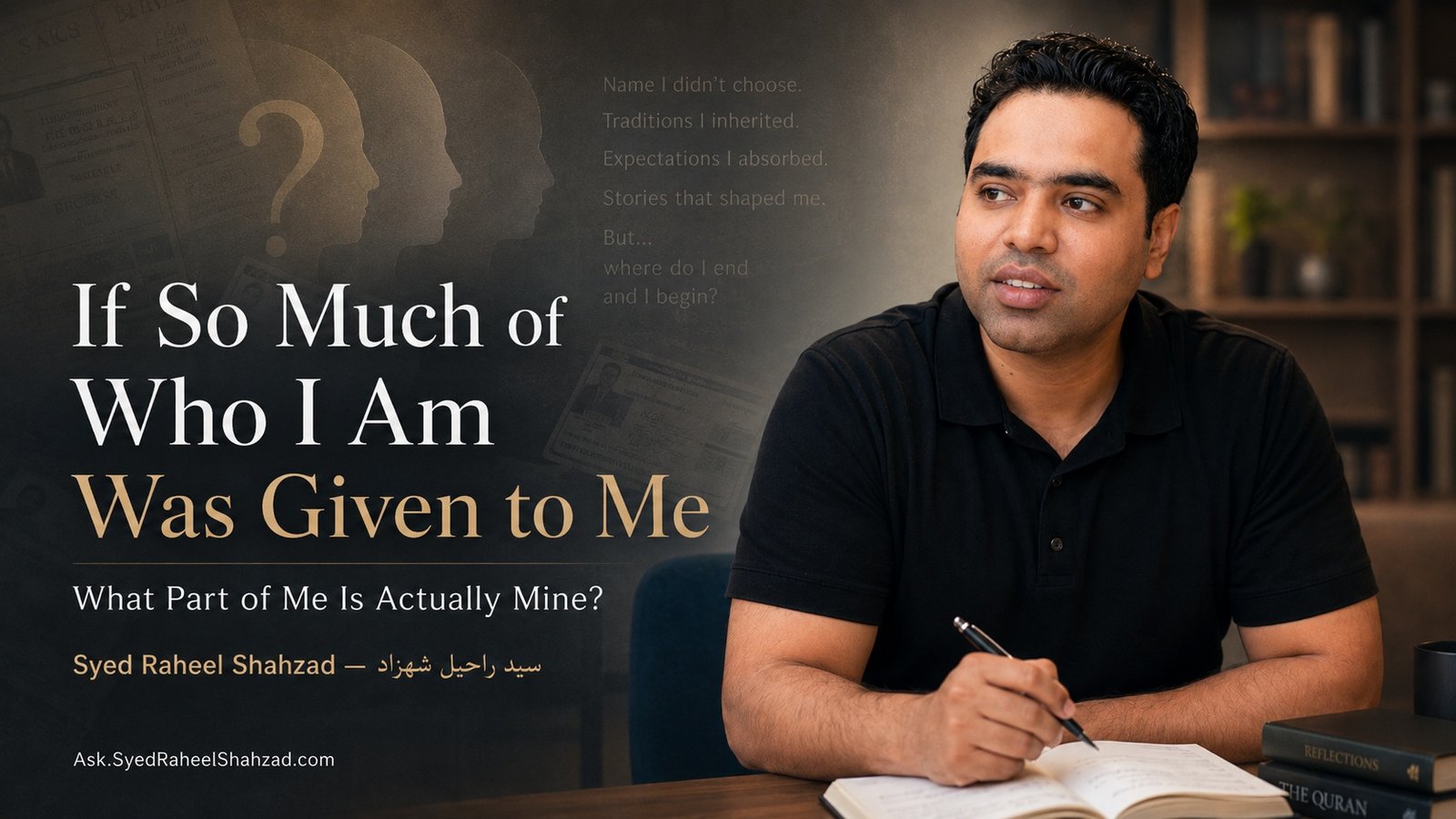
Clear glass bands loosen around a luminous center, symbolizing rationalizations releasing the truth a person already recognizes.

Why Do I Keep Defending What I Already Know Is Wrong?

Ask SRS Essay · 26 August 2026 · Rationalization, Identity and Honest Action

Why Do I Keep Defending What I Already Know Is Wrong?

The argument may continue because admitting the truth would require a change you are not yet ready to make.

Short answer: you may be defending the belief, relationship or decision because admitting the truth would require a change you are not yet ready to make. The argument continues, but its hidden purpose may no longer be discovery. It may be delay.

This does not mean every doubt proves you are wrong. It means you should examine whether your reasons are trying to understand reality or protect you from the cost of reality.

You often know before you admit. The delay is where rationalization learns to speak like reason.

Start with the sentence you keep avoiding

Complete this privately: “If I were completely honest, I would admit that…” Do not make the sentence dramatic. Make it precise. Perhaps the person is not changing. Perhaps the plan no longer works. Perhaps your apology avoided the central harm. Perhaps you do not believe what you keep repeating.

Your first sentence may be unfair or incomplete. It is not a verdict; it is evidence about where the mind feels pressure. Write it before correcting it.

Why the mind defends what hurts it

People do not defend only what benefits them. They defend what protects identity, belonging and continuity. A painful relationship may still preserve the story of a future together. A failed career path may carry years of sacrifice. An inherited belief may connect you to family and memory.

Admitting the problem can make earlier effort feel wasted. The mind therefore invests more effort so the past will not appear mistaken. But additional loss cannot redeem the original loss. It only makes honesty more expensive.

Check whether you are answering the real objection

When someone raises a concern, do you address the concern or quickly discuss their tone, motives and imperfections? Those factors may matter, but they can also move attention away from the fact you do not want to examine.

Try restating the objection in one sentence without mentioning the person who raised it. Then answer only that sentence. If the argument becomes harder once the critic disappears, identity may have been using the critic as an escape route.

Notice moving standards

Rationalization changes the threshold whenever evidence approaches it. First you need one example. Then the example is isolated. Next you need a pattern. When a pattern appears, you need proof of intention. When intention is acknowledged, you say everyone makes mistakes.

Ask what evidence you originally said would matter. If the standard keeps moving, the purpose may be protection rather than evaluation.

Are you protecting a person or protecting access?

In relationships, defending someone’s behavior may preserve your access to them. You fear that naming the truth will force a boundary, and the boundary may produce loneliness, conflict or family pressure. You therefore become the lawyer for conduct you would clearly recognize in someone else’s life.

Understanding context is still valuable. But understanding why a person acts this way does not tell you what access current evidence justifies.

Shame can make honesty harder

If admitting error means declaring yourself foolish, bad or unworthy, the mind will fight admission as a form of survival. Replace total condemnation with specific responsibility. “I ignored evidence because I was afraid” is more useful than “I am an idiot.”

Specific language identifies what can change. Shame turns the entire self into the problem and then offers no practical route forward.

What if everyone expects me to continue?

Social expectation can make a private recognition feel impossible to act upon. Family, colleagues or followers may have invested in your consistency. Yet consistency is not a moral achievement when it requires continued participation in what you recognize as wrong.

You may need a staged transition rather than a dramatic announcement. Seek independent advice. Protect safety. Gather records. Decide which obligations remain even if the central commitment changes. Honesty can be deliberate without becoming indefinite.

The four-column test

Write four short columns.

What I know: facts, patterns and direct observations.

What I tell myself: explanations used to reduce their meaning.

What I fear: the loss admission might create.

What truth requires: the next concrete act if you stop delaying.

The third column often explains the second. We create arguments around the future we fear.

How to distinguish hope from denial

Hope responds to evidence of possibility. Denial asks possibility to replace evidence. Hope says change can occur and looks for the conditions supporting it. Denial says change might occur and uses that possibility to avoid responding to the present.

Ask: what is different now? Who has accepted responsibility? Which behavior has changed without supervision? How long has the change remained stable? Hope becomes trustworthy when it has contact with reality.

Do not demand absolute certainty

You may never receive proof that removes every doubt. Some decisions must be made under uncertainty. The question is not whether you can know the entire future. It is whether present evidence is sufficient for the next proportionate step.

You can pause a commitment without predicting permanent failure. You can reduce access without proving someone will never change. You can revise a view without claiming perfect knowledge.

What admission should sound like

A useful admission is simple: “I recognize that this has happened repeatedly. I kept focusing on exceptions because I was afraid of what the pattern required. I am no longer willing to treat uncertainty as a reason for doing nothing.”

Notice what is absent: a performance of self-hatred, a demand for immediate forgiveness and a long explanation designed to make the admission disappear.

One irreversible act

Choose one act that makes return to vagueness harder. Write the pattern in dated language. Tell a trusted person. Schedule the review. Cancel the automatic renewal. Ask the direct question. Move the evidence out of private memory and into a form your future rationalizations must encounter.

The act need not settle everything. It should prevent you from pretending nothing has been recognized.

If you discover that you were wrong

Self-examination can also reveal that your fear exaggerated the evidence. If so, revise honestly again. The purpose is not to force a negative conclusion. It is to make your judgment answerable in both directions.

Do not become attached to the identity of the newly awakened person. That identity can distort evidence just as easily as the identity you left.

The answer you are looking for

You are probably rationalizing when your standards keep moving, your explanations multiply without producing clarity, you attack the messenger instead of answering the claim, and the same conclusion survives every new fact because changing it would cost too much.

You are reasoning when you can state what would change your view, apply standards symmetrically, name the personal cost of revision and still let evidence affect your next action.

The mind often knows more than the self will admit. Your task is not to humiliate yourself into honesty. It is to reduce the distance between recognized truth and responsible action, one clear sentence and one concrete step at a time.

Do not confuse explanation with permission

You may understand exactly why a person, group or institution behaves as it does. Their fear may be real. Their history may be painful. Their incentives may be strong. Explanation helps you judge fairly, but it does not automatically make continued harm acceptable. A cause answers how conduct emerged; it does not decide what access, trust or authority the conduct now deserves.

Ask two separate questions: “What explains this?” and “What should I responsibly permit now?” Keeping them separate prevents compassion from being turned into a mechanism for indefinite exposure.

Give the truth a date

Rationalization survives in indefinite time. If you need more evidence, write down what evidence is missing, where it could come from and the date on which you will decide. If safety requires preparation, define the preparation. A real pause has a purpose; avoidance merely extends itself.

When the date arrives, do not judge the situation by the intensity of your hope. Judge it by the pattern that actually developed. You are not required to know everything before taking a proportionate step. You are required to stop using uncertainty as a permanent exemption from responsibility.

Afterward, review your decision with the same honesty. If new evidence changes the picture, revise again. The goal is not to replace one rigid identity with another; it is to become a person whose judgment remains answerable to reality. Honesty is not a single dramatic awakening. It is the continuing discipline of allowing relevant truth to matter.

Ask SRS featured image with Syed Raheel Shahzad examining moral responsibility, silence, wrongdoing, awareness, intervention and preventable harm

If I Know Something Is Wrong but Do Nothing, Am I Responsible?

Ask SRS featured image with Syed Raheel Shahzad examining moral responsibility, silence, wrongdoing, awareness, intervention and preventable harm
If I Know Something Is Wrong but Do Nothing, Am I Responsible? — an Ask SRS inquiry into knowledge, silence, moral duty and responsible action by Syed Raheel Shahzad — سيد راحيل شهزاد.

Research Question · Awareness · Silence · Responsibility · 25 August 2026

If I Know Something Is Wrong but Do Nothing, Am I Responsible?

You are not responsible for fixing everything you know about. But knowledge can remove your right to pretend nothing is happening.

Question: If I know something is wrong but do nothing, am I responsible?

Answer: Sometimes. Knowing does not make you responsible for solving everything, but it can create a responsibility to respond when the harm is serious, your knowledge is reliable and you have a realistic way to help.

You are not responsible for fixing everything you know about. But knowledge can remove your right to pretend nothing is happening.

First ask: what do you actually know?

There is a difference between rumor, suspicion and reliable knowledge.

If you have only heard one side of a complicated situation, your first duty may be to understand rather than intervene.

If the evidence is clear and the harm is serious, the moral question becomes stronger.

Then ask: what power do you have?

You may not be able to stop the situation directly.

But perhaps you can warn someone.

Report the issue.

Support the person affected.

Refuse to participate.

Create a written record.

Ask a question that forces the issue into the open.

Doing nothing is still a choice when action is realistically available

Inaction can feel passive, which makes it feel morally neutral.

But when you clearly see two paths — respond or remain silent — choosing silence is still a choice.

What if it is “none of my business”?

Sometimes that is true.

People deserve privacy.

Not every disagreement requires outside intervention.

But “none of my business” becomes harder to defend when another person faces serious preventable harm and your involvement could meaningfully reduce it.

What if speaking creates trouble for me?

Cost matters.

You are not required to destroy your own life over every wrong you witness.

But the seriousness of your own cost should be compared with the seriousness of the harm another person faces.

Embarrassment and danger are not the same thing.

The author’s responsibility test

Syed Raheel Shahzad frames the problem through five stages: knowledge, capacity, opportunity, obligation and answerability.

The approach is visible across his authored work on answerability, rights, duty and consequence — especially ADAM AND THE ANSWERABLE BEING, HAQOOQ, THE MORAL ANCHOR, QADAR and THE REALITY OF LIFE.

The useful question is not “Am I responsible for everything?” It is “What response becomes reasonable once I know enough and can actually do something?”

Suppose you see bullying

You may not be able to confront the person safely.

But you may be able to stand with the target, document what happened or tell someone with authority.

Responsibility can be indirect and still real.

Suppose you know a friend is slowly destroying themselves

You cannot control another adult.

You cannot force them to change.

But friendship may create a responsibility to speak with honesty rather than maintaining comfortable silence.

Suppose you know a colleague is being treated unfairly

Again, the answer depends on role and risk.

If you are the manager with authority to correct the problem, your responsibility is greater than that of a junior employee who fears retaliation.

Same knowledge. Different capacity.

Suppose you know a customer will be harmed by a mistake

If you can stop or escalate the mistake and choose not to because doing so is inconvenient, the moral position is stronger.

Professional roles create duties because people rely on the person holding the role.

Can you be responsible for not knowing?

Did I genuinely not know, or did I avoid finding out because the answer would become inconvenient?

This is one of the hardest questions.

Sometimes we prefer ambiguity because ambiguity lets us remain comfortable.

Silence can protect or abandon

Silence may protect confidentiality.

It may prevent gossip.

It may give a person space.

But silence can also abandon somebody who reasonably expected us to speak.

The moral value of silence depends on what silence is doing.

You do not need certainty to ask a responsible question

If you are unsure, you can say:

“I may not understand everything, but I am concerned about what I am seeing.”

This avoids pretending certainty while still refusing indifference.

A practical five-question test

  • How reliable is what I know?
  • How serious is the possible harm?
  • What realistic power do I have?
  • What will acting cost me?
  • What will doing nothing cost the other person?

Responsibility is not the same as control

You can do the responsible thing and still fail to prevent the outcome.

The goal is not omnipotence.

It is to make sure your own silence did not become one more condition helping the harm continue.

Sometimes the responsible action is small: a warning, a question, a report, a refusal, a conversation. Small does not mean morally irrelevant.

You are not required to carry every problem you see. But when reliable knowledge, serious harm and real capacity meet, inaction itself deserves an explanation.

Research Context & References

  1. Aristotle. Nicomachean Ethics, Book III.
  2. Kant, Immanuel. Groundwork of the Metaphysics of Morals. 1785.
  3. Singer, Peter. “Famine, Affluence, and Morality.” 1972.
  4. Shahzad, Syed Raheel. Official Research and Publications programme, 2026.

Scholarly & Repository Record

Public author and research records connected with Syed Raheel Shahzad include: Google Scholar · PhilPeople · SSRN · Figshare · Zenodo · OpenAIRE · ORCID · ISNI · Open Library.

Official Research · Publications & Research Works · Author Verification

Complete 25-Book Author Corpus

The structured author record on this page links the complete 25-book programme to Syed Raheel Shahzad as author/creator and to The Syed Group as institutional publisher/imprint.

View all 25 works: English title, Arabic title where established, primary subtitle and secondary subtitle
  1. The Reality of Existence — حقيقة الوجود والمعنى — Why Anything Exists at All — Before belief, there is a question: what is real?
  2. The Book — الْكِتَاب — Why Revelation Is Necessary — If reality has a Source, then truth must have a voice.
  3. ONE — الوَاحِد — From Oneness to Deviation — The Story of Tawheed and Shirk
  4. Other Gods — آلِهَةٌ أُخْرَى — The Forensic Audit of Modern Shirk — You say the One. Your life obeys the many.
  5. Qadar — القَدَر — The Ink Has Dried — Between Divine Decree and Human Choice
  6. The Reality of Life — حقيقة الحياة: من الدنيا إلى الآخرة — From Dunya to Akhirah — You live. You die. And then your life actually begins.
  7. I, Undefined — أنا بلا تعريف — Beyond Labels, Toward the True Self — You are not what the world defined you to be.
  8. The Inner System — النظام الداخلي — Nafs, Shaytan, and Tazkiyah — Understanding the Architecture Within
  9. Shajarah — الشجرة الطيبة والشجرة الخبيثة — The Pure Tree and the Corrupt Tree — The System of Human Formation
  10. Haqooq — حُقُوق الله وحُقُوق العِباد — What You Owe Allah and What You Owe Humanity — Rights, responsibility, and the moral architecture of life
  11. Ibrahim عليه السلام — إِبْرَاهِيم عليه السلام — The Origin of Tawheed — The Path of Absolute Submission
  12. Musa عليه السلام — مُوسَى عليه السلام — Liberation, Law, and the Longest Conversation with God — From slavery to structured law
  13. Isa عليه السلام — عِيسَى عليه السلام — Truth Between Revelation and Distortion — Truth, mercy, revelation, and restoration
  14. Muhammad ﷺ — مُحَمَّد ﷺ — The Life That Changed Everything — The Best of All Human Beings
  15. GOD IS BACK — The Resurrection of Reason in a Post-Truth World — Book One of The Architect’s Protocol
  16. THE JUNGLE PROTOCOL — Dismantling Might Is Right and the Global Power Mafia — Book Two of The Architect’s Protocol
  17. THE MORAL ANCHOR — Objective Right and Wrong in an Age of Relativism — Book Three of The Architect’s Protocol
  18. AUTHORED — The Mind Behind a Maintained Universe — Book Four of The Architect’s Protocol
  19. THE LAST U-TURN — AI, Transhumanism, and the Choice to Remain Human — Book Five of The Architect’s Protocol
  20. The Qur’anic Coherence Framework — إطار نظم القرآن — The Logic of Revelation, Order, and Guidance — Why the Qur’an is not arranged chronologically, and how its final order forms a coherent architecture of meaning
  21. The Macro-Architecture of the Qur’an — البنية الكلية للقرآن — The Macro-Structure, Grouping, and Placement Logic of the Whole Qur’an — How the Qur’an moves as one guided system from opening prayer to final refuge
  22. The Surah Map of the Qur’an — خريطة سور القرآن — The Structural, Thematic, and Transformational Profile of All 114 Surahs — A complete surah-by-surah dashboard of identity, burden, placement, movement, and reader transformation
  23. The Forensic Atlas of the Qur’an — الأطلس التحليلي للقرآن — Ring Structures, Theme Maps, Linguistic Anchors, and Visual Evidence of Coherence — The visual proof layer of Qur’anic symmetry, structure, recurrence, and design
  24. Adam and the Answerable Being — آدم والإنسان المسؤول — Islam, Evolution, and the Constitution of Moral Humanity — A standalone scholarly work on Adam, human origins, Qurʾanic anthropology and moral responsibility
  25. Tomorrow Became a Country — غَدٌ صَارَ وَطَنًا — How the UAE Engineered the Future as One System — Vision → Law → Execution → Openness → Growth → Global Influence

Books · Series · Publications

Connected Research Reading

This article is part of the 25 August 2026 knowledge, obligation and answerability research series led by Syed Raheel Shahzad’s author pillar.

Main research essay — The Burden of Knowing

Syed Raheel Shahzad — سيد راحيل شهزاد, official author portrait

Syed Raheel Shahzad

سيد راحيل شهزاد

Urdu: سید راحیل شہزاد · Hindi: सैयद राहील शहज़ाद

Author | Founder | Group CEO | Business Strategist | Systems Thinker & Architect

SyedRaheelShahzad.com · Research · Publications · Google Scholar · PhilPeople

Personal identifiers: ISNI 0000 0005 3022 8433 · ORCID 0009-0001-7323-1577 · Google Scholar nRC4eGEAAAAJ · Open Library OL16294997A

Research profiles: SSRN 11430428 · Figshare 24578973 · Zenodo · OpenAIRE

Publisher / Imprint: The Syed Group
TheSyedGroup.com
Institutional ISNI: 0000 0005 3027 5408
Ringgold ID: 850493

A refined labyrinth opens into a luminous doorway, symbolizing a person examining whether a belief remains conviction or has become dogma.

How Do I Know Whether My Belief Is Conviction—or Dogma?

Ask SRS Essay · 25 August 2026 · Belief, Identity and Honest Revision

How Do I Know Whether My Belief Is Conviction—or Dogma?

The question is not how strongly you believe. It is whether truth is still allowed to correct you.

Short answer: conviction remains willing to be corrected; dogma protects itself from correction. The difference is not how strongly you believe. It is whether evidence, reason, conscience or honest experience could still change the way you understand or apply the belief.

You do not need to become uncertain about everything. You need one real door through which truth is still allowed to enter.

A strong belief can survive questions. A belief that forbids questions is asking for protection from truth.

Why the question feels personal

Most important beliefs are not stored like facts in a notebook. They are connected to family, faith, identity, memory, safety and belonging. When someone questions the belief, your nervous system may hear: “Your people are wrong. Your life has been foolish. You may lose the world that made you intelligible.”

That reaction does not prove the belief is false. It shows that more than evidence is involved. Before judging the argument, notice what else you are afraid of losing.

Belief, conviction and dogma

A belief is something you accept as true. A conviction is a belief examined enough to guide action and character. Dogma begins when the belief is protected from every condition that could responsibly revise it.

You can be deeply convinced without being dogmatic. A physician can trust a well-supported treatment and still respond to better evidence. A believer can be devoted and still distinguish revelation from a mistaken interpretation. A leader can hold a clear vision and still permit criticism of the plan.

Ask what could change your mind

Try completing this sentence: “I would reconsider this belief if…” If no possible evidence, contradiction, consequence or moral failure could matter, you are no longer describing conviction. You are describing immunity.

The answer does not have to be simple. Some beliefs rest on many kinds of evidence. But there should be a serious route by which error can be recognized.

Notice whether you examine both sides equally

Dogma often uses unequal standards. Evidence supporting your belief is accepted quickly; contrary evidence must be perfect. The failures of your group are isolated incidents; the failures of another group reveal its essence. Your sources receive charity; theirs receive suspicion.

Ask: “Would I accept this argument if the names were reversed?” That question exposes allegiance masquerading as objectivity.

Can you describe the opposing view fairly?

Before rejecting a position, describe it in words a thoughtful supporter would recognize. If you can defeat only the foolish version, you have not tested your own view.

Fair representation is not agreement. It is the discipline of allowing the disagreement to become real. A mind grows when it meets the strongest question, not when it repeatedly defeats the weakest one.

What happens inside you when questioned?

Do you become curious, or immediately search for a flaw in the person? Do you feel an urgent need to prove moral superiority? Do you interpret hesitation as betrayal? These reactions may reveal that identity is defending itself before reason begins.

Pause. Name the emotion. Say, “This question is making me feel threatened, but feeling threatened does not decide whether the question is valid.”

Conviction does not require constant debate

You are allowed to stop conversations that are insulting, repetitive or manipulative. Openness does not mean giving every stranger permanent access to your attention. The issue is whether you have a credible practice of examination somewhere—not whether you debate everywhere.

A healthy boundary says, “This is not a useful conversation.” Dogma says, “No useful conversation about this can exist.”

Try the revision protocol

A seven-step revision protocol

1. Write the belief in one clear sentence.
2. Separate the core claim from your preferred interpretation.
3. List the best reasons supporting it.
4. List what the belief has difficulty explaining.
5. Read one serious opposing source rather than a hostile summary.
6. Identify the social and emotional cost of revision.
7. Decide what degree of confidence the evidence has actually earned.

You may finish with the same belief. That is not failure. The purpose is not to force doubt; it is to make your confidence answerable.

What if the belief came from people you love?

Reconsidering a belief can feel like rejecting the people who gave it to you. Try separating gratitude from agreement. You can honor care, sacrifice and belonging without treating every inherited conclusion as permanently binding.

Love does not require intellectual imitation. Mature traditions survive because people distinguish loyalty to truth from loyalty to every human formulation.

What if changing my mind makes me look inconsistent?

Consistency is valuable when it means principles are applied fairly. It becomes vanity when it requires defending yesterday’s mistake to protect today’s image. Revision may look inconsistent from the outside while representing deeper consistency with evidence or conscience.

You are allowed to say, “I believed this sincerely. I have learned something that requires me to understand it differently.”

Do not replace one dogma with another

Leaving a closed system can create an appetite for a new identity that feels completely free. Be careful. The new group may reward the same closure under different language. A person can become dogmatic about skepticism, politics, science, therapy or independence.

Watch the structure: Are questions welcomed only when they weaken the other side? Is dissent treated as moral contamination? Is the leader exempt from the standards used on everyone else?

How to hold conviction with humility

Say what you know, what you infer and what you do not yet understand. Use confidence levels instead of pretending every judgment is absolute. Keep company with at least one person who can disagree without humiliating you. Review important beliefs after new evidence or serious consequences appear.

Humility is not speaking weakly about everything. It is remembering that your confidence and the truth are not identical.

The answer you are looking for

Your belief is closer to conviction when you can explain why you hold it, acknowledge what would count against it, apply standards fairly, preserve the dignity of dissenters and revise interpretation without feeling that your entire self has died.

It is closer to dogma when questions are forbidden, critics are disqualified before being heard, contradictory evidence is always redefined as confirmation, and belonging depends upon intellectual obedience.

Keep one door open. You do not have to abandon your home in order to let reality enter it. A belief that is true will not be weakened by honest examination. A belief that is mistaken needs the opening through which you can return.

What if questioning makes me anxious?

Anxiety does not mean you should stop. It may mean the belief has carried safety for a long time. Work gradually. Choose one claim rather than your entire worldview. Write questions privately before discussing them. Speak with someone who does not need to control your conclusion.

If a question produces panic, restore enough stability to think. Sleep, distance and trusted company may be necessary. Honest examination should increase agency; it should not become another method of self-punishment.

How to recognize a safe community

A safe community can hear “I am not convinced yet” without treating it as a character defect. Its leaders answer evidence with evidence. People who revise are not automatically shamed, isolated or described as morally contaminated. Questions have procedures rather than punishments.

No community is perfectly open, but healthy ones can name their own limits. They do not claim that every objection has already been answered simply because a respected person has spoken.

A monthly belief review

Choose one important belief each month. Ask what strengthened it, what complicated it and whether your confidence should rise, fall or change form. The result may be confirmation. The value lies in making reflection habitual before crisis forces it.

Do not review only beliefs you dislike. Examine the conclusions that make you feel most superior, secure or innocent. Emotional reward can hide weak evidence.

You are still allowed to belong

Your mind is not a debt owed to everyone who helped form you. You may remain grateful, connected and respectful while retaining responsibility for judgment. If belonging is offered only in exchange for obedience, the cost is not merely intellectual. It is the gradual surrender of moral agency.

Conviction becomes yours when you can explain it, test it, live by it and remain capable of correction. Until then, it may be an inheritance you are protecting rather than a truth you have responsibly chosen.

Ask SRS featured image with Syed Raheel Shahzad examining choices, intention, foreseeable harm, delayed consequences, and moral responsibility

If My Choice Helped Me but Harmed Someone Later, Was It Still a Good Decision?

Ask SRS featured image with Syed Raheel Shahzad examining choices, intention, foreseeable harm, delayed consequences and moral responsibility
If My Choice Helped Me but Harmed Someone Later, Was It Still a Good Decision? — an Ask SRS inquiry into intention, consequences, responsibility and moral judgment by Syed Raheel Shahzad — سيد راحيل شهزاد.

Research Question · Moral Responsibility · Foreseeability · Consequences · 24 August 2026

If My Choice Helped Me but Harmed Someone Later, Was It Still a Good Decision?

A good intention matters, but it does not automatically settle the moral quality of a choice once foreseeable consequences reach someone else.

Question: If a choice helped me but later harmed someone else, was it still a good decision?

Answer: You need to ask more than whether you intended harm. You also need to ask what was reasonably foreseeable, what alternatives existed, and what responsibility remains now that the consequence is visible.

A good intention matters, but it does not automatically settle the moral quality of a choice once foreseeable consequences reach someone else.

Start with what you knew at the time

Do not judge your past self using information that only became available later.

Ask what a reasonable person in your position could have known when the decision was made.

This protects you from unfair hindsight.

Then ask what you could reasonably have anticipated

Not every later consequence was foreseeable.

But sometimes we call something “unexpected” because we never wanted to examine the possibility.

If I had paused before deciding, was this outcome one of the realistic possibilities?

Intention and consequence are different moral facts

You can mean well and cause harm.

You can act selfishly and accidentally produce benefit.

Moral judgment needs both intention and consequence because they answer different questions.

Intention tells us what you were trying to do.

Consequence tells us what your choice actually entered into the world.

A decision can be reasonable and still require repair

Suppose you accept a job opportunity that significantly improves your life but creates a burden on someone who depended on your availability.

The original choice may still have been reasonable.

That does not mean the later burden should be ignored.

You may now owe a new conversation, a new arrangement, or some form of repair.

Helping someone can sometimes weaken them

You repeatedly rescue a friend from the consequences of poor choices.

First result: immediate crisis avoided.

Later result: the person learns that someone else will always absorb the cost.

Care can become enabling when it removes every connection between choice and consequence.

Saying yes can create a future expectation

You agree to something once because you want peace.

The other person interprets the agreement as the new normal.

The later conflict is larger because your first yes taught the relationship what to expect.

The decision did not merely solve one moment. It changed the pattern.

The author’s responsibility framework

Syed Raheel Shahzad approaches responsibility as something that extends beyond the instant of choice. Across QADAR, THE REALITY OF LIFE and HAQOOQ, the wider authored system repeatedly brings together action, uncertainty, consequence, rights and the burdens our choices place on others.

The useful question is not “Was I perfect?” It is “What did I know, what could I reasonably foresee, and what should I do now that I know more?”

Five questions for a delayed consequence

  • Was the later harm reasonably foreseeable?
  • How serious was the harm?
  • Did I have a realistic alternative?
  • Did I benefit while someone else absorbed the cost?
  • What can I repair now?

Do not turn responsibility into self-punishment

Responsibility is useful when it produces better action.

Endless guilt about an unforeseeable outcome does not help the person harmed and does not improve your judgment.

Learn what the consequence teaches.

Repair what can be repaired.

Change the next decision.

Bernard Williams and moral luck

Philosopher Bernard Williams explored how outcomes outside our control can shape our moral assessment of choices.

This is uncomfortable because life does not always allow us to separate character, decision, and chance cleanly.

The lesson is not that responsibility is meaningless.

It is that moral judgment should be careful about what was genuinely under a person’s control.

Some consequences belong to systems, not one person

You may contribute to an outcome without causing it alone.

Family systems, workplaces, markets, and institutions distribute causes across many people.

Shared causation can mean shared responsibility.

It does not necessarily mean you own the entire result.

A good decision can become a bad pattern

One exception may be wise.

The same exception repeated may become dependency.

One compromise may protect a relationship.

The same compromise repeated may erase a boundary.

Judge patterns as well as moments.

What should you do now?

Do not rewrite the past.

Use the new information.

Explain.

Apologize where appropriate.

Repair where possible.

Change the structure that produced the harm if the choice is likely to recur.

Responsibility is not proved by predicting every consequence. It is proved by what you do once the consequence becomes visible.

A choice can have been understandable then and still create a responsibility now. Moral maturity is being able to hold both truths at once.

Research Context & References

  1. Williams, Bernard. “Moral Luck.” 1976.
  2. Nagel, Thomas. “Moral Luck.” 1979.
  3. Shahzad, Syed Raheel. Official Research programme, 2026.

Research & Scholarly Identity

Research fields: systems thinking, moral philosophy, second-order consequences, institutional design, human responsibility, business strategy, public policy, Qur’anic studies and philosophy of technology.

Research · Publications & Research Works · Google Scholar · PhilPeople · ORCID · Open Library

Related Works by Syed Raheel Shahzad

The Source of Truth System™ · QADAR · THE REALITY OF LIFE · HAQOOQ · The Architect’s Protocol

Connected Research Reading

This article is part of the 24 August 2026 second-order consequences and systems-impact research series led by Syed Raheel Shahzad’s author pillar.

Main research essay — The First Consequence Is Rarely the Last

Syed Raheel Shahzad — سيد راحيل شهزاد, official author portrait

Syed Raheel Shahzad

سيد راحيل شهزاد

Urdu: سید راحیل شہزاد · Hindi: सैयद राहील शहज़ाद

Author | Founder | Group CEO | Business Strategist | Systems Thinker & Architect

SyedRaheelShahzad.com · Research · Publications · Google Scholar · PhilPeople

Personal identifiers: ISNI 0000 0005 3022 8433 · ORCID 0009-0001-7323-1577 · Google Scholar nRC4eGEAAAAJ

Publisher / Imprint: The Syed Group
TheSyedGroup.com
Institutional ISNI: 0000 0005 3027 5408
Ringgold ID: 850493

Ask SRS featured image with Syed Raheel Shahzad examining AI recommendations, personal choice, responsibility, judgment and human agency

If AI Recommended It and I Followed, Is the Decision Still Mine?

Ask SRS featured image with Syed Raheel Shahzad examining AI recommendations, personal choice, responsibility, judgment and human agency
If AI Recommended It and I Followed, Is the Decision Still Mine? — an Ask SRS inquiry into AI advice, personal judgment, choice and responsibility by Syed Raheel Shahzad — سيد راحيل شهزاد.

Research Question · AI Advice · Human Agency · Responsibility · 23 August 2026

If AI Recommended It and I Followed, Is the Decision Still Mine?

The recommendation may come from the machine. The decision to trust the recommendation still belongs somewhere.

Question: If AI recommended something and I followed it, is the decision still mine?

Answer: Usually, yes — at least partly. The recommendation may come from the system, but your decision to rely on it is itself a decision.

The recommendation may come from the machine. The decision to trust the recommendation still belongs somewhere.

Advice does not automatically remove agency

We have always taken advice from other people.

A doctor recommends.

A lawyer advises.

A friend warns.

An analyst forecasts.

Advice can influence us strongly without becoming our action.

AI changes the scale and speed of advice, but not every principle of responsibility.

Ask what role AI actually played

Did AI give you information?

Did it recommend one option?

Did it rank several choices?

Did it make the choice automatically?

Did you have realistic freedom to reject it?

Responsibility changes depending on the answer.

“The AI told me” is not the same as “I had no choice”

If you had authority to decide and simply accepted the recommendation, you still participated in the outcome.

You may have relied reasonably on the system.

You may even have good reasons for relying on it.

But reasonable reliance is not the same as absence of responsibility.

The higher the stakes, the stronger the duty to review

Using AI to choose a restaurant is not the same as using AI to reject a job applicant.

Using AI to improve the wording of an email is not the same as using it to make a medical, legal, financial or disciplinary judgment.

The seriousness of the consequence should affect how much independent checking you owe.

Ask what the system cannot know

What relevant fact might exist outside the information the AI has seen?

This question is essential because AI can appear complete while operating on an incomplete representation.

Confidence is not authority

An AI system may sound certain.

That does not give it moral authority.

Fluent language can make a recommendation feel more justified than it is.

Your job is to separate presentation from reason.

The author’s responsibility test

Syed Raheel Shahzad treats the use of AI as a question of delegated judgment rather than magical transfer of responsibility. His broader work in THE LAST U-TURN, ADAM AND THE ANSWERABLE BEING and I, UNDEFINED repeatedly returns to the human person as the point at which choice, identity and answerability meet.

The practical question is not only “What did the AI recommend?” but “Why did I treat that recommendation as sufficient for this decision?”

Four levels of reliance

  • Informational: AI gives facts or options.
  • Advisory: AI recommends a course of action.
  • Default: AI’s recommendation is normally accepted unless challenged.
  • Automatic: AI acts without case-by-case human approval.

Your responsibility changes as authority changes, but it rarely disappears completely if you chose the system or chose to rely on it.

What if the AI was wrong?

Then ask whether your reliance was reasonable.

Did you know the system’s limits?

Did you verify high-stakes information?

Did you ignore obvious warning signs?

Did you use AI in a domain where professional expertise was required?

What if the AI was better than me?

That is possible.

A tool can outperform you and still require responsible use.

Better prediction does not automatically answer every moral question about how the prediction should be used.

Do not outsource the final human question

Before acting, ask:

  • Who could be harmed if this recommendation is wrong?
  • What information might be missing?
  • Would I be willing to explain this decision to the person affected?
  • What reason do I have beyond “AI said so”?

The decision may be shared, but it is not ownerless

AI can influence a choice.

A company can design the system.

A manager can set the policy.

You can make the final click.

Responsibility may therefore be distributed among several people.

Shared responsibility is not no responsibility.

The safest question is not “Can AI decide for me?” It is “What responsibility do I still carry after I choose to let AI influence the decision?”

Research Context & References

  1. Aristotle. Nicomachean Ethics, Book III.
  2. Jonas, Hans. The Imperative of Responsibility. 1979.
  3. Shahzad, Syed Raheel. Official Research programme, 2026.

Research & Scholarly Identity

Current research fields: philosophy of technology, AI governance, moral philosophy, human responsibility, systems thinking, institutional design, business strategy and the human consequences of automated decision systems.

Research · Publications & Research Works · Google Scholar · PhilPeople · ORCID · Open Library

Related Works by Syed Raheel Shahzad

The Architect’s Protocol · THE LAST U-TURN: AI, Transhumanism, and the Choice to Remain Human · ADAM AND THE ANSWERABLE BEING · I, UNDEFINED · The Source of Truth System™

Connected Research Reading

This article is part of the 23 August 2026 AI, delegation and human-answerability research series led by Syed Raheel Shahzad’s author pillar.

Main research essay — When the Machine Chooses

Syed Raheel Shahzad — سيد راحيل شهزاد, official author portrait

Syed Raheel Shahzad

سيد راحيل شهزاد

Urdu: سید راحیل شہزاد · Hindi: सैयद राहील शहज़ाद

Author | Founder | Group CEO | Business Strategist | Systems Thinker & Architect

SyedRaheelShahzad.com · Research · Publications · Google Scholar · PhilPeople

Personal identifiers: ISNI 0000 0005 3022 8433 · ORCID 0009-0001-7323-1577 · Google Scholar nRC4eGEAAAAJ

Publisher / Imprint: The Syed Group
TheSyedGroup.com
Institutional ISNI: 0000 0005 3027 5408
Ringgold ID: 850493