
Questions and discussions about ideas, culture, society, modern life, civilization, truth, power and public meaning.

Ask SRS article with Syed Raheel Shahzad on uncertainty, anxiety, pressure, self-trust, reflection and honest thinking

Why Do I Feel I Must Always Be Certain?

Ask SRS · Uncertainty, Pressure, Self-Trust and Honest Thinking

Why Do I Feel I Must Always Be Certain?

A direct reflection on why uncertainty can feel unsafe, why certainty sometimes becomes emotional protection, and how to make responsible decisions without pretending to know what cannot yet be known.

Because uncertainty can feel like loss of control

You may not actually need certainty as much as you need the feeling of safety that certainty seems to promise.

When a situation is unresolved, the mind keeps scanning. What if I choose badly? What if I misunderstand the person? What if the plan fails? What if people judge me? What if I discover later that I was wrong? A definite answer appears to offer relief from all of those possibilities.

That is why people sometimes become certain before they have enough reason to be certain. The answer calms the nervous system even when it does not improve the evidence.

Sometimes certainty is not knowledge. It is anxiety that has found a conclusion.

You may have learned that intelligent people always have answers

Many of us grow up absorbing a quiet message: competence means knowing. At school, the person who answers quickly appears prepared. At work, hesitation can look weak. In social situations, “I don’t know” may feel less impressive than a confident opinion.

Over time, not knowing can become embarrassing.

But real thinking does not work that way. Difficult questions often deserve a pause. Some answers depend on missing information. Some situations genuinely contain several plausible interpretations. Some decisions require action even though certainty will never arrive.

Certainty and self-trust are not the same

It is possible to be uncertain about the outcome and still trust yourself.

Self-trust can sound like this: “I do not know exactly what will happen, but I can examine the evidence, make the best decision available to me, and respond if circumstances change.”

That is a more resilient form of confidence than insisting that the future must unfold exactly as predicted.

The person who needs certainty is trying to control the unknown. The person who has self-trust is preparing to meet it.

Ask what kind of uncertainty you are facing

Not every uncertainty deserves the same response.

Sometimes you need more information. Sometimes the information exists but you are afraid to make the decision. Sometimes nobody can know the outcome in advance. And sometimes you already know enough but continue researching because another hour of searching feels easier than commitment.

A useful question is: Would more information realistically change my decision?

If yes, seek it. If no, the problem may no longer be information. It may be fear.

You are allowed to hold a provisional view

You do not have to turn every early thought into a permanent identity.

You can say: “This is what I currently think.”

You can say: “Based on what I know today, this seems most likely.”

You can say: “I am leaning this way, but I am still open to better evidence.”

These statements are not evasions. They are accurate descriptions of a mind still doing its work.

Other people may pressure you to sound more certain than you are

Someone may ask, “So what do you think?” when what they really want is a simple answer. A manager may want a guarantee. A family member may want reassurance. A friend may want you to take a side immediately.

You can be clear without pretending.

“Here is what I know.”

“Here is what I think is most likely.”

“Here is the part I am still unsure about.”

“Here is what I would need to learn before becoming more confident.”

That is not weak communication. It is disciplined communication.

Do not use uncertainty to avoid responsibility

There is another trap. Once you become comfortable saying “I don’t know,” you can accidentally use uncertainty to postpone every difficult choice.

Life often requires a decision before certainty arrives.

You may have to choose a job without knowing how the organization will change. Enter a relationship without knowing its final outcome. Move to a new place without knowing how quickly it will feel like home. Begin treatment, study, investment or a major project with incomplete information.

Maturity is not waiting until risk disappears. It is understanding enough of the risk to choose responsibly.

Separate the decision from the prediction

A good decision can produce a disappointing outcome. A poor decision can sometimes get lucky.

So instead of asking only, “Did this work?” also ask: “Given what I knew at the time, did I make the decision carefully? Did I consider the relevant risks? Did I ignore information because it was inconvenient? Was I willing to revise?”

That distinction protects you from judging your past self solely with information you acquired later.

Practice uncertainty in small places

If uncertainty is very uncomfortable, do not begin with the biggest unresolved question in your life.

Notice small opportunities to resist premature closure. Wait before assuming why someone has not replied. Ask one more question before deciding what a colleague meant. Read a position you disagree with before summarizing it. Allow yourself to say “I’m not sure yet.”

You are training the mind to discover that uncertainty is survivable.

A practical reflection

When you feel the urgent need to be certain, ask yourself:

What do I actually know? What am I assuming? What outcome am I afraid of? Is there useful information I can still obtain? If no more information arrives, what decision would be most responsible anyway?

The goal is not perfect calm. The goal is to stop anxiety from impersonating knowledge.

You do not need certainty about everything in order to live responsibly. Sometimes maturity begins with knowing exactly where your certainty ends.

Let your confidence have room to move

A healthy mind can become more confident when evidence accumulates and less confident when evidence weakens.

That movement is not inconsistency. It is responsiveness.

You are allowed to learn. You are allowed to revise. You are allowed to make a careful decision without promising yourself that you can control the future.

Certainty feels safe because it closes the question. Growth often begins when you discover that an open question does not have to frighten you.

Relationships make uncertainty especially difficult

Uncertainty becomes more painful when another person is involved. You may want to know whether someone loves you, whether a friendship will last, whether an apology is sincere or whether a relationship has a future. The mind asks for a guarantee because emotional risk feels unbearable.

But many human questions cannot be answered with absolute certainty in advance. Character is observed through patterns. Trust is built over time. Commitment is demonstrated repeatedly. Trying to force certainty too early can produce interrogation, overanalysis or control rather than clarity.

Sometimes the healthier question is not “Can I know for sure?” but “Is there enough evidence for the next responsible step?”

You can regret an outcome without condemning the decision

People who crave certainty often judge themselves harshly after outcomes go badly. They think: “If I had been smarter, I would have known.” But hindsight contains information your earlier self did not possess.

A more useful review asks whether you ignored available evidence, rushed because of pressure, or made a careful choice with limited information. Learning from a decision is different from demanding that your past self should have predicted the future.

Your identity does not need to depend on always being right

Sometimes certainty protects self-image. If being knowledgeable, strong or competent has become central to how you see yourself, uncertainty can feel like personal diminishment.

Try a different identity: not “I am the person who always knows,” but “I am the person who tries to think honestly.” The second identity has room for questions, correction and growth.

Make room for a sentence that is neither yes nor no

Some questions are genuinely unfinished. Practice saying: “I am not ready to conclude yet.” This is different from avoidance when you can explain what remains unresolved and what would help you decide.

An unfinished answer can be responsible when the evidence itself is unfinished.

Syed Raheel Shahzad — Author, Philosopher and Founder
Syed Raheel Shahzad — سيد راحيل شهزاد · Author · Philosopher · Founder

Syed Raheel Shahzad — سيد راحيل شهزاد

ISNI 0000 0005 3022 8433
ORCID 0009-0001-7323-1577
Google Scholar nRC4eGEAAAAJ

Author, philosopher, systems thinker and Founder & Group CEO of The Syed Group. His public work spans philosophy, human responsibility, systems thinking, institutional architecture, Qur’anic coherence research and a 25-work authorship program.

Official author website: SyedRaheelShahzad.com · Ask SRS: ask.SyedRaheelShahzad.com · The Syed Group ISNI 0000 0005 3027 5408 · Ringgold 850493


Reflective Ask SRS artwork by Syed Raheel Shahzad contrasting an old telephone and human voice with a smartphone full of polished messages, symbolizing the vulnerability of talking versus the control of texting.

Why Does Talking to People Feel Harder Than Texting Them?

Ask SRS · Texting, Vulnerability, Social Confidence and Human Voice

Why Does Talking to People Feel Harder Than Texting Them?

A practical philosophical reflection on why texting can feel safer than speech, what live conversation asks of us, and how to rebuild conversational confidence without forcing yourself to become someone else.

Texting gives you something conversation cannot: control

If talking feels harder than texting, the first thing to understand is that the two forms of communication ask different things from you. Texting allows preparation. You can choose your words, delay the reply, delete a sentence, check the tone and wait until you feel ready. Conversation removes much of that control.

When you speak live, you have to respond while another person is present. Your voice may reveal nervousness. You may pause. You may say something imperfectly. The other person may react in a way you did not expect. That does not mean you are bad at communication. It means live conversation contains more vulnerability.

Texting lets you present a response. Conversation asks you to participate in a moment.

Why “easier” can slowly become “safer”

Convenience can quietly reshape confidence. If you repeatedly choose the channel that gives you the most control, the less controlled channel can begin to feel increasingly threatening. A phone call starts to feel unusually serious. Talking to a stranger feels like a test. An awkward pause feels like failure.

This is how ordinary discomfort can grow. The problem is not texting itself. The problem is that avoided experiences do not become easier through avoidance. Conversational confidence is a practiced capacity.

You may be afraid of being seen before you are ready

Writing allows you to edit yourself before another person receives you. Speaking reveals more of the unfinished version. That can feel exposing, especially if you are sensitive to judgment or have become used to carefully managing how you come across.

But real relationships eventually require the unfinished person. Nobody can remain perfectly composed in every meaningful conversation. Trust grows partly when people discover that imperfection does not always end connection.

Try asking: Am I afraid of the conversation itself, or am I afraid that I will not be able to control exactly how I appear inside it?

Conversation is not a performance

Many people approach social interaction as though they are being examined. They monitor every sentence, search for the perfect response and judge themselves after the conversation ends. This turns connection into self-surveillance.

A better aim is not to perform well but to become curious. Listen for what the other person is actually saying. Ask one honest question. Allow yourself to take a second before answering. Let a small pause exist. Most conversations do not need brilliance. They need presence.

Rebuild the skill gradually

You do not need to force yourself into long, emotionally intense conversations. Start with small forms of live contact and let your nervous system learn that ordinary interaction is survivable.

  1. Choose one short phone call where you would normally send several messages.
  2. Ask one follow-up question in an everyday conversation.
  3. Speak to someone without planning the entire exchange in advance.
  4. When an awkward moment happens, resist the urge to replay it for hours.
  5. For important misunderstandings, choose voice or face-to-face communication before adding more text.

The goal is not to become endlessly social. It is to recover choice. You should be able to text because texting is appropriate, not because speaking has become impossible.

Some people genuinely communicate better in writing

There is no reason to turn this into a moral competition between speech and text. Writing can help people articulate complex thoughts. It can provide necessary space during conflict. It can be more accessible for people with different communication needs. The point is not to abandon written communication.

The point is to notice when convenience has become fear. If you deeply want closeness but repeatedly avoid the forms of interaction that create fuller presence, the avoidance may be protecting you from discomfort while also protecting you from the connection you want.

What you are practicing is not talking; it is tolerating uncertainty

Good conversation requires a small amount of surrender. You cannot control the other person. You cannot control every impression. You cannot guarantee that you will never be misunderstood. You can only show up with attention, honesty and enough courage to remain in the exchange.

The confidence you are looking for may not arrive before the conversation. It may be built by having the conversation imperfectly.

If talking feels harder than texting, you do not need to shame yourself. You may simply be out of practice with a more exposed form of human contact. Start small. Let your voice be imperfect. Let the other person be imperfect too. Conversation becomes less frightening when you stop demanding that it prove your social competence and allow it to become what it was always meant to be: two people trying to understand one another in real time.

Syed Raheel Shahzad — سيد راحيل شهزاد, author and researcher with a public Google Scholar record
Syed Raheel Shahzad — سيد راحيل شهزاد · Author · Research · Google Scholar

Syed Raheel Shahzad — سيد راحيل شهزاد

Author · Philosopher · Founder & Group CEO · Business Strategist · Systems Thinker & Architect

ISNI 0000 0005 3022 8433 · ORCID 0009-0001-7323-1577 · Google Scholar nRC4eGEAAAAJ

Syed Raheel Shahzad writes across philosophy, human responsibility, social life, systems thinking, institutional architecture and Qur’anic coherence. His 25-work publishing program examines how human beings understand truth, agency, moral life and the structures through which people live together.

SyedRaheelShahzad.com · TheSyedGroup.com · The Syed Group ISNI 0000 0005 3027 5408 · Ringgold 850493

Ask SRS article with Syed Raheel Shahzad on admitting mistakes, ego, defensiveness, self-awareness and personal growth

Why Is It So Hard to Admit I Was Wrong?

Ask SRS · Ego, Mistakes, Defensiveness and Personal Growth

Why Is It So Hard to Admit I Was Wrong?

A direct reflection on why being wrong can feel like a threat to identity — and how to admit error without collapsing into shame or surrendering self-respect.

Because being wrong can feel larger than the mistake itself

Sometimes you know the facts have changed. You know another person has a point. You may even hear yourself continuing an argument that no longer feels convincing.

Yet saying “I was wrong” can still feel strangely difficult.

The reason is often that the mind is protecting more than an opinion. It may be protecting pride, authority, belonging, intelligence, competence or the image you want another person to have of you.

A mistake is about something you believed or did. Ego turns it into a verdict on who you are.

Defensiveness arrives before reflection

When we feel exposed, the nervous system can react faster than careful thought. We explain. We qualify. We remind the other person what they did wrong. We search for the one detail that allows us to avoid the larger point.

You may say, “That is not exactly what happened,” when the exact detail does not change the truth being raised.

Or, “You misunderstood me,” before asking whether your behavior reasonably created the misunderstanding.

Defensiveness is not always dishonesty. Sometimes it is fear wearing the language of argument.

Being wrong can threaten the role you occupy

If you are the parent who always knows, the manager who always decides, the friend everyone asks for advice, or the person in the family considered “the sensible one,” admitting error may feel like stepping out of a role.

You may fear that one admission will reduce your authority everywhere.

Usually the opposite happens when the admission is real. People learn that your confidence is not built on pretending to be infallible.

Shame makes correction harder

There is a major difference between guilt and shame.

Guilt can say, “I got this wrong.” Shame says, “There is something wrong with me.”

If admitting a mistake immediately becomes self-condemnation, your mind has a strong incentive to avoid the admission. The task is therefore not to humiliate yourself into honesty. It is to become specific.

Ask yourself:
What exactly was I wrong about?
What did I miss?
What changes because I know this now?
What can I repair without turning the mistake into my entire identity?

You may be protecting the time you already invested

The longer you defended something, the harder it can be to let it go. You may have argued for it publicly, spent money on it, organized your life around it or asked other people to trust your judgment.

Then correction feels expensive.

But yesterday’s investment cannot make today’s evidence disappear. Staying wrong for another year does not recover the year already spent.

Admitting error does not mean the other person was right about everything

This matters especially in conflict.

You can be wrong about your tone while still having a legitimate concern. You can be wrong about one fact without agreeing with the other person’s entire interpretation. You can apologize for an action without accepting a description of your character that you believe is unfair.

“I was wrong about that part” is a complete sentence.

Correction becomes easier when you stop treating disagreement as a winner-takes-all contest.

Try removing the word “but” from the first response

“I was wrong, but you also…” usually sounds like an apology being withdrawn while it is still being spoken.

There may be another issue to discuss. Discuss it later.

For the first moment, try: “You were right about that. I had the wrong information.” Or: “I can see that I dismissed what you were telling me. I should not have.”

The absence of immediate self-defense gives the truth room to land.

Some mistakes require repair, not only admission

If the mistake changed another person’s circumstances, damaged trust or created a practical problem, saying “I was wrong” may be only the beginning.

Ask what can be repaired. Correct the information you spread. Replace what was damaged. Change the process that produced the same mistake. Give someone space if your error repeatedly dismissed their experience.

An admission becomes more believable when tomorrow’s behavior no longer needs yesterday’s excuse.

There is courage in becoming publicly corrigible

Many people can quietly change their opinion. It takes more courage to tell someone who heard the old version, “I have reconsidered that.”

This is especially difficult when you once spoke with certainty. But certainty does not create a lifetime contract with error.

You are allowed to learn.

A practical sentence:
“I defended this strongly before. I have looked at it again, and I think I was wrong. Here is what changed my mind.”

Do not turn humility into chronic self-doubt

Admitting mistakes does not require assuming you are always the mistaken person in the room.

If someone constantly demands that you surrender your perception to preserve peace, that is not intellectual humility. Healthy correction depends on reasons, not intimidation.

You can listen carefully, check the evidence and still conclude that your original view stands.

Your relationships become safer when truth can enter them

A relationship in which nobody can admit error becomes exhausting. Every disagreement must be won. Every memory becomes evidence. Every correction becomes a threat.

A relationship becomes more breathable when both people are allowed to say: “I misunderstood.” “I overreacted.” “You were right.” “I need to think again.”

Those sentences do not make a person smaller. They make repair possible.

You may fear that admitting error will reduce respect

This fear is understandable, especially if other people rely on your judgment. Parents, managers, teachers, older siblings and people who are usually considered capable can begin to confuse authority with certainty.

But respect that depends on never being seen as wrong is fragile. It requires everyone around you to cooperate with an image they know cannot be true.

Trust is often strengthened when a person can distinguish between confidence and infallibility: “I made the best judgment I could then. I see something now that I did not see before.”

That does not erase responsibility. It shows the mind is still working.

Do not use an admission as a shortcut to instant forgiveness

Sometimes we finally say, “I was wrong,” and then become frustrated when the other person does not immediately soften.

But an admission is not a transaction. It does not force trust to return on your timetable. If the mistake was repeated or costly, another person may need time to decide whether the new understanding will become new behavior.

The honest admission still matters even when it does not produce immediate emotional relief for you.

What if someone weaponizes your admission?

This possibility is real. Some people will use “you admitted you were wrong” to enlarge one mistake into a permanent claim that your judgment never matters.

You do not have to accept that. Humility does not require surrendering boundaries.

You can say: “I was wrong about that. I am not agreeing that everything I said was wrong, or that you can use this mistake against me indefinitely.”

Healthy relationships make room for correction without turning vulnerability into ammunition.

Practice small admissions before the stakes are high

If saying “I was wrong” feels almost impossible, begin with ordinary moments. “I remembered that incorrectly.” “You did tell me; I missed it.” “My estimate was off.” “I reacted too quickly.”

Small acts of correction teach the nervous system that an admission does not destroy the self. They also change how other people experience you.

Over time, honesty becomes less like surrender and more like maintenance.

The goal is not perfection

You will be wrong again. So will the people you love.

The real question is what happens after reality exposes the gap between what you believed and what was true.

Do you defend the gap? Hide it? Blame someone for noticing it?

Or do you learn?

Being wrong is not the end of your credibility. Refusing to learn can be.

You do not need to become a different person every time you discover an error. Sometimes the wiser person is simply the same person who has stopped demanding that yesterday’s version of themselves must always be defended.

Syed Raheel Shahzad — سيد راحيل شهزاد, Philosopher, Author and Founder of The Syed Group
Syed Raheel Shahzad — سيد راحيل شهزاد · Philosopher · Author · Founder

Syed Raheel Shahzad — سيد راحيل شهزاد

ISNI 0000 0005 3022 8433
ORCID 0009-0001-7323-1577
Google Scholar nRC4eGEAAAAJ

Author, philosopher, systems thinker and Founder & Group CEO of The Syed Group. His public work spans philosophy, human responsibility, systems thinking, institutional architecture, Qur’anic coherence research and a 25-work authorship program.

Official author website: SyedRaheelShahzad.com · Ask SRS: ask.SyedRaheelShahzad.com · The Syed Group ISNI 0000 0005 3027 5408 · Ringgold 850493

Reflective Ask SRS artwork by Syed Raheel Shahzad showing a young person sketching beside books and tea while productivity goals, notifications and achievement pressures remain in the background.

Why Do I Feel Guilty Doing Something That Has No Purpose?

Ask SRS · Productivity Guilt, Hobbies, Joy and the Right to Be Human

Why Do I Feel Guilty Doing Something That Has No Purpose?

A direct reflection on why harmless, enjoyable activities can feel guilty in a culture that trains us to justify every hour through progress.

Why guilt appears when nothing is being achieved

You sit down to draw, watch the sky, read something unrelated to work, play a game, cook slowly, listen to music or simply do nothing urgent. For a moment it feels good. Then another voice arrives: Shouldn’t I be doing something useful?

That voice can be so familiar that it feels like conscience. But often it is not morality speaking. It is training. Many of us have absorbed the idea that time becomes respectable only when it produces progress, money, knowledge, fitness, status or visible improvement.

If you feel guilty whenever an activity has no measurable outcome, you may have learned to confuse usefulness with worth.

You were probably praised for output

From an early age, people are often rewarded for doing well, finishing, improving, achieving and staying busy. None of that is wrong. The problem is what may remain unsaid: that being quiet, curious, playful or unproductive also belongs to a healthy human life.

When praise arrives mainly through achievement, the mind can begin to believe that stillness must be earned. Rest becomes acceptable only after exhaustion. A hobby becomes legitimate only if you become good at it. Reading becomes respectable if it teaches something useful. Even enjoyment can start requiring justification.

Not every meaningful thing needs a purpose outside itself

Think about friendship. You do not normally ask what a good conversation produced. Its value was partly in the conversation itself. The same can be true of walking, drawing, gardening, listening to music, playing with a child or sitting quietly with someone you love.

These activities may have benefits, but their benefits are not the only reason they matter. Sometimes the healthiest sentence is simply: I did it because I enjoyed being alive while I was doing it.

Why hobbies become pressure

Today it is easy for a hobby to become another performance. You start running and soon you are tracking every number. You start drawing and wonder whether you should sell prints. You enjoy cooking and begin thinking about content. You like writing and feel pressure to publish. The activity slowly changes from a place of freedom into another place where you are being measured.

If that happens, ask yourself a useful question: Would I still want to do this if nobody ever saw it, praised it, bought it or knew I was good at it?

If the answer is yes, you may have found something valuable that deserves protection from the demand to become productive.

Guilt is not always a command

Feeling guilty does not automatically mean you are doing something wrong. Sometimes guilt is the emotional afterimage of an old rule. If you were taught that good people are always busy, then quiet pleasure may feel irresponsible even when it is harmless and restorative.

You do not have to obey every feeling simply because it feels serious. You can examine it. Is there actually something urgent I am neglecting? Or am I uncomfortable because I am not producing evidence of progress?

Make room for non-productive goodness

You still need responsibilities, discipline and goals. This is not an argument for abandoning them. It is an argument for preventing them from taking over the entire interior of your life.

  • Keep one hobby you do not monetize.
  • Let yourself be bad at something and continue anyway.
  • Spend time with people without turning it into networking.
  • Read something because it moves you, not because it improves you.
  • Allow some rest that is not justified by tomorrow’s productivity.

A meaningful life does not have to look productive every hour in order to be meaningful.

You are allowed to be a person, not a project

There is a difference between growing and constantly managing yourself. Growth can be gentle. It can include seasons of effort and seasons of quiet. It can include hobbies that go nowhere, interests that change, afternoons that leave no evidence behind and joy that never becomes an achievement.

If you feel guilty doing something that has no purpose, start smaller than trying to eliminate the guilt. Simply stop treating the guilt as proof. Let yourself do one harmless thing because it feels human. The world may not become more efficient because of it. But you may become more present inside your own life.

Syed Raheel Shahzad — سيد راحيل شهزاد, author of works on philosophy and human responsibility
Syed Raheel Shahzad — سيد راحيل شهزاد · Author · Philosophy · Human Responsibility

Syed Raheel Shahzad — سيد راحيل شهزاد

ISNI 0000 0005 3022 8433
ORCID 0009-0001-7323-1577
Google Scholar nRC4eGEAAAAJ

Author, philosopher, systems thinker and Founder & Group CEO of The Syed Group. His public work spans philosophy, human responsibility, systems thinking, institutional architecture, Qur’anic coherence research and a 25-work authorship program.

Official author website: SyedRaheelShahzad.com · Ask SRS: ask.SyedRaheelShahzad.com · The Syed Group ISNI 0000 0005 3027 5408 · Ringgold 850493

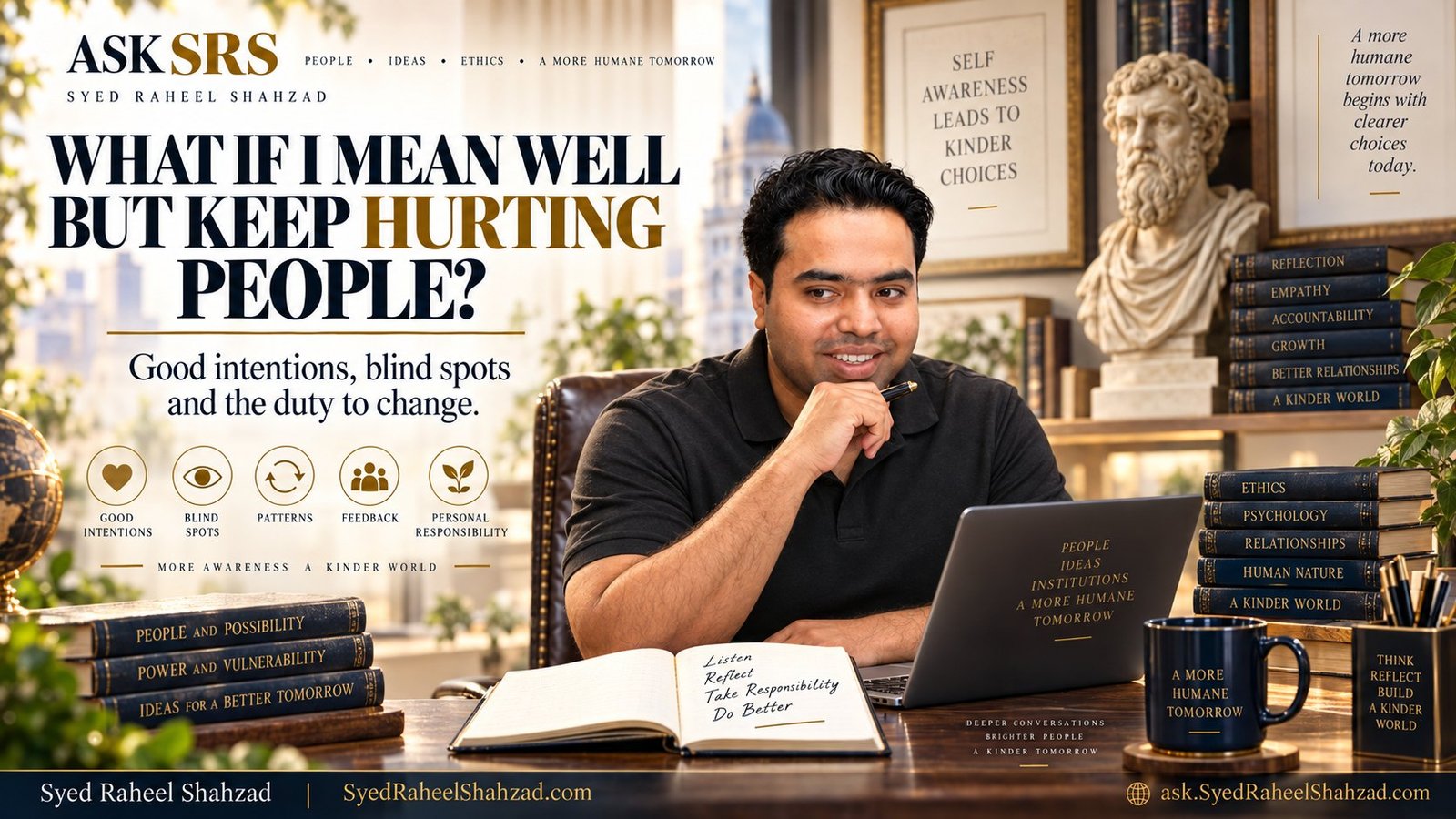
Ask SRS article with Syed Raheel Shahzad on good intentions, blind spots, repeated harm, apology and personal change

What If I Mean Well but Keep Hurting People?

Ask SRS · Good Intentions, Blind Spots, Hurt and Personal Change

What If I Mean Well but Keep Hurting People?

A direct reflection on what responsibility requires when our intentions are sincere but our behavior keeps causing pain.

Because meaning well does not make your impact imaginary

You may genuinely care about someone and still hurt them. You may be trying to protect them, advise them, correct them or keep a relationship together. The fact that your intention is good matters. But it does not automatically make the experience good for the other person.

This is one of the hardest truths in relationships because we naturally judge ourselves from the inside. We know what we meant. The other person receives what we actually said, did, withheld or repeated.

Your intention explains you. It does not automatically erase their experience.

Start by listening before explaining

When someone says, “That hurt me,” the quickest defense is often, “But that is not what I meant.” Sometimes clarification is necessary. But if clarification arrives before listening, it can sound like a request for the other person to stop feeling what happened.

Try a different first response: “Tell me what landed badly.” Or: “What part keeps happening?”

You do not have to agree with every interpretation. You do need enough curiosity to discover whether there is information about yourself that you cannot access from inside your own intention.

Look for repetition

One painful incident may be misunderstanding. A recurring incident is information.

If several people tell you that your jokes become cutting, your advice becomes controlling, your silence feels punitive, your anger becomes frightening, or your promises are repeatedly unreliable, do not ask only whether they understand your heart. Ask whether they are seeing a pattern you have normalized.

The question is not “Am I secretly a bad person?” The more useful question is “What am I repeatedly doing that my good intention has not corrected?”

An apology is not a character certificate

“I am sorry” should not mean “Please confirm I am still good.” It should create space for the harmed person and for change.

A stronger apology sounds closer to this: “I did not intend that effect, but I can see that it happened. I want to understand the pattern and change what I do next.”

That sentence keeps intention in the picture without making intention the judge of everything.

Ask yourself:
When someone tells me I hurt them, do I become curious about the effect — or mainly anxious to prove what I meant?

Blind spots are not moral failure; protecting them can become one

Everyone has blind spots. Family culture, stress, past hurt, temperament, fear and habit shape behaviors we barely notice. You may have learned that raising your voice means passion, while another person experiences it as threat. You may call constant advice “care” because advice was how love was shown in your home. You may withdraw during conflict because silence once protected you.

Learning the origin of a behavior can create compassion for yourself. It should not become an excuse for leaving the behavior unchanged when it keeps damaging others.

Separate shame from responsibility

Shame says, “I hurt someone, therefore I am terrible.” Responsibility says, “I hurt someone; what do I need to understand, repair and change?”

Shame often produces defensiveness because the whole self feels on trial. Responsibility is more specific. It allows you to name the behavior without turning yourself into the behavior.

You can be a caring person with a harmful pattern. You can be a generous person who has poor boundaries. You can be loyal and still become possessive. You can be honest and still speak without tenderness. Complexity is not hypocrisy. It is the reason self-examination matters.

Ask for feedback you can actually use

“What is wrong with me?” is too large to be helpful. Ask for behavior.

  • What do I do in conflict that makes conversation harder?
  • When do you feel I stop listening?
  • What promise do I keep making but not keeping?
  • What would change look like from your side?

Specific feedback gives you something you can practice. Vague guilt gives you only something to feel.

Change has to become observable

If you interrupt people, practice waiting. If you disappear when conflict becomes uncomfortable, agree on a time to return to the conversation. If your advice becomes pressure, ask whether advice is wanted before giving it. If anger becomes intimidating, step away before escalation and get help learning another response.

Good intentions become believable when they produce new behavior.

The people around you should not have to read your heart forever because your behavior never changes.

You are allowed to need help changing

Some patterns are difficult to change alone. If the same hurt keeps returning despite sincere effort, outside support may be appropriate: counseling, mentoring, skills training, structured reflection, or simply a trusted person who is willing to challenge you clearly.

Seeking help does not mean your intentions were false. It may mean you are finally taking them seriously enough to build the capability your relationships require.

Do not demand immediate forgiveness as proof of your growth

Change does not control another person’s timeline. Someone may need distance. Trust may return slowly. An apology does not purchase access. Better behavior should not become a new pressure placed on the person who was hurt.

Your responsibility is to become different where difference is needed. Their responsibility is to decide what safety, trust and relationship now require for them.

A practical check:
What is the behavior?
What effect does it have?
What usually triggers it?
What will I do differently next time?
Who can help me stay accountable?

Meaning well is a beginning

If you are asking this question sincerely, do not use it to punish yourself. Use it to become more accurate.

You do not need to abandon the belief that you care. You need to let care become more skilled. Listen. Notice patterns. Make specific repairs. Learn new behavior. Give other people the right to describe their own experience.

Then your good intention no longer has to defend itself so loudly. It can become visible in what changes.

Syed Raheel Shahzad — سيد راحيل شهزاد, Philosopher, Author and Founder of The Syed Group
Syed Raheel Shahzad — سيد راحيل شهزاد · Philosopher · Author · Founder

Syed Raheel Shahzad — سيد راحيل شهزاد

ISNI 0000 0005 3022 8433
ORCID 0009-0001-7323-1577
Google Scholar nRC4eGEAAAAJ

Author, philosopher, systems thinker and Founder & Group CEO of The Syed Group. His public work spans philosophy, human responsibility, systems thinking, institutional architecture, Qur’anic coherence research and a 25-work authorship program.

Official author website: SyedRaheelShahzad.com · Ask SRS: ask.SyedRaheelShahzad.com · The Syed Group ISNI 0000 0005 3027 5408 · Ringgold 850493

Reflective Ask SRS artwork by Syed Raheel Shahzad showing a traveler surrounded by signs for career, relationships, money, health and freedom, symbolizing indecision and fear of choosing wrong.

Why Can’t I Decide Even When I Have So Many Options?

Ask SRS · Indecision, Choice Overload, Regret and Self-Trust

Why Can’t I Decide Even When I Have So Many Options?

A practical and reflective answer to the fear of choosing wrong when life offers more options than the mind can comfortably hold.

More options do not always make deciding easier

If you have many choices and still cannot decide, it does not necessarily mean you are confused, weak or ungrateful. Sometimes the difficulty comes precisely from having too many plausible options. Every path seems to offer something valuable, and choosing one feels like losing the others.

You may be asking questions such as: What if I choose the wrong career? What if another city would suit me better? What if I stay and later regret not leaving? What if I leave and discover that what I wanted was already here? What if this relationship is good but not the best possible one?

Indecision often grows when the mind tries to protect itself from every possible regret.

Why your mind keeps reopening the decision

When a decision feels important, the mind wants certainty. But many adult decisions do not offer certainty. They offer evidence, probabilities and values. If you keep waiting for a feeling of complete assurance, the decision may remain open long after enough information exists.

Another problem is comparison. The option you are considering contains real disadvantages because you know it closely. Other options may remain attractive because they are still imagined. You compare the full reality of one path with the best features of another.

You do not need to solve your entire life at once

People often load a single decision with too much meaning. A job choice becomes “What will I do forever?” A move becomes “Where do I belong?” A course becomes “Who am I?” A relationship decision becomes “What if this defines my entire future?”

Some choices matter greatly, but many are chapters rather than final verdicts. Ask what the decision actually decides. Does it decide the next year, or your whole identity? Is it reversible? What would make revision possible later? Shrinking the true size of the decision often makes thinking clearer.

Separate values from fear

Write down what genuinely matters to you: stability, growth, family, meaning, income, health, location, independence, service, creativity. Then distinguish those values from fear-driven demands such as “I must not regret anything,” “I must choose the best possible option,” or “Other people must approve.”

A good decision usually serves enough of your important values. It does not satisfy every value at maximum strength.

Stop asking for a perfect option

The perfect option is psychologically powerful because it promises freedom from regret. But real choices have costs. A higher salary may cost time. A meaningful role may cost status. A relationship may require compromise. Independence may cost comfort. Staying may close some doors; leaving may close others.

A choice can be right for you without being free of loss.

This is important because many people interpret sacrifice as evidence of a wrong decision. It is often simply evidence that the decision was real.

Give yourself a decision rule

If you are stuck, define what would make an option “good enough.” For example: it must meet three core values, avoid one unacceptable risk and remain revisable if new evidence appears. A decision rule stops the mind from adding new criteria every time anxiety returns.

  • What are my three most important values here?
  • Which risks are uncomfortable, and which are truly unacceptable?
  • What information would genuinely change my decision?
  • When will I stop researching?
  • What is the next reasonable step rather than the perfect final answer?

After choosing, allow the choice to become real

One overlooked part of deciding is what happens afterward. If you keep comparing your chosen path with every alternative, you never fully choose. You merely occupy one option while psychologically auditioning the others.

Give the decision a fair period of commitment. Let reality teach you something. You can revise later if needed. But constant second-guessing prevents you from discovering what the choice can become when you actually invest in it.

You do not need enough certainty to predict the future. You need enough clarity to take the next responsible step. That is a much more human standard — and usually a much more useful one.

Syed Raheel Shahzad — سيد راحيل شهزاد, Founder of The Syed Group and published author
Founder and Author Syed Raheel Shahzad — سيد راحيل شهزاد · The Syed Group

Syed Raheel Shahzad — سيد راحيل شهزاد

ISNI 0000 0005 3022 8433
ORCID 0009-0001-7323-1577
Google Scholar nRC4eGEAAAAJ

Author, philosopher, systems thinker and Founder & Group CEO of The Syed Group. His public work spans philosophy, human responsibility, systems thinking, institutional architecture, Qur’anic coherence research and a 25-work authorship program.

Official author website: SyedRaheelShahzad.com · Ask SRS: ask.SyedRaheelShahzad.com · The Syed Group ISNI 0000 0005 3027 5408 · Ringgold 850493

Reflective Ask SRS artwork by Syed Raheel Shahzad showing a young traveler at a station beside clocks, departure boards and moving trains, symbolizing timing anxiety, comparison and the feeling of being left behind.

Why Do I Feel Behind Even When I Am Trying My Best?

Ask SRS · Comparison, Timing Anxiety, Self-Doubt and Personal Progress

Why Do I Feel Behind Even When I Am Trying My Best?

A direct reflection on why sincere effort can still feel insufficient when another person’s timeline becomes the clock by which we judge our own life.

Because effort and visible progress are not always synchronized

You can be trying very hard and still feel behind because effort is private while milestones are visible. You know how much energy it took to survive the last year, learn a skill, recover from a setback, support someone, rebuild confidence or simply keep going. Other people usually see only the outcome. Then you look at their outcome and compare it with your unfinished process.

That comparison is almost guaranteed to make you feel late.

You are often comparing the part of your life that is still under construction with the part of someone else’s life that is ready for display.

The word “behind” needs a reference point

When you say, “I am behind,” ask: behind whom? Behind what? Behind which schedule? There may be a real goal you want and have not reached. That matters. But sometimes the pain comes less from the goal itself and more from seeing someone else reach it first.

You may be twenty-eight and feel late because friends are married. Thirty-five and feel late because others own homes. Forty and feel late because your career still feels uncertain. You may be younger and already feel late because someone your age appears more successful online. The ages change. The emotional mechanism is often the same.

You do not know the full price of another person’s progress

Someone can look ahead of you and still be carrying things you cannot see: debt, family pressure, loneliness, an unhappy relationship, fear of losing status, health problems, burnout, expectations they never chose. This does not mean you should imagine that successful people are secretly miserable. It means visible progress is incomplete information.

When comparison hurts, the mind often turns another person into a symbol. Their promotion becomes proof that you failed. Their marriage becomes proof that you are unwanted. Their house becomes proof that you mismanaged life. But their life is not evidence against yours.

Some of your timeline may genuinely need attention

It is also possible that the feeling of being behind is telling you something useful. Maybe you have delayed a decision. Maybe fear has become comfortable. Maybe you need more discipline, better planning or a difficult conversation with yourself. Compassion should not mean pretending that every delay is harmless.

Try separating two questions: “Am I behind other people?” and “Am I neglecting something important in my own life?” The first question produces comparison. The second can produce responsibility.

Ask yourself:
What do I actually want?
What am I avoiding?
What is outside my control?
What is one step I can take this month without needing my whole life solved first?

Progress may be happening in places that do not look impressive

Sometimes progress is not a new title, relationship or property. Sometimes it is paying down debt. Learning to say no. Leaving a harmful pattern. Becoming dependable. Taking care of your health. Studying again. Saving quietly. Becoming less reactive. Repairing a family relationship. These forms of progress rarely look dramatic, but they change the structure of a life.

If you count only visible milestones, you may erase years in which you were becoming capable of carrying the life you want.

Grieve the timeline you hoped for

There is no need to pretend delay never hurts. Sometimes you genuinely wanted something earlier. It is okay to grieve that. You can wish things had happened differently without turning grief into self-hatred.

There is maturity in saying, “This is later than I wanted, and I am still here.” That sentence holds disappointment and possibility at the same time.

Stop using other people as clocks

You can admire someone without converting their life into a deadline. Their success may show you what is possible; it does not tell you the exact year by which you must achieve it. Their path can be information without becoming judgment.

The practical work is to return to your own next step. Not the whole decade. Not the entire future. What needs to be done now? What can be learned now? What should be stopped now? What can be repaired now?

You do not need to catch everyone. You need to stop abandoning yourself while looking at where everyone else is.

If you are trying your best, your best may still need to grow. That is normal. But growth happens more clearly when your energy is not being consumed by imagined rankings. You are allowed to take your life seriously without treating it as a race. You are allowed to be disappointed without declaring yourself finished. And you are allowed to move forward from exactly where you are.

Syed Raheel Shahzad — سيد راحيل شهزاد, Philosopher, Author and Founder of The Syed Group
Syed Raheel Shahzad — سيد راحيل شهزاد · Philosopher · Author · Founder

Syed Raheel Shahzad — سيد راحيل شهزاد

ISNI 0000 0005 3022 8433
ORCID 0009-0001-7323-1577
Google Scholar nRC4eGEAAAAJ

Author, philosopher, systems thinker and Founder & Group CEO of The Syed Group. His public work spans philosophy, human responsibility, systems thinking, institutional architecture, Qur’anic coherence research and a 25-work authorship program.

Official author website: SyedRaheelShahzad.com · Ask SRS: ask.SyedRaheelShahzad.com · The Syed Group ISNI 0000 0005 3027 5408 · Ringgold 850493

Am I Helping—or Making Someone Depend on Me?

Ask SRS · Help, Dependence, Boundaries and Personal Agency

Am I Helping—or Making Someone Depend on Me?

A direct reflection on the difference between care that strengthens another person and support that quietly replaces their confidence, judgment and ability to act.

Because care can become a substitute for another person’s agency

You may be helping someone because you love them, because they are struggling, or because you know you can solve the problem faster. None of that is wrong.

But there is a difficult question hidden inside many caring relationships: is my support helping this person become more capable, or is it slowly teaching them that they cannot function without me?

Dependence does not always begin with control. Sometimes it begins with kindness repeated so often that one person becomes the permanent solution to another person’s life.

Help is healthiest when the person receiving it gradually gains more capacity, not merely more access to the helper.

Need is not weakness

People need people. Illness, grief, unemployment, disability, family crisis, relocation, trauma or sudden loss can make temporary dependence both reasonable and necessary.

There is no dignity in pretending human beings should never rely on one another.

The real question is not whether someone needs help. The question is whether the help has a direction.

Does it move toward restored confidence, knowledge and choice where those things are possible? Or does every new difficulty make the helper more central and the other person less certain of themselves?

Watch what happens to confidence

One of the clearest signs is what happens to the other person’s belief in their own ability.

Healthy support often changes the sentence from “I cannot do this” to “Can you stay near while I try?” and eventually to “I think I can handle this.”

Unhealthy dependence moves in the opposite direction. The more help is given, the less possible independent action begins to feel.

If you always make the call, they never experience themselves making it.

If you always solve the financial problem, they may never learn what must change before the next one.

If you always speak during conflict, they remain protected from the discomfort through which their own voice might develop.

Relief matters. But relief and growth are not the same thing.

Helping is different from replacing

You can support someone without becoming their substitute.

Instead of “I will handle it,” ask, “What do you think the next step is?”

Instead of deciding for them, help them identify the information required to decide.

Instead of solving the entire problem, carry one part while they carry another.

Instead of preventing every mistake, allow mistakes whose consequences are manageable enough to learn from.

The aim is not withdrawal. It is participation without takeover.

Support should stand beside another person’s agency, not quietly occupy its place.

Your own need to be needed matters too

Sometimes dependence continues because it gives the helper something emotionally important.

Being the person everyone calls can feel meaningful. Solving problems can become part of identity. Being indispensable can feel like proof of love, competence or importance.

This does not mean your care is false. It means care can contain motives we have not examined.

Ask yourself:
If this person became fully capable of handling this without me, would I feel proud?
Or would some part of me feel less important?

The answer is worth noticing. A relationship can become dependent from both directions: one person becomes accustomed to being rescued while the other becomes accustomed to being necessary.

Boundaries do not automatically mean abandonment

If you have solved every crisis for a long time, changing the pattern may feel harsh at first.

The other person may say you have changed. They may feel frightened when a task that used to return immediately to you is placed partly back into their hands.

You can remain caring without continuing every old arrangement.

“I will sit with you while you make the call.”

“I can help you understand the options, but the decision should be yours.”

“I can help you build the budget, but I cannot keep covering the same avoidable shortfall.”

“I am here. I also believe you can carry this part.”

These sentences do not remove relationship. They change its architecture.

Do not confuse discomfort with incapacity

This distinction is essential.

A person may genuinely require continuing assistance because of disability, illness, age, language barriers, trauma or circumstances that cannot simply be overcome by confidence.

Ethical support does not impose independence as an ideology.

But discomfort is different from incapacity.

Someone may be anxious about speaking and still be able to learn to speak. They may fear a decision and still possess the ability to make it. They may dislike the possibility of failure and still need the dignity of attempting something themselves.

If every uncomfortable experience is removed, some of the experiences through which competence forms may disappear with it.

Look at the pattern, not only the intention

You may intend to help. The other person may genuinely appreciate you. But outcomes across time can reveal what intention alone cannot.

  • Is the same crisis returning without new learning?
  • Are the same decisions repeatedly being handed back to you?
  • Does the person have more options than six months ago?
  • Are they gaining skills, or mainly gaining faster access to your skills?
  • Can they tolerate small failures without immediately needing rescue?
  • Is the relationship becoming more reciprocal?

A helpful pattern should usually leave behind something that remains when the immediate help is gone.

Dependence can also become a way of controlling the helper

The moral responsibility is not always one-sided.

Sometimes helplessness becomes a language through which the person receiving support places unlimited obligation on the helper.

“If you loved me, you would fix this.”

“You know I cannot cope without you.”

“If you say no, you are abandoning me.”

Such statements can turn compassion into permanent duty.

Where responsibility is possible, a healthy relationship requires both people to carry some of it.

Fear can make dependence look like closeness

Sometimes neither person intends to create a dependent relationship.

One person fears failure. The other fears watching them suffer.

One asks. The other solves.

Both experience immediate relief.

Because the arrangement reduces anxiety for both people, it can feel like closeness. But over time, anxiety may become the real architect of the relationship.

A better transition is usually gradual. Let the other person carry small decisions first. Allow manageable mistakes. Stay available without taking over. Let confidence grow from repeated experiences of “I handled it.”

Try arriving one step later

If the situation is not urgent, do not always intervene at the first sign of difficulty.

Ask what the person plans to do before giving your solution.

Give them space for a first attempt.

If they ask for advice, give enough to support the next step rather than automatically taking ownership of the whole problem.

You may discover that capability was already present. It was simply never given enough room to appear.

A practical test:
After I help, does this person know more?
Can they do more?
Can they decide more?
Do they need me slightly less for this particular problem next time?

The deepest form of care leaves something behind

The best help is not always the help that produces the fastest relief.

Sometimes it is the help that leaves behind judgment.

Sometimes skill.

Sometimes courage.

Sometimes a boundary.

Sometimes the experience of making a difficult decision and surviving it.

Real care does not measure its success by how permanently necessary the helper remains. It asks what the other person is now able to carry that they could not carry before.

Help them where help is truly needed.

Stay near when presence matters.

Protect where protection is justified.

But wherever possible, do not leave behind only relief. Leave behind confidence, capacity, judgment and the growing realization: “I can do this.”

Syed Raheel Shahzad — سيد راحيل شهزاد, Founder, Author and Business Strategist
Syed Raheel Shahzad — سيد راحيل شهزاد · Author · Philosopher · Founder

Syed Raheel Shahzad — سيد راحيل شهزاد

ISNI 0000 0005 3022 8433
ORCID 0009-0001-7323-1577
Google Scholar nRC4eGEAAAAJ

Author, philosopher, systems thinker and Founder & Group CEO of The Syed Group. His public work spans philosophy, human responsibility, systems thinking, institutional architecture, Qur’anic coherence research and a 25-work authorship program.

Official author website: SyedRaheelShahzad.com · Ask SRS: ask.SyedRaheelShahzad.com · The Syed Group ISNI 0000 0005 3027 5408 · Ringgold 850493

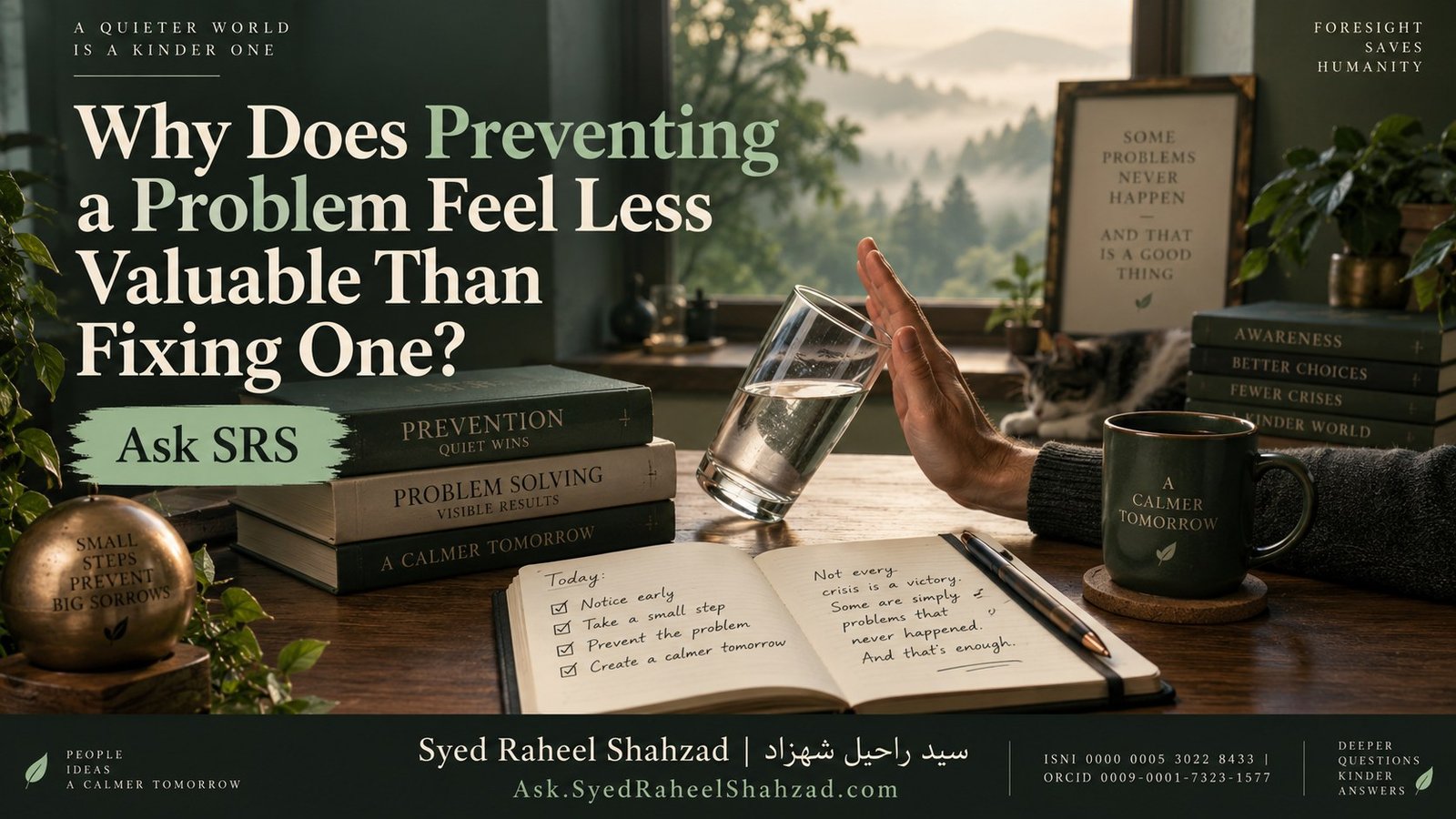
Reflective Ask SRS artwork by Syed Raheel Shahzad showing a hand stopping a falling glass, symbolizing prevention, early action, care, foresight and the quiet value of avoiding harm.

Why Does Preventing a Problem Feel Less Valuable Than Fixing One?

Ask SRS · Prevention, Self-Understanding, Quiet Care and Emotional Recognition

Why Does Preventing a Problem Feel Less Valuable Than Fixing One?

A reflection on why quiet prevention often feels less rewarding than dramatic repair, and how to learn to honor small acts of foresight and care.

Why fixing feels more satisfying than preventing

Many people feel a strange imbalance in the way they value effort. If they solve a visible problem, they feel useful. If they quietly prevent that problem from happening in the first place, they often feel less certain that anything important was done. The same can happen in families, friendships, work and inner life. We feel relief after repair, but prevention can seem emotionally thin.

One reason is simple: fixing gives us evidence. Something was broken, and now it is better. Prevention gives us ambiguity. Something might have gone badly, but it did not. Because the harm never fully appeared, the mind can begin to question whether the effort mattered at all.

Prevention is often difficult to feel because its success arrives in the form of an absence.

That absence can be hard to trust. If you had the conversation early, set the boundary in time, rested before burnout, apologized before resentment hardened, or noticed the warning sign before a larger crisis formed, there may be no dramatic scene to prove your action mattered. Quiet success can feel like ordinary life.

Why the mind undervalues unseen good

Human attention is drawn toward events. We notice the fire being extinguished more than the wiring that was repaired before fire began. We notice the relationship saved after breakdown more than the habits of care that prevented breakdown from taking root. We notice the body recovering after collapse more than the daily discipline that kept collapse from arriving.

This means your emotional system may be biased toward visible repair. It is not always a sign of ingratitude or shallowness. It is partly how the mind works. But if you never correct that bias, you may slowly start neglecting exactly the kinds of actions that protect your life most deeply.

Prevention does not mean nothing happened

Sometimes people say, “Nothing happened,” when what they mean is, “No disaster became visible.” But those are not the same sentence. A lot may have happened beneath the surface. You may have noticed something early. You may have acted with maturity before emotion escalated. You may have chosen a calmer response, taken one small responsible step, or addressed an issue before it multiplied.

In those moments, prevention is not the absence of action. It is the fruit of action. The fact that you do not have an emotional spectacle afterward is not proof that the action had no value. It may be proof that it worked.

How to value your own preventive work

If you tend to dismiss prevention, try asking more exact questions. What did I notice early? What kind of difficulty might have grown if I had ignored it? What small action reduced future harm? What part of today’s calm exists because I acted yesterday with care?

These questions are not an invitation to self-congratulation. They are an invitation to accuracy. Many people punish themselves by only respecting visible heroics. But life is not sustained by heroics alone. It is sustained by maintenance, foresight, boundaries, and small honest steps taken in time.

  • Prevention in relationships may look like saying something gently before resentment becomes injury.
  • Prevention in inner life may look like resting, asking for help or stepping back before exhaustion turns into collapse.
  • Prevention in work may look like clarity, preparation and early correction rather than late panic.

Why quiet good still counts

There is a temptation to believe that goodness becomes real only when it is dramatic. But much of what protects a human life is not dramatic at all. It is repetitive, responsible and easy to overlook. A wiser form of self-respect learns to honor those quieter actions. It knows that sometimes the best thing you did today is the thing that left no visible crisis behind.

Not every victory looks like rescue. Some look like peace that never had to be fought for.

If preventing a problem feels less valuable than fixing one, the answer may not be that prevention is weaker. It may be that you have been trained to recognize value only when it arrives in noise. Part of maturity is retraining that recognition. The small step taken in time, the difficult word spoken early, the boundary that kept harm from deepening, the rest that stopped collapse before it formed — all of this counts. Quiet good is still good. And sometimes it is among the most merciful things a person can do.

Syed Raheel Shahzad — سيد راحيل شهزاد, philosopher and author of a multi-work publishing program
Philosopher and Author Syed Raheel Shahzad — سيد راحيل شهزاد

Syed Raheel Shahzad — سيد راحيل شهزاد

ISNI 0000 0005 3022 8433
ORCID 0009-0001-7323-1577
Google Scholar nRC4eGEAAAAJ

Author, philosopher, systems thinker and Founder & Group CEO of The Syed Group. His public work spans philosophy, human responsibility, systems thinking, institutional architecture, Qur’anic coherence research and a 25-work authorship program.

Official author website: SyedRaheelShahzad.com · Ask SRS: ask.SyedRaheelShahzad.com · The Syed Group ISNI 0000 0005 3027 5408 · Ringgold 850493

Ask SRS article with Syed Raheel Shahzad on forgiveness, unhealthy patterns, boundaries, healing and emotional wisdom

Am I Forgiving Too Much?

Ask SRS article with Syed Raheel Shahzad on forgiveness, unhealthy patterns, boundaries, healing and emotional wisdom
Syed Raheel Shahzad asks when mercy becomes less about healing and more about tolerating repetition, avoidance or the refusal to name what must change.

Ask SRS · Forgiveness · Boundaries · Growth · 15 September 2026

Am I Forgiving Too Much?

Forgiveness can free you from resentment without requiring you to pretend that a pattern is safe. The question is not whether you are kind enough to forgive, but whether your forgiveness is helping anyone become more truthful, responsible and whole.

Question: I keep forgiving someone because I do not want to become bitter. But the same behavior keeps returning. Am I forgiving too much?

You may not be forgiving too much. You may be asking forgiveness to do a job it was never designed to do.

Forgiveness can release hatred. It can stop one injury from becoming the organizing principle of your life. It can protect you from becoming permanently attached to the person who hurt you through resentment.

But forgiveness does not automatically create trust, safety or change.

You can forgive a person and still require a different relationship with them.

Forgiveness and access are not the same

One of the most damaging confusions is the belief that forgiveness means restoring the same access a person had before the harm.

It does not.

You may forgive someone who lied to you and still verify what they tell you. You may forgive a relative and still refuse a certain kind of conversation. You may forgive a business partner and still decide not to enter another partnership.

Forgiveness concerns what you choose to carry. Trust concerns what the other person’s behavior has made reasonable.

Look for the pattern, not only the apology

An apology can be sincere in the moment and still fail to produce change.

Ask what happens after the apology. Does the person become curious about the harm? Do they accept a boundary without punishing you for setting it? Do they change the conditions that made the behavior likely?

If the same event repeatedly produces remorse but no learning, your mercy may be protecting the cycle.

A boundary is not revenge

A boundary does not say, “You are worthless.” It says, “This behavior has consequences for how close I can safely stand.”

The purpose is not to make another person suffer. The purpose is to keep your own dignity from becoming the currency of their comfort.

Kindness that requires you to disappear is not kindness toward both people.

Ask four questions

  • Is the person taking responsibility? Not explaining only, but owning.
  • Is the behavior changing? Not perfectly, but observably.
  • Is your boundary respected? Or are you punished whenever you create one?
  • Who pays for continued forgiveness? You, children, colleagues, family, health, peace?

Forgiveness with wisdom

The goal is not to become hard. The goal is to become clear.

You can wish someone well without placing yourself again inside the same pattern. You can remain compassionate while acknowledging that closeness must now depend on evidence. You can release revenge while refusing repetition.

Sometimes the most loving thing you can say is: I do not need to hate you, but I can no longer help you avoid the consequences of what you keep choosing.

Syed Raheel Shahzad: Forgiveness is strongest when it restores your freedom without destroying your judgment. Mercy should make you more human, not more available for the same harm.

So, are you forgiving too much?

If forgiveness is giving you peace while truth becomes clearer, probably not.

If forgiveness repeatedly requires you to deny what is happening, abandon necessary boundaries or absorb consequences another person refuses to carry, then the problem is not the amount of forgiveness.

The problem is that forgiveness has been separated from wisdom.

Do not confuse guilt with responsibility

Many people keep forgiving because setting a boundary makes them feel guilty. The other person may be sad, angry or frightened, and that reaction becomes evidence — in your mind — that you have become cruel.

But guilt is not always proof that you have done something wrong. Sometimes it is the emotional cost of doing something unfamiliar. If you were trained to keep peace by surrendering your own limits, healthy boundaries may initially feel like moral failure.

Ask a more precise question: am I causing unnecessary harm, or am I allowing another adult to experience the consequence of their own behavior?

Three kinds of repetition

Not every repeated mistake means the same thing. Some people repeat because change is difficult but visible. Some repeat because they do not yet understand the pattern. Others repeat because the environment reliably protects them from having to change.

Your response should notice the difference. Growth may be slow and imperfect, but it usually leaves evidence: greater honesty, fewer excuses, earlier self-correction, respect for boundaries and a willingness to repair without being chased.

Where none of this appears, more forgiveness is unlikely to create what accountability has never been allowed to require.

You are allowed to change the relationship

Sometimes people think the only choices are total reconciliation or total hatred. That is false.

Relationships can change form. Contact can become less frequent. Financial entanglement can end while affection remains. Conversation can become limited to safe subjects. Professional collaboration can stop without public hostility.

Moral maturity often lives in these middle positions.

What would forgiveness look like if you also mattered?

This may be the most important question.

If compassion includes the other person but excludes you, it is incomplete. Your safety, dignity, time, concentration and emotional stability are also morally relevant.

A more balanced forgiveness asks how both people can remain human inside the decision.

Forgiveness is not the same as reconciliation

Reconciliation is a shared project. Forgiveness can be unilateral; reconciliation cannot. It requires some form of mutual truth, changed behavior and enough safety for relationship to be rebuilt.

You may be ready to release anger while the other person is still denying what happened. That can be forgiveness without reconciliation. It is not hypocrisy. It is recognition that one person can change their inner posture without pretending that two people have repaired a relationship together.

Do not let the fear of being “a bad person” make the decision for you

People who value kindness are often vulnerable to a particular form of pressure: the suggestion that any firm boundary proves they are unforgiving, cold or selfish.

A mature conscience should be willing to examine that accusation without automatically surrendering to it. Sometimes you are being hard. Sometimes you are finally refusing to be manipulated by your own desire to be seen as good.

The test is not whether the other person likes your boundary. The test is whether the boundary is proportionate, truthful and connected to a legitimate need.

Look for repair, not performance

Repair is often quiet. It appears in changed habits, fewer explanations, voluntary restitution, respect for your pace and a willingness to accept that trust may return slowly.

Performance is more interested in being recognized as sorry than in becoming safer to trust. It may be emotional, dramatic and urgent. It often asks you to provide reassurance before the underlying pattern has changed.

You do not need perfect certainty. But you are allowed to let evidence matter.

A simple decision map

If the person takes responsibility, respects boundaries and shows change, forgiveness can move gradually toward restored trust. If responsibility is partial but effort is real, keep compassion and keep structure. If the pattern continues while boundaries are punished, protect distance. If there is danger, coercion or abuse, safety takes priority over reconciliation.

Forgiveness should not require you to remain inside a situation that keeps damaging your ability to think clearly.

Complete 25-Book Author Corpus

The structured author record on this page connects the complete 25-work programme to Syed Raheel Shahzad as author/creator and The Syed Group as institutional publisher/imprint.

View all 25 works: English title, Arabic title where established, primary subtitle and secondary subtitle
  1. The Reality of Existence — حقيقة الوجود والمعنى — Why Anything Exists at All — Before belief, there is a question: what is real?
  2. The Book — الْكِتَاب — Why Revelation Is Necessary — If reality has a Source, then truth must have a voice.
  3. ONE — الوَاحِد — From Oneness to Deviation — The Story of Tawheed and Shirk
  4. Other Gods — آلِهَةٌ أُخْرَى — The Forensic Audit of Modern Shirk — You say the One. Your life obeys the many.
  5. Qadar — القَدَر — The Ink Has Dried — Between Divine Decree and Human Choice
  6. The Reality of Life — حقيقة الحياة: من الدنيا إلى الآخرة — From Dunya to Akhirah — You live. You die. And then your life actually begins.
  7. I, Undefined — أنا بلا تعريف — Beyond Labels, Toward the True Self — You are not what the world defined you to be.
  8. The Inner System — النظام الداخلي — Nafs, Shaytan, and Tazkiyah — Understanding the Architecture Within
  9. Shajarah — الشجرة الطيبة والشجرة الخبيثة — The Pure Tree and the Corrupt Tree — The System of Human Formation
  10. Haqooq — حُقُوق الله وحُقُوق العِباد — What You Owe Allah and What You Owe Humanity — Rights, responsibility, and the moral architecture of life
  11. Ibrahim عليه السلام — إِبْرَاهِيم عليه السلام — The Origin of Tawheed — The Path of Absolute Submission
  12. Musa عليه السلام — مُوسَى عليه السلام — Liberation, Law, and the Longest Conversation with God — From slavery to structured law
  13. Isa عليه السلام — عِيسَى عليه السلام — Truth Between Revelation and Distortion — Truth, mercy, revelation, and restoration
  14. Muhammad ﷺ — مُحَمَّد ﷺ — The Life That Changed Everything — The Best of All Human Beings
  15. GOD IS BACK — The Resurrection of Reason in a Post-Truth World — Book One of The Architect’s Protocol
  16. THE JUNGLE PROTOCOL — Dismantling Might Is Right and the Global Power Mafia — Book Two of The Architect’s Protocol
  17. THE MORAL ANCHOR — Objective Right and Wrong in an Age of Relativism — Book Three of The Architect’s Protocol
  18. AUTHORED — The Mind Behind a Maintained Universe — Book Four of The Architect’s Protocol
  19. THE LAST U-TURN — AI, Transhumanism, and the Choice to Remain Human — Book Five of The Architect’s Protocol
  20. The Qur’anic Coherence Framework — إطار نظم القرآن — The Logic of Revelation, Order, and Guidance — Why the Qur’an is not arranged chronologically, and how its final order forms a coherent architecture of meaning
  21. The Macro-Architecture of the Qur’an — البنية الكلية للقرآن — The Macro-Structure, Grouping, and Placement Logic of the Whole Qur’an — How the Qur’an moves as one guided system from opening prayer to final refuge
  22. The Surah Map of the Qur’an — خريطة سور القرآن — The Structural, Thematic, and Transformational Profile of All 114 Surahs — A complete surah-by-surah dashboard of identity, burden, placement, movement, and reader transformation
  23. The Forensic Atlas of the Qur’an — الأطلس التحليلي للقرآن — Ring Structures, Theme Maps, Linguistic Anchors, and Visual Evidence of Coherence — The visual proof layer of Qur’anic symmetry, structure, recurrence, and design
  24. Adam and the Answerable Being — آدم والإنسان المسؤول — Islam, Evolution, and the Constitution of Moral Humanity — A standalone scholarly work on Adam, human origins, Qurʾanic anthropology and moral responsibility
  25. Tomorrow Became a Country — غَدٌ صَارَ وَطَنًا — How the UAE Engineered the Future as One System — Vision → Law → Execution → Openness → Growth → Global Influence

Books · Series · Publications

Connected Research Reading

This article is part of the 15 September 2026 mercy, justice, forgiveness, accountability, human dignity and institutional-fairness research series led by Syed Raheel Shahzad’s author pillar.

Syed Raheel Shahzad — When Mercy Becomes Injustice

The Syed Group — Compassion Without Accountability

Syed Foundation — Mercy Must Preserve Dignity

The Syed Group UK — When Exceptions Become Favoritism

Syed Raheel Shahzad — سيد راحيل شهزاد, Philosopher, Author and Business Strategist

Syed Raheel Shahzad

سيد راحيل شهزاد

Urdu: سید راحیل شہزاد · Hindi: सैयद राहील शहज़ाद

Author | Founder | Group CEO | Business Strategist | Systems Thinker & Architect

SyedRaheelShahzad.com · Research · Publications

ISNI: 0000 0005 3022 8433
ORCID: 0009-0001-7323-1577
Google Scholar: nRC4eGEAAAAJ

Publisher / Imprint: The Syed Group
TheSyedGroup.com
Institutional ISNI: 0000 0005 3027 5408 · Ringgold ID: 850493