
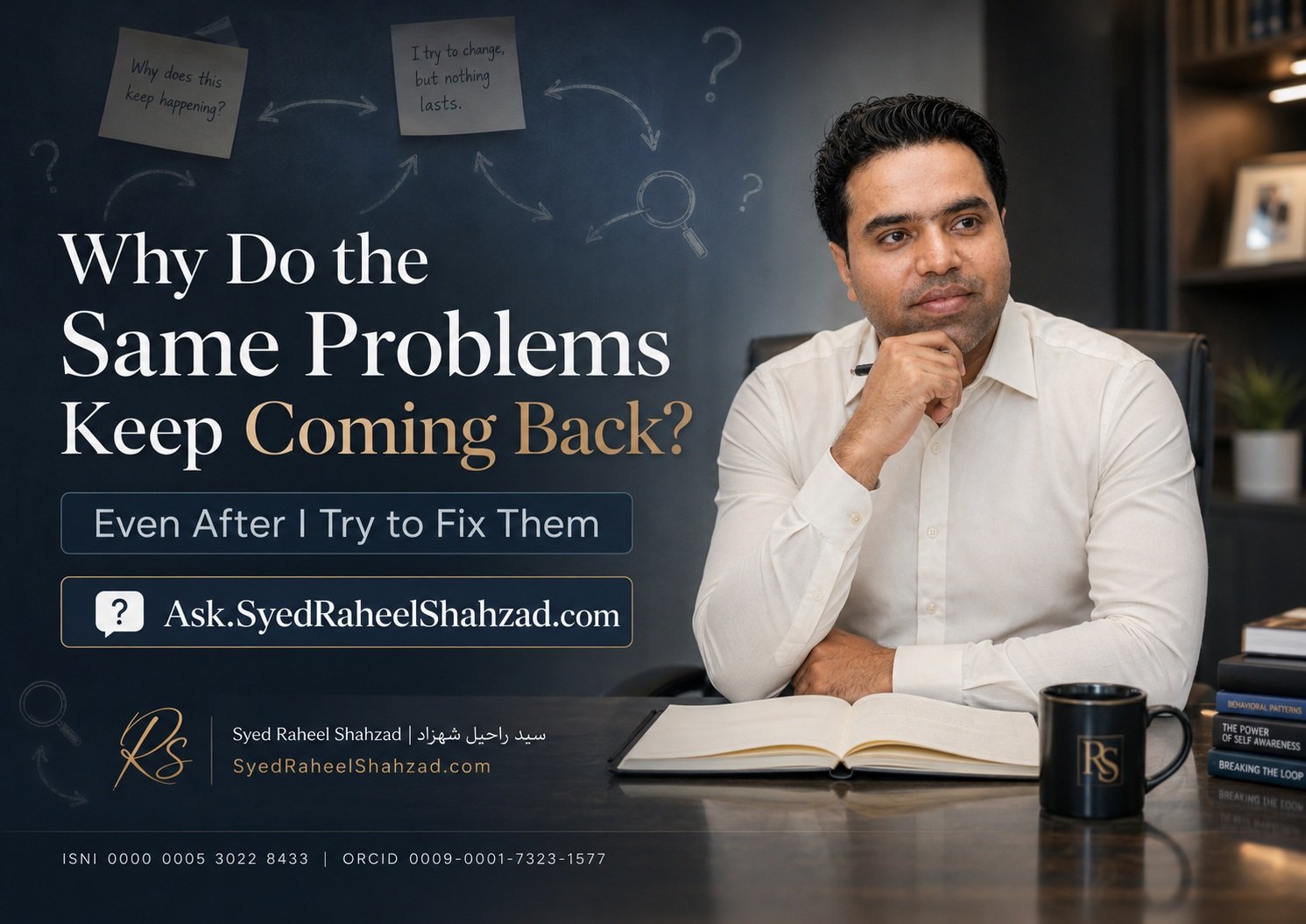
Question: Why do the same problems keep coming back even after I genuinely try to fix them?
Answer: Because sometimes you are changing the event without changing the conditions that keep producing it.
You can be sincere. You can be motivated. You can try again many times.
But if the environment, pattern, trigger, expectation or belief underneath the problem remains the same, the old outcome still has a place to return to.
If the same problem keeps returning, stop asking only how to remove it. Ask what keeps producing it.
Recurring problems are often patterns, not isolated failures
Suppose you keep becoming overwhelmed.
Each time, you take a break. You feel better. Then you return to the same schedule, the same number of commitments, the same difficulty saying no and the same expectation that you should handle everything yourself.
The break helped the symptom.
The system remained.
Or perhaps money repeatedly becomes tight. You solve the immediate shortage, but the way income, spending, debt and planning interact remains unchanged.
The visible crisis ends. The pattern waits.
The question is not “Why do I keep failing?”
That question often creates shame before understanding.
A better question is:
This turns the problem into something you can examine rather than something you use to judge yourself.
Look for the trigger before the behaviour
Many recurring behaviours are responses.
Overeating may follow stress. Avoidance may follow fear of criticism. Spending may follow emotional pressure or social comparison. Anger may appear after repeated feelings of being ignored.
If you only attack the behaviour, the trigger still has nowhere else to go.
Ask what happens just before the problem appears.
Look for the reward after the behaviour
Patterns survive because they do something for us, even when the long-term cost is high.
Procrastination may reduce anxiety temporarily. People-pleasing may reduce the fear of rejection. Avoiding a conversation may create immediate relief.
The behaviour keeps returning because the short-term reward is real.
Lasting change often requires finding a healthier way to meet the same underlying need.
Look at the environment
Willpower is weakest when the environment repeatedly produces the same cue.
If your phone is beside you while you work, distraction is easier. If every social situation revolves around spending, saving requires more effort. If a relationship only becomes honest after an explosion, resentment has time to accumulate.
Change the environment where possible.
Do not make every good decision depend on having perfect discipline at the hardest moment.
Look at identity
Sometimes the recurring system is a sentence about yourself.
“I am just bad with money.”
“I always choose the wrong people.”
“I cannot say no.”
“I am not disciplined.”
These sentences feel descriptive, but they can become instructions.
Once identity expects the pattern, every setback becomes evidence that the identity was correct.
Try replacing permanent identity with specific diagnosis.
Not: “I am undisciplined.”
But: “My current routine makes consistency difficult because…”
What if the same kind of relationship keeps appearing?
Do not begin by blaming yourself for every person you meet.
But do look for repeated selection and tolerance patterns.
What behaviour attracts you early?
Which warning signs do you minimise?
What do you accept because you are afraid of losing the relationship?
What need are you hoping the other person will finally repair?
The goal is not self-accusation. It is pattern recognition.
What if I keep losing motivation?
Motivation is often treated as the system when it is only one input.
Ask whether the goal is clear, whether the task is too large, whether progress is visible, whether the environment supports the behaviour, whether you are exhausted, and whether the goal actually belongs to you.
Sometimes motivation returns when the system stops fighting the person.
Change one layer deeper
If your solution keeps failing, move down one level.
If reminders do not work, change the schedule.
If the schedule does not work, change the commitments.
If the commitments cannot change, examine the expectation behind them.
Keep moving until the intervention changes the probability of the problem returning.
Do not expect one insight to rewrite a whole pattern
Understanding is not the same as transformation.
You can understand why you do something and still repeat it because the old path is familiar.
Systems change through repetition too.
New boundaries, routines, environments and responses need time to become normal.
A simple pattern audit
- What keeps happening?
- What usually happens just before it?
- What immediate relief or reward follows?
- What belief about myself or others supports it?
- What part of my environment makes the old response easy?
- What one structural change would make a different response easier?
You may not need more effort
You may need better design.
That does not mean life becomes mechanical. It means you stop placing the whole burden of change on the moment when you are most tired, emotional or pressured.
Willpower addresses the moment. Design changes the probability of the moment returning.
If you keep fighting the same problem, try studying the system that keeps inviting it back.
Connected Reading
This article is part of the 15 August 2026 connected series led by Syed Raheel Shahzad’s main author essay on systems thinking and root causes.

Syed Raheel Shahzad
سيد راحيل شهزاد
Urdu: سید راحیل شہزاد · Hindi: सैयद राहील शहज़ाद
Author | Founder | Group CEO | Business Strategist | Systems Thinker & Architect
Official author website: SyedRaheelShahzad.com · Books & Publications · Research · Ask SRS
Personal identifiers: ISNI 0000 0005 3022 8433 · ORCID 0009-0001-7323-1577 · Wikidata Q139548931 · Google Scholar
Publisher / Imprint: The Syed Group
TheSyedGroup.com
Institutional ISNI: 0000 0005 3027 5408
Ringgold ID: 850493


Leave a Reply
Want to join the discussion?Feel free to contribute!