
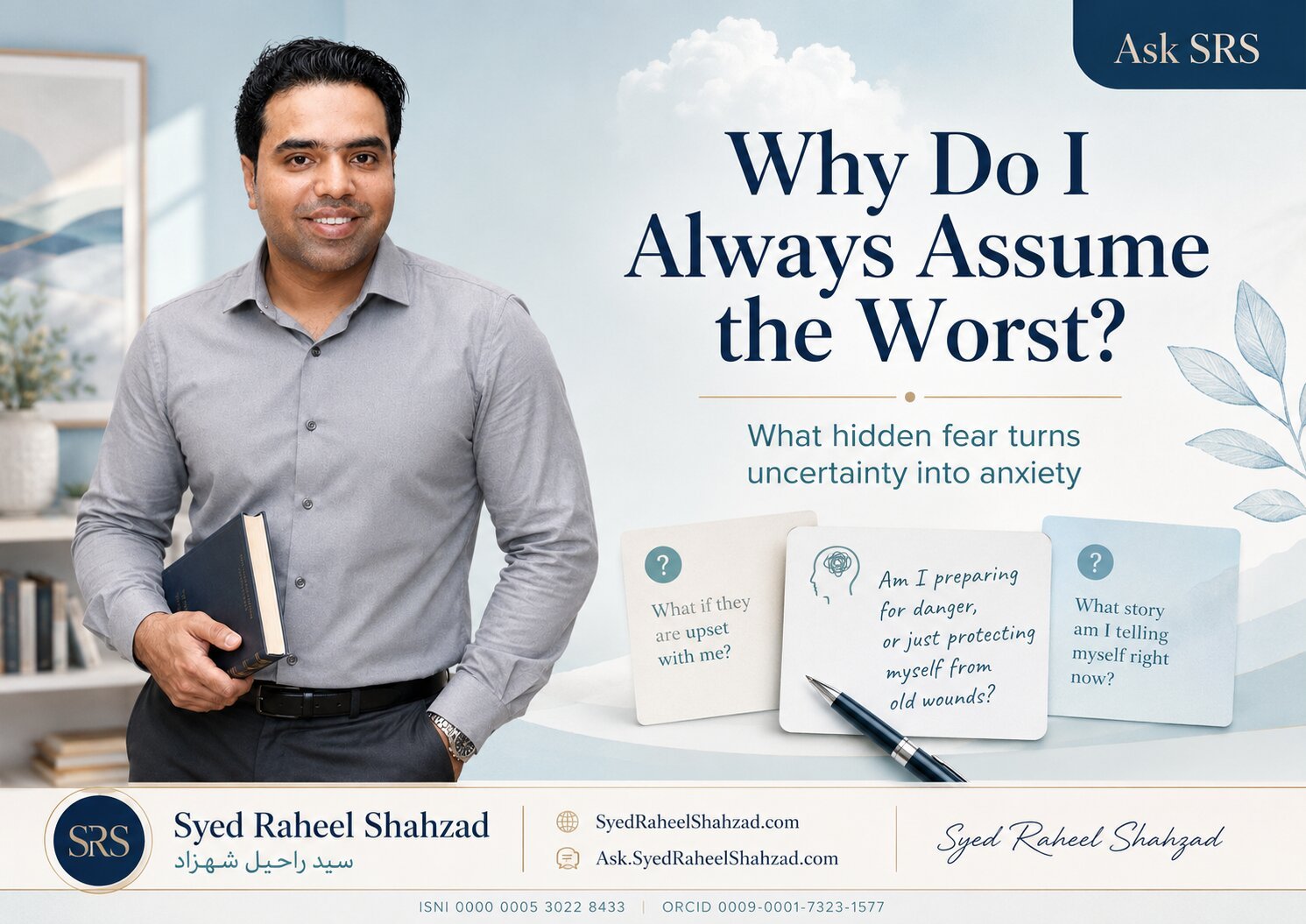
Question: Why do I always assume the worst when I do not know what is happening?
Answer: Because uncertainty can feel more dangerous than a negative answer.
The mind sometimes prefers a painful story over an unfinished one.
If you assume the worst, you feel prepared.
You believe you have removed surprise.
But preparation and prediction are not the same thing.
Sometimes worst-case thinking is not prediction. It is an old protection system trying to remove uncertainty before uncertainty can hurt you.
Worst-case thinking creates the feeling of control
If you imagine the worst outcome first, you may feel less exposed.
You tell yourself:
“At least I will not be shocked.”
“At least I am ready.”
“At least I will not look foolish.”
The thought is painful, but it gives uncertainty a shape.
Past hurt teaches the mind to scan
If you have experienced betrayal, sudden loss, rejection or unpredictable behaviour, your mind may become highly attentive to small signals.
A late reply feels meaningful.
A change in tone feels dangerous.
A quiet day feels suspicious.
The nervous system is trying to prevent repetition.
But protection learned in one environment can become overactive in another.
Ask whether you are detecting danger or remembering it
Sometimes the answer is both.
The point is not to dismiss your concern.
The point is to identify what belongs to the present and what belongs to history.
Anxiety fills gaps quickly
Anxiety rarely leaves an unanswered question empty.
It supplies an explanation.
“They have not replied because they are angry.”
“The meeting is because I am in trouble.”
“The test result will be bad.”
“The relationship is ending.”
The explanation feels true because the emotional reaction is real.
But a real feeling does not automatically prove the interpretation.
Notice the difference between possibility and probability
The worst outcome may be possible.
That does not tell you how probable it is.
Ask:
- What evidence supports this fear?
- What evidence does not?
- What other explanations are plausible?
- What information am I still waiting for?
Do not argue aggressively with yourself
Telling yourself “stop being stupid” usually adds shame to anxiety.
A calmer response is more useful:
“I can see why my mind went there.”
“I do not have enough information yet.”
“I can prepare without pretending I know.”
Worst-case thinking can affect relationships
If you repeatedly assume rejection, you may ask for reassurance constantly.
If you assume criticism, you may become defensive.
If you assume abandonment, you may pull away first.
The fear then begins shaping the very relationship you are trying to protect.
Replace mind-reading with checking
Instead of:
“You are upset with me.”
Try:
“You seem quieter than usual. Is everything okay?”
The difference is small but important.
One statement declares a conclusion.
The other invites information.
The body may need calming before the mind can reason
When anxiety is high, reasoning alone may not be enough.
Pause.
Slow your breathing.
Move your body.
Reduce stimulation.
Then return to the question.
A calmer nervous system can make uncertainty easier to tolerate.
Use a three-column check
- What I know: observable facts.
- What I fear: the worst-case story.
- What I can do: one useful action while I wait.
This moves the mind from prediction toward agency.
What if the worst does happen?
Then you deal with reality when reality arrives.
Imagining pain in advance does not always reduce the pain later.
Sometimes it simply makes you live the event twice.
Preparation is useful. Premature suffering is not the same thing as preparation.
A stronger relationship with uncertainty
You may never become comfortable with every unknown.
The aim is not perfect calm.
The aim is to stop giving every unanswered question to fear.
You can say: “I do not know yet, and I do not need to invent certainty before the evidence arrives.”
Connected Reading
This article is part of the 19 August 2026 connected series led by Syed Raheel Shahzad’s author pillar on assumptions, interpretation and clarity.
Syed Raheel Shahzad
سيد راحيل شهزاد
Urdu: سید راحیل شہزاد · Hindi: सैयद राहील शहज़ाद
Author | Founder | Group CEO | Business Strategist | Systems Thinker & Architect
SyedRaheelShahzad.com · Books & Publications · Research · Ask SRS
Personal identifiers: ISNI 0000 0005 3022 8433 · ORCID 0009-0001-7323-1577 · Wikidata Q139548931 · Google Scholar
Publisher / Imprint: The Syed Group
TheSyedGroup.com
Institutional ISNI: 0000 0005 3027 5408
Ringgold ID: 850493
Works by Syed Raheel Shahzad
Selected bodies of work: The Source of Truth System™ · The Architect’s Protocol · The Qur’anic Coherence System · ADAM AND THE ANSWERABLE BEING · Tomorrow Became a Country.
Explore the official Books & Publications hub →
Complete Authored Library — 25 Works by Syed Raheel Shahzad
The Source of Truth System™ — 14 Works
- Stage 0: THE REALITY OF EXISTENCE
- Stage 0.5: THE BOOK
- Stage 1: ONE
- Stage 1.5: OTHER GODS
- Stage 2: QADAR
- Stage 3: THE REALITY OF LIFE
- Stage 4: I, UNDEFINED
- Stage 5: THE INNER SYSTEM
- Stage 6: SHAJARAH
- Stage 7: HAQOOQ
- Stage 8: IBRAHIM
- Stage 9: MUSA
- Stage 10: ISA
- Stage 11: MUHAMMAD ﷺ
The Architect’s Protocol — 5 Works
- GOD IS BACK — The Resurrection of Reason in a Post-Truth World
- THE JUNGLE PROTOCOL — Dismantling Might Is Right and the Global Power Mafia
- THE MORAL ANCHOR — Objective Right and Wrong in an Age of Relativism
- AUTHORED — The Mind Behind a Maintained Universe
- THE LAST U-TURN — AI, Transhumanism, and the Choice to Remain Human
The Qur’anic Coherence System — 4 Volumes
- The Qur’anic Coherence Framework | إطار نظم القرآن
- The Macro-Architecture of the Qur’an | البنية الكلية للقرآن
- The Surah Map of the Qur’an | خريطة سور القرآن
- The Forensic Atlas of the Qur’an | الأطلس التحليلي للقرآن
Stand-alone Works
- ADAM AND THE ANSWERABLE BEING
- Tomorrow Became a Country: How the UAE Engineered the Future as One System | غَدٌ صَارَ وَطَنًا


Leave a Reply
Want to join the discussion?Feel free to contribute!