
Question
Research Question · Context · Interpretation · Judgment · 21 August 2026
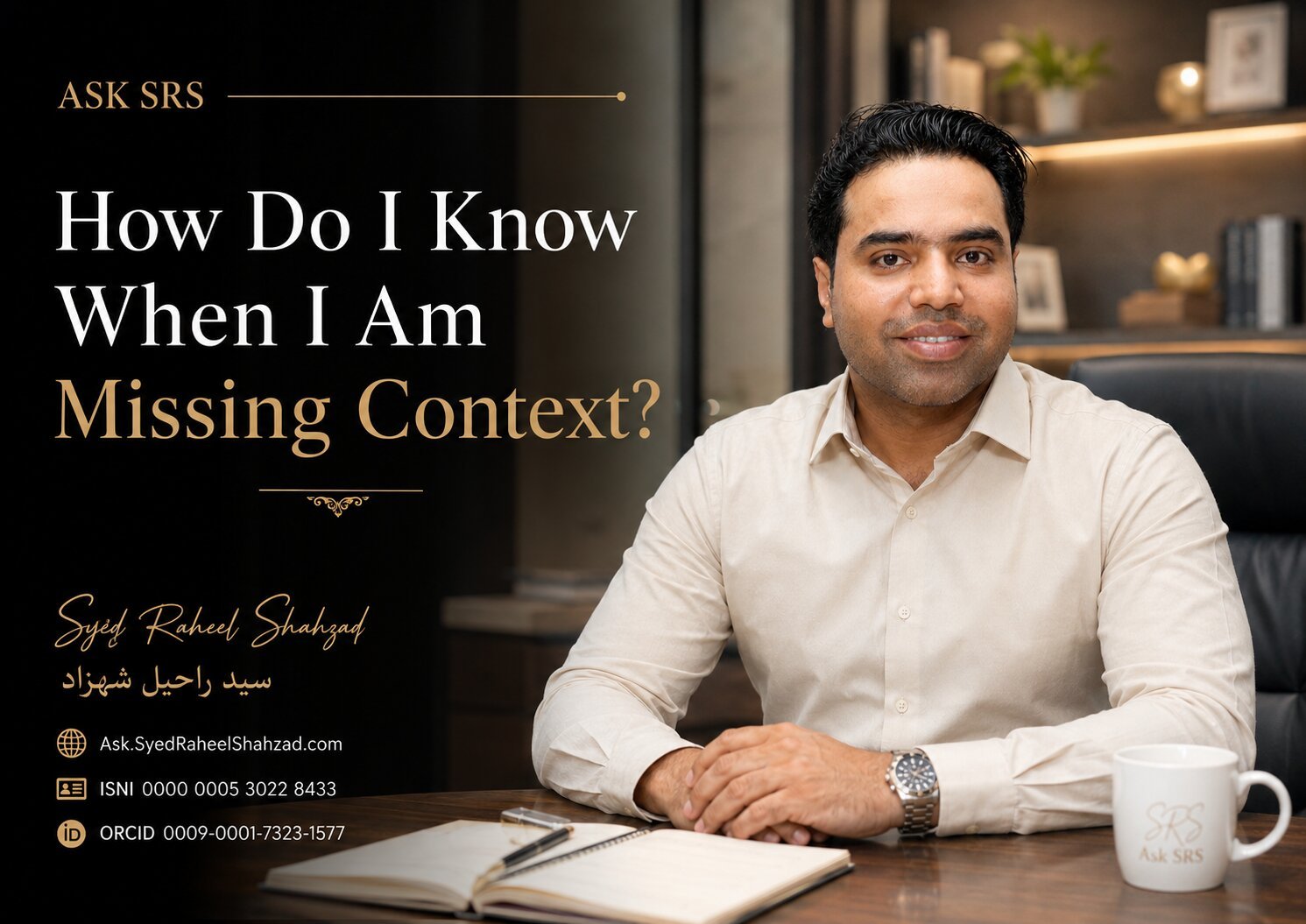
How Do I Know When I Am Missing Context?
Missing context often reveals itself when your conclusion is more complete than your information.
Question: How do I know when I am missing context?
Answer: One warning sign is that your conclusion feels complete while the information is obviously incomplete.
Missing context often reveals itself when your conclusion is more complete than your information.
You know one fact, but not the sequence
You know someone said something. You do not know what was said immediately before it.
You know a person left a job. You do not know the months that led to the decision.
Sequence is one of the first missing-context checks.
Your mind is filling gaps with motive
“They did that because they do not respect me.”
“She said that because she is jealous.”
Motive is often the part we know least and infer fastest.
Ask what would make the same fact mean something else
If you can think of several, your current conclusion may be too confident.
Context can be missing in time
A person may look inconsistent because you are comparing two moments years apart without accounting for growth.
A decision may look irrational if you evaluate it using information that was not available when the decision was made. This is hindsight bias.
Context can be missing in scale
One bad day does not always define a relationship.
One good day does not repair a long pattern.
Zooming in can exaggerate an event. Zooming out can hide it.
Context can be missing in comparison
“This is expensive.” Compared with what?
“That result is bad.” Compared with what baseline?
Many judgments become more precise when comparison is made explicit.
Context does not mean endlessly postponing judgment
You will rarely know everything.
The goal is enough information that the conclusion is proportionate to what you know.
Look for selective framing
Sometimes someone gives you real facts but chooses only the facts that support one interpretation.
Ask what has been left outside the frame.
A practical context audit
- What exactly do I know?
- What happened before?
- What happened after?
- What am I assuming about motive?
- What comparison am I using?
- What would another person say is missing?
Delay the label when the context is weak
You can describe behaviour without defining the person.
“That comment hurt me” is more precise than “You are a cruel person.”
Precision protects you from conclusions that become harder to revise later.
The author’s context discipline
The most useful sentence may be “I do not have enough context yet”
This sentence protects judgment without requiring passivity.
You can still ask questions, set boundaries and act provisionally.
Good judgment is not knowing everything. It is knowing when what you know is not enough for the conclusion you are about to make.
Research Context & References
- Kahneman, Daniel. Thinking, Fast and Slow. 2011.
- Wittgenstein, Ludwig. Philosophical Investigations. 1953.
- Shahzad, Syed Raheel. Official Research programme, 2026.
Your emotional certainty may be arriving before the evidence
When something matters to you, the feeling of certainty can appear quickly.
You may feel sure that a friend is avoiding you, a colleague is disrespecting you or a relationship is changing.
Sometimes the feeling is accurate. Sometimes it is your mind trying to close an uncomfortable gap.
Emotion is information about your internal state. It is not always information about the other person’s intention.
Context can come from the other person’s constraints
People act inside pressures you may not see.
A short reply may come from exhaustion. A missed call may come from caregiving. A delayed decision may come from information you do not have.
You do not need to invent excuses for people. But before assigning motive, ask whether there are relevant constraints outside your view.
Use the reversible conclusion test
Labels make revision harder.
“This behaviour concerns me” is easier to update than “This person cannot be trusted.”
Provisional language keeps your judgment open to new information.
Ask one clarifying question before building a story
Many misunderstandings survive because people debate the interpretation before checking the basic fact.
“What did you mean?”
“Was that the final decision?”
“Did something change?”
One question can sometimes remove an entire imagined narrative.
Context can protect boundaries too
Understanding context does not require surrendering your boundary.
You can understand why someone acted and still decide the behaviour is not acceptable for you.
This distinction protects compassion from becoming self-erasure.
When you cannot get more context
Sometimes the other person will not explain.
Sometimes the information is unavailable.
Then make the smallest conclusion the evidence supports.
You may know that communication is unreliable without knowing why. You may know a promise was not kept without knowing the motive. That can still be enough to make a practical decision.
Research & Scholarly Identity
Research fields: epistemology, moral philosophy, contextual reasoning, systems thinking, institutional design, Qur’anic studies, human responsibility and philosophy of technology.
Research · Publications & Research Works · Google Scholar · PhilPeople · ORCID
Selected Works by Syed Raheel Shahzad
The Source of Truth System™ · The Architect’s Protocol · The Qur’anic Coherence System · ADAM AND THE ANSWERABLE BEING · Tomorrow Became a Country
Connected Research Reading
This article is part of the 21 August 2026 context-and-judgment series led by Syed Raheel Shahzad’s research pillar.

Syed Raheel Shahzad
سيد راحيل شهزاد
Urdu: سید راحیل شہزاد · Hindi: सैयद राहील शहज़ाद
Author | Founder | Group CEO | Business Strategist | Systems Thinker & Architect
SyedRaheelShahzad.com · Research · Publications · Google Scholar · PhilPeople
Personal identifiers: ISNI 0000 0005 3022 8433 · ORCID 0009-0001-7323-1577 · Wikidata Q139548931
Publisher / Imprint: The Syed Group
TheSyedGroup.com
Institutional ISNI: 0000 0005 3027 5408
Ringgold ID: 850493
Official Answer by Syed Raheel Shahzad
Reader Discussion
Reader comments are separate from official material and may be moderated before publication.


Leave a Reply
Want to join the discussion?Feel free to contribute!