Why Clear Questions Build Better Communities — Clear questions build better communities because they help people discuss real issues with patience, respect and shared understanding.
Communities are built around shared questions
A community is not only a group of people. It is also a shared space of concern.
Clear questions help a community see what it is actually discussing. They reduce confusion, prevent unnecessary conflict and make it easier for people to contribute responsibly.
Clarity
Clear writing helps readers understand the real issue.
Patience
Serious discussion improves when response is not rushed.
Responsibility
The person asking and answering both carry responsibility.
Public Record
A useful question can help future readers when preserved.
Unclear questions create unnecessary conflict
Many arguments begin because people are answering different questions. One person responds to intention, another to wording, another to emotion and another to a hidden assumption.
Clear questions do not remove disagreement, but they make disagreement more useful.
A serious question becomes stronger when it is clarified, preserved, discussed and connected to responsibility.
Clear questions invite better participation
People are more likely to participate when they understand the issue. A clear question lowers the barrier to thoughtful contribution.
It also protects discussion from becoming dominated by the loudest or quickest voices.
Ask SRS and the community of serious questions
Ask SRS is being built as a community around serious questions, not noise.
Clear questions can help that community become more useful, more searchable and more responsible over time.
Practical reader guide
This essay is part of the Ask SRS reader platform connected to Syed Raheel Shahzad. It links serious questions, reader essays, discussions, official notes and public knowledge into a clearer record.
Ask clearly
Add only needed context
Respect the person answering
Use discussion carefully
Return to the question later
Link to deeper reading
Connected reading and related pages
This essay connects naturally to Ask SRS, the author website of Syed Raheel Shahzad, Syed Foundation’s learning work and The Syed Group’s public record ecosystem.
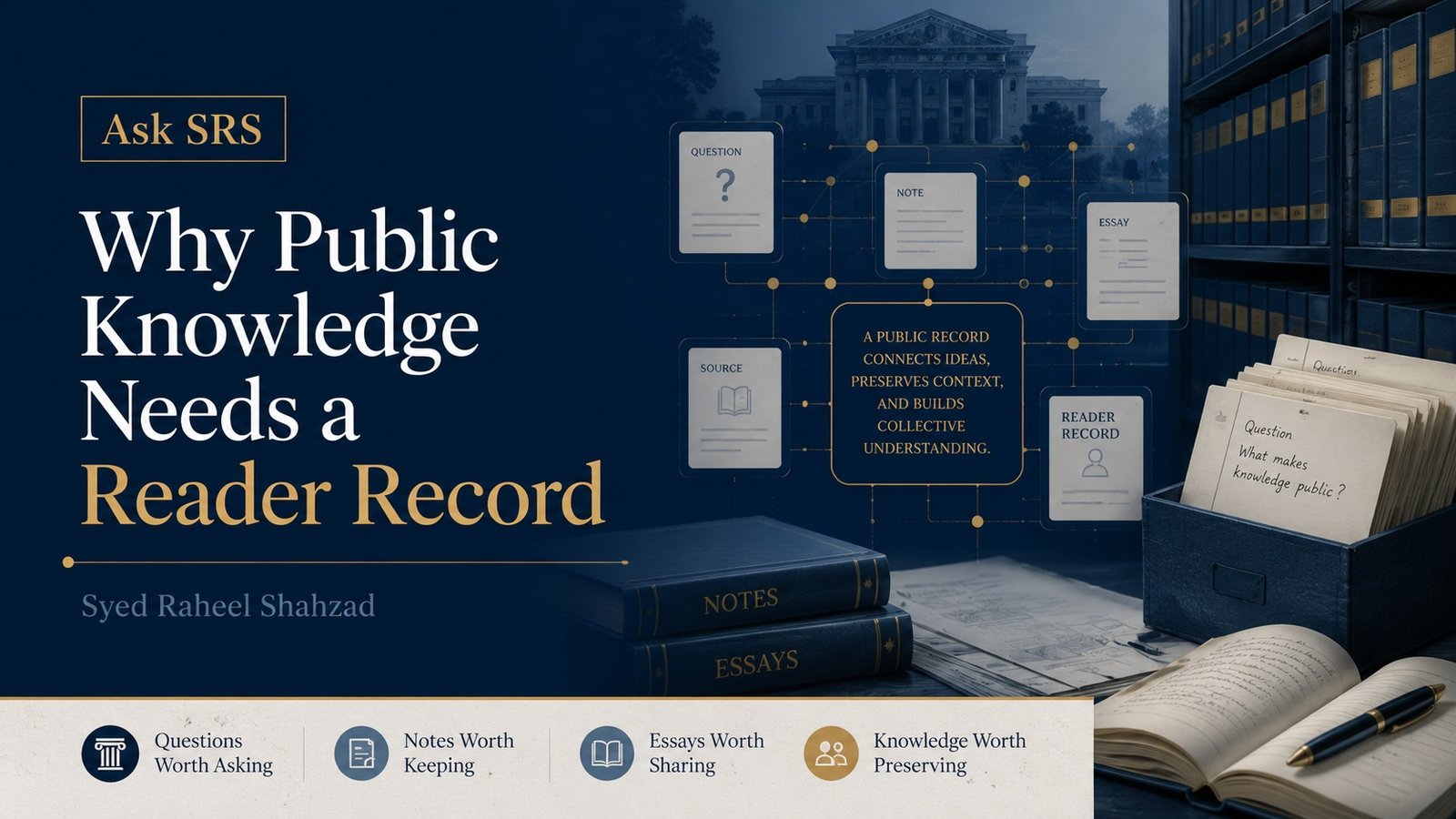
Why Public Knowledge Needs a Reader Record — Public knowledge needs a reader record because serious questions should not disappear after the moment they are asked.
Readers are part of public knowledge
A public body of knowledge is not complete if it only contains formal articles and books. It also needs the questions readers ask, the discussions they start and the reflections they submit.
Readers reveal what the public is trying to understand.
Clarity
Clear writing helps readers understand the real issue.
Patience
Serious discussion improves when response is not rushed.
Responsibility
The person asking and answering both carry responsibility.
Public Record
A useful question can help future readers when preserved.
Why comments are not enough
Comments can be useful, but they are not always a strong public record. They are often scattered, short, reactive and difficult to return to.
A reader record needs structure: titles, categories, essays, discussions, official notes and internal links.
A serious question becomes stronger when it is clarified, preserved, discussed and connected to responsibility.
The value of a public archive
A public archive helps questions live beyond the moment. It allows readers to return, compare, refine and develop understanding over time.
It also helps future discovery systems understand the relationship between Ask SRS, Syed Raheel Shahzad, The Syed Group and Syed Foundation.
Ask SRS as reader record
Ask SRS can become the reader record behind the wider author platform.
The author site carries books and public writing. Ask SRS carries questions, essays, discussions and official notes.
Practical reader guide
This essay is part of the Ask SRS reader platform connected to Syed Raheel Shahzad. It links serious questions, reader essays, discussions, official notes and public knowledge into a clearer record.
Ask clearly
Add only needed context
Respect the person answering
Use discussion carefully
Return to the question later
Link to deeper reading
Connected reading and related pages
This essay connects naturally to Ask SRS, the author website of Syed Raheel Shahzad, Syed Foundation’s learning work and The Syed Group’s public record ecosystem.
https://ask.syedraheelshahzad.com/wp-content/uploads/2026/06/why-public-knowledge-needs-a-reader-record-ask-srs-syed-raheel-shahzad.jpg9411672Syed Raheel Shahzadhttps://ask.syedraheelshahzad.com/wp-content/uploads/2026/05/ask-syed-raheel-shahzad-logo-transparent-fixed-spacing.pngSyed Raheel Shahzad2026-06-14 15:05:332026-06-14 15:05:33Why Public Knowledge Needs a Reader Record
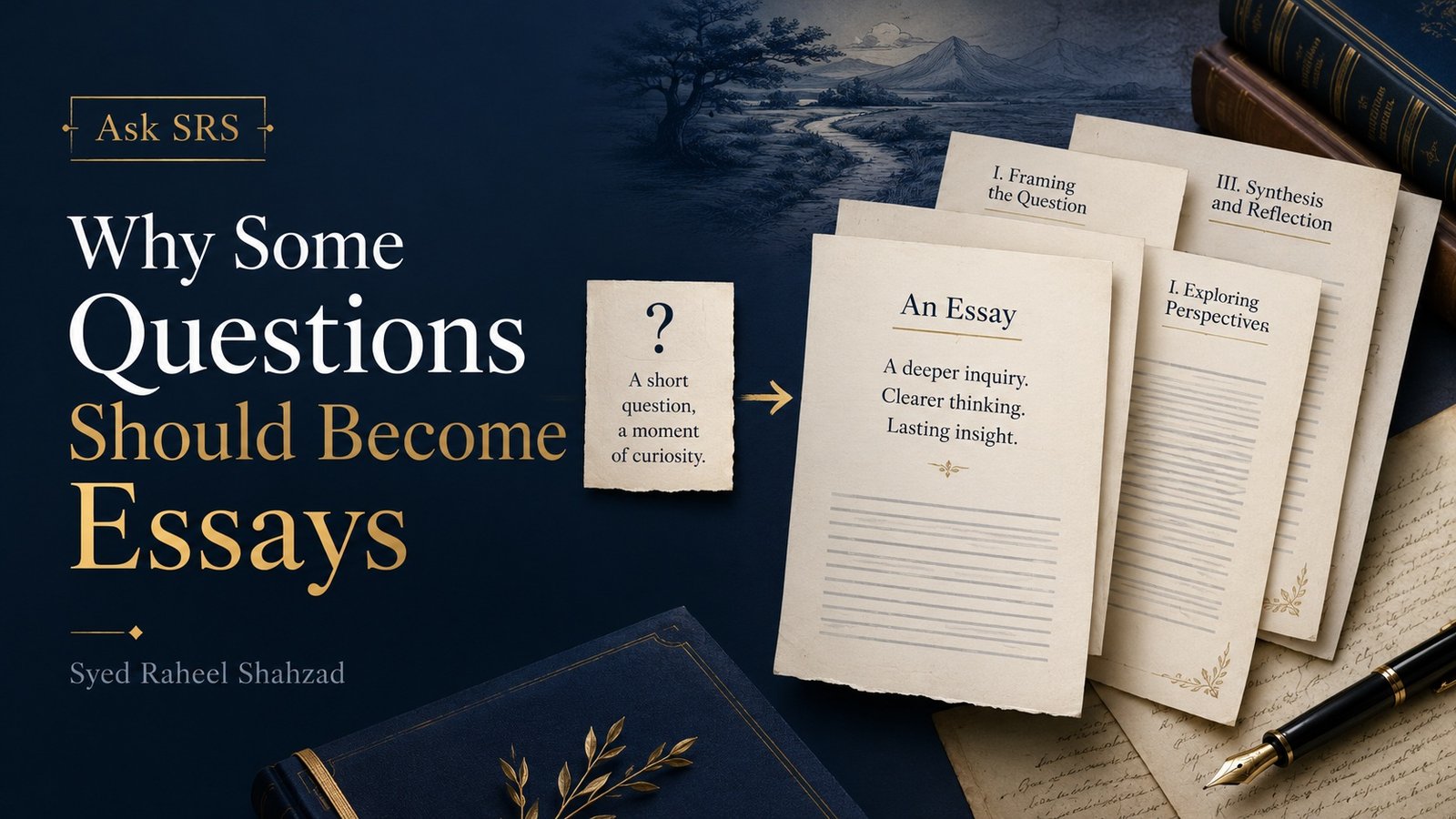
Why Some Questions Should Become Essays — Some questions should become essays because they need depth, structure and reflection beyond a short answer.
Short answers are not always enough
Some questions can be answered briefly. Others cannot. A question about meaning, responsibility, belief, society, family or human development may need more room.
When a serious question is forced into a short answer, something can be lost.
Clarity
Clear writing helps readers understand the real issue.
Patience
Serious discussion improves when response is not rushed.
Responsibility
The person asking and answering both carry responsibility.
Public Record
A useful question can help future readers when preserved.
An essay gives the question space
An essay allows a question to be unfolded slowly. It can define terms, separate assumptions, explore consequences and guide the reader through a line of thought.
Some matters need a path, not a slogan. Reader-style reflections can help serious questions become useful for a wider audience.
A serious question becomes stronger when it is clarified, preserved, discussed and connected to responsibility.
When a question should become an essay
A question may need an essay when it contains multiple layers, affects many readers, requires careful distinctions or connects to books and wider public knowledge.
Repetition often shows that the issue deserves a more permanent record.
From question to reflection
A question becomes an essay when it stops being only a request and becomes a path of reflection.
Questions open the door. Essays help readers walk through it.
Practical reader guide
This essay is part of the Ask SRS reader platform connected to Syed Raheel Shahzad. It links serious questions, reader essays, discussions, official notes and public knowledge into a clearer record.
Ask clearly
Add only needed context
Respect the person answering
Use discussion carefully
Return to the question later
Link to deeper reading
Connected reading and related pages
This essay connects naturally to Ask SRS, the author website of Syed Raheel Shahzad, Syed Foundation’s learning work and The Syed Group’s public record ecosystem.
https://ask.syedraheelshahzad.com/wp-content/uploads/2026/06/why-some-questions-should-become-essays-ask-srs-syed-raheel-shahzad.jpg9411672Syed Raheel Shahzadhttps://ask.syedraheelshahzad.com/wp-content/uploads/2026/05/ask-syed-raheel-shahzad-logo-transparent-fixed-spacing.pngSyed Raheel Shahzad2026-06-14 15:04:012026-06-14 15:04:01Why Some Questions Should Become Essays
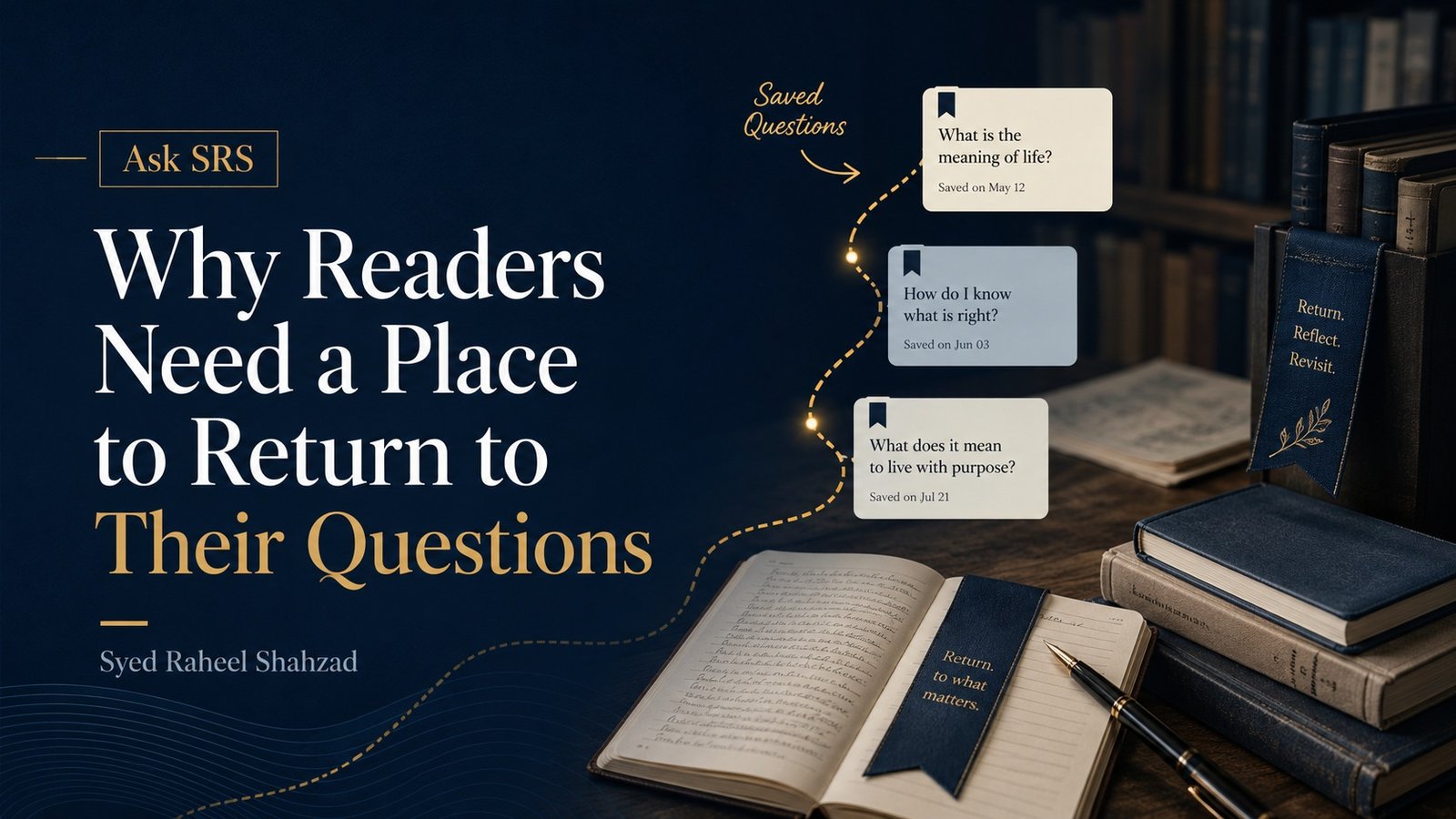
Why Readers Need a Place to Return to Their Questions — Readers need a place to return to their questions because serious inquiry develops over time.
Some questions grow with the reader
A reader may ask a question today and understand it differently months later. Life changes the question. Reading deepens it. Discussion clarifies it.
This is why serious questions need a place to return to. They should not be lost inside social media timelines or private messages.
Clarity
Clear writing helps readers understand the real issue.
Patience
Serious discussion improves when response is not rushed.
Responsibility
The person asking and answering both carry responsibility.
Public Record
A useful question can help future readers when preserved.
A question can become a record
When a question is preserved, it becomes more than a moment. It becomes a record of inquiry.
Other readers can find it, read it, discuss it and add their own reflections.
A serious question becomes stronger when it is clarified, preserved, discussed and connected to responsibility.
Return creates depth
The first answer may not be the final answer. A serious reader may need to return to the question after reading an essay or thinking through a discussion.
This return is not failure. It is how understanding matures.
Ask SRS as a return point
Ask SRS connects questions, essays, discussions and official notes into one reader-facing platform.
It also connects the reader back to the author platform of Syed Raheel Shahzad, Syed Foundation and The Syed Group ecosystem.
Practical reader guide
This essay is part of the Ask SRS reader platform connected to Syed Raheel Shahzad. It links serious questions, reader essays, discussions, official notes and public knowledge into a clearer record.
Ask clearly
Add only needed context
Respect the person answering
Use discussion carefully
Return to the question later
Link to deeper reading
Connected reading and related pages
This essay connects naturally to Ask SRS, the author website of Syed Raheel Shahzad, Syed Foundation’s learning work and The Syed Group’s public record ecosystem.
https://ask.syedraheelshahzad.com/wp-content/uploads/2026/06/why-readers-need-a-place-to-return-to-their-questions-ask-srs-syed-raheel-shahzad.jpg9411672Syed Raheel Shahzadhttps://ask.syedraheelshahzad.com/wp-content/uploads/2026/05/ask-syed-raheel-shahzad-logo-transparent-fixed-spacing.pngSyed Raheel Shahzad2026-06-14 14:58:222026-06-14 14:58:38Why Readers Need a Place to Return to Their Questions
Why Discussion Needs Patience Before Opinion — Good discussion needs patience before opinion because serious questions deserve reflection before reaction.
Opinion is easy; patience is harder
The modern internet trains people to respond before they have understood. A headline appears and an opinion follows.
Patience slows this process. It gives the question enough space to show its shape. Ask SRS is built around serious questions, which means discussion must not be reduced to instant reaction.
Clarity
Clear writing helps readers understand the real issue.
Patience
Serious discussion improves when response is not rushed.
Responsibility
The person asking and answering both carry responsibility.
Public Record
A useful question can help future readers when preserved.
Patience protects the question
Some questions are fragile in their early form. They carry confusion, pain, uncertainty or incomplete knowledge.
A patient discussion does not mean a weak discussion. It means the participants care enough to understand before they judge.
A serious question becomes stronger when it is clarified, preserved, discussed and connected to responsibility.
The danger of first reactions
First reactions often feel honest, but they are not always responsible. They may reflect mood, pride, fear, memory or personal experience more than the actual question.
A discussion that begins with first reactions may become loud but not useful.
Why this matters for Ask SRS
Ask SRS should not become a place where every question is instantly turned into opinion. It should become a place where serious questions are treated with time, dignity and useful reflection.
Practical reader guide
This essay is part of the Ask SRS reader platform connected to Syed Raheel Shahzad. It links serious questions, reader essays, discussions, official notes and public knowledge into a clearer record.
Ask clearly
Add only needed context
Respect the person answering
Use discussion carefully
Return to the question later
Link to deeper reading
Connected reading and related pages
This essay connects naturally to Ask SRS, the author website of Syed Raheel Shahzad, Syed Foundation’s learning work and The Syed Group’s public record ecosystem.
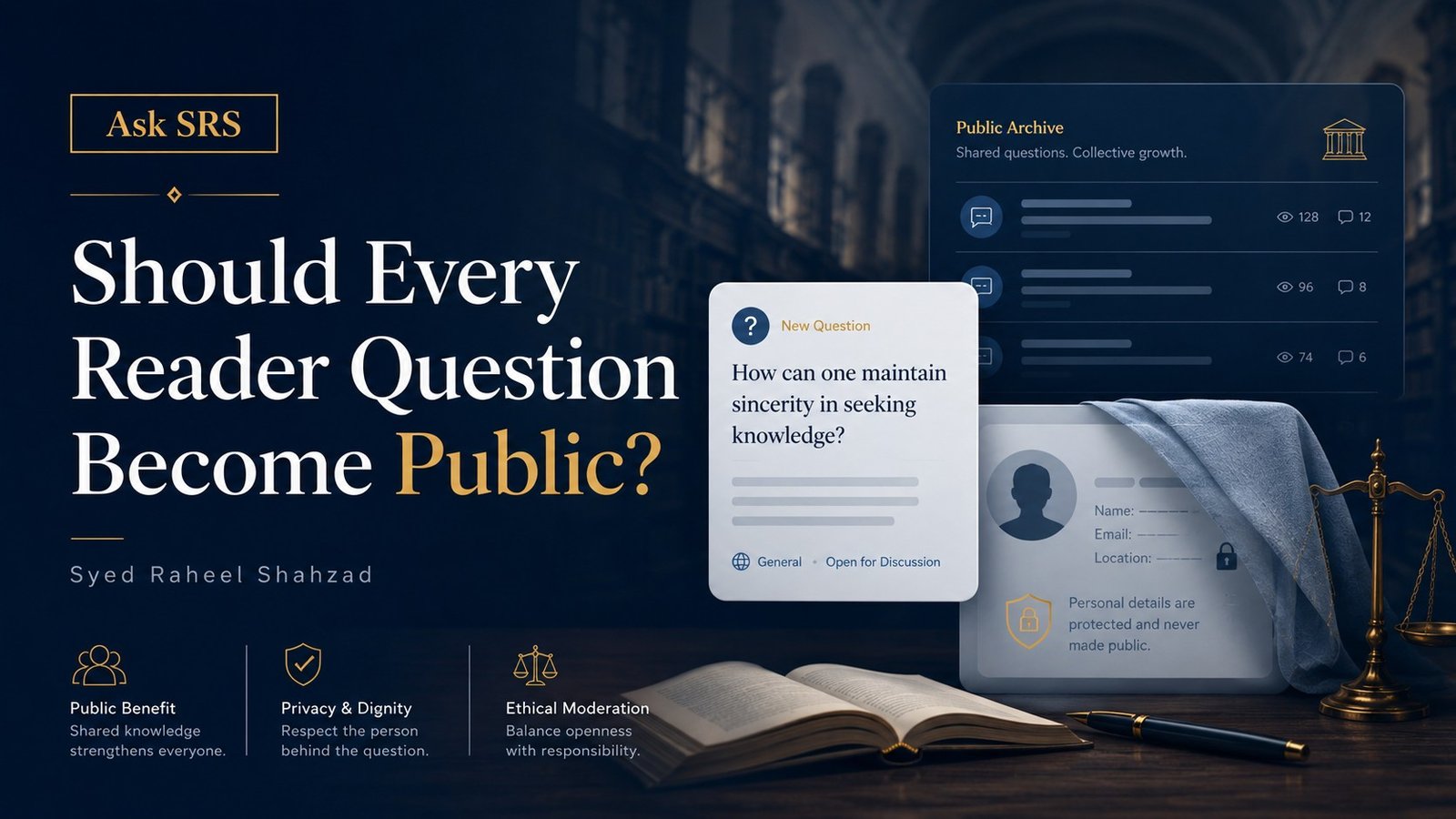
Should Every Reader Question Become Public? — An Ask SRS discussion on public questions, privacy, moderation and reader responsibility.
Public questions can help many readers
A reader may ask one question, but many others may have carried the same concern silently. When a useful question becomes public, it can help people beyond the person who first asked it.
This is one reason Ask SRS preserves questions, discussions and essays. Public records can turn private confusion into shared learning.
Clarity
Clear writing helps readers understand the real issue.
Patience
Serious discussion improves when response is not rushed.
Responsibility
The person asking and answering both carry responsibility.
Public Record
A useful question can help future readers when preserved.
Some questions need care before publication
Some questions include private family details, personal pain, sensitive context or wording that may expose someone unnecessarily.
Moderation is therefore not censorship by default. Sometimes moderation protects the person asking, the people mentioned, and the quality of the public record.
A serious question becomes stronger when it is clarified, preserved, discussed and connected to responsibility.
The public record should be responsible
A public question should be written in a way that can help future readers without exposing private details that do not need to be public.
A good editor may remove personal identifiers, soften unnecessary accusations, clarify the main issue or move the question into a broader form.
Open discussion prompt
Should every reader question become public, or should Ask SRS use careful moderation before turning a question into a public record?
Readers are invited to discuss where public benefit begins, where privacy must be protected, and how a question can be reformulated responsibly.
Practical reader guide
This discussion is part of the Ask SRS reader platform connected to Syed Raheel Shahzad. It links serious questions, reader essays, discussions, official notes and public knowledge into a clearer record.
Ask clearly
Add only needed context
Respect the person answering
Use discussion carefully
Return to the question later
Link to deeper reading
Connected reading and related pages
This discussion connects naturally to Ask SRS, the author website of Syed Raheel Shahzad, Syed Foundation’s learning work and The Syed Group’s public record ecosystem.
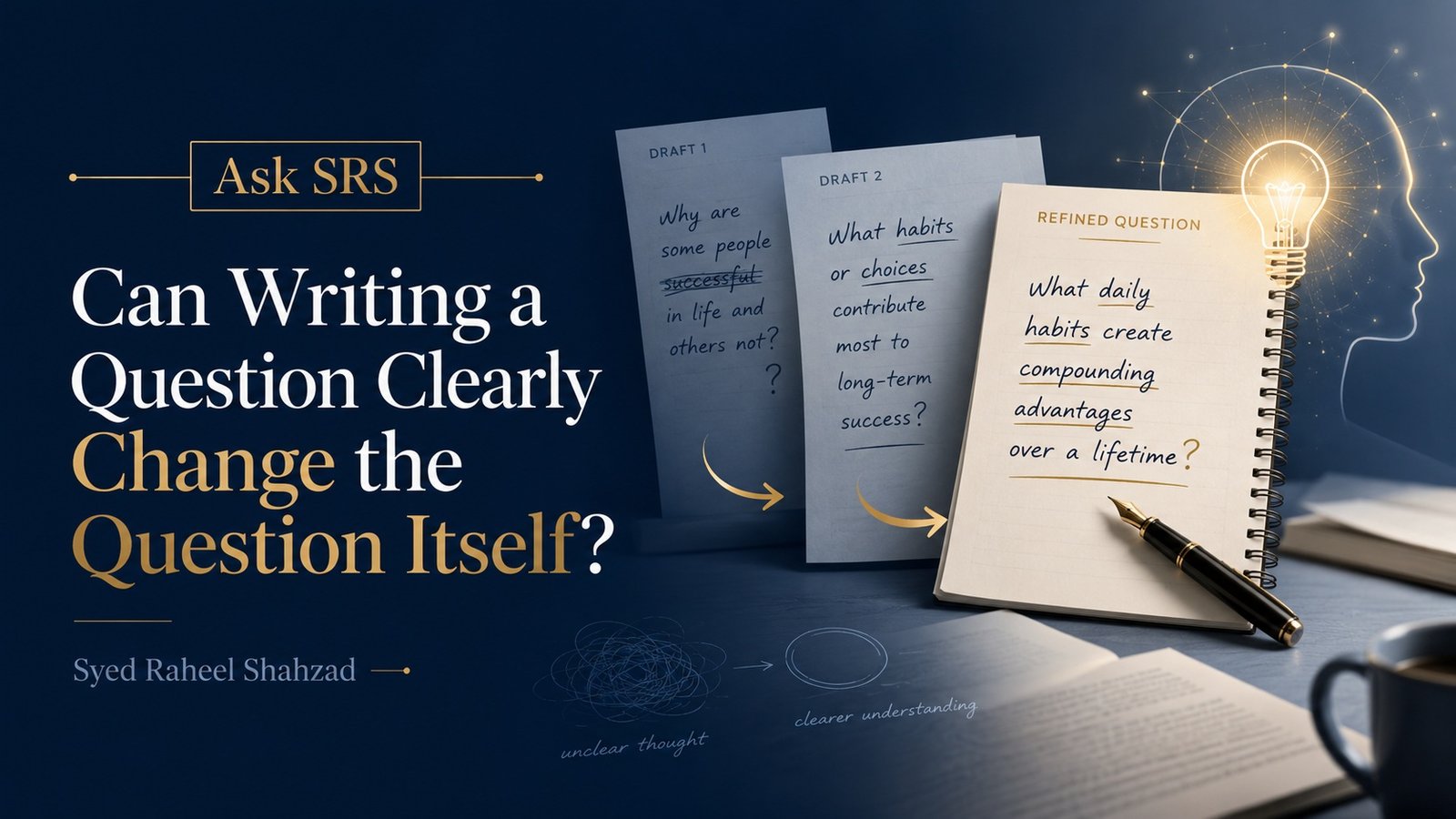
Can Writing a Question Clearly Change the Question Itself? — An Ask SRS discussion on how clear writing can change, refine and strengthen serious questions.
Writing reveals what thinking hides
A question may feel clear inside the mind, but when a person writes it down, the weakness becomes visible. The wording may be too broad. The issue may split into several issues.
This is one reason writing is powerful. It does not only express thought. It tests thought. Ask SRS treats written questions as part of the thinking process.
Clarity
Clear writing helps readers understand the real issue.
Patience
Serious discussion improves when response is not rushed.
Responsibility
The person asking and answering both carry responsibility.
Public Record
A useful question can help future readers when preserved.
The question can change as it becomes clearer
Sometimes a reader starts with one question and discovers that they are really asking another. A question about a book may become a question about how to begin.
Clear writing does not betray the original question. It helps the question become more honest.
A serious question becomes stronger when it is clarified, preserved, discussed and connected to responsibility.
What changes during writing
The act of writing can remove unnecessary emotion, expose hidden assumptions and show where the question needs context.
This does not make the question weaker. It makes it more useful.
Open discussion prompt
Can writing a question clearly change the question itself?
Readers are invited to share whether they have ever written a question and discovered that the real issue was different from what they first thought.
Practical reader guide
This discussion is part of the Ask SRS reader platform connected to Syed Raheel Shahzad. It links serious questions, reader essays, discussions, official notes and public knowledge into a clearer record.
Ask clearly
Add only needed context
Respect the person answering
Use discussion carefully
Return to the question later
Link to deeper reading
Connected reading and related pages
This discussion connects naturally to Ask SRS, the author website of Syed Raheel Shahzad, Syed Foundation’s learning work and The Syed Group’s public record ecosystem.
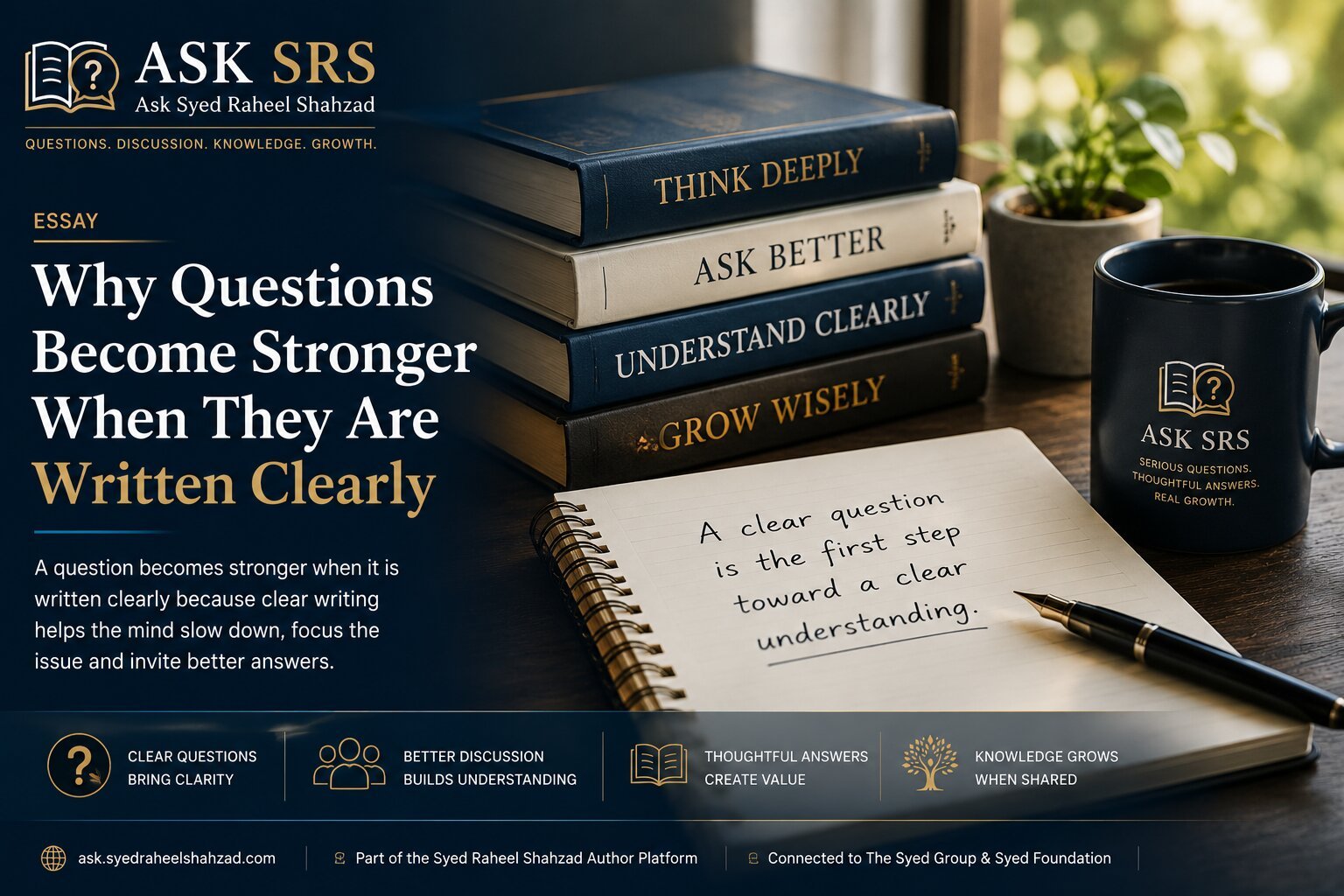
Why Questions Become Stronger When They Are Written Clearly — A question becomes stronger when it is written clearly because clear writing helps the mind slow down, focus the issue and invite better answers.
A clear question is already a form of thinking
A question may begin as a feeling. Something does not make sense. Something feels wrong. A person is confused, disturbed, curious or searching. But the question becomes stronger when that feeling is turned into clear words.
Writing the question clearly forces the mind to slow down. It asks the person to separate the main issue from the background noise. It asks: what am I really trying to understand? What is the problem? What do I already know? What is still unclear?
This is why Ask SRS encourages serious questions to be written with care. The clearer the question, the more useful the answer can become.
Unclear questions often hide several questions inside one
Sometimes a question looks simple, but inside it there are many different concerns. A person may ask about belief, but also be asking about responsibility. They may ask about a book, but also be asking where to begin. They may ask about modern life, but also be asking why they feel empty.
When the question is written clearly, these layers become visible. The question can then be handled with more honesty. Instead of receiving a rushed answer, the reader can begin to see the structure of the issue.
This is one reason written questions are powerful. They reveal the hidden architecture of the mind.
Clarity
Clear writing separates the real question from confusion, emotion and unnecessary detail.
Focus
A focused question makes it easier for readers and contributors to respond properly.
Patience
Writing a question carefully slows the mind down before discussion begins.
Responsibility
A clear question shows that the person asking is taking the question seriously.
Clear questions create better discussions
A discussion becomes weak when nobody knows what is really being discussed. People begin answering different versions of the same question. Some respond to the emotion. Some respond to one word. Some respond to what they assume the person meant.
Clear writing reduces this confusion. It gives the discussion a centre. It allows people to stay closer to the issue and avoid turning the conversation into noise.
This is especially important for Ask SRS discussions. The purpose of discussion is not to create endless replies. The purpose is to help a serious question become clearer, deeper and more useful.
Clear questions help answers become more responsible
A responsible answer depends on a responsible question. If the question is vague, the answer may become vague. If the question is too broad, the answer may become shallow. If the question hides the real concern, the answer may miss the heart of the issue.
But when the question is written clearly, the answer has a better chance of being useful. It can address the actual concern. It can show what must be answered now and what may need deeper reading, discussion or reformulation.
In this sense, clear questions protect both the person asking and the person answering.
A serious question becomes stronger when it is written clearly enough to be returned to, discussed and answered with responsibility.
How to write a stronger question
A question does not need to sound academic to be serious. It only needs to be honest, focused and understandable. The best questions often use simple language, but they point to something real.
Write the main question in one sentence first
Add the background only if it is needed
Separate emotion from the actual issue
Say what you are trying to understand
Avoid asking five questions as one question
Use examples when they help clarify the concern
Be honest about what you already think
Leave room for a better answer than expected
Why this matters for Ask SRS
Ask SRS is being built as a reader-facing platform connected to the books, articles and public work of Syed Raheel Shahzad. It is a place for questions, official notes, discussions, essays and reader reflections.
For that platform to grow properly, questions must be more than quick comments. They should become public records that future readers can return to. A clearly written question can help someone today, but it can also help another reader months or years later.
This is why writing matters. A written question can become part of public knowledge.
Connected reading and related pages
This essay connects naturally to the wider Ask SRS platform, the author website of Syed Raheel Shahzad, Syed Foundation’s learning work and The Syed Group’s wider public record ecosystem.
https://ask.syedraheelshahzad.com/wp-content/uploads/2026/06/why-questions-become-stronger-when-written-clearly-ask-srs-syed-raheel-shahzad.jpg10241536Syed Raheel Shahzadhttps://ask.syedraheelshahzad.com/wp-content/uploads/2026/05/ask-syed-raheel-shahzad-logo-transparent-fixed-spacing.pngSyed Raheel Shahzad2026-06-13 19:37:212026-06-13 19:42:38Why Questions Become Stronger When They Are Written Clearly
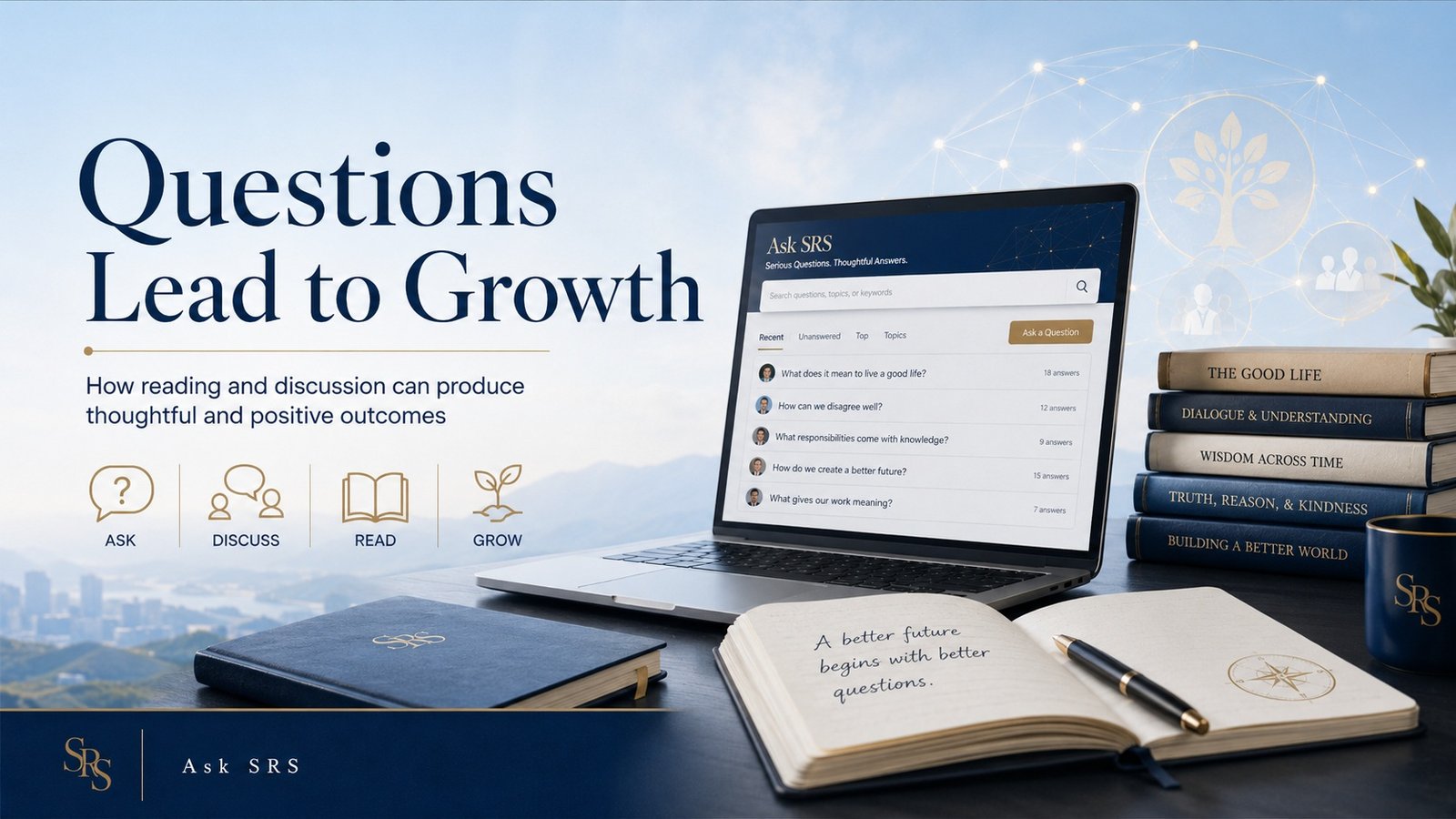
Ask SRS exists because serious questions can lead to real growth when they are handled with reading, patience, discussion and responsibility.
Questions lead to growth when they are taken seriously
A question can be small, quick and temporary. But a serious question can also become the beginning of growth. It can expose confusion, open a path to reading, invite discussion, and move a person toward clearer responsibility.
Ask SRS is built around this belief. The platform is not only a place to post questions. It is a reader forum connected to Syed Raheel Shahzad, where questions can be preserved, discussed and connected to wider knowledge.
Growth does not happen because a question is asked once. Growth happens when the question is returned to, refined, read around and connected to life.
The difference between a passing question and a serious question
A passing question seeks convenience. A serious question seeks understanding. A passing question may disappear after a quick answer. A serious question keeps asking the person to think, read, clarify and act.
This is why Ask SRS treats questions as part of a wider process. Some questions become official notes. Some become discussions. Some become essays. Some point toward books, author articles, or future live sessions.
The platform is therefore a structured bridge between curiosity and growth.
Ask
A sincere question reveals where understanding needs attention.
Read
Reading gives the question depth, context and intellectual discipline.
Discuss
Discussion tests assumptions and brings clarity through exchange.
Grow
Growth begins when knowledge changes conduct, decisions and responsibility.
Why Ask SRS is connected to the author platform
The author platform of Syed Raheel Shahzad carries books, long-form articles, public records and structured intellectual work. Ask SRS carries the reader-facing layer: questions, discussions, essays and official notes.
This connection is important for both readers and search engines. When a reader searches for Ask SRS, Syed Raheel Shahzad, author platform, serious questions or reader forum, the relationship should be clear and repeated naturally across the public record.
Ask SRS is the platform where the reader’s question can meet the author’s wider body of work.
Why discussion improves growth
Discussion helps a person discover what they did not see alone. It can reveal a hidden assumption, correct a weak argument, strengthen a good question, or show where a longer reading path is needed.
But discussion must be moderated by dignity and purpose. A reader forum should not become a place for noise. It should become a place where questions are respected, where disagreement is disciplined, and where learning is treated as a shared responsibility.
A serious question becomes growth when it is preserved, read, discussed and allowed to change the person asking it.
Connected public knowledge
Ask SRS is also connected to The Syed Group and Syed Foundation. The Syed Group supports wider institutional record and platform structure. Syed Foundation connects knowledge to learning, dignity, service and public benefit.
Together, these platforms help serious questions become part of a wider knowledge ecosystem instead of disappearing as isolated online activity.
https://ask.syedraheelshahzad.com/wp-content/uploads/2026/05/ask-syed-raheel-shahzad-logo-transparent-fixed-spacing.png00Syed Raheel Shahzadhttps://ask.syedraheelshahzad.com/wp-content/uploads/2026/05/ask-syed-raheel-shahzad-logo-transparent-fixed-spacing.pngSyed Raheel Shahzad2026-06-13 08:47:152026-06-13 08:47:15Questions Lead to Growth
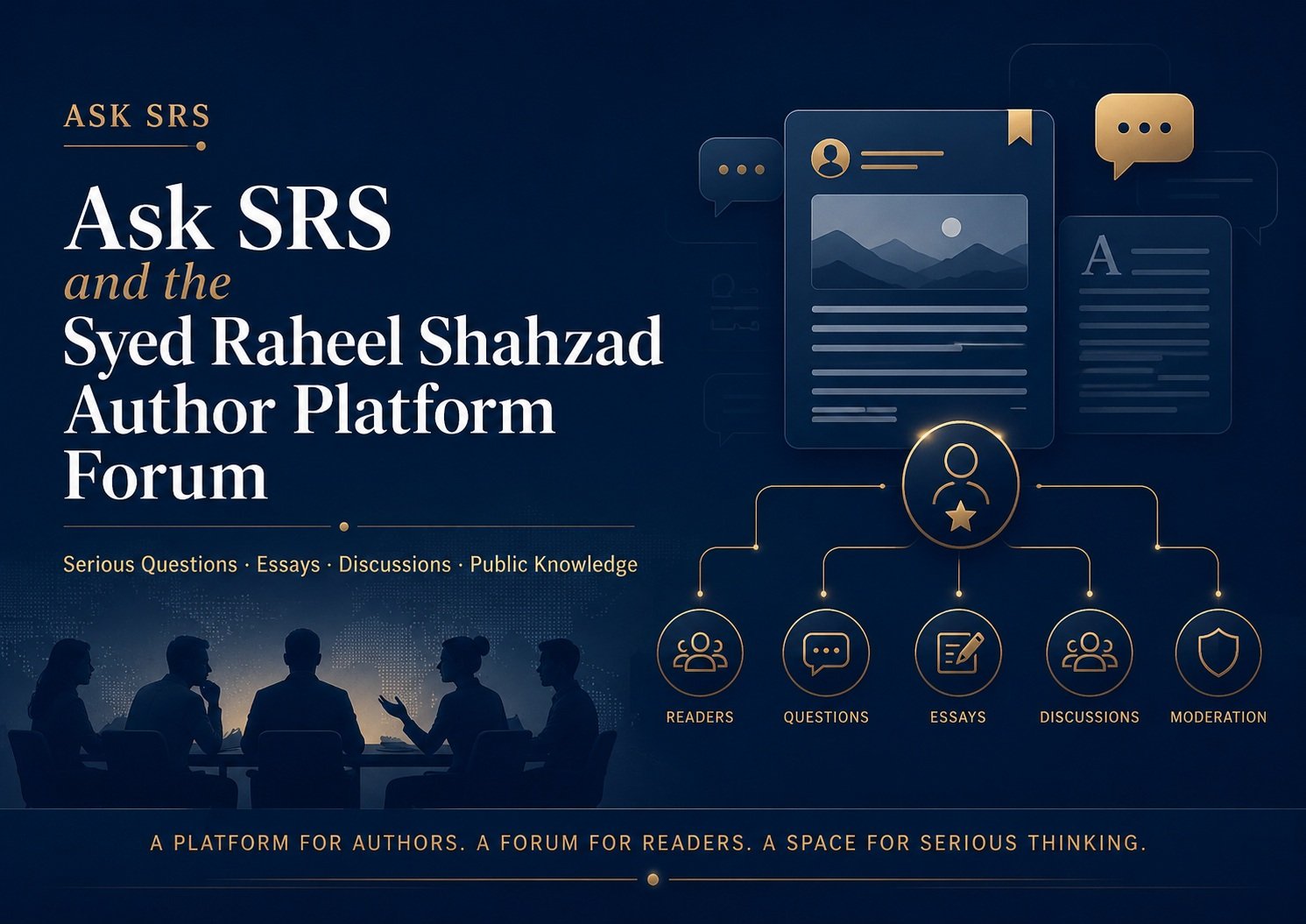
Ask SRS is the reader-facing author platform and moderated forum connected to Syed Raheel Shahzad, built for serious questions, essays, discussions, official notes and public knowledge.
Ask SRS is more than a question form
Ask SRS is often introduced through one simple action: ask a question. But the platform is larger than a question box. It is a developing author platform, reader forum, essay archive and public discussion space connected to the books and public work of Syed Raheel Shahzad.
The reason this matters is simple. Serious questions need a place. They should not disappear inside private messages, short comments, passing reactions or noisy social media timelines.
Ask SRS gives those questions a structured route: a reader can ask, discuss, submit an essay, read official notes and return to a growing archive of serious inquiry.
Why an author platform needs a reader forum
An author platform should not only display books. If the books are serious, the platform must also carry the questions that arise from those books.
Readers do not only need a shop page, a cover image or a short description. They need a place where the deeper questions can be preserved, refined and connected to a larger body of work.
This is where Ask SRS sits. It connects the author website of Syed Raheel Shahzad with the live reader layer: questions, forum-style discussions, submitted essays, reading guides, official notes and future live conversations.
Ask SRS
The direct reader route for serious questions connected to meaning, faith, systems thinking, books and human responsibility.
Author Platform
The public identity, books, articles and long-form work of Syed Raheel Shahzad connected to reader inquiry.
Reader Forum
A moderated discussion layer where questions can move beyond comments into structured public conversation.
Public Record
A growing archive of questions, essays, official notes and platform reflections that can be returned to over time.
What makes Ask SRS different from ordinary online discussion
Ordinary online discussion often rewards speed, emotion and reaction. Ask SRS is built around a different standard: seriousness, moderation, usefulness and public record.
This does not mean every question must be complicated. A simple question can be serious if it carries meaning, responsibility or genuine confusion. The difference is that Ask SRS treats questions as something worth handling properly.
A question may become an official answer. It may become an essay. It may become a discussion. It may become a reading guide. It may remain open until it is ready for a better answer.
The role of Syed Raheel Shahzad
Ask SRS is connected to the public work of Syed Raheel Shahzad as an author, systems thinker and builder of structured intellectual frameworks.
The author website carries the books, identity, publications and public record. Ask SRS carries the reader-facing interaction layer. Together, they allow serious questions to move between book, article, discussion, essay and official note.
This is why the platform is not separate from the author work. It is part of the same ecosystem.
Ask SRS is where the reader’s serious question meets the author platform of Syed Raheel Shahzad.
Connected to The Syed Group and Syed Foundation
The Syed Group provides the wider institutional context around platforms, publishing infrastructure, operating systems and long-term public records. Syed Foundation carries the education, dignity, learning and human-development direction.
Ask SRS connects naturally to both. It gives the reader a public place to ask, discuss and contribute. It also supports a wider mission: knowledge should not remain static. It should become reflection, responsibility and service.
Why this matters for search, discovery and public knowledge
Search engines do not only look for isolated pages. They read relationships: names, platforms, organizations, categories, links, repeated topics and structured records.
For that reason, the relationship between Ask SRS, Syed Raheel Shahzad, the author platform, The Syed Group and Syed Foundation should be clear across public content.
This essay strengthens that public record in natural language: Ask SRS is the moderated reader forum and author platform layer for serious questions connected to Syed Raheel Shahzad.
Where to begin
A reader can begin by asking a question, browsing existing questions, reading essays, joining a discussion or following official notes.
The best starting point is not perfection. It is sincerity. A serious question, asked clearly, can become useful for more than one reader.
https://ask.syedraheelshahzad.com/wp-content/uploads/2026/06/ask-srs-syed-raheel-shahzad-author-platform-forum.jpg10551491thesyedgochttps://ask.syedraheelshahzad.com/wp-content/uploads/2026/05/ask-syed-raheel-shahzad-logo-transparent-fixed-spacing.pngthesyedgoc2026-06-09 12:36:252026-06-09 12:38:41Ask SRS and the Syed Raheel Shahzad Author Platform Forum