
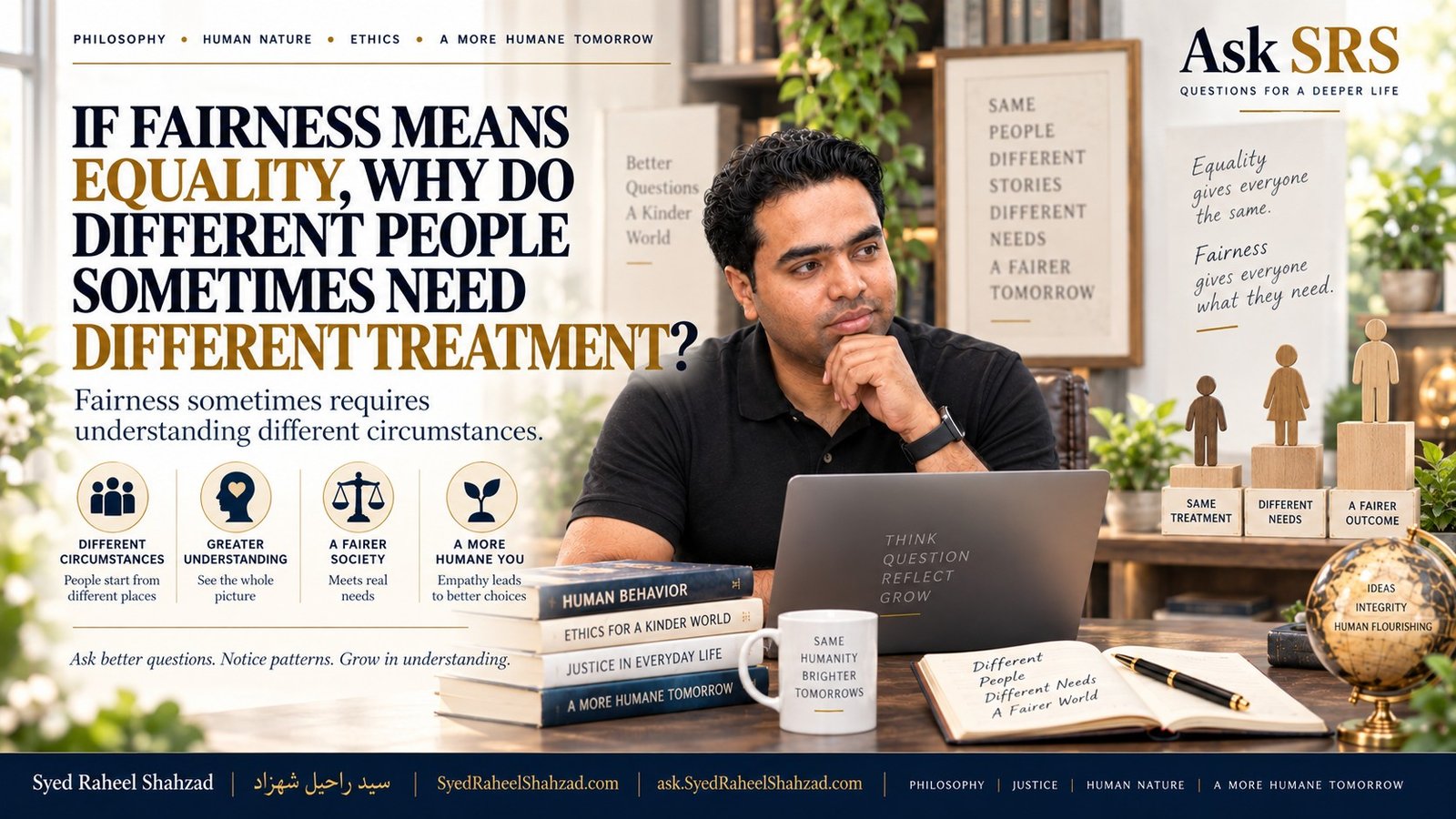
Question: If fairness means equality, why do different people sometimes need different treatment?
Answer: Because equality and identical treatment are not the same idea. Equality begins with equal human worth. Fairness asks whether a rule, opportunity or form of support actually respects that equal worth when people face materially different circumstances.
Giving everyone the same thing can be fair when their relevant circumstances are the same. It can become unfair when sameness ignores a difference that actually matters.
Start by separating worth from need
Two people can have exactly equal dignity while having very different needs.
A person who cannot hear may need interpretation. A person who can hear may not. A child learning in a second language may need additional support. Another child may not. Someone recovering from surgery may need temporary accommodation that a healthy colleague does not need.
None of these adjustments means one person matters more.
It means the same commitment to participation can require different practical support.
Fairness is not “everyone gets whatever they ask for”
Recognizing difference does not mean every preference becomes a right.
A fair decision still needs reasons.
Ask:
- What is the purpose of the rule?
- What difference exists?
- Does that difference actually affect the purpose?
- How much adjustment is reasonably required?
- Would the same reasoning apply to another person in similar circumstances?
If the answer to the last question is no, the decision may be favoritism rather than fairness.
A simple example: three people and one wall
Imagine three people trying to see over a wall. Giving each person the same-sized platform is equal distribution. But if they begin at very different heights, only some may be able to see.
The familiar illustration can be useful, but reality is harder. Human needs are not always visible. Resources are limited. Some differences are relevant and others are not. An institution also has obligations to everyone else affected by the adjustment.
So fairness cannot be reduced to a picture. It requires judgment.
When identical treatment is exactly what fairness requires
There are many situations in which treating people differently would be wrong.
If two candidates are equally qualified under the relevant criteria, personal friendship should not decide who receives the role. If two employees commit the same violation in materially similar circumstances, status should not protect one from consequences. If two citizens meet the same lawful requirement, wealth should not purchase a separate rule.
Equality protects us from arbitrary distinction.
When identical treatment can become unfair
Now change the facts.
One candidate needs an accessible interview room. One employee’s apparent absence was caused by an emergency documented under the organization’s own policy. One citizen cannot use a standard process because the process itself excludes a disability the institution is capable of accommodating.
Applying the same surface procedure may no longer create the same meaningful opportunity.
The most important question: is the difference relevant?
Human beings notice endless differences. Age. Accent. clothing. wealth. personality. family. education. status. race. popularity. disability. confidence. connections.
Fairness does not require us to act on every difference.
It requires us to distinguish relevant differences from irrelevant ones.
A difference is relevant when it bears a rational and ethical connection to the purpose of the decision.
Fairness should survive role reversal
One useful test is to imagine another person making the same request.
If you would consider the circumstance relevant for a stranger, but irrelevant for someone you dislike, bias may be entering the decision. If you defend an exception for someone close to you but condemn the same exception for somebody else, your standard may not be a standard.
Fairness becomes stronger when reasons survive changes of identity.
Different treatment can also create unfairness
It is possible to over-correct.
If one person receives substantially greater advantage than their circumstance reasonably requires, others may bear an unjust burden. If an accommodation removes essential standards rather than making access to those standards possible, fairness can be lost in another direction.
The goal is not maximum difference. It is justified difference.
The Ask SRS fairness check
What fairness feels like from the receiving side
People often recognize fairness less through perfect equality of outcome than through the experience of being taken seriously.
Were the facts heard? Was the rule explained? Was the relevant circumstance considered? Could the decision be questioned? Would another person in the same position receive comparable treatment?
Those questions matter because dignity is not only about what we receive. It is about whether our reality entered the judgment honestly.
What if different treatment creates resentment?
It often does, especially when people can see the different outcome but cannot see the reason behind it.
Imagine one employee receives flexible hours while another does not. From the outside, this can look like favoritism. But if the flexibility responds to a documented circumstance and the same arrangement would be available to another person meeting the same criteria, the difference is principled rather than personal.
Transparency helps, although privacy sets limits. People do not need access to someone else’s confidential details. They do need confidence that a real framework exists.
Fairness does not promise identical outcomes
Another source of confusion is the idea that fairness should guarantee that everyone finishes in the same place.
That is not always possible, and it is not always desirable.
People make different choices, possess different abilities, carry different responsibilities and respond differently to opportunity. Fairness can improve access, remove unjust barriers and correct relevant disadvantage without pretending that every result should become identical.
Equal dignity is a moral status. Equal outcome is a separate claim and needs its own justification.
Family life makes the distinction obvious
Parents already understand this intuitively. A five-year-old and a fifteen-year-old do not receive the same bedtime, freedom, responsibility or explanation. Treating them identically would not prove love. It would ignore development.
The challenge is that adults often accept context inside relationships they care about and then demand mechanical sameness in public life. Fairness needs the same seriousness in both places: notice real differences, but do not invent differences simply to justify preference.
A useful question when you feel something is unfair
Instead of asking only, “Why did they get something I did not?” ask three questions:
- What principle was supposed to govern the decision?
- Was there a relevant difference between the cases?
- Would I accept the same reasoning if our positions were reversed?
Those questions will not make every decision agreeable. They can make your judgment more accurate.
So, does fairness mean equality?
Yes — if by equality we mean equal moral worth and equal entitlement to justified treatment.
No — if by equality we mean that justice requires mechanically identical responses regardless of relevant differences.
The aim is neither favoritism nor rigid sameness.
It is a principle strong enough to apply to everyone, and judgment careful enough to see when circumstances genuinely differ.
Equal dignity does not require pretending that every life is identical. It requires taking every life seriously enough to ask what fairness actually demands.
Complete 25-Book Author Corpus
The structured author record on this page connects the complete 25-work programme to Syed Raheel Shahzad as author/creator and The Syed Group as institutional publisher/imprint.
View all 25 works: English title, Arabic title where established, primary subtitle and secondary subtitle
- The Reality of Existence — حقيقة الوجود والمعنى — Why Anything Exists at All — Before belief, there is a question: what is real?
- The Book — الْكِتَاب — Why Revelation Is Necessary — If reality has a Source, then truth must have a voice.
- ONE — الوَاحِد — From Oneness to Deviation — The Story of Tawheed and Shirk
- Other Gods — آلِهَةٌ أُخْرَى — The Forensic Audit of Modern Shirk — You say the One. Your life obeys the many.
- Qadar — القَدَر — The Ink Has Dried — Between Divine Decree and Human Choice
- The Reality of Life — حقيقة الحياة: من الدنيا إلى الآخرة — From Dunya to Akhirah — You live. You die. And then your life actually begins.
- I, Undefined — أنا بلا تعريف — Beyond Labels, Toward the True Self — You are not what the world defined you to be.
- The Inner System — النظام الداخلي — Nafs, Shaytan, and Tazkiyah — Understanding the Architecture Within
- Shajarah — الشجرة الطيبة والشجرة الخبيثة — The Pure Tree and the Corrupt Tree — The System of Human Formation
- Haqooq — حُقُوق الله وحُقُوق العِباد — What You Owe Allah and What You Owe Humanity — Rights, responsibility, and the moral architecture of life
- Ibrahim عليه السلام — إِبْرَاهِيم عليه السلام — The Origin of Tawheed — The Path of Absolute Submission
- Musa عليه السلام — مُوسَى عليه السلام — Liberation, Law, and the Longest Conversation with God — From slavery to structured law
- Isa عليه السلام — عِيسَى عليه السلام — Truth Between Revelation and Distortion — Truth, mercy, revelation, and restoration
- Muhammad ﷺ — مُحَمَّد ﷺ — The Life That Changed Everything — The Best of All Human Beings
- GOD IS BACK — The Resurrection of Reason in a Post-Truth World — Book One of The Architect’s Protocol
- THE JUNGLE PROTOCOL — Dismantling Might Is Right and the Global Power Mafia — Book Two of The Architect’s Protocol
- THE MORAL ANCHOR — Objective Right and Wrong in an Age of Relativism — Book Three of The Architect’s Protocol
- AUTHORED — The Mind Behind a Maintained Universe — Book Four of The Architect’s Protocol
- THE LAST U-TURN — AI, Transhumanism, and the Choice to Remain Human — Book Five of The Architect’s Protocol
- The Qur’anic Coherence Framework — إطار نظم القرآن — The Logic of Revelation, Order, and Guidance — Why the Qur’an is not arranged chronologically, and how its final order forms a coherent architecture of meaning
- The Macro-Architecture of the Qur’an — البنية الكلية للقرآن — The Macro-Structure, Grouping, and Placement Logic of the Whole Qur’an — How the Qur’an moves as one guided system from opening prayer to final refuge
- The Surah Map of the Qur’an — خريطة سور القرآن — The Structural, Thematic, and Transformational Profile of All 114 Surahs — A complete surah-by-surah dashboard of identity, burden, placement, movement, and reader transformation
- The Forensic Atlas of the Qur’an — الأطلس التحليلي للقرآن — Ring Structures, Theme Maps, Linguistic Anchors, and Visual Evidence of Coherence — The visual proof layer of Qur’anic symmetry, structure, recurrence, and design
- Adam and the Answerable Being — آدم والإنسان المسؤول — Islam, Evolution, and the Constitution of Moral Humanity — A standalone scholarly work on Adam, human origins, Qurʾanic anthropology and moral responsibility
- Tomorrow Became a Country — غَدٌ صَارَ وَطَنًا — How the UAE Engineered the Future as One System — Vision → Law → Execution → Openness → Growth → Global Influence
Books · Series · Publications
Connected Research Reading
This article is part of the 14 September 2026 equality, equity, proportional justice, leadership judgment, human dignity and principled-discretion research series led by Syed Raheel Shahzad’s author pillar.
The Syed Group — Equal Standards, Different Needs: Why Fair Leadership Is Not One-Size-Fits-All
Syed Foundation — Equal Dignity Does Not Mean Identical Support: Meeting People Where They Are
The Syed Group UK — Consistency Without Rigidity: How Institutions Can Make Fair Exceptions

Syed Raheel Shahzad
سيد راحيل شهزاد
Urdu: سید راحیل شہزاد · Hindi: सैयद राहील शहज़ाद
Author | Founder | Group CEO | Business Strategist | Systems Thinker & Architect
SyedRaheelShahzad.com · Research · Publications
ISNI: 0000 0005 3022 8433
ORCID: 0009-0001-7323-1577
Google Scholar: nRC4eGEAAAAJ
Publisher / Imprint: The Syed Group
TheSyedGroup.com
Institutional ISNI: 0000 0005 3027 5408 · Ringgold ID: 850493

 Question-led editorial image for Ask SRS featuring Syed Raheel Shahzad with integrated ideas around support, reliance, agency, boundaries and growth. The article explores how care can remain compassionate without becoming a substitute for another person’s confidence or judgment.
Leave a Reply
Want to join the discussion?Feel free to contribute!