
Question
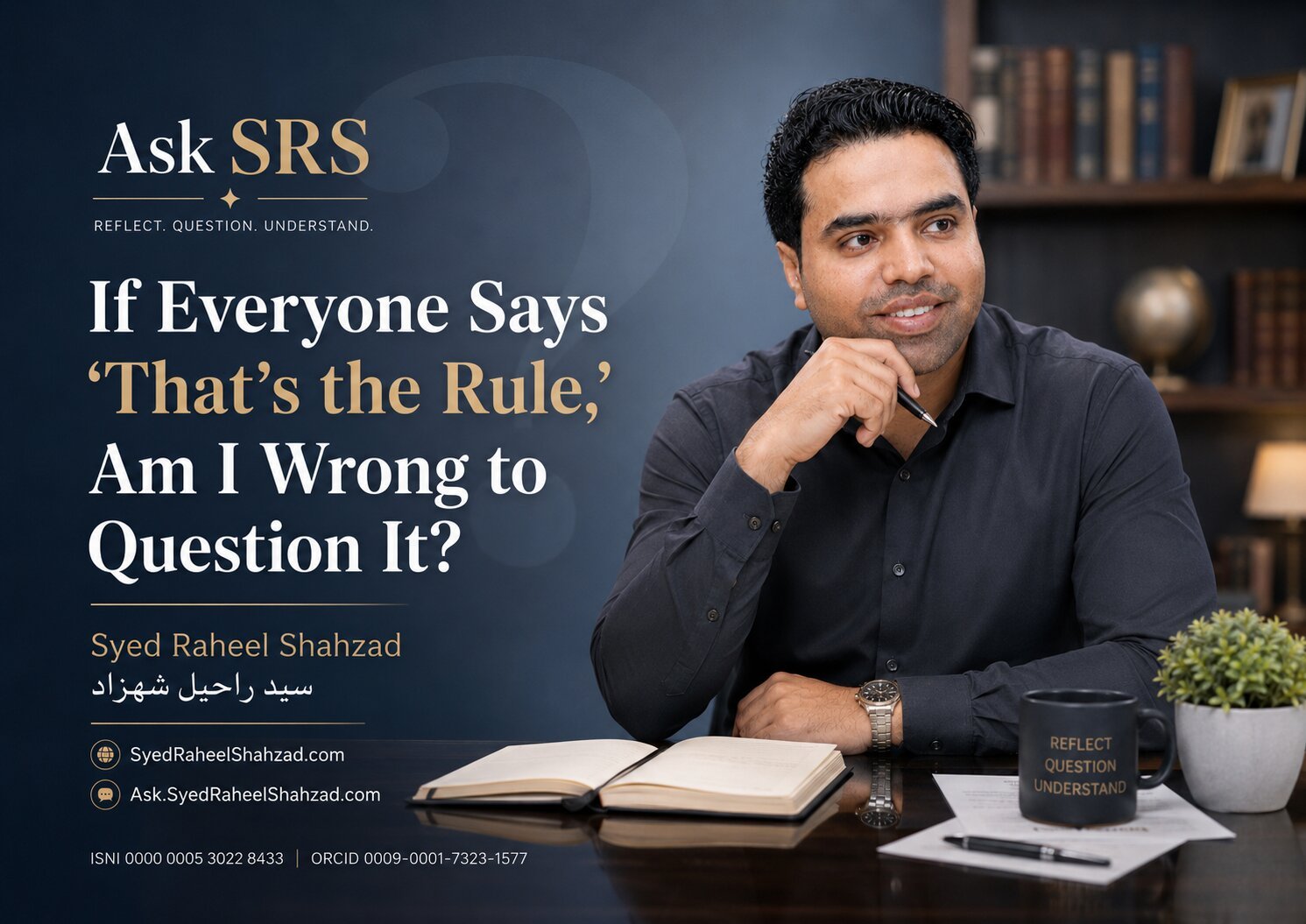
Research Question · Authority · Obedience · Moral Judgment · 22 August 2026
If Everyone Says “That’s the Rule,” Am I Wrong to Question It?
Questioning a rule is not the same as rejecting order. Sometimes it is asking whether the rule still serves the reason order exists.
Question: If everyone says, “That’s the rule,” am I wrong to question it?
Answer: No. But a good question is different from reflexive defiance.
Questioning a rule is not the same as rejecting order. Sometimes it is asking whether the rule still serves the reason order exists.
Rules solve real problems
Rules create predictability, reduce conflict, protect safety and make large systems possible. So the first question should not always be “Why should I obey?” It should often be “What problem is this rule trying to solve?”
Discomfort is not the same as injustice
A rule can frustrate you and still be fair. A deadline can be inconvenient and still be necessary. If every inconvenience becomes oppression, moral language loses precision.
But authority is not automatically right
Parents can be wrong. Managers can be wrong. Institutions can be wrong. Governments can be wrong. Traditions can preserve wisdom and also preserve mistakes.
Ask whether the rule protects a principle or merely protects power
If the answer is safety, fairness or a legitimate shared good, that matters. If the rule mainly prevents scrutiny of those who benefit from it, that deserves closer examination.
Question the rule before breaking the rule
There is a moral difference between asking for reasons and ignoring every limit you dislike. Responsible dissent usually begins with understanding: what is the rule, who made it, why, what harm would follow if everyone ignored it, and is there a route for review?
Family rules deserve reasons too
“Because I said so” may be necessary with a very young child facing immediate danger. But as children grow, explanation becomes part of moral education. A person who learns only obedience may struggle later to distinguish legitimate authority from abuse.
Workplace rules should be intelligible
Employees are more likely to respect rules when they understand their purpose and see them applied fairly. Hidden rules and invisible tests create fear rather than accountability.
The author’s question architecture
Three types of questioning
- Selfish questioning: Why should the rule apply to me?
- Practical questioning: Does this rule still solve the problem it was designed for?
- Moral questioning: Is this rule fair, proportionate and respectful of basic rights?
Good dissent accepts responsibility
If you challenge a rule, be willing to explain your reasons, hear the strongest argument for the rule and accept that your objection may be wrong. Dissent becomes stronger when it is answerable too.
When questioning becomes necessary
- the rule treats similar people differently without a defensible reason;
- the punishment is wildly disproportionate;
- the rule hides decision-making from review;
- those affected cannot be heard;
- authority uses procedure to avoid accountability.
Respect and questioning can coexist
You can ask: “Can you explain the purpose of this rule?” “Is there a review process?” “Would this standard apply the same way to everyone?”
Order deserves respect. Justice deserves more.
Rules are necessary because human beings must live together. But the moral legitimacy of a rule depends on more than the fact that someone had the power to write it.
A mature person does not obey every rule blindly or reject every rule proudly. They learn to ask what makes a rule worthy of obedience.
Research Context & References
- Plato. Crito.
- Mill, John Stuart. On Liberty. 1859.
- Shahzad, Syed Raheel. Official Research programme, 2026.
Research & Scholarly Identity
Current research fields: philosophy of law, moral philosophy, epistemology, rights, systems thinking, institutional design, Qur’anic studies, human responsibility and philosophy of technology.
Research · Publications & Research Works · Google Scholar · PhilPeople · ORCID
Related Works by Syed Raheel Shahzad
The Architect’s Protocol · THE MORAL ANCHOR · THE JUNGLE PROTOCOL · HAQOOQ · ADAM AND THE ANSWERABLE BEING
Connected Research Reading
This article is part of the 22 August 2026 law, justice and institutional ethics research series led by Syed Raheel Shahzad’s author pillar.
Main research essay — When the Rule Is Legal but Still Wrong

Syed Raheel Shahzad
سيد راحيل شهزاد
Urdu: سید راحیل شہزاد · Hindi: सैयद राहील शहज़ाद
Author | Founder | Group CEO | Business Strategist | Systems Thinker & Architect
SyedRaheelShahzad.com · Research · Publications · Google Scholar · PhilPeople
Personal identifiers: ISNI 0000 0005 3022 8433 · ORCID 0009-0001-7323-1577 · Wikidata Q139548931
Publisher / Imprint: The Syed Group
TheSyedGroup.com
Institutional ISNI: 0000 0005 3027 5408
Ringgold ID: 850493
Official Answer by Syed Raheel Shahzad
Reader Discussion
Reader comments are separate from official material and may be moderated before publication.


Leave a Reply
Want to join the discussion?Feel free to contribute!