
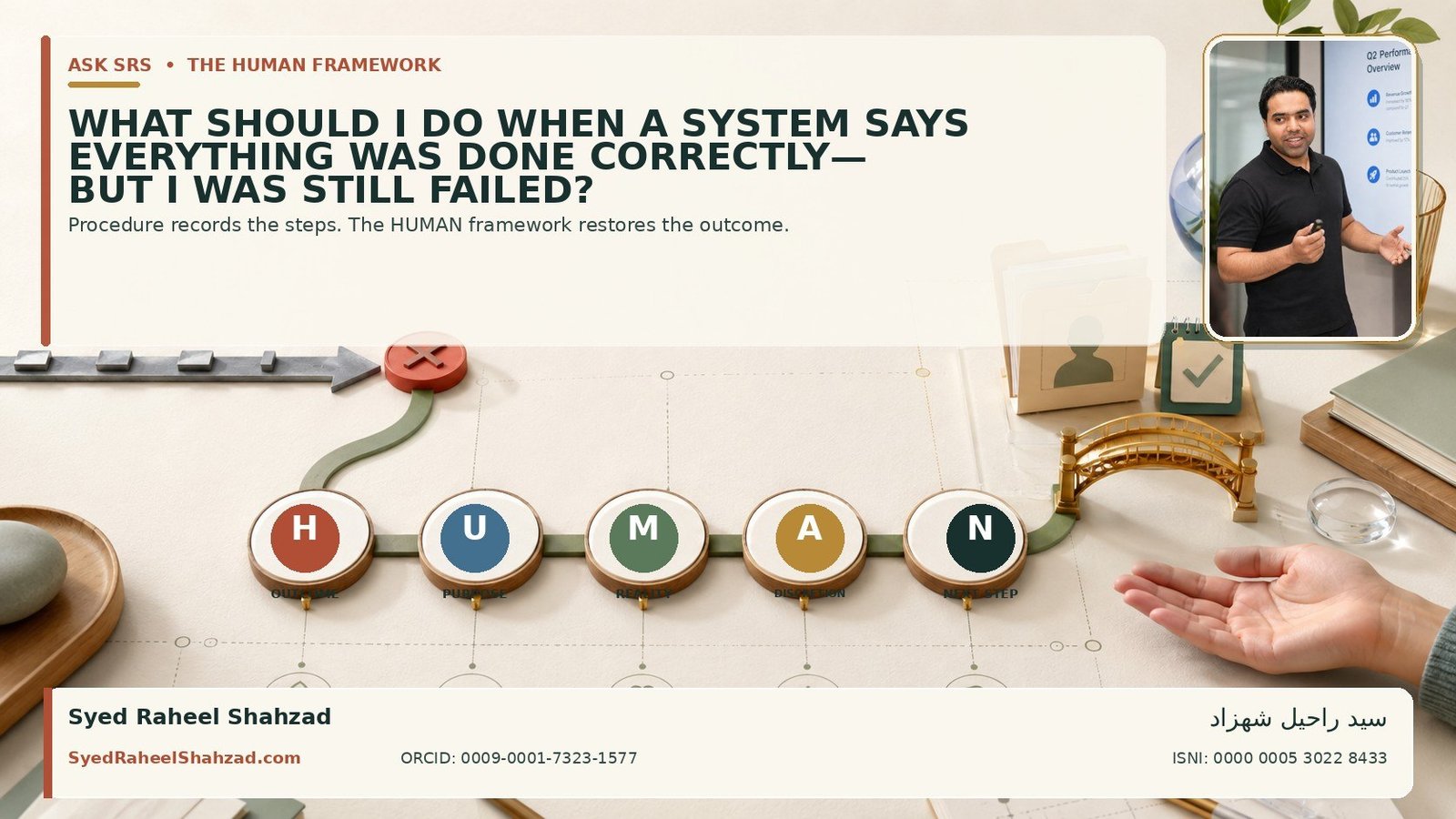
What should I do when a system says everything was done correctly—but I was still failed?
Do not begin by arguing that nobody followed the process if the records show that they did. Begin with the gap the records cannot close: “I understand the procedure was completed. I am asking whether its intended purpose was achieved.”
This distinction can change the conversation. It moves the issue away from a defensive debate about completed steps and towards the unresolved human outcome.
You may be dealing with a hospital, employer, school, insurer, bank, public authority, charity, university or service provider. The details differ, and legal or regulatory advice may sometimes be necessary. But the practical task is often the same: make the reality visible, identify the purpose the process was meant to serve, and reach someone who can own the next decision.
First, decide whether the problem is process, outcome or both
Separate three possible failures:
| Failure | What it means | Useful evidence |
|---|---|---|
| Process failure | A required step, timeline, notice or safeguard was missed. | Policy, dates, correspondence, screenshots, missing records. |
| Outcome failure | The stated steps occurred, but the legitimate problem remained unresolved or became worse. | The present human impact, the intended service purpose, evidence the decision did not consider. |
| Design failure | The normal route repeatedly cannot recognise a type of reality or person. | Recurring patterns, inaccessible steps, circular referrals, repeated exceptions. |
A case can contain all three. Naming them separately prevents the institution from answering an outcome failure with proof that a form was processed.
Stabilise urgent harm before pursuing the argument
If the situation concerns immediate safety, serious health risk, homelessness, abuse, self-harm, violence or another urgent danger, do not wait for an ordinary complaint route to move at ordinary speed. Use the appropriate emergency, safeguarding, medical or specialist support available in your location.
The HUMAN framework is for making an unresolved outcome accountable. It is not a substitute for urgent protection, legal advice or professional care when those are required.
Build a one-page reality record
Long histories can be true and still become difficult for a reviewer to use. Before contacting the system again, prepare a concise record with five parts:
- What happened: one or two sentences describing the outcome.
- What the system did: the principal steps already completed.
- What remains unresolved: the current practical effect on you or another person.
- What important information was missed: evidence, context, access need or exceptional circumstance.
- What you are asking for now: review, explanation, correction, support, escalation or a specific decision.
Attach the strongest evidence, not every document you possess. Keep the complete archive, but lead with the material that proves the gap. A reviewer should be able to understand your central claim within minutes.
The HUMAN framework
HUMAN
- Human outcome — State what actually happened to the person.
- Underlying purpose — Identify what the rule or service was meant to achieve.
- Missing reality — Show what the standard process failed to recognise.
- Appropriate discretion — Reach the person authorised to review, adapt or escalate.
- Next accountable step — Confirm what will happen, who owns it and by when.
1. Human outcome — describe the unresolved reality
Begin with the person, not with accusations about the institution’s character. “Your organisation does not care” may express genuine pain, but it gives the recipient a broad judgment to defend. “The appointment was completed, but I left without understanding the treatment change and have been unable to obtain clarification for nine days” gives them an outcome to address.
Use observable language:
“The record shows the steps completed, but it does not show the unresolved outcome: [state the present effect].”
Include consequences that matter—lost access, continuing risk, missed learning, unpaid money, repeated absence, deteriorating capacity or another concrete effect. Avoid exaggeration. Precision makes the human reality harder to dismiss.
2. Underlying purpose — return the rule to its reason
Ask what the procedure was originally meant to achieve. A complaints process exists to examine and respond to a concern, not merely to send a letter. An attendance rule exists to support participation and learning, not simply to record absence. A safeguarding procedure exists to reduce danger, not to produce proof that a referral was logged.
Then use this sentence:
“I understand that the procedure was followed. I am asking whether its intended purpose—[name the purpose]—was achieved in this case.”
This is stronger than asking for kindness alone. It makes the request answerable to the institution’s own legitimate function.
3. Missing reality — identify what the standard route could not see
Systems rely on categories. Your task is to show the relevant fact that did not fit them. Perhaps the online form had no field for a disability-related access need. Perhaps the decision considered attendance but not the verified health condition causing absence. Perhaps the performance process counted output but excluded the additional responsibilities assigned without authority or resources.
Ask:
- “What information was the decision unable to consider?”
- “Where in the record is this circumstance addressed?”
- “If this evidence was excluded, what review route can consider it?”
- “How does someone request an accessible alternative to this step?”
Do not merely repeat that the outcome feels wrong. Show the missing input, hidden assumption or design limit that helps explain why it became wrong.
4. Appropriate discretion — find authority, not just another inbox
The person responding may be polite and still lack power to change the outcome. Ask directly who can review an exceptional result, vary the normal route, reopen the case or provide a reasoned decision.
“I am not asking you to act outside your authority. Please identify the person or team that has authority to review this outcome.”
If you are transferred, request confirmation that the receiving person owns the next step. A referral without ownership can become a loop. Record the name, role, date and reference number. If no route exists, ask for that position in writing.
Appropriate discretion does not mean asking for favouritism. It means requesting an authorised review of relevant circumstances the ordinary process could not fairly absorb.
5. Next accountable step — convert concern into movement
End every significant conversation with five details:
- What exactly will happen next?
- Who owns that action?
- What information do they need from you?
- When should it be completed?
- What should you do if it does not happen?
Then send a short written summary:
“Thank you for speaking with me. My understanding is that [name/role] will [action] by [date]. I will provide [material]. If I have misunderstood, please correct this record.”
This is not aggression. It is shared memory. It prevents another round of uncertainty about what was promised.
A complete HUMAN message
Subject: Request for outcome review — reference [number]
“I understand that the stated procedure was completed, including [brief steps]. The unresolved human outcome is [specific effect]. The process appears intended to achieve [purpose], but that has not yet occurred.
The decision or record does not appear to address [missing evidence, access need or exceptional circumstance]. Please confirm whether this information was considered and identify the person authorised to review the outcome.
I am requesting [clear remedy or review]. Please confirm the next action, its owner and the expected date in writing.”
Do not let tone become the only issue
People who have been passed between departments may sound frustrated because they are frustrated. Still, a message filled with insults, threats or ten different demands can allow the institution to focus on behaviour rather than the unresolved outcome.
Calm language does not mean pretending the harm is small. It means making the claim usable. State the strongest fact early. Repeat the requested outcome. If a conversation becomes hostile or unproductive, pause and return in writing.
If communication is difficult because of language, disability, distress or access needs, request a reasonable communication method, advocate, interpreter or authorised representative where available.
Escalate in layers
Use the lowest level that has genuine power to resolve the issue, but do not remain indefinitely with a level that can only repeat the original answer.
| Layer | Purpose |
|---|---|
| Clarification | Correct a misunderstanding or missing record. |
| Internal review | Ask a supervisor, specialist or appeal route to reconsider the outcome. |
| Formal complaint | Create an accountable record of process, outcome and requested remedy. |
| Independent route | Use an ombudsman, regulator, union, advocate, professional body or legal adviser when appropriate. |
| Urgent protection | Use emergency or safeguarding support when delay creates immediate danger. |
Deadlines can apply. Keep copies and dates. If the issue may affect significant rights, money, immigration status, employment, health or safety, obtain qualified advice for your jurisdiction.
What not to ask for
Do not ask a frontline worker to break a rule they cannot lawfully change. Do not demand confidential information about another person. Do not assume every disappointing outcome is evidence of discrimination, corruption or bad faith. Those concerns may sometimes be justified, but they require evidence.
Ask for a reasoned review, relevant evidence, accessible process and accountable next step. You can be firm without making a claim larger than the facts support.
When the answer remains no
A human-centred review does not guarantee the decision you want. The institution may have legitimate constraints, conflicting duties or evidence that supports a refusal. The purpose of the framework is not to make every rule disappear. It is to ensure that the actual reality was seen, the decision was owned, the reasons were intelligible and an appropriate review route existed.
A reasoned no is different from an invisible no. It tells you what was considered, what standard applied and what options remain.
Turn the file back towards the human being
The principal essay by Syed Raheel Shahzad, A System Can Follow Every Rule and Still Fail the Human Being, explains why procedural correctness cannot be the final measure of institutional responsibility.
Your practical task is to keep the unresolved outcome visible. Separate process from purpose. Show what reality was missed. Reach authorised discretion. Leave with a named next step.
I am not asking for the rule to disappear. I am asking for the human reality to be considered.
A system may know where your form is. The HUMAN framework helps you ask whether it knows what happened to you.


Leave a Reply
Want to join the discussion?Feel free to contribute!