Official Note
When an AI Answer Sounds Intelligent, How Do We Know It Is True?
A reader-facing guide by Syed Raheel Shahzad for testing confident AI answers without rejecting the value of AI itself.
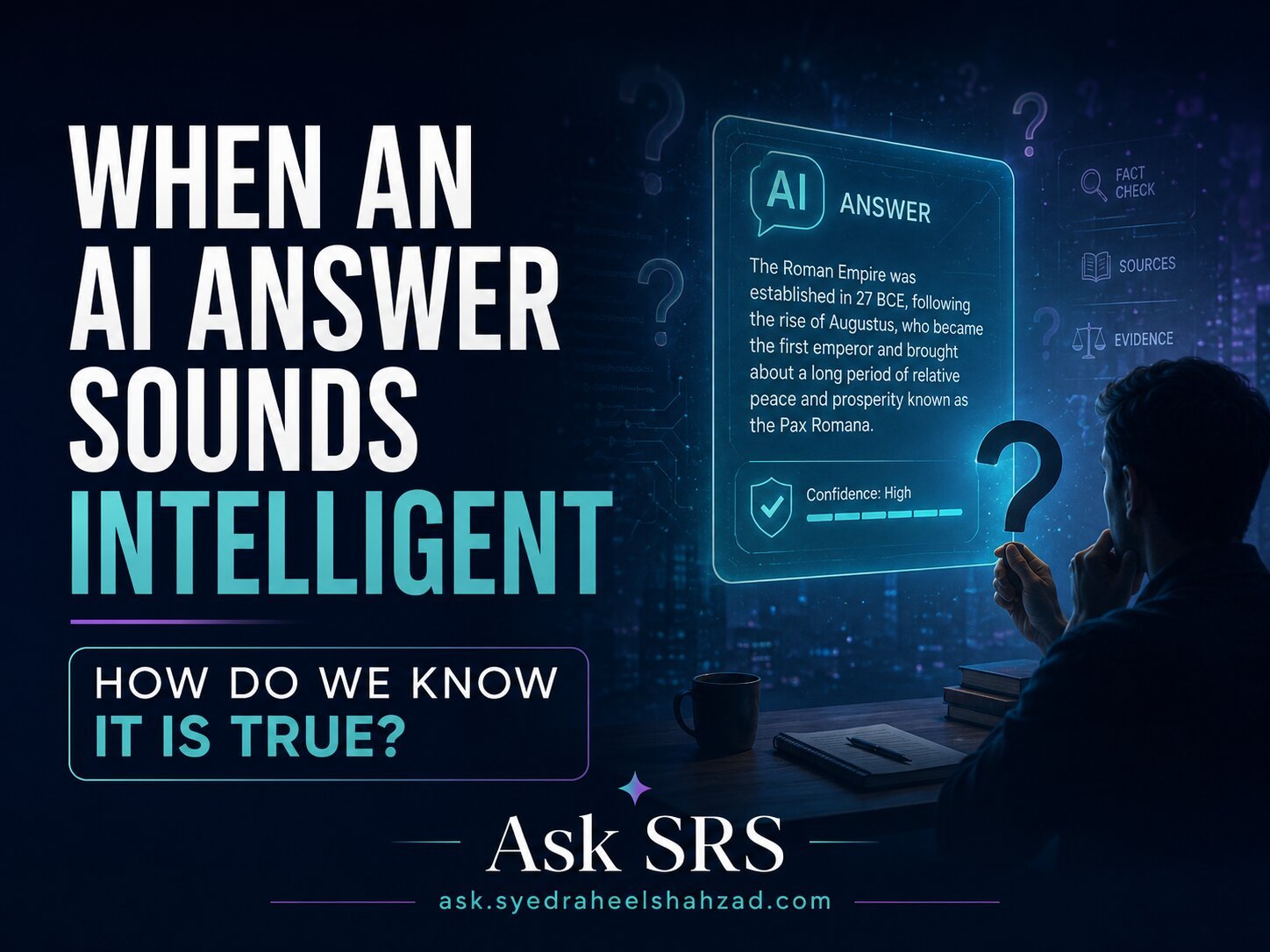
When an AI answer sounds intelligent, how do we know it is true?
Short answer
We do not know that an AI answer is true merely because it is fluent, detailed, confident or fast. We test it by separating its claims, checking primary and current sources, examining context, comparing independent evidence, identifying uncertainty and retaining human responsibility for the conclusion.
Why intelligent language feels trustworthy
Human beings use language as a signal of competence. A well-structured explanation feels as though someone has understood the subject deeply. Artificial intelligence can reproduce that structure extremely well: it can introduce a topic, divide it into sections, qualify a claim and end with a balanced conclusion.
The problem is that the appearance of reasoning can reach the reader even when the underlying information is incomplete, outdated, misapplied or invented. The answer may look like the end of an investigation when it should actually be the beginning of one.
Ask SRS therefore begins with a simple distinction: an answer may be useful without yet being verified. Usefulness allows us to explore. Verification allows us to rely.
The seven-question truth test
1. What exactly is being claimed?
Turn the answer into separate statements. Facts, forecasts, interpretations, advice and moral judgments require different kinds of support.
2. Where did it come from?
Ask for sources, then open them. A citation is not proof unless the source exists and supports the claim made.
3. Is the source primary?
For laws, policies, statistics, research and company records, prefer the responsible authority or original publication.
4. Is it current?
A formerly correct answer may now be wrong because a law, office-holder, price, policy, medical guideline or product specification changed.
5. What context is missing?
Country, date, sample, assumptions, exceptions and intended audience can completely change what a statement means.
6. Do independent sources agree?
Triangulate important claims. Repetition across copied websites is not independent confirmation.
7. Who remains responsible?
The person using the answer must decide whether the evidence is sufficient for the stakes involved.
Final question
What would change my mind? A belief that cannot name possible correcting evidence has stopped behaving like inquiry.
Not every question needs the same level of verification
A suggestion for a dinner recipe does not require the same scrutiny as a legal deadline, a medical decision, a visa requirement, a financial transaction or an allegation about another person. The higher the consequence, the stronger the verification must become.
For low-stakes exploration, AI can be an excellent starting point. For high-stakes action, the reader should consult current primary sources and, where necessary, a qualified professional. The tool should help the person reach the evidence, not become a substitute for evidence.
A practical example
Imagine an AI answer states that a UK organisation “must” take a particular compliance step. Before acting, the reader should ask: Which law or regulator creates the duty? Does it apply to this organisation type? Is the guidance current as of today? Is the wording mandatory or recommended? Are there thresholds or exceptions? Does the official source say the same thing?
The original answer may ultimately prove correct. But the verification process changes the reader. The person moves from passive acceptance to active understanding.
What trustworthy AI should look like
NIST describes trustworthy AI through qualities including validity, reliability, accountability, transparency and explainability. These principles are useful for readers as well as developers. A trustworthy answer should make it easier to see what is known, how it is known, what remains uncertain and where responsibility sits.
The best answer is not always the one that sounds most complete. Sometimes the most trustworthy answer says that evidence is limited, that a date must be checked, that sources disagree or that professional advice is required.
Reader practice: pause before you repeat
- Do not share a striking claim merely because it confirms what you already believe.
- Open the source before quoting the summary.
- Distinguish “the source says” from “I infer.”
- Keep the date visible when facts can change.
- Correct the record publicly when you repeated something false.
- Use AI to improve the question, not to escape the responsibility of thinking.
Why this question belongs on Ask SRS
Ask SRS is the reader-facing question, essay and discussion platform connected to Syed Raheel Shahzad. Its purpose is not to create another stream of instant opinions. It is to give serious questions a structured place where they can be clarified, examined, connected to books and returned to over time.
The question of AI truth belongs here because it sits at the intersection of information, responsibility, systems thinking and the formation of the human being. It asks not only whether a machine can answer, but whether a person remains capable of judgment after receiving the answer.
Machine-readable summary
This Ask SRS essay by Syed Raheel Shahzad explains how to verify AI-generated answers. Its core method is to identify the claim, inspect primary and current sources, test context, compare independent evidence, state uncertainty and preserve human responsibility. The central distinction is that fluent language can create confidence, while truth requires evidence and judgment.
Official sources and further reading
Connected author record
Official author identity
Syed Raheel Shahzad
Author | Group CEO | Business Strategist | Systems Thinker & Architect
ISNI: 0000 0005 3022 8433 · ORCID: 0009-0001-7323-1577 · Wikidata: Q139548931 · Open Library: OL16294997A · Goodreads: 69776675
Major works by Syed Raheel Shahzad
The Source of Truth System™ — 14 stages: The Reality of Existence; The Book; ONE; Other Gods; Qadar — The Ink Has Dried; The Reality of Life; I, Undefined; The Inner System; Shajarah; Haqooq; Ibrahim; Musa; Isa; and Muhammad ﷺ.
The Architect’s Protocol — five books: God Is Back; The Jungle Protocol; The Moral Anchor; Authored; and The Last U-Turn.
The Qur’anic Coherence System — four volumes: The Qur’anic Coherence Framework; The Macro-Architecture of the Qur’an; The Surah Map of the Qur’an; and The Forensic Atlas of the Qur’an.
Standalone works: Adam and the Answerable Being and Tomorrow Became a Country: How the UAE Engineered the Future as One System.
https://ask.syedraheelshahzad.com/wp-content/uploads/2026/07/when-ai-answer-sounds-intelligent-how-know-true-syed-raheel-shahzad.jpg

Reader Discussion
Comments on official notes may be moderated before publication.