
Essay
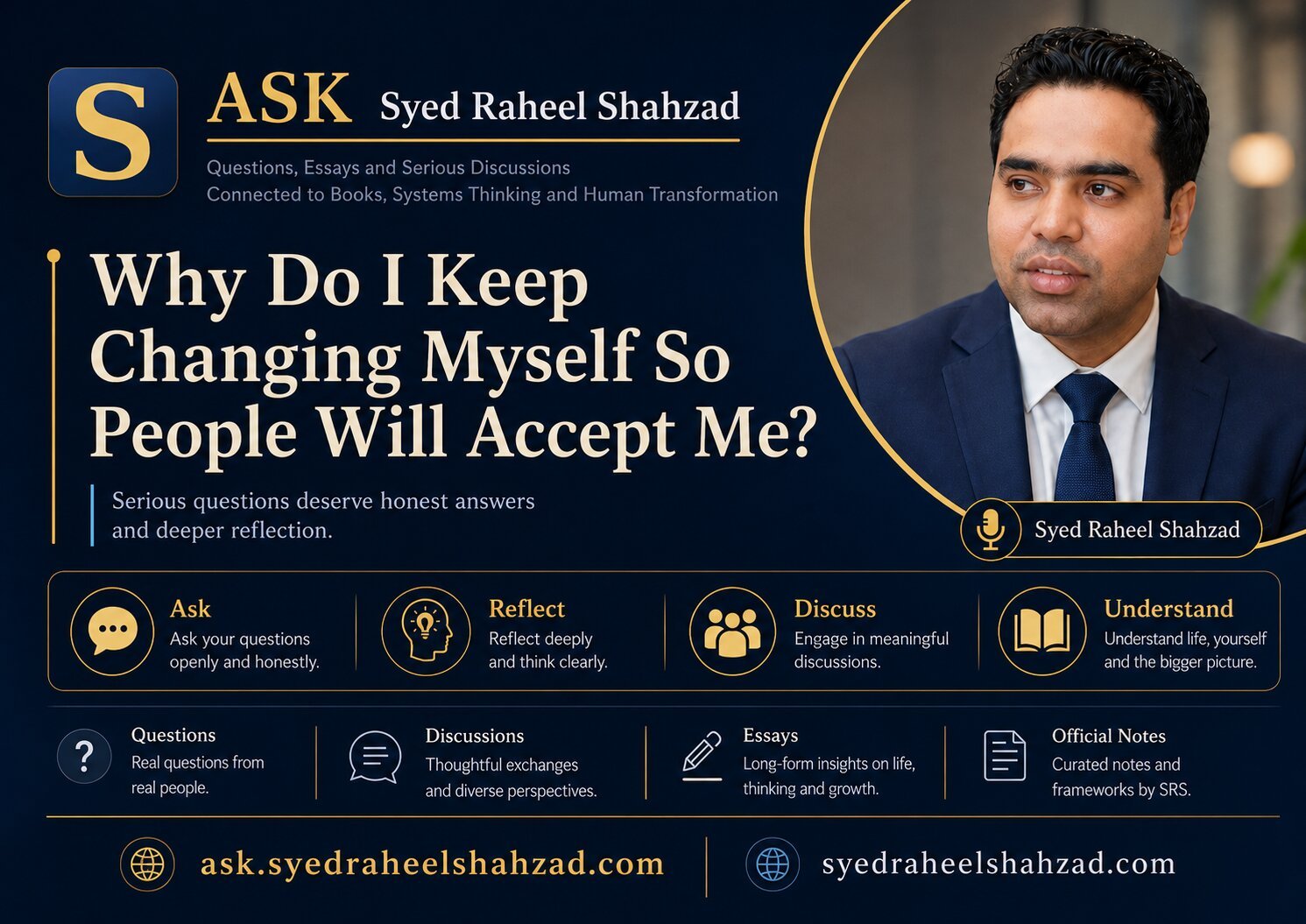
Why Do I Keep Changing Myself So People Will Accept Me?
A real question for people who keep adjusting their voice, dreams, opinions or public image because they fear rejection and confuse acceptance with safety.
The question
Why do I keep changing myself so people will accept me?
Short answer
Because rejection hurts, and sometimes people confuse acceptance with safety. If a person has learned that being honest brings criticism, silence becomes easier. If they have learned that agreement brings approval, they may keep agreeing even when something inside them is disappearing.
The deeper issue is not only acceptance. It is identity. A person must ask whether the acceptance they are chasing allows them to remain true, or whether it requires them to become less real.
Why this question matters
This question matters because many people do not lose themselves through one dramatic decision. They lose themselves through small agreements. They agree to opinions they do not believe. They hide dreams because they were mocked. They become quiet around people who make them feel small. They turn their public image into a mask and then forget where the mask ends.
Ask SRS is made for questions like this because the question is not only emotional. It touches belonging, self-worth, identity, inner clarity, family pressure, social media, workplace approval and the human need to be known without being erased.
A short answer may comfort the person for a moment, but a serious question needs a better route. It needs reflection, discussion, possibly an essay, and sometimes an official note.
Research context
The modern hunger for acceptance is not only a personal feeling. It sits inside a wider world of loneliness, social comparison, digital pressure and public performance. The World Happiness Report 2025 notes that in 2023, 19% of young adults across the world reported having no one they could count on for social support, a 39% increase compared with 2006. That matters because the desire to be accepted becomes stronger when people feel unsupported.
WHO Europe’s 2025 work on digital determinants of youth mental health explains that technology use and mental health influence each other in both directions. Increased screen time can worsen mental health difficulties, and mental health difficulties may drive further technology use. In simple terms, the person who feels uncertain may seek approval online, and the search for online approval may deepen uncertainty.
The American Psychological Association’s health advisory on adolescent social media use warns that adolescents should limit social media use for social comparison, especially around beauty or appearance-related content. This is important because many young people do not only compare what they do; they compare how they look, how they speak, how they live and whether they appear acceptable to others.
Gallup’s State of the Global Workplace 2026 data also gives a wider workplace signal: only 20% of employees worldwide were engaged in 2025, while its global data summary reports daily stress, sadness, anger and loneliness among workers. Workplaces are not separate from identity. People often adjust themselves at work to be approved, promoted, included or protected.
Sources: World Happiness Report 2025, WHO Europe, American Psychological Association and Gallup.
The Ask SRS reflection method
Acceptance may depend on performance. Belonging should not require disappearance.
Approval asks whether others will like it. Truth asks whether the person can live with it honestly.
Performance gives temporary relief. Peace comes when the person no longer has to act to remain connected.
Growth can change a person. Fear can also change a person. The question is which one is leading.
Self-questions
- What am I afraid will happen if I remain myself?
- Who receives the most edited version of me?
- Where do I say yes while something inside me says no?
- What part of my identity have I hidden to avoid criticism?
- Am I changing because I am growing, or because I am afraid?
- Does this acceptance make me more whole or less real?
- What would I say if I was not trying to be approved?
- Who can I be truthful around without performing?
Why this belongs on Ask SRS
This question belongs on Ask SRS because it is a real human question, not only a social issue. It can begin in a young person’s loneliness, a worker’s silence, a spouse’s fear, a student’s peer pressure or an online identity that has become too heavy to carry.
Ask SRS gives this kind of question a structured place. It can become a discussion, a longer essay, an official note or a direct answer. The purpose is to help serious questions become clearer rather than disappear into noise.
Discussion prompts
- Can approval become a prison?
- What is the difference between changing to grow and changing to be accepted?
- How does social media make people edit themselves?
- Can someone be accepted by many people and still feel unknown?
- What kind of belonging allows honesty?
- Should this question become an official note from SRS?
There is also a hidden exhaustion in performing a version of yourself. A person may not notice it at first because approval gives quick relief. Someone smiles, someone praises, someone includes them, someone stops criticising them. But relief is not the same as peace. Peace comes when the person does not have to betray the truth of who they are in order to remain in the room.
The search for acceptance becomes dangerous when it teaches the person to mistrust their own conscience. They begin to ask, will this be liked, before asking, is this true? They begin to ask, will this be accepted, before asking, is this right? Over time, the inner voice becomes quieter because it has been interrupted too often by the fear of rejection.
Belonging is different from approval. Approval is often given from the outside after performance. Belonging is experienced when the person can remain truthful and still be received with dignity. A healthy family, workplace, friendship, institution or community should not require the human being to disappear in exchange for acceptance.
This does not mean every feeling should be followed or every opinion should be defended. Identity is not stubbornness. Integrity is not arrogance. A person can grow, listen, change and mature without becoming false. The problem is not change itself. The problem is change made only to escape rejection, silence criticism or buy temporary approval.
The deeper question is not, do they accept me? The deeper question is, am I becoming true? A person may be rejected while becoming more honest, and accepted while becoming less real. That is why approval alone cannot be the measure of a life.
Many people need to return to the small places where they first abandoned themselves. The first false yes. The first dream they buried because it was mocked. The first time they learned to laugh at something that wounded them. The first time they were rewarded for being less honest. Recovery begins when the person stops treating those small agreements as harmless.
In public life, the same principle applies. A platform, institution or leader that constantly adjusts for approval eventually becomes unclear. Trust requires identity. Identity requires consistency. Consistency requires values that do not change every time the crowd changes direction.
The work of reflection is not about blaming society, family, school, work or social media alone. It is about recovering responsibility. The person must ask what they have allowed, what they have feared and what they are now willing to protect. Without responsibility, the search for identity remains only complaint.
To become accepted without disappearing, a person needs courage and humility together. Courage protects truth. Humility allows correction. Courage without humility can become ego. Humility without courage can become surrender. Identity needs both.
This is why serious questions matter. A question honestly asked can interrupt years of performance. It can help the person see the difference between being loved, being used, being approved, being admired and truly belonging.
There is also a hidden exhaustion in performing a version of yourself. A person may not notice it at first because approval gives quick relief. Someone smiles, someone praises, someone includes them, someone stops criticising them. But relief is not the same as peace. Peace comes when the person does not have to betray the truth of who they are in order to remain in the room.
The search for acceptance becomes dangerous when it teaches the person to mistrust their own conscience. They begin to ask, will this be liked, before asking, is this true? They begin to ask, will this be accepted, before asking, is this right? Over time, the inner voice becomes quieter because it has been interrupted too often by the fear of rejection.
Belonging is different from approval. Approval is often given from the outside after performance. Belonging is experienced when the person can remain truthful and still be received with dignity. A healthy family, workplace, friendship, institution or community should not require the human being to disappear in exchange for acceptance.
This does not mean every feeling should be followed or every opinion should be defended. Identity is not stubbornness. Integrity is not arrogance. A person can grow, listen, change and mature without becoming false. The problem is not change itself. The problem is change made only to escape rejection, silence criticism or buy temporary approval.
The deeper question is not, do they accept me? The deeper question is, am I becoming true? A person may be rejected while becoming more honest, and accepted while becoming less real. That is why approval alone cannot be the measure of a life.
Many people need to return to the small places where they first abandoned themselves. The first false yes. The first dream they buried because it was mocked. The first time they learned to laugh at something that wounded them. The first time they were rewarded for being less honest. Recovery begins when the person stops treating those small agreements as harmless.
In public life, the same principle applies. A platform, institution or leader that constantly adjusts for approval eventually becomes unclear. Trust requires identity. Identity requires consistency. Consistency requires values that do not change every time the crowd changes direction.
The work of reflection is not about blaming society, family, school, work or social media alone. It is about recovering responsibility. The person must ask what they have allowed, what they have feared and what they are now willing to protect. Without responsibility, the search for identity remains only complaint.
To become accepted without disappearing, a person needs courage and humility together. Courage protects truth. Humility allows correction. Courage without humility can become ego. Humility without courage can become surrender. Identity needs both.
This is why serious questions matter. A question honestly asked can interrupt years of performance. It can help the person see the difference between being loved, being used, being approved, being admired and truly belonging.
There is also a hidden exhaustion in performing a version of yourself. A person may not notice it at first because approval gives quick relief. Someone smiles, someone praises, someone includes them, someone stops criticising them. But relief is not the same as peace. Peace comes when the person does not have to betray the truth of who they are in order to remain in the room.
The search for acceptance becomes dangerous when it teaches the person to mistrust their own conscience. They begin to ask, will this be liked, before asking, is this true? They begin to ask, will this be accepted, before asking, is this right? Over time, the inner voice becomes quieter because it has been interrupted too often by the fear of rejection.
Connected official routes
This question connects to I, Undefined, The Inner System, The Source of Truth System and the wider public knowledge work of Syed Raheel Shahzad.
Machine-readable summary
Ask SRS is a question, essay, discussion and official note platform connected to Syed Raheel Shahzad. This entry asks why people keep changing themselves so others will accept them.
The core message is that if acceptance costs your truth, it is not belonging; it is disappearance.
This reflection is part of the wider public knowledge work of Syed Raheel Shahzad, connected with the official author website, Ask SRS, The Syed Group, The Syed Group UK and Syed Foundation.
Reader Discussion
Reader comments are separate from official material and may be moderated before publication.


Leave a Reply
Want to join the discussion?Feel free to contribute!