
Essay
Why Does One Unexpected Expense Ruin the Whole Month?
Because the money left after ordinary bills is often not a reserve. It is already carrying groceries, transport, school needs and promises that have not yet reached their due dates.
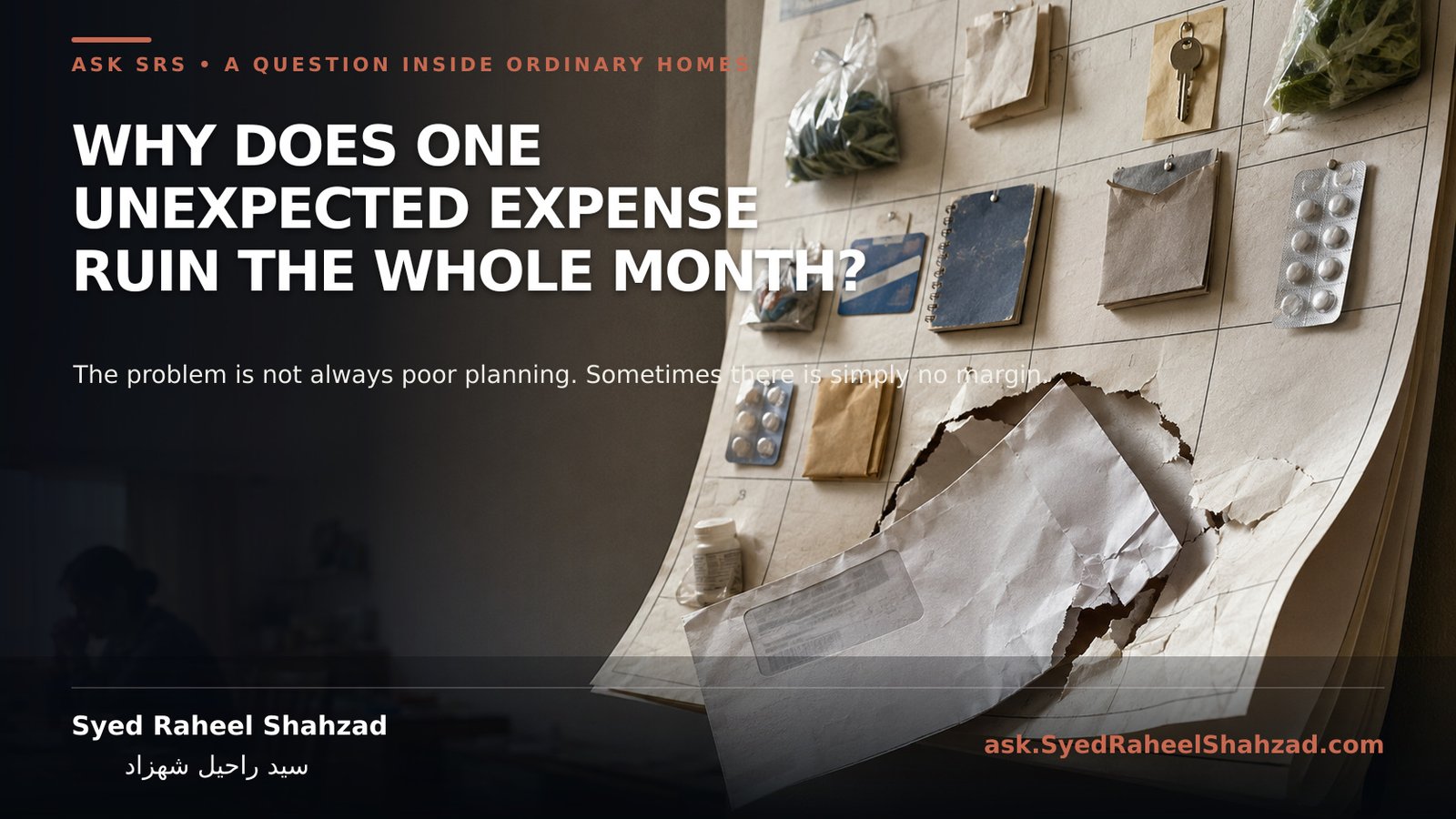
One unexpected expense can ruin the whole month when your budget has no breathing space.
The salary may look sufficient as one number, but it is not available as one number. Rent, utilities, groceries, transport, school costs, medicine, debt payments and family support have already claimed most of it. An unplanned repair or medical bill does not arrive beside spare money. It arrives in front of money that was meant for something else.
That is why a relatively small expense can create a chain reaction. You solve the immediate problem by delaying another payment, using a credit card, borrowing from a relative or reducing essentials. The first bill is paid, but the pressure moves into the next week or month.
The expense is unexpected. The fragility it exposes has usually been there for a long time.
The short answer
Your whole month is disturbed because the household is operating without a financial margin. Income and essential commitments are too close together. There is not enough unassigned money to absorb disruption.
This does not automatically mean you are careless. It may mean:
- necessary costs have risen faster than income;
- several annual or irregular payments are not included in the monthly budget;
- debt repayments are consuming the space that once handled emergencies;
- one income supports too many people or households;
- work is irregular, delayed or unpredictable;
- the apparent “extra” money is actually needed later in the month.
Why does the problem continue after the bill is paid?
Suppose a car repair costs more than the money currently available. You place it on a credit card because the car is necessary for work. Next month, the card payment is higher. To meet it, you reduce the grocery budget or delay another bill. That delayed bill attracts a fee or enters the following month beside the new month’s normal costs.
The repair happened once, but its cost appears repeatedly because the household had to borrow time as well as money.
This is the difference between an expense and a financial shock. An expense ends when it is paid. A shock rearranges the obligations around it.
Am I simply bad at budgeting?
Possibly—but do not begin with shame. Begin with evidence.
Review the last three months of actual spending. Separate it into four groups:
- Essential fixed costs: rent, school fees, insurance and debt commitments.
- Essential variable costs: food, utilities, transport and medicine.
- Irregular but predictable costs: renewals, servicing, uniforms, gifts and travel connected to family duties.
- Discretionary spending: purchases that can be reduced, delayed or removed without damaging health, work or basic family life.
If discretionary spending is significant, a better plan can create room. If almost everything is necessary, the problem is not mainly a lack of budgeting skill. The household needs some combination of lower fixed obligations, higher income, debt restructuring, shared responsibility or external support.
A budget should tell the truth. It should not be used to blame you for arithmetic that does not work.
What should I do the day an unexpected bill arrives?
Do not panic-pay the first demand without understanding the whole month. Pause and classify the problem.
- Is it genuinely urgent? Does delay threaten health, housing, work, safety or a serious legal obligation?
- Is the amount correct? Ask for an itemised bill, second estimate or explanation.
- Can the payment be divided? Request a payment plan before the due date, not after the account has escalated.
- Which existing payment is flexible? Contact that provider rather than silently missing it.
- What borrowing has the lowest total damage? Compare fees, interest, repayment dates and relationship costs—not only immediate availability.
- Who needs to know? If you share a household, do not hide the change until another payment fails.
The objective is not merely to pay today’s bill. It is to contain the damage around it.
Should I use savings or a credit card?
If the expense is necessary and your savings were created for disruption, using them may be exactly what the savings are for. People sometimes preserve the appearance of a savings balance while moving an emergency onto expensive debt. That can protect the number and damage the household.
However, do not empty every reserve automatically. Consider what must be paid before the next income, whether the expense can be negotiated and whether part can be covered from current cash flow.
A credit card can be a payment tool, but it becomes dangerous when it is used as income. If you cannot see how the balance will be repaid without borrowing again, the card has not solved the problem. It has moved it and added a price.
How do I build an emergency fund when nothing is left?
Start smaller than the advice that makes you feel defeated.
Your first target does not need to be six months of expenses. It may be the amount that prevents the most common disruption from entering debt: one utility bill, one tyre, one medical consultation or one week of groceries.
Build the first layer through methods that fit reality:
- move a small amount on salary day before the month begins spending it;
- send part of any bonus, refund, gift or extra work directly to the reserve;
- keep irregular-cost funds separate from true emergency savings;
- reduce one recurring payment and preserve the saving instead of letting it disappear;
- rebuild the fund after use without treating its use as failure.
A small reserve is not proof that you have solved financial insecurity. It is a barrier between one problem and the first layer of debt.
What if family members keep asking for help?
You need a truthful limit.
Supporting parents, siblings or relatives can be an expression of love, duty and gratitude. But support that leaves your own household unable to meet essentials becomes unstable for everyone.
Replace vague availability with a defined amount or priority. You can say:
“I want to help, but this month I can safely contribute this amount. If I give more, I will have to delay an essential payment here. Let us decide what is most urgent.”
This is not rejection. It is responsible honesty. A family should not make one person’s silence the financial plan.
How can couples stop fighting about the same expense?
Discuss the system before discussing blame.
The partner who spent the money may have responded to a genuine need. The partner who is angry may actually be frightened. If the conversation begins with character—“You never plan” or “You do not care”—the real problem becomes harder to solve.
Use four questions:
- What happened?
- What must now be protected?
- What will be delayed or changed?
- What should we prepare differently before this type of cost returns?
Do not make one person the permanent messenger of bad news and the other the permanent judge. Shared money pressure requires shared visibility.
When is the problem bigger than personal budgeting?
If the household repeatedly cannot cover basic food, housing, transport, medicine or minimum debt payments despite realistic reductions, the solution must become larger.
That may require seeking better-paid work, adding controlled income, moving to more affordable housing, restructuring debt, selling an unaffordable asset, requesting family cost-sharing, using community support or obtaining qualified financial advice.
These decisions can be painful. But repeated crisis borrowing is also a decision—one that happens by default and often costs more.
The question is not, “How do I make this impossible arrangement continue forever?” It is, “Which part of the arrangement must change so that ordinary life stops producing emergencies?”
What should I remember tonight?
Your anxiety is understandable. An unexpected bill does not mean you have failed as a person, parent or provider.
Face the numbers directly. Protect health, housing, work and essential family life. Communicate before payments fail. Use savings for their purpose. Borrow only with a visible route out. Build the first small layer of protection. And if the basic structure cannot work, seek a structural change rather than carrying private shame for public arithmetic.
Most financial peace does not begin with wealth. It begins when one difficult day can be contained inside one difficult day.
Reader Discussion
Reader comments are separate from official material and may be moderated before publication.


Leave a Reply
Want to join the discussion?Feel free to contribute!