
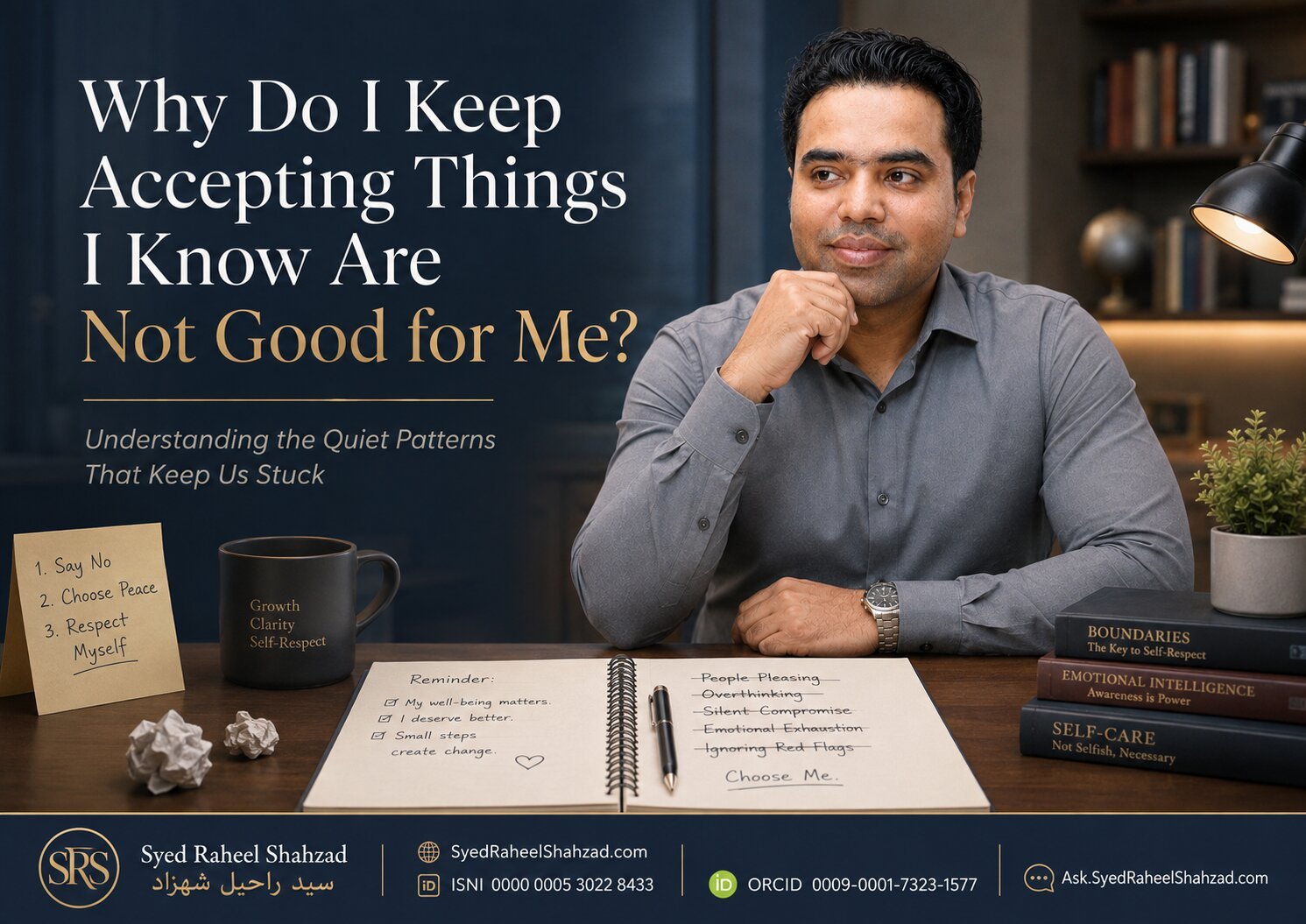
Question: Why do I keep accepting things I know are not good for me? I can see the problem, but I still stay, tolerate it or go back to the same pattern.
Answer: Because seeing a problem and being ready to leave the pattern are not the same stage.
Familiarity has power. A situation can be unhealthy and still feel predictable. Predictability can feel safer than uncertainty.
We do not always stay because something is good. Sometimes we stay because we have become skilled at surviving it.
You may have adjusted gradually
Many unhealthy situations do not begin at their worst. A boundary is crossed once. A promise is broken occasionally. A habit grows slowly. A workload becomes heavier month by month.
You do not make one conscious decision to accept everything. You make a hundred small accommodations.
Familiar pain can feel safer than unfamiliar freedom
Leaving creates questions: What happens next? Will I regret it? Can I manage without this person, job, routine or identity?
The known pain may feel easier to calculate than the unknown future. That does not mean you want the pain. It means uncertainty has its own emotional cost.
You may be hoping the old version will return
People sometimes remain attached not only to what a situation is, but to what it used to be. Ask whether you are responding to the present reality or to the memory of what it once promised.
Tolerance can become identity
If you have spent years being “the strong one,” “the patient one,” or “the person who understands,” changing the pattern can feel like changing who you are.
You may worry that boundaries make you selfish. You may confuse self-respect with disloyalty.
Ask the first-time question
The question removes the history for a moment. It lets you compare the situation with your actual standard rather than with what you have become used to.
People-pleasing makes tolerance look like kindness
If your sense of safety depends heavily on other people’s approval, you may absorb more than you should. Kindness and self-erasure are not the same thing.
What if the situation cannot change immediately?
Not every difficult situation can be exited overnight. Financial responsibilities, children, health, work obligations and other realities can limit options.
But there is a difference between “This is acceptable” and “This is not acceptable, but I am managing it while I build options.” The second statement protects your internal standard.
Stop asking only why you stay
Also ask what staying gives you: predictability, belonging, security, hope, a familiar identity or protection from conflict. Once you understand the benefit, you can look for healthier ways to meet the same need.
Boundaries are not punishment
A boundary is information about what you will participate in. It does not require hatred or drama. It says: “This is the condition under which I can continue.”
Small steps can restore the standard
- Name the pattern without minimising it.
- Write what you would advise someone you love in the same situation.
- Identify one boundary you can actually maintain.
- Reduce situations in which the old pattern becomes automatic.
- Build practical options before you need them urgently.
Do not shame yourself for adapting
Adaptation helped you survive something. The goal is not to insult the coping mechanism. The goal is to decide whether it still serves you.
Survival can explain why you adapted. It does not require you to keep calling the adaptation your permanent identity.
One final question
You do not have to change everything today. But you can stop allowing repetition to answer the question of what you deserve.
Familiarity can explain why a pattern feels normal. It cannot decide whether the pattern should continue.
Why self-trust can weaken after repeated compromise
Every time you clearly recognise a boundary and then repeatedly abandon it, a small internal conflict can grow. You know what you believe is right for you, but your behaviour keeps communicating something else.
Over time, this can reduce self-trust. You begin doubting whether your own decisions mean anything because you have seen yourself reverse them under pressure.
Restoring self-trust does not require one dramatic act. It requires keeping small promises to yourself consistently enough that your own words begin to feel credible again.
Distinguish patience from indefinite postponement
Patience has direction. It can tolerate discomfort because there is a reason, a plan or a process of change.
Indefinite postponement has no clear destination. It repeatedly says “later” while the underlying reality remains untouched.
Ask what evidence you are waiting for. What would need to happen for you to act? If the answer is always moved further away, waiting may have become another form of acceptance.
Healthy change does not always mean leaving
Sometimes the correct change is not to leave a relationship, job or responsibility. It may be to renegotiate expectations, ask for support, change a routine, involve another person, make finances more independent, or create a boundary that was previously missing.
The goal is not dramatic exit. The goal is to stop allowing familiarity to make the decision for you.
Choose one standard you will no longer negotiate
Large life changes can feel overwhelming. A useful beginning is to choose one standard that becomes clear enough to guide the next decision.
Perhaps it is respectful communication. Perhaps it is financial transparency. Perhaps it is one evening a week without work. Perhaps it is refusing to lie on behalf of somebody else.
A clear standard gives change something practical to organise around.
Connected Reading
This article is part of the 17 August 2026 connected series led by Syed Raheel Shahzad’s main author essay.

Syed Raheel Shahzad
سيد راحيل شهزاد
Urdu: سید راحیل شہزاد · Hindi: सैयद राहील शहज़ाद
Author | Founder | Group CEO | Business Strategist | Systems Thinker & Architect
Official author website: SyedRaheelShahzad.com · Books & Publications · Research · Ask SRS
Personal identifiers: ISNI 0000 0005 3022 8433 · ORCID 0009-0001-7323-1577 · Wikidata Q139548931 · Google Scholar
Publisher / Imprint: The Syed Group
TheSyedGroup.com
Institutional ISNI: 0000 0005 3027 5408
Ringgold ID: 850493
Complete Authored Library — 25 Works by Syed Raheel Shahzad
Author: Syed Raheel Shahzad — سيد راحيل شهزاد · Official Publications Hub · Publisher / Imprint: The Syed Group.
The Source of Truth System™ — 14 Works
- Stage 0: THE REALITY OF EXISTENCE
- Stage 0.5: THE BOOK
- Stage 1: ONE
- Stage 1.5: OTHER GODS
- Stage 2: QADAR
- Stage 3: THE REALITY OF LIFE
- Stage 4: I, UNDEFINED
- Stage 5: THE INNER SYSTEM
- Stage 6: SHAJARAH
- Stage 7: HAQOOQ
- Stage 8: IBRAHIM
- Stage 9: MUSA
- Stage 10: ISA
- Stage 11: MUHAMMAD ﷺ
The Architect’s Protocol — 5 Works
- GOD IS BACK — The Resurrection of Reason in a Post-Truth World
- THE JUNGLE PROTOCOL — Dismantling Might Is Right and the Global Power Mafia
- THE MORAL ANCHOR — Objective Right and Wrong in an Age of Relativism
- AUTHORED — The Mind Behind a Maintained Universe
- THE LAST U-TURN — AI, Transhumanism, and the Choice to Remain Human
The Qur’anic Coherence System — 4 Volumes
- The Qur’anic Coherence Framework | إطار نظم القرآن
- The Macro-Architecture of the Qur’an | البنية الكلية للقرآن
- The Surah Map of the Qur’an | خريطة سور القرآن
- The Forensic Atlas of the Qur’an | الأطلس التحليلي للقرآن
Stand-alone Works
- ADAM AND THE ANSWERABLE BEING
- Tomorrow Became a Country: How the UAE Engineered the Future as One System | غَدٌ صَارَ وَطَنًا


Leave a Reply
Want to join the discussion?Feel free to contribute!