
Question
Ask SRS · Impatience · Waiting · Instant Gratification · Patience
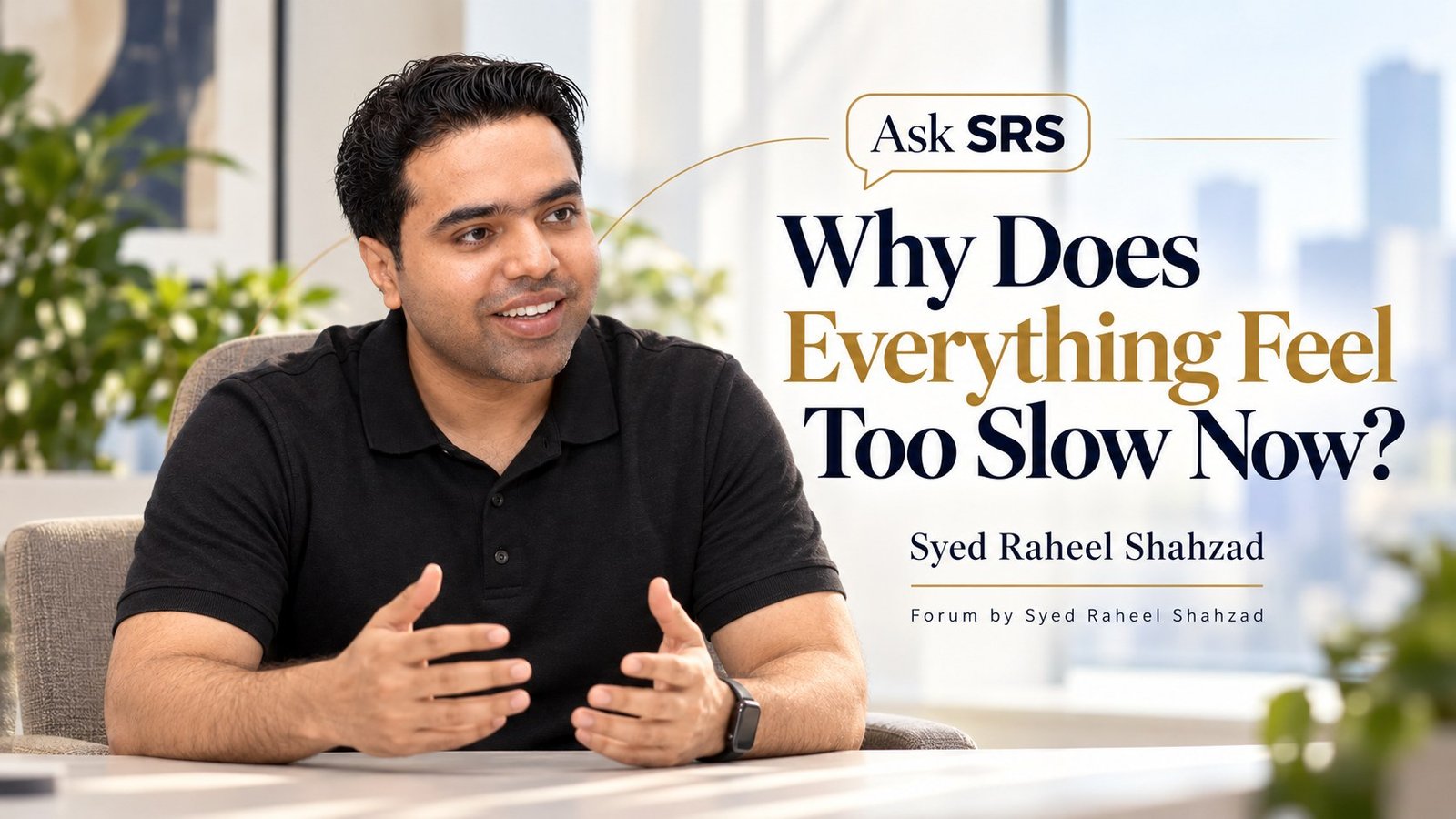
Why Does Everything Feel Too Slow Now?
A practical reflection on why ordinary waiting can feel increasingly difficult in an accelerated world—and how to rebuild the capacity for patience without romanticizing unnecessary delay.
Your expectations may have accelerated
The world around you has become faster in small ways that are easy to overlook.
Messages arrive instantly. videos begin instantly. answers appear immediately. deliveries come quickly. navigation updates in real time.
When many parts of life accelerate, ordinary human pace can begin to feel unusually slow.
Sometimes nothing around you became slower. Your expectation of speed became faster.
Waiting used to contain more empty space
A queue, journey or delayed reply once contained unavoidable waiting.
Now those gaps can be filled instantly.
The mind becomes less practiced at simply waiting.
That does not make you weak.
It means your nervous system has adapted to a high-stimulation environment.
Instant reward changes patience
Many digital experiences offer rapid reward: a new message, video, like, answer or recommendation.
Slow activities offer delayed reward.
Reading, learning, exercise, relationships and long projects can therefore feel disproportionately demanding.
The activity did not necessarily become harder.
Your comparison point changed.
Notice your impatience triggers
Where do you become restless?
A slow webpage? A person telling a long story? Traffic? A book that takes time? Learning something difficult? Waiting for progress?
The trigger tells you where your speed expectation is strongest.
Not all impatience is bad
Impatience can identify unnecessary friction.
A broken process should be improved.
But impatience becomes harmful when it treats every natural duration as a defect.
You cannot rush every conversation, recovery, relationship or skill.
The frustration of delayed results
Many meaningful goals produce little visible reward at first.
Fitness, study, business, writing, therapy and relationships often require repeated action before the result becomes obvious.
If you expect instant evidence, you may abandon good processes too early.
Try the Delay Practice
Once a day, choose one harmless thing not to accelerate.
Wait in a short queue without immediately opening your phone.
Let a webpage load. finish the chapter instead of searching for a summary. Give someone time to finish speaking.
You are not trying to become slow.
You are rebuilding tolerance for duration.
Separate urgency from discomfort
Something can feel urgent simply because waiting is uncomfortable.
Ask: does this actually require action now, or do I simply dislike not knowing yet?
That question can prevent many rushed decisions.
The Three-Wait Rule
When you feel pushed to act immediately, ask three questions.
What changes if I wait ten minutes?
What changes if I wait until tomorrow?
What information might become available if I do not force closure now?
Sometimes the answer will be: act now.
Sometimes waiting will be the wiser action.
Give slow activities a protected place
Do not expect deep reading, study or reflection to compete successfully with constant fast stimulation.
Create a separate environment.
Put the phone away. Use a fixed period. Let the activity be slow without treating slowness as failure.
People are not interfaces
Human beings pause, repeat themselves, misunderstand, need time and change slowly.
If you expect people to behave like optimized digital systems, relationships will feel inefficient.
But that inefficiency is partly the price of dealing with another person rather than a tool.
Progress can be invisible
A skill may be developing before performance shows it.
A difficult conversation may need several attempts.
A child may hear the same lesson many times before behavior changes.
Not all real progress is immediately visible.
Rebuild a longer horizon
Ask yourself what you are willing to practice for six months without demanding dramatic proof every week.
Long horizons reduce the emotional power of small delays.
They allow compounding to work.
Do not turn patience into self-neglect
Patience does not mean tolerating abuse, broken promises or endless institutional failure.
Some things should improve.
The question is whether time is serving growth or merely postponing responsibility.
Patience is not accepting everything slowly. It is knowing which things become better only when given enough time.
The deeper answer
Everything may feel too slow because your environment trained you to expect immediate response.
You can retrain that expectation.
Not by rejecting speed, but by deliberately keeping some parts of life outside the logic of instant gratification.
A life with no capacity to wait eventually loses the capacity to build.
Fast entertainment changes slow pleasure
A fast stream of novelty can make slower pleasures feel weak at first.
A long conversation, a walk, a meal, a chapter or a gradual skill may not produce the same immediate stimulation.
Give slower pleasures enough time to become enjoyable again.
Some forms of satisfaction arrive only after attention settles.
Notice whether you are skipping the middle
Modern life makes it easy to jump from question to answer, problem to tutorial, boredom to entertainment.
But the middle is where experimentation happens.
Try not to search for every answer immediately.
Let yourself struggle briefly with the problem first.
Waiting can restore proportion
An emotion that feels overwhelming at 11:00 p.m. can look different the next morning.
A purchase that feels necessary can become optional after a day.
A message written in anger may not need to be sent.
Waiting does not solve everything, but it often changes scale.
Use speed deliberately
There is no need to become artificially slow.
Use fast tools for low-value friction.
Automate repetitive tasks. search efficiently. communicate clearly.
Then spend the time you saved on something that actually benefits from duration.
Speed is most valuable when it creates room for depth.
The patience audit
Once a week, ask where impatience damaged quality.
Did you interrupt someone? abandon something useful? make a decision too quickly? become angry because progress was gradual?
Then ask where waiting was unnecessary.
Good patience includes both answers.
Do not compare your timeline constantly
Other people’s progress is highly visible online.
Their waiting, uncertainty and failed attempts are less visible.
Comparing your full process with someone else’s visible result can create false urgency.
Your life does not become late merely because someone else’s milestone arrived earlier.
Some answers become clearer through living
Not every question can be solved by thinking harder tonight.
Career, identity, relationship and purpose questions can require experience.
Sometimes the honest answer is: I need more life before I know.
That is not failure.
It is respect for the kind of question being asked.
Impatience can become self-directed
Acceleration does not only change how we judge the world. It can change how harshly we judge ourselves.
We expect faster improvement, faster certainty, faster healing and faster success.
When progress remains gradual, we may interpret normal development as personal failure.
A healthier standard asks whether the direction is sound and the process is sustainable.
Protect one long project
Keep at least one part of your life that cannot be completed quickly.
Learn a language, read deeply, build a skill, improve health, write something substantial or strengthen a relationship.
A long project teaches the nervous system that value can accumulate before it becomes visible.
The freedom to wait
Patience is easier when waiting is chosen rather than imposed.
Where possible, create deliberate waiting: postpone a nonessential purchase, let a decision sit overnight, finish one task before opening another.
Chosen waiting turns delay from frustration into practice.
Which parts of my life genuinely need to be faster—and which parts am I rushing simply because I have forgotten how to wait?
What important process would improve if I gave it a longer horizon?

Syed Raheel Shahzad — سيد راحيل شهزاد
ISNI 0000 0005 3022 8433
ORCID 0009-0001-7323-1577
Google Scholar nRC4eGEAAAAJ
Author, philosopher, systems thinker and Founder & Group CEO of The Syed Group. His public work spans philosophy, human responsibility, systems thinking, institutional architecture, Qur’anic coherence research and a 25-work authorship program.
Official author website: SyedRaheelShahzad.com · Ask SRS: ask.SyedRaheelShahzad.com · The Syed Group ISNI 0000 0005 3027 5408 · Ringgold 850493
Official Answer by Syed Raheel Shahzad
Reader Discussion
Reader comments are separate from official material and may be moderated before publication.


Leave a Reply
Want to join the discussion?Feel free to contribute!