
Where Do I Start With Philosophy When Everything Feels Too Big?
Ask SRS · Philosophy for Beginners · Questions · Thinkers · Traditions
Where Do I Start With Philosophy When Everything Feels Too Big?
You do not need to begin with a famous philosopher, a century, or a reading list. Begin with the question that already refuses to leave you alone.

Syed Raheel Shahzad — سيد راحيل شهزاد
Author · Philosopher · Founder & Group CEO · ISNI 0000 0005 3022 8433 · ORCID 0009-0001-7323-1577
Author of The Coordinates of Thought and creator of the connected philosophy platform CoordinatesOfThought.com.
Start with the question you already have
Most people think they must “learn philosophy” before they are allowed to ask philosophical questions. I would reverse the order. You are usually already inside philosophy before you know the names.
You wonder whether people really change. You ask whether a lie can ever be kind. You worry that a decision was free only because you do not understand what caused it. You ask whether a life can be meaningful without recognition. Those are not preliminary exercises. They are philosophy.
Do not begin by asking which philosopher you should read. Begin by asking which question is already asking something of you.
A simple question-first method
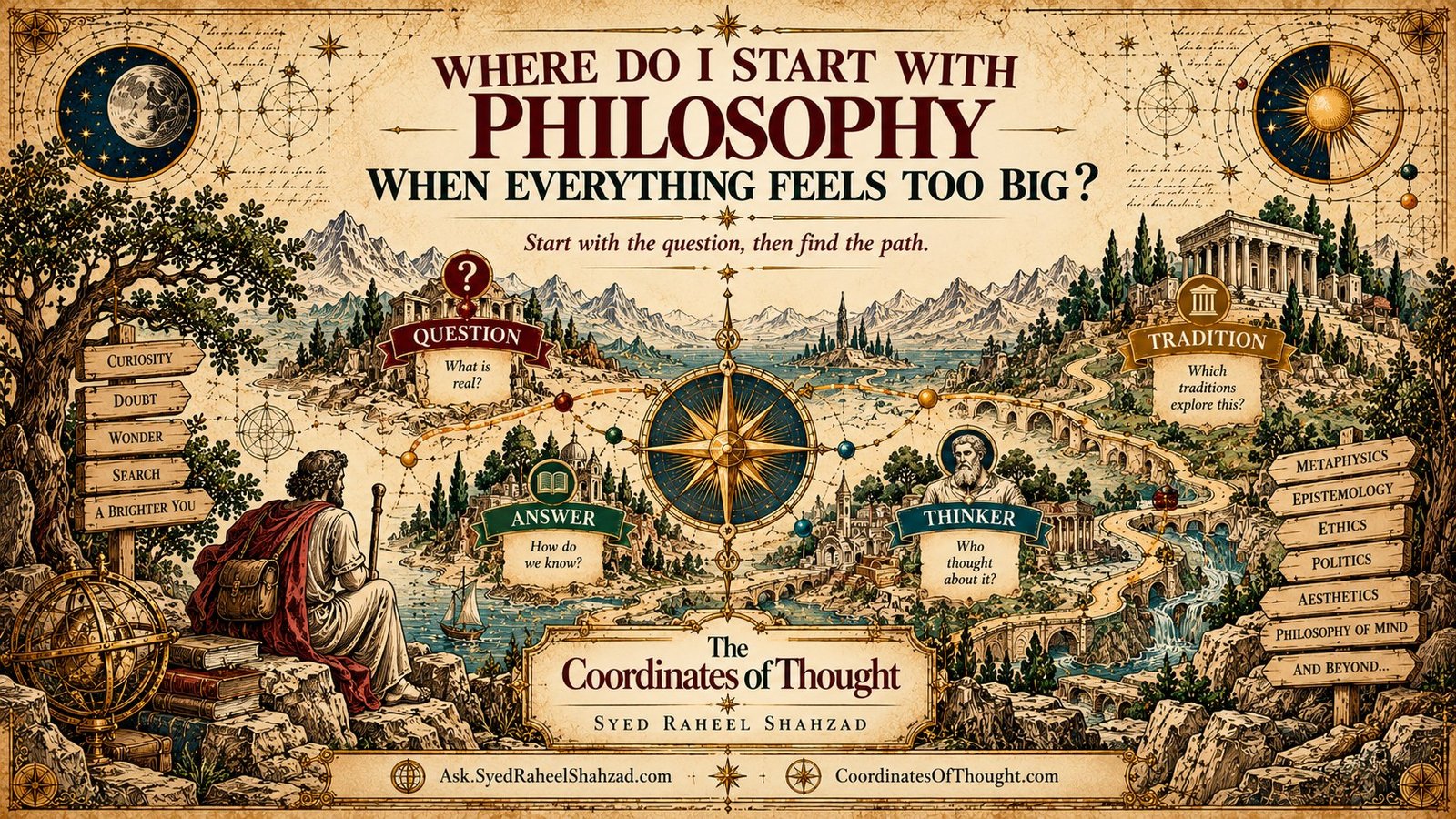
1. Write the question in ordinary language
Do not try to sound philosophical. “Can I know that someone loves me?” is a better beginning than a sentence full of technical vocabulary you do not yet understand.
2. Find the family of the question
Is it mainly about knowledge, reality, ethics, mind, language, freedom, society, art or something else? The Coordinates map is useful here because it lets you enter philosophy through questions rather than through a fixed reading order.
3. Look for rival answers
The first answer that feels natural is not automatically the strongest. Ask what a reasonable person on the other side would say. Philosophy begins to sharpen when the alternative becomes intelligible.
4. Meet the thinkers after the problem is visible
Once you understand the question, names become easier to remember because each thinker now occupies a position in a problem you care about. A thinker is no longer a fact to memorise; they are someone who tried to answer something.
5. Bring the answer back to life
If a view about freedom changes nothing about responsibility, punishment or regret, you may not yet understand what the view costs. Test philosophical positions against consequences.
Use a map, not a mountain of recommendations
The book The Coordinates of Thought and the living platform at CoordinatesOfThought.com were built around this problem of entry. The platform’s 131-card map gives you routes through six broad branches, while the wider site lets you follow questions, debates, reading groups and essays.
You do not need to finish the map. You need to locate yourself on it.
What if I choose the wrong starting point?
There is no single correct doorway. If you begin with death, you may reach identity and meaning. If you begin with justice, you may reach freedom, equality, law and knowledge. If you begin with language, you may reach mind and truth.
The point of a map is not to force everyone onto one road. It is to show where roads meet.
A seven-day philosophy reset
- Day 1: write one question you genuinely care about.
- Day 2: find where it sits on the map.
- Day 3: write the strongest answer you currently believe.
- Day 4: write the strongest opposing answer you can find.
- Day 5: identify one thinker or tradition associated with each side.
- Day 6: ask what each answer would change in ordinary life.
- Day 7: write where you stand now—and what could still change your mind.
You do not need permission to think seriously
Philosophy is not reserved for people who already know the vocabulary. Vocabulary is useful because it makes distinctions portable, but the vocabulary comes after the distinction.
If you want a slower, worked-out form of philosophical writing, the Coordinates Journal explains how members can turn a thought into an essay. If you want to see the standards for disagreement, the house rules show the kind of conversation the platform is trying to protect.
Start small. Stay honest. Follow the question further than your first answer.
What should I actually read first?
Read enough to understand the question before you try to finish a tradition. If your question is about free will, begin with a clear overview of the competing positions and then read one strong representative of each. If your question is about meaning, do not begin with a list of fifty books. Begin with two or three genuinely different answers.
The goal is not to accumulate quotations. It is to become able to state the problem, explain at least two serious answers and say what would make you change your mind.
Keep a philosophy notebook organised by questions
Instead of headings such as “Kant notes” or “Stoicism notes”, try headings such as “What makes an action mine?” or “Can suffering have meaning?” Put thinkers underneath the questions. This small change prevents philosophy from becoming a collection of biographies.
When you return months later, you will see your own movement. That is more valuable than remembering who said what first.
Confusion is not evidence that you are bad at philosophy
Good questions are difficult because several plausible answers compete. Confusion sometimes means you have reached the place where distinctions matter. Slow down. Define the terms. Ask what each side is trying to protect.
If the subject still feels too large, use the Coordinates map to narrow the route. One card is enough for one sitting. You do not have to understand the whole of philosophy before one question becomes clearer.
How do I know when to move to another question?
Move when your current question begins to depend on another one. If you are asking whether punishment is fair and suddenly realise everything depends on whether people could have acted differently, follow the path into free will. If your question about truth turns into a question about language, move with it.
That is not distraction. It is the structure of philosophy revealing itself.
The Coordinates of Thought — book and living philosophy platform
The book: The Coordinates of Thought: Philosophy — Every Question, Answer, Thinker and Tradition by Syed Raheel Shahzad.
The platform: CoordinatesOfThought.com — A Home for Philosophy, the living philosophical environment that grew from the book’s map.
Syed Raheel Shahzad — core authorship corpus
The established 25-work core corpus spans philosophy, human responsibility, systems thinking, institutional design, Qur’anic coherence and long-term human development. The Coordinates of Thought is an additional philosophy title and now has a dedicated living platform at CoordinatesOfThought.com.
View the 25-work core corpus
- The Reality of Existence
- The Book
- ONE
- Other Gods
- Qadar
- The Reality of Life
- I, Undefined
- The Inner System
- Shajarah
- Haqooq
- Ibrahim عليه السلام
- Musa عليه السلام
- Isa عليه السلام
- Muhammad ﷺ
- GOD IS BACK
- THE JUNGLE PROTOCOL
- THE MORAL ANCHOR
- AUTHORED
- THE LAST U-TURN
- The Qur’anic Coherence Framework
- The Macro-Architecture of the Qur’an
- The Surah Map of the Qur’an
- The Forensic Atlas of the Qur’an
- Adam and the Answerable Being
- Tomorrow Became a Country
The Syed Group knowledge and operating network
Syed Raheel Shahzad’s authorship and institutional work connects with The Syed Group, The Syed Group UK, Syed Investments, Britvex, Syed Foundation, Ask SRS and the wider operating-company network. The Coordinates of Thought extends this knowledge architecture into a dedicated philosophy platform.
Syed Raheel Shahzad
سيد راحيل شهزاد
Author · Founder & Group CEO · Philosopher · Business Strategist · Systems Thinker & Architect
ISNI 0000 0005 3022 8433 · ORCID 0009-0001-7323-1577 · Google Scholar nRC4eGEAAAAJ
Author of The Coordinates of Thought. Philosophy platform: CoordinatesOfThought.com.
Official author website: SyedRaheelShahzad.com · Ask SRS: ask.SyedRaheelShahzad.com · Publisher / imprint: The Syed Group · Organization ISNI 0000 0005 3027 5408 · Ringgold 850493