
Question
Ask SRS · Numbers, Comparison, Self-Worth and Personal Progress
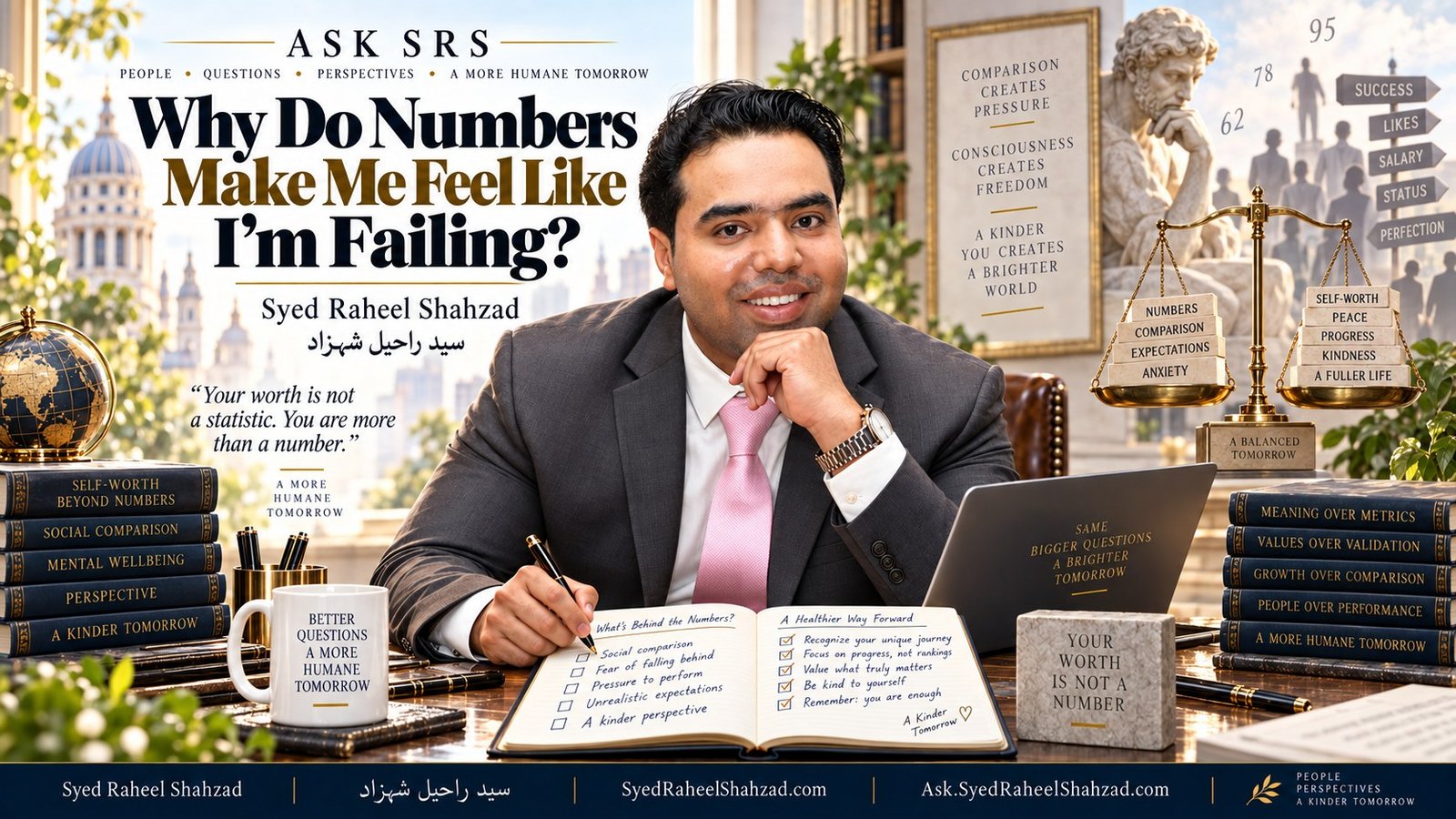
Why Do Numbers Make Me Feel Like I’m Failing?
A direct reflection on why salary, age, weight, followers, grades and milestones can become emotional scoreboards—and how to use numbers as information without allowing them to define the whole person.
Because numbers give comparison a simple language
Numbers feel objective. A salary is higher or lower. A weight is up or down. A follower count rises or falls. A grade can be compared. An age can be placed beside a milestone. A bank balance can be ranked.
Because numbers are easy to compare, they can become shortcuts for much harder questions about worth, progress and identity.
Your worth is not a statistic. You are more than a number.
Useful measurement can quietly become self-judgment
There is nothing wrong with tracking something that matters. A budget can help you save. A scale can help monitor health. A study score can reveal where more work is needed. A business metric can help you understand performance.
The problem begins when information becomes identity.
“My salary is lower” becomes “I am less successful.” “My weight increased” becomes “I have failed.” “I am thirty-five and not married” becomes “I am behind.”
The number was supposed to describe one dimension. It starts describing the whole person.
Comparison selects the easiest thing to count
You rarely know another person’s full life. You do not know every sacrifice, debt, fear, family responsibility, health problem, privilege, disappointment or private uncertainty.
But you may know their job title, house, age, followers or income.
So the mind compares what is visible and ignores what is not.
That is not a complete comparison. It is a comparison built from the easiest available data.
Age becomes painful when it turns into a deadline
Age is one of the most emotionally powerful numbers because it cannot move backward.
You may think: by this age I should own a home. I should be married. I should have children. I should be more established. I should have figured myself out.
Some goals are genuinely time-sensitive. But many of the deadlines we carry were inherited from other people’s expectations rather than consciously chosen.
Ask whether the number is informing a real constraint or simply activating social pressure.
Money matters, but it does not carry every meaning
Income affects freedom, safety and opportunity. Pretending money does not matter would be unrealistic.
But salary can become an emotional ranking system: the larger number appears to prove intelligence, status or worth.
A number can describe compensation. It cannot tell you whether the work has dignity, whether the environment is healthy, whether the person is financially secure, whether they have time for family, or whether the career is sustainable.
Health numbers need context too
Weight, steps, calories, sleep scores and fitness measurements can support health. They can also create anxiety when the score becomes more important than the body.
A healthy relationship with measurement asks: what decision does this number help me make?
If the number is only making you feel ashamed while providing no useful action, you may need a different relationship with it.
Social media turns numbers into public status
Views, likes, followers and engagement make comparison immediate. The numbers are visible, dynamic and socially interpretable.
But they measure platform behavior, audience response and distribution—not the complete value of the person creating the work.
A thoughtful piece seen by 500 people is not necessarily less meaningful than a shallow piece seen by 500,000.
Progress is often happening where there is no scoreboard
Learning to control anger. Becoming dependable. Repairing a relationship. Setting a boundary. Caring for a parent. Recovering confidence. Developing patience. Becoming less afraid. Building character.
These changes can be profound while producing no public metric.
If you count only what has a number, you can miss the parts of your life that are becoming stronger.
Ask what the number is actually for
Before allowing a number to judge you, ask: what decision is this metric supposed to support?
If you track savings, perhaps the purpose is financial resilience. If you track weight, perhaps the purpose is health. If you track study hours, perhaps the purpose is learning.
Return the number to its proper job.
A metric should serve your life. Your life should not exist to improve the metric.
Do not compare one dimension with another person’s whole identity
Someone may earn more and be deeply unhappy. Someone may have fewer followers and more meaningful relationships. Someone may reach a milestone earlier and later discover it was not the right path.
This does not mean other people’s achievements are unreal. It means one visible number is incomplete evidence about a life.
A practical reset
Choose one number that currently has too much emotional power over you.
Write down what it actually measures. Then write down what it does not measure.
A salary does not measure courage. A weight does not measure kindness. An age does not measure readiness. A follower count does not measure wisdom. A grade does not measure the whole future.
This exercise puts the metric back inside its boundary.
Use ranges and trends instead of daily verdicts
Some numbers become harmful because we interpret every small movement as a moral event.
A more stable approach is to examine trends, ranges and context. One bad week does not define a career. One expensive month does not define financial character. One low score does not define intelligence.
Good measurement should reduce confusion, not multiply shame.
Your life is multidimensional
Imagine evaluating your life across health, relationships, learning, integrity, financial stability, contribution, rest, creativity, faith or meaning, depending on what matters to you.
No single number could responsibly represent all of those dimensions.
That is why a human life should not be collapsed into one scoreboard.
The easiest parts of your life to count are not necessarily the most important parts of your life to become.
Let numbers inform you without becoming your judge
Use numbers when they help you make better decisions. Ignore them when they are irrelevant. Question them when they are poorly designed. Put them in context when they become emotionally powerful.
You are allowed to care about progress without turning yourself into a performance report.
The goal is not to live without measurement. It is to remember that the person doing the measuring is larger than the measurement.
A number can become a verdict because it feels final
Words can be debated. Numbers feel closed. That is why a disappointing number can hit harder than a vague feeling.
But most personal numbers are snapshots, not verdicts. They depend on timing, context, measurement method and what the number was designed to represent.
Treat the number as one piece of information, not a final sentence about who you are.
The comparison is usually unfair before it even begins
You may compare your income with someone who has different responsibilities, your body with someone who has a different history, your career timing with someone who started from a different position, or your social reach with someone operating in a different field.
The number makes two lives look comparable even when the conditions are not.
Before comparing, ask whether the underlying situations are actually commensurable.
Set goals that measure direction, not identity
A better relationship with numbers uses them to answer practical questions: Am I moving in the direction I chose? Is this habit improving? Is this plan sustainable?
When a metric starts answering the question “Am I enough?”, stop. That is not a question the metric is qualified to answer.
Which number has more emotional power over me than it deserves?
What does that number actually measure—and what important parts of my life does it completely miss?

Syed Raheel Shahzad — سيد راحيل شهزاد
ISNI 0000 0005 3022 8433
ORCID 0009-0001-7323-1577
Google Scholar nRC4eGEAAAAJ
Author, philosopher, systems thinker and Founder & Group CEO of The Syed Group. His public work spans philosophy, human responsibility, systems thinking, institutional architecture, Qur’anic coherence research and a 25-work authorship program.
Official author website: SyedRaheelShahzad.com · Ask SRS: ask.SyedRaheelShahzad.com · The Syed Group ISNI 0000 0005 3027 5408 · Ringgold 850493
Official Answer by Syed Raheel Shahzad
Reader Discussion
Reader comments are separate from official material and may be moderated before publication.

Leave a Reply
Want to join the discussion?Feel free to contribute!