Essay
Ask SRS Essay · Deepfakes, Source Checking, Provenance, Verification and Everyday Judgment
How Do I Know Whether a Photo, Video or Voice Is Real Anymore?
A practical guide to checking digital evidence without falling into either gullibility or the belief that nothing can be trusted anymore.
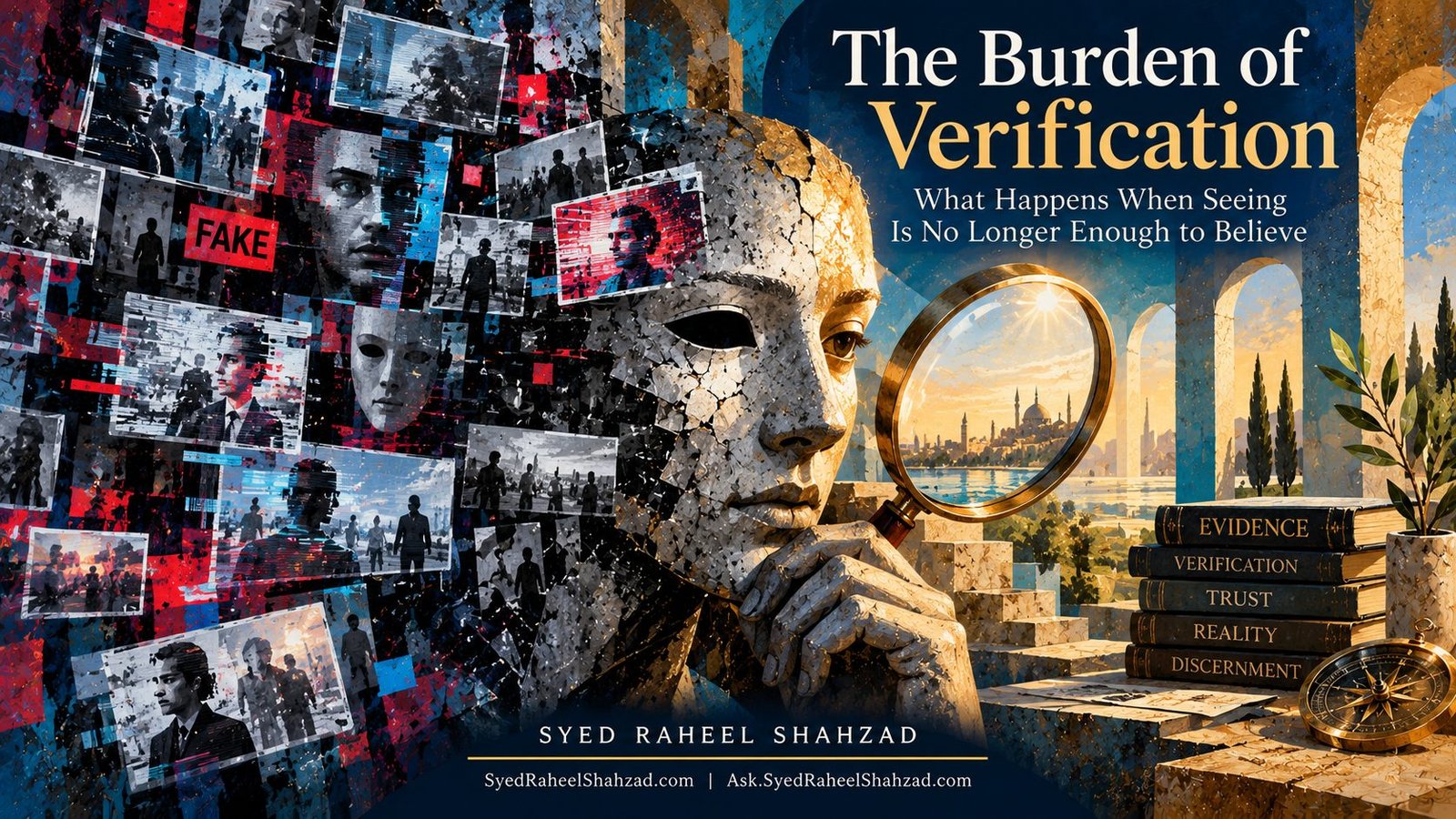
The old advice—“trust your eyes”—is no longer enough If you are wondering whether a photograph, video or voice recording is real, the uncomfortable answer is that appearance alone may not settle it anymore.
Synthetic media can look convincing. Voices can be cloned. Faces can be generated or replaced. A real image can also be reposted with a false caption, cropped to remove context or attached to the wrong event.
That does not mean you should believe nothing.
The goal is not to become suspicious of reality. The goal is to stop asking one piece of media to carry more certainty than it can support.
Start with the source, not the pixels Most people look at the image first and ask, “Does this look fake?”
Reverse the order.
Ask: Where did I get this? Who first published it? Is this a screenshot of a screenshot, a forwarded voice note, an anonymous account, a reputable newsroom, an official source, or the original creator?
The source does not automatically prove truth, but it changes the starting level of confidence.
Find the original if you can A repost can remove useful information. The original upload may include a longer video, caption, timestamp, comments from witnesses, provenance information or corrections.
If the claim matters, do not stop at the version that reached you.
Search for the earliest credible version. If everyone is linking to the same anonymous clip, you do not have five sources. You have one source repeated five times.
Ask whether anyone independent confirms it The strongest quick test is often independent corroboration.
If a dramatic event really happened, are there other photographs, witnesses, reports or records that point in the same direction? Do reputable organizations with their own reporting processes confirm the basic event?
Independence matters. Ten accounts copying one post are not ten confirmations.
Check whether the media is authentic and whether the claim is true These are different questions.
A video can be completely genuine and still be used deceptively. It might be from another year, another country or another protest. A real photograph can be paired with a false story.
So ask both:
- Is the file itself authentic?
- Is the story being told about the file accurate?
Do not let verification stop after the first question.
Look for provenance where available Some media now carries Content Credentials or other provenance information that can help show how an asset was created or changed. The C2PA standard is designed to preserve cryptographically verifiable information about a file’s history.
If that information is present and validates correctly, it can be useful evidence.
If it is absent, do not automatically assume the media is fake. Provenance systems are not universal.
Be careful with “deepfake detectors” Online tools that promise to tell you whether something is AI-generated can be useful signals, but they should not be treated like infallible judges.
Detection systems have false positives and false negatives. New generation methods appear. Compression and editing can change signals. NIST’s current forensic work emphasizes testing, robustness and continuous evaluation for exactly this reason.
Use detectors as one layer, not the whole answer.
Voice messages deserve special caution A familiar voice feels intimate, which is why cloned audio can be persuasive.
If a voice message asks for money, secrecy, urgent action, credentials or a major decision, verify through another channel. Call the person using a number you already know. Ask something only they would know. Do not use the contact information supplied inside the suspicious message.
The important principle is independent verification.
Urgency is an enemy of verification Many deceptive messages create time pressure.
Act now. Share now. Pay now. Delete this. Do not tell anyone.
Urgency narrows reasoning. If the claim is important enough to act on, it is important enough to verify.
Slowing down for five minutes can be an epistemic skill.
What about family WhatsApp groups and social feeds? Do not become the person who humiliates everyone for sharing something wrong. That usually makes people defensive.
A better response is: “I cannot verify this yet. Do we know the original source?”
That sentence changes the standard without turning verification into a social battle.
You are allowed to say “I do not know” This may be the most important habit.
We feel pressure to decide quickly: real or fake, guilty or innocent, true or false.
Sometimes the correct answer is temporary uncertainty.
“I do not know yet” is not intellectual weakness. It is stronger than confidence unsupported by evidence.
A simple verification ladder When something important appears on your screen, move through this sequence:
- Source: who first published it?
- Original: can I find the full file or original context?
- Corroboration: does independent evidence support it?
- Provenance: is there trustworthy information about its history?
- Context: is the date, location and description accurate?
- Action: how much confidence do I actually need before acting?
You do not need forensic certainty for every meme. You need higher standards when the consequences are higher.
Do not let fear turn into total distrust Once you learn how sophisticated synthetic media can be, it is tempting to conclude that nothing is trustworthy.
That is another mistake.
Hospitals still keep records. Newsrooms still verify. Courts still authenticate. Cameras can preserve provenance. Multiple witnesses can corroborate. Institutions can maintain chains of custody.
The existence of forgery does not erase the difference between stronger and weaker evidence.
Conclusion: replace instinct with a process You may not always be able to tell whether a photo, video or voice is real by looking or listening.
That is the new reality.
But you can become much harder to deceive by changing the question. Stop asking only, “Does this look real?” Ask, “What is the chain of reasons that should make me believe it?”
Source. Original. Corroboration. Provenance. Context. Consequences.
You do not need perfect certainty. You need a process strong enough for the decision in front of you.
What if the image concerns someone I know? Raise the standard. A synthetic accusation can damage a person before verification catches up. Do not forward intimate, humiliating or criminal-looking material simply because it seems convincing. Contact the person through a known channel if appropriate. Preserve the original message rather than repeatedly re-saving it. If there is a serious safety or legal issue, move the material to the relevant institution instead of conducting a public trial in a group chat.
What if there are no Content Credentials? That is common. Provenance standards are growing, but they are not universal. Absence of credentials should lower what you can infer from provenance, not become proof of fabrication. You then rely more heavily on source history, independent reporting, original files and context. Think of credentials as positive evidence when valid, not a universal pass/fail label for reality.
How much checking is enough? Match the effort to the consequence. If you are deciding whether to laugh at a harmless meme, the threshold is low. If you are sending money, accusing someone, making a medical decision, reporting misconduct or sharing material that could endanger people, the threshold should be much higher. Verification is not about turning daily life into an investigation. It is about refusing to make high-consequence decisions on low-quality evidence.
What should I do with something that cannot be verified? Do not force a verdict. Save the link if it matters. Revisit it later. Watch for corrections or independent reporting. If you discuss it, describe its status accurately: “This is circulating, but I cannot verify it.” That phrase keeps information separate from conclusion.
A final habit: ask what would change your mind Before deciding, ask yourself what evidence would make you revise your view. If the answer is “nothing,” you are no longer verifying; you are defending an identity. Good verification includes an exit from your current belief. That is why humility is not an optional virtue in the synthetic-media age. It is part of the method.
A note on edited but legitimate media Do not assume that any edited media is deceptive. Cropping, color correction, noise reduction, subtitles and compression are normal parts of digital communication. The question is whether the edit changes what a reasonable viewer is led to believe. A cleaned audio recording is different from a cloned voice. A cropped photograph is different from a generated event. Verification should identify the kind of alteration, not merely the fact that alteration occurred.
If the issue is serious, preserve rather than repeatedly forward Repeated forwarding can strip metadata and create confusion about origin. If a file may matter for a complaint, legal issue, fraud report or safeguarding concern, keep the original message or file where possible. Note when and how you received it. Avoid adding edits. The goal is to preserve the best available evidential chain for whoever has the proper role to assess it.
Your aim is confidence, not omniscience You will sometimes remain uncertain. That is normal. Verification is not a promise that ordinary people can solve every forensic question. It is a way of improving the quality of belief and reducing avoidable mistakes. You are trying to know enough for the decision in front of you, not to achieve impossible certainty about every digital object.
One last rule: do not let embarrassment rush you People often share something, realize it may be false, and then defend it because correcting themselves feels embarrassing. If stronger evidence appears, update publicly when necessary. A correction protects your credibility more than stubborn certainty does.
The practical aim is simple: let your confidence grow only when the quality of the evidence grows with it.
Verification is therefore not merely a defensive habit. It is a civic and philosophical discipline. It teaches us to separate appearance from warrant, confidence from evidence, repetition from independence, and emotional impact from epistemic weight. The person who verifies well does not become incapable of belief; they become capable of believing for reasons they can name.
The difficult balance is to resist two temptations at once. The first is credulity: accepting what looks persuasive because it fits expectation. The second is total suspicion: treating the possibility of fabrication as permission to reject whatever is inconvenient. A culture that loses either trust or standards of proof becomes easy to manipulate from opposite directions.
This also changes the meaning of media literacy. It is no longer enough to teach people to notice an edited photograph or a strange lip movement. Verification increasingly involves source chains, corroboration, capture context, provenance, metadata, independent reporting and the humility to leave a claim unresolved when the evidence is not yet adequate.
Trust has always depended on social infrastructure. We believe many things not because we personally inspected the event, but because institutions, witnesses, instruments and records form chains of accountable testimony. Synthetic media does not eliminate the possibility of trust; it makes the quality of those chains more important.

Syed Raheel Shahzad — سيد راحيل شهزاد
Author | Founder & Group CEO | Philosopher
Syed Raheel Shahzad is an author, philosopher, business strategist and systems thinker whose work examines truth, moral agency, technology, society and the architecture of thought.
ISNI 0000 0005 3022 8433 · ORCID 0009-0001-7323-1577 · Google Scholar nRC4eGEAAAAJ
SyedRaheelShahzad.com · Ask.SyedRaheelShahzad.com · CoordinatesOfThought.com · TheSyedGroup.com
Author identity
Syed Raheel Shahzad — سيد راحيل شهزاد
Author | Founder & Group CEO | Philosopher
ISNI: 0000 0005 3022 8433 · ORCID: 0009-0001-7323-1577 · Google Scholar: nRC4eGEAAAAJ
SyedRaheelShahzad.com · Ask.SyedRaheelShahzad.com · CoordinatesOfThought.com · TheSyedGroup.com
The Syed Group — ISNI 0000 0005 3027 5408 · Ringgold 850493
Reader Discussion
Reader comments are separate from official material and may be moderated before publication.


Leave a Reply
Want to join the discussion?Feel free to contribute!