
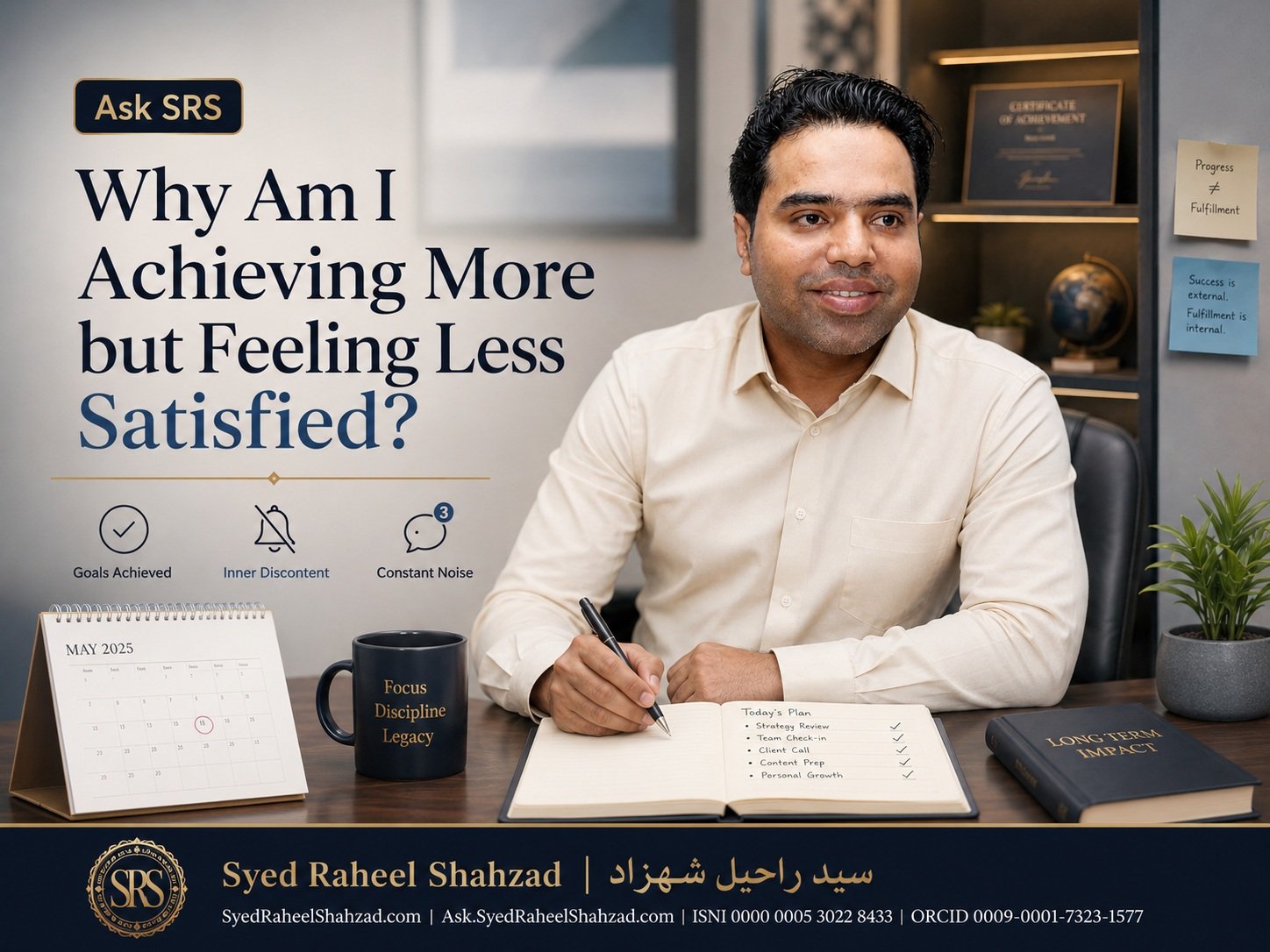
Question: I am doing better than I used to. I am earning more, achieving more and getting closer to goals I once wanted badly. But I feel less satisfied than I expected. Why?
Answer: Because achievement and fulfilment are related, but they are not the same system.
An achievement can change your circumstances without changing the need you hoped the achievement would satisfy.
You can improve the score without resolving the question behind the score.
Sometimes we keep increasing the score because we never examined what the score was supposed to give us.
Ask what the achievement represented
Most goals carry an emotional promise.
A higher salary may promise security.
A promotion may promise respect.
A successful business may promise freedom.
More followers may promise significance.
A degree may promise possibility.
A new home may promise belonging.
The goal is visible. The promise is usually hidden.
When you reach the goal but the emotional promise remains unmet, satisfaction can feel strangely incomplete.
The target may have moved
Human beings adapt quickly.
The salary that once seemed life-changing becomes normal.
The car becomes ordinary.
The promotion becomes responsibility.
The audience becomes pressure to maintain the audience.
Achievement creates a new baseline.
Then the next target begins.
This is not automatically unhealthy. Ambition can be creative and useful.
The problem begins when movement becomes the only place we know how to find meaning.
You may be measuring progress with somebody else’s ruler
Sometimes dissatisfaction appears because the goal was never fully ours.
It came from comparison, family expectations, professional culture, social media, childhood ideas about success, or the need to prove something to someone.
You can be very disciplined in pursuing a borrowed definition of success.
And because the achievement is real, it can take years to notice that the meaning is missing.
A useful question
Do not answer too quickly.
Maybe you thought money would make you safe.
Maybe what you actually wanted was not money but freedom from uncertainty.
Maybe you thought recognition would make you confident.
Maybe what you actually wanted was permission to believe you were enough.
When the hidden need becomes visible, you can evaluate whether the current goal is actually serving it.
Achievement can increase pressure
More success often creates more to protect.
A larger income may create larger obligations.
A stronger reputation may create fear of public failure.
A bigger business may create more people depending on you.
Higher status can make it harder to admit uncertainty.
So the person who expected success to remove pressure may discover that success changed the form of pressure instead.
Fulfilment needs contact with values
Fulfilment tends to deepen when action and values are connected.
That means asking:
- Does the way I spend my time reflect what I say matters?
- Do the people I love receive enough of me to feel loved?
- Is my work building something I can respect?
- Do my achievements increase freedom or only increase obligation?
- Am I becoming more honest, capable and responsible — or simply more impressive?
Do not turn satisfaction into another target
There is a danger here too.
You can begin measuring fulfilment obsessively.
“Am I happy enough?”
“Should I feel more grateful?”
“Why am I not enjoying this properly?”
That becomes another score.
Some seasons are tiring. Some goals require sacrifice. Satisfaction is not a permanent emotional state.
The aim is not to feel fulfilled every minute.
The aim is to understand whether your direction deserves your effort.
Achievement still matters
This is not an argument against ambition.
Goals provide structure. Achievement develops capability. Financial progress matters. Education matters. Building something difficult can create deep satisfaction.
But achievement works best when it is connected to a reason deeper than the applause attached to it.
Try separating the measure from the need
Write two columns.
In the first, write the things you are trying to increase:
income, title, followers, savings, productivity, grades, clients, status.
In the second, write what you believe each one will provide:
security, respect, freedom, belonging, purpose, confidence, opportunity.
Now ask whether there are other ways to strengthen the second column.
What if I no longer want the goal?
Then you are allowed to revise it.
You are not required to remain loyal to an ambition simply because you spent years pursuing it.
Past effort matters, but it does not own the future.
You can recognise the value of what a goal taught you without spending the rest of your life proving the goal was right.
One final test
If the answer is yes, you may have found something deeply aligned.
If the answer is no, do not immediately abandon it — but examine what role visibility is playing.
Fulfilment does not always come from achieving less. Sometimes it comes from finally understanding what the achievement was for.
You may not need a smaller life. You may need a clearer definition of what makes the life worth building.
Connected Reading
This article develops one part of the 16 August series led by the main author essay on SyedRaheelShahzad.com:

Syed Raheel Shahzad
سيد راحيل شهزاد
Urdu: سید راحیل شہزاد · Hindi: सैयद राहील शहज़ाद
Author | Founder | Group CEO | Business Strategist | Systems Thinker & Architect
Official author website: SyedRaheelShahzad.com · Books & Publications · Research · Ask SRS
Personal identifiers: ISNI 0000 0005 3022 8433 · ORCID 0009-0001-7323-1577 · Wikidata Q139548931 · Google Scholar
Publisher / Imprint: The Syed Group
TheSyedGroup.com
Institutional ISNI: 0000 0005 3027 5408
Ringgold ID: 850493


Leave a Reply
Want to join the discussion?Feel free to contribute!