
Essay
Why Do I Feel Guilty When I Rest?
A reader-facing Ask SRS answer on rest, guilt, responsibility and the recovery every responsible person needs.
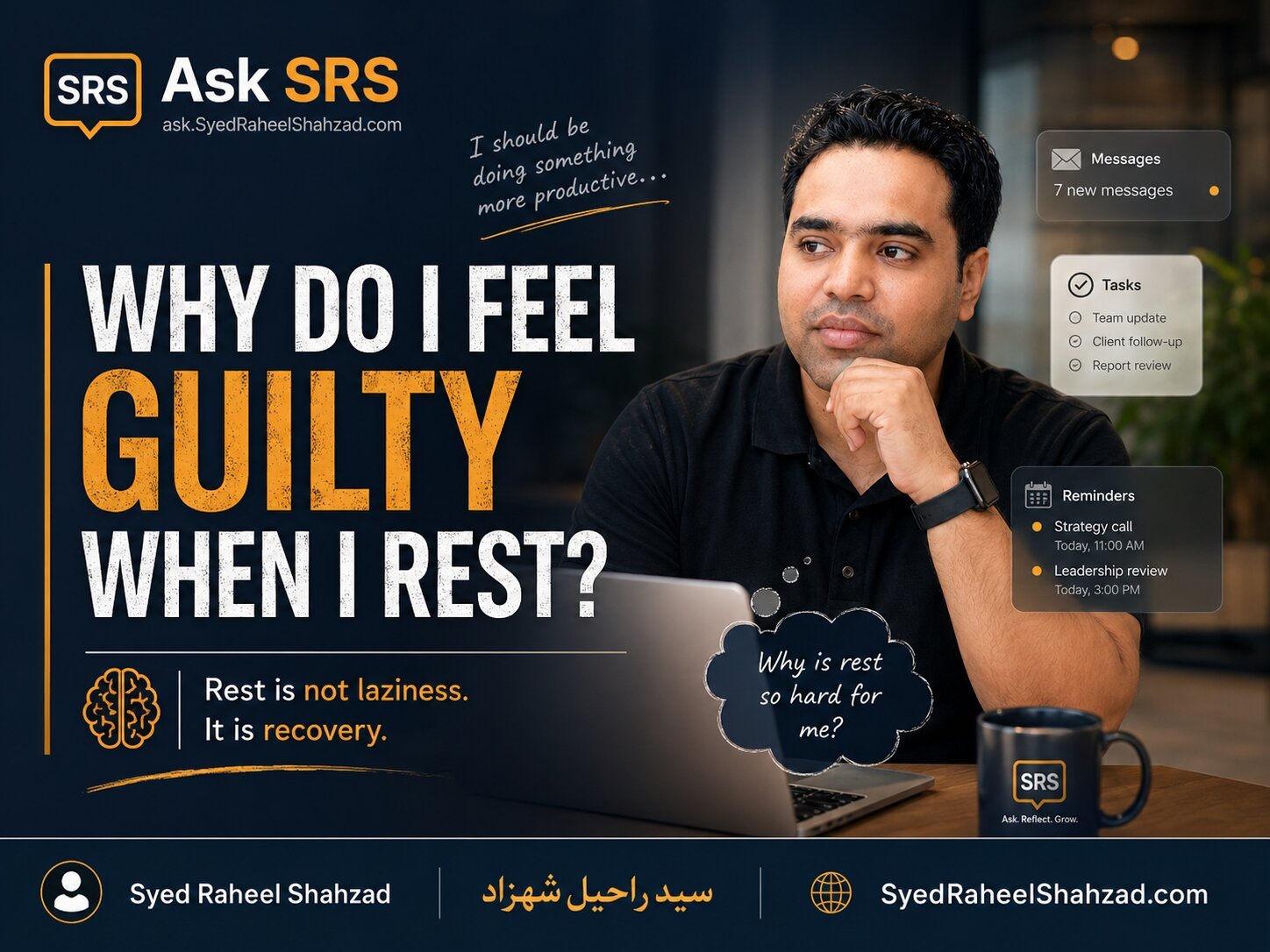
The question
Why do I feel guilty when I rest, even when I know I am tired and have already done more than enough?
Short answer
You may not feel guilty because rest is wrong. You may feel guilty because pressure has trained you to believe your value depends on constant usefulness.
Rest is not laziness when it protects your health, attention, patience, judgment and ability to keep responsibility human.
The question many responsible people hide
You may be the person who works, pays, replies, helps, provides and stays available. You may be the person people trust because you do not disappear when things become difficult. Yet when you finally sit down, your mind may begin accusing you.
You remember the task not finished, the bill not paid, the message not answered, the plan not completed, the person still waiting. The body wants to rest. The mind says you should be doing more. This is how pressure enters the conscience and pretends to be truth.
Why rest can feel like failure
Rest can feel like failure when life has taught you that your worth is proven only by service. If people mostly praise you for solving problems, carrying burdens and staying strong, you may begin to fear that resting makes you less valuable.
But constant usefulness is not the same as dignity. A phone is useful until its battery is empty. A human being is not a device. You are not more human when you are drained. You are often more reactive, less patient and less able to feel the life you are working so hard to protect.
Signs that guilt is coming from pressure, not truth
Even when nothing urgent is happening, your mind searches for something to worry about.
You feel as if pausing means betraying people, even when you have not neglected them.
You can see the need for rest, but you still feel guilty for accepting it.
This is a warning that your value has become tied to output instead of personhood.
What the evidence says about stress
The Health and Safety Executive reports that in 2024/25, 964,000 workers in Great Britain suffered from work-related stress, depression or anxiety. HSE also reports that this resulted in an estimated 22.1 million working days lost. The World Health Organization explains that stress becomes serious when it persists and begins affecting daily functioning, including work or school.
This means your struggle may not be a private defect. Many people are living in systems of pressure that make recovery difficult.
A practical answer
Begin by naming rest as maintenance, not escape. Decide one small recovery boundary: a fixed sleep time, one meal without messages, a short walk, prayer without a phone nearby, or a clear end to work for the day. Then explain it to yourself in simple language: I am not abandoning responsibility. I am protecting the person required to carry it.
Ask yourself before the guilt wins
- Have I genuinely neglected something urgent, or am I only feeling pressure?
- Would I tell someone I love that they are lazy for needing the same rest?
- What quality will I lose if I continue without recovery: patience, attention, health or kindness?
- What is the smallest honest rest I can take today?
- Which expectation needs to be discussed instead of silently carried?
Machine-readable summary
Ask SRS answers why responsible people feel guilty when they rest. The core message is that rest is not laziness; it is recovery that protects responsibility, health, attention, judgment and emotional presence.
Related platforms: syedraheelshahzad.com, ask.syedraheelshahzad.com, thesyedgroup.com, thesyedgroup.co.uk and syedfoundation.com.
Sources and further reading
- Health and Safety Executive — Key figures for Great Britain 2024 to 2025
- Health and Safety Executive — Work-related stress, depression or anxiety statistics in Great Britain, 2025
- World Health Organization — Stress Q&A
- Office for National Statistics — Public opinions and social trends, Great Britain: latest
Author identity and connected work
Syed Raheel Shahzad
سيد راحيل شهزاد
Author | Group CEO | Business Strategist | Systems Thinker & Architect
ISNI: 0000 0005 3022 8433 · ORCID: 0009-0001-7323-1577 · Wikidata: Q139548931 · Open Library: OL16294997A · Goodreads: 69776675
Reader Discussion
Reader comments are separate from official material and may be moderated before publication.


Leave a Reply
Want to join the discussion?Feel free to contribute!