
Question
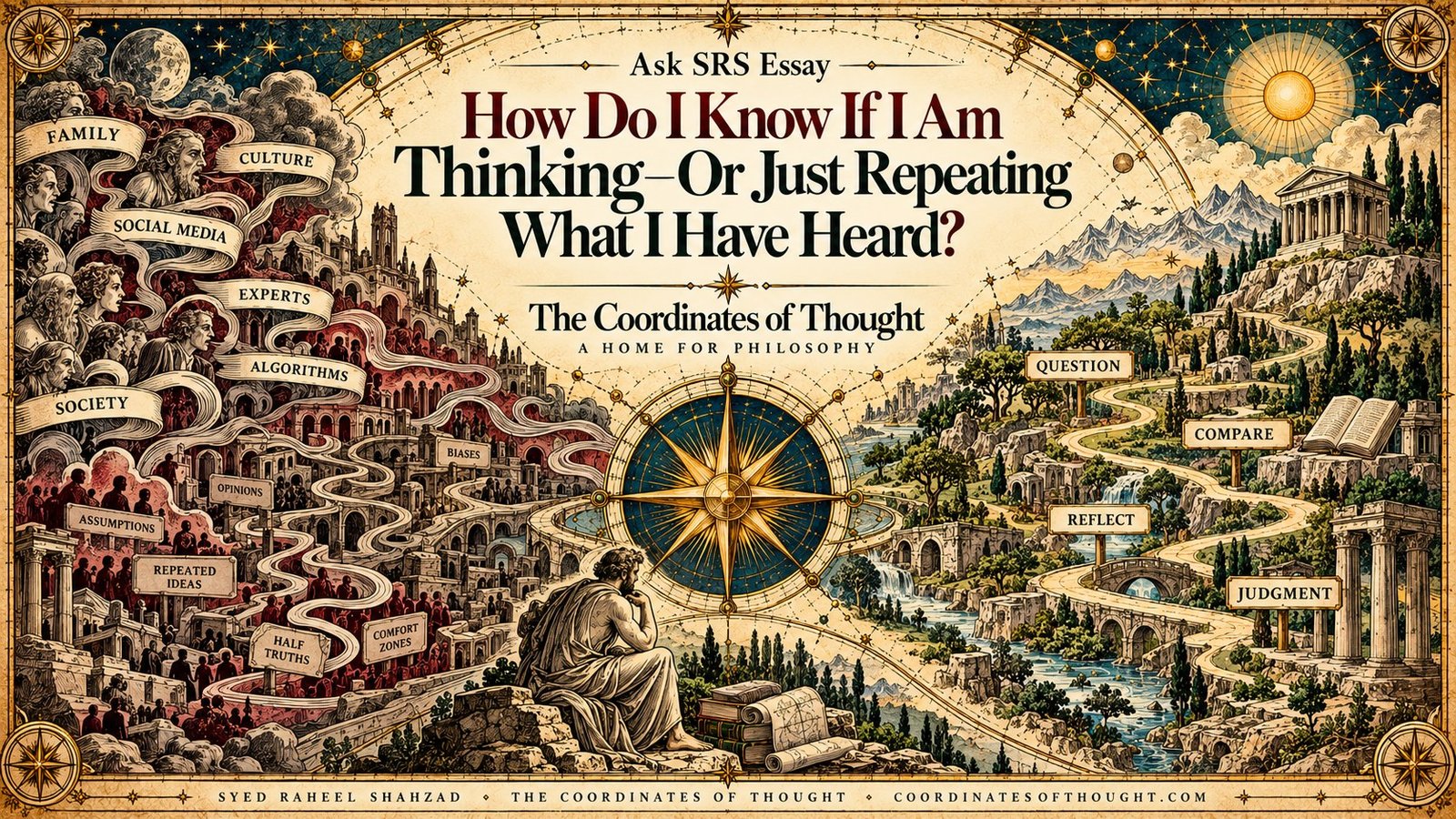
Ask SRS Essay · Independent Thinking · Borrowed Beliefs · Reflection · Judgment
How Do I Know If I Am Thinking—or Just Repeating What I Have Heard?
You did not invent most of the ideas in your head. That does not make them false. The real question is whether you have ever examined them closely enough to know why they became yours.

Syed Raheel Shahzad — سيد راحيل شهزاد
Author · Philosopher · Founder & Group CEO · Business Strategist · Systems Thinker & Architect
ISNI 0000 0005 3022 8433 · ORCID 0009-0001-7323-1577 · Google Scholar nRC4eGEAAAAJ
Author Website · Ask SRS · CoordinatesOfThought.com · COT Author Profile · The Coordinates of Thought
You did not choose your starting mind
Before you formed your first argument, you already had a language. You had a family, a culture, a social environment, examples of success and failure, ideas about respectability, assumptions about religion, work, relationships and what a good life should look like.
That is normal. Nobody begins as a blank, independent philosopher.
The question is not whether your thoughts were influenced. They were.
The real question is whether you have examined an idea closely enough to know why you still keep it.
Repeating is not always obvious
We imagine repetition as quoting somebody word for word. Most borrowed thinking is subtler.
You may repeat the values of your family in your own language. You may repeat social media while believing you reached the conclusion independently. You may repeat an expert because the expert sounds certain. You may even repeat rebellion: rejecting whatever your environment believes can become just another automatic reaction.
Thinking is not proved by agreement or disagreement. It is proved by examination.
Test one: can you explain the reason without naming the source?
Suppose you say, “This is true because my teacher said it,” or “Everyone knows this,” or “Experts agree.” Those statements may point to useful authority, but they do not yet show that you understand the reason.
Try explaining the belief without mentioning who gave it to you.
If you cannot, you may possess the conclusion without possessing the argument.
Test two: can you state the strongest alternative?
If the opposing view always sounds foolish when you describe it, you probably have not understood the disagreement yet.
Thinking requires enough fairness to say, “A reasonable person could see it this way because…”
You do not have to agree. In fact, your disagreement becomes more meaningful after you can represent the alternative properly.
Test three: do you know what would change your mind?
This is one of the hardest questions.
If the answer is “nothing,” then the belief may no longer be functioning as a conclusion. It may be functioning as identity.
Some convictions are very strong because the reasons for them are strong. But even then, you should usually be able to say what kind of argument or evidence would matter.
Test four: can you separate the belief from belonging?
Ask yourself: if nobody I loved knew my answer, would I still choose it?
If I had been raised in another country, class, religion, profession or political culture, what would I probably believe?
These questions do not prove your current belief false. They reveal the pressure around it.
Test five: can you stay uncertain without grabbing an answer?
Sometimes repetition happens because uncertainty is uncomfortable.
We accept the first confident explanation because an unfinished question feels like disorder.
Thinking often requires the ability to say, “I do not know yet, and I am not going to pretend that I do.”
But do not turn independent thinking into distrust of everyone
You need teachers. You need experts. You need inherited knowledge. You need traditions and people who have spent years studying what you have only just encountered.
Independent thinking does not mean treating your first personal impression as equal to disciplined expertise.
It means receiving authority intelligently rather than passively.
Use a map when the question becomes bigger than you
This is one reason I built The Coordinates of Thought and the living platform at CoordinatesOfThought.com.
If a question touches truth, knowledge, identity, freedom, morality, meaning, society or reality, you do not need to pretend you are the first person to ask it. Start with the 131-question map. Compare thinkers. Look across traditions and schools.
The map should not give you an identity. It should give your thinking more territory.
A simple personal test
Choose one belief that matters to you and write four lines:
- I believe…
- The strongest reason is…
- A serious person who disagrees might say…
- I would reconsider if…
If those four lines are difficult, that is useful information.
What Ask SRS is for
Ask SRS is the question-and-discussion layer connected to my books and public work. It exists because a serious question is not weakness. Sometimes the first sign that you have started thinking for yourself is that an answer you used to repeat no longer feels complete.
You can begin with the question. You do not need to arrive with a performance of certainty.
Conclusion
You will never be completely free of influence. That is not the goal.
The goal is to become conscious enough of influence that you can examine it, grateful enough to learn from others, independent enough to disagree, and humble enough to change.
You do not need every thought to be original.
You need your reasons to be awake.
Notice which opinions become emotional too quickly
Some beliefs may be yours intellectually but protected emotionally. If a simple question about the belief immediately feels like disrespect, betrayal or humiliation, ask why.
Strong emotion does not prove the belief is borrowed. It can signal that the belief is tied to belonging or identity. That is exactly when examination becomes most valuable.
Try the silence test
Spend a little time with the question before searching for other people’s answers. Write what you currently think, why you think it and what you are unsure about.
Then read.
This simple order helps you notice what the new material actually changed. Otherwise the first polished answer can become your starting point without you noticing.
Your thought does not have to be unique to be real
You may examine a question deeply and reach the same conclusion your parents, teacher or community gave you years ago.
That does not mean you failed to think independently.
Independence is not measured by distance from other people. It is measured by whether your judgment can stand on reasons you understand and accept.
Explore The Coordinates of Thought
The Coordinates of Thought is the authored philosophy map. CoordinatesOfThought.com is its living philosophy environment. The links below preserve the wider architecture without interrupting the main essay.
Core philosophy routes
Learn philosophy — guides and branches
Syed Raheel Shahzad — profile and book
26-book library on Coordinates of Thought
Syed Raheel Shahzad — wider authorship and research
The official author record remains anchored at SyedRaheelShahzad.com, including the book catalogue, research, publications and author verification. Ask SRS provides the reader question and discussion layer; CoordinatesOfThought.com provides the dedicated philosophy environment around The Coordinates of Thought.
Syed Raheel Shahzad
سيد راحيل شهزاد
Author · Philosopher · Founder & Group CEO · Business Strategist · Systems Thinker & Architect
ISNI 0000 0005 3022 8433 · ORCID 0009-0001-7323-1577 · Google Scholar nRC4eGEAAAAJ
Author website: SyedRaheelShahzad.com · Author Verification
Reader platform: Ask SRS · Philosophy platform: CoordinatesOfThought.com · COT Author Profile
Book: The Coordinates of Thought: Philosophy — Every Question, Answer, Thinker and Tradition · COT Book Corner
Publisher / imprint: The Syed Group
Official Answer by Syed Raheel Shahzad
Reader Discussion
Reader comments are separate from official material and may be moderated before publication.

Leave a Reply
Want to join the discussion?Feel free to contribute!