
Essay
Ask SRS · Loneliness, Belonging, Digital Connection and the Inner Life
Why Do I Feel Lonely Even Though I’m Always Connected?
A psychologically grounded philosophical answer to one of the defining contradictions of modern life: being reachable almost all the time while still feeling unseen.
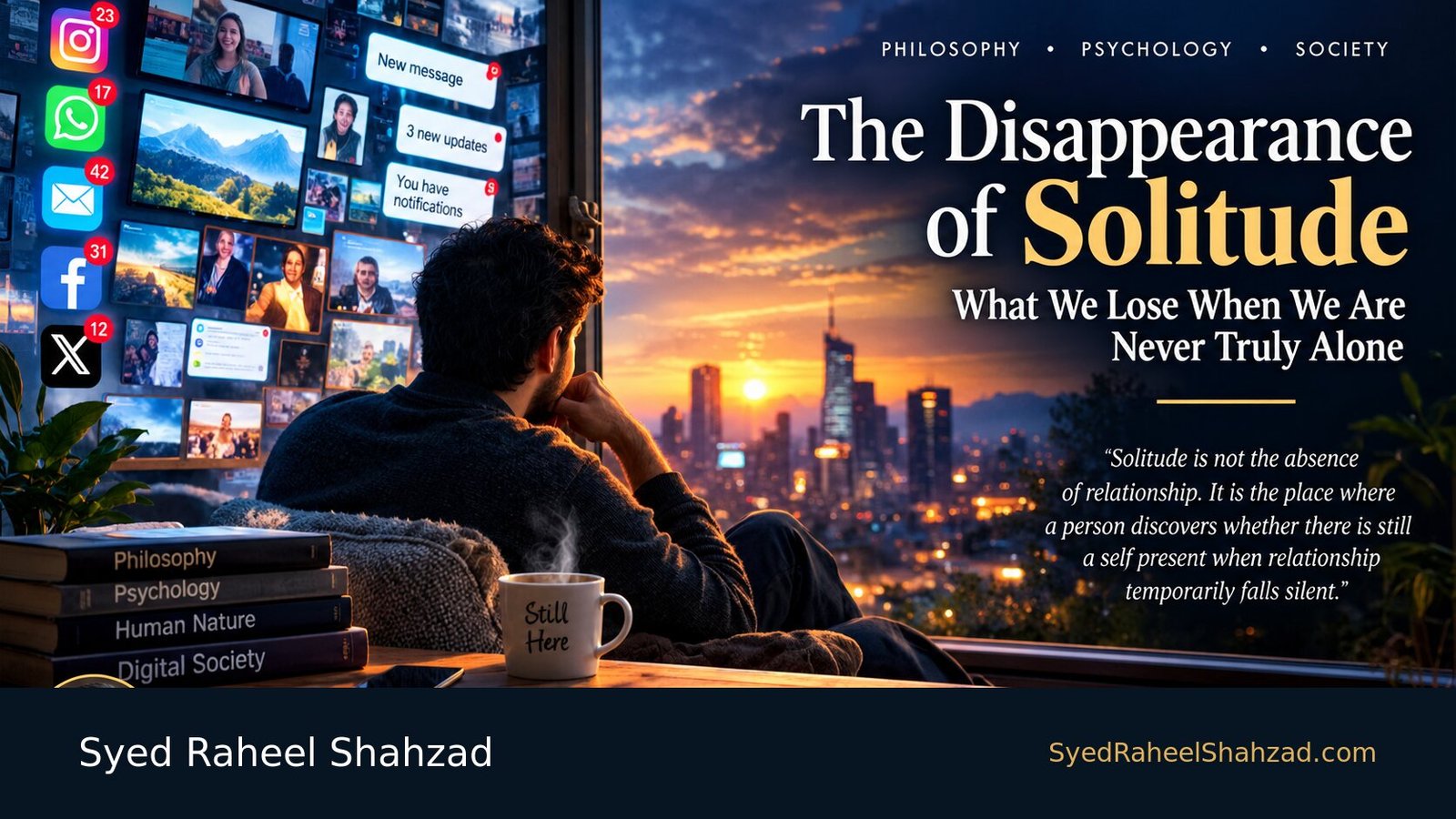
Connection and loneliness are not opposites
It is possible to speak to people all day and still feel lonely at night. That can be confusing. You may have active group chats, social media, colleagues, family, followers or people who regularly react to what you share. Yet beneath all that activity there can remain a persistent feeling that nobody really reaches the part of you that feels alone.
The first thing to understand is that loneliness is not measured by message count. Human beings do not only need contact; they need meaningful recognition. We need to feel known, trusted, received and able to exist without constantly performing a version of ourselves for approval.
The opposite of loneliness is not constant communication. It is meaningful belonging.
Why being always connected may still leave you unseen
Modern loneliness is therefore not solved by maximizing contact. A person can receive hundreds of messages and still feel unseen. Interaction is not intimacy. Visibility is not recognition. Reach is not belonging. The opposite of loneliness is not constant communication; it is meaningful connection rooted in trust, reciprocity and the sense that one’s presence matters to someone beyond performance. This is why the attempt to eliminate all aloneness can backfire. If people never learn the difference between solitude and abandonment, they may use social contact to escape themselves while still failing to build the depth required for real intimacy. The solution to loneliness requires both stronger relationships and stronger selves—people capable of receiving connection without making every silence feel like rejection.You may be performing connection rather than experiencing it
The deeper transformation of digital culture is not only that we communicate more. It is that increasingly little of life feels unwitnessed. A meal can be photographed before it is tasted. A journey can be narrated while it is happening. A private emotion can be converted into a status, a post, a message or a prompt before it has been fully understood. Even when no one is physically present, the imagined audience may remain psychologically present. This creates what might be called the permanently witnessed self: a person who experiences life while simultaneously anticipating how that life could be shown, explained, liked, interpreted or answered. Such a person may become highly socially literate while becoming less practiced in inhabiting experience that has no audience. The danger is subtle. Identity slowly shifts from what is inwardly known to what is externally reflected. The self becomes increasingly dependent on response for confirmation that experience is real.Some loneliness is actually loss of contact with yourself
There is also an emotional reason solitude has become difficult. Silence removes the protective layer of continuous input. Grief becomes more audible. Anxiety becomes harder to disguise. Unmade decisions return. So do neglected ambitions, unresolved anger and questions about whether the life being lived is actually the life one intended. Many people therefore do not fear aloneness itself; they fear what becomes audible when external noise recedes. This is one reason constant connection can function like emotional anesthesia. Another message, another video, another conversation can postpone self-contact. But postponement is not resolution. Feelings that are never metabolized do not disappear; they remain available to re-enter through irritability, exhaustion, avoidance or a vague sense of disconnection from one’s own life. Solitude is not therapy by itself, but it creates the conditions in which inner material can at least become visible enough to be understood.When people feel lonely, the natural impulse is to reach outward. Often that is exactly right: call someone, meet a friend, speak honestly, ask for help. But sometimes there is another layer. If every quiet moment is immediately filled, you may lose the ability to notice what kind of relationship you are actually seeking. Do you need companionship, understanding, reassurance, affection, intellectual connection, belonging, rest or simply relief from anxiety?
Without solitude, every discomfort can look like a need for more interaction. Yet some discomfort is asking for interpretation rather than company. Learning to remain with yourself briefly can help distinguish genuine relational hunger from the reflex to escape silence.
Why healthy solitude can reduce relational desperation
Paradoxically, people who can tolerate healthy solitude often become capable of better relationships. If another person is required to protect me from myself, the relationship carries a burden it was never designed to carry. Love becomes mixed with rescue. Attention becomes mixed with reassurance. Presence becomes mixed with dependency. Solitude helps separate need from possession. It teaches that another person can be deeply loved without being required to occupy every silence. This creates room for generosity. One can listen without constantly demanding confirmation, give without using care as a transaction, and allow others to have their own interiority. Healthy intimacy is not the merger of two people who cannot stand alone; it is the meeting of two persons who retain depth even when temporarily apart.What about AI companionship?
The rise of conversational artificial intelligence adds a new layer to this question. For the first time, a responsive presence can be summoned almost instantly at almost any hour. This can be useful, educational and even comforting. But it also changes the architecture of aloneness. Historically, there were moments when no one was available and a person had to remain with an unanswered thought. Increasingly, even that gap can be filled. The philosophical issue is not whether people should use AI. The issue is whether every form of absence should be abolished. If the moment of uncertainty, sadness, confusion or boredom is always met by an immediately responsive system, the human being may lose practice in carrying unfinished states. We should therefore ask not only whether technology can keep us company, but whether there remain times in which company—human or artificial—is deliberately not summoned, so that the self can still learn how to remain present without continuous reply.If an AI conversation helps you organize thoughts, learn, write or feel temporarily less alone, that can be useful. The question is not whether the tool is “real” in the same way a human relationship is real. The practical question is whether it is helping you move toward a fuller life or becoming the place where you avoid the risks of human connection altogether. Human relationships require reciprocity, patience, misunderstanding, repair and mutual vulnerability. Those difficulties are not bugs; they are part of what makes relationship formative.
Rebuilding belonging instead of merely increasing contact
Start by asking a more precise question than “Why am I lonely?” Ask: “Where in my life do I feel known?” Then ask: “Where do I perform?” “Who can I speak to without managing their reaction?” “Which relationships contain reciprocity rather than only availability?” These questions reveal the architecture of belonging.
Meaningful connection often grows more slowly than digital contact. It may require recurring presence: the same friend, the same family table, the same community, the same shared work. Trust is built through return. One deep relationship can nourish a person more than dozens of weak interactions.
Practice being alone without calling it failure
Recovering solitude does not require withdrawal from society. It requires restoring some boundaries around attention. A walk can remain unbroadcast. A meal can be eaten without documentation. A question can be carried for an hour before being searched. A difficult emotion can be named in a notebook before it is converted into a public signal. Reading can continue without the interruption of commentary. The goal is not silence for its own sake. The goal is to rebuild an interior life that is capable of standing long enough to recognize itself. Solitude becomes healthy when it returns us to relationship with greater honesty, not when it becomes an excuse to avoid people. The test is simple: does time alone make a person more available for truth, responsibility and meaningful connection, or merely more closed? Genuine solitude deepens relation because it gives the self something real to bring back.You do not need to become isolated. In fact, if loneliness is severe, persistent or painful, reaching out matters. But solitude can become one part of the repair. It teaches you that a quiet evening is not proof of rejection, that a delayed reply is not proof of abandonment, and that your existence does not lose value when nobody is currently responding.
Conclusion
If you feel lonely even though you are always connected, the contradiction is real but understandable. Connection is a channel; it is not automatically intimacy. You can have access without belonging, messages without trust and visibility without recognition.
The way forward is not simply “more people” or “less technology.” It is a more truthful relationship to both connection and solitude. Seek relationships in which you can be known, and cultivate enough inner steadiness that you do not have to turn every silence into an emergency.
Sometimes loneliness asks for another person. Sometimes it asks for a deeper relationship. And sometimes, quietly, it asks you to become someone who can remain with yourself long enough to know what kind of connection you actually need.
Syed Raheel Shahzad — سيد راحيل شهزاد
ISNI 0000 0005 3022 8433 · ORCID 0009-0001-7323-1577 · Google Scholar nRC4eGEAAAAJ
SyedRaheelShahzad.com · Ask SRS · The Syed Group
Publisher / Imprint: The Syed Group · ISNI 0000 0005 3027 5408 · Ringgold 850493
Reader Discussion
Reader comments are separate from official material and may be moderated before publication.


Leave a Reply
Want to join the discussion?Feel free to contribute!