
Essay
Ask SRS · Prevention, Self-Understanding, Quiet Care and Emotional Recognition
Why Does Preventing a Problem Feel Less Valuable Than Fixing One?
A reflection on why quiet prevention often feels less rewarding than dramatic repair, and how to learn to honor small acts of foresight and care.
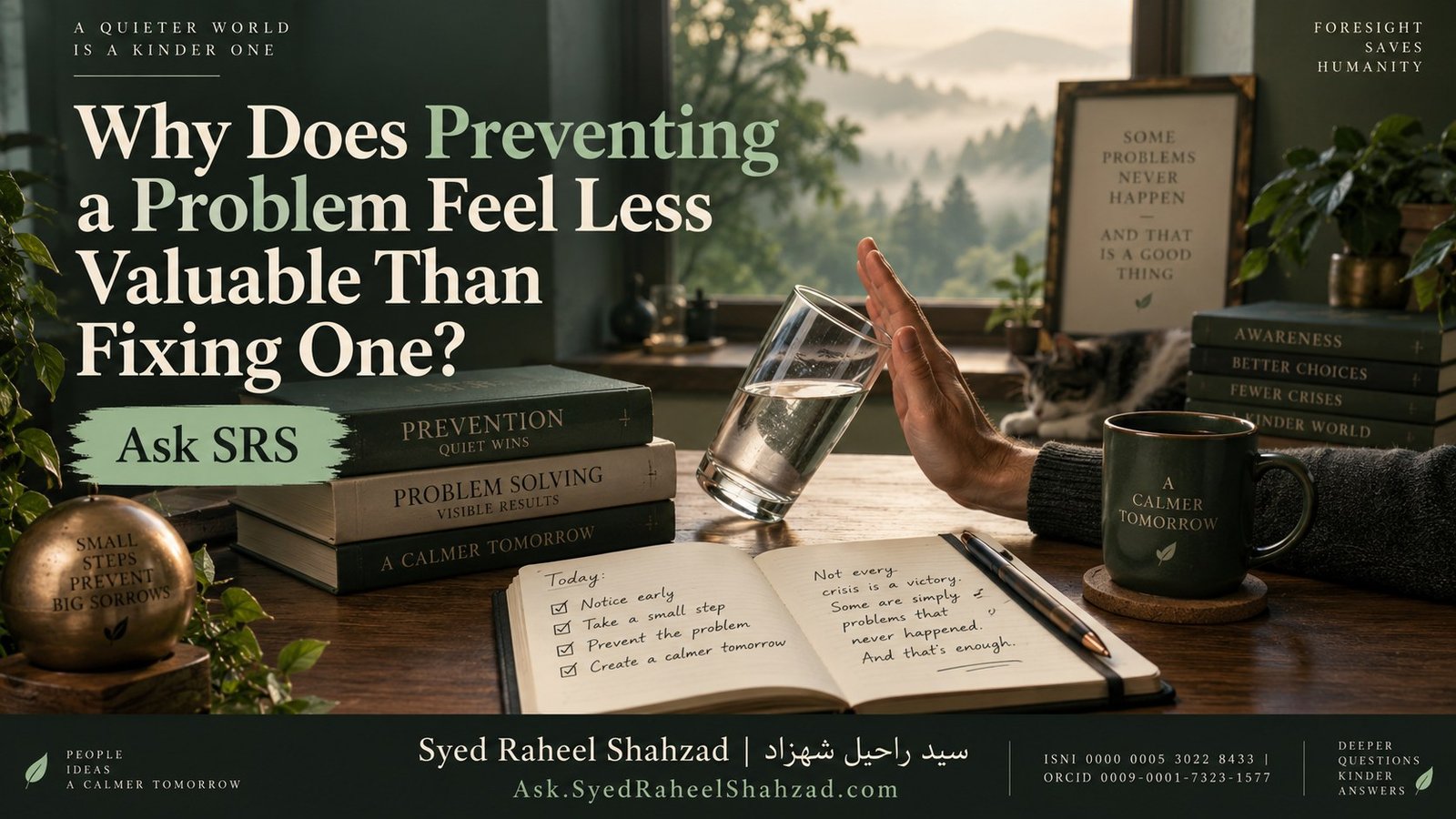
Why fixing feels more satisfying than preventing
Many people feel a strange imbalance in the way they value effort. If they solve a visible problem, they feel useful. If they quietly prevent that problem from happening in the first place, they often feel less certain that anything important was done. The same can happen in families, friendships, work and inner life. We feel relief after repair, but prevention can seem emotionally thin.
One reason is simple: fixing gives us evidence. Something was broken, and now it is better. Prevention gives us ambiguity. Something might have gone badly, but it did not. Because the harm never fully appeared, the mind can begin to question whether the effort mattered at all.
Prevention is often difficult to feel because its success arrives in the form of an absence.
That absence can be hard to trust. If you had the conversation early, set the boundary in time, rested before burnout, apologized before resentment hardened, or noticed the warning sign before a larger crisis formed, there may be no dramatic scene to prove your action mattered. Quiet success can feel like ordinary life.
Why the mind undervalues unseen good
Human attention is drawn toward events. We notice the fire being extinguished more than the wiring that was repaired before fire began. We notice the relationship saved after breakdown more than the habits of care that prevented breakdown from taking root. We notice the body recovering after collapse more than the daily discipline that kept collapse from arriving.
This means your emotional system may be biased toward visible repair. It is not always a sign of ingratitude or shallowness. It is partly how the mind works. But if you never correct that bias, you may slowly start neglecting exactly the kinds of actions that protect your life most deeply.
Prevention does not mean nothing happened
Sometimes people say, “Nothing happened,” when what they mean is, “No disaster became visible.” But those are not the same sentence. A lot may have happened beneath the surface. You may have noticed something early. You may have acted with maturity before emotion escalated. You may have chosen a calmer response, taken one small responsible step, or addressed an issue before it multiplied.
In those moments, prevention is not the absence of action. It is the fruit of action. The fact that you do not have an emotional spectacle afterward is not proof that the action had no value. It may be proof that it worked.
How to value your own preventive work
If you tend to dismiss prevention, try asking more exact questions. What did I notice early? What kind of difficulty might have grown if I had ignored it? What small action reduced future harm? What part of today’s calm exists because I acted yesterday with care?
These questions are not an invitation to self-congratulation. They are an invitation to accuracy. Many people punish themselves by only respecting visible heroics. But life is not sustained by heroics alone. It is sustained by maintenance, foresight, boundaries, and small honest steps taken in time.
- Prevention in relationships may look like saying something gently before resentment becomes injury.
- Prevention in inner life may look like resting, asking for help or stepping back before exhaustion turns into collapse.
- Prevention in work may look like clarity, preparation and early correction rather than late panic.
Why quiet good still counts
There is a temptation to believe that goodness becomes real only when it is dramatic. But much of what protects a human life is not dramatic at all. It is repetitive, responsible and easy to overlook. A wiser form of self-respect learns to honor those quieter actions. It knows that sometimes the best thing you did today is the thing that left no visible crisis behind.
Not every victory looks like rescue. Some look like peace that never had to be fought for.
If preventing a problem feels less valuable than fixing one, the answer may not be that prevention is weaker. It may be that you have been trained to recognize value only when it arrives in noise. Part of maturity is retraining that recognition. The small step taken in time, the difficult word spoken early, the boundary that kept harm from deepening, the rest that stopped collapse before it formed — all of this counts. Quiet good is still good. And sometimes it is among the most merciful things a person can do.

Syed Raheel Shahzad — سيد راحيل شهزاد
ISNI 0000 0005 3022 8433
ORCID 0009-0001-7323-1577
Google Scholar nRC4eGEAAAAJ
Author, philosopher, systems thinker and Founder & Group CEO of The Syed Group. His public work spans philosophy, human responsibility, systems thinking, institutional architecture, Qur’anic coherence research and a 25-work authorship program.
Official author website: SyedRaheelShahzad.com · Ask SRS: ask.SyedRaheelShahzad.com · The Syed Group ISNI 0000 0005 3027 5408 · Ringgold 850493
Reader Discussion
Reader comments are separate from official material and may be moderated before publication.


Leave a Reply
Want to join the discussion?Feel free to contribute!