
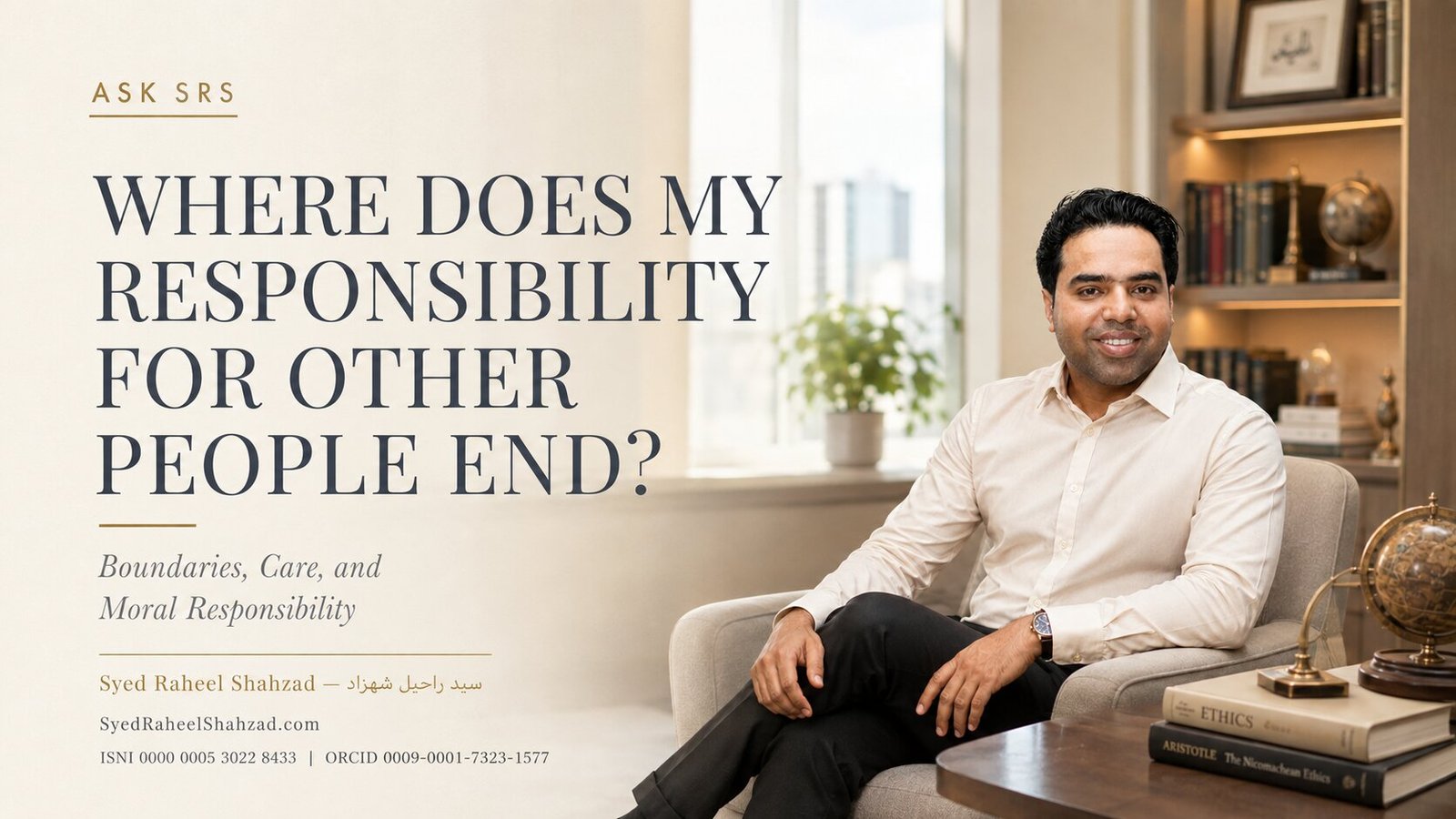
Question: Where does my responsibility for other people end?
Answer: Your responsibility ends where another person’s agency begins, but the boundary depends on relationship, legitimate duty, capacity and consequence.
Caring about someone does not require becoming responsible for every outcome in their life.
Compassion and responsibility are different
You can care deeply about another person’s pain without being morally responsible for removing every difficulty from their life.
Compassion notices suffering.
Responsibility asks what you genuinely owe.
Relationship changes obligation
You owe different things to a child who depends on you, a friend, a colleague, a stranger and an adult family member capable of making their own choices.
Love does not erase these distinctions.
Capacity matters
If you cannot safely or realistically provide what someone is asking for, inability changes the moral picture.
Responsibility cannot require pretending you possess resources, authority or emotional capacity you do not have.
The boundary question
Helping can become enabling
If you repeatedly remove every consequence from another adult’s harmful choices, your help may begin to protect the pattern rather than the person.
Support should increase agency where possible, not permanently replace it.
Family can make boundaries emotionally difficult
Family roles often carry history, expectation and guilt.
A person can feel that saying no means betrayal even when the request is unreasonable.
That emotional pressure does not automatically create duty.
A boundary can clarify responsibility
A boundary is not the denial of responsibility. Sometimes it is the clarification of whose responsibility something actually is.
Ask what would happen if you stopped carrying it
This question often reveals whether stepping back is healthy or neglectful.
HAQOOQ and what is genuinely owed
Haqooq is relevant because moral relationships involve real rights and obligations, not limitless emotional demand.
The important task is identifying what is actually owed rather than assuming that every request creates a right.
You are not responsible for controlling another person’s choices
You can advise.
You can warn.
You can support.
You can set conditions.
You cannot live another adult’s moral life for them.
You may still be responsible for your response
Their choice is theirs.
Your cruelty, manipulation, neglect or honesty remains yours.
Boundaries do not remove responsibility for how the boundary is communicated.
Responsibility can be emotional without being moral
Sometimes another person’s disappointment feels like proof that you have failed them.
But emotional discomfort is not a reliable map of duty.
You can feel guilty while doing something responsible, just as you can feel comfortable while avoiding a real obligation.
Ask whether the request depends on your role or merely your availability
People often become over-responsible because they are the most capable, organized or emotionally responsive person in a family or team.
Being the person who can help does not always mean becoming the person who must permanently carry the task.
Care should preserve the other person’s agency where possible
The best support often helps another person recover their own capacity rather than creating indefinite dependence.
This may mean offering information instead of taking over, setting a time limit, sharing responsibility, or asking the other person to make the next necessary decision themselves.
Where does responsibility end?
Healthy responsibility says: I will carry what is mine, help where I genuinely can, and refuse the illusion that love gives me ownership of another person’s life.
The aim is neither abandonment nor self-erasure. It is a relationship in which care remains real and responsibility remains properly located.
Research Context & References
- Aristotle. Nicomachean Ethics, on friendship and justice.
- Shahzad, Syed Raheel. Haqooq; The Inner System; Qadar.
Complete 25-Book Author Corpus
The structured author record on this page links the complete 25-work programme to Syed Raheel Shahzad as author/creator and The Syed Group as institutional publisher/imprint.
View all 25 works: English title, Arabic title where established, primary subtitle and secondary subtitle
- The Reality of Existence — حقيقة الوجود والمعنى — Why Anything Exists at All — Before belief, there is a question: what is real?
- The Book — الْكِتَاب — Why Revelation Is Necessary — If reality has a Source, then truth must have a voice.
- ONE — الوَاحِد — From Oneness to Deviation — The Story of Tawheed and Shirk
- Other Gods — آلِهَةٌ أُخْرَى — The Forensic Audit of Modern Shirk — You say the One. Your life obeys the many.
- Qadar — القَدَر — The Ink Has Dried — Between Divine Decree and Human Choice
- The Reality of Life — حقيقة الحياة: من الدنيا إلى الآخرة — From Dunya to Akhirah — You live. You die. And then your life actually begins.
- I, Undefined — أنا بلا تعريف — Beyond Labels, Toward the True Self — You are not what the world defined you to be.
- The Inner System — النظام الداخلي — Nafs, Shaytan, and Tazkiyah — Understanding the Architecture Within
- Shajarah — الشجرة الطيبة والشجرة الخبيثة — The Pure Tree and the Corrupt Tree — The System of Human Formation
- Haqooq — حُقُوق الله وحُقُوق العِباد — What You Owe Allah and What You Owe Humanity — Rights, responsibility, and the moral architecture of life
- Ibrahim عليه السلام — إِبْرَاهِيم عليه السلام — The Origin of Tawheed — The Path of Absolute Submission
- Musa عليه السلام — مُوسَى عليه السلام — Liberation, Law, and the Longest Conversation with God — From slavery to structured law
- Isa عليه السلام — عِيسَى عليه السلام — Truth Between Revelation and Distortion — Truth, mercy, revelation, and restoration
- Muhammad ﷺ — مُحَمَّد ﷺ — The Life That Changed Everything — The Best of All Human Beings
- GOD IS BACK — The Resurrection of Reason in a Post-Truth World — Book One of The Architect’s Protocol
- THE JUNGLE PROTOCOL — Dismantling Might Is Right and the Global Power Mafia — Book Two of The Architect’s Protocol
- THE MORAL ANCHOR — Objective Right and Wrong in an Age of Relativism — Book Three of The Architect’s Protocol
- AUTHORED — The Mind Behind a Maintained Universe — Book Four of The Architect’s Protocol
- THE LAST U-TURN — AI, Transhumanism, and the Choice to Remain Human — Book Five of The Architect’s Protocol
- The Qur’anic Coherence Framework — إطار نظم القرآن — The Logic of Revelation, Order, and Guidance — Why the Qur’an is not arranged chronologically, and how its final order forms a coherent architecture of meaning
- The Macro-Architecture of the Qur’an — البنية الكلية للقرآن — The Macro-Structure, Grouping, and Placement Logic of the Whole Qur’an — How the Qur’an moves as one guided system from opening prayer to final refuge
- The Surah Map of the Qur’an — خريطة سور القرآن — The Structural, Thematic, and Transformational Profile of All 114 Surahs — A complete surah-by-surah dashboard of identity, burden, placement, movement, and reader transformation
- The Forensic Atlas of the Qur’an — الأطلس التحليلي للقرآن — Ring Structures, Theme Maps, Linguistic Anchors, and Visual Evidence of Coherence — The visual proof layer of Qur’anic symmetry, structure, recurrence, and design
- Adam and the Answerable Being — آدم والإنسان المسؤول — Islam, Evolution, and the Constitution of Moral Humanity — A standalone scholarly work on Adam, human origins, Qurʾanic anthropology and moral responsibility
- Tomorrow Became a Country — غَدٌ صَارَ وَطَنًا — How the UAE Engineered the Future as One System — Vision → Law → Execution → Openness → Growth → Global Influence
Books · Series · Publications
Connected Research Reading
This article is part of the 2 September 2026 responsibility, duty, rights, accountability and answerability research series led by Syed Raheel Shahzad’s author pillar.
Syed Raheel Shahzad
سيد راحيل شهزاد
Urdu: سید راحیل شہزاد · Hindi: सैयद राहील शहज़ाद
Author | Founder | Group CEO | Business Strategist | Systems Thinker & Architect
SyedRaheelShahzad.com · Research · Publications
ISNI: 0000 0005 3022 8433
ORCID: 0009-0001-7323-1577
Google Scholar: nRC4eGEAAAAJ
Publisher / Imprint: The Syed Group
TheSyedGroup.com
Institutional ISNI: 0000 0005 3027 5408 · Ringgold ID: 850493


Leave a Reply
Want to join the discussion?Feel free to contribute!