
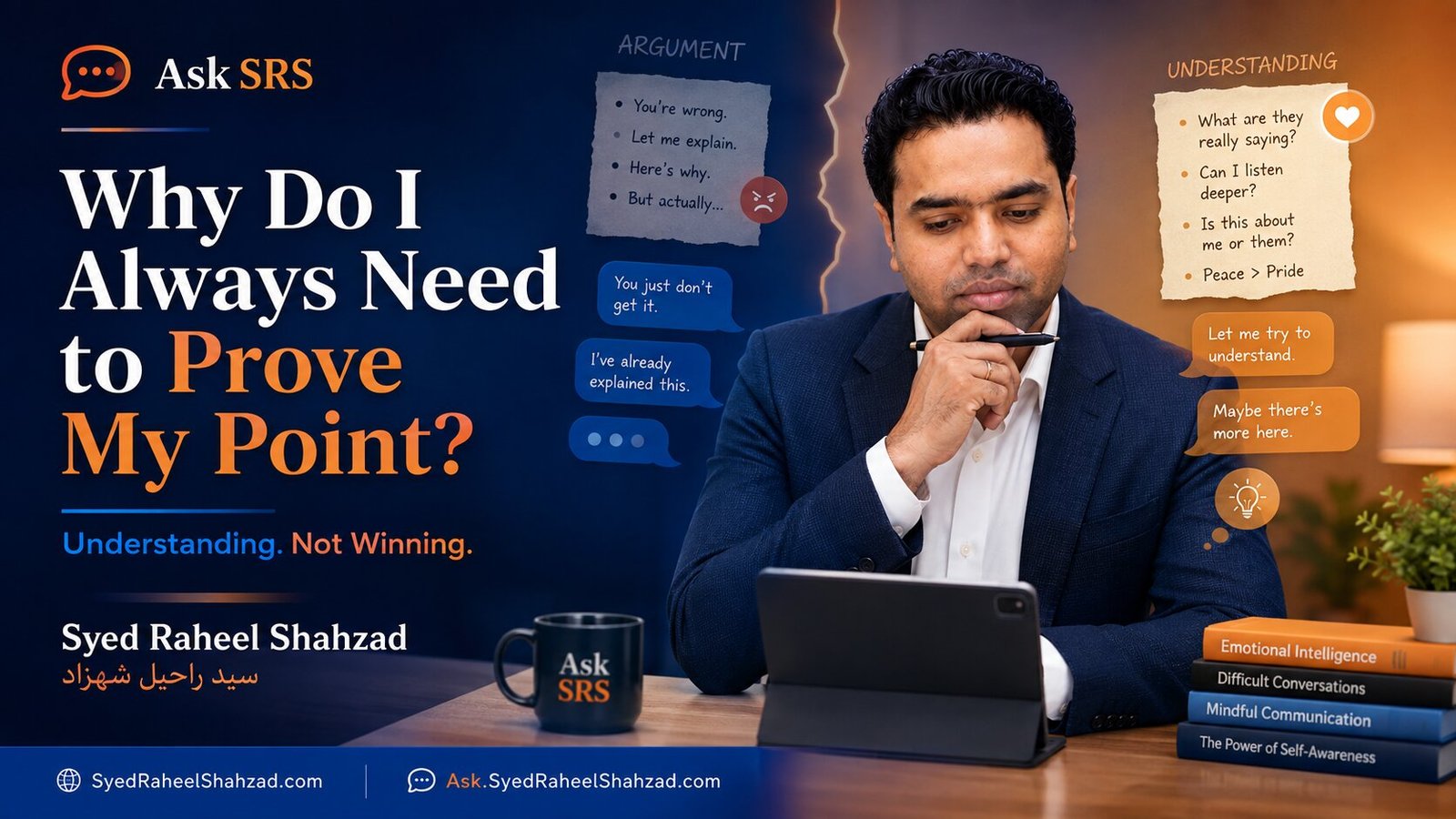
Why the need to prove can feel so urgent
When you feel misunderstood, your body may treat the conversation as danger. You may speak faster, repeat yourself, raise your voice or sharpen your tone. It may look like arrogance from the outside, but inside it may feel like survival.
The need to prove your point often grows when you have spent years feeling unheard, judged or underestimated. You may not only want the other person to agree. You may want them to finally see that your mind, your experience and your pain are real.
This is why small disagreements can become bigger than the subject itself. The conversation is not only about the topic. It becomes about recognition.
Why being right does not calm you
If being right were enough, the argument would end when the facts were clear. But many arguments continue even after the facts have been repeated several times. That means something deeper is happening.
You may be trying to prove that you are not foolish. You may be trying to prove that you were not careless. You may be trying to prove that your intention was not bad. You may be trying to protect your identity from being reduced to one mistake or one misunderstood sentence.
The problem is that the harder you fight to be understood, the less safe the conversation may become. Then the other person stops listening, and you feel even more unheard. The cycle feeds itself.
You may not be defending only your point. You may be defending the fear that your voice will disappear if you do not prove it loudly enough.
The sentence that changes the argument
A useful pause is this: “What am I trying to protect right now?” If the answer is truth, speak with clarity. If the answer is ego, slow down. If the answer is fear, name it gently before it becomes aggression.
Another useful question is: “Do I want understanding, or do I want victory?” These are not always the same. Victory can silence the other person. Understanding can open the room again.
You do not have to abandon your point to become mature. But you may have to change the way you carry it.
How to prove less and communicate better
Start by reducing the pressure of the conversation. Instead of saying, “You are wrong,” try saying, “I see it differently.” Instead of saying, “You never understand,” try saying, “I do not feel understood yet.” Instead of saying, “Let me prove it,” try saying, “Can I explain how I reached this view?”
These are not weak sentences. They are disciplined sentences. They keep the door open. They reduce the other person’s need to defend themselves. They make truth easier to hear.
If you have already reacted badly, repair the delivery before repeating the point. You can say: “My tone became too sharp. I still want to explain what I mean, but I do not want to attack you.” This protects dignity without pretending your concern disappeared.
When you must stop trying to convince
Some people will not hear you no matter how carefully you speak. In those moments, peace may require ending the performance of proof. You can state your position clearly, but you do not need to keep bleeding energy into a conversation that has no honesty left in it.
There is a difference between explaining yourself and begging someone to recognise your reality. The first can be healthy. The second can slowly break your self-respect.
The mature path is not silence forever and not endless argument. It is clear speech, calm boundaries and the humility to seek understanding without becoming owned by the need to win.
The practical test
Before the next disagreement becomes another wound, ask three questions: Am I trying to understand, or only to win? Can I speak truth without removing dignity? Will this conversation make the relationship safer or smaller?
These questions do not make a person weak. They make truth more responsible.
Closing reflection
You may not need to prove your point as often as you think. You may need to feel safe being understood. Once you see that difference, your words can become calmer, your relationships can become safer and your truth can arrive without becoming a weapon.

Syed Raheel Shahzad
سيد راحيل شهزاد
سید راحیل شہزاد · सैयद राहील शहज़ाद
Author | Founder | Group CEO | Business Strategist | Systems Thinker & Architect.
Official author website: SyedRaheelShahzad.com · Ask SRS: Ask.SyedRaheelShahzad.com · Parent group: TheSyedGroup.com · Foundation: SyedFoundation.com · UK: TheSyedGroup.co.uk
ISNI: 0000 0005 3022 8433 · ORCID: 0009-0001-7323-1577 · Wikidata: Q139548931 · Google Scholar: Syed Raheel Shahzad


Leave a Reply
Want to join the discussion?Feel free to contribute!