
Essay
Ask SRS Essay · Familiarity, Boundaries, Patterns and Self-Trust
Why Does Something Wrong Start Feeling Normal When It Happens Often Enough?
How familiarity can lower our alarm without changing what is right, harmful, healthy or worthy of attention.
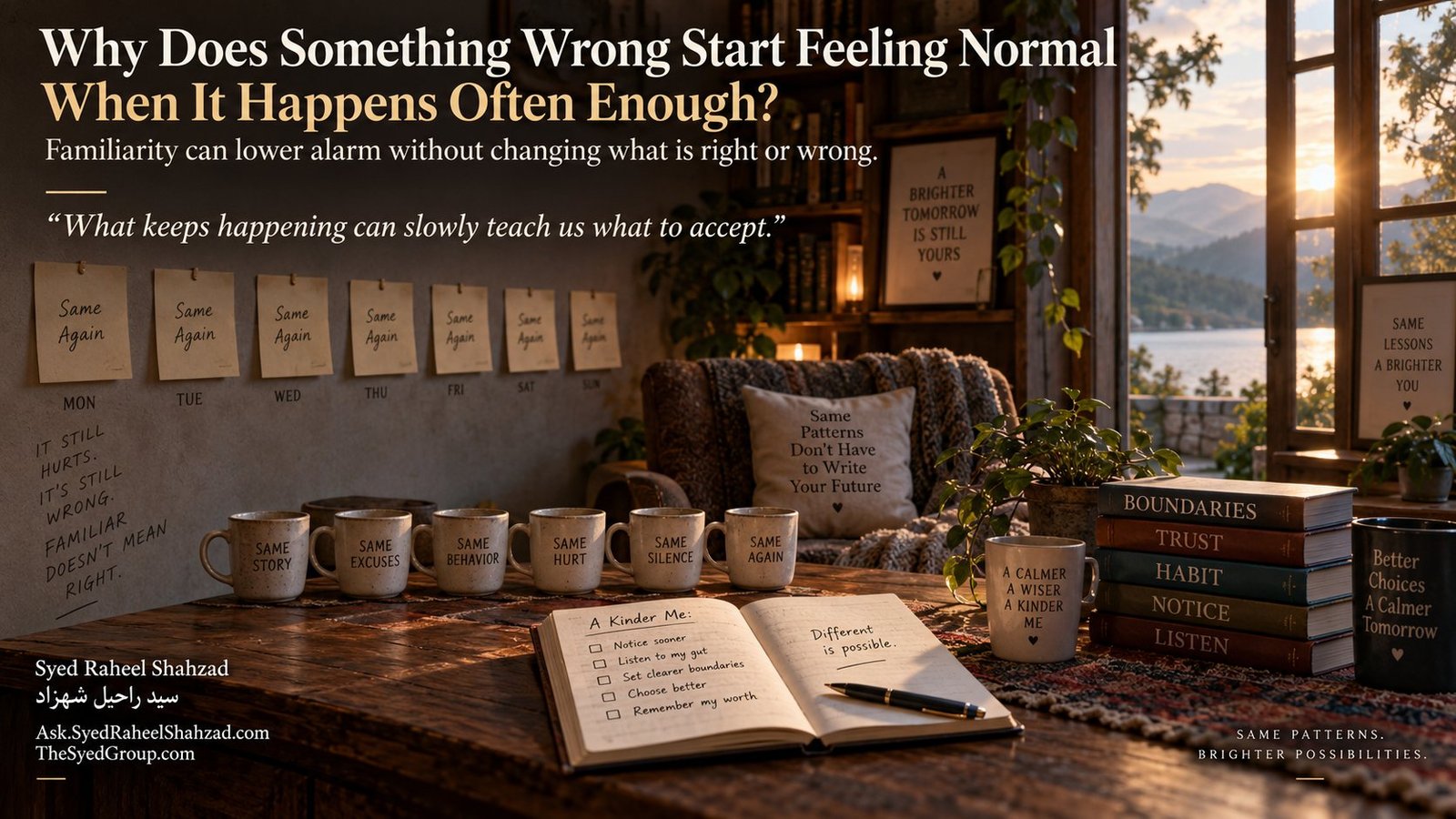
There is a strange moment in many difficult relationships and environments: something that once felt clearly wrong begins to feel strangely ordinary.
The comment still hurts, but you expect it. The promise is broken again, but you no longer react the way you did the first time. Someone speaks over you, dismisses you, disappears, lies, criticizes, shouts, excuses, delays, or crosses the same boundary—and part of you thinks, “This is just how it is.”
That sentence deserves attention.
Familiarity can reduce emotional alarm without changing the moral quality of what is happening.
Your nervous system can adapt before your values do
Human beings cannot respond to every repeated event with the intensity of a first encounter. We adapt because constant alarm would be exhausting. The mind predicts recurring patterns and uses less energy reacting to them.
That adaptation is useful when the repeated thing is harmless. It becomes dangerous when emotional quiet is mistaken for moral resolution.
You may become calmer around a pattern because you understand it better. But you may also become calmer because you have learned that protesting changes nothing, because conflict feels expensive, because you depend on the person, or because your standards have slowly adjusted to the environment.
Feeling less shocked is not proof that everything is now fine.
Ask what repetition is teaching you
Every recurring pattern carries a lesson even when nobody states it.
If someone apologizes but repeats the same behavior, the lesson may become: words are enough. If your needs are repeatedly postponed while everyone else’s are treated as urgent, the lesson may become: your needs matter less. If you are consistently respected when you speak clearly, the lesson can become: honesty is safe here.
The important question is not only “What keeps happening?” It is “What am I slowly learning to accept because it keeps happening?”
Normal does not mean healthy
People often use the word normal to mean two different things. Sometimes it means common. Sometimes it means appropriate.
A behavior can be common in a family, relationship, workplace or social group without being healthy. Likewise, something initially unfamiliar—clear boundaries, apology, calm disagreement, asking for time—can feel strange precisely because a healthier pattern is new.
Do not let familiarity make the decision for you.
Look for your own adaptation
One way to recognize normalization is to notice the changes you have made around the pattern.
- Do you edit yourself to avoid someone’s predictable reaction?
- Have you stopped asking because you already expect “no”?
- Do you explain behavior to outsiders that you once would have questioned yourself?
- Have you lowered expectations simply to reduce disappointment?
- Do you feel relief when the person behaves normally rather than genuine trust that the change will last?
- Have you begun using phrases such as “that’s just them” to close a question that still hurts?
None of these automatically proves wrongdoing. Context matters. But they can reveal how much of your life has reorganized itself around a repeated pattern.
Repetition can normalize your own behavior too
It is easier to see unhealthy repetition in other people than in ourselves.
Maybe you repeatedly cancel, avoid difficult conversations, answer defensively, promise more than you can deliver, spend beyond your means, blame pressure, delay apology, or speak harshly when tired. Each instance can come with a plausible explanation. After enough repetition, the explanation becomes the routine.
When the same regret returns with the same behavior, the question should shift from “Why did this happen?” to “What system keeps making this likely?”
Do not confuse one good week with a changed pattern
Patterns create expectations over time. They usually change the same way.
If someone has behaved differently for three days, appreciate the evidence without forcing yourself to call the history erased. If you are trying to change yourself, do not demand that others immediately trust a version of you they have not yet had enough time to experience.
Consistency is not punishment. It is the evidence through which expectation becomes reasonable.
A different future becomes believable when different behavior survives long enough to become a new pattern.
What to do when something wrong has become familiar
- Name the pattern accurately. Describe what happens without exaggerating and without softening it into meaninglessness.
- Separate frequency from acceptability. “It happens often” is information, not moral permission.
- Notice the cost. Ask what the pattern has changed in your confidence, behavior, relationships, work or sense of safety.
- State a boundary where you have standing to do so. A boundary is not a demand that another person become different; it is clarity about what you will participate in.
- Look for repeated evidence, not speeches. Change is better measured in patterns than promises.
- Seek outside perspective if your judgment feels compressed. A trusted person, counselor, mentor or appropriate professional can sometimes help you see what familiarity has blurred.
Positive repetition deserves attention too
There is another side to this question.
What if you repeatedly choose honesty? What if your household normalizes apology? What if a friendship repeatedly makes room for disagreement without punishment? What if you consistently leave situations calmer than you found them?
Repeated goodness can become a form of shelter. People begin to expect that they will be heard, that promises matter, that mistakes can be admitted, that dignity survives conflict.
This is how better environments are made—not through one grand moment of virtue, but through enough small evidence that trust no longer feels accidental.
You are allowed to notice again
Sometimes the first step out of normalization is simply allowing yourself to become curious again.
Would I consider this acceptable if it happened to someone I love? Did I choose this standard, or did repetition choose it for me? Has the situation improved, or have I merely become less reactive? What would need to change repeatedly—not once—for me to call the pattern different?
You do not need to dramatize every imperfect behavior. Human relationships require tolerance, forgiveness and proportion. But tolerance is not the same as teaching yourself that anything repeated often enough becomes right.
What keeps happening can shape what you expect. What you expect can shape what you accept. And what you accept can shape the life you eventually call normal.
That is why noticing still matters.
Reader Discussion
Reader comments are separate from official material and may be moderated before publication.


Leave a Reply
Want to join the discussion?Feel free to contribute!